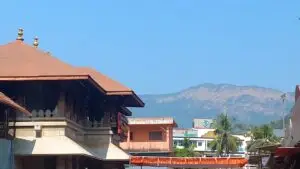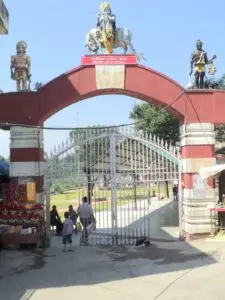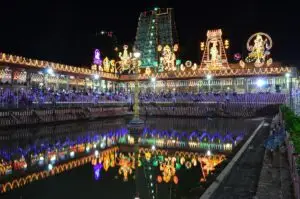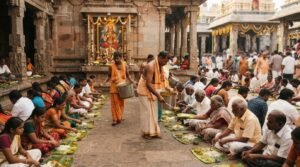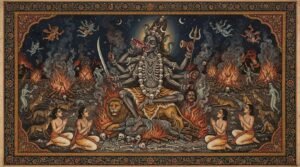
In the western Deccan city of Kolhapur, on the banks of the Panchganga river, stands one of the most revered Shakta shrines in Maharashtra - the temple of Shri Mahalakshmi, known to devotees simply as Ambabai, "the Mother." Unlike temples where the goddess appears beside her consort, Kolhapur's Mahalakshmi is enshrined and worshipped independently, as Karavir Nivasini, "she who resides in Karavir" (Kolhapur's ancient name) - a goddess understood by tradition to have chosen this city as her own dwelling place, distinct from and, in a particular sense, prior to her more familiar role as Vishnu's consort at Vaikuntha.
This guide traces the temple's founding legend, its status within the network of Shakti Peethas, the distinctive Hemadpanthi architecture of its ancient sanctum, the unusual westward orientation of the deity, the remarkable Kiranotsav when the setting sun's rays fall directly upon the goddess three times a year, its festivals, its daily rhythms of worship, and the practicalities of travelling to Kolhapur for pilgrims planning a visit of their own.
Readers wishing to understand Mahalakshmi's place among the great goddesses of abundance more broadly will find useful context in our guide to Goddess Lakshmi, of whom Kolhapur's Ambabai is understood as a direct and especially potent manifestation, while those interested in the wider network of sacred sites to which this temple is often linked may enjoy our guide to the 51 Shakti Peethas.
Who Is Ambabai, and Why Does Lakshmi Dwell Independently at Kolhapur?
Ambabai - literally "Mother" in Marathi, the name by which the goddess of this temple is most affectionately known to Maharashtrian devotees - is worshipped at Kolhapur as Mahalakshmi, the great goddess of wealth, sovereignty and abundance, but in a form and context distinctly her own. Where Lakshmi is most commonly pictured seated beside Vishnu or standing on a lotus with wealth flowing from her hands, the Kolhapur tradition presents a goddess who dwells here in her own right, ruling over Karavir (the old name for Kolhapur) as its guardian and sovereign deity rather than appearing chiefly as anyone's consort.
This independence is central to how devotees understand the temple's significance, and it is bound up with one of the most distinctive legends in the wider Lakshmi tradition: the story, told across various Puranic and regional sources with some variation, of Lakshmi's departure from Vaikuntha. According to this account, Lakshmi, displeased by an act of disrespect from Vishnu - in the most widely told version, connected to the sage Bhrigu's testing of the Trimurti, in which Bhrigu struck Vishnu on the chest to test his patience, and Vishnu's response (or, in some tellings, his silence regarding the affront) left Lakshmi feeling that her presence and dignity had gone unacknowledged - chose to leave Vaikuntha altogether and take up residence on earth, settling at Karavir, where she has remained an independent, sovereign presence ever since.
Regional tellings vary in their precise sequence of events and in how sympathetically they treat Vishnu's role in the episode, and readers are encouraged to treat this as one of several textual variations rather than a single fixed narrative; the fuller versions, along with their theological implications for how Shakta and Vaishnava traditions understand the relationship between Devi and Vishnu, are best explored under the guidance of a knowledgeable priest or scholar at the temple itself. What remains constant across nearly every version is the underlying message devotees draw from it: that Mahalakshmi at Kolhapur is not a subordinate or dependent figure but a goddess who asserts her own sovereignty, dwelling here by her own choice rather than by any lesser status.
A second strand of local tradition connects the city's very name to the goddess's power in a different way, holding that Kolhapur takes its name from a demon called Kolhasura, who oppressed the region until the goddess, in a fierce battle, slew him and thereafter took up residence at the site of her victory - a narrative pattern familiar from other goddess-founded cities and temples across India, and one that casts Ambabai in her protector-warrior aspect alongside her more commonly emphasised role as bestower of prosperity. Readers interested in how this warrior dimension of the goddess relates to her more widely known forms may find our guide to Kali, Durga and Parvati as forms of Shakti a useful companion reading.
Mahalakshmi Temple and the Shakti Peetha Tradition
Kolhapur's Mahalakshmi temple is widely regarded by devotees and by much popular tradition as one of the Shakti Peethas, the network of sites across the subcontinent sanctified, according to the well-known Puranic narrative, by the falling of a part of the goddess Sati's body or ornaments after Shiva carried her corpse across the heavens in grief following her self-immolation at Daksha's yagna. Different traditional lists associate Kolhapur with slightly different specifics - some sources connect it with Sati's eyes, others with different associations - and it is worth noting honestly, as careful readers of the Shakti Peetha corpus generally do, that Kolhapur's precise place within the various enumerations of the fifty-one or eighteen principal Peethas is treated somewhat differently across regional and textual traditions, with some later or more localised lists including it prominently and certain of the oldest core lists organised around other sites. This kind of variation is not unusual within the Shakti Peetha tradition as a whole, which grew across many centuries from multiple textual and oral streams rather than a single unified source, a point discussed at greater length in our guide to the 51 Shakti Peethas and in our account of the Sati Devi and Daksha Yagna story from which the entire network of Peethas is understood to arise.
What is not in dispute, however defined the precise category, is Kolhapur's immense and ancient standing as one of the subcontinent's most important Shakta pilgrimage centres, referenced in the Devi Bhagavata Purana and other Puranic sources, and long counted among Maharashtra's most visited and most deeply loved temples - a status the temple has held for well over a thousand years regardless of how any particular later enumeration of Shakti Peethas happens to classify it.
The Image of the Goddess and Her West-Facing Sanctum
The murti of Mahalakshmi at Kolhapur is carved from a black stone often described locally as a form of ratna shila (gem-stone) and stands a little over three feet tall, richly adorned with jewellery, a crown, and garlands, so that on ordinary days of darshan a great deal of the underlying stone is not directly visible beneath the abundant ornamentation the temple's priests maintain. The image is four-armed: she holds a mace (gada) and a shield in her upper hands, and in her lower hands a fruit, understood by tradition as a bilva or a citrus fruit representing the earth and its abundance, and a bowl or vessel (associated by some accounts with a variant reading as a mace-head or a discus, since exact iconographic details are described somewhat variably across sources). Above her crown rests a hooded serpent, understood as a canopy of protection, and a small stone lion, her vahana, is placed at the base of the image, affirming her identification as Mahalakshmi in her fuller, more sovereign aspect rather than in her purely benign form alone.
One of the most distinctive features of the temple, noted by nearly every visitor and pilgrimage account, is that the sanctum faces west, an orientation markedly less common than the eastward orientation of most Hindu temples, where the rising sun is understood to greet the deity each morning. Various explanations are offered locally for this westward orientation, some architectural and some devotional, but whatever its origin, this orientation is the very feature that makes possible Kolhapur's most famous annual phenomenon, the Kiranotsav, described in detail below, when the setting sun's rays travel directly into the sanctum to touch the goddess herself.
Hemadpanthi Architecture and the Temple Complex
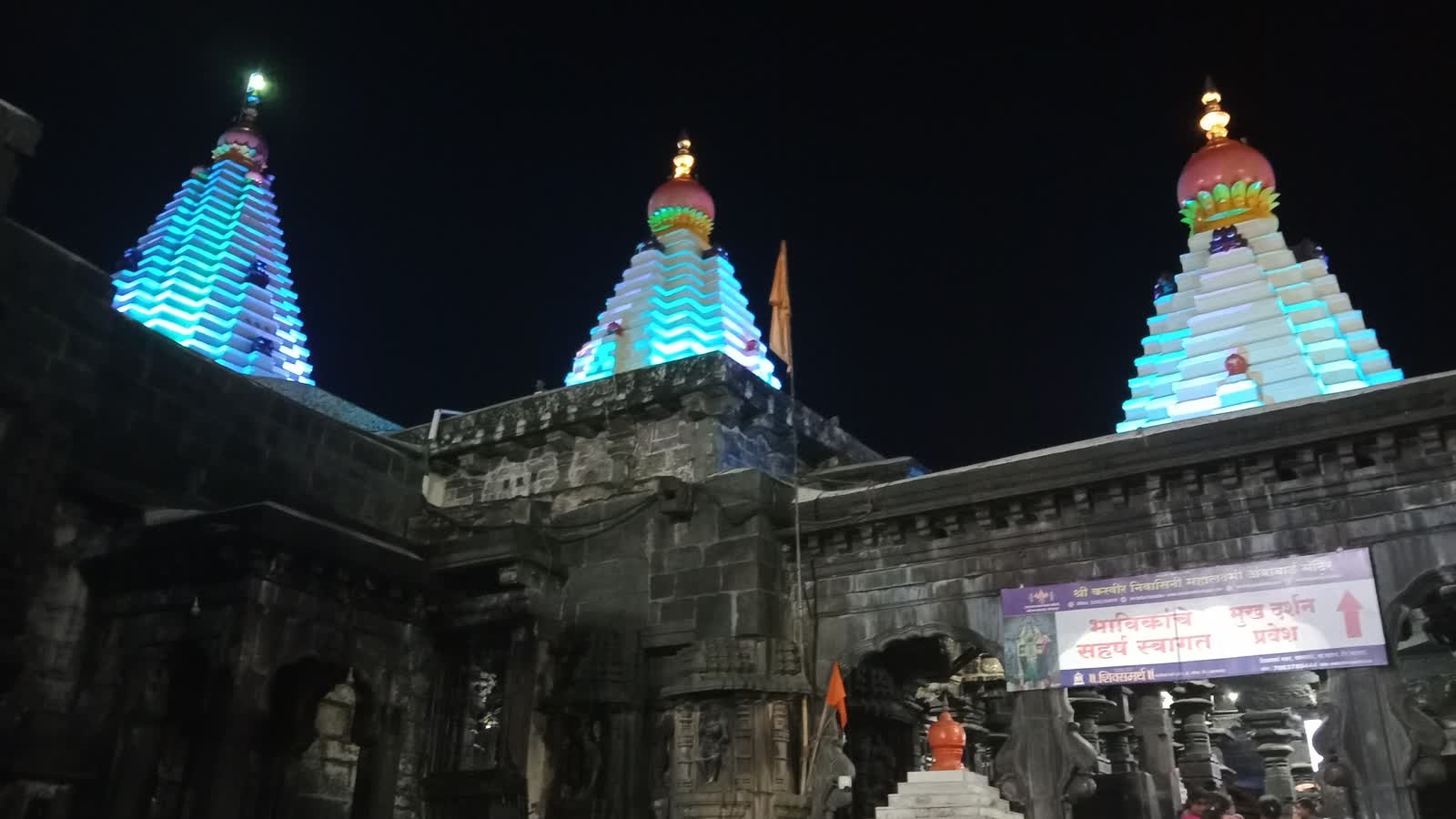
The Mahalakshmi temple's core structure is generally dated to the Chalukya period, with major portions of the complex, including much of its distinctive stonework, attributed to construction and later expansion under the Chalukyas and subsequently the Shilahara dynasty that ruled the Kolhapur region, with further additions and renovations carried out by the Yadavas of Devagiri and later still by the Maratha rulers, including the Bhonsle line associated with Kolhapur's princely state, who were closely connected to the temple's patronage into more recent centuries.
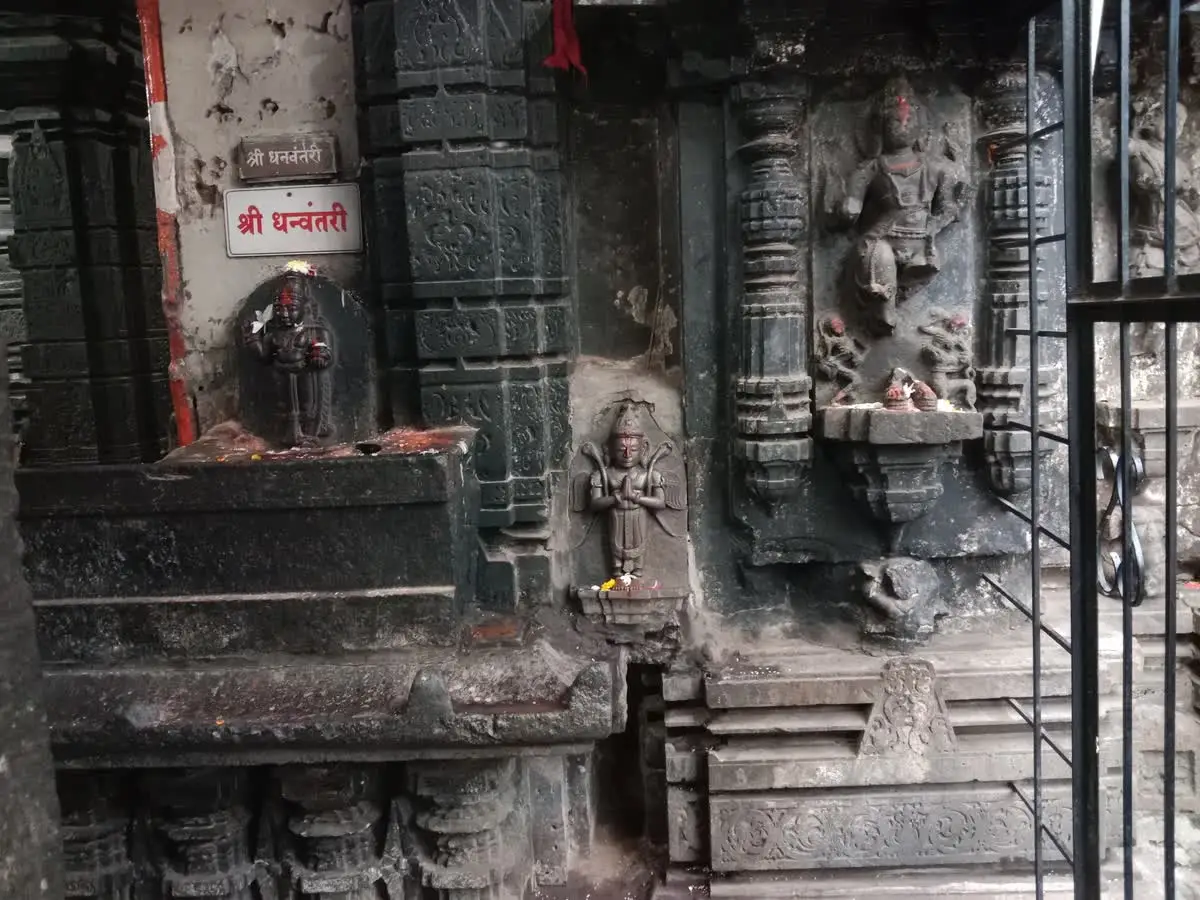
The temple is frequently described as built in the Hemadpanthi style, a term applied broadly across Maharashtra to a school of temple construction using dry, cut-stone masonry assembled without mortar, associated in popular tradition with the thirteenth-century Yadava minister Hemadpant, though scholars note that the style's actual origins and the attribution of any single individual temple to Hemadpant specifically should generally be treated as a broad stylistic descriptor rather than a precise claim of individual authorship. Distinctive features of this style at Kolhapur include heavy, star-shaped or stepped plinths, richly carved exterior panels depicting a wide range of deities and mythological scenes, and a layered mandapa structure leading toward the garbhagriha, the innermost sanctum housing the goddess.
The wider temple complex includes several subsidiary shrines dedicated to other deities, among them Mahakali and Mahasaraswati, worshipped here alongside Mahalakshmi in keeping with the widespread Tridevi conception found at several major Shakta sites across India, in which the three goddesses of power, wealth and wisdom are honoured together as complementary aspects of the one Devi. A large temple tank and several subsidiary mandaps used for various rituals and gatherings occupy the surrounding precincts, along with the Manikarnika Kund, a sacred water tank associated with ritual bathing before darshan.
The Kiranotsav: When Sunlight Touches the Goddess
Kolhapur's single most celebrated annual phenomenon is the Kiranotsav, or "festival of rays," during which the rays of the setting sun, entering through a series of aligned openings in the temple's western-facing structure, fall directly upon the image of the goddess for a brief window each evening across several consecutive days, twice each year. According to the temple's long-observed pattern, this alignment occurs across three consecutive evenings on each occasion, with the rays typically reaching the goddess's feet on the first day, rising to touch her chest on the second, and finally illuminating her face on the third - devotees describing the sequential ascent of light across the image as a moving, almost living manifestation of the goddess's own presence responding to the sun's approach.
The two annual windows for the Kiranotsav fall, by widely reported temple tradition, in the period around late January into early February, and again around early to mid November, corresponding to specific solar positions relative to the temple's precise architectural alignment. Because the exact dates depend on the sun's position and can shift slightly from year to year, and because temple authorities sometimes adjust the observed dates by a day or two based on direct astronomical observation in the days beforehand, pilgrims planning a visit specifically to witness the Kiranotsav should treat any dates found in advance as approximate and confirm the current year's schedule directly with the Kolhapur Devasthan Samiti (the temple's managing trust) close to the date of travel.
| Occasion | Approximate Window | What Happens |
|---|---|---|
| Winter Kiranotsav | Late January to early February (typically around 31 January-3 February) | Setting sun's rays fall on the goddess across three consecutive evenings, rising from feet to face |
| Autumn Kiranotsav | Early to mid November (typically around 9-12 November) | The same sequential illumination repeats as the sun's position shifts through its autumn alignment |
Given the popularity of this phenomenon, the temple premises are considerably more crowded during the Kiranotsav windows than on an ordinary day, and pilgrims intending to witness the event directly are advised to arrive well ahead of the expected evening timing and to follow the queue arrangements set by temple staff for the occasion.
Navratri and the Wider Festival Calendar
Navratri is celebrated at the Mahalakshmi temple with considerable devotion, the goddess adorned across the nine nights in a sequence of elaborate alankaram befitting her status as one of Maharashtra's foremost Devi shrines, with special abhishekams, cultural programmes and a marked increase in pilgrim numbers throughout the festival period, culminating in Vijayadashami. Readers wishing to understand the broader significance of this festival and its nine forms of the goddess may find our guide to Navratri and the Navadurga a helpful companion.
Beyond Navratri, the temple observes a full calendar of Maharashtrian festivals, including Rathotsav (the temple's chariot procession), special observances during the Marathi month of Chaitra, and the celebration of Kolhapur's broader civic and cultural identity, in which the Mahalakshmi temple functions as something like the city's spiritual anchor point, drawing local residents to daily darshan quite apart from the larger pilgrim crowds of festival season.
| Occasion | Approximate Timing | Notable Observance |
|---|---|---|
| Sharad Navratri | September-October | Nine nights of elaborate alankaram, culminating in Vijayadashami |
| Winter Kiranotsav | Late January-early February | Sunrays fall on the deity across three evenings |
| Autumn Kiranotsav | Early-mid November | Second annual occurrence of the sunray phenomenon |
| Rathotsav (chariot festival) | Varies by year, per temple almanac | Processional festival through Kolhapur city |
| Chaitra Navratri | March-April | Spring observance with special daily worship |
As with all festival dates set by the Hindu lunisolar calendar, and especially given the astronomically determined timing of the Kiranotsav, pilgrims should verify the specific dates for their year of travel directly with the Kolhapur Devasthan Samiti before finalising plans.
Darshan and Aarti Timings
The Mahalakshmi temple maintains long daily hours befitting its status as one of Kolhapur's most visited sites, with a structured sequence of aartis punctuating the day. The timings below reflect the temple's typically reported daily schedule, though, as with any major temple, these are subject to periodic revision and special arrangements during festivals and the Kiranotsav period, and confirming current timings before travel is strongly advised.
| Aspect | Typical Timing |
|---|---|
| Temple opens | Approximately 4:00-5:00 AM |
| Kakad Aarti (early morning aarti) | Approximately 4:30 AM to 6:00 AM |
| General darshan (morning session) | Approximately 6:00 AM to 2:30 PM |
| General darshan (evening session) | Approximately 4:00 PM to 10:00 PM |
| Temple closes | Approximately 10:00 PM to 11:00 PM |
Timings, fees and travel details checked against official sources in October 2026 are in Plan Your Visit below.
Given the temple's popularity and the volume of daily pilgrim traffic, visitors are advised to check current darshan queue arrangements, especially during weekends, Navratri and the Kiranotsav windows, with the Kolhapur Devasthan Samiti's official channels shortly before travel.
What Is Changing at the Ambabai Temple?
The temple is at the start of its largest redevelopment. On 6 May 2025 the Maharashtra cabinet approved ₹1,445.97 crore for the Shri Ambabai (Mahalakshmi) Temple Development Plan, to be carried out in three phases. ₹143.90 crore for the first phase was sanctioned on 28 August 2025, and Union Home Minister Amit Shah formally launched the plan in Kolhapur in June 2026.
When finished it is meant to include a large Darshan Mandap queue complex, an annachhatra community kitchen, a Vedic school, an information centre, parking and a first-aid centre, along with the restoration of 41 smaller temples around the main shrine. Structural conservation work worth ₹32.96 crore was already under way at the launch. (Mangalorean.com, 20 June 2026.)
How to Reach Mahalakshmi Temple, Kolhapur
Open the Ambabai temple in Google Maps for live directions from where you are.
Kolhapur is comparatively well connected for a pilgrimage town of its stature, sitting on established road, rail and air routes linking it to Mumbai, Pune and the wider Deccan region.
| Mode | Details |
|---|---|
| By Air | Chhatrapati Rajaram Maharaj Airport, Kolhapur, lies roughly 10 km from the temple, around 20-30 minutes by road, with domestic connections chiefly to Mumbai and other major cities; travellers from further afield often fly into Pune (around 230 km away) and continue by road or rail. |
| By Train | Kolhapur railway station (Chhatrapati Shahu Maharaj Terminus) is barely 2-3 km from the temple, with regular express connections to Mumbai, Pune, Hyderabad and other major cities, making rail one of the most convenient ways to reach the temple directly. |
| By Road | Kolhapur is well connected by national highway to Mumbai (around 380 km, roughly 7-8 hours by road) and Pune (around 230 km, roughly 4-5 hours), with frequent state and private bus services from across Maharashtra and northern Karnataka. |
Travellers arriving by train or air will find the temple within easy reach by auto-rickshaw or taxi, making Kolhapur one of the more logistically straightforward major Shakta pilgrimage destinations to plan a visit around.
Nearby Attractions and Where to Stay
Kolhapur offers pilgrims a number of worthwhile sites beyond the Mahalakshmi temple itself. Rankala Lake, a large and scenic urban lake a short distance from the temple, is a popular spot for an evening walk after darshan, while the New Palace (Chhatrapati Shahuji Maharaj Museum), built for the Kolhapur royal family, houses an extensive collection of artefacts, weaponry and portraits reflecting the region's Maratha history. Jyotiba Temple, dedicated to a form of Shiva closely linked with Kolhapur's regional devotional life and often visited in conjunction with Mahalakshmi darshan, lies around 17 km from the city, and Panhala Fort, a well-preserved hill fort with strong associations to Shivaji Maharaj, is a popular half-day excursion roughly 20 km away.
Accommodation in Kolhapur is plentiful and caters to a wide range of budgets, from simple pilgrim lodges within walking distance of the temple to a good range of mid-range and business hotels closer to the railway station and the city's commercial areas, with availability tightening considerably during Navratri and the Kiranotsav windows, when advance booking is strongly advisable.
Benefits of Worship and Why Devotees Visit Kolhapur
Devotees who undertake pilgrimage to Kolhapur describe Ambabai's blessing as one of comprehensive abundance - prosperity and material wellbeing, certainly, in keeping with her identity as Mahalakshmi, but also protection, courage and sovereign strength drawn from her warrior aspect and her legend of independent triumph over adversity. Many devotees specifically undertake the journey around the Kiranotsav, understanding the sun's direct illumination of the goddess as an especially potent moment for seeking her blessing, though temple priests are generally quick to note that sincere devotion on any ordinary day is considered no less meritorious than a visit timed to this celebrated astronomical alignment.
The temple's identification of Lakshmi as choosing independent residence at Karavir, apart from her more familiar consort role, also carries particular resonance for devotees drawn to the Devi's sovereign, self-possessed aspect rather than her purely nurturing or dependent forms - a theological emphasis worth reflecting on alongside our guide to the Mahalakshmi Ashtakam, the classical hymn of eight verses in praise of the goddess, which many devotees recite as part of their daily or festival worship of Mahalakshmi in any of her forms, including Ambabai at Kolhapur. As with any significant Shakta pilgrimage, devotees seeking to deepen their practice around this temple's particular traditions are encouraged to seek guidance from a qualified priest or scholar familiar with Kolhapur's specific rituals and observances.
Plan Your Visit to Kolhapur Mahalakshmi: Timings, Tickets and Travel
The details below were checked on 3 October 2026 against the Paschim Maharashtra Devasthan Management Committee and the other sources listed under each table. Timings and fees change on festival days, eclipses and special occasions, so confirm with the temple before you travel.
This is one of Maharashtra's three and a half Shakti Peeths; the Sade Teen Shakti Peeth route guide covers Kolhapur, Tuljapur, Mahur and Saptashrungi in one trip. For what happens here during Navratri 2026 (11 to 19 October), see Navratri 2026 at major Devi temples.
Darshan and Aarti Timings
| Information | Details |
|---|---|
| Temple open | 4:00 am to 10:00 pm |
| Morning darshan | 4:30 am to 12:30 pm |
| Afternoon and evening darshan | 1:00 pm to 8:30 pm |
| Evening aarti | 7:30 pm to 8:30 pm |
| Festival days | Timings can change on festival days. Check the temple website before you go. |
Sources: Incredible India (Ministry of Tourism, Govt of India): Mahalaxmi Temple, Kolh..., Paschim Maharashtra Devasthan Management Committee: Shree Karveer Niwasini Am....
Tickets, Darshan Options and Sevas
| Option | Price | Notes |
|---|---|---|
| General darshan | Free | No ticket is needed. |
General darshan is free. Queues are long at weekends and during festivals, especially for the line into the inner sanctum. Bookings are handled on mahalaxmikolhapur.com. The temple committee's website offers live darshan and online services. Check it for current booking options. Musinara is not connected with the temple and does not take bookings.
Sources: VipDarshanTickets: Kolhapur Mahalaxmi Darshan 2026: Timings, Kiranotsav & VIP..., Paschim Maharashtra Devasthan Management Committee: Shree Karveer Niwasini Am....
Temple Rules and Dress Code
- Modest, traditional clothing is advised.
Source: VipDarshanTickets: Kolhapur Mahalaxmi Darshan 2026: Timings, Kiranotsav & VIP....
How to Reach Kolhapur Mahalakshmi
| Mode | Nearest point | Distance to the temple |
|---|---|---|
| Air | Kolhapur Airport (Chhatrapati Rajaram Maharaj Airport) | about 10 km |
| Rail | Kolhapur (Chhatrapati Shahu Maharaj Terminus) | about 2.5 km |
| Bus | Kolhapur ST (Central) bus stand | about 3.5 km |
Source: Incredible India (Ministry of Tourism, Govt of India): Mahalaxmi Temple, Kolh....
Approximate distances and journey times from the cities most pilgrims start from. Road times assume normal traffic; festival weekends take longer.
| From | By road | Road time | Train or flight |
|---|---|---|---|
| Pune | about 225 km | about 4 to 5 hours | The Mahalaxmi Express, Koyna Express and Sahyadri Express serve this line. A Vande Bharat service began in September 2024; check the current running days. |
| Mumbai | about 370 km | about 6 to 7 hours | The Mahalaxmi Express and Sahyadri Express run from CSMT. Check current timings. |
Sources: Zingbus: Kolhapur to Pune distance, Wikipedia: SCSMT Kolhapur-Pune Vande Bharat Express, Yatra.com: Kolhapur to Mumbai distance.
The temple is in the old city on Mahadwar Road. Auto rickshaws are the usual way to get around.
When to Go and How Long to Allow
October to March is the most comfortable period. Navratri, Shravan Mondays and Kiranotsav are very crowded.
Sources: Incredible India (Ministry of Tourism, Govt of India): Mahalaxmi Temple, Kolh..., VipDarshanTickets: Kolhapur Mahalaxmi Darshan 2026: Timings, Kiranotsav & VIP....
Temples and Places Near Kolhapur Mahalakshmi
- New Palace Museum (about 2 km): Royal palace and museum in Kolhapur.
- Jyotiba Temple (about 20 km): Hill temple outside Kolhapur.
- Temblai (Tembhlai) hill temple: The goddess's palanquin visits this hill temple on Lalit Panchami.
Sources: Incredible India (Ministry of Tourism, Govt of India): Mahalaxmi Temple, Kolh..., Wikipedia: Mahalakshmi Temple, Kolhapur (Wikipedia).
Frequently Asked Questions
Who is Ambabai, and how is she related to Goddess Lakshmi?
Ambabai is the local, affectionate Marathi name for Mahalakshmi as worshipped at Kolhapur. She is understood as Lakshmi in her independent, sovereign form, dwelling at Karavir (Kolhapur) by her own choice rather than appearing primarily as Vishnu's consort.
What is the legend behind Mahalakshmi choosing to reside at Kolhapur?
Tradition holds that Lakshmi left Vaikuntha after feeling that her dignity had gone unacknowledged, in an episode connected to the sage Bhrigu's testing of the Trimurti, and settled independently at Karavir, where she has remained ever since as its sovereign guardian goddess.
Is the Kolhapur Mahalakshmi temple officially one of the 51 Shakti Peethas?
Its inclusion varies across different traditional lists and regional sources; some enumerate it among the principal Shakti Peethas while certain of the oldest core lists centre on other sites. Regardless of this classification, Kolhapur is unquestionably one of India's most ancient and revered Shakta pilgrimage centres.
What is the Kiranotsav, and when does it occur?
The Kiranotsav is the phenomenon in which the setting sun's rays fall directly on the image of the goddess across three consecutive evenings, occurring twice a year - typically in late January to early February and again in early to mid November. Exact dates shift slightly each year and should be confirmed with the temple trust before travel.
Why does the sanctum face west rather than east like most Hindu temples?
The temple's westward orientation is unusual among Hindu temples, which typically face east, and various architectural and devotional explanations are offered locally. It is this orientation that makes the Kiranotsav phenomenon possible each year.
What does the image of Mahalakshmi at Kolhapur look like?
She is depicted as a four-armed goddess carved from black stone, adorned with a crown, jewellery and garlands, holding a mace and shield in her upper hands and a fruit and vessel in her lower hands, with a hooded serpent above her crown and a small lion at the base of the image.
How do I reach Kolhapur from Mumbai or Pune?
By road, Kolhapur is around 380 km from Mumbai (roughly 7-8 hours) and around 230 km from Pune (roughly 4-5 hours). Kolhapur railway station has regular express train connections to both cities, and the city's own airport offers limited domestic flights, chiefly to Mumbai.
What are the typical darshan timings at the temple?
The temple typically opens around 4:00-5:00 AM with the Kakad Aarti, offering general darshan through the morning until around 2:30 PM and again from about 4:00 PM until closing around 10:00-11:00 PM, though timings should be confirmed with the Kolhapur Devasthan Samiti before travel.
What other sites are worth visiting near the Mahalakshmi temple?
Rankala Lake, the New Palace museum, Jyotiba Temple (around 17 km away) and the historic Panhala Fort (around 20 km away) are popular additions to a Kolhapur pilgrimage itinerary, alongside the temple's associated Manikarnika Kund.
Is there a specific hymn associated with worship of Mahalakshmi at Kolhapur?
Many devotees recite the Mahalakshmi Ashtakam, a classical eight-verse hymn in praise of the goddess, as part of their daily or festival worship, whether at Kolhapur or before any image of Mahalakshmi elsewhere.
For further reading on the temple's place within India's broader Shakti Peetha network, see the Wikipedia entry on the Shakti Peetha tradition.
To watch the last light of an evening sun climb slowly from the goddess's feet to her face at Kolhapur is to understand, in the simplest possible terms, why devotees have called this ancient sanctum home to Mahalakshmi's own sovereign presence for so many centuries. If Ambabai's story of independence and abundance has moved you, Musinara's channel offers 432 Hz recordings of Lakshmi mantras and stotras for reflective listening - we invite you to listen on YouTube and carry something of Kolhapur's golden evening light into your own practice.
Related reading
- Tulja Bhavani Temple, Tuljapur: A Complete Guide to the Kuldevi of the Marathas
- Kanaka Durga Temple, Vijayawada: A Complete Guide to the Goddess of Indrakeeladri
- Sringeri Sharada Peetham: A Complete Guide to Goddess Sharada's First Matha
- Bhramaramba Devi Temple, Srisailam: The Complete Guide to the Bee Goddess's Shakti Peetha
Ambabai of Karveer is the same Goddess Maharashtrian homes welcome as Gauri each September. See ज्येष्ठा गौरी २०२६ - संपूर्ण विधी in Marathi.
Official and Reference Sources
- Mahalaxmi Temple Kolhapur, official - Paschim Maharashtra Devasthan Samiti, named as official by the Maharashtra Law & Judiciary Department
Planning a pilgrimage? All twenty Devi temple guides on this site are arranged by region, with practical circuits, in Devi Temples of India. For where each site sits in the disputed lists of 51, 52 and 108, see the Shakti Peeth list.