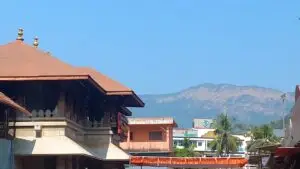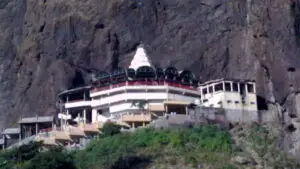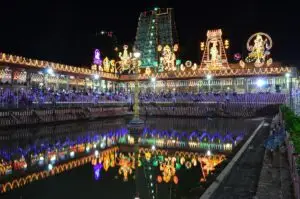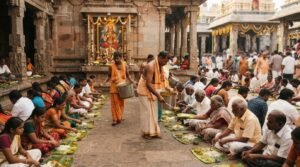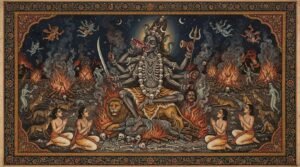
On a wooded hill above the wide, sand-banked Krishna river, where the city of Vijayawada gathers along both shores, stands one of South India's most visited and most fiercely loved goddess shrines. The Kanaka Durga Temple does not announce itself through age alone, though it is old, nor through scale alone, though its Dasara crowds number in the millions. It announces itself through intimacy - the sense, shared by pilgrims across generations, that the goddess enshrined here is not a stone image installed by human hands but a living presence that chose this particular hill, this particular bend of river, as her own eternal seat. Devotees call her simply Durgamma, "Mother Durga," and the affection in that name says as much about this temple as any historical account could.
This guide sets out to walk through everything a devotee or a curious traveller might reasonably want before making the journey: the legend of Indrakeeladri hill and its ties to the Mahabharata, the goddess's distinctive eight-armed swayambhu (self-manifested) form, the extraordinary nine-day Navaratri alankaram tradition that has made Vijayawada's Dasara nationally famous, the river festivals of Theppotsavam and Krishna Pushkaram, and the practical matters of timings and travel. Readers who wish to place Kanaka Durga within the wider map of Devi worship may find it useful to read alongside our complete guide to Goddess Durga and our account of the nine forms of Navadurga celebrated at Navratri, both of which illuminate traditions this temple observes in a particularly vivid, hilltop form.
Who Is Kanaka Durga?
Kanaka Durga - the name combines kanaka, gold, with Durga, the fierce and protective form of the Divine Mother - is worshipped at Vijayawada as a swayambhu murti, a self-manifested image believed to have appeared of its own accord rather than having been carved and consecrated by a sculptor. This distinction matters enormously to devotees: a swayambhu deity is understood not as a representation of the goddess but as the goddess herself, present in stone in a way that ordinary temple images, however beautifully made, are not considered to be.
The goddess is depicted in her Mahishasuramardini aspect, the slayer of the buffalo-demon Mahishasura, a form shared with countless Durga temples across India and treated at length in our guide to Goddess Durga. At Vijayawada she is shown with eight arms (ashtabhuja), each bearing a different weapon or symbolic object - trident, discus, sword, bow, and others that vary somewhat according to which account or which era's iconography one consults - standing in a posture of calm, assured command rather than active combat, which many pilgrims read as a sign of a victory already accomplished rather than a battle still underway.
Local devotion to Durgamma at Indrakeeladri is warm and immediate in a way that can surprise first-time visitors used to the more formal, distanced atmosphere of some larger temples. Pilgrims speak to her, request her blessing before examinations, journeys, weddings and new ventures, and treat the hill itself as an extension of her sanctity - it is common to see devotees pausing on the climb up, hands folded, well before the sanctum itself comes into view. This blend of grandeur and intimacy is part of what distinguishes Kanaka Durga from more austere or tightly ritualised Shakti shrines elsewhere in the country.
The Legend of Indrakeeladri: Arjuna, Kirata Shiva and the Hill of Keela
The hill on which the temple stands is called Indrakeeladri, and its name carries at least two layers of legend, both widely told at the temple and in regional Puranic tradition, though - as with much oral and Puranic material - accounts vary in emphasis and detail from source to source.
The Kiratarjuniya: Arjuna's Penance and Shiva the Hunter
The best-known association ties Indrakeeladri to the Mahabharata. During the Pandavas' exile, tradition holds that Arjuna undertook severe penance on this very hill in order to win celestial weapons from the gods, chief among them the Pashupatastra, the irresistible weapon of Shiva himself. As Arjuna's austerities intensified, Shiva resolved to test the depth of his resolve and devotion, and appeared before him disguised as a Kirata, a forest hunter, provoking a fierce duel over a wild boar both had, by different means, brought down. Only when the disguise fell away, and Arjuna recognised the hunter before him as Shiva, did the god relent and grant him the coveted weapon - a story immortalised in Sanskrit literature through the poet Bharavi's celebrated epic, the Kiratarjuniya.
Local tradition at Vijayawada holds that this confrontation, and the penance that preceded it, took place on the very hill that now bears the Kanaka Durga temple, lending Indrakeeladri a Mahabharata-era sanctity layered atop its identity as the goddess's own dwelling place. Devotees are advised, as with most such Puranic associations tied to specific geography, that the fuller textual sources and their regional variations are best explored with guidance from a knowledgeable priest or scholar, since oral tradition at the temple often preserves details that written sources treat only briefly.
The Legend of Keela and the Naming of the Hill
A second, closely related strand of legend explains the name Indrakeeladri more directly. According to this account, a mountain - or, in some tellings, a yaksha or minor divine being associated with the mountain and remembered in some regional retellings by names resembling Kritavirya - undertook long and severe penance, seeking as its reward the singular boon that the Divine Mother would consent to dwell upon it forever, rather than remaining only in her celestial abode. Pleased by this devotion, the goddess granted the request and took up permanent residence on the hill, which was thereafter known as Indrakeeladri - commonly explained as "the keela (peg, or fixed pillar) of Indra," reflecting the idea of the mountain as an immovable, foundational point sanctified by the goddess's abiding presence.
Where the two legends meet, in most tellings, is in the shared understanding that Indrakeeladri was already a site of extraordinary tapas (austerity) and divine attention long before any temple was built upon it - first through the penance that won the hill the goddess's eternal residence, and later through Arjuna's own penance and his encounter with Shiva in disguise. Regional retellings differ in which legend they foreground, and some accounts blend elements of both into a single continuous narrative; visitors keen to understand the precise textual lineage of each version are best served by consulting the temple's own published accounts or a qualified local pandit, since this is an area where oral tradition carries at least as much weight as any single written source.
Iconography: The Eight-Armed Swayambhu Goddess
The image enshrined in the main sanctum is carved directly into the natural rock of the hillside rather than installed as a separate, freestanding idol - a detail that reinforces the swayambhu tradition and gives the sanctum an unusually raw, elemental quality compared with temples where the deity sits on a built pedestal. The goddess is shown seated, ashtabhuja, her eight arms bearing weapons associated with several different gods of the Hindu pantheon, in keeping with the Puranic account of Durga's creation, in which the assembled devas each contributed a weapon and a measure of their own power to the goddess who alone could destroy Mahishasura - a story told in full in the Devi Mahatmya and summarised in our guide to the Durga Saptashati.
Tradition holds that Adi Shankaracharya, during his travels consolidating temple worship across the subcontinent, visited Indrakeeladri and installed a Sri Chakra before the goddess, a detail that - as at several other major Devi temples in South India - situates Kanaka Durga within the wider Sri Vidya current of goddess worship, alongside her more immediately visible identity as a warrior-protectress. As with similar claims made at numerous temples across India, the precise historical detail of Shankaracharya's visit is transmitted chiefly through devotional memory and temple tradition rather than independently dated record, though it is treated with considerable reverence locally.
Because the deity is carved into living rock rather than a separately consecrated stone, temple protocol here differs subtly from many other Devi shrines: certain forms of abhishekam (ritual bathing) are handled with particular care to protect the ancient rock surface, and priests at the temple are the appropriate source for devotees wishing to understand the exact ritual distinctions this creates.
Architecture and the Sanctum on Indrakeeladri Hill
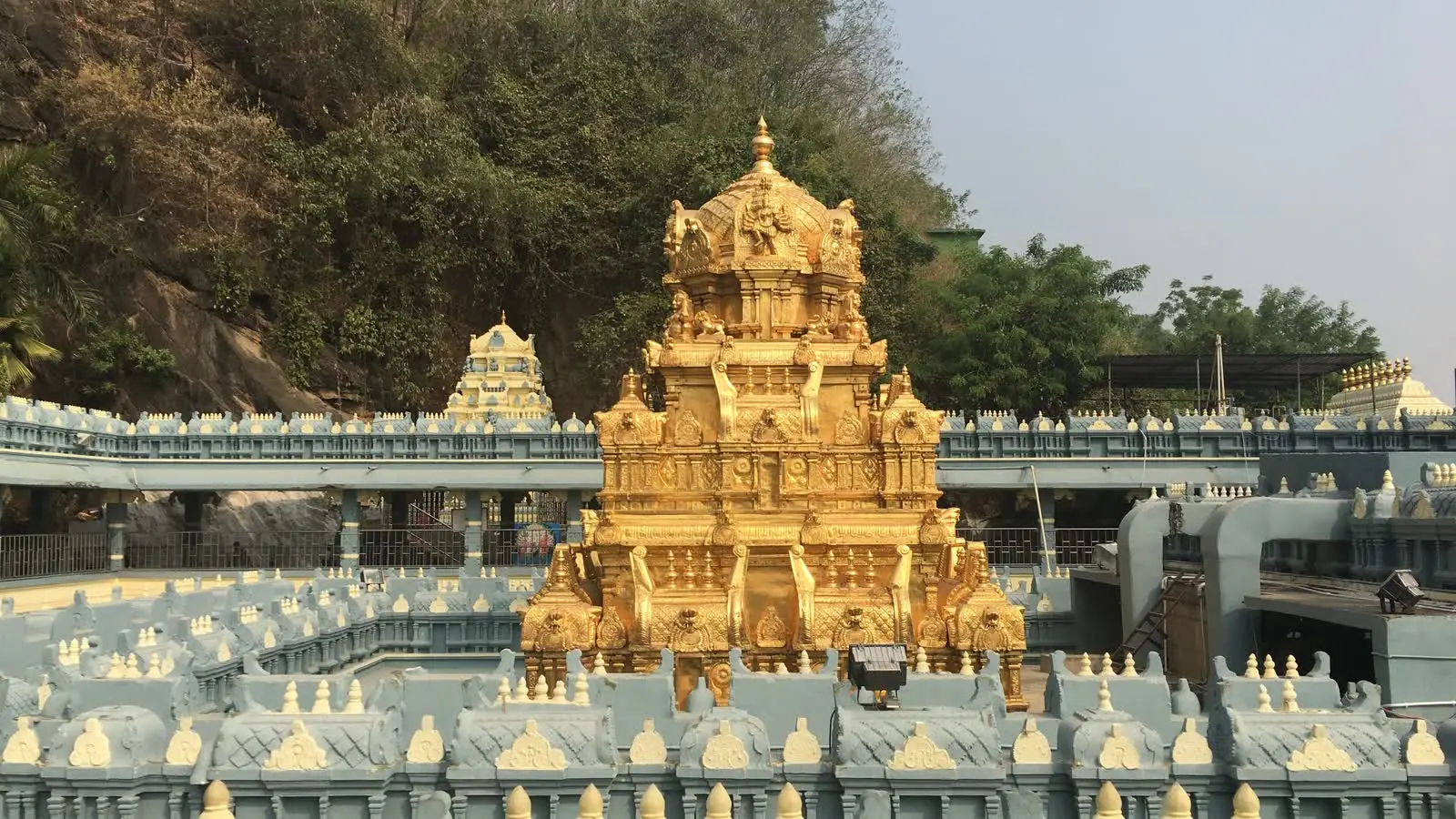
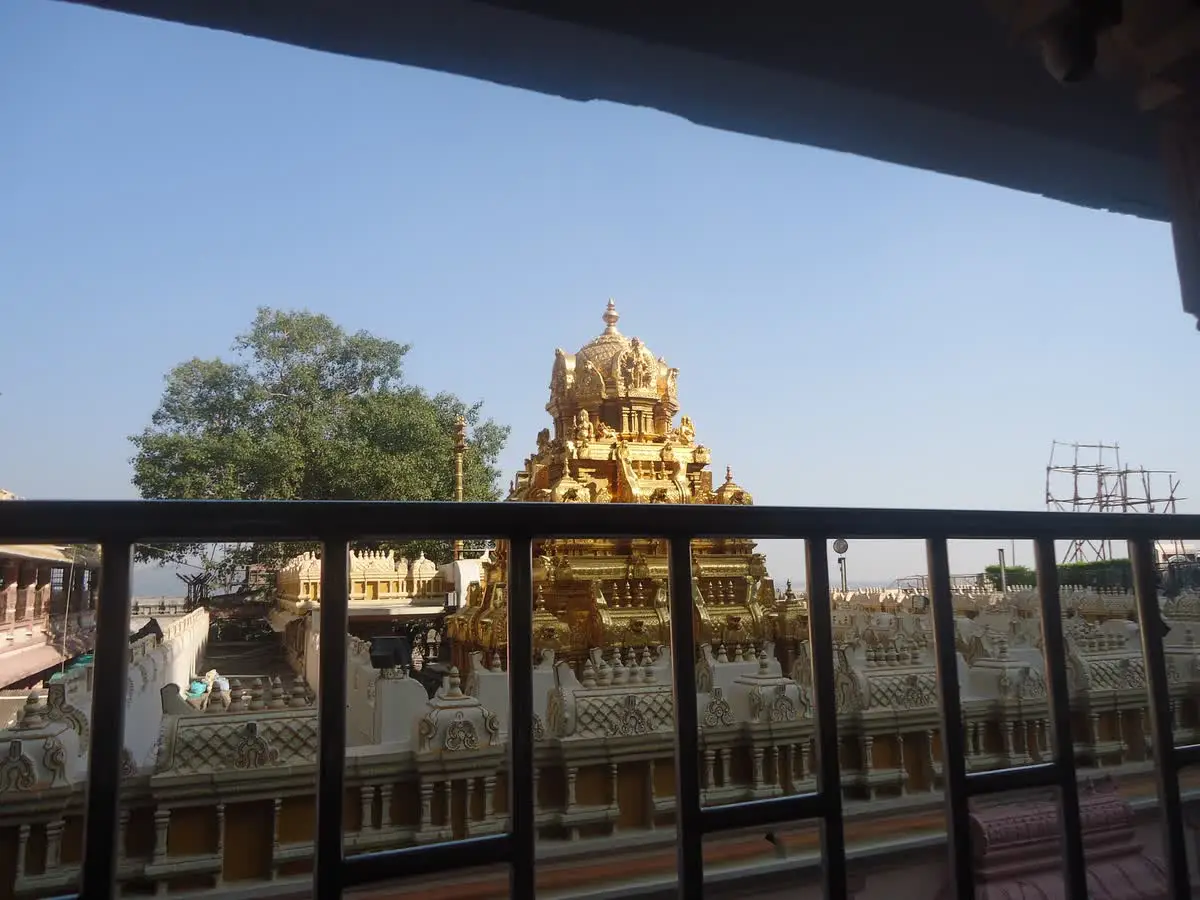
The temple complex has grown considerably over the centuries, and while inscriptional and structural evidence suggests a shrine of considerable antiquity on this site, much of what pilgrims see today - the tall gopuram, the approach steps, and the surrounding halls - reflects successive periods of renovation and expansion by various dynasties and, more recently, by the temple's modern trust, the Sri Durga Malleswara Swamy Varla Devasthanam, which administers the site jointly with the adjacent Malleswara Swamy (Shiva) temple.
This pairing of Durga and Malleswara Swamy within a shared administrative and physical precinct echoes a pattern found at other major Shakta-Shaiva sites in South India, where the goddess and a form of Shiva are worshipped side by side as consort deities, even where - as here - Durga's own shrine and legend are considerably more prominent in popular devotion than the adjoining Shiva sanctum.
Pilgrims reach the main sanctum by a long flight of stone steps up the hillside, though a ghat road and a lift facility have also been constructed in recent decades to accommodate the very large volume of daily and festival-season visitors, particularly elderly and differently-abled devotees. The climb itself, for those who choose the steps, is treated by many pilgrims as a small act of devotion in its own right, mirroring the ascent tradition found at numerous hilltop Devi shrines across India.
Navaratri at Kanaka Durga Temple: The Nine Alankarams
If there is a single event that has made the Kanaka Durga Temple a household name across Andhra Pradesh and beyond, it is Vijayawada's Dasara - among the most elaborately celebrated Navaratri observances anywhere in South India, drawing pilgrims in numbers that regularly run into the millions across the nine days.
Central to this celebration is the tradition of daily alankaram, in which the goddess is adorned each day in a distinct form, dressed and ornamented differently and, in many cases, addressed by a different name reflecting a different aspect of the Divine Mother - a practice that resonates closely with the nine-form Navadurga tradition discussed in our guide to Navratri and the Navadurga. While the precise sequence and naming can vary slightly from year to year according to the temple trust's calendar, the alankarams typically follow a broadly consistent pattern:
| Day | Typical Alankaram (Form) | Character of the Day |
|---|---|---|
| Day 1 | Sri Swarna Kavachalankruta Durga Devi | Goddess adorned in a golden armour-like covering, invoking her protective aspect |
| Day 2 | Sri Bala Tripura Sundari Devi | The youthful, radiant form of the goddess |
| Day 3 | Sri Gayatri Devi | The goddess as embodiment of the Gayatri mantra and Vedic wisdom |
| Day 4 | Sri Annapurna Devi / Lalita Tripura Sundari Devi | The goddess as nourisher and as the gentle, all-pervading Mother |
| Day 5 | Sri Lalita Tripura Sundari Devi / Saraswati Devi | The goddess of beauty and cosmic order, or of learning and the arts |
| Day 6 | Sri Mahalakshmi Devi | The goddess of wealth and auspiciousness |
| Day 7 | Sri Saraswati Devi | The goddess of knowledge, music and speech |
| Day 8 (Maha Ashtami) | Sri Durga Devi | The classical warrior form, marked with special Ashtami rites |
| Day 9 (Maha Navami) | Sri Mahishasura Mardini Devi | The goddess in full battle array, commemorating the slaying of Mahishasura |
| Vijayadashami | Sri Rajarajeswari Devi | The sovereign, all-ruling form, marking the festival's culmination |
Pilgrims planning a Dasara visit should treat this table as indicative rather than fixed; the Devasthanam publishes the confirmed sequence and exact dates each year, and given the enormous crowds, advance planning around specific alankaram days is strongly advised for those wishing to witness a particular form of the goddess.
Theppotsavam and Krishna Pushkaram: Festivals of the River
Two further festivals bind the Kanaka Durga Temple inseparably to the Krishna river on whose banks it stands.
Theppotsavam, the float festival, is typically observed following the main Dasara celebrations, when the utsava murti (the processional form of the goddess, distinct from the immovable swayambhu image in the sanctum) is taken down to the river and placed upon an elaborately decorated float, which is then rowed or towed along the water while devotees watch from the ghats and surrounding bridges. The sight of the goddess afloat upon the Krishna at dusk, lit by strings of lamps, is considered one of the most memorable spectacles of the entire festival season in Vijayawada.
Krishna Pushkaram is a rarer and even larger observance, held only once every twelve years when Jupiter (Brihaspati) enters the zodiac sign of Leo, according to traditional astrological reckoning. During this period, believed to be especially auspicious for ritual bathing in the Krishna river along its entire course, Vijayawada becomes one of the principal gathering points for pilgrims, who combine a ceremonial bath in the river with darshan at the Kanaka Durga Temple, treating the two acts as a single, unified act of purification and worship. Given its twelve-year cycle, prospective visitors should check current temple and municipal announcements to confirm whether a Pushkaram period falls within their planned travel dates.
Darshan and Aarti Timings
The temple maintains long daily hours to accommodate the very substantial number of pilgrims who visit even outside the festival season, given Vijayawada's position as a major transport hub in Andhra Pradesh. Typical timings, as generally published by the Devasthanam, are set out below, though these should always be confirmed shortly before travel, since they are subject to periodic revision and to special arrangements during Dasara and other major occasions.
| Aspect | Typical Timing |
|---|---|
| General darshan hours | Approximately 5:00 AM to 9:00 PM, daily, with a brief midday closure for ritual purposes in some schedules |
| Suprabhata seva / morning rituals | Early morning, generally before general darshan opens to the public |
| Evening aarti | Typically in the early evening, timing may shift seasonally |
| Special darshan / VIP darshan | Often available for an additional fee, particularly useful during Dasara |
Timings, fees and travel details checked against official sources in October 2026 are in Plan Your Visit below.
Given the exceptional crowds during Dasara and other major festivals, visitors are strongly advised to check current queue arrangements, special darshan schemes and any temporary timing changes with the Devasthanam's official channels before travelling.
How to Reach Kanaka Durga Temple, Vijayawada
Open Kanaka Durga Temple in Google Maps for live directions from where you are.
Vijayawada's position as one of Andhra Pradesh's principal transport hubs makes the Kanaka Durga Temple considerably easier to reach than many hilltop Devi shrines elsewhere in India.
| Mode | Details |
|---|---|
| By Air | Vijayawada International Airport at Gannavaram is the nearest airport, roughly 20-25 km from the temple, connected to major Indian cities including Hyderabad, Chennai, Bengaluru and Delhi; taxis and app-based cabs are readily available for the onward journey. |
| By Train | Vijayawada Junction, one of the busiest railway junctions in South India on the Chennai-Kolkata (Howrah) main line, lies only about 4-5 km from the temple, making rail arrival unusually convenient; autos and taxis complete the short remaining distance. |
| By Road | Vijayawada is well connected by National Highways (including NH16 and NH65) and regular long-distance bus services from Hyderabad (around 275 km, 4.5-5.5 hours), Chennai, Visakhapatnam and other regional cities; local buses and autos run frequently from the city centre to the base of Indrakeeladri hill. |
Given Vijayawada's excellent rail and road connectivity, many pilgrims combine a Kanaka Durga visit with a short stay in the city itself, particularly during Dasara when advance hotel booking is strongly advised.
Nearby Attractions and Where to Stay
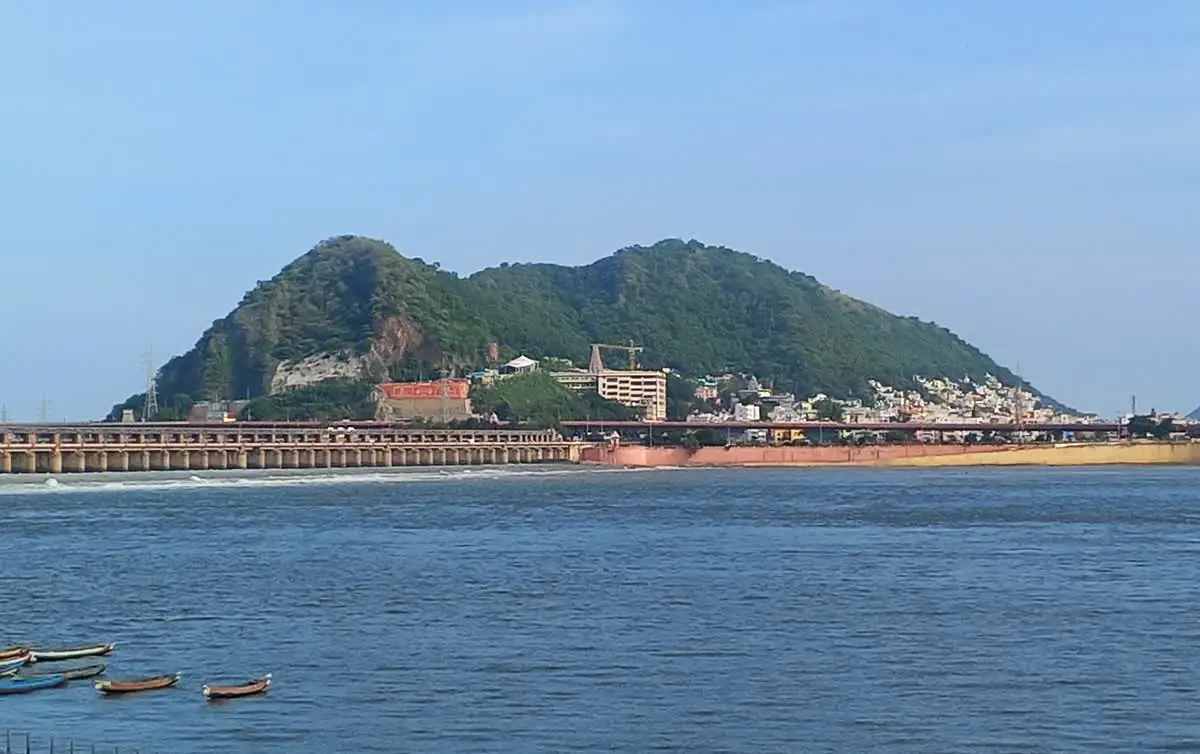
Vijayawada offers several notable sites within easy reach of the temple. The Prakasam Barrage, an imposing structure spanning the Krishna river close to the temple and offering fine views back toward Indrakeeladri hill, is a popular spot for an evening walk. The Undavalli Caves, a set of rock-cut cave temples dating to around the fourth to fifth century CE and featuring a notable reclining Vishnu image, lie a short drive away on the opposite bank of the river. The Bhavani Island in the Krishna, one of the larger river islands in Asia, and the Victoria Museum in the city centre also draw visitors extending their stay beyond a single day of darshan.
Accommodation in Vijayawada ranges from simple pilgrim lodges near the base of the hill to a wide range of mid-range and upmarket hotels throughout the city, reflecting Vijayawada's status as a major commercial centre rather than a purely pilgrimage town. Availability tightens considerably during Dasara, and pilgrims planning a festival-season visit are strongly advised to book well in advance, since the city's entire hospitality capacity comes under considerable pressure during the nine days of Navaratri.
Benefits of Worship and Pilgrimage at Indrakeeladri
Devotees who visit Kanaka Durga describe the pilgrimage in terms that blend the grandly cosmic with the intensely personal. Worship here is widely associated with the removal of obstacles and the granting of courage in the face of difficulty, echoing the goddess's own legend as the slayer of Mahishasura, and many pilgrims specifically seek her blessing before examinations, new ventures, journeys and marriages, treating Durgamma as a protector who takes a direct, personal interest in the difficulties of ordinary life rather than a distant cosmic power.
The setting itself is considered part of the pilgrimage's benefit: a hill sanctified first by penance and then by the goddess's own choice to dwell there, rising above a great river sacred in its own right, offers a devotional atmosphere many describe as unusually complete - combining hill, river and living rock sanctum within a single visit. Those wishing to deepen their understanding of the goddess's wider theological identity, including her place within the Devi Mahatmya and the Sri Vidya current touched on earlier in this guide, are encouraged to explore the fuller account of the Durga Saptashati and to seek guidance on pronunciation and advanced practice from a qualified guru or temple priest, since correct recitation is considered essential rather than a mere refinement.
Plan Your Visit to Kanaka Durga: Timings, Tickets and Travel
The details below were checked on 3 October 2026 against the Sri Durga Malleswara Swamy Varla Devasthanam and the other sources listed under each table. Timings and fees change on festival days, eclipses and special occasions, so confirm with the temple before you travel.
For what happens here during Navratri 2026 (11 to 19 October), see Navratri 2026 at major Devi temples.
Darshan and Aarti Timings
| Information | Details |
|---|---|
| Temple opens (normal days) | Early morning, between about 3:00 and 4:00 am. Reported opening times differ, so check locally. |
| Evening closing (normal days) | Around 10:00 pm |
| Nagarotsavam (Dasara) | Daily at 4:00 pm through the city streets |
Sources: TempleTimings.in: Kanaka Durga Temple Vijayawada Timings, Darshan & Guide 2026, Wikipedia: Kanaka Durga Temple, The Hans India: Devotee convenience, safety top priority: Minister Satya Kumar.
Tickets, Darshan Options and Sevas
| Option | Price | Notes |
|---|---|---|
| Mukhamandapa darshan | Rs 100 | Normal-day ticket. Cancelled during Dasara 2026 (11 to 20 October). |
| Sheeghra darshan | Rs 300 | Normal-day ticket. Cancelled during Dasara 2026 (11 to 20 October). |
| Antaralaya darshan | Rs 500 | Normal-day ticket. Cancelled during Dasara 2026 (11 to 20 October). |
| Bhavani Special Darshan (Dasara 2026) | Rs 1,000 | New ticket for Dasara 2026, sold online and at counters in two-hour slots (morning, afternoon and evening). Not sold on Moola Nakshatram and Vijayadashami. |
Free general darshan (Dharma darshanam) is open to all through the regular queue lines during Dasara. Five separate queue lanes are arranged, with separate lines and help for elderly and disabled devotees. Queues are arranged on Canal Road and Ghat Road. Bookings are handled on kanakadurgamma.org. Arjitha sevas can be reserved on the Endowments Department website or on WhatsApp through "Mana Mitra" at 9552300009, according to The Hans India (29 September 2026). Musinara is not connected with the temple and does not take bookings.
Sources: JustTelugu: Kanaka Durga Temple: Rs 100, 300, 500 darshan tickets cancelled f..., TempleTimings.in: Kanaka Durga Temple Vijayawada Timings, Darshan & Guide 2026, Deccan Chronicle: Dasara Festivities to Be Held on a Grand Scale at Indrakeel..., The Hans India: Devotee convenience, safety top priority: Minister Satya Kumar, Official site: Sri Durga Malleswara Swamy Varla Devasthanam.
Temple Rules and Dress Code
- Dress modestly and respectfully.
Source: TempleTimings.in: Kanaka Durga Temple Vijayawada Timings, Darshan & Guide 2026.
How to Reach Kanaka Durga
| Mode | Nearest point | Distance to the temple |
|---|---|---|
| Air | Vijayawada (Gannavaram) Airport | about 20 km |
| Rail | Vijayawada Junction | about 4 km |
| Bus | Vijayawada city bus stand |
Sources: TempleTimings.in: Kanaka Durga Temple Vijayawada Timings, Darshan & Guide 2026, Wikipedia: Kanaka Durga Temple.
Approximate distances and journey times from the cities most pilgrims start from. Road times assume normal traffic; festival weekends take longer.
| From | By road | Road time | Train or flight |
|---|---|---|---|
| Hyderabad | about 275 km | about 5 hours via NH 65 | |
| Visakhapatnam | about 345 to 380 km | 6 to 7 hours | |
| Chennai | about 450 km | 6 to 7.5 hours | |
| Guntur | about 35 km | about 1 hour |
Sources: Wikipedia: Kanaka Durga Temple, Yatra.com: Distance from Vijayawada to Visakhapatnam, Chennai and Guntur.
Temple buses run from the city bus stand and the railway station about every 20 minutes.
Prasadam, Annadanam and Where to Stay
About 60 lakh laddus are being prepared for Dasara 2026, and new buildings for prasadam and food distribution have been arranged.
Source: The Hans India: Devotee convenience, safety top priority: Minister Satya Kumar.
Frequently Asked Questions
What makes the Kanaka Durga Temple's deity special?
The goddess is a swayambhu, or self-manifested, image carved directly into the natural rock of Indrakeeladri hill rather than a separately consecrated idol. She is depicted as ashtabhuja, eight-armed, in her Mahishasuramardini form, and is understood by devotees not merely as a representation of Durga but as the goddess herself, present in the living stone.
Why is the hill called Indrakeeladri?
Tradition offers two closely related explanations. One holds that a mountain or divine being undertook severe penance and asked the goddess to dwell upon it forever, a request she granted, giving the hill its name as "the keela (fixed pillar) of Indra." The other ties the hill to the Mahabharata, holding that Arjuna performed his penance for celestial weapons here and encountered Shiva disguised as a Kirata hunter, the episode told in Bharavi's Kiratarjuniya.
Is Kanaka Durga Temple one of the Shakti Peethas?
No. Unlike temples such as Kamakhya or Vaishno Devi, Kanaka Durga is not traditionally counted among the fifty-one Shakti Peethas associated with the body of Sati. It is instead revered independently as a swayambhu Devi shrine with its own distinct legend rooted in Indrakeeladri hill.
What is the significance of the Navaratri alankarams at this temple?
During Dasara, the goddess is adorned in a different form each day across the nine nights - from Bala Tripura Sundari and Gayatri Devi to Mahalakshmi, Saraswati and, on the culminating days, Durga Devi, Mahishasura Mardini and Rajarajeswari Devi. The exact sequence is confirmed by the temple trust each year and draws pilgrims in the millions.
What is Theppotsavam?
Theppotsavam is the float festival held on the Krishna river, typically following Dasara, in which the goddess's processional image is carried on a decorated float across the water, lit by lamps, while devotees watch from the riverbanks.
What is Krishna Pushkaram and how often does it occur?
Krishna Pushkaram is a major river-bathing festival held once every twelve years, when Jupiter enters the zodiac sign of Leo. Vijayawada is one of the principal gathering points along the Krishna river during this period, and pilgrims typically combine a ritual bath with darshan at the Kanaka Durga Temple.
What are the typical darshan timings?
General darshan is typically available from around 5:00 AM to 9:00 PM daily, with morning and evening aarti at set times, though visitors should confirm current timings with the temple Devasthanam before travelling, especially during festival periods.
How do I reach the temple from Vijayawada Junction railway station?
The temple is only about 4-5 km from Vijayawada Junction, one of South India's busiest railway hubs, making it easily reachable by auto-rickshaw or taxi in well under half an hour outside peak festival crowds.
Is there an easier way up the hill than climbing the steps?
Yes. Alongside the traditional flight of stone steps, a ghat road and a lift facility have been built to assist elderly and differently-abled pilgrims and to manage the very heavy footfall the temple receives, particularly during Dasara.
Can this visit be combined with other Devi pilgrimages nearby?
Many pilgrims travelling through Andhra Pradesh combine a Kanaka Durga visit with the Bhramaramba Devi Temple at Srisailam, several hours away, or plan their trip around Navratri to also study the wider Navadurga tradition described in our guide to Navratri and the nine forms of the Goddess.
For further reading on the broader Mahabharata episode connected with this hill, see the Wikipedia entry on the Kiratarjuniya.
To climb Indrakeeladri at dawn, with the Krishna river catching the first light below and Durgamma waiting in her rock-cut sanctum above, is to feel how completely a landscape can be claimed by devotion - a hill won by penance, chosen by the goddess, and now climbed by millions each Dasara in gratitude for that choice. If Durgamma's story has stirred something in you, Musinara's channel offers 432 Hz recordings of Devi mantras and chants for quiet listening - we invite you to listen on YouTube and carry a little of Indrakeeladri's stillness into your own days.
Related reading
- The Durga Chalisa: Meaning, Verses and How to Recite the Forty-Verse Hymn to the Mother
- Tulja Bhavani Temple, Tuljapur: A Complete Guide to the Kuldevi of the Marathas
- Mahalakshmi Temple, Kolhapur: A Complete Guide to Ambabai, the Karavir Nivasini
- Sringeri Sharada Peetham: A Complete Guide to Goddess Sharada's First Matha
తెలంగాణలో ఈ కాలంలో జరిగే పండుగ వేరు - బతుకమ్మ ౨౦౨౬: తొమ్మిది రోజుల పేర్లు మరియు పేర్చే విధానం.
Official and Reference Sources
- Sri Durga Malleswara Swamy Varla Devasthanam - the devasthanam on the Andhra Pradesh Endowments platform
Planning a pilgrimage? All twenty Devi temple guides on this site are arranged by region, with practical circuits, in Devi Temples of India. For where each site sits in the disputed lists of 51, 52 and 108, see the Shakti Peeth list.