Few short stotras carry as much devotional weight per syllable as the Mahalakshmi Ashtakam. In eight compact verses, plus a closing verse describing the fruits of recitation, this hymn compresses an entire theology of the Goddess of fortune - her origin, her weapons, her cosmic titles, and her promise to remove hardship for anyone who approaches her with sincerity. It is short enough to memorise within a week of steady practice, yet dense enough that a lifetime of recitation continues to reveal new layers of meaning.
This guide sets out the Mahalakshmi Ashtakam's traditional origin in the Padma Purana and its association with Indra, presents several of its key verses in Devanagari, transliteration and translation, and explains the epithets of the Goddess that recur throughout. It also covers the benefits attributed to recitation, the customary guidance on reciting it once, three or eight times a day, and practical notes on pronunciation and timing. Readers wishing to understand Mahalakshmi more broadly, including her place as one of the Ashta Lakshmi and her relationship to her sibling forms, may enjoy our companion pieces on the complete guide to Goddess Lakshmi and the eight forms of Ashta Lakshmi.
As with any Sanskrit stotra, small variations in wording and verse order exist across regional printed editions and oral traditions. What follows reflects the version of the Mahalakshmi Ashtakam most widely printed and recited today, and readers who learn a slightly different wording from their own family tradition or temple should regard this as a normal feature of a long transmission rather than a discrepancy to be resolved in favour of one version over another.
What Is the Mahalakshmi Ashtakam?
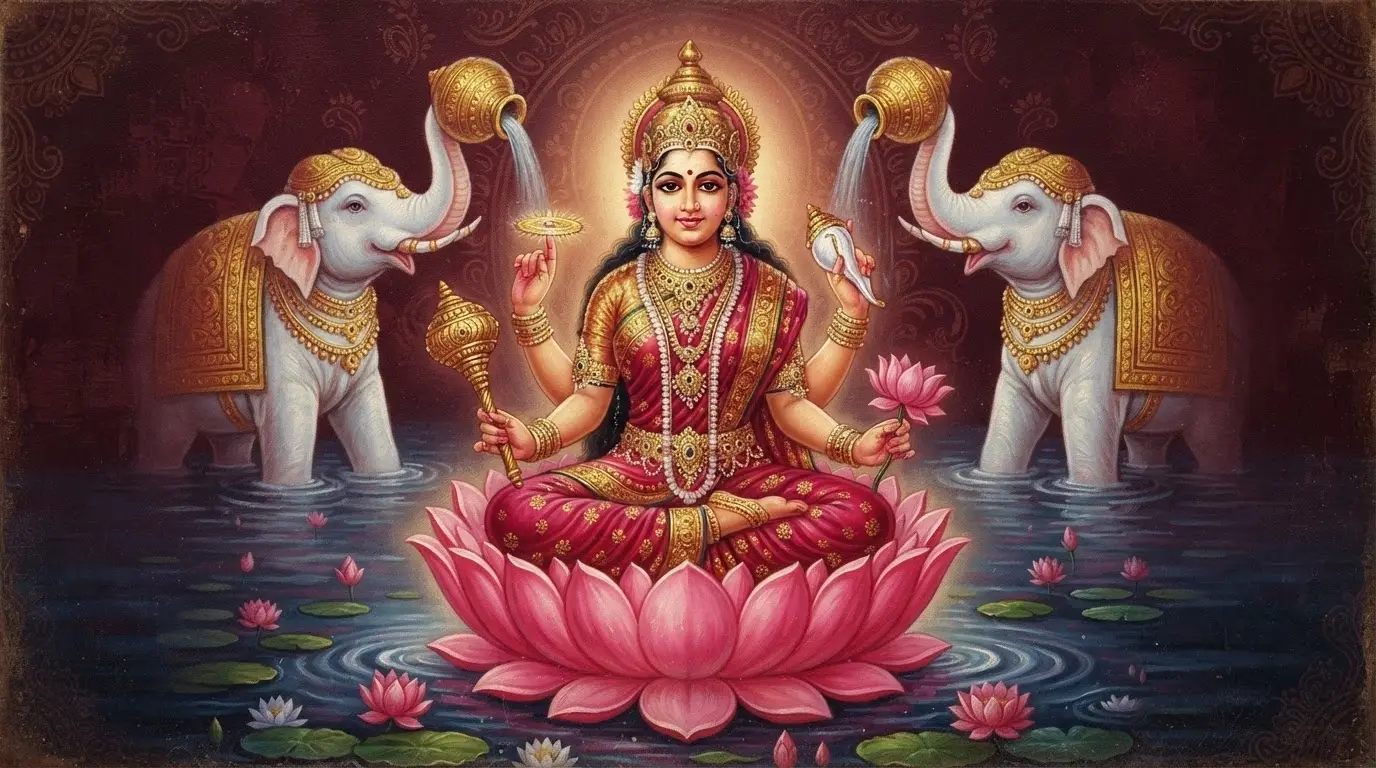
The Mahalakshmi Ashtakam, literally "the eight verses to Mahalakshmi," is a short Sanskrit stotra in praise of Goddess Mahalakshmi, the great and complete form of the Goddess of wealth, fortune and auspiciousness. As an ashtakam - a hymn composed of eight verses - it belongs to a well-established genre of Sanskrit devotional poetry, alongside similar eight-verse hymns dedicated to other deities, though the Mahalakshmi Ashtakam remains among the most widely recited of this genre across Hindu households, particularly in western and southern India.
Tradition holds that this stotra is spoken by Indra, king of the gods, and it is traditionally placed within the Padma Purana, one of the eighteen Mahapuranas, in a section connected to the churning of the cosmic ocean and the broader mythology surrounding Lakshmi's emergence and occasional withdrawal of grace from the heavens. As with many stotras of this kind, the precise placement and dating within the wider Puranic corpus is a matter of some scholarly discussion, and the hymn circulates today primarily as an independent devotional text rather than as a passage read strictly within its original narrative context. What has remained constant across centuries of transmission is the hymn's content and structure - eight verses of praise followed by a phala shruti describing the benefits of recitation.
The Legend: Indra's Plea to the Goddess
The traditional account behind the Mahalakshmi Ashtakam is closely bound up with the larger cycle of stories in which Indra, ruler of the heavens, loses and subsequently regains the favour of the Goddess of fortune. In the version most commonly associated with this stotra, Indra and the assembled devas found themselves stripped of their wealth, radiance and authority - accounts vary as to whether this followed a curse from an offended sage or a period of ascendancy by hostile forces - and, recognising that their loss was ultimately Lakshmi's absence rather than any failure of their own strength, turned to her in earnest praise. It is in this moment of humbled supplication, according to tradition, that Indra composed and recited these eight verses, and Mahalakshmi, pleased by his sincerity, restored her presence and blessing to the heavens.
This legend carries a lesson that devotees continue to draw on today: that Lakshmi's grace is not a possession to be seized or hoarded, but a presence that must be humbly invited and honoured, and that even the king of the gods, at the height of his power, could lose everything the moment he took her favour for granted. The Mahalakshmi Ashtakam, read against this backdrop, is not merely a hymn of praise but a hymn of humility - the words of someone who has learned, through loss, precisely what he was failing to value while he had it.
Popular retelling often connects this episode to the wider Samudra Manthan narrative, in which the churning of the cosmic ocean by gods and demons together produces Lakshmi herself, rising from the waters bearing a lotus, well after Indra and the devas had already been humbled and stripped of their radiance by an earlier curse. Some tellings identify the offended party as the sage Durvasa, whose garland, gifted to Indra as a mark of honour, was carelessly cast aside and trampled by Indra's elephant, provoking the sage's curse and the subsequent departure of prosperity from the three worlds. Whichever precise chain of events a particular retelling follows, the underlying structure is consistent: Indra's loss of Lakshmi's grace through carelessness or arrogance, a period of genuine hardship among the gods, and her eventual return once approached with the right spirit of humility and praise, of which this Ashtakam is offered as the surviving record. Readers interested in Mahalakshmi's broader place among Vishnu's consort forms, and her connection to prosperity in its fullest sense, may find our guide to Maa Kamala, the tenth Mahavidya closely associated with Lakshmi, a useful further reading.
Structure of the Hymn
The Mahalakshmi Ashtakam follows a clear and economical structure, well suited to daily memorisation and recitation.
Eight Core Verses
The main body of the stotra consists of eight verses, each addressed directly to the Goddess and each concluding with the same refrain - "Mahalakshmi namostute," "salutations to you, Mahalakshmi" - a repeated closing line that gives the hymn its distinctive rhythmic unity. Each verse foregrounds a different aspect of the Goddess: her cosmic origin, her weapons and mount, her role as remover of sin and fear, her identity as the source of siddhi (spiritual accomplishment) and buddhi (intellect), her position beyond beginning and end, her embodiment of both gentle and formidable power, her seat upon the lotus as the very form of the highest reality, and finally her universal, all-pervading motherhood.
The Phala Shruti
Following the eight core verses, the hymn concludes with a phala shruti verse describing the fruit of recitation, promising that one who recites the Mahalakshmi Ashtakam with devotion attains all manner of accomplishment and prosperity. Many printed editions extend this closing section with additional verses specifying that reciting the stotra once daily removes great sin, reciting it three times daily brings wealth and grain in abundance, and reciting it eight times daily is said to grant the fullest measure of the Goddess's blessing - a graduated structure that gives devotees a clear, practical framework for building their own daily practice according to the time and devotion they are able to bring to it.
The Mahalakshmi Ashtakam: Full Lyrics, Transliteration and Meaning
The complete hymn is given below: all eight verses of the Ashtakam followed by the three verses of the phala shruti, each in Devanagari, in transliteration, and with its meaning in English. Every verse closes on the same refrain, Mahalakshmi namo’stu te, salutations to you, Mahalakshmi, which is what makes the hymn so easy to hold in memory.
| Devanagari | Transliteration | Meaning |
|---|---|---|
| नमस्तेऽस्तु महामाये श्रीपीठे सुरपूजिते । शङ्खचक्रगदाहस्ते महालक्ष्मि नमोऽस्तु ते ॥ १ ॥ | Namaste’stu Mahamaye Shripithe Surapujite, Shankhachakragadahaste Mahalakshmi namo’stu te. | Salutations to you, O Mahamaya, seated on the throne of Sri and worshipped by the gods, bearing conch, discus and mace in your hands. Salutations to you, Mahalakshmi. |
| नमस्ते गरुडारूढे कोलासुरभयङ्करि । सर्वपापहरे देवि महालक्ष्मि नमोऽस्तु ते ॥ २ ॥ | Namaste Garudarudhe Kolasurabhayankari, Sarvapapahare Devi Mahalakshmi namo’stu te. | Salutations to you who ride upon Garuda, terror of the demon Kola, remover of every sin. Salutations to you, Mahalakshmi. |
| सर्वज्ञे सर्ववरदे सर्वदुष्टभयङ्करि । सर्वदुःखहरे देवि महालक्ष्मि नमोऽस्तु ते ॥ ३ ॥ | Sarvajne Sarvavarade Sarvadushtabhayankari, Sarvaduhkhahare Devi Mahalakshmi namo’stu te. | Knower of all, giver of every boon, terror of all the wicked, remover of every sorrow. Salutations to you, Mahalakshmi. |
| सिद्धिबुद्धिप्रदे देवि भुक्तिमुक्तिप्रदायिनि । मन्त्रमूर्ते सदा देवि महालक्ष्मि नमोऽस्तु ते ॥ ४ ॥ | Siddhibuddhiprade Devi Bhuktimuktipradayini, Mantramurte sada Devi Mahalakshmi namo’stu te. | Giver of attainment and of intelligence, bestower of both enjoyment and liberation, you whose very form is the mantra. Salutations to you, Mahalakshmi. |
| आद्यन्तरहिते देवि आद्यशक्ति महेश्वरि । योगजे योगसम्भूते महालक्ष्मि नमोऽस्तु ते ॥ ५ ॥ | Adyantarahite Devi Adyashakti Maheshvari, Yogaje Yogasambhute Mahalakshmi namo’stu te. | Without beginning or end, primordial power, great sovereign, born of yoga and arisen from yoga. Salutations to you, Mahalakshmi. |
| स्थूलसूक्ष्ममहारौद्रे महाशक्ति महोदरे । महापापहरे देवि महालक्ष्मि नमोऽस्तु ते ॥ ६ ॥ | Sthulasukshmamaharaudre Mahashakti Mahodare, Mahapapahare Devi Mahalakshmi namo’stu te. | Gross and subtle and terrible, great power, great of womb, remover of the greatest sins. Salutations to you, Mahalakshmi. |
| पद्मासनस्थिते देवि परब्रह्मस्वरूपिणि । परमेशि जगन्मातर्महालक्ष्मि नमोऽस्तु ते ॥ ७ ॥ | Padmasanasthite Devi Parabrahmasvarupini, Parameshi Jaganmatar Mahalakshmi namo’stu te. | Seated upon the lotus, whose very nature is the supreme Brahman, highest sovereign and Mother of the world. Salutations to you, Mahalakshmi. |
| श्वेताम्बरधरे देवि नानालङ्कारभूषिते । जगत्स्थिते जगन्मातर्महालक्ष्मि नमोऽस्तु ते ॥ ८ ॥ | Shvetambaradhare Devi Nanalankarabhushite, Jagatsthite Jaganmatar Mahalakshmi namo’stu te. | Clothed in white, adorned with manifold ornaments, abiding in the world as its Mother. Salutations to you, Mahalakshmi. |
Phala Shruti: The Closing Verses
The phala shruti states what the recitation is said to yield. It is traditionally recited along with the hymn rather than treated as separate.
| Devanagari | Transliteration | Meaning |
|---|---|---|
| महालक्ष्म्यष्टकं स्तोत्रं यः पठेद्भक्तिमान्नरः । सर्वसिद्धिमवाप्नोति राज्यं प्राप्नोति सर्वदा ॥ | Mahalakshmyashtakam stotram yah pathed bhaktiman narah, Sarvasiddhim avapnoti rajyam prapnoti sarvada. | The devoted person who recites this Mahalakshmi Ashtakam attains every accomplishment and lasting sovereignty. |
| एककाले पठेन्नित्यं महापापविनाशनम् । द्विकालं यः पठेन्नित्यं धनधान्यसमन्वितः ॥ | Ekakale pathen nityam mahapapavinashanam, Dvikalam yah pathen nityam dhanadhanyasamanvitah. | Recited once daily it destroys great sin; recited twice daily it brings wealth and grain in abundance. |
| त्रिकालं यः पठेन्नित्यं महाशत्रुविनाशनम् । महालक्ष्मीर्भवेन्नित्यं प्रसन्ना वरदा शुभा ॥ | Trikalam yah pathen nityam mahashatruvinashanam, Mahalakshmir bhaven nityam prasanna varada shubha. | Recited three times daily it destroys the greatest enemies, and Mahalakshmi becomes ever gracious, boon-giving and auspicious. |
Minor textual variants exist between recensions, as with every hymn carried for centuries in recitation. The text above follows the version most widely recited.
The Epithets of the Goddess in the Ashtakam
Part of what makes the Mahalakshmi Ashtakam so densely rewarding to study is the sheer range of titles it applies to the Goddess within so short a space. Among the most significant recurring epithets:
- Mahamaya - the great illusion or great creative power, acknowledging Lakshmi's role as the force that gives rise to the perceived world.
- Sripitha - she who is seated upon the throne of Sri, denoting her sovereignty over auspiciousness and prosperity itself.
- Garudarudha - mounted upon Garuda, Vishnu's eagle vehicle, linking her inseparably to her consort.
- Sarvajna - the all-knowing one, an epithet more commonly associated with wisdom deities, here applied to Lakshmi to underscore that prosperity without discernment is incomplete.
- Siddhibuddhiprada - bestower of siddhi (spiritual accomplishment) and buddhi (intellect), extending her blessing well beyond material wealth alone.
- Adyashakti Maheshwari - the primordial power and great sovereign, a title that places her, within this hymn, at the very source of cosmic energy rather than as a secondary or derivative figure.
- Parabrahmasvarupini - she whose very form is the supreme, formless reality of Vedantic philosophy, the boldest theological claim the hymn makes.
- Jaganmata - mother of the universe, the epithet on which the hymn's penultimate and closing verses both come to rest.
Some commentators have observed that the final two or three verses of the Ashtakam broaden noticeably beyond the imagery most closely associated with Lakshmi elsewhere - wealth, lotuses, elephants and gold - toward language more commonly used of the Goddess in her universal, undifferentiated form. This has led a number of traditional readers to understand the closing verses as addressing the singular Adi Shakti underlying Mahakali, Mahalakshmi and Mahasaraswati together, rather than Lakshmi in her narrower, wealth-bestowing aspect alone. Whether or not one adopts this reading, it reflects the broader Shakta principle that any one goddess, addressed fully and sincerely enough, opens outward into praise of the single Devi underlying all her forms.
It is also worth noting how the hymn's epithets work together rather than in isolation. Sripitha establishes her seat and station; Garudarudha and the weapons of the first verse anchor her firmly to Vishnu's iconographic world; Sarvajna and Siddhibuddhiprada extend her domain into wisdom and inner accomplishment, guarding against any reading of the hymn as praising wealth for its own sake; and Adyashaktimaheshwari and Parabrahmasvarupini lift the entire hymn, by its close, into the register of ultimate reality rather than mere fortune. A devotee reciting the Ashtakam slowly, allowing each epithet to register in turn, moves through this same arc - from gratitude for tangible blessings toward a quieter recognition of the Goddess as the ground of being itself.
Benefits and Phala Shruti
The concluding phala shruti of the Mahalakshmi Ashtakam, together with long-standing devotional practice, attributes the following benefits to sincere recitation:
- Removal of sin and hardship - the closing verses promise that regular recitation dissolves accumulated difficulty and misfortune.
- Growth in wealth and grain - reflecting Lakshmi's most immediate and widely sought blessing, prosperity in both monetary and agricultural terms.
- Attainment of siddhi and buddhi - spiritual accomplishment and clarity of intellect, extending the hymn's benefits beyond material gain alone.
- Protection from fear and adversaries - several verses specifically invoke her as terror of the wicked and remover of fear, offering the reciter a sense of protection in difficult circumstances.
- Progress toward both worldly fulfilment and liberation - the hymn explicitly promises bhukti (enjoyment) and mukti (liberation) together, a combination devotees often find reassuring, since it does not ask them to renounce worldly life in order to receive spiritual benefit.
Tradition offers a graduated framework for how frequently to recite the stotra in order to draw out these benefits fully: reciting it once daily is said to remove great sin and settle the mind; reciting it three times daily is associated with the steady growth of wealth, grain and general household prosperity; and reciting it eight times daily - a practice generally reserved for periods of concentrated devotion, such as the nine days of Navratri or the days immediately surrounding Diwali - is held to bring the fullest measure of the Goddess's blessing. Most householders, in ordinary daily practice, recite the stotra once or three times, reserving the eightfold recitation for special occasions when more time can be devoted to worship.
How and When to Recite the Mahalakshmi Ashtakam
Auspicious Days and Occasions
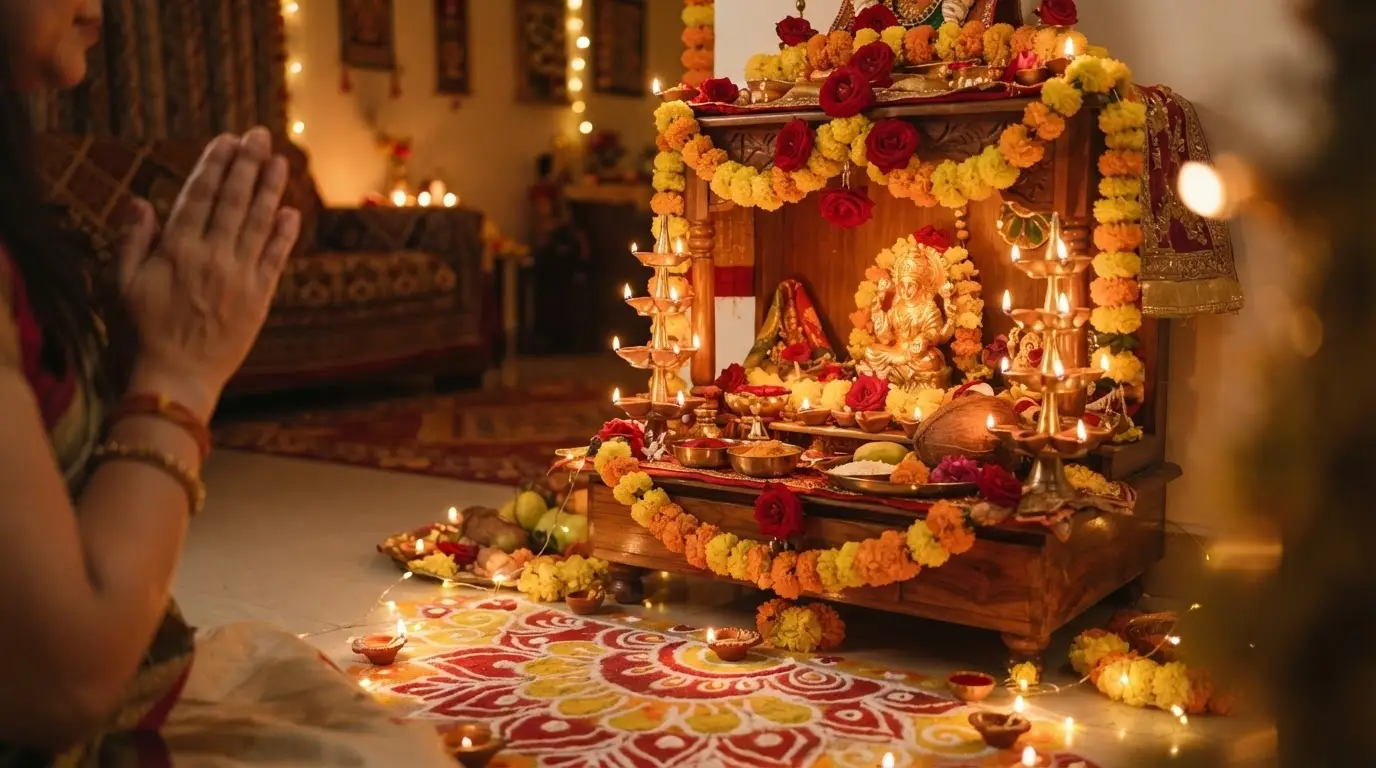
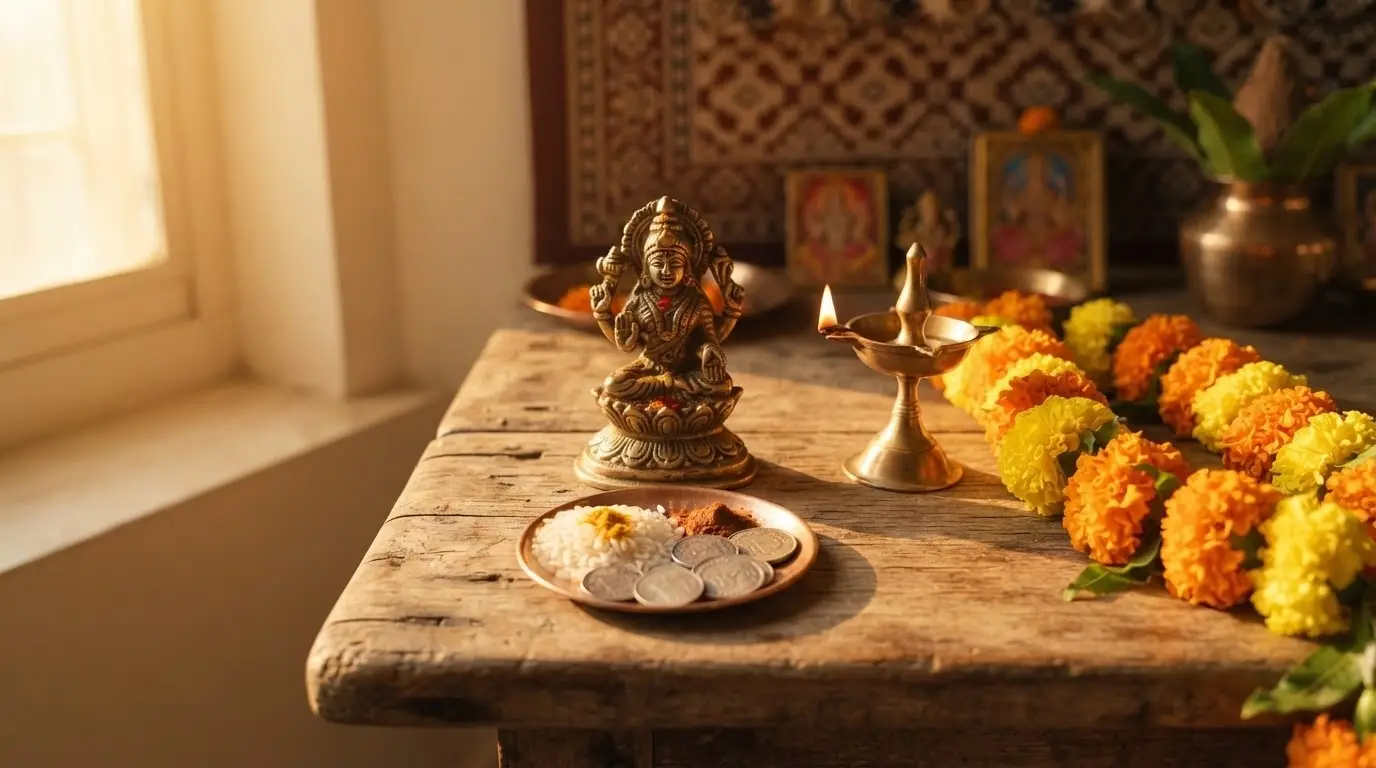
Friday (Shukravara) is the day most widely associated with Lakshmi worship across Hindu households, and it is considered an especially favourable day for reciting the Mahalakshmi Ashtakam, often alongside a simple lamp-lighting ritual before the household altar. Diwali, the festival most closely tied to Lakshmi's presence and blessing, sees the stotra recited very widely, frequently alongside the Lakshmi aarti and Ganesh-Lakshmi puja that mark the festival's central evening rites. Readers preparing for the festival in detail may find our companion guide to Diwali Lakshmi puja vidhi useful for situating this stotra within the fuller ritual sequence. Morning recitation, ideally shortly after waking and bathing, is the time most commonly recommended for daily practice, since the mind is considered clearest and least distracted at this hour, though many households also recite it in the evening at the time of lighting the lamp.
Method and Setting
The stotra is customarily recited facing east or north, seated on a clean mat or cushion rather than directly on the floor, before a lit lamp or an image of the Goddess. Some households recite it as part of a broader daily sequence alongside the Vishnu Sahasranama or a simple Lakshmi aarti, given her inseparability from Vishnu within traditional iconography. As with any Sanskrit stotra, sincerity and steadiness of practice matter more than perfection from the outset; new reciters are encouraged to begin slowly, checking pronunciation against a reliable audio recording or the guidance of a knowledgeable elder or temple priest rather than attempting to memorise from a printed transliteration alone.
Pronunciation Notes
A handful of pronunciation points are worth particular attention for new reciters. The aspirated consonants in words like "Mahamaye" and "bhukti" should be given a clear breath of air rather than softened toward their unaspirated counterparts. The long vowels marked in transliteration, such as the "ā" in "Sripithe" or "Adyashakti," should be held for roughly twice the duration of a short vowel, a distinction that affects both the metre and, tradition holds, the resonance of the verse when chanted aloud. Conjunct consonants such as "ddh" in "Siddhi" or "ksh" in "Parameshi" are best learned by listening closely to an experienced reciter rather than attempting to reconstruct them from the Roman transliteration alone, since transliteration schemes can only approximate the precise sounds of Devanagari script.
Regional Variations
As is common with widely circulated stotras, minor differences exist between printed editions of the Mahalakshmi Ashtakam. Some editions include a sixth verse addressing themes of fierce protective power, occasionally rendered as "Sthula Sukshma Maharaudre" (gross, subtle and greatly fearsome), positioned between the fifth verse given above and the lotus-seat verse, while others compress the hymn slightly differently or present the phala shruti as two or three separate concluding verses rather than one combined verse as given here. Some regional collections also append further phala shruti verses beyond the single one included above, specifying in additional detail the graduated benefits of reciting the stotra once, twice, three times or eight times daily; these extended versions are common in printed Gujarati and Marathi prayer books in particular, reflecting the stotra's especially strong popularity in western India.
None of these variations alter the hymn's fundamental content, its sequence of epithets, or its closing refrain, and a devotee encountering a slightly different arrangement in a regional prayer book, temple pamphlet, or family notebook of stotras should regard it as a natural feature of a long oral and printed transmission rather than a departure from an authoritative original. As with the Lalita Sahasranamam and other widely recited Devi stotras, the underlying devotional intent - humble praise of the Goddess through her titles and attributes - remains constant even where individual words or verse groupings differ slightly from one household or region to the next.
Frequently Asked Questions
What is the Mahalakshmi Ashtakam?
The Mahalakshmi Ashtakam is a Sanskrit stotra of eight verses in praise of Goddess Mahalakshmi, traditionally attributed to Indra and associated with the Padma Purana. Each verse closes with the refrain "Mahalakshmi namostute," salutations to Mahalakshmi.
Who composed the Mahalakshmi Ashtakam?
Tradition holds that the hymn was composed and recited by Indra, king of the gods, after he sought to regain the Goddess's lost favour and restore prosperity to the heavens.
What does "Namastestu Mahamaye" mean?
It is the opening line of the stotra, meaning "salutations to you, O great illusion (or great creative power)," addressing the Goddess by her epithet Mahamaye before continuing to describe her as seated upon the throne of Sri and worshipped by the gods.
How many times a day should the Mahalakshmi Ashtakam be recited?
Tradition suggests reciting it once daily for the removal of sin, three times daily to encourage the growth of wealth and grain, and eight times daily during periods of intensified devotion, such as Navratri or the days around Diwali, for the fullest measure of blessing.
When is the best time to recite the Mahalakshmi Ashtakam?
Morning, shortly after waking and bathing, is the time most commonly recommended, though many households also recite it in the evening at the time of lighting the lamp. Friday and Diwali are considered especially auspicious occasions for recitation.
Is the Mahalakshmi Ashtakam the same as the Lakshmi Ashtottara or Lakshmi Sahasranama?
No. The Ashtottara (108 names) and Sahasranama (1,000 names) are longer name-based hymns, whereas the Ashtakam is a short, eight-verse devotional stotra with its own distinct wording, composed as a compact hymn of praise rather than a list of names.
Can the Mahalakshmi Ashtakam be recited by anyone, without initiation?
Yes. Unlike some esoteric mantras that traditionally require initiation from a guru, the Mahalakshmi Ashtakam is an openly recited devotional stotra suitable for any sincere devotee, and it is commonly taught to children as one of the first stotras memorised in many households.
What is the significance of the refrain "Mahalakshmi namostute"?
The repeated closing line, "salutations to you, Mahalakshmi," gives the hymn its rhythmic unity and reinforces, verse after verse, the reciter's humility and surrender before the Goddess, regardless of which specific aspect of her nature each verse has just described.
Why does the hymn mention Indra losing his wealth?
The legend behind the stotra teaches that Lakshmi's grace is not a fixed possession but a presence that must be continually honoured; even Indra, at the height of his power, is said to have lost her favour, and the hymn preserves his words of humble supplication upon seeking to regain it.
How is the Mahalakshmi Ashtakam connected to Ashta Lakshmi?
While the Mahalakshmi Ashtakam and the Ashtalakshmi Stotram are distinct texts, both share the number eight and both address the fullness of Lakshmi's blessing; Mahalakshmi is often understood as the singular, complete source from which the eight specific forms enumerated in the Ashtalakshmi Stotram emanate. Readers can explore this further in our guide to the eight forms of Ashta Lakshmi.
Further Reading
Readers seeking further scholarly and comparative context may find the Wikipedia entry on Lakshmi a useful starting point for the wider mythology and iconography referenced throughout this stotra.
Eight verses, each closing on the same humble refrain, hold within them Indra's full plea and the Goddess's full response - wealth restored, wisdom granted, fear removed. Musinara's YouTube channel carries 432 Hz recordings of the Mahalakshmi Ashtakam and related Devi stotras, composed for quiet, sustained listening. We warmly invite you to listen and subscribe as part of your own morning or Friday devotional practice.
Stay in Touch
An occasional note when there is a new chant or a mantra worth sharing. No spam, and you can unsubscribe at any time.
This stotra is recited in Karnataka homes during the Shravana vrata. See ವರಮಹಾಲಕ್ಷ್ಮಿ ಹಬ್ಬ in Kannada.
New to chanting? Two short guides cover the practicalities: how to chant a mantra (mala, count, pronunciation and the three traditional modes of japa), and Devi worship at home (a simple altar and a ten minute daily sequence).