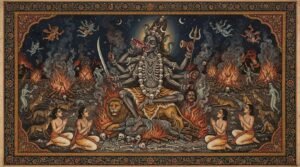
Not every avatar of the Goddess arrives with weapons. The Devi Mahatmya’s closing prophecy has the Devi herself declare it: when rain fails for a hundred years, "I shall sustain the whole world with life-supporting vegetables, born of my own body" - and she will be praised as Shakambhari, She Who Bears the Greens. Her sister-form in the sacred geography of Kashi is Annapurna, the goddess with the rice pot, before whom even Shiva stands with a begging bowl. Between them they hold a whole theology: food is not below divinity - food is divinity, given for a cause.
Two Forms, One Descent
| Shakambhari | Annapurna | |
|---|---|---|
| The cause | A hundred-year drought; the world starving | Shiva’s teaching that the world is maya - answered when food itself vanished |
| The gift | Vegetables, fruits and greens from her own body | The full vessel that never empties; grain as grace |
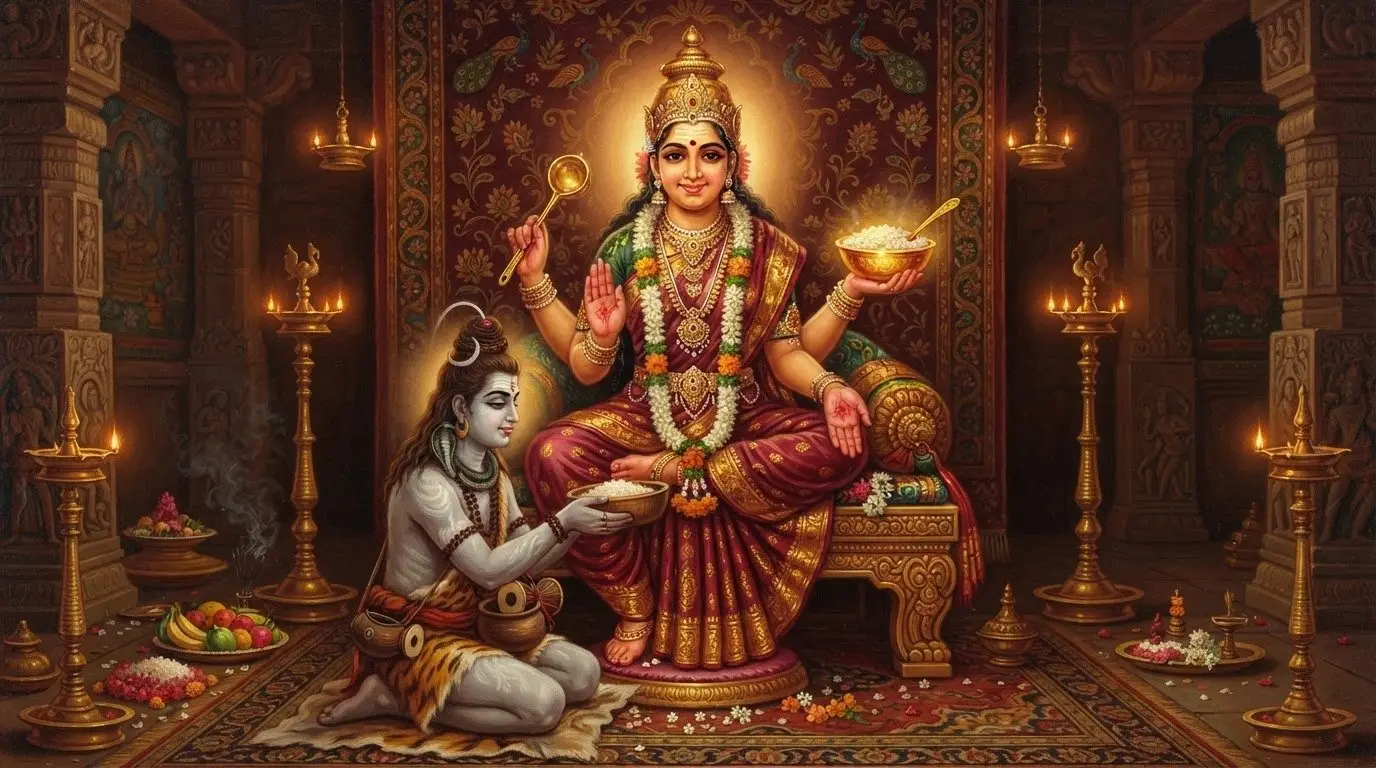
| Iconography | Blue-hued, seated amid produce, sheaves in her hands | Golden, ladle in hand, serving Shiva himself |
| Scripture | Devi Mahatmya 11.49-50 and the Murti Rahasya | Kashi tradition; the Annapurna Stotram of Shankaracharya |
| Season | Shakambhari Navratri, Paush month (January) | Annakut, in Diwali week - 10 November 2026 |
The Drought and the Body That Fed the World
The story, kept in the Durga Saptashati’s appendices and told at her temples: rain withheld itself for a century. Rivers thinned, seed died in the ground, and the rishis prayed to the Mother of the universe. She appeared bearing a hundred eyes - Shatakshi, "the hundred-eyed", for she wept a hundred streams looking on the world’s hunger - and from her own body brought forth every growing thing until the rains returned. No battle, no demon: the enemy was famine, and the weapon was nourishment.
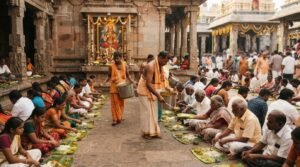
Devotees read in this the Goddess’s widest teaching: annadana, the gift of food, is the one offering that can never be wrong. Feeding another person is her worship performed in her own currency.
Where India Keeps the Nourishing Avatar
Saharanpur, Uttar Pradesh: the Shivalik seat
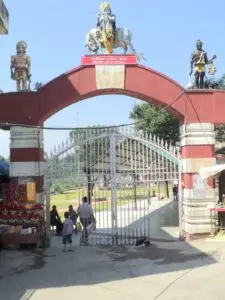
The Shakambhari Devi temple in the Shivalik foothills near Saharanpur is held to be the site of the drought-ending descent, and the surrounding region still carries her name in its geography. Her mela in Paush draws pilgrims from across western UP, Haryana and Uttarakhand.
Sakray, Rajasthan: the merchants’ mother
In the Sikar district of Shekhawati, Shakambhari Mata at Sakray is the kuldevi of many trading families - the goddess of provisions honoured by those whose livelihood is provisioning. The Shekhawati frescoes around her testify to centuries of gratitude in paint.
Badami, Karnataka: Banashankari
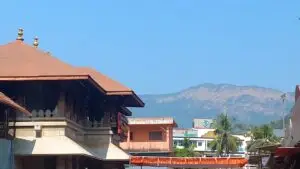
South of the Chalukyan caves at Badami sits Banashankari - Shakambhari under her Kannada name, "the forest Shankari". Her Banashankari jatre in Paush is one of north Karnataka’s great fairs, and Bengaluru’s Banashankari neighbourhood carries her name across the state today. The Kannada devotional calendar keeps her feast beside its Lakshmi vratas.
Varanasi: Annapurna of Kashi
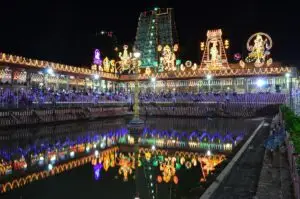
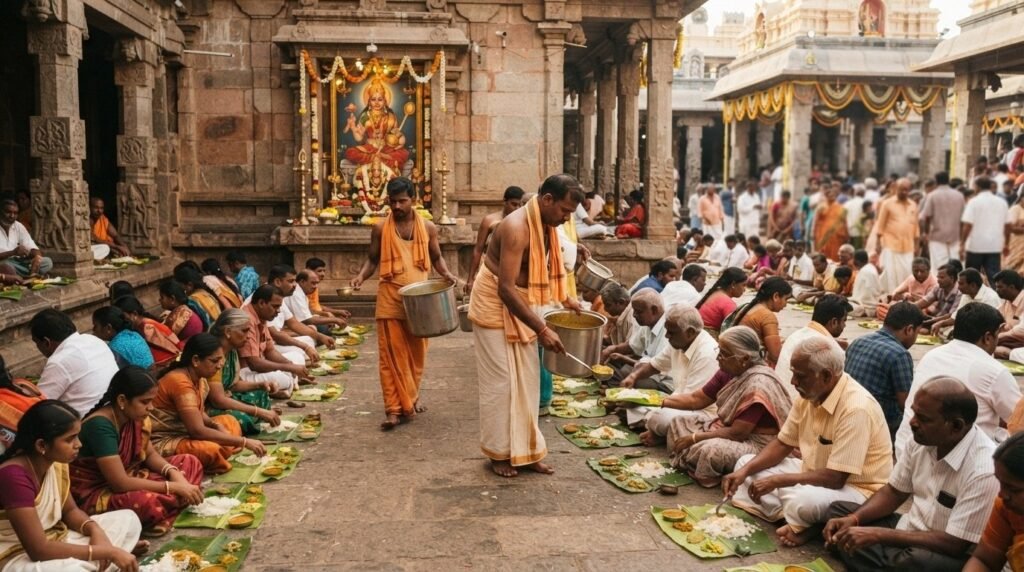
In Kashi’s telling, Shiva declared the world illusion; Parvati, to show what "illusion" eats, withdrew as food itself. When hunger taught its lesson, she reopened her kitchen in Kashi as Annapurna, and Shiva himself held out the bowl. Her temple stands beside Kashi Vishwanath, and on Annakut day her image is decked with a mountain of food that then feeds thousands - the goddess’s own economics. Our full guide: Goddess Annapurna.
Bringing the Avatar Home
- Before meals: the simplest Annapurna practice is a moment’s pause - "Om Annapurnayai Namah" - before the first bite.
- Annadana: feed someone on Fridays or on Annakut (10 November 2026) - a tiffin given, a meal sponsored at a temple kitchen, grain to a gaushala.
- Shakambhari Navratri: in Paush (January), her devotees offer only fruits and vegetables on her altar - the harvest returned to its source.
- Waste as the opposite of worship: in every one of her temples the same rule is taught - food thrown away is her gift refused.
Frequently Asked Questions
Who is Goddess Shakambhari?
A form the Devi herself promises in the Devi Mahatmya: when a hundred-year drought starves the world, she will sustain it with vegetables born of her own body. Her major seats are Saharanpur (UP), Sakray (Rajasthan) and Badami (Karnataka, as Banashankari).
Are Shakambhari and Annapurna the same?
They are two nourishing forms of the one Devi with different causes: Shakambhari answers famine with growing things; Annapurna answers Kashi’s hunger with the cooked meal. Together they consecrate the whole journey from field to plate.
When is Shakambhari Navratri?
In the month of Paush, ending on Paush Purnima in January. Unlike the autumn Navratri it is kept mainly at her own temples, with offerings of fruit and vegetables.
What is Annakut?
"The mountain of food" - 10 November 2026, the panchang’s Annakut day in Diwali week, when temples pile the year’s gratitude before the deity and then distribute all of it as prasad.
What is the best offering to these forms?
Feeding someone. The tradition is unanimous that annadana - the gift of food - is their worship in its purest form.
Official Sources
- Karnataka Tourism - the state’s official portal, including the Badami-Banashankari circuit
- Uttar Pradesh Tourism - official portal for the Saharanpur and Varanasi circuits
- Utsav - Ministry of Tourism, Government of India - official festival listings
Continue Your Journey
- Goddess Annapurna: The Complete Guide
- Diwali Lakshmi Puja Vidhi
- Mahishasura Mardini and Durga Puja 2026
- The Forms of Kali: Avatars Born for a Cause
May your table never empty, and may something from it always reach another’s.