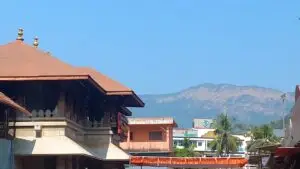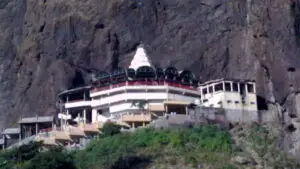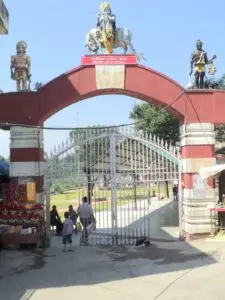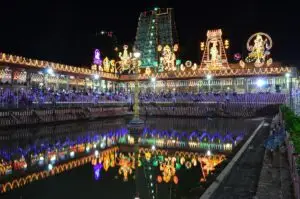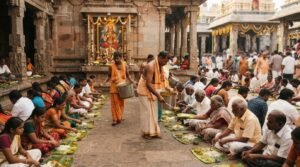
Deep in the forested folds of the Nallamala hills in Andhra Pradesh, on the southern bank of the river Krishna, stands a temple complex unlike any other in India. At Srisailam, the goddess Bhramaramba shares her sanctum precincts with Mallikarjuna, one of the twelve Jyotirlingas of Shiva - making this the only site in the country where a Maha Shakti Peetha and a Jyotirlinga exist side by side within the same temple campus. For a tradition that generally keeps its great pilgrimage networks distinct, Shakta sites in one list and Shaiva sites in another, Srisailam is the single striking exception, a place where both currents of devotion converge at one gate.
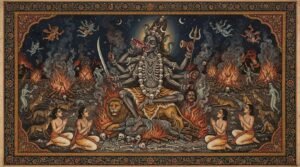
Bhramaramba's own story is as distinctive as her temple's geography. She is not remembered here chiefly through calm iconography or a gentle legend, but through an extraordinary act of transformation: to destroy a demon who could not be slain by any two-legged or four-legged being, the goddess became countless six-legged bees, swarming and stinging him into destruction, and so earned the name that has clung to this shrine ever since - Bhramaramba, "Mother of the Bees." This guide traces that legend, the temple's status as one of the eighteen Maha Shakti Peethas, its deep connection to the Sri Vidya and Sri Chakra tradition of tantric worship, its ties to Adi Shankaracharya, its festivals and timings, and the practicalities of reaching this remarkable temple in the Nallamala forest.
Readers wishing to place this temple within the wider map of Shakti worship across India will find useful background in our guide to the 51 Shakti Peethas, and those drawn to the tantric and Sri Vidya dimension of goddess worship explored later in this piece may also enjoy our companion guide to Maa Tripura Sundari and the Sri Vidya tradition.
Who Is Bhramaramba Devi?
Bhramaramba - also called Bhramarambika, Sri Sundari, or simply Ammavaru by local devotees - is worshipped at Srisailam as the consort of Mallikarjuna Swamy, understood here as a form of Parvati beside her husband Shiva in his Jyotirlinga manifestation. Her name derives from the Sanskrit bhramara, meaning bee, joined with amba, mother - "the Mother of Bees" or "the Bee Goddess," a title earned through the central legend of her worship, discussed in detail below.
Unlike goddesses primarily approached through gentle, nurturing imagery, Bhramaramba's identity is built around an act of ferocious, transformative power exercised in defence of the cosmos, placing her firmly within the wider tradition of warrior-goddess forms such as Durga and Chamunda. At the same time, she is deeply associated with the more refined, contemplative current of Sri Vidya worship centred on the Sri Chakra, discussed later in this guide - a duality of fierce protector and serene, cosmic Mother that recurs throughout Shakta theology and is treated at length in our guide to Kali, Durga and Parvati as forms of Shakti.
Local devotees frequently refer to her simply as Ammavaru - "the Mother" - reflecting an intimacy of address that sits alongside the grandeur of her Shakti Peetha status. Pilgrims visiting Srisailam typically complete darshan of both Mallikarjuna and Bhramaramba as a single, unified visit, since both deities are considered inseparable expressions of the one site's sanctity, and temple protocol at Srisailam is built around honouring both together rather than treating either as primary.
The Legend of Bhramari and the Demon Arunasura
The story that gives Bhramaramba her name is told, with some regional variation, across Puranic and later devotional literature associated with Srisailam. A demon named Arunasura, tradition relates, performed severe austerities directed at Brahma, the creator, and was granted in return a boon of near-invulnerability: he could not be killed by any being with two legs or four legs - a formula clearly modelled on the more famous boon of invulnerability granted to Mahishasura, whom Durga alone was able to defeat precisely because his own boon had overlooked certain possibilities.
Emboldened by this apparent immunity, Arunasura began to terrorise both gods and sages, disrupting yagnas (sacrificial rites) and oppressing the three worlds, until the assembled deities appealed to the Divine Mother for deliverance. Understanding that Arunasura's boon left one narrow gap - he had said nothing of beings with six legs - the goddess resolved to exploit precisely that oversight. She transformed herself, or more precisely projected from herself, an immense swarm of bees, and in this form as Bhramari, the bee-goddess, she and her countless bee-manifestations descended upon Arunasura and stung him to death, his boon rendered useless against a form of attack its wording had never anticipated.
Having accomplished this deliverance, the goddess was honoured and worshipped at Srisailam under the name that commemorated her victory: Bhramaramba, the Mother who became bees. Regional tellings vary somewhat in their emphasis and detail - some accounts describe her assuming a single terrifying bee-like form herself rather than commanding a swarm, and some place greater weight on Brahma's role in granting and later regretting the boon - but the core narrative, of invulnerability defeated through a deliberately overlooked loophole and an army of bees, remains constant across virtually every version told at the temple itself. Devotees are advised that, as with many Puranic narratives, learning the fuller textual variations and their theological significance is best pursued under the guidance of a knowledgeable priest or scholar at the temple, where oral tradition often preserves details not found in any single written source.
The bee motif is far from a decorative detail. Devotees and temple literature alike note that a low humming sound, likened to the drone of bees, is sometimes reported by pilgrims near the sanctum, understood locally as a living trace of the goddess's bee-form still resonant at the site of her ancient victory - an experiential detail that adds a distinctive, almost sensory dimension to darshan here that few other Shakti Peethas offer.
A Shakti Peetha and Jyotirlinga in One Sanctum
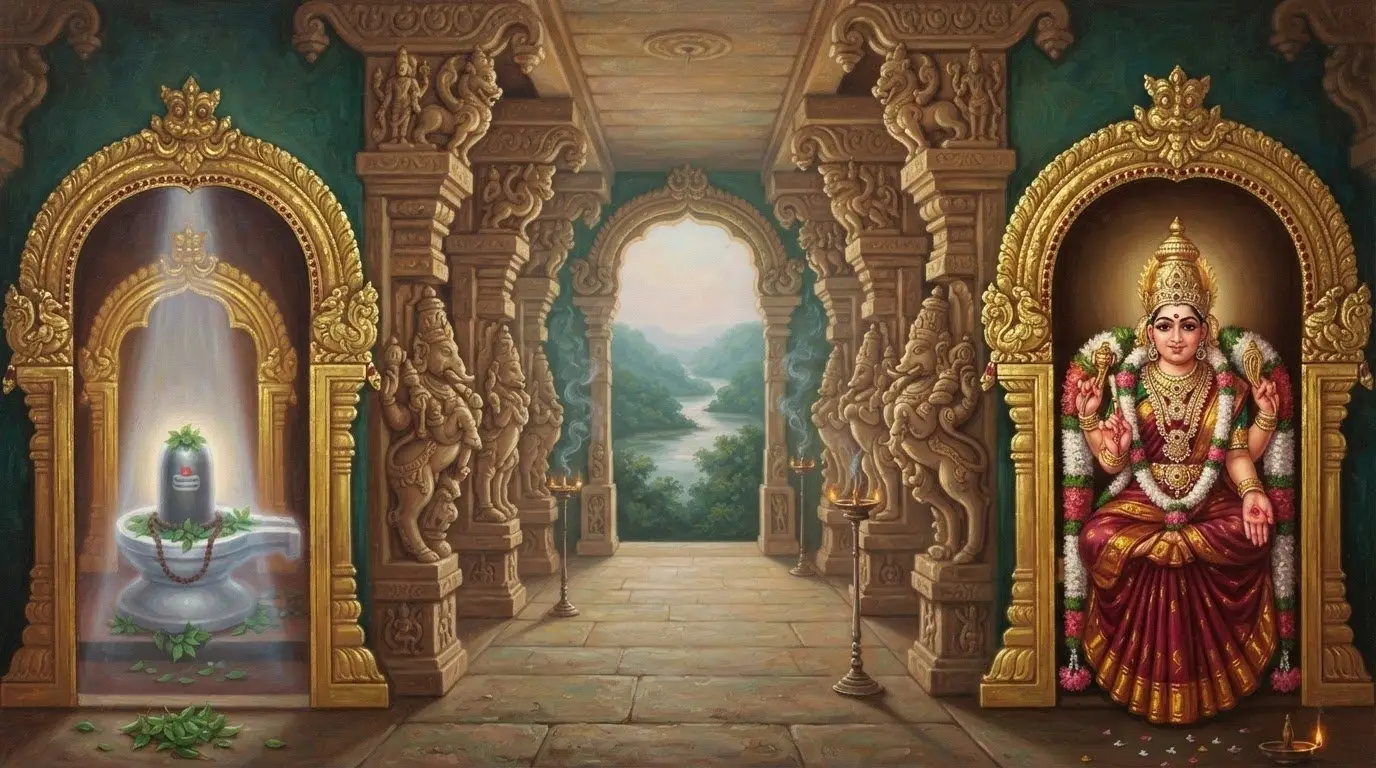
Srisailam's most extraordinary distinction is structural rather than mythological: it is the only site among the major Shiva and Devi pilgrimage networks of India where a Jyotirlinga and a Maha Shakti Peetha coexist within a single temple campus, worshipped side by side rather than at separate, distant locations. Mallikarjuna Swamy, enshrined here, is counted as the second of the twelve Jyotirlingas - the sites where Shiva is believed to have manifested as a self-luminous column of light - while Bhramaramba, in her own adjoining shrine within the same complex, is counted among the eighteen Ashtadasha Maha Shakti Peethas, the principal subset of the wider fifty-one Shakti Peethas considered especially significant.
According to the Shakti Peetha tradition, it is Sati's neck (kantha) that is believed to have fallen at this site, sanctifying the ground on which the temple now stands. The presiding Bhairava associated with this Peetha is named in traditional sources as Sundarananda, a form of Shiva who, notably, is here already present at the same site in his even more central form as Mallikarjuna - a rare instance where the Shakti Peetha's guardian Bhairava and the site's principal Jyotirlinga deity are understood as one and the same presence, reinforcing just how tightly interwoven Shaiva and Shakta worship become at Srisailam. Readers wishing to understand the broader Shakti Peetha framework within which this fits will find it detailed in our guide to the 51 Shakti Peethas and in our account of the Sati Devi and Daksha Yagna story that gives rise to every Peetha in the network.
This dual sanctity is affirmed in scriptural sources beyond oral tradition. The site's status as a Shakti Peetha is recorded in the Devi Bhagavata Purana and the Skanda Purana, and it appears explicitly in the Ashtadasha Shakti Peetha Stotram attributed to Adi Shankaracharya, a Sanskrit hymn enumerating the eighteen principal Shakti Peethas, which names this site directly: "Sri Saile Bhramarambika" - "at Sri Saila (Srisailam), Bhramarambika." Its inclusion in a hymn attributed to one of Hindu philosophy's most consequential figures situates Srisailam firmly within the classical, textually attested core of Shakti Peetha tradition, rather than among sites recognised only through later regional custom.
The Sri Chakra and the Sri Vidya Tradition at Srisailam
Beyond her role as the bee-goddess and Shakti Peetha deity, Bhramaramba occupies an important place within Sri Vidya, the tantric tradition of goddess worship centred on Tripura Sundari and structured around the geometric diagram known as the Sri Chakra or Sri Yantra - nine interlocking triangles representing the union of Shiva and Shakti and the unfolding of the cosmos from a single point (bindu) at the diagram's centre. A Sri Yantra is installed before the garbhagriha (inner sanctum) of the Bhramaramba shrine at Srisailam, a detail that formally marks this temple as a significant site within the Sri Vidya lineage rather than a purely regional or purely mythological shrine.
This tantric dimension connects Srisailam to a broader current of goddess philosophy in which the Devi is approached not merely through narrative and iconography but through structured meditative and ritual disciplines - a tradition our guide to Maa Tripura Sundari explores at length, and one closely bound up with the practice of reciting the Lalita Sahasranamam, the thousand names of the Divine Mother in her Sri Vidya form, which many devotees consider a natural companion practice for pilgrims visiting Sri Vidya-associated sites such as this one.
Adi Shankaracharya's association with Srisailam runs deeper than his authorship of the Ashtadasha Shakti Peetha Stotram alone. Tradition holds that the great philosopher-saint visited Srisailam during his travels establishing and consolidating Shakta and Shaiva worship across the subcontinent, and is widely credited with composing the Shivananda Lahari, a devotional hymn to Shiva, at or near this very site - traditionally said to have been written as an act of spontaneous devotion during his stay here, though as with much of Shankaracharya's traditional biography, precise historical details are transmitted through lineage and devotional memory rather than independently dated documentary record. What can be said with confidence is that Srisailam occupies an important place in the traditional account of Shankaracharya's pan-Indian pilgrimage and consolidation of temple worship, and this association continues to shape how the site is understood by scholars and devotees of the Advaita and Sri Vidya traditions alike.
Architecture and the Nallamala Hills Setting
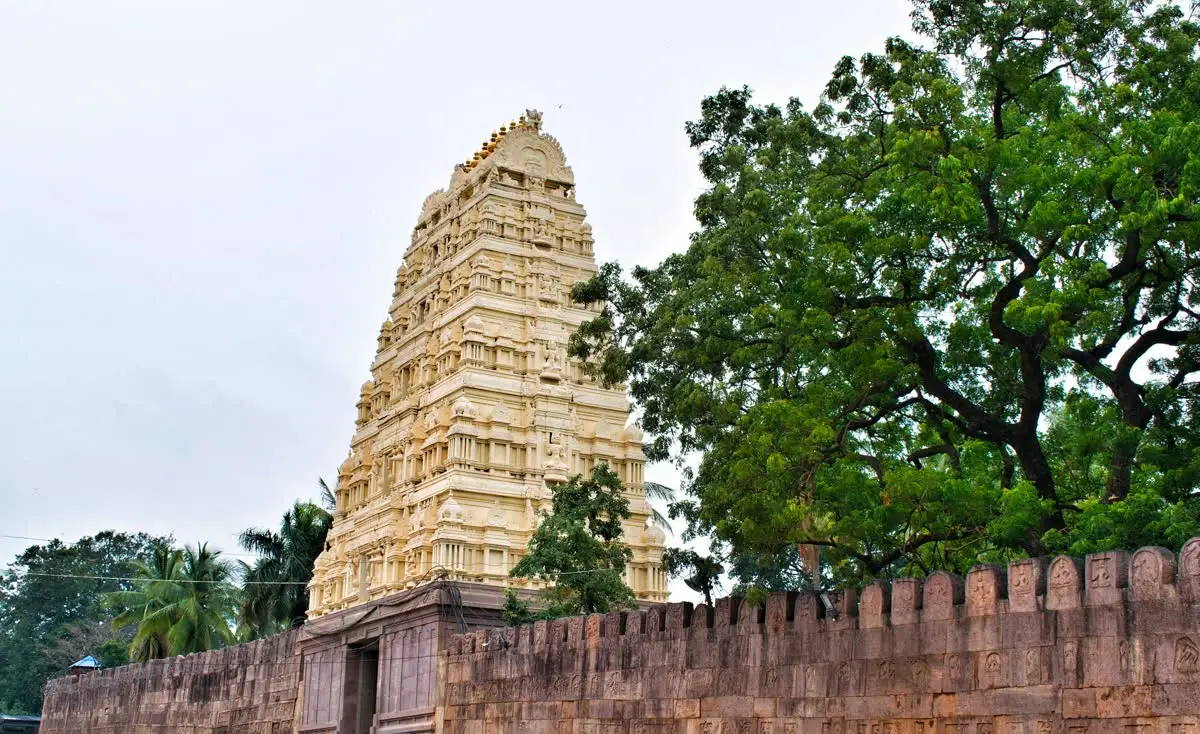
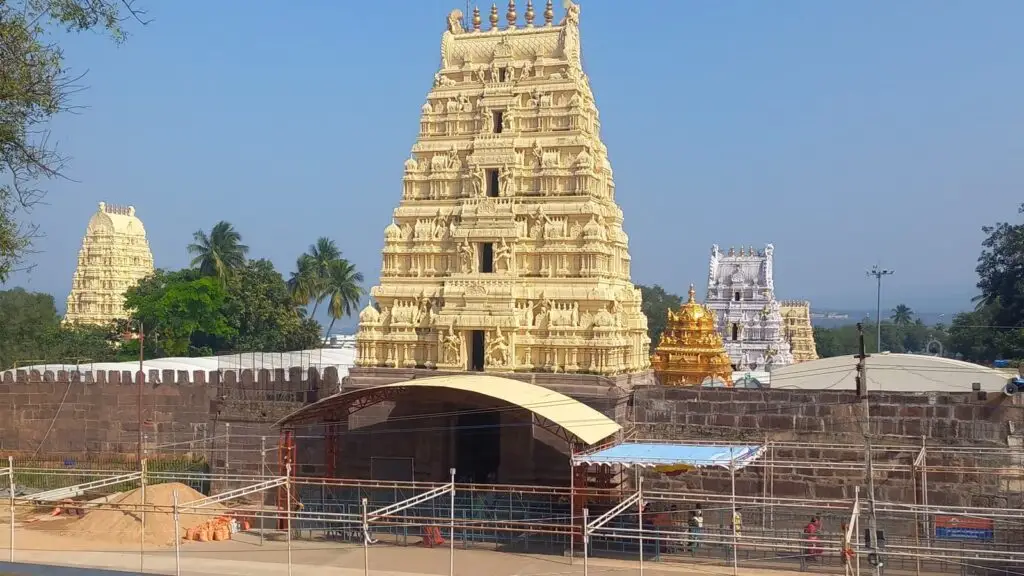
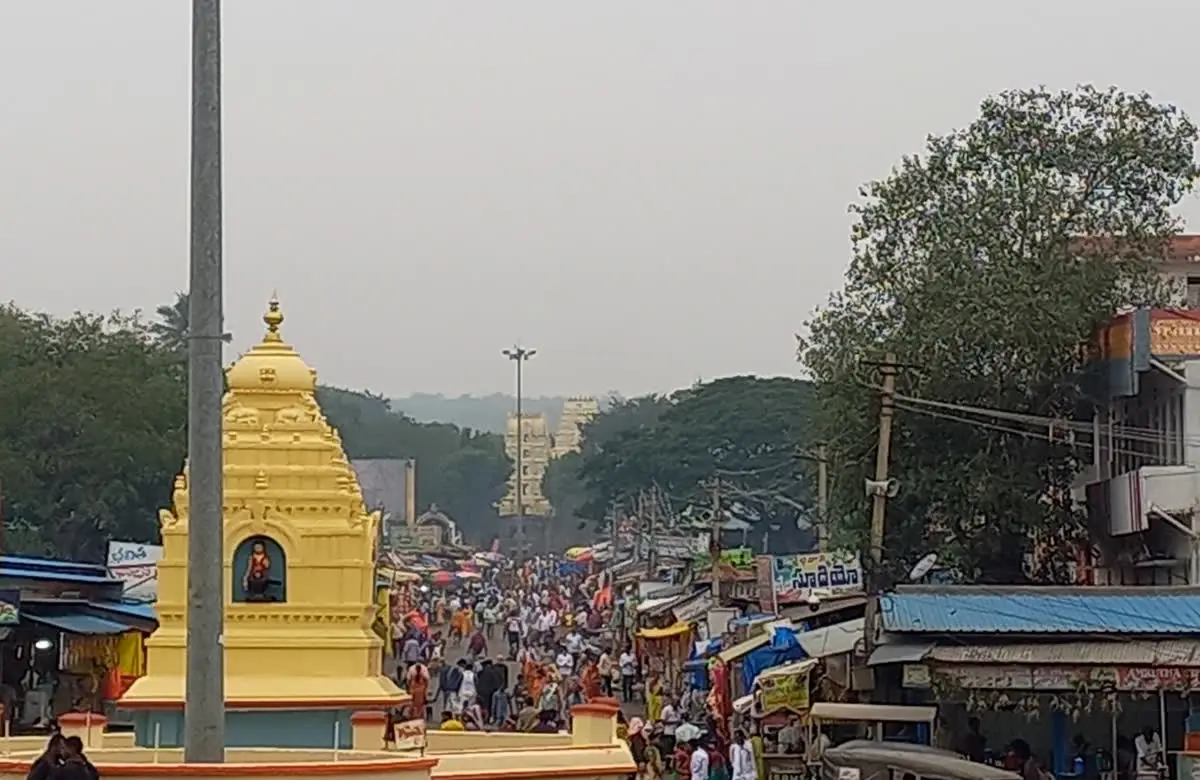
The Srisailam temple complex is enclosed within a substantial fortified wall, a feature that reflects both its historical importance as a site of royal patronage - successive dynasties including the Kakatiyas, the Reddy kings, and the Vijayanagara emperors contributed to its construction and endowment - and the practical need, in earlier centuries, to protect an immensely wealthy shrine deep within forested and at times contested hill country. The main gopuram (gateway tower) and the sculpted panels along the outer walls, depicting a range of Puranic scenes, are considered notable examples of mediaeval Deccan temple art, showing the layered contributions of successive ruling dynasties across several centuries.
Bhramaramba's own shrine sits within this larger complex, structurally close to but distinct from the Mallikarjuna sanctum, with pilgrims typically moving between the two as part of a single continuous darshan circuit. The goddess is represented here in a fully iconographic, richly ornamented form rather than as an aniconic pindi, reflecting Srisailam's somewhat different sculptural tradition compared with several of the northern Shakti Peethas.
The wider setting is as significant as the architecture itself. Srisailam lies within the Nallamala hills, a forested range that is also home to the Nagarjunasagar-Srisailam Tiger Reserve, one of India's largest protected tiger habitats, and the temple town sits on the southern bank of the Krishna river at a point where the river cuts a dramatic gorge through the hills, later dammed downstream to form the Srisailam reservoir. This combination of deep forest, river gorge and ancient temple gives Srisailam an atmosphere markedly different from the temple towns of the plains - pilgrims frequently describe the approach through winding forest roads, with the temple's gopuram appearing suddenly out of dense tree cover, as a memorable part of the pilgrimage itself.
Festivals at Srisailam
The temple's festival calendar reflects its dual Shaiva-Shakta character, with major observances honouring both Mallikarjuna and Bhramaramba, often on the same days or within the same broader festival window.
Maha Shivaratri is among the most significant occasions at Srisailam, drawing very large crowds who undertake darshan of Mallikarjuna alongside Bhramaramba, often after arduous overnight travel through the surrounding hills. Navratri, particularly the autumn Sharad Navratri, is celebrated with special prominence for Bhramaramba herself, with elaborate daily alankaram (goddess adornment) in different forms across the nine nights, a practice familiar to devotees of other major Devi temples across South India. The Srisailam Kumbh Mela / Rathotsavam period, associated with a major chariot festival and periodic large-scale gathering, also draws substantial pilgrim traffic, particularly in years when it coincides with especially auspicious astrological configurations, though the exact periodicity and scale of these larger gatherings should be confirmed for the specific year of travel with the Srisaila Devasthanam (temple trust).
| Occasion | Approximate Timing | Notable Observance |
|---|---|---|
| Maha Shivaratri | February-March | Very large crowds; combined darshan of Mallikarjuna and Bhramaramba |
| Sharad Navratri | September-October | Nine nights of elaborate alankaram for Bhramaramba Devi |
| Ugadi and regional New Year observances | March-April | Special pujas marking the Telugu new year |
| Chariot festival (Rathotsavam) period | Varies by year | Large processional festival; dates set by temple almanac |
As with all major festival dates in the Hindu lunisolar calendar, pilgrims should verify the specific dates for their year of travel directly with the Srisaila Devasthanam, since timings and the scale of celebration can vary considerably from year to year.
Darshan and Aarti Timings
Srisailam's temple complex maintains long daily hours to accommodate the considerable distances many pilgrims travel to reach this remote hill shrine. Typical timings reported by the Srisaila Devasthanam are given below, though these should always be confirmed close to the date of travel, since they are subject to periodic revision and to special arrangements during major festivals.
| Aspect | Typical Timing |
|---|---|
| General darshan hours | Approximately 6:00 AM to 10:00 PM, daily |
| Morning aarti / abhishekam | Early morning, generally before general darshan opens to the public |
| Evening aarti | Typically in the early evening hours |
| Special darshan queues | Often available for an additional fee during peak season and festivals |
Timings, fees and travel details checked against official sources in October 2026 are in Plan Your Visit below.
Given the volume of pilgrim traffic, particularly around Maha Shivaratri and Navratri, visitors are strongly advised to check current queue and darshan arrangements with the Srisaila Devasthanam's official channels shortly before travel.
How to Reach Bhramaramba Devi Temple, Srisailam
Srisailam's location within the Nallamala forest means the journey itself, by any mode, is part of the pilgrimage experience - winding hill roads and, for those arriving by rail, a final stretch by road through reserve forest.
| Mode | Details |
|---|---|
| By Air | The nearest major airport is Rajiv Gandhi International Airport, Hyderabad, roughly 200 km away, connected onward to Srisailam by road, a journey of approximately 5-6 hours via NH44 and NH765. |
| By Train | The nearest railway station is Markapur Road, roughly 85 km from the temple, with connections to Hyderabad, Vijayawada and other major cities; onward travel to Srisailam is by taxi or bus, taking roughly 2-2.5 hours. Nandyal, somewhat further away, is another commonly used rail junction for travellers approaching from the south. |
| By Road | Srisailam is well connected by regular bus services from Hyderabad (around 200 km, 5-6 hours), as well as from Kurnool, Markapur and Nandyal; the drive from Hyderabad passes through scenic ghat sections within the Nallamala forest and is best undertaken in daylight. |
Travellers driving from Hyderabad should note that a section of the route passes through reserve forest with restricted night-time movement in places; checking current road advisories before an overnight or early-morning departure is worthwhile.
Nearby Attractions and Where to Stay
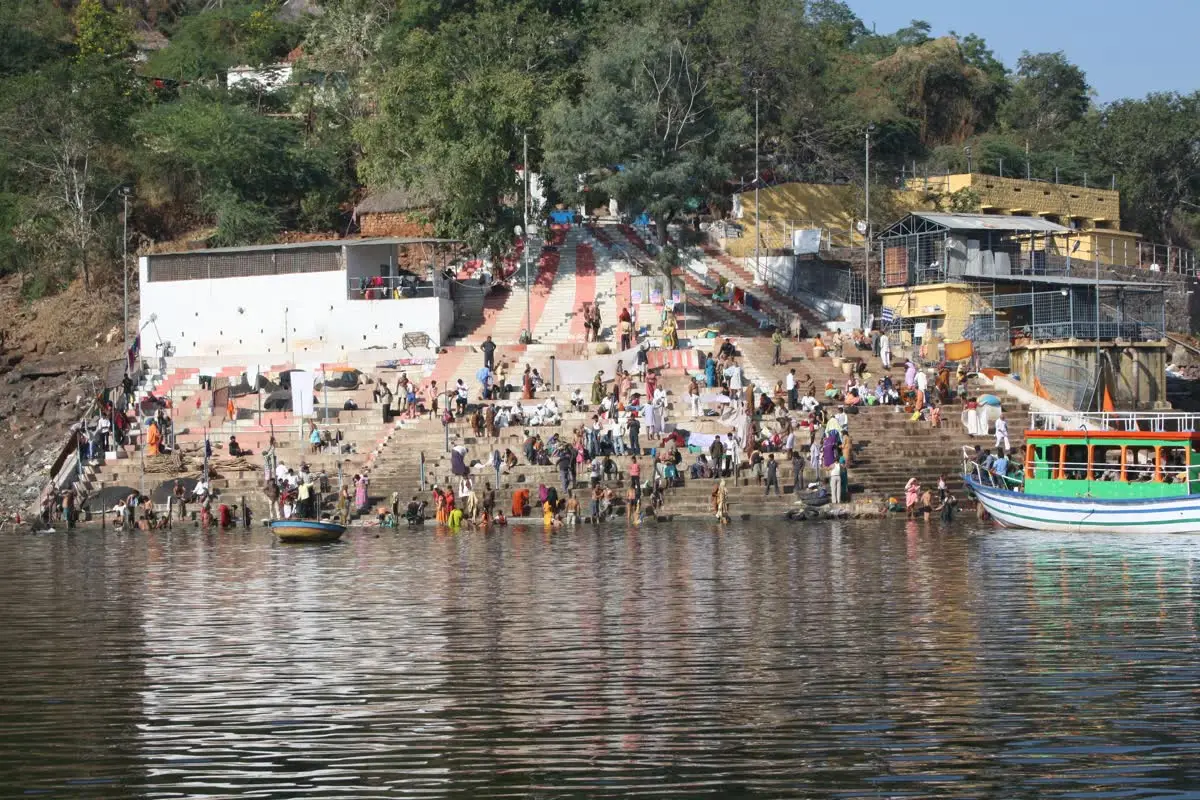
Srisailam offers several notable sites beyond the temple itself. Patala Ganga, a steep flight of steps (and a ropeway alternative) leading down to the Krishna river directly below the temple, is where many pilgrims traditionally bathe before darshan, and the ropeway journey itself offers striking views over the river gorge. The Srisailam Dam, an imposing structure spanning the Krishna river a short distance from the temple town, and the surrounding Nagarjunasagar-Srisailam Tiger Reserve, one of India's largest tiger reserves, both draw visitors extending their stay beyond a single day of darshan. The Akkamahadevi Caves, a set of natural limestone caves associated with a Kannada saint-poetess of the Virashaiva tradition, lie a short distance from the main town and are of particular interest to visitors with time for a longer stay.
Accommodation in Srisailam itself ranges from simple pilgrim guesthouses and dharamshalas run by or affiliated with the Srisaila Devasthanam to a modest number of private hotels catering to tourists, with availability tightening considerably during Maha Shivaratri and Navratri. Given the town's relatively remote hill setting, most pilgrims plan to stay at least one night in Srisailam itself rather than attempting the return journey to Hyderabad or Kurnool on the same day, particularly given the winding forest roads and the desire to attend both morning and evening aarti.
Benefits of Worship and Pilgrimage at Srisailam
Devotees who undertake the pilgrimage to Srisailam often describe it as uniquely complete among Indian temple journeys, precisely because it allows darshan of both a Jyotirlinga and a Maha Shakti Peetha within a single visit - understood by many as fulfilling, in condensed form, aspirations ordinarily requiring separate pilgrimages across different parts of the country. Worship of Bhramaramba in particular is associated locally with the removal of obstacles considered otherwise intractable (echoing her legend of defeating an apparently invulnerable demon through unexpected means), with courage in the face of overwhelming difficulty, and with the blessings of the Sri Vidya tradition for those pursuing more structured meditative practice.
Pilgrims are also drawn by the site's natural setting, which many describe as itself conducive to reflection - a forested hill temple beside a great river gorge offering a markedly different devotional atmosphere from temples set amid dense urban surroundings. Those wishing to deepen a Sri Vidya-oriented practice connected to this site are generally advised to seek guidance from a qualified guru or temple priest, particularly for the more advanced meditative and mantra dimensions of the tradition, since correct initiation and pronunciation are considered essential in this lineage rather than optional refinements.
Plan Your Visit to Srisailam: Timings, Tickets and Travel
The details below were checked on 3 October 2026 against the Srisailam Devasthanam Online and the other sources listed under each table. Timings and fees change on festival days, eclipses and special occasions, so confirm with the temple before you travel.
For what happens here during Navratri 2026 (11 to 19 October), see Navratri 2026 at major Devi temples.
Darshan and Aarti Timings
| Information | Details |
|---|---|
| Darshan begins | Around 6:00 am. Check locally, as timings change on festival days. |
| Sparsha darshan (touching the lingam) | Offered in designated slots, not every day. Since August 2026, Saturday, Sunday and Monday have night slots only. Confirm the day's slots at the temple. |
Sources: TemplesTalk: Srisailam Temple 2026: Darshan Timings, Seeghra Darshan, Sparsha..., Templesinindiainfo: Sparsha darshan Srisailam: timings and price, The Hans India: Srisailam temple revises protocol darshan timings.
Tickets, Darshan Options and Sevas
| Option | Price | Notes |
|---|---|---|
| Paid darshan (Seeghra, Athi Seeghra and sparsha) | Fee shown at the counter | Fees are revised from time to time and are shown at the ticket counters and on the Devasthanam website. Sparsha darshan is restricted in busy periods. |
Free sarva darshan is available daily. Bookings are handled on srisailadevasthanam.org. Tickets and sevas can be booked on the Devasthanam website. For VIP and dignitary darshan, inform the temple two days ahead; recommendation letters on letterhead go to the temple's official email or WhatsApp 9160016215 (The Hans India, August 2026). Musinara is not connected with the temple and does not take bookings.
Sources: The Hans India: Srisailam temple revises protocol darshan timings, TemplesTalk: Srisailam Temple 2026: Darshan Timings, Seeghra Darshan, Sparsha..., Templesinindiainfo: Sparsha darshan Srisailam: timings and price, Official site: Srisailam Devasthanam Online.
Temple Rules and Dress Code
- Traditional, modest dress is expected. Avoid shorts and sleeveless outfits. For sparsha darshan the dress code is usually stricter: dhoti or pancha without a shirt for men, saree or churidar with dupatta for women.
- Vehicles are not allowed on the forest road to Srisailam between 9:00 pm and 6:00 am (Nallamala forest, Nagarjunsagar-Srisailam Tiger Reserve). The gates at Mannanur and Domalapenta are closed to all traffic in that window, so plan to cross before 9:00 pm.
Sources: TemplesTalk: Srisailam Temple 2026: Darshan Timings, Seeghra Darshan, Sparsha..., Templesinindiainfo: Sparsha darshan Srisailam: timings and price, MileMarked: Srisailam Ghat Road Guide 2026: Timings, Safety & Costs, Wikipedia: Srisailam.
How to Reach Srisailam
Open Srisailam in Google Maps for live directions.
| Mode | Nearest point | Distance to the temple |
|---|---|---|
| Air | Rajiv Gandhi International Airport, Hyderabad | about 215 km |
| Rail | Markapur Road | about 80 to 87 km |
| Bus | Srisailam bus station (APSRTC) |
Sources: Wikipedia: Srisailam, Wikipedia: Mallikarjuna Temple, Srisailam.
Approximate distances and journey times from the cities most pilgrims start from. Road times assume normal traffic; festival weekends take longer.
| From | By road | Road time | Train or flight |
|---|---|---|---|
| Hyderabad | about 215 to 230 km | 4.5 to 6 hours; cross the forest gates before 9:00 pm | Hyderabad airport is about 215 km away |
| Kurnool | about 180 km | ||
| Vijayawada | about 264 km |
Sources: MileMarked: Srisailam Ghat Road Guide 2026: Timings, Safety & Costs, Wikipedia: Srisailam, Wikipedia: Mallikarjuna Temple, Srisailam.
APSRTC buses connect Srisailam with nearby towns. There are two main road entries: via Dornala and via Atchampet.
Prasadam, Annadanam and Where to Stay
The Devasthanam runs guest accommodation. Requests for rooms with recommendation letters go to the temple's official email or WhatsApp 9160016215 (The Hans India, August 2026).
Source: The Hans India: Srisailam temple revises protocol darshan timings.
Temples and Places Near Srisailam
- Patala Ganga: Access point to the Krishna river, reached by about 852 steps
Source: Wikipedia: Mallikarjuna Temple, Srisailam.
Frequently Asked Questions
What makes the Bhramaramba Devi Temple unique among Indian pilgrimage sites?
It is the only site in India where a Maha Shakti Peetha and a Jyotirlinga are enshrined together within a single temple campus - Bhramaramba Devi alongside Mallikarjuna Swamy, the second of the twelve Jyotirlingas of Shiva.
Why is the goddess here called Bhramaramba, or the "bee goddess"?
According to temple legend, the demon Arunasura had received a boon that he could not be killed by any two-legged or four-legged being. The goddess exploited this narrow loophole by transforming into countless six-legged bees (or manifesting as Bhramari, the bee-form of the Devi) and destroying him, earning the name Bhramaramba - "Mother of the Bees."
Which body part of Sati is associated with this Shakti Peetha?
Tradition holds that Sati's neck (kantha) fell at Srisailam, making it one of the eighteen principal Ashtadasha Maha Shakti Peethas. The site's Bhairava is named Sundarananda in traditional sources, closely identified here with Mallikarjuna himself.
What is the connection between this temple and Adi Shankaracharya?
Adi Shankaracharya's Ashtadasha Shakti Peetha Stotram names Srisailam explicitly ("Sri Saile Bhramarambika"), and tradition holds that he visited the site and composed the Shivananda Lahari, a devotional hymn to Shiva, during his time there, though as with much of his traditional biography this is transmitted primarily through devotional and lineage memory.
What is the Sri Chakra's significance at this temple?
A Sri Yantra, the geometric diagram central to Sri Vidya tantric worship, is installed before the inner sanctum of the Bhramaramba shrine, marking Srisailam as a significant site within the Sri Vidya tradition centred on the goddess Tripura Sundari, alongside its identity as a Shakti Peetha and Jyotirlinga site.
How do I reach Srisailam from Hyderabad?
The most common route is by road, roughly 200 km and 5-6 hours via NH44 and NH765, either by private car or by regular bus services. There is no direct rail line to Srisailam itself; travellers arriving by train typically use Markapur Road or Nandyal station and continue by road.
What are the typical darshan timings at the temple?
General darshan is typically available from around 6:00 AM to 10:00 PM daily, with morning abhishekam and aarti earlier and an evening aarti later in the day, though pilgrims should confirm current timings with the Srisaila Devasthanam before travel, especially around major festivals.
Is Srisailam associated with wildlife or forest attractions as well as the temple?
Yes - the temple town lies within the Nallamala hills, home to the Nagarjunasagar-Srisailam Tiger Reserve, one of India's largest tiger reserves, and pilgrims often combine temple darshan with a visit to Patala Ganga, the Krishna river gorge, and the Srisailam dam.
When is the best time to visit for festivals?
Maha Shivaratri (typically February-March) and Sharad Navratri (typically September-October) are considered the two most significant festival periods, drawing the largest crowds and the most elaborate ritual observance for both Mallikarjuna and Bhramaramba.
Should I combine this visit with other Shakti or Sri Vidya sites?
Many devotees pursuing a deeper Sri Vidya practice choose to pair a Srisailam pilgrimage with study of the Lalita Sahasranamam and the broader Tripura Sundari tradition, which share the same tantric framework centred on the Sri Chakra, even though the temples themselves are geographically distant.
For further reading on the temple's place within India's broader Shakti Peetha network, see the Wikipedia entry on the Shakti Peetha tradition.
To walk the corridor between the Jyotirlinga and the bee-goddess's sanctum at Srisailam is to witness, in stone and incense and the low hum devotees still speak of, how completely the Shaiva and Shakta streams of worship can converge in a single sacred ground. If Bhramaramba's story of quiet, unexpected power has moved you, Musinara's channel offers 432 Hz recordings of Devi mantras and stotras for reflective listening - we invite you to listen on YouTube and carry something of Srisailam's forested stillness into your own practice.
Related reading
- Brajeshwari Devi Temple, Kangra: The Complete Shakti Peetha Guide
- Naina Devi Temple: A Complete Guide to the Shakti Peetha of Bilaspur
- Mansa Devi & Chandi Devi: The Hilltop Goddesses of Haridwar (with Maya Devi Shakti Peetha)
- Ambaji Temple: The Shakti Peetha Where the Heart of Sati Fell (Gujarat)
For the household festival of these nine nights in Telangana, see బతుకమ్మ ౨౦౨౬, written in Telugu.
Official and Reference Sources
- Srisaila Devasthanam, official - the devasthanam on the Andhra Pradesh Endowments platform
Planning a pilgrimage? All twenty Devi temple guides on this site are arranged by region, with practical circuits, in Devi Temples of India. For where each site sits in the disputed lists of 51, 52 and 108, see the Shakti Peeth list.