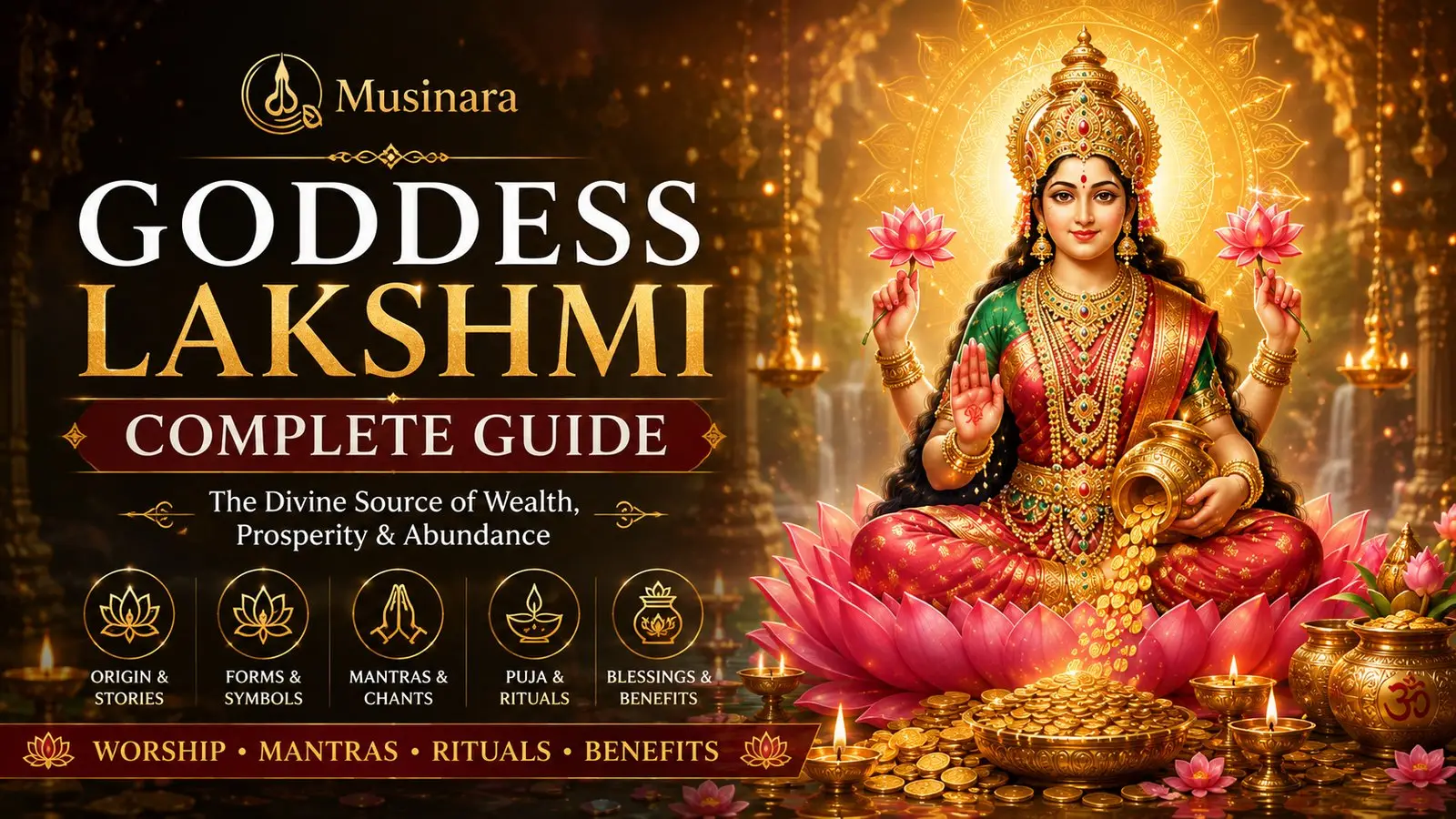
There is a reason the image of Goddess Lakshmi - seated on a full-bloomed lotus, gold coins spilling gently from her open palm - appears in shops, homes, temples and wallets across the Indian subcontinent and far beyond it. She is not merely a bestower of money, though that popular shorthand has its place. She is Sri, the very quality of auspiciousness, radiance and flourishing that Sanskrit tradition recognises as inseparable from Vishnu, the preserver of the cosmos. Where Vishnu sustains order, Lakshmi is the grace that makes that order beautiful, abundant and worth sustaining.
For the householder lighting a diya at dusk, for the merchant opening new account books on Diwali morning, and for the seeker chanting her beej mantra in a quiet room before dawn, Lakshmi occupies a singular place in Hindu devotional life. She is approached daily and without embarrassment - there is no shame in asking her for prosperity, because in her theology, prosperity rightly earned and rightly shared is itself a form of dharma. This guide walks through her origin in the churning of the cosmic ocean, her iconography and many forms, her principal mantras with Devanagari and meaning, and the practical, time-tested ways devotees have worshipped her for centuries.
Who Is Goddess Lakshmi?
Lakshmi - also called Sri, Sri Devi, or Mahalakshmi - is the Hindu goddess of wealth, fortune, beauty, fertility and auspiciousness. She is the eternal consort of Vishnu, and in the Vaishnava tradition the two are considered inseparable, much as speech is inseparable from meaning. Wherever Vishnu descends as an avatar to restore dharma, Lakshmi is understood to accompany him in a corresponding form: as Sita beside Rama, as Rukmini and Radha beside Krishna, as Padmavati beside Venkateswara at Tirupati. This pattern is not incidental. It expresses a central theological idea - that material and worldly flourishing (Lakshmi) is never separate from righteous order and protection (Vishnu). One does not exist meaningfully without the other.
The name Lakshmi is thought to derive from the Sanskrit root lakṣ, meaning "to perceive" or "to observe," and is connected to lakṣya, meaning "goal" or "aim." She is, in this reading, the one who perceives merit and directs fortune toward it. She is also called Sri, a word that in the Rig Veda already carries connotations of splendour, radiance and royal glory well before the fully personified goddess of the Puranas emerges. Some of the earliest textual seeds of her worship appear in the Sri Sukta, a hymn appended to the Rig Veda, which invokes Sri-Lakshmi as golden, lotus-coloured, and seated upon a lotus - imagery that has remained remarkably stable for roughly three thousand years.
Unlike some goddesses whose worship is confined to particular regions or particular sectarian communities, Lakshmi is worshipped almost universally across Hindu households, regardless of which primary deity a family favours. A Shiva devotee, a Vishnu devotee, and a Shakta devoted to the Devi will each, in their own way, still light a lamp for Lakshmi at Diwali. This makes her, in practice, one of the most continuously and widely worshipped figures in the entire Hindu pantheon - a goddess of the home altar as much as the temple sanctum.
Readers who wish to understand Lakshmi's place among the broader constellation of Devi worship, particularly her more esoteric or tantric dimension, may find it useful to also read our guide to Maa Kamala, the tenth of the Mahavidyas, who is understood by many traditions to be a tantric form of Lakshmi herself.
Iconography: Reading the Symbols of the Goddess
Lakshmi's classical form is instantly recognisable, yet every element of it carries deliberate meaning. She is most commonly depicted with four arms, though two-armed forms are also common in simpler temple murtis and household images. Her complexion is golden or rose-gold, evoking ripened grain and the glow of prosperity. She is seated or standing upon a fully opened lotus, and often two, four, or eight elephants flank her, trunks raised, pouring water from golden vessels over her head and shoulders.
The Four Hands and What They Hold
Each of Lakshmi's four hands carries a specific symbolic burden, and understanding them transforms a devotional image from decoration into a teaching.
| Hand | Object Held | Symbolic Meaning |
|---|---|---|
| Upper right | Lotus (padma) in full bloom | Spiritual liberation and purity amid worldly life |
| Lower right | Stream of gold coins | Material wealth flowing generously to sincere effort |
| Upper left | Lotus bud | Potential, the unfolding of future prosperity |
| Lower left | Abhaya mudra (gesture of reassurance) or a pot (kalasha) of gold | Protection and freedom from fear; the vessel of abundance |
The lotus is perhaps the single most important motif in her iconography. It grows from mud yet remains untouched by it, rising toward light on a stalk that passes through murky water without absorbing any of that murkiness. This is understood as an instruction to the devotee: wealth and worldly engagement need not corrupt the soul that holds them rightly. Lakshmi herself is frequently called Padma or Kamala - "the lotus one" - and is shown seated upon it in the padmasana posture, radiating calm rather than agitation, a detail devotees are encouraged to notice and internalise.
Elephants, Colour and Companions
The elephants that flank Lakshmi - known as Gaja Lakshmi imagery when they appear pouring water over her - represent royal power, the monsoon rains upon which agrarian prosperity depended in ancient India, and mental discipline (the elephant being a traditional symbol of a well-trained, powerful mind). Gaja Lakshmi is among the oldest surviving iconographic types in Indian art, found carved on stupas and coins from centuries before the Common Era, which tells us how ancient this particular image of the goddess truly is.
Red and gold dominate her palette almost without exception. Red signifies activity, life-force and auspiciousness (the colour of the kumkum and sindoor used in her worship), while gold signifies purity, illumination and the very wealth she bestows. Her vahana, or vehicle, is most often the owl (uluka), an unusual choice that tradition explains as a lesson in vigilance - the owl sees in darkness what others miss, reminding the devotee that true prosperity requires clear-sightedness even when circumstances are obscure or difficult. In some regional and folk traditions she is instead shown near or accompanied by Kubera, the treasurer of the gods, reinforcing her role as sovereign over material abundance.
The Origin of Lakshmi: Samudra Manthan, the Churning of the Ocean
The most celebrated origin story of Lakshmi appears in the Samudra Manthan, the churning of the cosmic ocean of milk (Kshira Sagara), narrated across the Vishnu Purana, the Bhagavata Purana, and referenced in the Mahabharata. The devas (gods) and asuras (demigods opposed to them) had grown weak, having lost the amrita, the nectar of immortality, through a curse. Seeking to recover strength and the lost nectar, the devas approached Vishnu, who counselled an extraordinary alliance: gods and demons would together churn the ocean of milk to bring forth the treasures hidden within it, amrita among them.
Mount Mandara was used as the churning rod, and Vasuki, the serpent king, agreed to serve as the churning rope, wound around the mountain. Vishnu himself descended as Kurma, the tortoise avatar, to support the mountain's base on his shell as the devas and asuras pulled the serpent from opposite ends, the mountain spinning and grinding against the ocean floor for what the texts describe as centuries of cosmic time. As the churning proceeded, the ocean yielded up a sequence of treasures - Airavata the white elephant, Uchchaihshravas the seven-headed horse, Kaustubha the divine gem, Varuni the goddess of wine, the wish-fulfilling tree Parijata, the divine physician Dhanvantari bearing the pot of amrita, and, radiant among them, Lakshmi herself, rising fully formed from the waters seated upon a lotus.
Her arrival was so luminous that the devas, led by Indra, immediately worshipped her, and she in turn chose Vishnu as her eternal consort, garlanding him before the assembled gods. This moment is understood theologically as significant beyond the drama of the myth: Lakshmi does not emerge as a passive prize to be claimed, but as a sovereign goddess who exercises choice, selecting Vishnu of her own will - a detail devotees often highlight when discussing her independent divine authority rather than a purely subordinate consort role. Some later texts, including portions of the Vishnu Purana, also describe her as the daughter of the sage Bhrigu and his wife Khyati in an earlier incarnation, later reborn from the ocean of milk, reconciling the two lineages found across differing regional tellings.
It is worth noting, in the spirit of intellectual honesty that any serious study of these narratives requires, that the Puranas are not uniform on every detail - some versions differ on the exact order of treasures churned, and Southern and Bengali retellings occasionally emphasise different emotional beats of the story. What remains constant across nearly every version is the central image: Lakshmi rising from the ocean on a lotus, garlanding Vishnu, and being welcomed by the assembled gods as the goddess who would restore auspiciousness to a weakened cosmos.
The Many Forms of Lakshmi
Lakshmi's nature as the goddess of flourishing means she is rarely worshipped as a single undifferentiated figure. Tradition, particularly in South India, recognises eight principal forms of her collectively called the Ashta Lakshmi, each governing a distinct domain of prosperity - wealth, grain, courage, progeny, victory, patience, and knowledge among them. We have written a dedicated, in-depth guide to these eight forms, their individual mantras, and the Ashtalakshmi Stotram at Ashta Lakshmi: The Eight Forms of the Goddess, which is the natural next reading for anyone wishing to go deeper into this aspect of her worship.
Beyond the Ashta Lakshmi framework, several other forms recur across regional and sectarian practice:
- Mahalakshmi - her supreme, unqualified form as the source of all abundance, worshipped independently of Vishnu in many Shakta contexts, and identified in Devi Mahatmya tradition as one of the three central goddess forms alongside Mahakali and Mahasaraswati.
- Gaja Lakshmi - the form flanked by elephants pouring water, emphasising royal fortune and rainfall-linked agricultural prosperity.
- Vaikuntha Lakshmi - seated beside Vishnu in his heavenly abode of Vaikuntha, the form emphasised in most Vaishnava temple sanctums.
- Kamala/Kamalatmika - her tantric form as the tenth Mahavidya, seated on a lotus, worshipped in Shakta and tantric lineages; readers curious about this dimension should see our complete guide to Maa Kamala.
- Bhargavi - Lakshmi as daughter of sage Bhrigu, connecting her to an earlier incarnation preceding the Samudra Manthan episode.
- Padmavati - her form as consort of Venkateswara at Tirupati, one of the most visited pilgrimage temples in the world.
Principal Mantras of Goddess Lakshmi
Mantra practice is considered among the most direct and accessible ways to draw close to Lakshmi's grace, requiring no elaborate ritual apparatus, only sincerity, correct pronunciation and steady repetition. The table below gives her most widely used mantras in Devanagari, transliteration, and plain-language meaning.
| Devanagari | Transliteration | Meaning |
|---|---|---|
| ॐ श्रीं महालक्ष्म्यै नमः | Om Shreem Mahalakshmyai Namah | Salutations to the great goddess Lakshmi, invoking her beej (seed sound) Shreem, the sonic seed of abundance and grace |
| ॐ ह्रीं श्रीं क्लीं महालक्ष्म्यै नमः | Om Hreem Shreem Kleem Mahalakshmyai Namah | A tri-beej form combining the seeds of maya (illusion/power), Sri (abundance) and attraction, used in more elaborate sadhana |
| ॐ महालक्ष्म्यै च विद्महे विष्णुपत्न्यै च धीमहि। तन्नो लक्ष्मीः प्रचोदयात्॥ | Om Mahalakshmyai cha vidmahe Vishnupatnyai cha dhimahi, tanno Lakshmi prachodayat | This is the Lakshmi Gayatri Mantra: "We meditate upon the great goddess Lakshmi, consort of Vishnu; may that Lakshmi illumine and guide our understanding" |
| श्री | Shreem (beej mantra) | The single-syllable seed sound of Lakshmi herself, said to encapsulate her entire energy of abundance, beauty and grace |
| ॐ श्रीं क्लीं महालक्ष्म्यै नमः | Om Shreem Kleem Mahalakshmyai Namah | Combines the Sri beej with Kleem, the beej of attraction and fulfilment, often used for prosperity in business and relationships |
The Shreem beej mantra deserves particular attention, since it recurs across nearly all of Lakshmi's longer mantras and is frequently chanted alone, in malas of 108 repetitions, as a standalone practice. For readers who wish to understand beej mantras more broadly - how they function, why single syllables are considered so potent, and how each goddess is associated with her own seed sounds - our guide to the Beej Mantras of the Goddess is a useful companion to this section.
Beyond these, devotees also recite the Mahalakshmi Ashtakam, an eight-verse hymn of praise traditionally attributed to Indra himself, composed in gratitude after Lakshmi's emergence from the ocean of milk. It is considered one of the most powerful and popularly recited hymns to the goddess, particularly on Fridays and during Diwali. We cover its full text, transliteration and verse-by-verse meaning separately in our Mahalakshmi Ashtakam: Lyrics and Meaning guide.
A note of caution that any responsible teacher would offer: mantra sounds in Sanskrit carry precise vibrational qualities, and incorrect pronunciation, particularly of conjunct consonants and nasalised endings like the anusvara in "Shreem," can shift the intended resonance. Devotees serious about mantra sadhana are always advised to learn correct pronunciation directly from a qualified guru, temple priest, or experienced practitioner rather than relying solely on written transliteration.
Benefits of Worshipping Goddess Lakshmi
Devotees across generations report a range of benefits from sincere, sustained worship of Lakshmi, understood both in material and spiritual terms. It is worth stating plainly, in keeping with the intellectually honest spirit of this guide, that devotional tradition frames these as blessings that accompany sincere effort and right conduct - not substitutes for it. Lakshmi is traditionally understood to favour those who combine devotion with diligence, honesty and generosity, and to withdraw from spaces marked by greed, discord or idleness.
- Financial stability and growth - steady, well-earned prosperity in business, career and household finances.
- Removal of obstacles to abundance - clearing blockages related to debt, stagnant income, or repeated financial setbacks.
- Domestic harmony - Lakshmi is closely associated with a peaceful, well-ordered home, and her worship is traditionally linked to reduced discord between family members.
- Beauty and grace - an inner radiance and dignity of bearing, one of her original Vedic meanings as Sri.
- Fertility and well-being of children - particularly through her Santana Lakshmi aspect, discussed in our Ashta Lakshmi guide.
- Courage and steadiness in adversity - through her Dhairya Lakshmi or Veera Lakshmi aspect, invoked when facing hardship rather than only when seeking gain.
- Spiritual refinement - since her lotus symbolism points beyond material wealth toward an unattached, purified engagement with worldly life.
How to Worship Goddess Lakshmi
Lakshmi worship blends daily, modest household practice with larger, occasion-based ritual. Both are valid, and tradition holds that sincerity matters considerably more than scale.
The Day, the Direction and the Altar
Friday (Shukravara) is considered Lakshmi's day across most regional traditions in India, and many households perform a simple Lakshmi puja every Friday evening, particularly at dusk when the goddess is believed to visit clean, well-lit homes. The devotee typically faces east or north while worshipping, seated on a clean asana, with the image or murti of Lakshmi placed on a raised platform, ideally with Vishnu or Ganesha nearby, since Ganesha is traditionally invoked first to remove obstacles before Lakshmi is welcomed.
Offerings and Method
A traditional Lakshmi puja, whether the brief Friday version or the elaborate Diwali Lakshmi Puja, generally follows this arc:
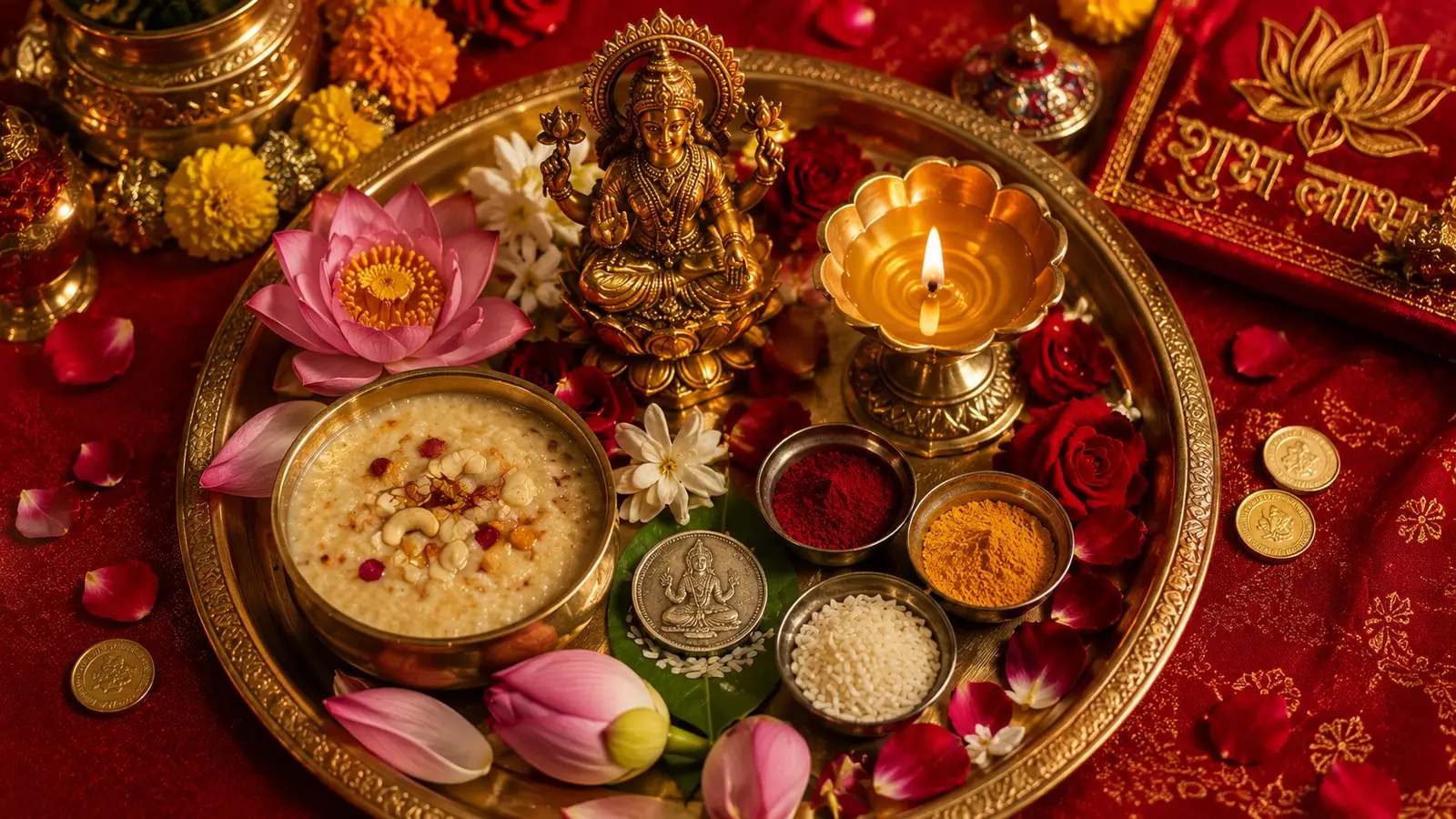
- Cleaning and lighting - the home, and particularly the entrance, is cleaned thoroughly; a diya (oil lamp) is lit, since Lakshmi is said to avoid dark, neglected or untidy spaces.
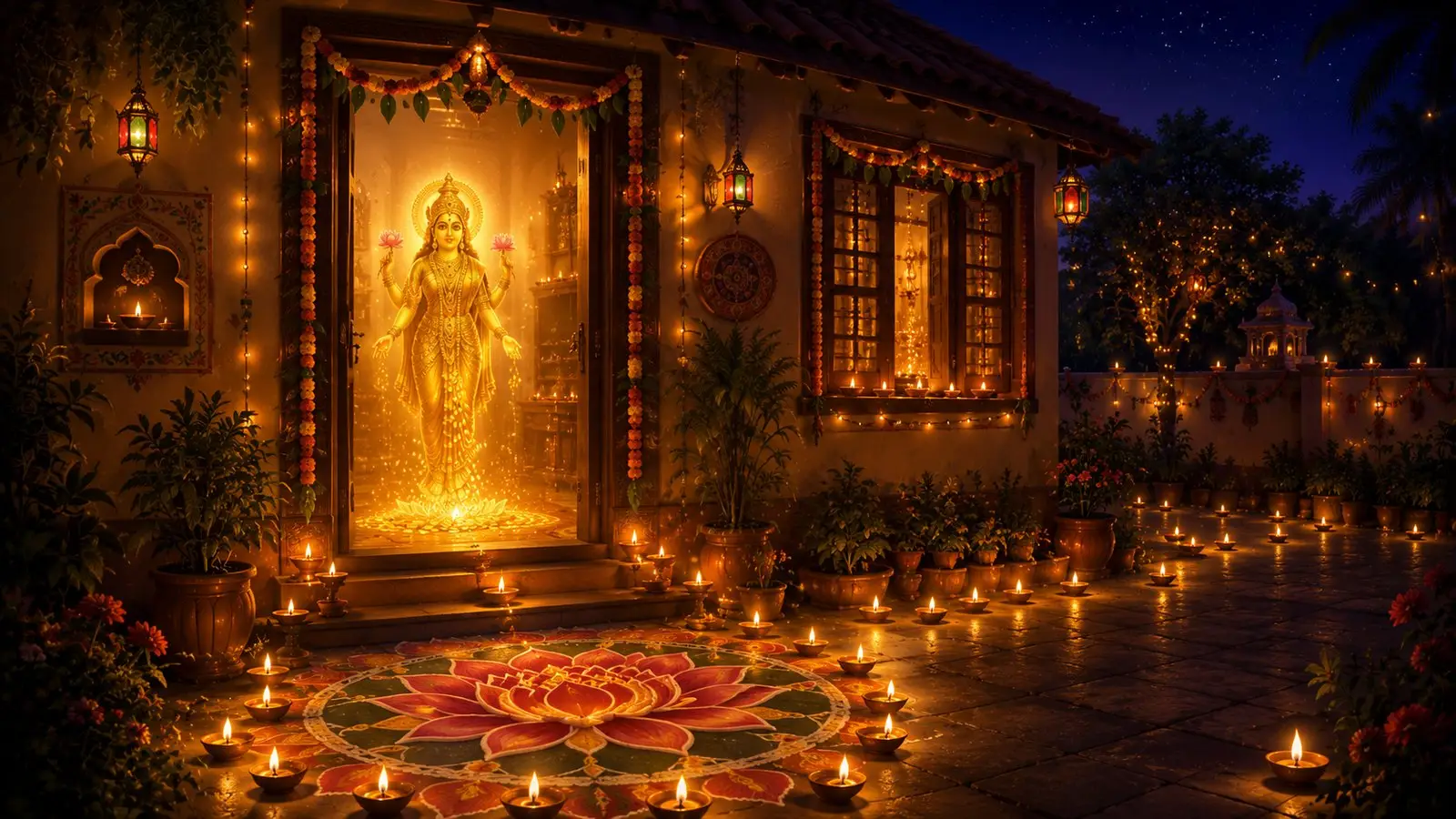
- Rangoli and lotus motifs - a rangoli, often with lotus or footprint (Lakshmi ke charan) designs at the doorway, is drawn to welcome her symbolically into the home.
- The lotus flower - fresh lotus flowers, or where unavailable, red and pink flowers such as roses, are offered directly at her feet; the lotus remains her single most important floral offering.
- Kheer and sweets - kheer (a sweetened rice or vermicelli pudding), along with coconut, batasha (sugar drops), and seasonal fruit, are offered as naivedya (food offering).
- Kumkum, haldi and akshata - red kumkum and turmeric are applied to the murti, and unbroken rice grains (akshata) mixed with turmeric are offered.
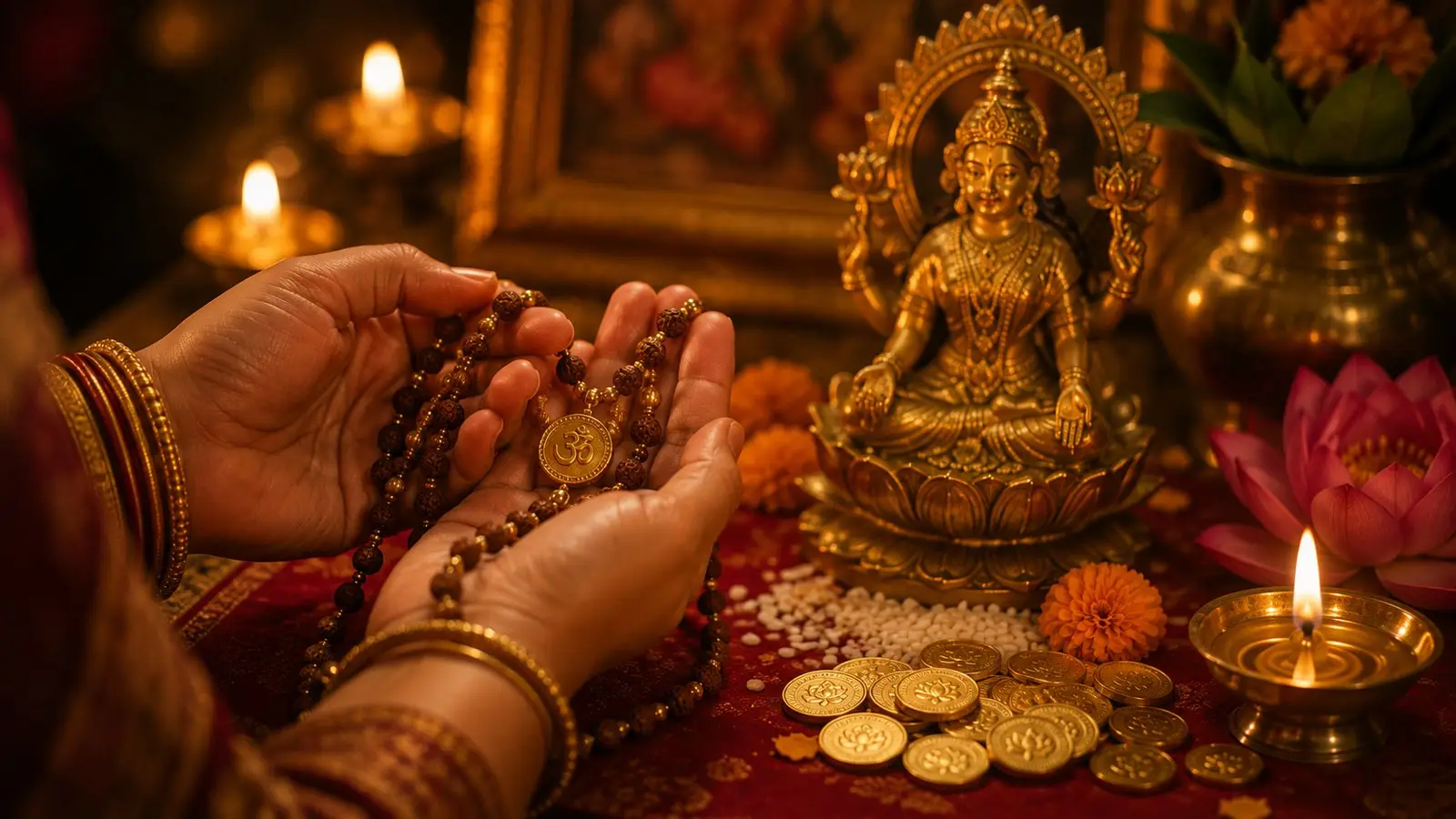
- Chanting - the Om Shreem Mahalakshmyai Namah mantra, the Lakshmi Gayatri, or the Mahalakshmi Ashtakam is recited, typically 108 times using a mala for the beej mantra.
- Aarti - the Lakshmi aarti (commonly beginning "Om Jai Lakshmi Mata") is sung with a lit lamp waved before the image.
- Sharing prasad - the offered food is distributed among family members after the puja concludes.
The Sri Yantra
Many serious devotees also install and worship the Sri Yantra, the geometric diagram of nine interlocking triangles considered the abstract, formless representation of Lakshmi's energy (and, in Shakta tantric contexts, of the Devi as Tripura Sundari). The Sri Yantra is placed facing east, kept scrupulously clean, and is sometimes anointed with sandalwood paste or kumkum during worship. It is considered one of the most potent objects of devotion in the entire Hindu tradition, condensing the goddess's presence into pure geometric form rather than anthropomorphic image.
Major Temples of Goddess Lakshmi
While Lakshmi is worshipped in nearly every Vishnu temple as his consort, several temples are dedicated principally, or in a specially elaborated form, to her.
Mahalakshmi Temple, Kolhapur, Maharashtra
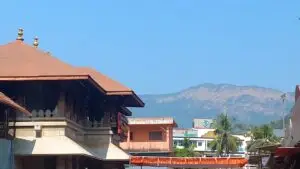
One of the oldest and most revered Shakti Peetha-associated temples dedicated to Lakshmi, the Mahalakshmi Temple in Kolhapur dates in its earliest structural form to roughly the seventh or eighth century, with the current temple complex substantially developed under the Chalukya and later Maratha patronage. The presiding deity, known locally as Ambabai, is depicted as a black stone murti roughly three feet tall, wearing a crown embedded with a Shiva linga, and holding a mace, a shield, a fruit and a bowl - an unusual iconographic blend that has made scholars debate whether the original form was Lakshmi, Parvati, or a syncretic goddess later formally identified with Mahalakshmi. The temple is one of the 51 Shakti Peethas in some enumerations, and it draws vast crowds during the Kirnotsav festival, when the setting sun's rays are engineered, through the temple's ancient architecture, to fall directly upon the deity's feet on specific days each year.
Ashtalakshmi Temple, Chennai, Tamil Nadu
Located on the East Coast Road near Besant Nagar in Chennai, the Ashtalakshmi Kovil is a relatively modern but architecturally striking temple, consecrated in 1976, dedicated jointly to all eight forms of the Ashta Lakshmi, each enshrined in her own individual shrine across the temple's several storeys. Overlooking the Bay of Bengal, it has become one of South India's most visited Lakshmi temples precisely because it allows devotees to worship all eight aspects of the goddess within a single pilgrimage, rather than travelling to eight separate sites. We describe this temple's layout and each shrine in detail in our companion piece on the Ashta Lakshmi eight forms.
Other Notable Temples
The Padmavati Temple at Tiruchanur near Tirupati, dedicated to Lakshmi as consort of Venkateswara, is considered so significant that tradition holds a pilgrimage to Tirupati is incomplete without first visiting her here. The Mahalakshmi Temple in Mumbai's Bhuleshwar area, overlooking the Arabian Sea, is another widely visited shrine, particularly popular during Navratri, while smaller but locally revered Lakshmi shrines exist across nearly every state in India, often positioned within larger Vishnu or Devi temple complexes rather than as freestanding structures.
Festivals Dedicated to Goddess Lakshmi
Diwali and Lakshmi Puja
Diwali, the festival of lights, is above all a festival of Lakshmi. On Amavasya (the new moon night) of the Hindu month of Kartik, typically falling in October or November, households across India perform the year's most elaborate Lakshmi Puja, welcoming the goddess into freshly cleaned, brightly lit homes with the belief that she visits and blesses those spaces that are clean, well-lit and harmonious. Business owners traditionally open new account ledgers (chopda pujan in Gujarati and Marwari communities) on this night, invoking Lakshmi's blessing over the coming financial year. We have written a dedicated, step-by-step guide to this ritual at Diwali Lakshmi Puja Vidhi: A Complete Guide, covering the muhurat timing logic, full samagri list and sequence of the puja.
Varalakshmi Vratam
Observed primarily in Andhra Pradesh, Telangana, Tamil Nadu and Karnataka, Varalakshmi Vratam falls on the Friday before the full moon (Purnima) in the Hindu month of Shravana, typically in July or August. Married women undertake this vrata (vow) specifically to invoke Vara Lakshmi, "the Lakshmi who grants boons," for the wellbeing of their family, praying particularly for the health and prosperity of their husbands and children. The ritual involves a kalasha (sacred pot) representing the goddess, decorated elaborately with a coconut, mango leaves and a face motif, worshipped through the day with a special akshata and a reading of the Varalakshmi Vratam Katha, the traditional legend explaining the origin and merit of the observance.
Other Occasions
Lakshmi is also invoked prominently during Navratri, particularly on the days associated with wealth and abundance within the nine-night sequence, and during Sharad Purnima, the autumn full moon night, when in several regional traditions she is believed to descend to earth and ask, "Who is awake?" - rewarding those still keeping vigil with her blessings. Thursday evenings, alongside Friday, are also considered auspicious by many communities for a brief Lakshmi aarti at home.
Frequently Asked Questions
Who is Goddess Lakshmi married to?
Goddess Lakshmi is the eternal consort of Vishnu, the preserver deity in the Hindu trinity. Tradition holds that wherever Vishnu takes an avatar or incarnation, Lakshmi accompanies him in a corresponding form, such as Sita alongside Rama or Padmavati alongside Venkateswara.
What is the best day to worship Lakshmi?
Friday is considered Lakshmi's most auspicious day across most Hindu traditions, though Thursday evenings are also favoured in some regional customs. Diwali night remains the single most significant annual occasion for her worship.
What is the meaning of the mantra Om Shreem Mahalakshmyai Namah?
This mantra translates roughly to "Salutations to the great goddess Lakshmi," with Shreem being her beej or seed-sound, said to carry the vibrational essence of abundance, beauty and grace. It is typically chanted 108 times using a mala.
Why does Lakshmi sit on a lotus?
The lotus grows from muddy water yet rises untouched by the mud, symbolising the possibility of engaging fully with material and worldly life without being spiritually corrupted by it. It also represents purity, unfolding potential and the beauty of consciousness rising above circumstance.
What is the difference between Lakshmi and Mahalakshmi?
Lakshmi generally refers to the consort of Vishnu in her gentler, domestic aspect, while Mahalakshmi refers to her supreme, unqualified form as the source of all abundance, often worshipped independently in Shakta contexts and identified as one of the three central goddess forms in Devi Mahatmya tradition, alongside Mahakali and Mahasaraswati.
What are the eight forms of Lakshmi called?
They are collectively called the Ashta Lakshmi, comprising forms such as Adi Lakshmi, Dhana Lakshmi, Dhanya Lakshmi, Gaja Lakshmi, Santana Lakshmi, Veera Lakshmi, Vijaya Lakshmi and Vidya Lakshmi, though exact listings vary slightly by tradition. We explore each in detail in our Ashta Lakshmi guide.
How did Lakshmi originate?
Her most celebrated origin is the Samudra Manthan, the churning of the cosmic ocean of milk by gods and demons, from which she emerged seated upon a lotus, radiant and fully formed, and chose Vishnu as her consort. Some Puranic sources also describe an earlier incarnation as the daughter of the sage Bhrigu.
Can anyone worship Lakshmi, regardless of which deity they primarily follow?
Yes. Lakshmi is worshipped almost universally across Hindu households irrespective of sectarian affiliation, since prosperity and auspiciousness are considered universally desirable and are not treated as belonging to any single sect's exclusive domain.
What is the Sri Yantra and how is it connected to Lakshmi?
The Sri Yantra is a geometric diagram of nine interlocking triangles considered the abstract, formless representation of the goddess's energy. It is worshipped by serious devotees as a direct object of meditation and is placed facing east on a home altar, kept clean and sometimes anointed with sandalwood or kumkum.
What should I offer Goddess Lakshmi during puja?
Traditional offerings include lotus or red flowers, kheer, coconut, fruit, kumkum, turmeric and unbroken rice grains (akshata). A lit diya is considered essential, since Lakshmi is believed to avoid dark or untidy spaces.
Further Reading
For readers interested in academic and historical context beyond devotional tradition, the Wikipedia entry on Lakshmi offers a useful overview of textual sources and regional variations, and the article on the Samudra Manthan traces the churning narrative across its various Puranic tellings.
Goddess Lakshmi's grace, tradition tells us, is drawn less by grandeur than by sincerity - a clean lamp-lit corner, a steady mantra, a heart willing to hold wealth without being held by it. If you would like to bring her presence into your own daily practice, Musinara's YouTube channel offers 432 Hz recordings of her mantras and the Mahalakshmi Ashtakam, composed to support quiet, sustained repetition. You are warmly invited to listen and subscribe.
Related reading
- Goddess Durga: The Complete Guide to the Invincible Mother
- Santoshi Maa: The Story, Vrat Katha and Complete 16-Friday Worship Guide
- Goddess Gayatri: The Mother of the Vedas and Her Mantra
- Goddess Annapurna: The Complete Guide to the Mother Who Feeds the World
Watch and listen to devotional music and mantras on the Musinara YouTube channel.