Introduction to Maa Dhumavati
Maa Dhumavati is the seventh Mahavidya and the most unusual among the ten wisdom goddesses - she is the only one depicted as a widow, without a consort. Her name means 'She who is made of smoke' (Dhuma = smoke). She rides a chariot without horses, holds a winnowing basket, and wears white or grey clothing.
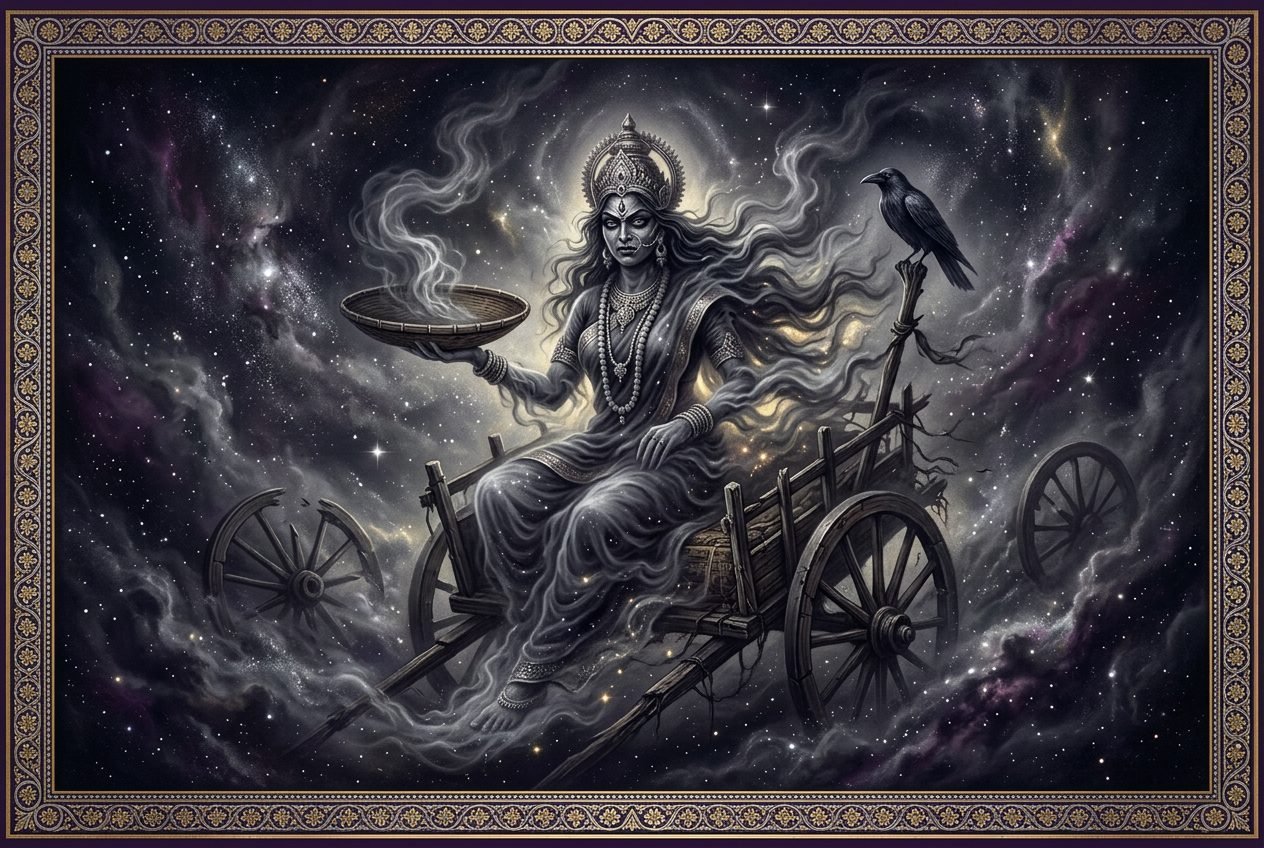
Dhumavati represents the void - the empty space that remains when all attachments are released. She teaches the profound spiritual lesson that even nothingness is divine. Her worship is connected to Saturn (Shani) energy and is particularly beneficial on Saturdays.
Though rarely worshipped compared to other Mahavidyas, those who connect with Dhumavati gain extraordinary detachment, clarity, and the ability to find contentment in simplicity. She is the goddess who reveals that when everything is taken away, what remains is indestructible.
Formation and Incarnation
The Shakta Pramoda tells that Sati, Shiva's wife, once became extremely hungry and asked Shiva for food. When he ignored her request, she consumed him entirely. Shiva emerged from her body as smoke, and Sati took on the form of a widow - Dhumavati - forever marked by the loss of her husband through her own actions.
This mythological account contains deep philosophical teaching: Dhumavati represents the state of consciousness that exists after all relationships, including the primal Shiva-Shakti relationship, have been transcended. She is what remains after even the concept of 'other' has been dissolved - pure, independent awareness beyond all duality.
Another tradition identifies Dhumavati with the cosmic pralaya - the great dissolution at the end of a cosmic cycle. She is the smoke that rises from the funeral pyre of the universe, representing the aftermath of total dissolution.
Importance and Benefits
Dhumavati worship offers unique benefits for those on the path of renunciation and detachment: deep peace through acceptance of impermanence; freedom from attachment to relationships and possessions; wisdom in times of loss, grief, and solitude; ability to find the sacred in the mundane and the empty; protection during Saturn transits (Sade Sati, Shani Dasha); overcoming depression through understanding its spiritual dimension; and the rare gift of contentment without external conditions.
She is especially invoked by widows, the elderly, and those going through major life transitions involving loss. Her energy teaches that there is a state of being beyond both happiness and unhappiness - a profound equanimity that comes from resting in the void.
Beej Mantra of Maa Dhumavati
| Sanskrit | ॐ धूं धूं धूमावत्यै स्वाहा |
|---|---|
| Hindi | ओम् धूं धूं धूमावत्यै स्वाहा |
| Transliteration | Om Dhum Dhum Dhumavatyai Swaha |
| Meaning | I invoke Dhumavati through her seed syllable Dhum (the sound of smoke/dissolution), offered into sacred fire (Swaha). |
Dhumavati's bija 'Dhum' carries the vibration of dissolution and release. Chanting it creates powerful detachment from worldly attachments. The double repetition 'Dhum Dhum' amplifies the releasing energy.
Best chanted on Saturday evenings facing south, using a dark rudraksha or iron mala. Offer dry foods, dark flowers, and sesame oil lamp. This mantra is particularly powerful during Saturn transits and for overcoming Saturn-related difficulties in the astrological chart.
Mool Mantra of Maa Dhumavati
| Sanskrit | ॐ धूं धूं धूं धूं धूमावत्यै ठः ठः |
|---|---|
| Hindi | ओम् धूं धूं धूं धूं धूमावत्यै ठः ठः |
| Transliteration | Om Dhum Dhum Dhum Dhum Dhumavatyai Thah Thah |
| Meaning | I invoke Dhumavati through the quadruple seed of dissolution (Dhum), with the sound of finality (Thah Thah). |
The Mool Mantra intensifies the dissolution energy with four repetitions of 'Dhum' and the unique ending 'Thah Thah' - sounds of finality and emptiness. This mantra is used for deeper sadhana work, particularly for releasing very deep attachments and karmic patterns.
Core Sanskrit Root Words
Dhumavati's vocabulary centers on themes of dissolution, emptiness, and the wisdom found in letting go.
- धूम (Dhuma) - Smoke - impermanence made visible, dissolution in process
- विधवा (Vidhava) - Widow - she who is independent of all relationship
- शून्य (Shunya) - Void, emptiness - the state Dhumavati embodies
- वैराग्य (Vairagya) - Detachment, dispassion - the quality she bestows
- शनि (Shani) - Saturn - the planet whose energy she governs
- सूर्प (Surpa) - Winnowing basket - separating truth from falsehood
- प्रलय (Pralaya) - Cosmic dissolution - the end of a universal cycle
Major Temples
Dhumavati Temple (Varanasi, Uttar Pradesh)
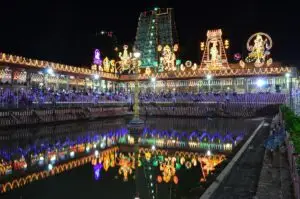
The most important Dhumavati temple, located in the holy city of Varanasi near Dashashwamedh Ghat. This ancient temple maintains traditional worship practices and is one of the few temples dedicated to this rare goddess. Saturday evening pujas are especially significant.
- By Air: Lal Bahadur Shastri Airport (25 km).
- By Train: Varanasi Junction - major railway hub connected to all Indian cities.
- By Road: Located in the old city near Dashashwamedh Ghat. Auto-rickshaws from main areas.
Attahasa Shakti Peetha (Khanakul, West Bengal)
A Shakti Peetha where the lower lip of Sati is said to have fallen. Dhumavati receives worship here as Phullara Devi. The temple is particularly active during Navaratri and on Saturdays.
- By Air: Netaji Subhas Chandra Bose Airport, Kolkata (85 km).
- By Train: Khanakul station on Howrah-Amta line. Local trains from Howrah (2 hours).
- By Road: Located in Hooghly district, 85 km from Kolkata via NH-6.
Festivals and Celebrations
Dhumavati receives worship during the seventh night of Navaratri and particularly on Saturdays throughout the year. Shani Amavasya (Saturday new moon) is the most powerful day for her worship.
The month of Shravana (July-August) is sacred to Dhumavati as it coincides with the rainy season - a time of introspection and withdrawal. Mahalaya (the dark fortnight before Navaratri) includes special Dhumavati worship in some Tantric traditions.
Listen to the Mantra
Watch the mantra video on YouTube
🔱 Explore All Ten Mahavidyas
The Das Mahavidya are the ten aspects of the Divine Mother. Continue your journey through each Wisdom Goddess:
- Maa Kali - The First Mahavidya
- Maa Tara - The Second Mahavidya
- Maa Tripura Sundari - The Third Mahavidya
- Maa Bhuvaneshwari - The Fourth Mahavidya
- Maa Bhairavi - The Fifth Mahavidya
- Maa Chinnamasta - The Sixth Mahavidya
- Maa Bagalamukhi - The Eighth Mahavidya
- Maa Matangi - The Ninth Mahavidya
- Maa Kamala - The Tenth Mahavidya
Frequently Asked Questions
Why is Maa Dhumavati depicted as a widow?
Dhumavati's widow form symbolizes independence from all relationships and attachments - even from Shiva. She represents consciousness beyond all duality, desire, and worldly connection.
When should Dhumavati mantra be chanted?
Saturdays at dusk are most auspicious, facing south. Amavasya (new moon) on Saturday is especially powerful. Chant 11 or 108 times daily.
What is the connection to Saturn (Shani)?
Dhumavati governs Saturn's energy. Her worship mitigates Saturn's malefic effects including Sade Sati and Shani Dasha. Saturn teaches detachment through difficulty; Dhumavati teaches the same through wisdom.
Is Dhumavati worship inauspicious?
No. While she represents loss and void, her worship brings profound peace, wisdom, and contentment. She teaches that true auspiciousness lies beyond external circumstances.
Can Dhumavati help with grief?
Yes, Dhumavati's energy is specifically healing for grief and loss. She teaches that loss is not the end but a doorway to deeper understanding and peace.
What offerings does Dhumavati accept?
Dry foods, dark flowers, sesame seeds, sesame oil lamp, and plain white cloth. Cooked rice and dal are also offered. Simple, humble offerings are most appropriate.
Why is Dhumavati's chariot horseless?
The horseless chariot symbolizes movement without visible means - spiritual progress that happens through surrender and grace rather than effort and will.
What is the winnowing basket?
The surpa (winnowing basket) separates grain from chaff - truth from falsehood, essential from non-essential. Dhumavati grants the wisdom to distinguish what truly matters.
Where is the main Dhumavati temple?
The most important temple is in Varanasi, near Dashashwamedh Ghat. There are very few temples dedicated to Dhumavati, making her one of the rarest deities to have a dedicated shrine.
How to start Dhumavati practice?
Chant 'Om Dhum Dhum Dhumavatyai Swaha' 108 times on Saturday evenings. Face south. Light a sesame oil lamp. Maintain simplicity in practice and life. Listen to Musinara Sounds recording.
Part of the Das Mahavidya series. All ten wisdom goddesses, the origin story, their beej mantras and temple guides are collected in one place: Das Mahavidya: The Ten Wisdom Goddesses.