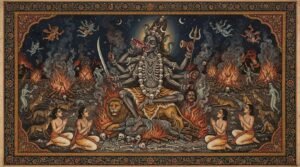
There is a particular kind of courage that does not come from anger, and it is this courage that Goddess Durga represents. She is not a deity who destroys out of malice, nor one who fights for her own sake; she is invoked, in text after text, at the precise moment when the gods themselves have exhausted their strength and dharma is on the verge of being overrun. Where other deities falter, Durga is described as arising - literally, in the central myth of her origin, formed from the combined radiance of every god's power, because no single force among them was sufficient to meet the threat alone.
🎧 Chant along - 108 times in 432 Hz
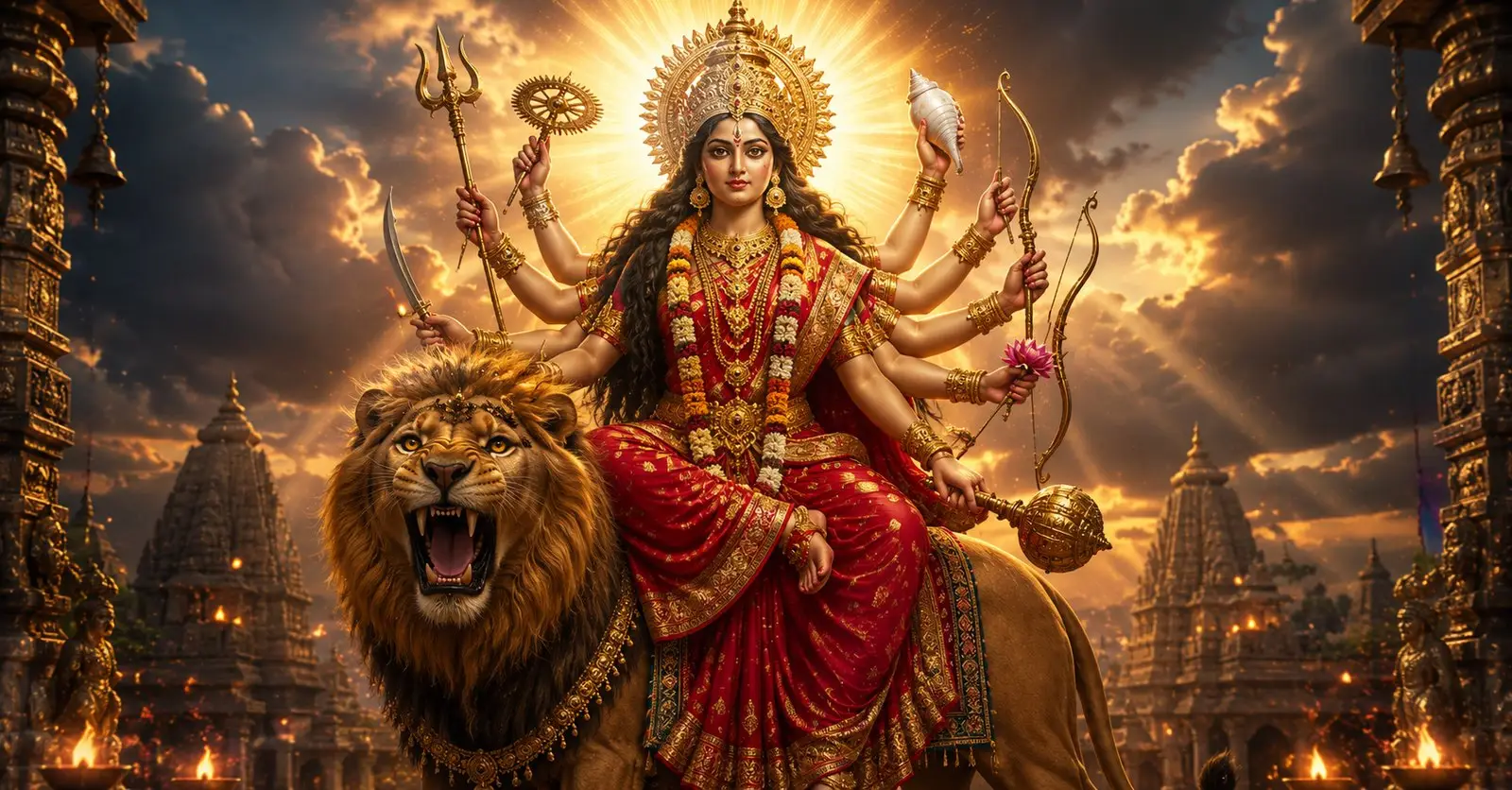
Durga is worshipped across the length and breadth of India, and well beyond it, as the supreme warrior form of the Divine Mother - Mahishasura Mardini, the slayer of the buffalo-demon, riding a lion or tiger into battle, her ten arms bearing the weapons of every major god. She is at once fiercely protective and deeply maternal, a goddess approached by the frightened and the ambitious alike, for courage, for victory over obstacles both worldly and inward, and for the sheer reassurance that comes from believing something greater than oneself stands between the devotee and what threatens them.
This guide brings together, in one place, who Durga is and how she came to be, what her iconography and her many weapons signify, the outline of her central scripture the Durga Saptashati, her nine forms known as the Navadurga, her principal mantras with meaning, and the customs of her great festivals, Navratri and Durga Puja, along with the major temples where her power is most keenly felt.
- Who Is Goddess Durga?
- Iconography: Ten Arms, the Lion and the Weapons of the Gods
- The Legend: Devi Mahatmya and the Slaying of Mahishasura
- The Nine Forms: Navadurga
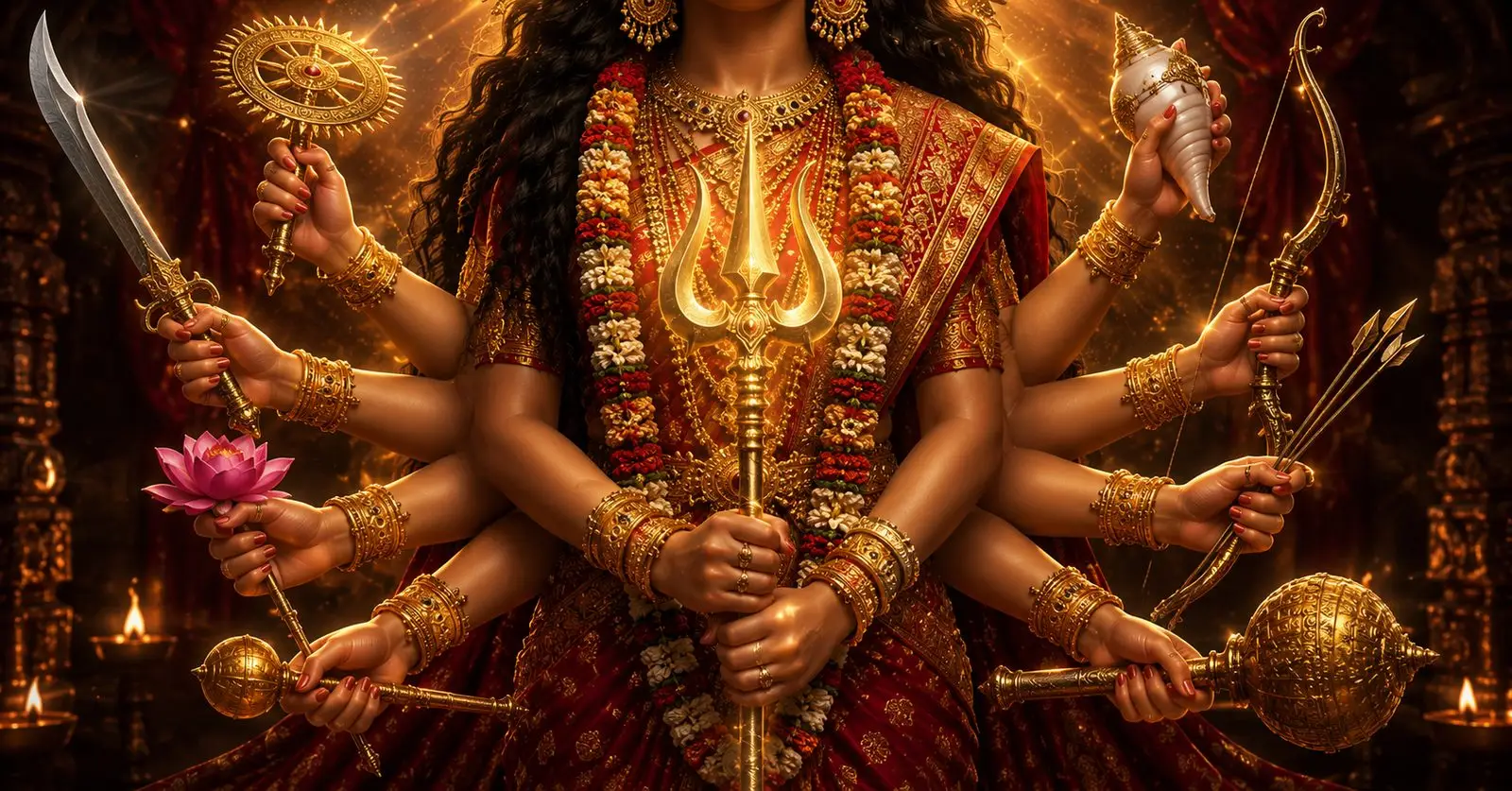
- Durga's Weapons and Their Meaning
- Durga's Mantras
- Benefits of Worshipping Durga
- How to Worship Durga
- Major Temples of Durga
- Frequently Asked Questions
Who Is Goddess Durga?
Durga's name is generally understood to derive from the Sanskrit root meaning "difficult to reach" or "invincible" - durga, a fortress that cannot be stormed. She is the supreme warrior aspect of Devi, the Divine Mother, and in most Shakta traditions she is regarded not as a separate, minor deity but as a direct and complete manifestation of the same Adi Parashakti who underlies every other form of the goddess, from gentle Saraswati to fierce Kali. Where the Kali guide explores the goddess in her most transcendent and dissolving aspect, and our guide to Kali, Durga and Parvati as forms of Shakti examines how these three great goddesses relate to one another, Durga herself is most often approached as the protective, battle-ready Mother - the one devotees call upon specifically when something needs defending, whether that is a home, a community, a cause, or one's own resolve.
She is most famous as Mahishasura Mardini, "she who crushed the buffalo-demon Mahishasura," a title and image so central to her worship that it appears in temple sculpture across nearly every region of the subcontinent. Yet Durga is not confined to this single episode. She is also identified, in different regional and sectarian traditions, with Parvati in her fierce aspect, with the mother goddess of the Devi Mahatmya generally, and with the presiding deity of Navratri and Durga Puja, the two festivals most associated with her worship.
Durga occupies a distinctive place in the devotional imagination as a goddess who is fierce without being frightening in the way that, say, Chinnamasta or Dhumavati can be to the uninitiated. She is armed, certainly, and shown in the act of combat, yet her expression in classical iconography is almost always serene - a calm, unhurried confidence in the midst of battle, rather than rage. This combination of ferocity and composure is, in many ways, the central teaching of her form: that true strength does not require losing one's centre.
Her family, too, is a distinctive part of her worship, particularly in eastern India. In Bengali tradition, Durga is imagined as a beloved daughter returning to her natal home each autumn, accompanied by her four children - Ganesha, Kartikeya, Lakshmi and Saraswati - a domestic warmth that sits alongside her martial ferocity without any sense of contradiction. This is part of why Durga Puja carries such a strong emotional undertone of homecoming and family reunion, distinct from the purely martial framing the goddess receives in some North Indian retellings of the Navratri and Dussehra narrative, which foreground her battle with Mahishasura and, separately, Rama's own victory over Ravana on the same closing day.
Iconography: Ten Arms, the Lion and the Weapons of the Gods
Durga is most commonly depicted with ten arms, though eight-armed and, less commonly, twelve or eighteen-armed forms also appear in regional and textual traditions. Each arm carries a different weapon, gifted to her, according to the central legend, by a different god, so that her form is in effect a composite of the combined power of the entire pantheon assembled for a single purpose.
Her vahana, or mount, is a lion or, in many depictions particularly common in Bengal, a tiger. The lion represents raw power, willpower and royal authority harnessed rather than indulged - Durga does not merely possess this ferocious strength, she rides it, directing it entirely to the protection of dharma. In the most iconic scene of her mythology, she is shown in the very act of combat with Mahishasura, her trident piercing the demon at the moment of his attempted escape from his buffalo form into his true, monstrous shape - a scene of extraordinary dynamism captured in temple art from Tamil Nadu to Bengal to Nepal.
Her multiple faces in some depictions, and her serene central expression even amid so many weapons, are often read together as a statement that protection and calm are not opposites: the goddess fights precisely because she is not disturbed by fear or anger, but moves from a place of settled clarity about what must be done.
The Legend: Devi Mahatmya and the Slaying of Mahishasura
The foundational account of Durga's origin and her defeat of Mahishasura is told in the Devi Mahatmya (also called the Durga Saptashati or Chandi Path), a text embedded within the Markandeya Purana and considered one of the central scriptures of Shakta tradition. Readers wishing for a full verse-by-verse treatment of this remarkable text should consult our companion guide to the Durga Saptashati and Devi Mahatmya; what follows here is a brief outline sufficient to understand her iconography and worship.
According to the narrative, the buffalo-demon Mahishasura had, through severe austerities, won a boon that no man or god could kill him. Emboldened by this apparent invincibility, he waged war on the heavens and drove the gods from their thrones. Unable to defeat him by any individual or combined effort, the gods - led by Brahma, Vishnu and Shiva - released their combined tejas, their radiant energy, which converged and took the form of a single, supremely powerful goddess: Durga. Each god then armed her with his own signature weapon, and the Himalaya gave her a lion to ride. Thus armed and mounted, Durga rode to battle against Mahishasura's demonic armies.
The demon, seeing the goddess, first attempted diplomacy and then open war, shifting through several animal forms in an attempt to escape or overpower her - a buffalo, a lion, an elephant, and a man - but Durga matched each transformation, and in the climactic moment, as he attempted to emerge half-transformed from the buffalo body back into his true form, she pierced him with her trident and struck off his head, restoring order to the three worlds. This episode is retold and expanded across the Devi Mahatmya's chapters, alongside two further major episodes - her battles against the demons Madhu and Kaitabha, and against Shumbha and Nishumbha - making the text a sustained meditation on the goddess's power under three distinct forms and circumstances. Devotees seeking a shorter, hymn-based retelling of the Mahishasura episode specifically may also wish to explore the Mahishasura Mardini Stotram, a lyrical composition recited widely during Navratri.
The Nine Forms: Navadurga
During the nine nights of Sharadiya (autumn) Navratri, Durga is worshipped in nine successive forms known collectively as the Navadurga, each representing a stage in the goddess's own development or a distinct aspect of her power, worshipped on a corresponding day of the festival.
| Day | Form (Devanagari) | Transliteration | Association |
|---|---|---|---|
| 1 | शैलपुत्री | Shailaputri | Daughter of the mountain (Himalaya); the foundational, grounded form of the goddess |
| 2 | ब्रह्मचारिणी | Brahmacharini | The ascetic form, representing penance and discipline |
| 3 | चन्द्रघण्टा | Chandraghanta | The bell-and-crescent-moon form, associated with courage and grace |
| 4 | कूष्माण्डा | Kushmanda | Said to have created the universe with her radiant smile |
| 5 | स्कन्दमाता | Skandamata | Mother of Skanda (Kartikeya), representing maternal strength |
| 6 | कात्यायनी | Katyayani | The warrior form born to sage Katyayana, closely tied to the Mahishasura legend |
| 7 | कालरात्रि | Kalaratri | The dark, fierce night-form who destroys ignorance and fear |
| 8 | महागौरी | Mahagauri | The radiant, fair form representing purity and peace |
| 9 | सिद्धिदात्री | Siddhidatri | The bestower of spiritual accomplishments (siddhis) |
This nine-day progression, along with the fuller devotional and ritual detail of each form, is treated at length in our dedicated guide to Navratri and the Navadurga, which readers observing the festival closely will find useful for day-by-day worship.
Durga's Weapons and Their Meaning
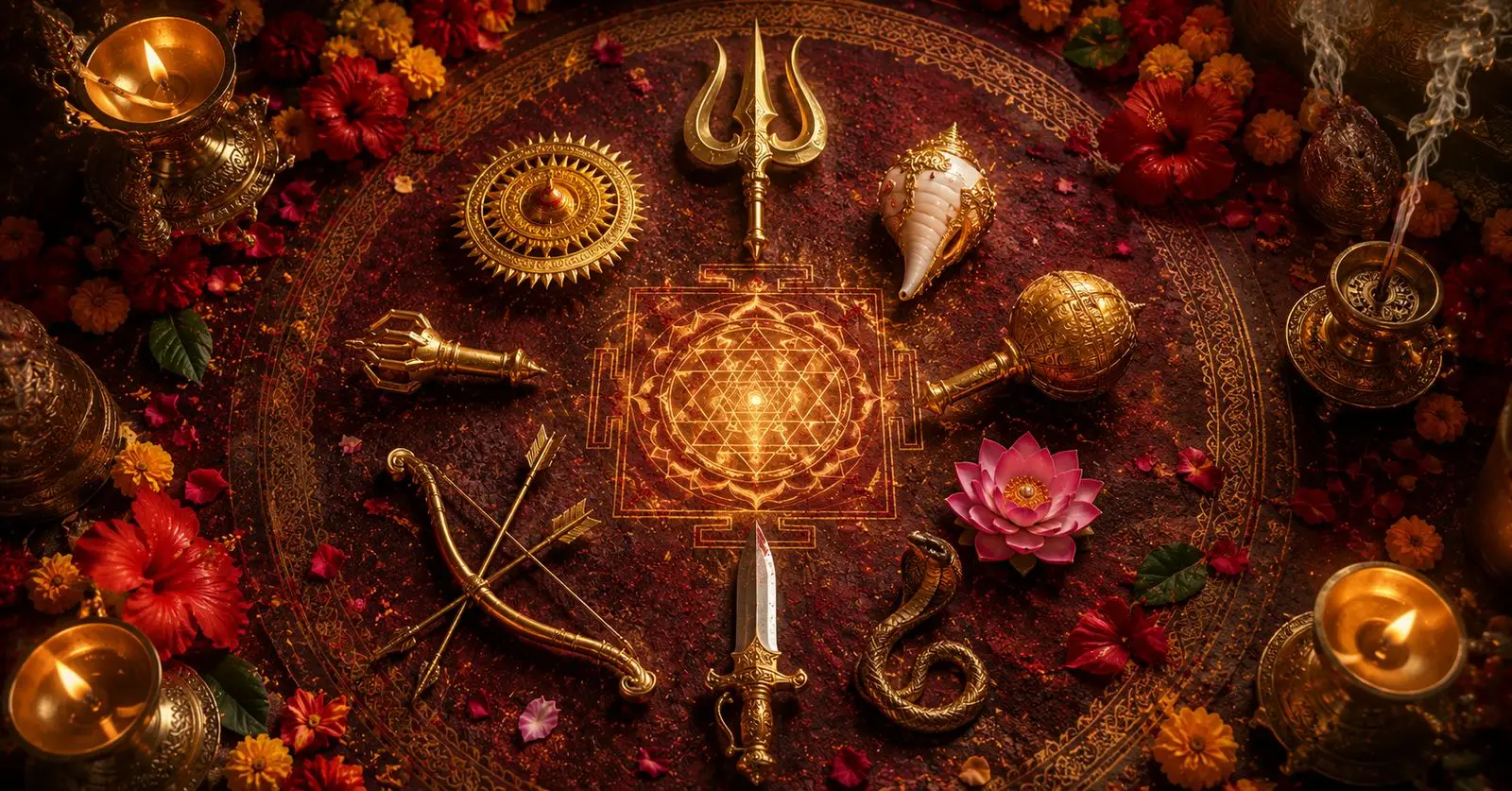
The weapons Durga carries are not merely martial props; each is drawn from a specific god's own iconography, and each is generally read as representing a particular inner or cosmic principle that the goddess brings to bear against adharma.
| Weapon | Given By (Traditional Association) | Symbolic Meaning |
|---|---|---|
| Trishul (trident) | Shiva | Destruction of the threefold affliction - physical, mental and spiritual - and the cutting away of ego |
| Sudarshana Chakra (discus) | Vishnu | The wheel of time and cosmic order, protecting dharma and maintaining balance |
| Shankha (conch) | Varuna | The primordial sound of creation (Om) and the proclamation of victory over evil |
| Vajra (thunderbolt) | Indra | Unbreakable firmness of resolve and unwavering faith |
| Dhanush-Baan (bow and arrow) | Vayu | Focused energy and precision of purpose |
| Khadga (sword) | Yama or Kala | Discrimination and the cutting away of ignorance |
| Gada (mace) | Kubera or Vishwakarma | Discipline, strength and the maintenance of order |
| Kamal (lotus) | Brahma | Detachment and purity of purpose even while acting in the world |
| Naga (serpent) | Shiva | The awakened power of kundalini and primal energy |
Regional and textual variations exist in exactly which god is credited with which weapon, and readers will find slightly different lists across different retellings of the Devi Mahatmya and later Puranic accounts; the table above reflects the associations most commonly cited in popular tradition rather than a single, uniformly fixed canon.
Durga's Mantras
Durga's mantras are recited for protection, courage, and the removal of obstacles, and are especially prominent during Navratri, on Tuesdays, and before undertaking any difficult or fearful task.
| Devanagari | Transliteration | Meaning |
|---|---|---|
| ॐ दुं दुर्गायै नमः | Om Dum Durgayai Namah | Salutations to Goddess Durga; "Dum" is her beej (seed) mantra, invoked for protection and the removal of obstacles. |
| ॐ कात्यायनाय विद्महे कन्यकुमारि धीमहि तन्नो दुर्गिः प्रचोदयात् | Om Katyayanaya Vidmahe Kanyakumari Dhimahi Tanno Durgi Prachodayat | We seek to know the daughter of Katyayana; we meditate upon the eternal maiden; may Durga illumine and guide us. This is the Durga Gayatri mantra. |
| सर्वमङ्गलमाङ्गल्ये शिवे सर्वार्थसाधिके। शरण्ये त्र्यम्बके गौरि नारायणि नमोऽस्तु ते॥ | Sarva Mangala Mangalye Shive Sarvartha Sadhike, Sharanye Tryambake Gauri Narayani Namostute | O auspicious one among all auspicious things, benevolent one who accomplishes every purpose, refuge of all, three-eyed one, Gauri - salutations to you, Narayani. A celebrated verse from the Devi Mahatmya recited widely during Navratri and Durga Puja. |
For readers who wish to go further into the Devi Mahatmya's protective and invocatory apparatus that traditionally frames recitation of these mantras and the wider text, our guide to the Devi Kavach, Argala and Keelak Stotram explains the protective armour-verses recited before undertaking a full reading of the scripture.
Benefits of Worshipping Durga
- Protection from harm - Durga is the goddess most widely invoked for raksha, protection of self, family and home, particularly in times of illness, travel, conflict or uncertainty.
- Courage in the face of fear - her worship is sought by those confronting a daunting task, a legal battle, an illness, or any circumstance requiring sustained inner strength.
- Victory over obstacles - the theme of Vijayadashami, the "day of victory" that concludes Navratri, reflects the broader belief that sincere devotion to Durga clears the way through difficulties that had seemed insurmountable.
- Removal of negative influence - many devotees invoke her specifically against ill-will, malicious intent, or what tradition describes as negative or hostile energies directed at them.
- Strength for women and the vulnerable - Durga is very widely understood as a particular source of strength and protection for women, and is frequently invoked in this specific role in both domestic and public devotional life.
- Support in righteous struggle - her mythology consistently frames her battles as being fought in defence of dharma rather than for personal gain, and devotees often invoke her when undertaking a cause they believe to be just.
How to Worship Durga
Daily and Weekly Practice
Tuesday is widely regarded as Durga's day in many parts of India, particularly in the worship of her form as Santoshi Maa and in general Devi worship traditions, and devotees often observe a fast or offer a simple puja on this day. Daily worship is generally simple: lighting a lamp before her image, offering a red flower such as hibiscus, and reciting Om Dum Durgayai Namah or the Durga Gayatri.
Navratri
Navratri, "nine nights," occurs four times a year in the Hindu calendar, but the most widely celebrated instance is Sharadiya Navratri, falling in the autumn month of Ashwin, typically in September or October, with exact dates shifting yearly according to the lunar calendar and worth confirming against a current panchang. Over nine nights, the Navadurga are worshipped in sequence as described above, culminating in Vijayadashami (Dussehra), the tenth day marking Durga's victory over Mahishasura, celebrated across India with processions, the burning of effigies of Ravana in northern traditions, and the immersion (visarjan) of Durga idols in eastern India.
Durga Puja
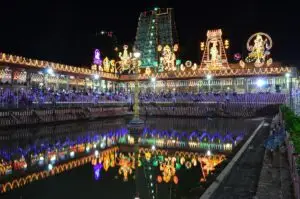
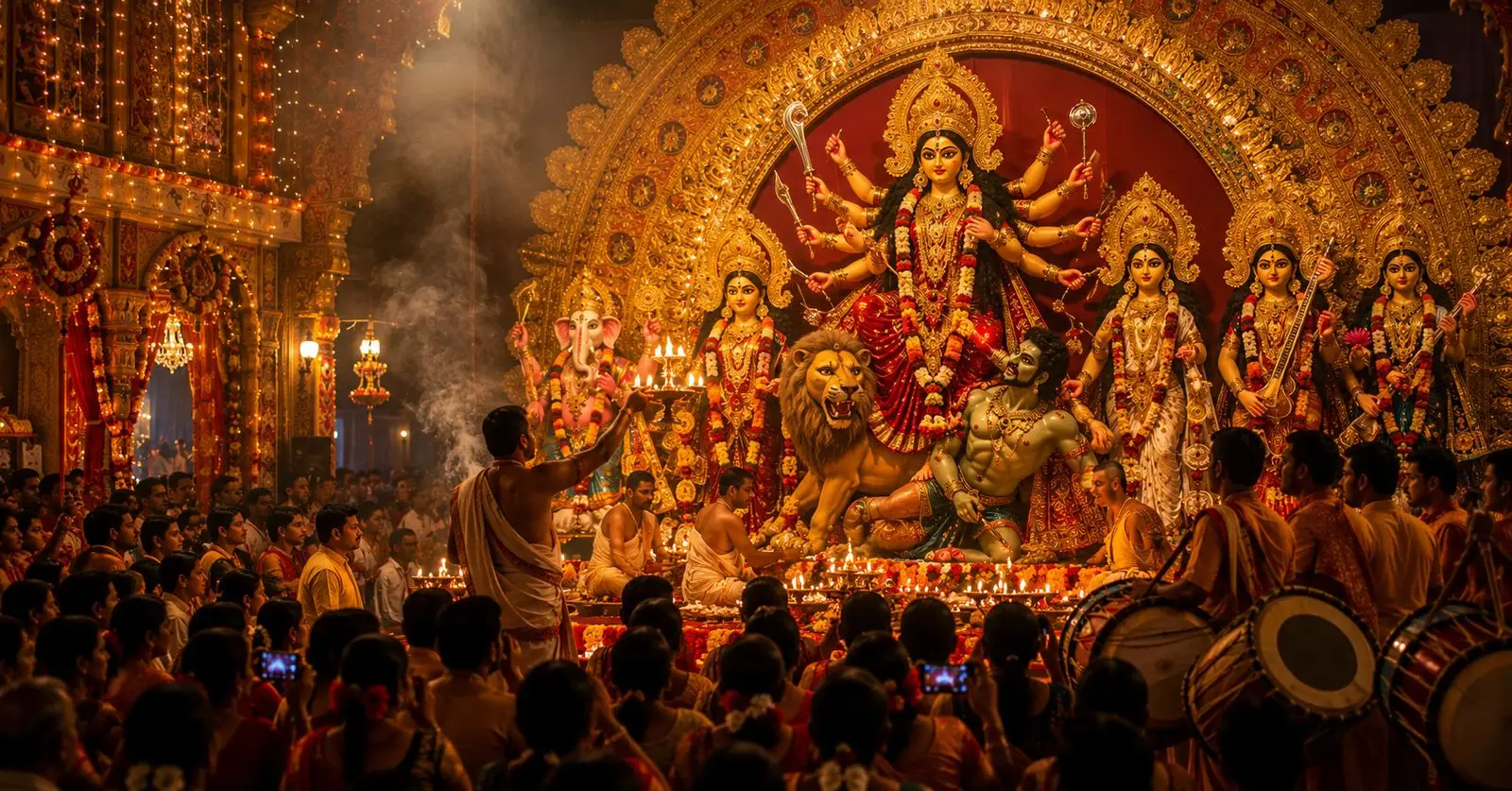
In Bengal, Odisha, Assam, Bihar, Jharkhand and Tripura, the final five days of Navratri constitute Durga Puja, the single largest and most elaborate festival of the year in this region, comparable in scale and civic importance to Diwali elsewhere in India. Elaborately sculpted clay idols of Durga, typically shown with her children Ganesha, Kartikeya, Lakshmi and Saraswati arranged around her, are installed in temporary pandals constructed by neighbourhood committees, often rivalling professional art installations in their scale and craftsmanship. The five principal days are Shashti, Saptami, Ashtami, Navami and Dashami, each with specific rituals - Sandhi Puja, performed at the exact juncture between Ashtami and Navami, is considered the most powerful moment of the entire festival, commemorating the precise instant of Mahishasura's defeat. The festival closes with Sindoor Khela, in which married women apply vermilion to the goddess's idol and to one another, and the emotional immersion procession as the idol is taken to a river or sea for visarjan.
Puja Offerings and Method
- Red flowers, particularly hibiscus (jasoon) and lotus, are the traditional offering.
- Red vermilion (sindoor), a red or maroon cloth, and bangles are commonly offered, especially in Bengali tradition.
- A simple fast (vrat) is often observed on Ashtami or throughout all nine days by devout households.
- Kanya Puja - the ritual worship and feeding of young girls, honoured as living representations of the goddess - is performed on Ashtami or Navami in many North Indian households.
- Chanting the Durga Chalisa is a widely loved daily practice during Navratri; our companion piece on the Durga Chalisa's meaning and benefits walks through the verses line by line for devotees who wish to understand what they are reciting.
Major Temples of Durga
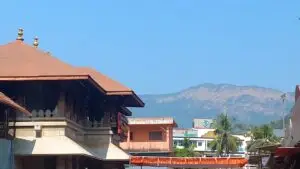
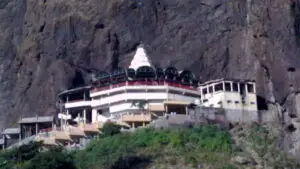
Durga is worshipped in an extraordinary range of temples across India, often under a specific regional name or form:
- Kamakhya Temple, Assam - one of the most important Shakti Peethas, where Durga is worshipped in her fierce, tantric aspect; our full guide to Kamakhya covers its unique traditions in detail.
- Vaishno Devi, Jammu and Kashmir - one of the most visited pilgrimage sites in India, where the goddess is worshipped in the form of three natural rock formations (pindis) representing Maha Kali, Maha Lakshmi and Maha Saraswati together, understood by many devotees as a manifestation of Durga; see our complete Vaishno Devi pilgrimage guide for travel logistics and darshan details.
- Dakshineswar and Kalighat, Kolkata - while more closely associated with Kali worship, both sit within the broader Durga Puja culture of Bengal and are visited heavily during the festival season.
- Chamundeshwari Temple, Mysuru - atop Chamundi Hill, dedicated to Chamundeshwari, a fierce form of Durga closely tied to the Mahishasura legend, since Mysuru's very name derives from Mahishasura.
- Meenakshi Amman Temple, Madurai - while Meenakshi is primarily worshipped as a form of Parvati, Durga is honoured within the temple complex, and the wider Tamil tradition closely associates warrior-goddess worship with this region.
- Countless community and neighbourhood Durga Puja pandals across Bengal and eastern India, which, though temporary, function as genuine pilgrimage destinations during the festival fortnight, drawing visitors who tour dozens of pandals over the nine nights.
Frequently Asked Questions
Why does Durga have ten arms?
Her ten arms represent the combined power (tejas) of the major gods of the Hindu pantheon, each of whom, according to the Devi Mahatmya, contributed his own weapon and strength to create her so that she alone could defeat the demon Mahishasura, whom no single god could overcome.
What is the story of Mahishasura Mardini?
Mahishasura was a buffalo-demon who had won a boon making him unkillable by any man or god. The combined radiance of the gods formed Durga, who was armed with their weapons and rode into battle on a lion, ultimately piercing and beheading Mahishasura as he attempted to shift between forms - an episode central to the Devi Mahatmya and to Durga's iconography.
What is the difference between Navratri and Durga Puja?
Navratri refers to the full nine nights of worship of the Navadurga observed across India, particularly in North India, often accompanied by fasting and Ramlila performances leading to Dussehra. Durga Puja specifically refers to the elaborate five-day celebration of the final days of Navratri as practised in Bengal, Odisha, Assam and neighbouring regions, centred on large public idol installations.
What is the most powerful Durga mantra?
Om Dum Durgayai Namah is the most widely used and simplest protective mantra, using her beej sound "Dum." The Durga Gayatri and verses such as Sarva Mangala Mangalye from the Devi Mahatmya are also very widely recited, particularly during Navratri.
Which day is best for worshipping Durga?
Tuesday is generally regarded as her day for regular weekly worship, while the nine days of Navratri, and especially Ashtami and Navami, are considered the most powerful and auspicious occasions for her worship annually.
What animal does Durga ride, and why?
Durga rides a lion, or in many Bengali depictions a tiger, representing raw power and willpower that she has fully mastered and directs entirely towards the protection of dharma, rather than being ruled by it.
Are Durga and Kali the same goddess?
They are closely related but generally distinguished within Shakta tradition: Durga is typically the composed, armed, protective warrior-mother, while Kali represents a more transcendent, fierce, time-dissolving aspect of the Divine Mother. Our guide comparing Kali, Durga and Parvati as forms of Shakti explores how these forms relate without being strictly identical.
What are the Navadurga?
The Navadurga are the nine forms of Durga worshipped on the nine successive nights of Sharadiya Navratri - Shailaputri, Brahmacharini, Chandraghanta, Kushmanda, Skandamata, Katyayani, Kalaratri, Mahagauri and Siddhidatri - each representing a distinct stage or quality of the goddess's power.
What is Kanya Puja and when is it performed?
Kanya Puja is the ritual worship and feeding of young girls, typically aged between two and ten, who are honoured as living forms of the goddess, generally performed on Ashtami or Navami during Navratri in many North Indian households.
Can I read the Durga Saptashati at home, and are there rules for reciting it?
Yes, the Durga Saptashati (Devi Mahatmya) is widely read at home, particularly during Navratri, though tradition recommends completing a reading in a single sitting where possible, maintaining cleanliness and a calm state of mind, and beginning with the protective Kavach, Argala and Keelak verses. Our detailed guide to the Durga Saptashati and Devi Mahatmya covers the recommended method in full, and learning the correct rhythm and pronunciation from a knowledgeable priest or teacher is always advisable for a first reading.
To read of Durga's battles is one thing; to feel the steadiness she represents settle into your own chest before something difficult is quite another, and that is where sound and repetition do their quiet work. Musinara records her mantras and stotras at 432 Hz for exactly this purpose, and you are warmly invited to listen and chant along on our YouTube channel - particularly in the nine nights when her presence is felt most closely.
Related reading
- Goddess Lakshmi: The Complete Guide to Her Forms, Mantras and Worship
- Goddess Gayatri: The Mother of the Vedas and Her Mantra
- Goddess Annapurna: The Complete Guide to the Mother Who Feeds the World
- Santoshi Maa: The Story, Vrat Katha and Complete 16-Friday Worship Guide
Watch and listen to devotional music and mantras on the Musinara YouTube channel.
Listen: the Durga beej mantra, 108 times at 432 Hz, with the meaning and how to chant it.
For the courage that Hanuman embodies, many keep Om Hum Hanumate Namah alongside the Durga beej mantra on Tuesdays.
हिंदी में पढ़ें: नवरात्रि 2026 के रंग - नौ दिनों की पूरी सूची
New: Mahishasura Mardini - the avatar born for one battle, and Durga Puja 2026