Among the countless invocations offered to the Devi across the length of India, one mantra is so widely known, so frequently repeated, and so deeply woven into the daily rhythm of devout households that it has, over three thousand years, become almost synonymous with the very idea of prayer in Sanskrit. That is the Gayatri Mantra, addressed to the sun as the source of all illumination, and personified in devotional worship as the goddess Gayatri - Gayatri Mata, Vedamata, the Mother of the Vedas.
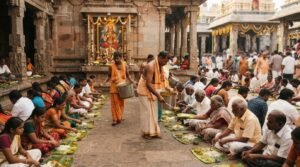
Gayatri occupies an unusual place among the goddesses of the Hindu tradition. She is not primarily approached through elaborate temple ritual in the way a village goddess or a Shakti Peetha deity might be, though sacred spaces devoted wholly to her do exist. She is instead met, morning after morning, in the quiet act of a single verse repeated with attention - a verse so foundational that it is said to contain, in essence, the wisdom of all four Vedas. To chant it is, in a real sense, to touch the root from which the entire Vedic corpus is said to have grown.
This guide sets out who Gayatri Mata is, how she came to be pictured with five faces and ten hands, her relationship to Savitri and Saraswati, the Gayatri Mantra itself with a word-by-word breakdown of its meaning, the benefits ascribed to its recitation, the traditional method and timing of chanting through Sandhyavandana, the rules surrounding the practice, other Gayatri-pattern mantras addressed to different forms of the Devi, and the principal places of pilgrimage, from Shantikunj in Haridwar to the hill temples above Pushkar.
- Who Is Gayatri Mata?
- Iconography: Five Faces and Ten Hands
- Gayatri, Savitri and Saraswati
- The Gayatri Mantra: Text and Meaning
- Benefits of Chanting the Gayatri Mantra
- How and When to Chant: Sandhyavandana
- Rules and Etiquette of Gayatri Japa
- Other Gayatri Mantras of the Goddess
- Temples of Gayatri Mata
- Frequently Asked Questions
Who Is Gayatri Mata?
Gayatri is, in the strictest sense, a metre of Sanskrit poetry before she is a goddess - the term names a specific verse structure of three lines of eight syllables each, twenty-four syllables in total, one of the oldest and most sacred metres used in Vedic composition. The mantra that bears this metre, addressed to Savitr, the solar deity and source of light and life, appears in the Rigveda (3.62.10), attributed to the sage Vishvamitra. Over centuries this verse came to be regarded as so complete a distillation of Vedic wisdom that it was personified as a goddess in her own right - Gayatri Devi, addressed with the same reverence given to any great form of the Devi.
She is called Vedamata, the Mother of the Vedas, because tradition holds that the essence of all four Vedas - Rig, Yajur, Sama and Atharva - is compressed within her twenty-four syllables, so that a practitioner who fully absorbs the Gayatri Mantra has, in condensed form, taken in the wisdom the entire Vedic corpus is meant to impart. She is also called Vishwamata (mother of the universe) and Devmata (mother of the gods), reflecting the belief that from this single seed-verse all subsequent scripture and right understanding unfold, much as a great tree is said to be contained within a single seed.
Unlike goddesses whose worship centres on dramatic myth - a battle with a demon, the churning of an ocean, a fierce protective intervention - Gayatri's presence in Hindu religious life is primarily contemplative and habitual. She is invoked at the threshold of the day, and her worship asks less for grand ritual than for regularity: the same syllables, returned to daily, with attention deepening over years. Readers who have explored our guide to Goddess Saraswati, the goddess of speech and learning, will recognise a similar emphasis on sound and clarity of mind - the two goddesses are closely related in several traditions, as the next section explains.
It is also worth situating Gayatri within the widest frame of Devi worship. In Shakta theology, every named goddess - however grand or however intimate her worship - is understood as a particular manifestation of a single undivided source. Readers new to this idea may find it useful to read our guide to Adi Parashakti, the supreme, formless Divine Mother from whom Gayatri, like Saraswati, Lakshmi, Durga and the fierce Mahavidyas, is said to emerge as a particular ray of one boundless light.
Iconography: Five Faces and Ten Hands
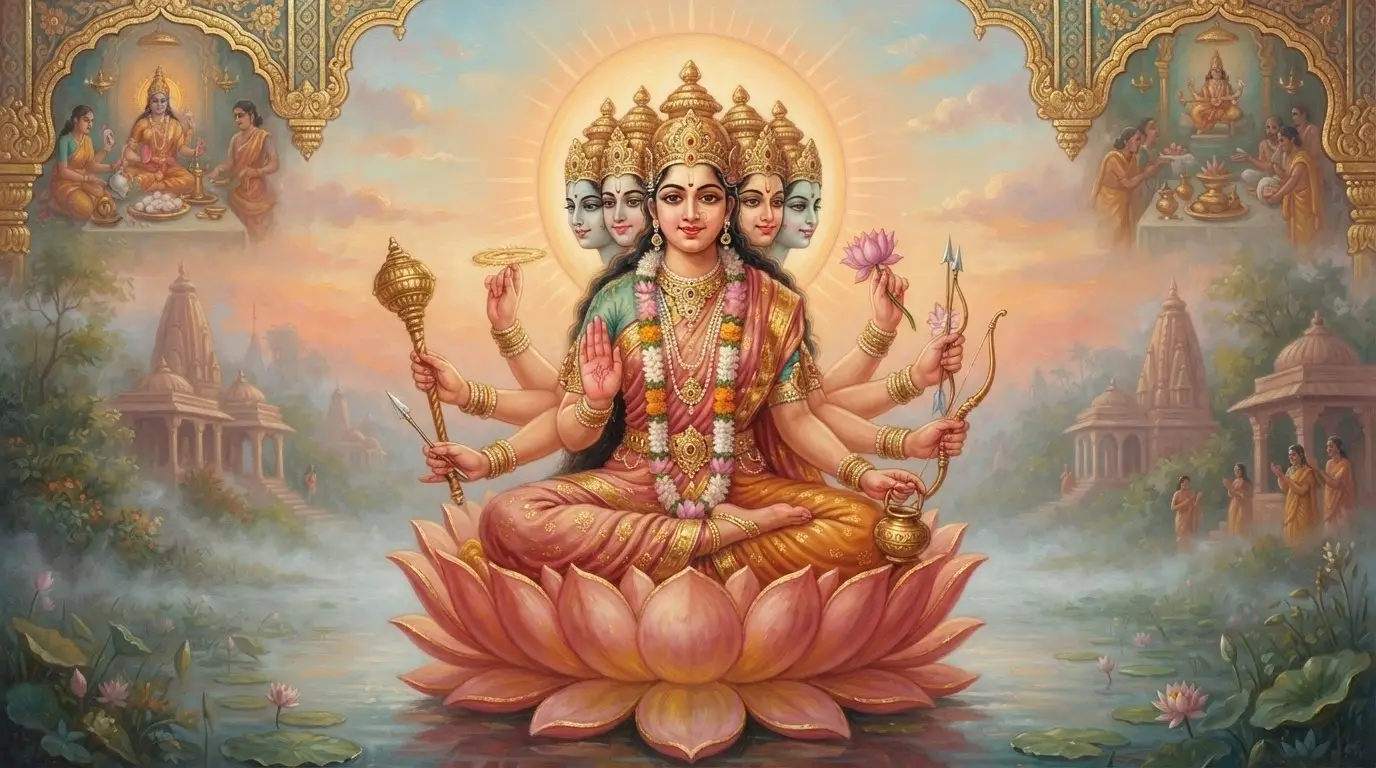
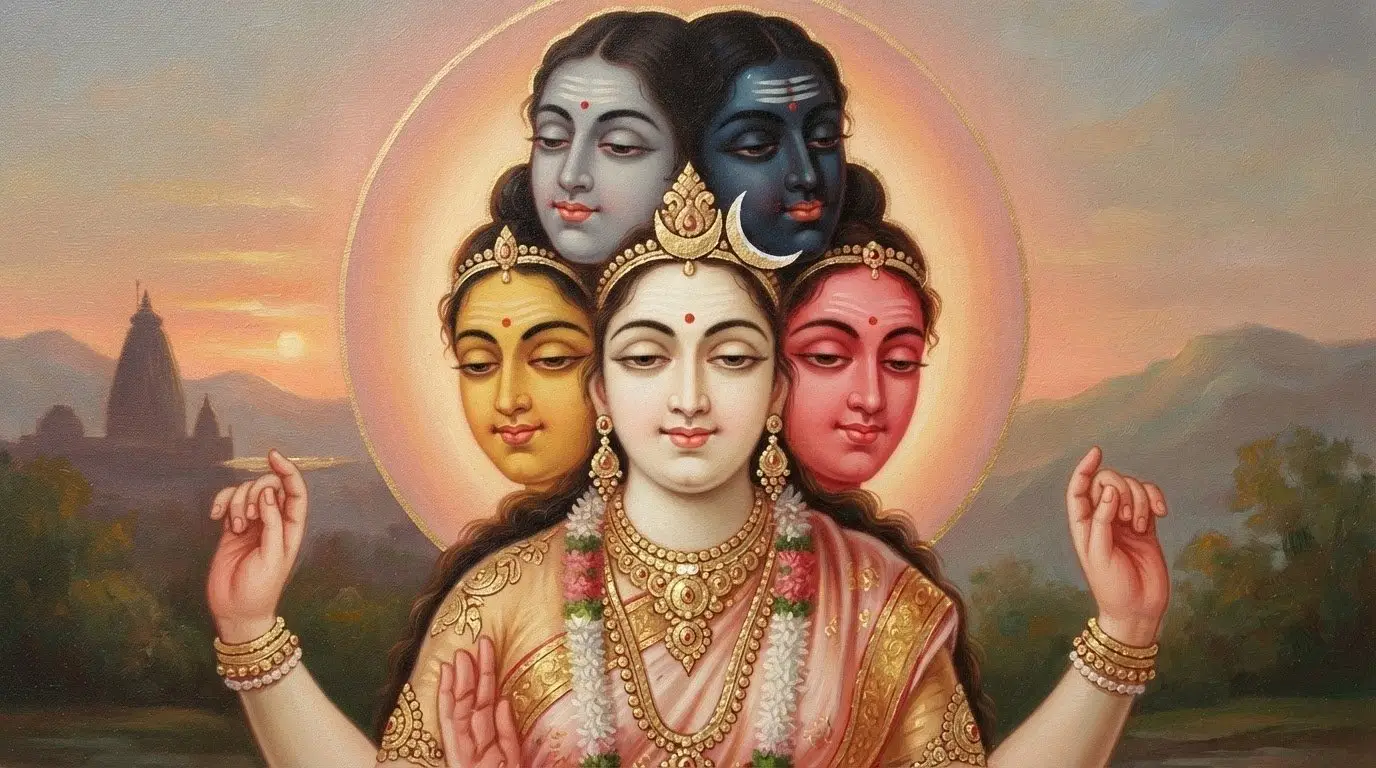
Where Vedic literature speaks of Gayatri chiefly as sound - a metre, a mantra, a verse recited rather than a form pictured - later devotional tradition gave her a visible body, one unusually elaborate even by the standards of a pantheon accustomed to multiple arms and faces.
The Five Faces
Gayatri is most commonly depicted with five faces, each traditionally described as a different colour, associated in some worship traditions with one portion of the mantra itself - white, red, yellow, a dusky hue, and black, corresponding loosely to Om, Bhur, Bhuvah, Svah and the remainder of the verse. Other traditions read the five faces as the five pranas, or vital breaths, that sustain the body, while still others connect them to the five elements (Panchabhuta: earth, water, fire, air and space). These readings are not mutually exclusive so much as layered, and the seeker is generally encouraged to sit with whichever explanation deepens their own contemplation.
The Ten Hands
Gayatri is typically shown with ten arms, a number signalling completeness - often explained as command over the ten directions (four cardinal, four intermediate, zenith and nadir), a presence confined to no single quarter of existence. In her ten hands she generally holds implements from the wider vocabulary of Devi iconography: a conch (shankha), the primal sound of creation; a discus (chakra), the ordered cycle of time; a mace (gada), strength and discipline; a lotus (padma), purity rising untouched from mud; a rosary (akshamala), steady practice; and a water vessel (kamandalu), the self-sufficiency of the ascetic. Two hands are usually shown in mudras - abhaya, freedom from fear, and varada, the granting of boons - a reminder that Gayatri's worship is oriented toward the devotee's practical wellbeing, not abstract doctrine alone. This overlaps considerably with the iconography of Vishnu and Lakshmi; not an inconsistency, but a statement that Gayatri, as Vedamata, holds within her the essence of the entire pantheon's power.
Her Vehicle
Gayatri's vahana is most often given as the swan (hamsa), the same discerning bird associated with Saraswati, reinforcing her identification with knowledge and the discrimination of truth from illusion. Some traditions instead show her seated on a lotus without a vehicle, or occasionally riding a peacock; such regional variation is genuine, and a devotee encountering a slightly different image need not read this as an error.
Gayatri, Savitri and Saraswati
The relationship between Gayatri and the two other names most often mentioned alongside her - Savitri and Saraswati - is one of the more genuinely layered questions in Puranic literature, and different texts resolve it differently.
Gayatri and Savitri
In one widely told Puranic account, Brahma the creator needed to perform a great yajna (sacrificial rite) that required his wife's ritual presence. When Savitri, his principal consort, was delayed, Brahma is said to have taken a second wife - in some tellings a cowherd woman who had appeared during a ritual of milking a cow - on priestly advice that the sacrifice could not proceed without an accompanying wife. This second consort is identified as Gayatri. Finding another woman seated in her place, Savitri is said to have pronounced a curse, one version of which holds that Brahma would henceforth be worshipped in only a single earthly temple, unlike other major gods. This story is central to the temple traditions of Pushkar, discussed below, where both Savitri and Gayatri continue to be honoured close to Brahma.
Because of this narrative, some traditions treat Savitri and Gayatri as related but distinct - Savitri as Brahma's principal, senior consort, Gayatri as a second consort tied to the verse bearing her name. Others treat "Savitri" and "Gayatri" as two names for one goddess, since the mantra itself addresses Savitr, the solar deity, making "Savitri" a natural alternate name for his invocation personified. Readers encountering both names used interchangeably are not meeting an error but a genuine, long-standing plurality within the tradition - worth stating honestly rather than resolving artificially.
Gayatri and Saraswati
Saraswati, too, is frequently named as Brahma's consort, and some traditions treat Gayatri and Saraswati as closely related or even identified - both understood as forms of Vedamata, both associated with the swan, both concerned with true knowledge and articulate speech. Others distinguish them more sharply: Saraswati as the broader goddess of learning and the arts in her full Puranic form, Gayatri as specifically the personification of the foundational Vedic mantra and daily Sandhyavandana. Our companion guide to Goddess Saraswati explores her iconography, origins and mantras in full for readers drawn to the connection between these two knowledge-centred goddesses.
What can be said with confidence is that Gayatri, Savitri and Saraswati together represent one constellation of ideas - sacred sound, disciplined recitation, the sun as the source of inner illumination, and the conviction that true knowledge is inseparable from a purified mind. Which name a devotee uses is, in most living traditions, a matter of regional custom rather than doctrinal dispute.
The Gayatri Mantra: Text and Meaning
The mantra itself is short enough to be learned by a small child and, tradition holds, deep enough that a lifetime of recitation does not exhaust its meaning. It is given below in Devanagari, in transliteration, and with a word-by-word breakdown, since a great deal of the mantra's traditional power is said to rest not merely in its overall sense but in the precise resonance of each individual syllable.
> ॐ भूर्भुवः स्वः तत्सवितुर्वरेण्यं भर्गो देवस्य धीमहि धियो यो नः प्रचोदयात्॥
Om Bhur Bhuvah Svah, Tat Savitur Varenyam, Bhargo Devasya Dhimahi, Dhiyo Yo Nah Prachodayat.
| Sanskrit Word | Transliteration | Word-by-Word Meaning |
|---|---|---|
| ॐ | Om | The primordial sound, the seed-syllable said to underlie all creation |
| भूः | Bhur | The physical or earthly plane of existence |
| भुवः | Bhuvah | The subtle or atmospheric plane, the realm of mind and vital energy |
| स्वः | Svah | The heavenly or celestial plane, the realm of pure being |
| तत् | Tat | That (referring reverently to the divine, rather than naming it directly) |
| सवितुः | Savitur | Of Savitr, the sun conceived as the source and impeller of all life |
| वरेण्यं | Varenyam | Most excellent; worthy of choosing, worthy of worship |
| भर्गो | Bhargo | Radiance, divine effulgence; that which burns away impurity and ignorance |
| देवस्य | Devasya | Of the deity, of the divine |
| धीमहि | Dhimahi | We meditate upon, we contemplate |
| धियो | Dhiyo | The intellect, understanding, the discerning faculty of mind |
| यो | Yo | Who, which (referring back to that divine radiance) |
| नः | Nah | Our |
| प्रचोदयात् | Prachodayat | May it illumine, inspire, impel and direct forward |
Read as a continuous whole, the verse may be rendered: "We meditate upon the adorable radiance of that divine sun, the source of the three worlds; may it illumine and inspire our understanding." It is, at its core, a prayer not for wealth or a specific worldly outcome, but for the awakening of the intellect itself - a request that the light sustaining the physical, mental and spiritual worlds might also sharpen the inner faculty of discernment. This is why the mantra is regarded as suitable for recitation by practically anyone, since a clearer mind is understood as the necessary foundation for whatever more specific aim a person might otherwise pursue.
Scholars and grammarians have long debated fine points of the verse's syntax, and regional oral traditions sometimes present small variations in pronunciation or emphasis. None of this touches the verse's essential meaning or its long-established textual form in the Rigveda; a devotee should not be troubled by minor variant renderings in different books or from different teachers.
Benefits of Chanting the Gayatri Mantra
Traditional and contemporary devotional literature ascribes a wide range of benefits to sincere, regular recitation of the Gayatri Mantra, and it is worth setting these out plainly, while also noting that classical sources are consistent in stressing that benefit is proportional to sincerity, correct pronunciation and regularity, rather than to mere mechanical repetition.
- Clarity and sharpness of intellect (buddhi) - the mantra's central request is precisely for illumination of understanding, so it is widely chanted before serious study or decision-making.
- Inner steadiness and calm - regular practitioners report a settling of scattered, anxious thought, attributed to daily repetition at fixed hours.
- Purification of speech and thought - Bhargo, radiance that burns away impurity, is often read as referring to confused or unwholesome thinking, not only physical light.
- Spiritual protection - many households treat the mantra as daily protective armour, chanted before any significant task or journey.
- Support for meditation - short, rhythmic and familiar from childhood, it is frequently used as an anchor for pranayama and seated practice.
- A bridge across sectarian lines - because it addresses the sun as a universal principle rather than a narrowly sectarian deity, it is recited by Vaishnavas, Shaivas and Shaktas alike.
- Association with longevity and vitality - some traditional sources link sincere practice with bodily health, understood as a natural consequence of the disciplined life Sandhyavandana encourages.
Readers should meet very specific promised outcomes with the same gentle scepticism this tradition generally counsels; the consistent claim across serious sources is a clearer, calmer, more disciplined mind, from which other benefits are said to follow naturally rather than as an automatic transaction.
How and When to Chant: Sandhyavandana
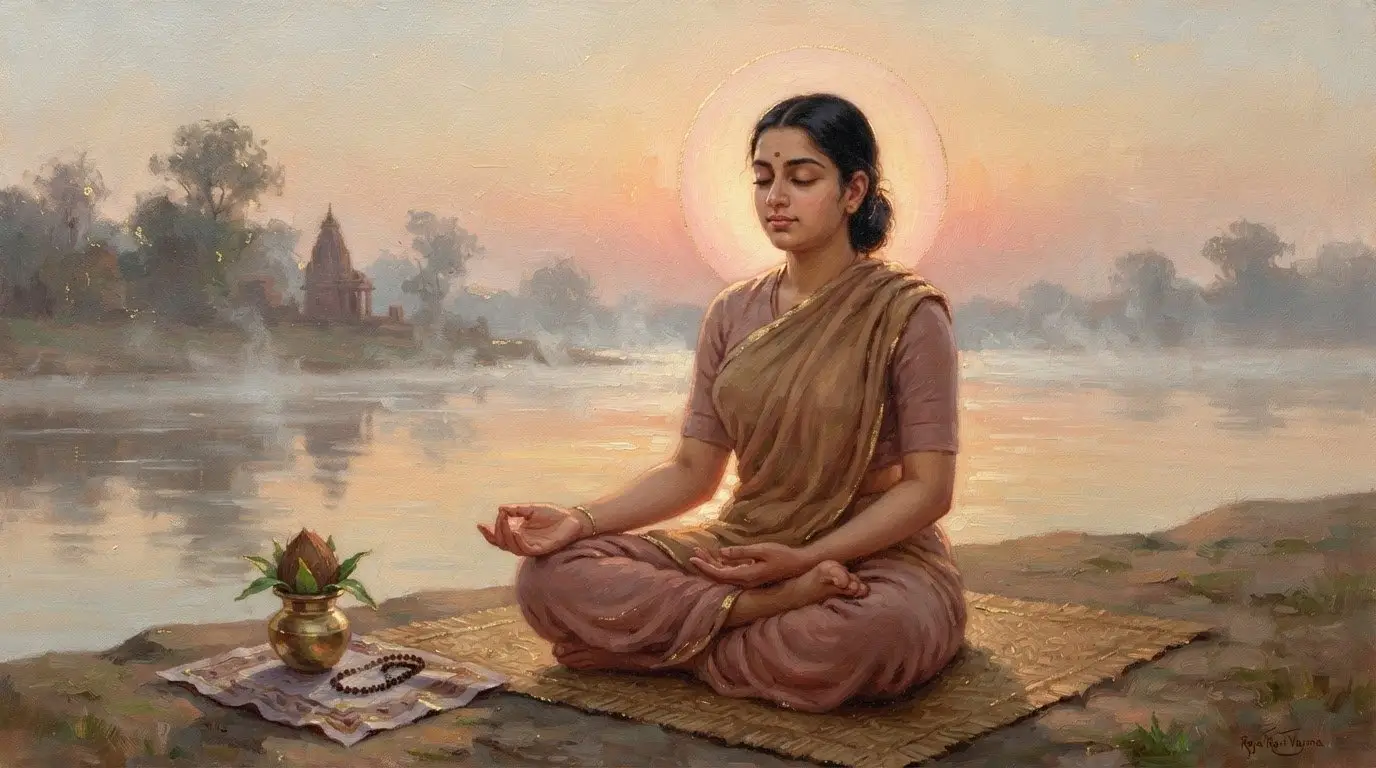
The traditional home of Gayatri Mantra recitation is Sandhyavandana, literally "worship of the junctions" - the three points in the day when one segment of time gives way to another: dawn, midday and dusk. These junctures are considered especially auspicious for contemplative practice because they mark transitions, moments when the day's ordinary business has not yet begun or has already been set aside.
The Three Sandhyas
- Pratah Sandhya (morning) - performed around sunrise, traditionally facing east toward the rising sun, considered the most important and most widely observed of the three sandhyas in contemporary practice.
- Madhyahnika (midday) - performed around noon, when the sun stands at its zenith, traditionally facing north or standing rather than seated.
- Sayam Sandhya (evening) - performed at sunset, traditionally facing west toward the setting sun, marking the close of the day's activity.
In contemporary practice, many devotees who cannot observe all three sandhyas focus on the morning recitation alone, understanding that the discipline of a single, regular daily practice is of greater value than an inconsistent attempt at all three.
The Count
The Gayatri Mantra is traditionally recited in specific multiples, most commonly 108 times, using a mala of 108 beads plus a head bead (the meru), which is not crossed during counting; the practitioner instead reverses direction at the meru once a round is complete. Where 108 repetitions are impractical, traditional guidance permits smaller counts - commonly 3, 9, 28 or 54 - with 108 remaining the ideal.
Method
A typical Sandhyavandana-style Gayatri practice proceeds through several stages: washing the hands, feet and face (achamana), or a full bath where practicable, as external and symbolic purification; a few rounds of pranayama to settle the mind; a steady seated posture facing the appropriate direction for the time of day; the mantra recited aloud, in a whisper, or silently, counted on the mala; and a closing period of quiet sitting, letting the mind rest in the stillness the recitation has cultivated rather than rising immediately into ordinary activity. Some practitioners also use the Gayatri mudra, a specific interlocking of the fingers during recitation - a lineage-specific detail best learned directly from a teacher rather than from a general description.
Rules and Etiquette of Gayatri Japa
Classical Vedic tradition historically associated formal Sandhyavandana and Gayatri initiation with the Upanayana, or sacred thread ceremony, undergone by boys of the twice-born (dvija) communities, and recitation was, for centuries, restricted along lines of caste and gender in ways worth acknowledging honestly rather than glossing over. This has since changed substantially: reform movements over the past century and a half, prominently the All World Gayatri Pariwar founded by Pandit Shriram Sharma Acharya, have actively encouraged recitation by people of every caste and by women, treating the mantra's universal address to the sun as sufficient warrant for universal accessibility. Today it is chanted very widely, and most contemporary teachers welcome sincere practitioners regardless of birth; those wishing to understand a particular family custom are best served by asking a qualified priest or elder.
Beyond this larger historical question, several practical points of etiquette are commonly observed:
- Recite after washing the hands, feet and face, or after a full bath where practicable, as an act of readiness rather than mere superstition.
- Face east at sunrise, west at sunset, and north (or remain standing) at midday, where all three sandhyas are observed.
- Use a mala of rudraksha or tulsi beads, held in the right hand, without crossing the meru bead.
- Avoid reciting while lying down, eating, or distracted; the practice is meant to be undertaken with full attention.
- Maintain a steady, unhurried pace; classical guidance favours quality of attention over speed.
- Correct pronunciation matters - learn the verse directly from a teacher or elder at least once, so subtle errors are corrected early rather than repeated for years.
Other Gayatri Mantras of the Goddess
The word "Gayatri," strictly speaking, names a metre rather than a single fixed verse, and this has given rise, over centuries, to a whole family of Gayatri-pattern mantras addressed to other deities, each following the same three-line, twenty-four-syllable structure of invocation, meditation and request. A brief selection relevant to Devi worship follows.
| Deity | Devanagari | Transliteration |
|---|---|---|
| Devi Gayatri (general) | ॐ सर्वसम्मोहिन्यै च विद्महे विश्वरूपिण्यै च धीमहि तन्नो देवी प्रचोदयात् | Om Sarvasammohinyai Cha Vidmahe Vishwarupinyai Cha Dhimahi Tanno Devi Prachodayat |
| Lakshmi Gayatri | ॐ महादेव्यै च विद्महे विष्णुपत्न्यै च धीमहि तन्नो लक्ष्मी प्रचोदयात् | Om Mahadevyai Cha Vidmahe Vishnupatnyai Cha Dhimahi Tanno Lakshmi Prachodayat |
| Durga Gayatri | ॐ गिरिजायै च विद्महे शिवप्रियायै च धीमहि तन्नो दुर्गा प्रचोदयात् | Om Girijayai Cha Vidmahe Shivapriyayai Cha Dhimahi Tanno Durga Prachodayat |
| Saraswati Gayatri | ॐ सरस्वत्यै विद्महे ब्रह्मपुत्र्यै धीमहि तन्नो देवी प्रचोदयात् | Om Saraswatyai Vidmahe Brahmaputryai Dhimahi Tanno Devi Prachodayat |
Regional traditions preserve more than one version of several of these mantras, particularly the Durga Gayatri, where some sources give "Om Katyayanaya Vidmahe Kanyakumari Dhimahi Tanno Durgi Prachodayat" as an equally well-attested alternative; both forms are widely used. Readers wishing to explore the still more compressed, single-syllable seed sounds Tantric tradition associates with each form of the Devi - Aim, Hreem, Kleem - will find our guide to the beej mantras of the goddess a useful companion here.
Temples of Gayatri Mata
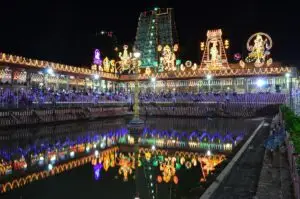
Gayatri is not associated with the dense network of ancient stone temples surrounding goddesses such as Kali or Durga, but two places have become genuine centres of pilgrimage for her devotees.
Shantikunj, Haridwar
Shantikunj, on the outskirts of Haridwar in Uttarakhand, is the headquarters of the All World Gayatri Pariwar, a devotional and social reform organisation founded by Pandit Shriram Sharma Acharya in the mid-twentieth century to popularise Gayatri Mantra practice, Vedic learning and social service across India and the diaspora. The ashram houses a prominent Gayatri temple and conducts regular yajnas, chanting sessions and priest-training programmes, and is closely associated with a wider network of several thousand smaller Gayatri Shaktipeeth shrines across India - making Shantikunj less a single ancient sanctum and more the living, contemporary centre of a devotional movement built around this one goddess and her mantra.
Pushkar, Rajasthan
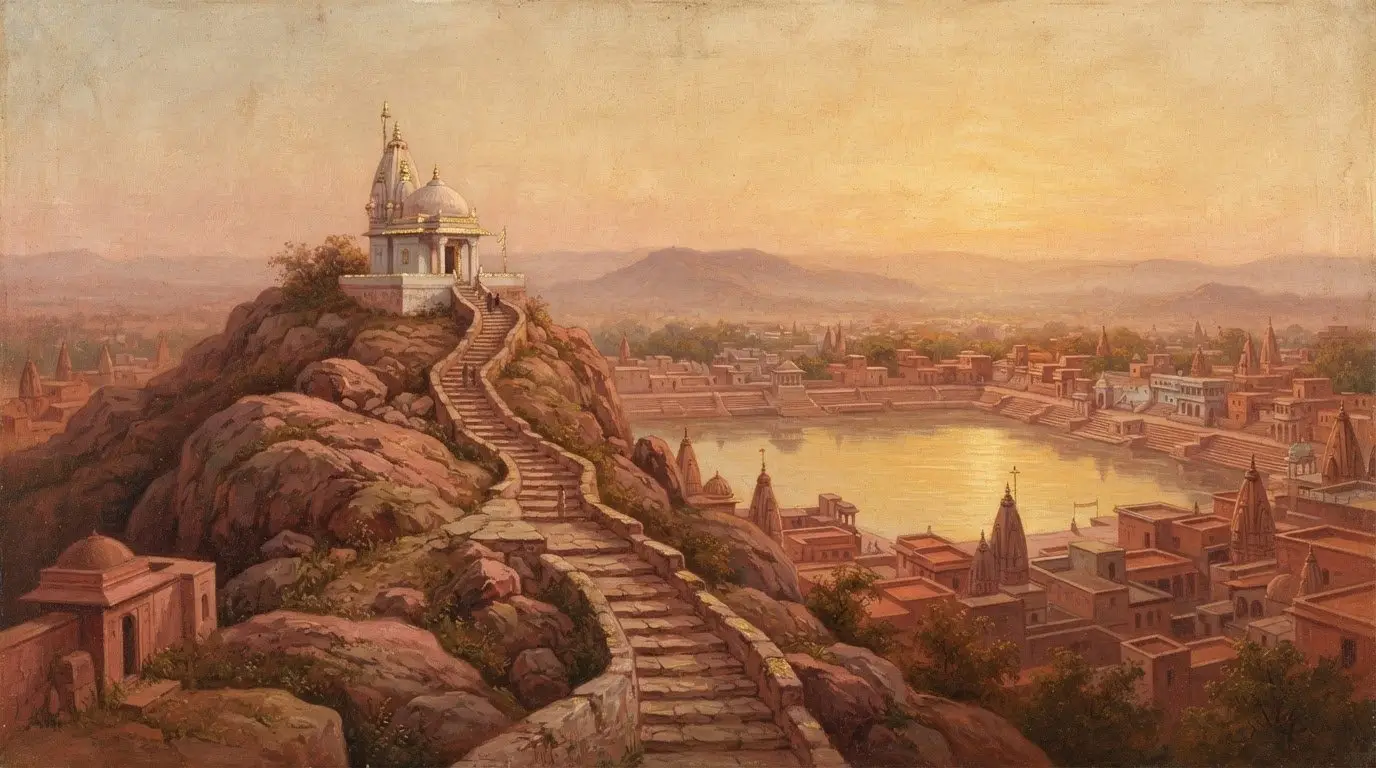
Pushkar, in Rajasthan, is home to one of the very few prominent temples dedicated to Brahma, inseparable from Gayatri's own temple history given the legend recounted earlier in this guide. The main Brahma temple enshrines images understood to represent both of Brahma's consorts, and a small temple to Savitri (sometimes identified with, sometimes distinguished from, Gayatri) stands on a hill overlooking the town, reached by a flight of steps with a wide view over sacred Pushkar Lake. A distinct Gayatri temple stands on a hillside across the lake, and devotees often visit both shrines in a single pilgrimage, along with bathing in the lake, held to be especially purifying during the Kartik Purnima period, when the town's famous fair also takes place.
| How to Reach Pushkar | Detail |
|---|---|
| By Air | Nearest airport is Kishangarh (roughly 25 km) or Jaipur International Airport (roughly 145 km) |
| By Train | Ajmer Junction, about 15 km away, is the nearest major railhead, well connected to Delhi, Jaipur and Mumbai |
| By Road | Well-connected by state highway to Ajmer (15 km) and Jaipur (approximately 3 hours by car) |
Pilgrims travelling to either site are advised to verify current darshan timings locally, since these can vary seasonally and around major festival dates.
Frequently Asked Questions
What does Gayatri Mata mean, and why is she called Vedamata?
Gayatri Mata refers to the goddess personification of the Gayatri Mantra, the foundational Vedic verse addressed to the solar deity Savitr. She is called Vedamata, Mother of the Vedas, because tradition holds that the essence of all four Vedas is contained within her twenty-four syllables.
What is the meaning of Om Bhur Bhuvah Svah?
Bhur, Bhuvah and Svah name the three worlds or planes of existence - the physical, the subtle or mental, and the heavenly or spiritual realm - invoked at the mantra's opening before the main verse addresses the divine radiance of the sun and prays for the illumination of the intellect.
How many times should the Gayatri Mantra be chanted daily?
The traditional and most commonly recommended count is 108 repetitions, using a mala of 108 beads. Where time is limited, smaller established counts of 3, 9, 28 or 54 repetitions are considered acceptable, with regularity valued more highly than achieving the full count on any given day.
What is the best time to chant the Gayatri Mantra?
Sunrise is considered the most important time, followed by noon and sunset - together forming the three sandhyas of traditional Sandhyavandana practice. Many contemporary practitioners who cannot observe all three focus consistently on the morning recitation alone.
Who can chant the Gayatri Mantra?
Formal Sandhyavandana and Gayatri initiation were historically restricted along lines of caste and gender, a fact worth acknowledging honestly. Following decades of reform teaching by organisations such as the Gayatri Pariwar, the mantra is now chanted very widely by people of all backgrounds, and most present-day teachers welcome sincere practitioners regardless of birth.
Is Gayatri the same goddess as Savitri?
Some traditions identify Gayatri and Savitri as the same goddess, since the mantra itself addresses Savitr, the sun, making "Savitri" a natural alternate name. Other tellings, particularly the Pushkar legend of Brahma's two wives, treat them as related but distinct figures. Both readings are genuinely present in the tradition.
What is the connection between Gayatri and Saraswati?
Both goddesses are associated with Brahma and the swan, and with knowledge and sacred speech, and some traditions treat them as closely related or even identified with one another. Others distinguish Saraswati as the broader goddess of learning and the arts, and Gayatri specifically as the personification of the foundational Vedic mantra.
Can the Gayatri Mantra be chanted by anyone, regardless of religion or belief?
The mantra addresses the sun as a universal source of light rather than a narrowly sectarian figure, and in contemporary practice it is chanted very widely, including by many outside strict orthodox tradition. As with any Sanskrit mantra, learning correct pronunciation from a qualified teacher is advised before regular practice.
What are the five faces of Gayatri believed to represent?
Various traditions offer different but complementary explanations - the five faces are variously linked to the opening syllables of the mantra itself, to the five vital breaths (pranas) that sustain the body, or to the five elements that compose the manifest universe. These readings are not considered contradictory so much as layered.
Where can devotees visit a Gayatri temple?
Shantikunj in Haridwar, headquarters of the All World Gayatri Pariwar, is the most prominent contemporary centre of organised Gayatri worship. Pushkar in Rajasthan, home to India's principal Brahma temple, also has dedicated hill shrines to Savitri and Gayatri overlooking the sacred lake.
To chant the Gayatri Mantra with attention, even briefly, each morning, is to keep faith with one of the oldest continuous devotional practices in the Hindu tradition - a small daily return to the light that is said to have given rise to the Vedas themselves. For readers who wish to bring this practice into their own dawn, Musinara offers 432 Hz recordings of the Gayatri Mantra and related chants on our YouTube channel, recorded to be listened to slowly, in the unhurried spirit this mantra has always asked of its reciters.
Related reading
- Goddess Durga: The Complete Guide to the Invincible Mother
- Goddess Lakshmi: The Complete Guide to Her Forms, Mantras and Worship
- Goddess Annapurna: The Complete Guide to the Mother Who Feeds the World
- The Durga Chalisa: Meaning, Verses and How to Recite the Forty-Verse Hymn to the Mother
Watch and listen to devotional music and mantras on the Musinara YouTube channel.