Every form of the Goddess in the Shakta tradition arose for a reason. When the gods could not defeat the buffalo-demon Mahishasura, their combined radiance took shape as a woman with ten arms, and each god placed his weapon in her hands. She was not summoned to exist - she was summoned to finish something. That is Mahishasura Mardini, "the slayer of Mahishasura", and Durga Puja is the festival of her arrival.
This guide tells the story as the Devi Mahatmya tells it, and then follows the avatar across India - because Bengal, Karnataka and Andhra each keep a different piece of the same battle.
Durga Puja 2026: The Dates
| Day | Date | What happens |
|---|---|---|
| Mahalaya | Sat 10 Oct 2026 | Devi Paksha begins; Bengal wakes before dawn to the Mahishasura Mardini recitation |
| Shashthi | Fri 16 Oct | Bodhon - the goddess is awakened; pandals open |
| Saptami | Sat 17 Oct | Nabapatrika snan at dawn; the puja proper begins |
| Ashtami | Sun 18 Oct | Pushpanjali, Kumari Puja; Sandhi Puja at the junction of Ashtami and Navami |
| Navami | Mon 19 Oct | Maha-arati; the last full day of worship |
| Vijayadashami | Tue 20 Oct | Sindoor khela, immersion - and Dashain’s tika in Nepal |
The same nine nights are Sharadiya Navratri across the rest of India - one festival, two grammars of worship.
Why This Avatar Exists: The Story
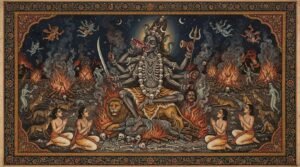
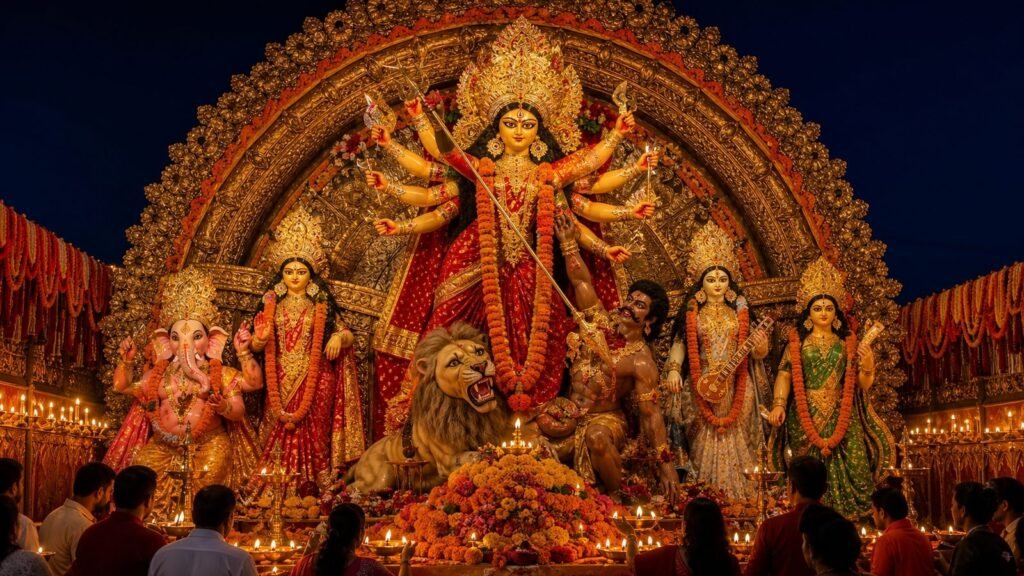
Mahishasura had won a boon that no man or god could kill him. Emboldened, he drove the devas from heaven. In the Devi Mahatmya, the humiliated gods pour their tejas - their burning essence - into one blazing point, and from it the Devi takes form: Himalaya gives her the lion, Vishnu the discus, Shiva the trident, Indra the thunderbolt. The boon had one omission. He had never imagined a woman.
For nine nights the battle turns. Mahishasura shifts shapes - buffalo, lion, elephant, man - and on the tenth day, as he half-emerges from the buffalo’s neck, she pins him with her foot and ends it. The tenth day is Vijayadashami: the victory the whole festival counts down to.
Read alongside: the Mahishasura Mardini Stotram (Aigiri Nandini), verse by verse - the hymn Bengal plays at Mahalaya dawn.
One Avatar, Many Regions
Bengal: she comes home as a daughter
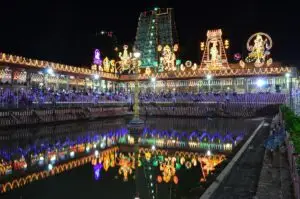
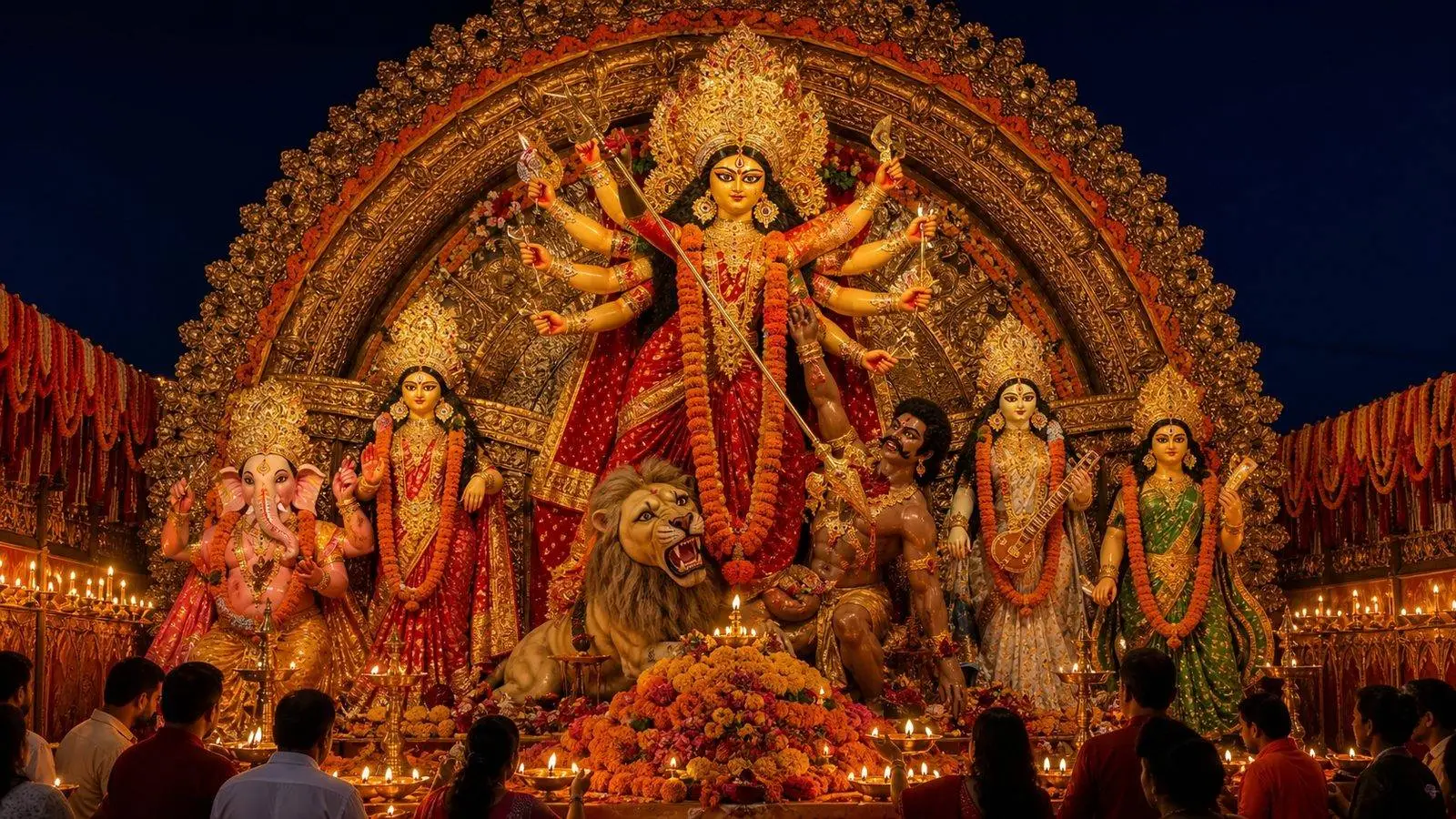
Bengal reads the warrior tenderly. For these five days Durga is Uma returning to her parents’ house with her four children, and the immersion on Dashami is a daughter leaving for her husband’s home - which is why sindoor khela is both joyous and tearful. Kolkata’s Durga Puja is inscribed by UNESCO as intangible cultural heritage, and the murti itself - ten arms, the lion, the falling Mahishasura - is the Devi Mahatmya cast in clay from the Kumartuli workshops.
Karnataka: the hill of the slain buffalo
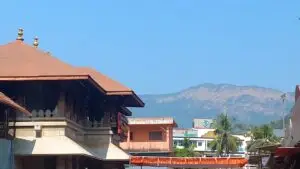
Mysuru remembers the battle as geography. The city’s name is read through Mahishuru - the place of Mahisha - and Chamundeshwari on Chamundi Hill is the slayer herself, honoured every year by the royal Dasara procession. Here the avatar is not a visiting daughter but the resident sovereign of the city she freed.
Andhra and Telangana: the fortress goddess
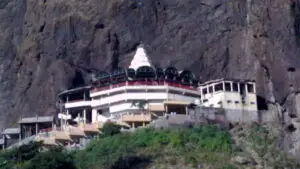
At Kanaka Durga in Vijayawada, perched on Indrakeeladri hill above the Krishna river, Dasara is the year’s great festival, while the same weeks in Telangana belong to Bathukamma - a reminder that the Goddess’s autumn has more than one face even within one language region.
Nepal: Dashain
Across the border the same victory becomes Dashain, the longest festival of the Nepali year, closing with elders placing tika and jamara on the young - the avatar’s blessing passed hand to hand.
Planning a temple visit this Navratri? Navratri 2026 at major Devi temples collects the dates, temple notices and crowd advice for Mysuru, Vijayawada, Kolkata, Vaishno Devi, Kamakhya and other shrines.
Frequently Asked Questions
When is Durga Puja in 2026?
Shashthi falls on Friday 16 October 2026, Ashtami on Sunday 18 October, and Vijayadashami on Tuesday 20 October. Mahalaya is Saturday 10 October.
Why is Durga called Mahishasura Mardini?
Mardini means "she who crushes". The name records the single purpose for which this form arose: the defeat of Mahishasura, the buffalo-demon no god could kill.
Is Durga Puja the same as Navratri?
They share the same nine nights of Ashwin. North and West India keep them as Navratri - nine forms, nine colours, fasting - while Bengal, Odisha and Assam keep the last five days as Durga Puja, the daughter’s homecoming.
What is Sandhi Puja?
The 48-minute junction between Ashtami and Navami - held to be the moment the Devi took the fierce Chamunda aspect and slew Chanda and Munda. It is the ritual heart of Durga Puja, marked with 108 lamps.
What happens on Mahalaya?
Devi Paksha begins. In Bengal, households wake before dawn for Mahishasura Mardini - the radio recitation of the Devi’s birth and battle - and ancestors are offered tarpan.
Official Sources
- UNESCO - Durga Puja in Kolkata - the 2021 inscription on the Representative List of Intangible Cultural Heritage
- Utsav - Ministry of Tourism, Government of India - official festival listings
- Mysuru Dasara - Government of Karnataka’s official Dasara portal
Continue Your Journey
- Goddess Durga: The Complete Guide
- Mahishasura Mardini Stotram: Ayi Giri Nandini, verse by verse
- Navratri Colours 2026: all nine days
- Kali Puja 2026: date, muhurat and vidhi
May the one who arrived for a single battle stand guard over all of yours.
What are the ten days of Durga Puja?
This question comes up constantly, and the confusion is understandable, because three overlapping counts are all in use at once.
- Nine nights. Sharadiya Navratri runs from Pratipada to Navami, 11 to 19 October 2026. Nine nights, nine forms of the Goddess.
- Ten days. Add Vijayadashami on 20 October and you have ten. This is the count most people mean by "the ten days", and it is why the festival is called Dussehra, from dasha-hara, the tenth.
- Five days. The Bengali Durga Puja proper is only the last stretch: Shashthi to Dashami, 16 to 20 October. Pandals open on Shashthi, not on Pratipada.
Mahalaya on Saturday 10 October sits outside all three. It is the amavasya that closes Pitru Paksha and opens Devi Paksha, and in Bengali households it is the pre-dawn radio recitation of the Mahishasura Mardini stotram rather than a day of puja.
Can Durga Puja be done at home?
Yes, in the household form. What is not usually attempted at home is the full community pratima puja.
What households commonly do: establish a ghot or kalash, keep a lamp through the days, offer flowers and fruit each morning, read the Devi Mahatmya or the Durga Chalisa, observe fasts on Ashtami, and perform pushpanjali at home if a pandal is not reachable. None of this requires a priest.
What traditionally does not move home: the Nabapatrika snan at dawn on Saptami, the Sandhi Puja at the junction of Ashtami and Navami, and the pran pratishtha of an image. These are performed by a purohit to a fixed timing taken from the panjika, and the timing differs by city and by which panjika a family follows. We deliberately do not publish those muhurat times, because being an hour out on Sandhi Puja is not a small error.
If you are setting up for the first time, the practical steps are in our guide to Devi worship at home, and the chanting side is covered in how to chant a mantra. For the stotram that defines Mahalaya morning, see the Mahishasura Mardini stotram with meaning.