Among the many devotional compositions addressed to the Divine Mother, few are recited with the sheer daily regularity, in so many ordinary households, as the Durga Chalisa. It does not carry the antiquity of the Devi Mahatmya, nor the elaborate Sanskrit architecture of a classical stotra composed by a great acharya; it is, instead, a forty-verse hymn set in a register of Hindi close enough to everyday speech that a devotee with no training in Sanskrit can read it, follow a good part of its meaning unaided, and carry its rhythm through a busy morning without strain. This accessibility is, in a sense, the entire purpose of the Chalisa as a devotional form - a genre of which the far more widely known Hanuman Chalisa is the best-known example, designed to place the essence of a deity's power, character and protection within reach of the household altar rather than the Sanskrit school.
The Durga Chalisa is chanted by devotees across North India and well beyond it, particularly through the nine nights of Navratri, when it is very often sung after the evening Durga Aarti as households gather before the goddess's image or a lit akhand jyot. Yet its use is by no means confined to the festival calendar. A great many households recite it every single morning of the year, treating it as a compact, dependable practice that asks for no elaborate preparation - only a lit lamp, a few unhurried minutes, and the attention of the one reciting.
This guide sets out what the Chalisa is and the tradition surrounding its authorship, the shape of its forty verses and their surrounding dohas, a selection of its most loved lines given in Devanagari with transliteration and meaning, the vivid imagery of lion, weapon and vanquished demon running through its lines, the many forms of the goddess it touches upon, and the benefits devotees have long associated with its recitation - together with practical guidance on when, how, and with what quiet care to chant it.
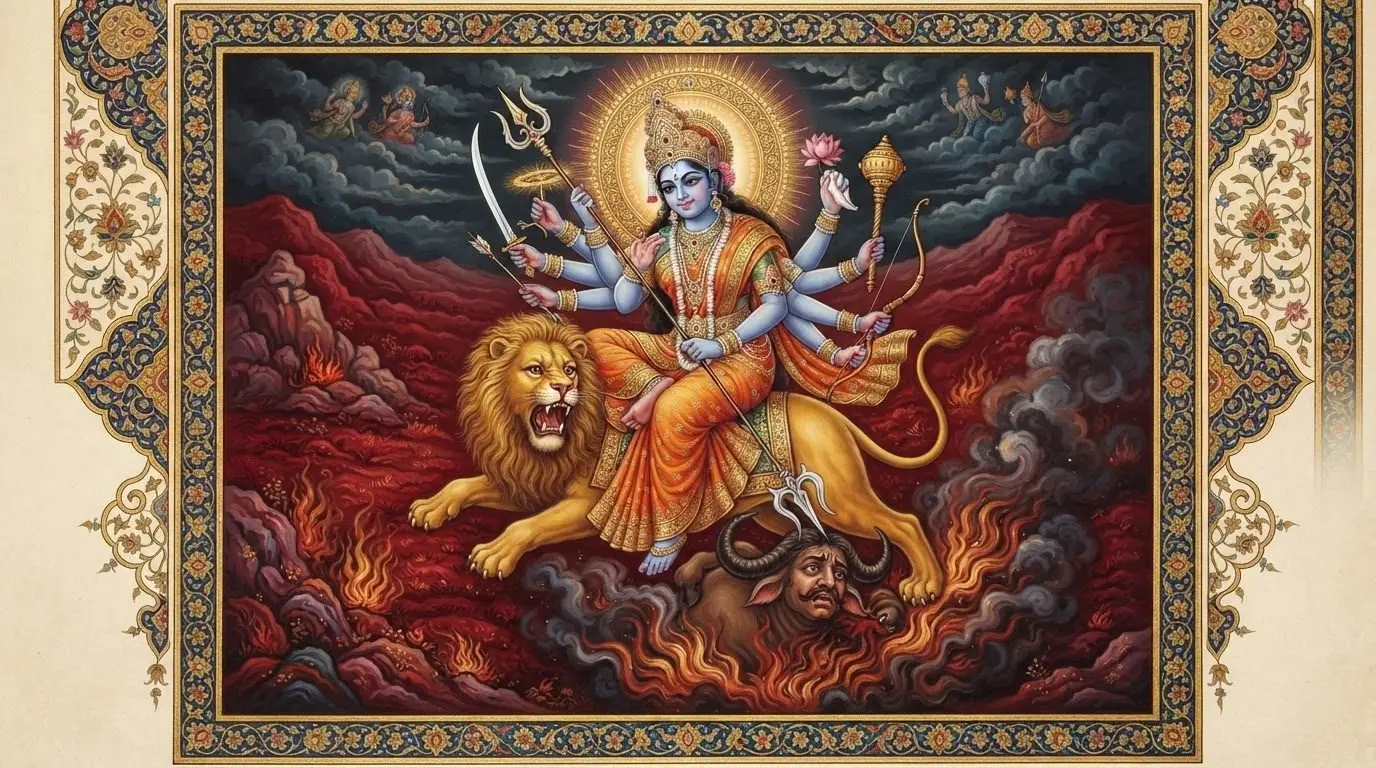
- What Is the Durga Chalisa?
- Who Composed It? The Question of Devidas
- Structure: Doha, Forty Chaupais and the Closing Verse
- Selected Verses: Devanagari, Transliteration and Meaning
- The Imagery of the Chalisa: Lion, Weapons and Mahishasura
- The Many Forms of the Goddess Invoked
- Themes and Meaning
- Benefits of Reciting the Durga Chalisa
- How and When to Recite the Durga Chalisa
- Pronunciation and Rules to Observe
- Frequently Asked Questions
What Is the Durga Chalisa?
"Chalisa" derives from the Hindi chalis, forty, and denotes a devotional composition built around forty core verses, typically framed by an opening and closing doha - a couplet in a slower, more deliberate metre - that bookend the main body of chaupais, four-line verses in a lighter, more singable metre. The Durga Chalisa follows this template closely, and anyone who has recited the far more famous Hanuman Chalisa will recognise its cadence almost at once - the two compositions share not only a metrical structure but a certain unhurried, conversational warmth quite different from the denser Sanskrit of a classical stotra.
Unlike the Durga Saptashati, the seven-hundred-verse Sanskrit text embedded in the Markandeya Purana that narrates Durga's battles with Mahishasura, Madhu-Kaitabha and Shumbha-Nishumbha in full mythological detail, the Chalisa does not attempt sustained narrative. It is closer to a garland of praise - verse after verse naming the goddess's qualities, her forms, her past acts of grace, and the devotee's own plea for continued protection - than to a scripture recounting events in careful sequence. A reader who wants the full mythological architecture behind the goddess's battles should turn to the Saptashati, or to our complete guide to Goddess Durga; the Chalisa, by contrast, is meant to be lived with daily, its lines returned to so often that they become less something one reads and more something one simply knows by heart.
A Chalisa, Not a Stotra
The distinction matters for how the text is used in practice. A Sanskrit stotra is typically recited with close attention to precise metre and pronunciation, often under guidance, and carries the weight of a fixed liturgical composition attributed to a named author of considerable scholarly standing. A Chalisa, being composed in vernacular language - here an older register of Hindi with Braj and Awadhi inflections rather than formal Sanskrit - sits closer to folk devotional literature. It circulates in slightly different printed versions from one publisher to another, verse order occasionally shifts, and the tone throughout is warmer and less formal than Sanskrit hymnody, better suited to being sung by a family gathered before a small shrine than performed as elaborate temple liturgy.
Who Composed It? The Question of Devidas
Authorship of the Durga Chalisa is not established with anything like the documentary certainty scholars can bring to, say, Adi Shankaracharya's stotras. What is known rests largely on an internal clue within the text itself: the closing verses of most widely printed editions include a line in which the composer names himself, asking the goddess for refuge and grace - a signature convention common across the Chalisa genre, where the author often works his own name into the final couplet as a mark of authenticity and personal devotion, much as Tulsidas does in the closing lines of the Hanuman Chalisa.
The name that appears is Devidas, and tradition accordingly attributes the Durga Chalisa to a devotee or poet of that name, though very little verifiable biographical detail about him survives outside this signature. Some regional traditions place the composition within the broader Bhakti-era flowering of vernacular devotional literature in North India, a period in which numerous chalisas, aartis and simple bhajans were composed in Hindi and its dialects specifically to bring temple worship within reach of people who had no access to Sanskrit education - a democratising impulse that runs through the entire genre, from the Hanuman Chalisa to lesser-known compositions honouring Shani, Santoshi Maa and other widely loved deities.
Readers should hold this attribution with the same intellectual honesty the wider Chalisa tradition invites: the Durga Chalisa is best understood as a beloved piece of devotional folk literature, shaped and reshaped somewhat across generations of oral and printed transmission, rather than a fixed scriptural text with a single, certain authorial history. This does not diminish its power in daily practice in the slightest - if anything, the very fact that it emerged from and was sustained by ordinary devotional life, rather than a court or monastic institution, is part of why it has remained so widely and affectionately recited for so long.
Structure: Doha, Forty Chaupais and the Closing Verse
The Durga Chalisa follows the now-familiar three-part architecture it shares with the Hanuman Chalisa and several other compositions of the same devotional lineage.
It opens with an invocatory doha, a short couplet composed in a slower, more deliberate metre than what follows, whose purpose is to settle the reciter's attention, offer initial salutation to the goddess, and state the reciter's intention to sing her praise. This is followed by the main body: forty chaupais, four-line verses in a lighter, quicker metre well suited to being sung or chanted at a steady, almost rhythmic pace. These forty verses move through praise of the goddess's radiance and form, her various associated forms and legends - including, in the version most widely printed today, references to her as Annapurna, as Saraswati, and to her incarnation as Narasimha - her role in the Mahishasura episode, her weapons and her lion, and a series of personal petitions for the removal of obstacles, illness, poverty and fear, closing with renewed praise and surrender.
The composition then closes with a final doha, mirroring the opening in metre and tone, in which the composer's signature appears - the reference to Devidas noted above - along with a final plea for the goddess's grace and protection to remain upon whoever recites the hymn with faith.
It is worth noting, for newer readers, that printed editions vary somewhat in exactly how they divide and number the forty chaupais, and a small number of lines differ between publishers - a normal feature of orally transmitted and widely printed vernacular devotional literature rather than a sign that any particular edition is incorrect. Devotees are best served by settling on one trusted printed or temple-published edition and reciting it consistently, rather than anxiously comparing every minor variant against another.
Selected Verses: Devanagari, Transliteration and Meaning
The verses below are among the most widely recognised lines of the Durga Chalisa, chosen to give a sense of its imagery, its devotional register, and the range of themes it moves through - from the goddess's radiant form, to her various incarnations, to the closing signature and petition. They are presented here as commonly published rather than under a single, fixed verse numbering, since, as noted above, numbering and minor wording vary a little across editions.
| Devanagari | Transliteration | Meaning |
|---|---|---|
| नमो नमो दुर्गे सुख करनी। नमो नमो अम्बे दुःख हरनी॥ | Namo namo Durge sukh karani, namo namo Ambe dukh harani | Salutations again and again to Durga, giver of happiness; salutations again and again to Amba, remover of sorrow. |
| निराकार है ज्योति तुम्हारी। तिहुं लोक फैली उजियारी॥ | Nirakar hai jyoti tumhari, tihun lok phaili ujiyari | Your light is formless, without a fixed shape; it has spread its brightness through all three worlds. |
| शशि ललाट मुख महाविशाला। नेत्र लाल भृकुटि विकराला॥ | Shashi lalat mukh mahavishala, netra lal bhrikuti vikarala | A crescent moon rests upon your vast, radiant brow; your eyes are red, your furrowed brow fierce and commanding. |
| रूप मातु को अधिक सुहावे। दरश करत जन अति सुख पावे॥ | Roop matu ko adhik suhave, darash karat jan ati sukh pave | Your form, Mother, is exceedingly beautiful; the devotee who beholds it attains the greatest joy. |
| नरसिंह रूप धरो तुम अम्बा। प्रगट भई फाड़कर खम्बा॥ | Narsingh roop dharo tum amba, pragat bhai phaadkar khamba | You took the form of Narasimha, O Amba, and appeared bursting forth from the pillar to protect your devotee. |
| देवीदास शरण निज जानी। करहु कृपा जगदम्ब भवानी॥ | Devidas sharan nij jaani, karahu kripa jagadamb Bhavani | Knowing Devidas to be under your own refuge, O Mother of the universe, Bhavani, bestow your grace upon him. |
The final verse above is the closing couplet in which the composer's name appears, discussed in the authorship section - it is this line, more than any other, that grounds the traditional attribution of the hymn to a devotee named Devidas.
The Imagery of the Chalisa: Lion, Weapons and Mahishasura
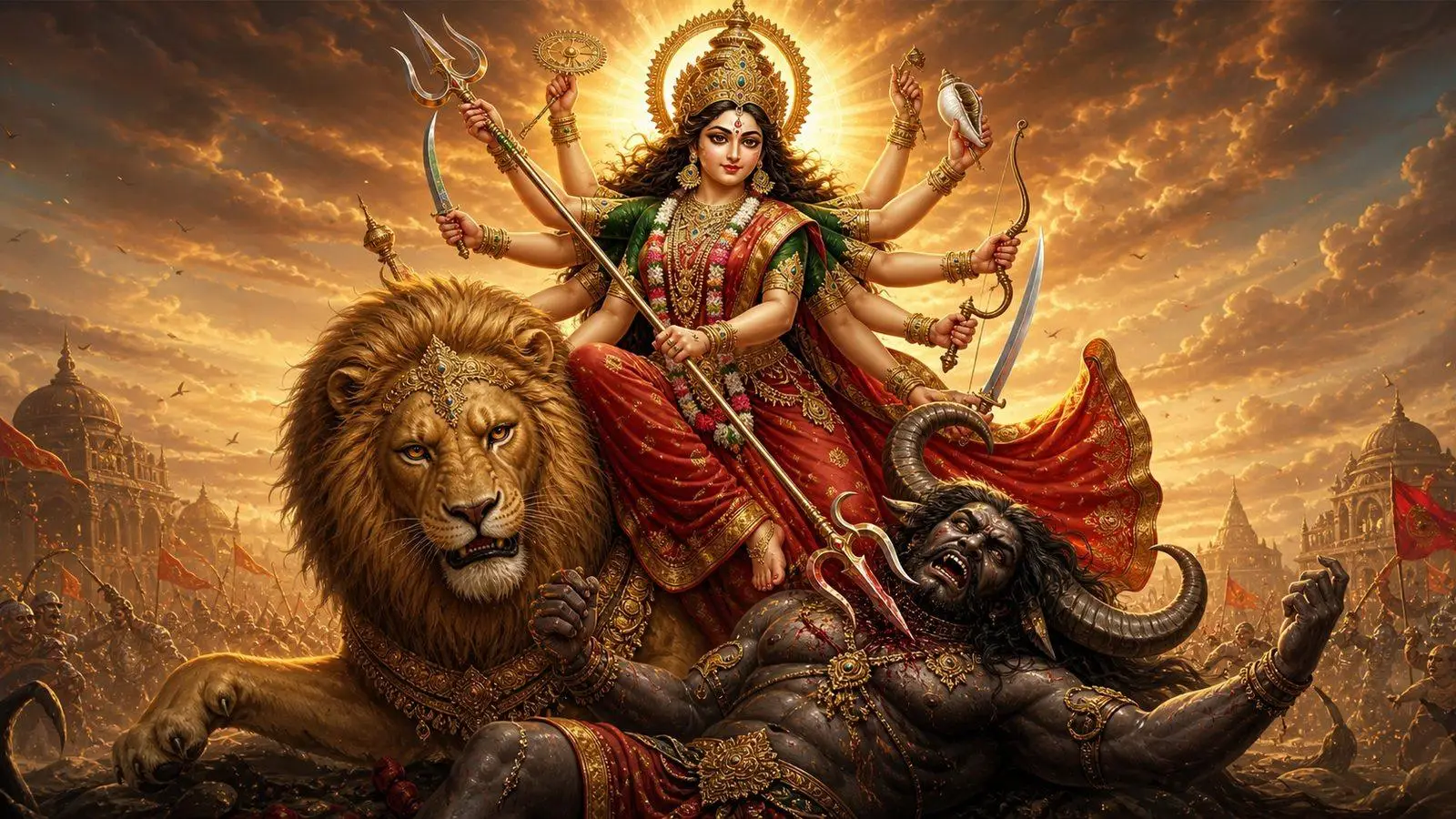
Though the Durga Chalisa is not a narrative text in the way the Devi Mahatmya is, it draws its imagery directly from the same well of mythology, compressing entire episodes into single lines that a devotee who already knows the stories will recognise immediately.
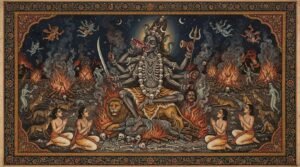
The goddess's lion vahana appears repeatedly, as it does throughout Durga iconography generally, representing willpower and raw strength brought fully under her command rather than left to run wild - the same reading given at length in our complete guide to Goddess Durga. Several verses describe her weapons, gifted by the gods according to the Devi Mahatmya's own account of her creation, though the Chalisa treats them impressionistically, invoking the general image of an armed, protective mother rather than cataloguing each weapon individually as some Sanskrit stotras do.
Mahishasura, the buffalo-demon whose defeat is the central episode of Durga's mythology, is named directly in several chaupais describing him as an arrogant king whose burden of sin had grown so heavy that the earth itself could no longer bear it - language that closely echoes the opening frame of the Devi Mahatmya, in which the earth goddess petitions Brahma for relief from the demon's oppression before Durga is ever created. The Chalisa then moves swiftly to the goddess's triumph, treating the battle less as an event to be narrated blow by blow and more as an established fact of her character: she is the one who has already vanquished what could not otherwise be defeated, and this settled certainty is precisely what the devotee draws upon in reciting her praise.
One especially striking verse recalls her incarnation as Narasimha, the man-lion who burst forth from a palace pillar to destroy the demon Hiranyakashipu and protect his devotee Prahlada - an episode more usually associated with Vishnu's ten avatars than with the Devi tradition specifically, and its inclusion here is a good example of how vernacular devotional literature often moves fluidly across sectarian lines, treating the Divine Mother as the underlying power behind every avatar and every act of divine protection, rather than confining her strictly to episodes drawn only from Shakta scripture.
The Many Forms of the Goddess Invoked
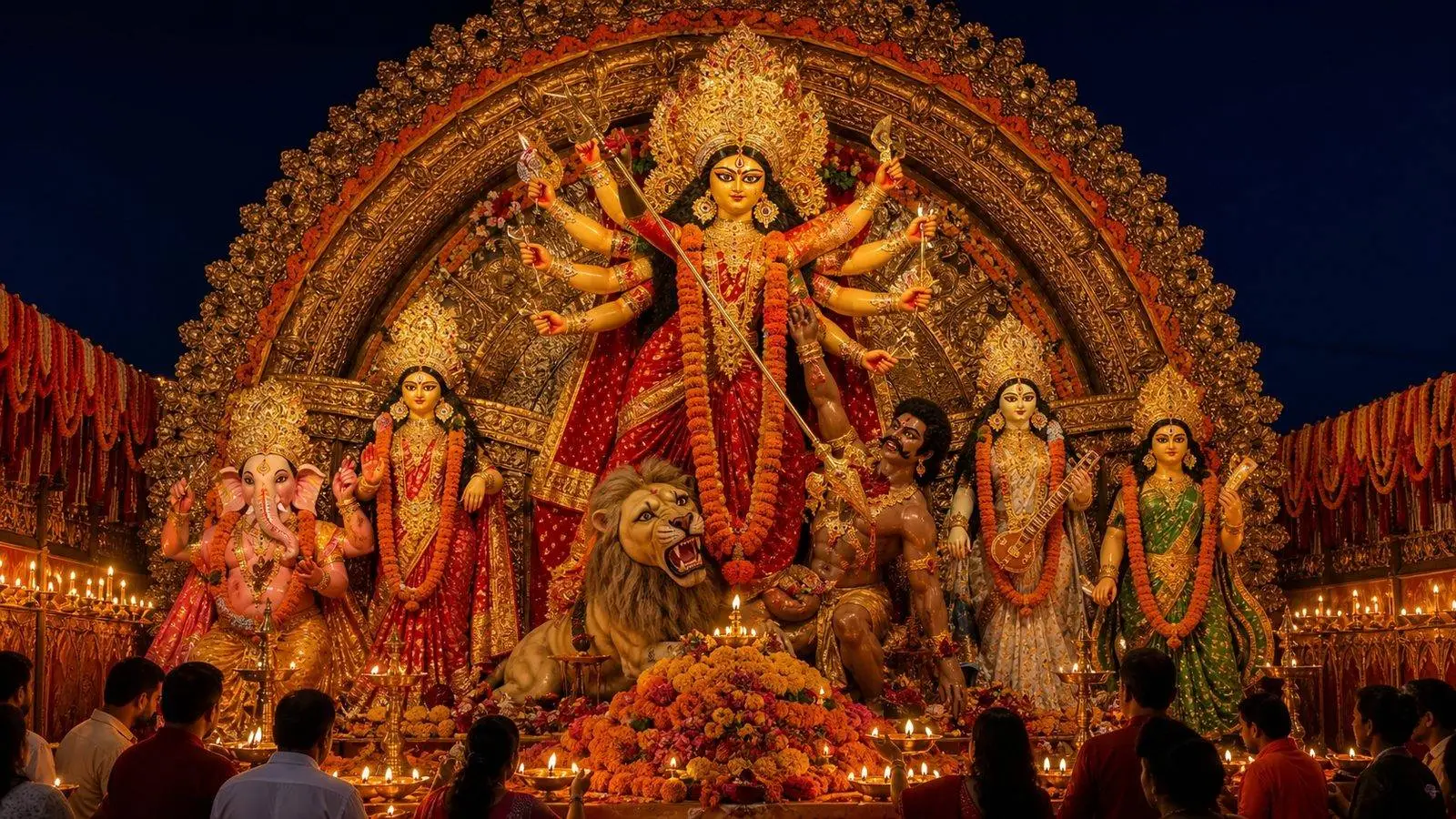
Part of what makes the Durga Chalisa such a well-loved daily practice is its refusal to confine the goddess to a single narrow role. Across its forty verses she is addressed and described as Annapurna, the giver of food and sustenance, as Saraswati, granting the wisdom that is said to have saved sages and seers in a moment of crisis, and as Gauri, beloved consort of Shiva - each identification folded into a single verse rather than developed at length, in keeping with the Chalisa's compressed, garland-like style. This multiplicity is not a contradiction devotees feel any need to resolve: within Shakta tradition generally, and reinforced explicitly in the Chalisa's own lines, these are understood as different faces of one underlying Adi Parashakti, the current explored at length in our piece on Adi Parashakti as the supreme, undivided divine mother behind every individual goddess.
During Navratri specifically, when the Chalisa is recited most intensively, this multiplicity of forms resonates directly with the nine-night sequence of the Navadurga, the nine forms of the goddess worshipped on successive nights, covered fully in our guide to Navratri and the Navadurga; reciting the Chalisa nightly through the festival, many devotees feel, is a way of holding all nine forms in view at once rather than moving through them one at a time. Devotees who wish to explore a shorter, more tightly focused hymn specifically on the Mahishasura episode, sung by many households alongside or instead of the Chalisa during Navratri, may also find our guide to the Mahishasura Mardini Stotram a useful companion piece.
Themes and Meaning
If a single image threads the whole of the Durga Chalisa together, it is light - the second verse's declaration that the goddess's radiance, formless in itself, has spread its brightness through all three worlds. This is not merely poetic decoration; it sets the tone for everything that follows. The goddess is approached here not primarily as a distant cosmic force but as an immediate, warm, illuminating presence, one whose light a devotee can invite into an ordinary room with an ordinary lamp.
Running alongside this is the recurring theme of sharan, refuge. Nearly every chaupai either praises the goddess or asks something of her, and the requests are strikingly human in scale: relief from daridra (poverty), rog (illness), bhay (fear) and vipatti (calamity) recur again and again, rather than requests for grand spiritual attainment. This is part of what distinguishes the Chalisa's register from a more philosophically ambitious Sanskrit stotra - it is a text written, and recited, by and for people asking the Divine Mother to help them through the ordinary difficulties of a life, not primarily for advanced metaphysical insight.
The Chalisa also holds fierceness and tenderness together without strain, in exactly the way Durga's iconography does more broadly. She is described with a "fierce, furrowed brow" in one line and as a form devotees find endlessly beautiful and joy-giving in the next; she is armed and victorious over demons, and in the same breath she is Annapurna, quietly feeding the world. This combination - a mother who is both battle-ready and nourishing - is arguably the single most important theological idea the Chalisa communicates, and it is communicated not through argument but through the simple accumulation of verse after verse of praise.
Benefits of Reciting the Durga Chalisa
- Removal of fear and anxiety - many devotees turn to the Chalisa specifically in moments of dread, before a difficult meeting, a medical test, or a journey, treating its recitation as a way of steadying the mind.
- Protection from obstacles and negative influence - its verses are widely believed to ward off ill-will, obstruction and what tradition describes as negative energy directed at the household.
- Relief in illness and hardship - several chaupais directly petition the goddess for relief from disease and poverty, and the Chalisa is a common daily practice for households going through a difficult period.
- An accessible daily discipline - because it is short, memorable and in Hindi rather than Sanskrit, it is one of the easiest devotional practices to sustain consistently, even for readers with no prior training in scripture.
- Deepened connection during Navratri - reciting it nightly through the nine nights, alongside the Aarti, is one of the most common ways ordinary households mark the festival without needing an elaborate ritual calendar.
- A settling effect on the mind - the steady, singable metre of the chaupais lends itself to a kind of gentle repetition that many devotees describe as calming in the same way a mantra's repetition is calming, even without formal mantra initiation.
- A gateway into wider Devi worship - for many households, the Durga Chalisa is the very first devotional text a child or new devotee learns by heart, forming the foundation from which an interest in the goddess's fuller mythology and scripture later grows.
How and When to Recite the Durga Chalisa
Daily Practice
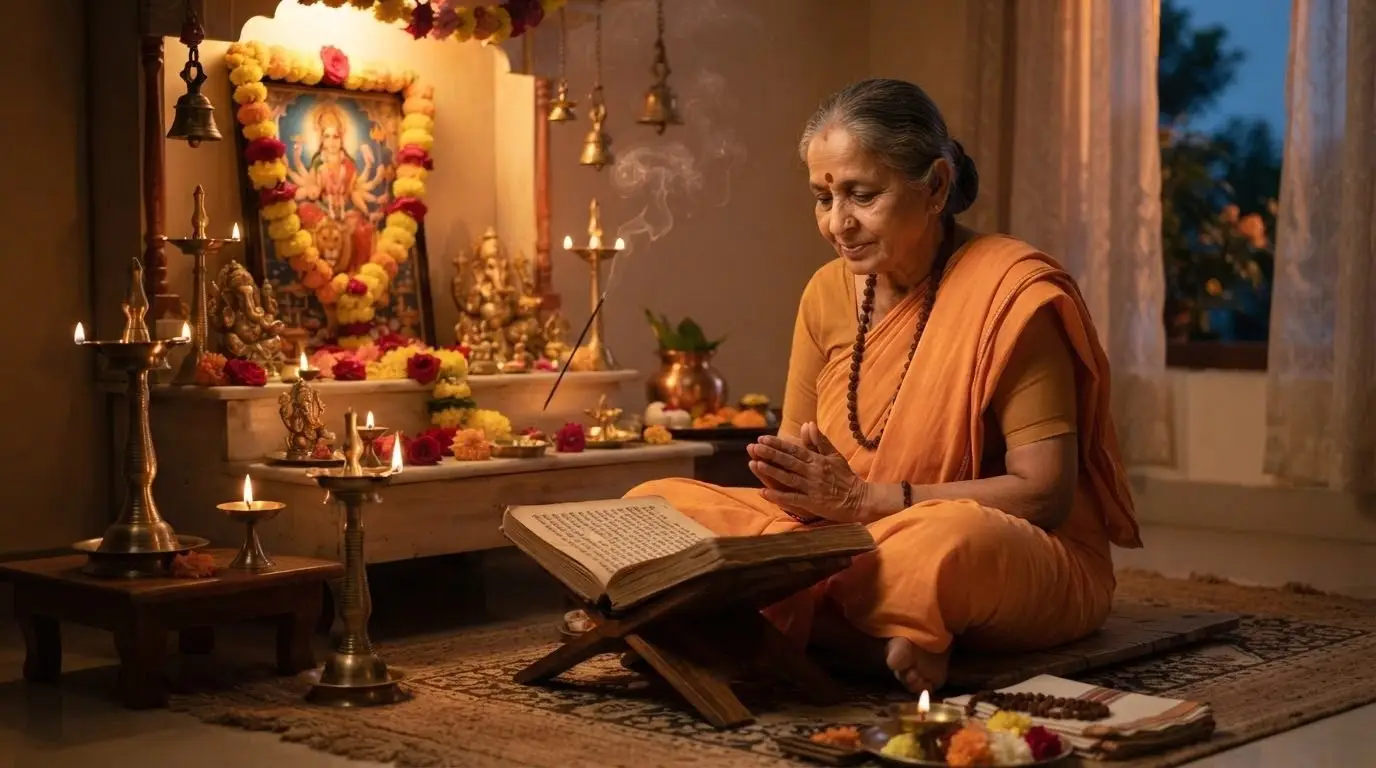
Most households recite the Durga Chalisa once each morning, ideally after bathing, facing the household shrine or an image of the goddess, with a lit diya and, where possible, a stick of incense. It takes only a few minutes in full and requires no elaborate preparation beyond this - which is precisely why it has become such a durable daily habit across generations.
Navratri
Through the nine nights of Navratri, the Chalisa is very often recited each evening after the Durga Aarti, once the household or temple gathering has completed the formal lamp offering. Many devotees increase their recitation during this period, some reciting it once at dawn and again in the evening, treating the whole festival as an intensified version of their ordinary daily practice rather than a wholly separate observance.
Tuesdays and Fridays
Tuesday is widely regarded in many parts of North India as a day particularly suited to Devi worship generally, alongside its long association with Hanuman, and a good number of devotees make a point of reciting the Durga Chalisa on this day even if they do not manage it daily. Friday, too, is treated by many households as an auspicious day for worship of the Divine Mother in her various forms, and some devotees specifically reserve their weekly recitation for this day, particularly where Friday is already set aside for wider household puja.
After Durga Aarti
In many temples and household traditions, the Chalisa is recited immediately following the Aarti rather than before it - the reasoning offered is that the Aarti itself is an act of formal welcome and honour to the goddess, and the Chalisa that follows becomes a more personal, conversational continuation of that welcome, praise moving into petition once the formal light-offering is complete.
Count and Mala
Unlike some Sanskrit stotras recited a fixed number of times using a mala, the Durga Chalisa is generally recited once through in a single sitting as a complete unit, rather than counted in repetitions of individual verses. Devotees undertaking a more intensive personal sadhana, particularly during Navratri, sometimes recite it multiple times through the day, but there is no fixed traditional count comparable to the 108 repetitions common to short mantras.
Pronunciation and Rules to Observe
Because the Durga Chalisa is composed in Hindi rather than formal Sanskrit, its pronunciation is considerably more forgiving than that of a classical stotra, and most literate readers of Hindi or Devanagari can recite it correctly with only modest practice. That said, listening to a trusted recording, or reciting alongside someone more experienced, for the first several attempts is still worthwhile - it helps a new reciter internalise the natural rhythm of the chaupai metre, which reads far more smoothly when sung or chanted at a steady pace than when read silently word by word.
A few simple observances are widely followed. Devotees generally bathe before reciting, or at least wash the hands and face if a full bath is not practical, and prefer to face the deity's image or an eastward direction while chanting. The text itself is treated with the same basic respect given to any devotional book - not placed directly on the bare floor, not stepped over, and closed or covered rather than left open when not in use. Beyond this, tradition places relatively few restrictions on who may recite the Chalisa or under what circumstances; family and community conventions vary on matters such as recitation during a period of mourning or menstruation, and devotees are best guided by the practice their own household or local temple follows rather than a single universal rule.
For readers new to Devi worship more broadly, our guide to the Beej Mantras of the Goddess explains the seed-sound tradition - including the "Dum" invoked in Durga's own beej mantra - that underlies much of the shorter mantra practice often paired alongside chalisa recitation.
Further reading: for the broader history of chalisa literature as a devotional genre in North Indian bhakti tradition, see the [Wikipedia entry on the Chalisa](https://en.wikipedia.org/wiki/Hanuman_Chalisa) form.
Frequently Asked Questions
What is the Durga Chalisa?
The Durga Chalisa is a forty-verse Hindi devotional hymn in praise of Goddess Durga, framed by an opening and closing doha, recited daily by many households and especially through the nine nights of Navratri.
Who wrote the Durga Chalisa?
Tradition attributes it to a devotee named Devidas, based on a signature line in the closing verses, though little further biographical detail about him is verifiably known - it is best understood as a beloved piece of devotional folk literature rather than a text with a single certain authorship.
How many verses does the Durga Chalisa have?
As its name suggests, it comprises forty chaupais, bookended by an opening doha and a closing doha, following the same three-part structure as the Hanuman Chalisa and several related compositions.
Can the Durga Chalisa be recited daily?
Yes - daily recitation, typically once each morning after bathing, is the most common way it is practised, and it requires no elaborate ritual preparation beyond a lit lamp and a few unhurried minutes of attention.
What is the best time to recite the Durga Chalisa?
Morning, after bathing, is the most common time, though many households also recite it each evening during Navratri immediately after the Durga Aarti. There is no single mandatory hour; consistency matters more than the precise time chosen.
Is it necessary to know Sanskrit to recite the Durga Chalisa?
No. It is composed in an accessible register of Hindi specifically so that devotees without Sanskrit training can read, understand and recite it, which is a large part of why it has remained so widely popular across generations.
What is the difference between the Durga Chalisa and the Durga Saptashati?
The Durga Chalisa is a short Hindi hymn of forty verses of praise and petition, while the Durga Saptashati (Devi Mahatmya) is a much longer Sanskrit scripture of roughly seven hundred verses narrating Durga's mythology in full, including her battles with Mahishasura and other demons.
Can women recite the Durga Chalisa during menstruation?
Practice varies considerably by family, region and personal conviction, and there is no single universal rule; devotees are best guided by their own household or community tradition on this question rather than a fixed external ruling.
How many times should the Durga Chalisa be recited in one sitting?
It is generally recited once through in full as a complete unit, rather than in fixed repetitions like a short mantra. During Navratri or times of particular need, some devotees choose to recite it more than once in a day, but there is no obligatory count.
What are the benefits of reciting the Durga Chalisa during Navratri?
Reciting it nightly alongside the Durga Aarti is one of the most common and accessible ways ordinary households observe Navratri, believed to invite the goddess's protection, remove obstacles and fear, and deepen the devotee's connection to her many forms across the nine nights.
To read the Durga Chalisa is to notice how quickly its light-filled, unhurried lines settle into memory, and how naturally they return to mind in a difficult hour long after the page has been closed. Musinara records the Durga Chalisa and Durga's wider mantras at 432 Hz for exactly this kind of daily companionship, and you are warmly invited to listen and chant along on our YouTube channel, especially through the nine nights when her presence is felt most closely.
Related reading
- Kanakadhara Stotram: The Legend, Verses and Benefits of Adi Shankaracharya's Hymn to Mahalakshmi
- Lalita Sahasranamam: Meaning, Structure and Benefits of the Thousand Names
- Devi Kavach, Argala Stotram & Keelak: The Three Sacred Preludes to the Durga Saptashati
- Goddess Lakshmi: The Complete Guide to Her Forms, Mantras and Worship
Watch and listen to devotional music and mantras on the Musinara YouTube channel.
New to chanting? Two short guides cover the practicalities: how to chant a mantra (mala, count, pronunciation and the three traditional modes of japa), and Devi worship at home (a simple altar and a ten minute daily sequence).