The Durga Saptashati, also called the Devi Mahatmya or Chandi Path, is a Sanskrit scripture of seven hundred verses in thirteen chapters glorifying the Divine Mother as the supreme reality. Embedded in the Markandeya Purana, it narrates three great victories of the Goddess and stands as the foundational text of the Shakta tradition.
Few scriptures in the Hindu tradition are recited with as much love, awe, and unbroken continuity. Its seven hundred verses (sapta-shati literally means seven hundred) do not merely narrate the victory of the Goddess over demons; they proclaim that the entire cosmos, from the highest gods to the smallest atom, is a manifestation of her power, her Shakti. Composed in elegant Sanskrit around the fifth to sixth century CE, the Devi Mahatmya forms chapters 81 to 93 of the Markandeya Purana, one of the eighteen great Puranas.
For roughly fifteen centuries it has been chanted at dawn and dusk, whispered during Navaratri, and recited as a sacred vow, a parayana, by devotees seeking protection, prosperity, and liberation. This complete guide walks you through the structure of the text, its three great episodes or charitras, its presiding forms, the ancillary hymns called angas, the rules of proper recitation, its benefits, and the celebrated Navarna mantra. One note before we begin: the Saptashati is a living oral tradition, and while this article explains its shape and meaning, correct pronunciation, intonation, and ritual method are ideally learned directly from a qualified guru or temple priest.
Key Takeaways
- The Durga Saptashati, Devi Mahatmya and Chandi Path are three names for the same 700-verse scripture within the Markandeya Purana (chapters 81 to 93).
- Its thirteen chapters are grouped into three charitras presided over by Mahakali, Mahalakshmi and Mahasaraswati.
- A traditional recitation is framed by ancillary hymns called angas, including the Kavacham, Argala and Keelakam.
- The Navarna mantra, Om Aim Hreem Kleem Chamundayai Vichche, is the nine-syllable seed-formula of the entire text.
- Navaratri, in spring (Chaitra) and autumn (Sharada), is the most auspicious time for a Saptashati parayana.
What Is the Durga Saptashati?
The Durga Saptashati is a self-contained devotional and philosophical poem of about seven hundred Sanskrit verses embedded within the Markandeya Purana. Through the story of a dethroned king and a betrayed merchant taught by the sage Medhas, it reveals the Goddess as Mahamaya, both the cosmic illusion and the liberating wisdom.
Its frame story is deceptively simple. A dethroned king named Suratha, robbed of his kingdom and betrayed by his own ministers, wanders into the forest. There he meets a merchant, Samadhi, who has been cast out by his greedy family. Though both men have every reason to feel free of their old lives, they find themselves still bound by attachment and worry. Puzzled, they approach the sage Medhas, who explains that this clinging is the work of Mahamaya, the great cosmic illusion who is none other than the Goddess herself. To free them, the sage recounts three great deeds of the Devi. Those three narrations become the three charitras of the text.
The names of the text point to its many dimensions. As Durga Saptashati it is the seven hundred verses in praise of Durga. As Devi Mahatmya it is the glorification (mahatmya) of the Goddess (Devi). As Chandi Path it is the recitation (path) directed to Chandi or Chandika, the fierce and radiant form of the Mother who blazes forth to destroy evil. All three names refer to the same scripture.
What sets the Devi Mahatmya apart is its bold theological claim. Earlier texts described goddesses as consorts or attendants of male deities. Here, for the first time in a major Sanskrit work, the feminine divine is declared the supreme principle: the one from whom Brahma, Vishnu, and Shiva derive their power, the one who is both the veiling illusion and the liberating wisdom. This is why the Saptashati is regarded as the Veda of the Shakta tradition, the same current of Goddess-centred wisdom that later flowers in the Das Mahavidya tradition.
How Are the 700 Verses, 13 Chapters and 3 Charitras Organised?
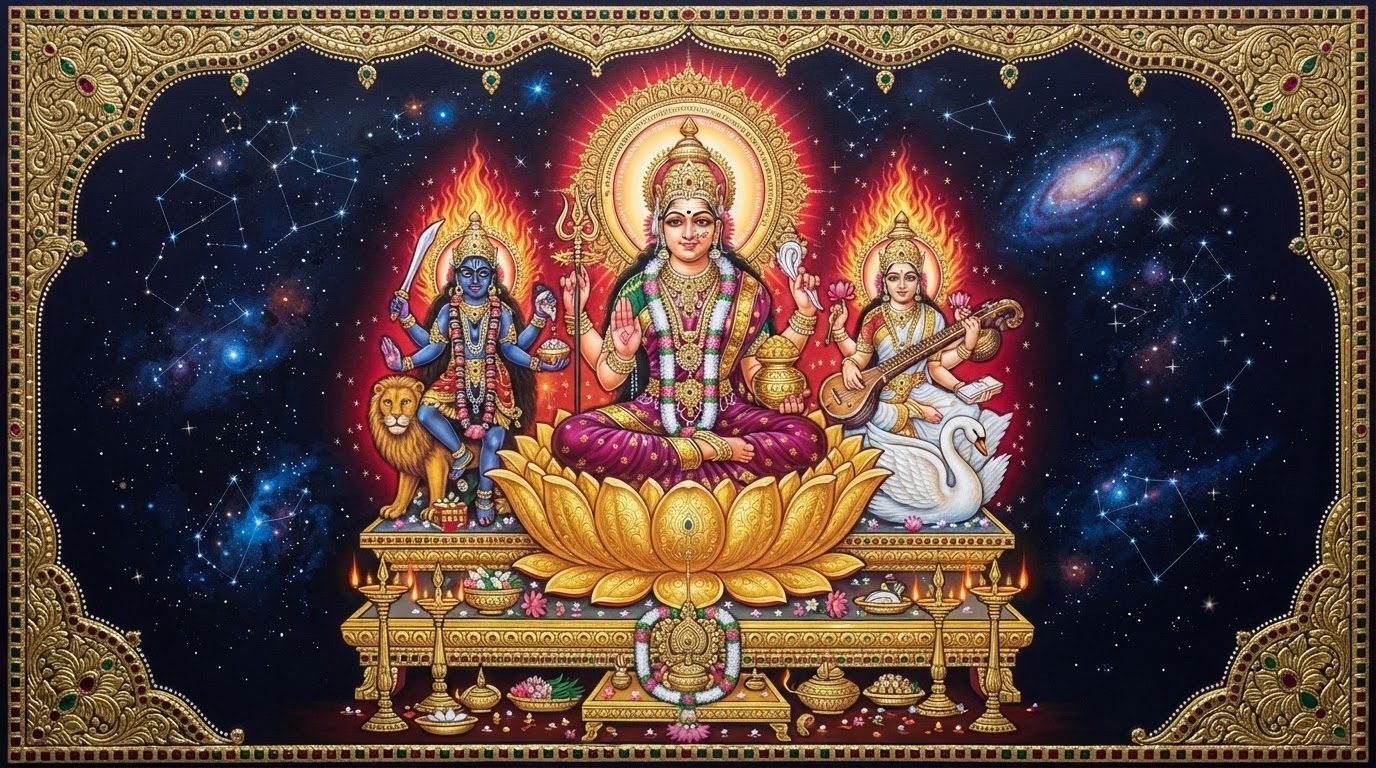
The thirteen chapters (adhyayas) of the Devi Mahatmya are grouped into three episodes called charitras, each presided over by one of the three great forms of the Goddess: Mahakali, Mahalakshmi and Mahasaraswati. Understanding this architecture is the key to understanding the whole text.
The Three Charitras at a Glance
| Charitra | Chapters | Presiding Form | Central Episode |
|---|---|---|---|
| Prathama Charitra (First) | Chapter 1 | Mahakali | The Goddess as Yoganidra awakens Vishnu, who slays the demons Madhu and Kaitabha |
| Madhyama Charitra (Middle) | Chapters 2 to 4 | Mahalakshmi | The Goddess Durga is born of the combined splendour of the gods and slays the buffalo-demon Mahishasura |
| Uttama Charitra (Final) | Chapters 5 to 13 | Mahasaraswati | Ambika, Kali and the Matrikas destroy Shumbha, Nishumbha, Raktabija, Chanda and Munda |
A brief note on terminology: the third and largest section is most commonly called the Uttama Charitra (the excellent or final episode); some editions and reciters refer to it as the Uttara Charitra (the latter episode). Both terms point to the same chapters, five through thirteen.
Chapter-by-Chapter Overview
| Chapter | Charitra | Presiding Form | Episode |
|---|---|---|---|
| 1 | Prathama | Mahakali | The slaying of Madhu and Kaitabha |
| 2 | Madhyama | Mahalakshmi | The destruction of Mahishasura's armies |
| 3 | Madhyama | Mahalakshmi | The slaying of Mahishasura |
| 4 | Madhyama | Mahalakshmi | The hymn of the gods (Shakradi Stuti) |
| 5 | Uttama | Mahasaraswati | The Devi and the envoy; the Aparajita Stuti |
| 6 | Uttama | Mahasaraswati | The slaying of Dhumralochana |
| 7 | Uttama | Mahasaraswati | The slaying of Chanda and Munda by Kali |
| 8 | Uttama | Mahasaraswati | The slaying of Raktabija |
| 9 | Uttama | Mahasaraswati | The slaying of Nishumbha |
| 10 | Uttama | Mahasaraswati | The slaying of Shumbha |
| 11 | Uttama | Mahasaraswati | The hymn to Narayani (Narayani Stuti) |
| 12 | Uttama | Mahasaraswati | The glory of reciting the Devi Mahatmya |
| 13 | Uttama | Mahasaraswati | The boons granted to King Suratha and the merchant Samadhi |
A traditional accounting distributes the seven hundred verses across the chapters, though counts vary slightly between recensions because some editions include the uvacha (spoken-by) lines in the total and others do not. Reciters therefore sometimes speak of the text as having approximately, rather than exactly, seven hundred verses. This is a normal and well-known variation, not an error.
What Happens in the Prathama Charitra: Mahakali and Madhu-Kaitabha?
The first charitra, contained in Chapter 1, tells how the Goddess as Yoganidra, the cosmic sleep, withdraws from Vishnu so he can awaken and slay the demons Madhu and Kaitabha. It is presided over by Mahakali and teaches that the very power which veils awareness can also release it.
At the dawn of a cosmic cycle, Lord Vishnu rests in yogic sleep upon the serpent Shesha in the primordial ocean. This sleep is not mere unconsciousness; it is Yoganidra, the Goddess herself in the form of the great slumber that veils all beings. From the wax of Vishnu's ears arise two fierce demons, Madhu and Kaitabha, who threaten to destroy Brahma, seated on the lotus emerging from Vishnu's navel.
Brahma cannot rouse Vishnu, for the Lord is held by Yoganidra. So Brahma turns and praises the Goddess directly, singing the Tantric Ratri Suktam, the Hymn to the Night. Moved by his devotion, the Goddess withdraws from Vishnu's senses; he awakens, battles the two demons for five thousand years, and finally, by her deluding power, slays them upon his own thigh.
The teaching of the first charitra is profound. The very illusion that binds us is the Goddess, and the same power that veils divine awareness is the power that, when invoked, releases it. Mahakali, whose fierce grace is explored further in our complete guide to Maa Kali, is thus not an enemy of the seeker but the gatekeeper of awakening.
What Happens in the Madhyama Charitra: Mahalakshmi and Mahishasura?
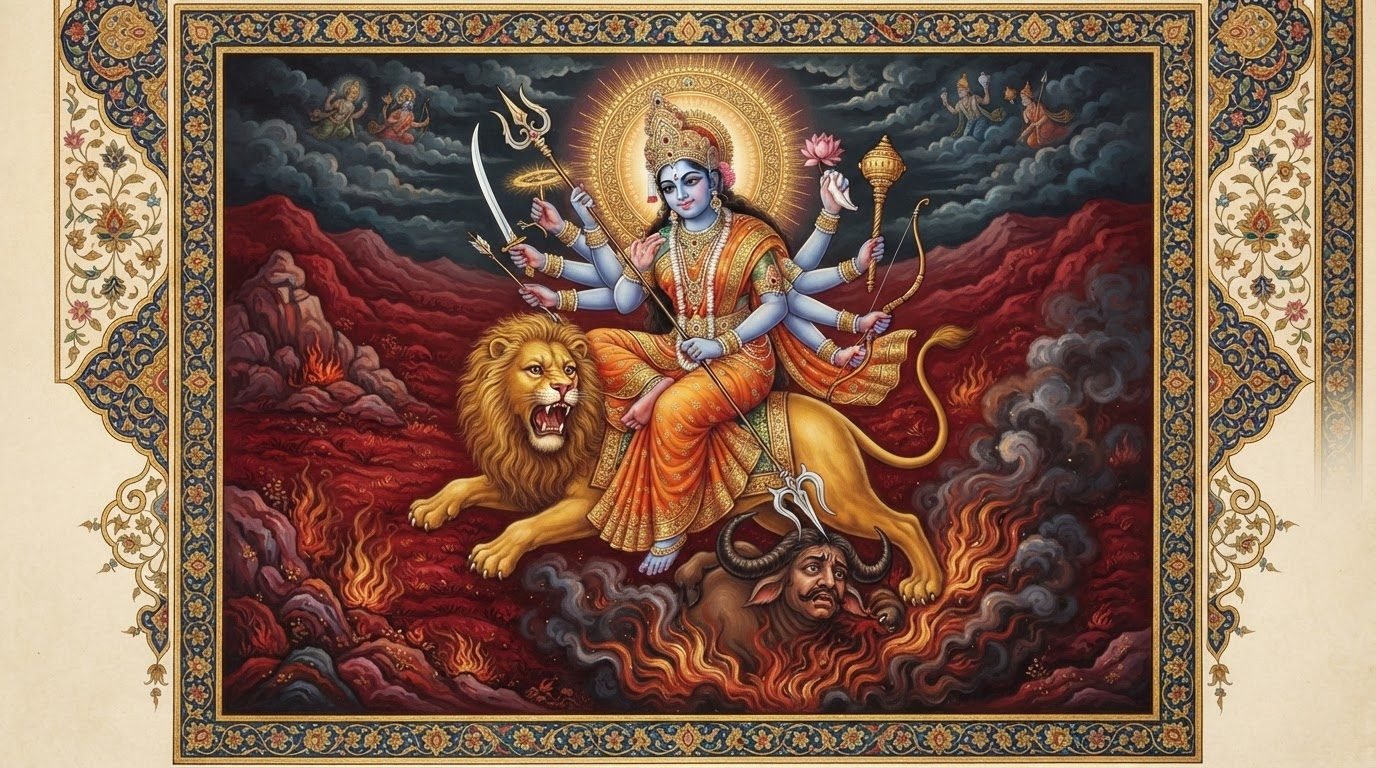
The middle charitra, spanning Chapters 2 to 4, tells how Durga is born from the combined splendour of all the gods and slays Mahishasura, the shape-shifting buffalo-demon who had conquered the three worlds. It is presided over by Mahalakshmi, the rajasic power of activity and sovereignty.
Here unfolds the most famous of all the Goddess's exploits. No single god could defeat Mahishasura, for he held a boon that made him invincible to males. In their distress, the gods release their concentrated splendour, their tejas. The combined light of Shiva, Vishnu, Brahma and all the devas coalesces into a blazing mountain of radiance, and from it emerges the resplendent Goddess Durga, eighteen-armed, riding a lion, each deity gifting her a weapon: Shiva's trident, Vishnu's discus, Indra's thunderbolt, and more.
The battle that follows is one of the great set pieces of Sanskrit literature. Mahishasura shifts from buffalo to lion to man to elephant, but the Goddess pursues him through every form. At last, as he re-emerges in buffalo shape, she pins him with her foot, pierces him with her trident, and severs his head, earning the beloved title Mahishasura Mardini, the crusher of Mahishasura.
Chapter 4 closes the episode with the Shakradi Stuti, the hymn sung by Indra and the gods, one of the most beautiful passages in the entire scripture, praising the Devi as intelligence, mercy, modesty, and peace dwelling within all beings.
What Happens in the Uttama Charitra: Mahasaraswati and Shumbha-Nishumbha?
The final charitra, Chapters 5 to 13, tells how the Goddess and her emanations, including Kali and the Matrikas, destroy the demon brothers Shumbha and Nishumbha along with Dhumralochana, Chanda, Munda and Raktabija. It is presided over by Mahasaraswati, the sattvic light of wisdom and harmony.
Two mighty demon brothers, Shumbha and Nishumbha, have seized the domains of the gods. The devas remember a promise the Goddess once made, that she would come to their aid whenever remembered, and they sing the celebrated Aparajita Stuti, the hymn beginning ya devi sarva-bhuteshu, which honours the Goddess as she who abides in all beings as consciousness, power, and compassion.
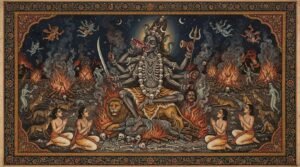
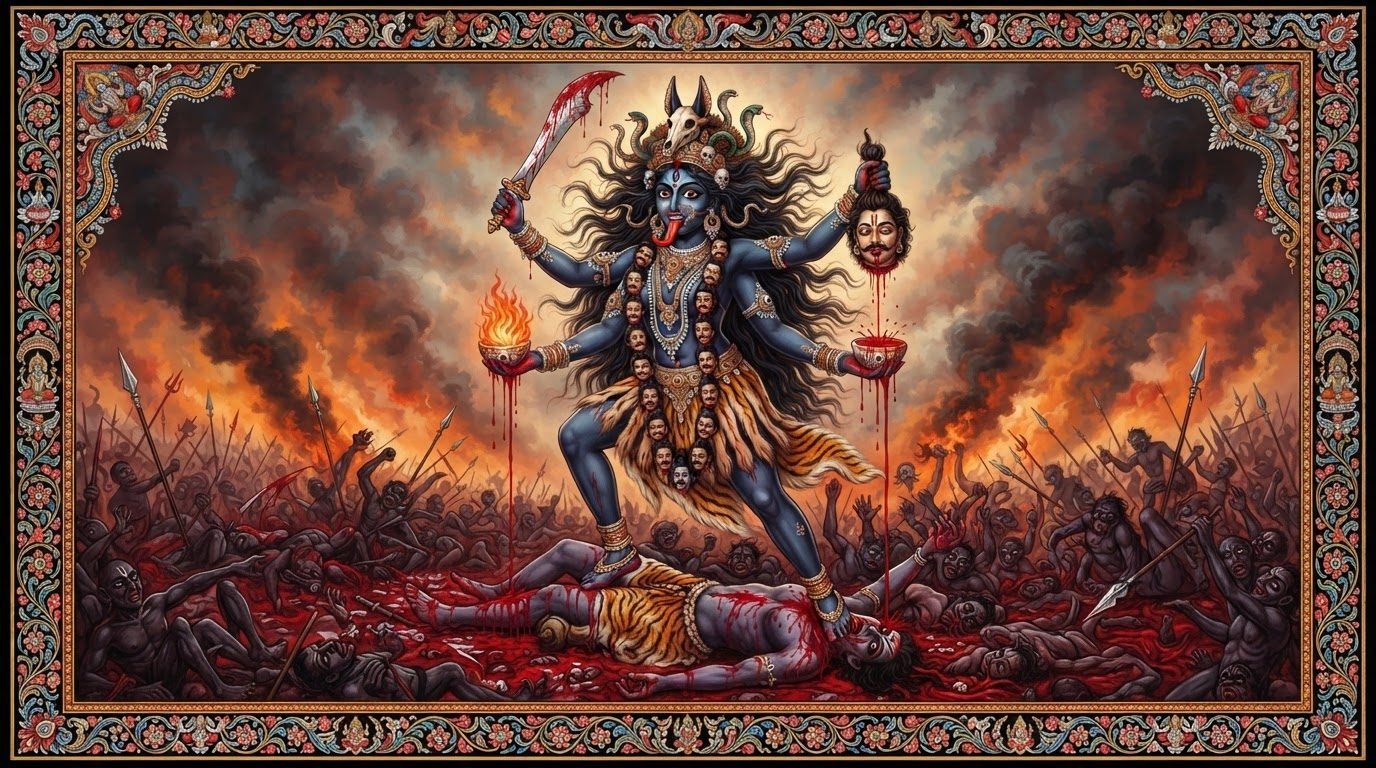
In answer, the beautiful Ambika appears, and from her body springs the fierce Kaushiki (or Kali). Enchanted by her beauty, Shumbha sends envoys and generals to seize her. One by one they fall: the demon Dhumralochana is reduced to ash in Chapter 6; in Chapter 7 the generals Chanda and Munda attack, and from the Goddess's furrowed, wrath-darkened brow leaps the terrifying Kali, who slays them and presents their heads, thereby earning the name Chamunda.
Why Is the Raktabija Episode So Important?
Chapter 8 introduces one of the most vivid and philosophically rich episodes in all of Hindu scripture: the battle with Raktabija. This demon holds a fearsome boon. Wherever a drop of his blood (rakta) falls to the earth, a new demon of equal strength springs up like a seed (bija). As the Goddess strikes him, thousands of clones arise from the spilled blood, and the battlefield fills with copies of the demon.
The solution is as elegant as it is terrifying. Kali, in her Chamunda form, spreads her enormous tongue across the battlefield and drinks every drop of blood before it can touch the ground, while the Goddess strikes Raktabija down. With no soil to receive his blood, no clone can arise, and the demon is finally destroyed. Symbolically, Raktabija is desire and the proliferating thoughts of the ego: cut one down and countless more spring up, unless the very ground of craving is consumed by higher awareness.
The episode reaches its climax in Chapters 9 and 10 with the slaying of Nishumbha and then Shumbha. In a supreme teaching moment, when Shumbha accuses the Goddess of relying on the help of others, she withdraws all her emanating forms, the Matrikas, back into herself and declares: I alone exist here in the world; what second, other than I, is there? She then defeats him single-handed, revealing the non-dual truth that all the many goddesses are but expressions of the one Shakti.
Chapter 11 gives the sublime Narayani Stuti, the hymn to Narayani. Chapter 12 records the phalashruti, the promised fruits of reciting the text. Chapter 13 returns to the frame story: King Suratha and the merchant Samadhi complete their worship, and the Goddess grants each his heart's boon, the king a renewed and imperishable sovereignty, the merchant the liberating wisdom that dissolves attachment.
What Are the Angas, the Sacred Limbs of the Saptashati?
The angas are the ancillary hymns and prayers that frame a traditional recitation of the Durga Saptashati, preparing, protecting and completing the parayana. A proper Chandi Path is never the bare thirteen chapters alone; it is clothed in these limbs.
The Preparatory Angas (Purvanga)
- Devi Kavacham (the Armour): a hymn of about sixty-one verses invoking the protective forms of the Goddess over every part of the body and direction, forming a shield of grace before recitation begins.
- Argala Stotram (the Bolt): a hymn of roughly twenty-seven verses with the recurring refrain rupam dehi jayam dehi, requesting beauty, victory, fame and the removal of enemies.
- Keelakam (the Pin or Wedge): a short hymn that unlocks the full efficacy of the text and removes obstacles, said to release the seal that guards the Saptashati's power.
Recited together, the Kavacham, Argala and Keelakam form the trayanga (three limbs) method. When further hymns are added, the recitation is called navanga (nine limbs).
The Night Hymns and the Devi Suktam
- Ratri Suktam (Hymn to the Night): there are two forms, the Vedokta Ratri Suktam drawn from the Rigveda and the Tantrokta Ratri Suktam that appears within Chapter 1 itself, praising the Goddess as the cosmic night, Yoganidra.
- Devi Suktam: the celebrated Rigvedic hymn (the Vak Suktam of the seer Vak Ambhrini) in which the Goddess declares herself the sustaining power of all the gods; a distinct Tantrokta Devi Suktam beginning ya devi sarva-bhuteshu also appears within the text and is often chanted.
The Three Rahasyas (Secret Teachings)
Appended after the thirteen chapters are three concluding sections called the Rahasyas, or secret teachings, spoken by the sage to King Suratha. They reveal the deeper theology and the ritual worship (puja) of the Goddess.
- Pradhanika Rahasya: expounds Mahalakshmi as the primordial Prakriti (pradhana) from whom the entire triad of goddesses and the cosmos unfold.
- Vaikritika Rahasya: describes the modified or manifested forms (vikriti) of the Goddess and their worship, iconography and attributes.
- Murti Rahasya (Moorti Rahasya): details the various incarnatory forms (murtis) the Goddess assumes in different ages to protect the world.
Because the Rahasyas are esoteric, many householder recitations conclude with the thirteen chapters and the closing hymns, while the Rahasyas are taken up under the guidance of a teacher. Practices vary by tradition and lineage.
How Do You Recite the Durga Saptashati (Parayana)?
A Saptashati parayana is a complete, disciplined reading of the text as a devotional vow, framed by purification, sankalpa, the preparatory angas, the thirteen chapters in order, and concluding prayers. It can be completed in one sitting, spread over several days, or repeated through a resolved period such as Navaratri.
The following describes the widely observed general framework; specific lineages differ, and a guru's instruction always takes precedence.
The Basic Sequence
- Begin with achamana (sipping water for purification) and pranayama, then state your sankalpa, the intention and purpose of the reading.
- Worship the book itself as a form of the Goddess, along with a kalasha (sacred pot), and light a lamp.
- Recite the preparatory angas: Kavacham, Argala and Keelakam (the trayanga), optionally preceded by the Ratri Suktam and Devi Suktam.
- Read the thirteen chapters in order, ideally aloud and with correct pronunciation, maintaining an unbroken flow within each charitra where possible.
- Conclude with the closing hymns, the Aparadha Kshamapana (prayer seeking forgiveness for errors), and offer the fruit of the recitation to the Goddess.
How Many Times Should It Be Recited, and When?
Traditional manuals prescribe different numbers of parayanas for different aims, ranging from a single reading for daily grace to elaborate cycles such as a Shata-chandi (one hundred recitations) and Sahasra-chandi (one thousand recitations) performed collectively for great occasions. The most auspicious time for Saptashati parayana is Navaratri, the nine nights of the Goddess celebrated in the spring (Chaitra) and autumn (Sharada), when the text is read in whole or in part on each of the nine days.
One common Navaratri distribution reads the whole text daily; another divides it across the nine days by chapters. Because these schemes differ by region and lineage, follow the vidhi (method) taught in your own tradition.
What Is Samputa, the Enclosing of Verses?
An advanced practice called samputa involves inserting a chosen mantra or verse before and after each verse of the Saptashati, effectively enclosing (samputita) every line of the text within a specific prayer to intensify it toward a particular aim, such as health, peace, or removal of obstacles. Different samputa mantras are prescribed for different purposes.
Samputa parayana is powerful and specific and should be undertaken only under proper guidance, as the choice of enclosing mantra and the discipline it requires are precise.
What Rules and Etiquette Govern the Chandi Path?
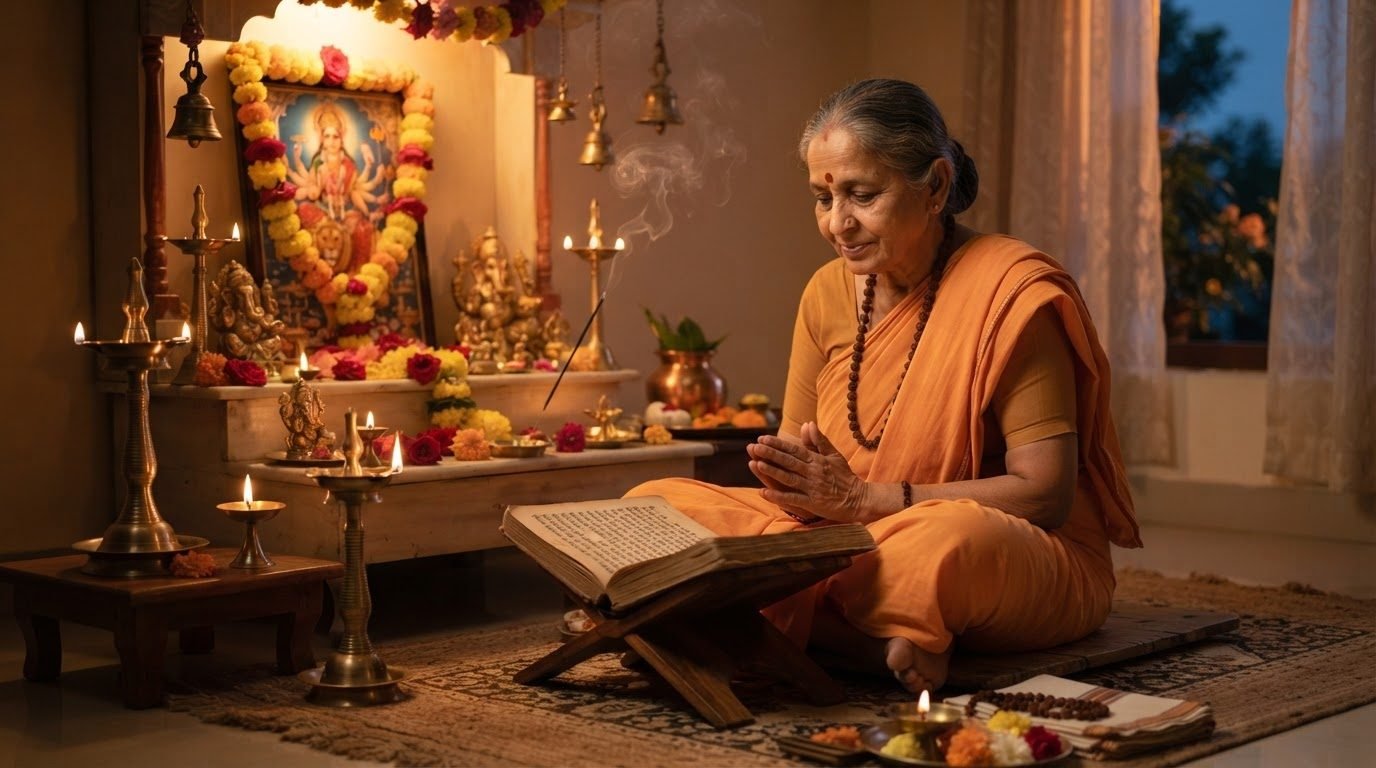
The Chandi Path is traditionally surrounded by observances (niyamas) of purity, posture, pace and sequence: bathing beforehand, sitting on a clean mat facing east or north, reciting steadily without skipping verses, and never omitting the preparatory angas or concluding prayers. These are aids to devotion rather than superstitions.
- Bathe and wear clean clothes; recite in a clean, quiet space before an image or symbol of the Goddess.
- Face east or north, sit on a mat of wool, cotton or kusha grass, and light a lamp of ghee or sesame oil.
- Observe moderation in diet during a parayana period; many devotees keep a sattvic or fasting regimen and practise self-restraint (brahmacharya).
- Read at a steady, unhurried pace with clear articulation; do not skip or rush verses, and avoid interrupting a charitra midway where it can be helped.
- Maintain the correct sequence: never begin the chapters without the preparatory angas, and never omit the concluding prayers.
- Treat the physical book with reverence; keep it on a clean stand, never on the bare floor.
- Cultivate the inner attitude of a child before the Mother; sincerity and love matter more than mechanical perfection.
Most importantly, because Sanskrit chanting carries precise sounds and rhythms, the tradition strongly recommends learning the pronunciation, the pauses, and the ritual method from a qualified guru or temple priest before undertaking a serious parayana. A recording by an authentic reciter is a helpful companion, but personal guidance is invaluable.
What Is the Navarna (Navakshari) Mantra?
The Navarna mantra, Om Aim Hreem Kleem Chamundayai Vichche, is the nine-syllable seed-formula of the entire Devi Mahatmya, holding within it the energies of the three great Goddesses of the three charitras. It is also called the Navakshari mantra, the Chandi mantra, or the Chamunda mantra.
| Sanskrit (Devanagari) | Hindi | Transliteration | Meaning |
|---|---|---|---|
| ॐ ऐं ह्रीं क्लीं चामुण्डायै विच्चे | ओम् ऐं ह्रीं क्लीं चामुंडायै विच्चे | Om Aim Hreem Kleem Chamundayai Vichche | Om, salutations to Chamunda; may the Goddess who is knowledge (Aim), power and grace (Hreem) and blissful transformation (Kleem) awaken pure consciousness (Vichche) within me. |
What Do the Nine Syllables Mean?
| Syllable | Invocation | Corresponding Charitra and Fruit |
|---|---|---|
| Aim | Bija of Mahasaraswati, the Goddess of wisdom and speech | Sattvic Uttama Charitra; bestows knowledge and clarity |
| Hreem | Bija of Mahalakshmi (Bhuvaneshwari), the nurturing and sovereign Goddess | Rajasic Madhyama Charitra; bestows sustenance and grace |
| Kleem | Bija of Mahakali, the power of attraction and transformative dissolution | Tamasic Prathama Charitra; dissolves what must be released |
| Chamundayai | Offering to Chamunda, who slew Chanda and Munda | Destroys negativity and protects beings |
| Vichche | The seed of divine consciousness | Guides the chanter inward toward awareness of the Self |
The Hreem bija connects this mantra with Maa Bhuvaneshwari, the sovereign Queen of the worlds in the Mahavidya tradition. Because the Navarna mantra is a Tantric bija-mantra, tradition holds that it is ideally received through diksha (initiation) from a guru, who transmits not only the syllables but the living current behind them. The line itself is authentic and widely published; some lineages add an anga-nyasa and dhyana before japa. Seek proper guidance for formal sadhana.
What Are the Benefits of Reciting the Durga Saptashati?
Chapter 12 of the Devi Mahatmya, spoken by the Goddess herself, promises protection from dangers, removal of obstacles, prosperity, peace of mind, purification of karma and, ultimately, liberation. Tradition and this phalashruti chapter together describe benefits across the material, psychological and spiritual planes.
- Protection from dangers, enemies, disease, accidents, and negative influences, the Goddess promising to guard those who remember her deeds.
- Removal of obstacles and the fulfilment of righteous desires, including prosperity, progeny, and success in undertakings.
- Peace of mind, courage, and the dissolution of fear, grief and delusion, as the inner demons of ego and craving are symbolically slain.
- Purification of accumulated karma and the calming of planetary and astrological afflictions, for which specific chapters are traditionally recommended.
- Spiritual upliftment culminating in liberation (moksha), as the seeker recognises the Goddess as the very ground of consciousness.
The deeper benefit, echoed throughout the text, is transformation of vision. To recite the Saptashati sincerely is to train the mind to see the one Shakti behind all appearances, and to meet life's battles, outer and inner, with the fearless love of a child before the Mother.
Conclusion: Entering the Living Stream
The Durga Saptashati is far more than an ancient account of divine battles. It is a mirror in which the seeker sees the war within, the buffalo of inertia, the shape-shifting demons of ego, the endlessly multiplying seeds of desire, and it hands the reader the Mother's own weapons to meet them. Its three charitras trace a journey from the darkness of illusion, through the dynamism of struggle, into the light of wisdom and liberation.
To take up the Chandi Path is to step into a stream that has flowed unbroken for fifteen centuries. Begin gently, learn the pronunciation from a teacher, observe the simple niyamas, and let the verses do their quiet work. May the Divine Mother, Chamunda, Durga, Chandika, the one Shakti behind all names, bless every reciter with fearlessness, wisdom, and peace.
Listen: Subscribe to Musinara Sounds for 432 Hz mantra chants
🕉️ Hear these sacred mantras come alive. Subscribe to Musinara Sounds on YouTube for 432 Hz Devi mantra chants, sung slowly enough to follow and repeat.
🎧 Listen - ओं दुं दुर्गायै नमः (Om Dum Durgayai Namah) chanted 108 times at 432 Hz - a Musinara recording of the Durga seed mantra to chant along with.
Frequently Asked Questions
What is the Durga Saptashati?
The Durga Saptashati, also called the Devi Mahatmya or Chandi Path, is a Sanskrit devotional scripture of seven hundred verses in thirteen chapters that glorifies the Divine Mother. It forms chapters 81 to 93 of the Markandeya Purana and is the central text of the Shakta tradition, narrating three great victories of the Goddess over demonic forces.
Why is it called Saptashati?
Saptashati is Sanskrit for seven hundred, and the text traditionally contains about seven hundred verses. Slight variations in the count occur between recensions depending on whether the introductory uvacha lines are included, so the figure is sometimes given as approximately seven hundred.
What are the three charitras of the Durga Saptashati?
The text is divided into three episodes: the Prathama Charitra (Chapter 1, presided by Mahakali, the slaying of Madhu and Kaitabha); the Madhyama Charitra (Chapters 2 to 4, presided by Mahalakshmi, the slaying of Mahishasura); and the Uttama Charitra (Chapters 5 to 13, presided by Mahasaraswati, the destruction of Shumbha, Nishumbha and Raktabija).
What is the difference between Devi Mahatmya and Durga Saptashati?
There is no difference in content; they are two names for the same scripture. Devi Mahatmya means the glory of the Goddess and Durga Saptashati means the seven hundred verses of Durga. It is also called Chandi Path, meaning the recitation of Chandi.
What are the angas of the Saptashati?
The angas are the ancillary hymns that frame the recitation: the preparatory Kavacham, Argala and Keelakam; the Ratri Suktam and Devi Suktam; and the concluding Pradhanika, Vaikritika and Murti Rahasyas. Reciting the three preparatory hymns is called the trayanga method; adding more forms the navanga method.
What is the Navarna mantra?
The Navarna or Navakshari mantra is Om Aim Hreem Kleem Chamundayai Vichche, a nine-syllable seed mantra that concentrates the power of all three Goddesses of the Saptashati. Aim invokes Mahasaraswati, Hreem invokes Mahalakshmi, Kleem invokes Mahakali, and the mantra as a whole is offered to Chamunda for the awakening of consciousness.
When is the best time to recite the Durga Saptashati?
Navaratri, the nine nights of the Goddess in spring (Chaitra) and autumn (Sharada), is the most auspicious time. Daily recitation, and readings on Tuesdays, Fridays, Ashtami and Navami, and on Amavasya and Purnima, are also considered especially beneficial. Early morning is generally preferred.
What is samputa in Saptashati recitation?
Samputa is an advanced practice of enclosing each verse of the Saptashati between a chosen mantra recited before and after it, intensifying the reading toward a specific aim such as health, peace or removal of obstacles. Because it requires precise mantras and discipline, it should be done under a guru's guidance.
Can I recite the Chandi Path at home without a guru?
Devotees may lovingly read the text at home, and simple daily reading is widely encouraged. However, because Sanskrit chanting demands correct pronunciation and the full ritual (especially for a formal parayana, samputa practice, or the Navarna mantra given through initiation) it is strongly recommended to learn the proper method from a qualified guru or temple priest.
What are the benefits of the Durga Saptashati?
The text promises protection from dangers and enemies, removal of obstacles, prosperity and fulfilment of righteous desires, freedom from fear and grief, purification of karma, relief from astrological afflictions, and ultimately spiritual liberation, as the seeker comes to see the one Shakti behind all things.
Official and Reference Sources
- Durga Saptashati, full Sanskrit text - Sanskrit Documents, a long-running volunteer e-text archive
- Pargiter, The Mārkaṇḍeya Purāṇa (1904) - the standard scholarly translation, Asiatic Society of Bengal, scanned by Cornell University Library