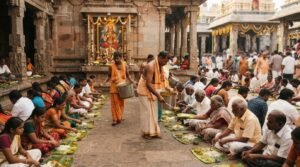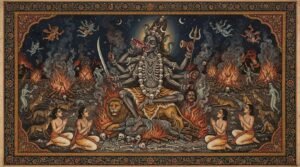
Navratri, meaning "nine nights", is the great Hindu festival of the Divine Mother, during which the nine forms of Goddess Durga, the Navadurga, receive worship one per night. Each form has her own day, color, bhog offering and mantra, and the festival culminates in Vijayadashami, the day of victory.
Few festivals in the Sanatana tradition gather as much joy, devotion and cosmic meaning as Navratri. For nine nights and ten luminous days, temples glow with lamps, homes fill with the fragrance of incense and bhog, and the names of the Goddess rise from millions of lips. Navratri is not merely a celebration; it is a sustained sadhana, a guided ascent through nine forms of Shakti that lead the soul from the solid earth of Shailaputri to the boundless liberation of Siddhidatri.
The story that frames these nights is the timeless triumph of the Devi over the buffalo-demon Mahishasura, recorded in the Devi Mahatmya of the Markandeya Purana and amplified in the Devi Bhagavata Purana. Together the nine forms map an inner journey: birth and stability, discipline and devotion, courage, creativity, nurture, ferocity, fearlessness, purity, and finally the gift of every spiritual attainment.
This complete guide walks you through the meaning of Navratri and its four forms, the great story behind it, all nine forms of Navadurga with their days, colors, bhog and mantras, the core rituals from Ghatasthapana to Vijayadashami, the profound link between Navratri and the Das Mahavidya, and the vibrant regional celebrations from Bengal's Durga Puja to Gujarat's Garba. Whether you are a lifelong devotee or a curious seeker, may these nine nights illuminate your path.
Key Takeaways
- Navratri means "nine nights" and honours the worship of Adi Shakti through the nine forms of Durga, the Navadurga.
- There are four Navratris in a year: Sharad, Chaitra, and two Gupt (secret) Navratris in Magha and Ashadha.
- Each of the nine days has its own goddess, color, bhog offering and mantra, from Shailaputri on day one to Siddhidatri on day nine.
- The festival commemorates Durga's nine-night battle with Mahishasura, told in the Devi Mahatmya of the Markandeya Purana.
- The two Gupt Navratris are closely tied to the Das Mahavidya and are considered the most potent windows for Tantric sadhana.
Navratri 2026 Dates and Day-Wise Calendar
Sharad Navratri 2026 begins on Sunday 11 October and ends on Monday 19 October, with Vijayadashami on Tuesday 20 October. Ghatasthapana is performed on the morning of 11 October, Durga Ashtami falls on Sunday 18 October and Maha Navami on Monday 19 October.
| Day | Date | Tithi | Navadurga form | Colour |
|---|---|---|---|---|
| 1 | Sun 11 Oct | Pratipada | Shailaputri | Orange |
| 2 | Mon 12 Oct | Dwitiya | Brahmacharini | White |
| 3 | Tue 13 Oct | Tritiya | Chandraghanta | Red |
| 4 | Wed 14 Oct | Chaturthi | Kushmanda | Royal Blue |
| 5 | Thu 15 Oct | Panchami | Skandamata | Yellow |
| 6 | Fri 16 Oct | Shashthi | Katyayani | Green |
| 7 | Sat 17 Oct | Saptami | Kalaratri | Grey |
| 8 | Sun 18 Oct | Ashtami | Mahagauri | Purple |
| 9 | Mon 19 Oct | Navami | Siddhidatri | Peacock Green |
| - | Tue 20 Oct | Dashami | Vijayadashami (Dussehra) | - |
The colours follow the weekday on which each tithi falls, which is why they differ from year to year. The reasoning, along with each night bhog and mantra, is set out in our guide to the Navratri 2026 colours.
When Should Ghatasthapana Be Performed in 2026?
Ghatasthapana belongs to the first third of Pratipada, in the auspicious window that follows sunrise. Tradition holds that it should be avoided during Chitra Nakshatra and Vaidhriti Yoga, and that it should never be done at midday. Where the morning window is unavailable, the Abhijit Muhurta near noon is accepted instead.
The exact clock time differs by city, because it depends on your local sunrise, and sunrise across India varies by well over an hour. For that reason we do not publish a single India-wide timing. Check a reliable panchang for your own city on the morning of 11 October, or ask your family priest, and you will have a time you can trust.
What Is Navratri and How Many Navratris Are There in a Year?
Navratri comes from the Sanskrit nava (nine) and ratri (night): nine sacred nights dedicated to Adi Shakti, the primordial feminine energy. The tradition recognises four Navratris across the year: Sharad Navratri in autumn, Chaitra Navratri in spring, and two hidden Gupt Navratris in Magha and Ashadha.
Night, in the yogic view, is the time of inwardness and dissolution, when the outer world quietens and the seeker can turn toward the inner Goddess. Hence the Mother receives worship through the nights, and her victory celebrated on the tenth day, Vijayadashami.
Although most people associate Navratri with a single autumn festival, the four Navratris mark the changing seasons: powerful junctures when the body, mind and cosmos are especially receptive to spiritual practice.
| Navratri | Month | Character |
|---|---|---|
| Sharad (Shardiya) Navratri | Ashwin (September-October) | The grandest and most widely observed: the Navratri of pandals, Garba, Golu and Dussehra |
| Chaitra (Vasanta) Navratri | Chaitra (March-April) | The spring Navratri, culminating on the ninth day in Ram Navami, the birth of Lord Rama |
| Gupt Navratri (Magha) | Magha (January-February) | A "secret" Navratri observed quietly by Tantric practitioners |
| Gupt Navratri (Ashadha) | Ashadha (June-July) | A second hidden Navratri, favoured for intense Tantric and Mahavidya sadhana |
The two "gupt" (hidden) Navratris are less known to the general public but deeply significant to seekers of the Das Mahavidya, as we explore later. In every Navratri, however, the central thread is the same: the adoration of the Divine Mother in her nine ascending forms.
What Is the Story Behind Navratri?
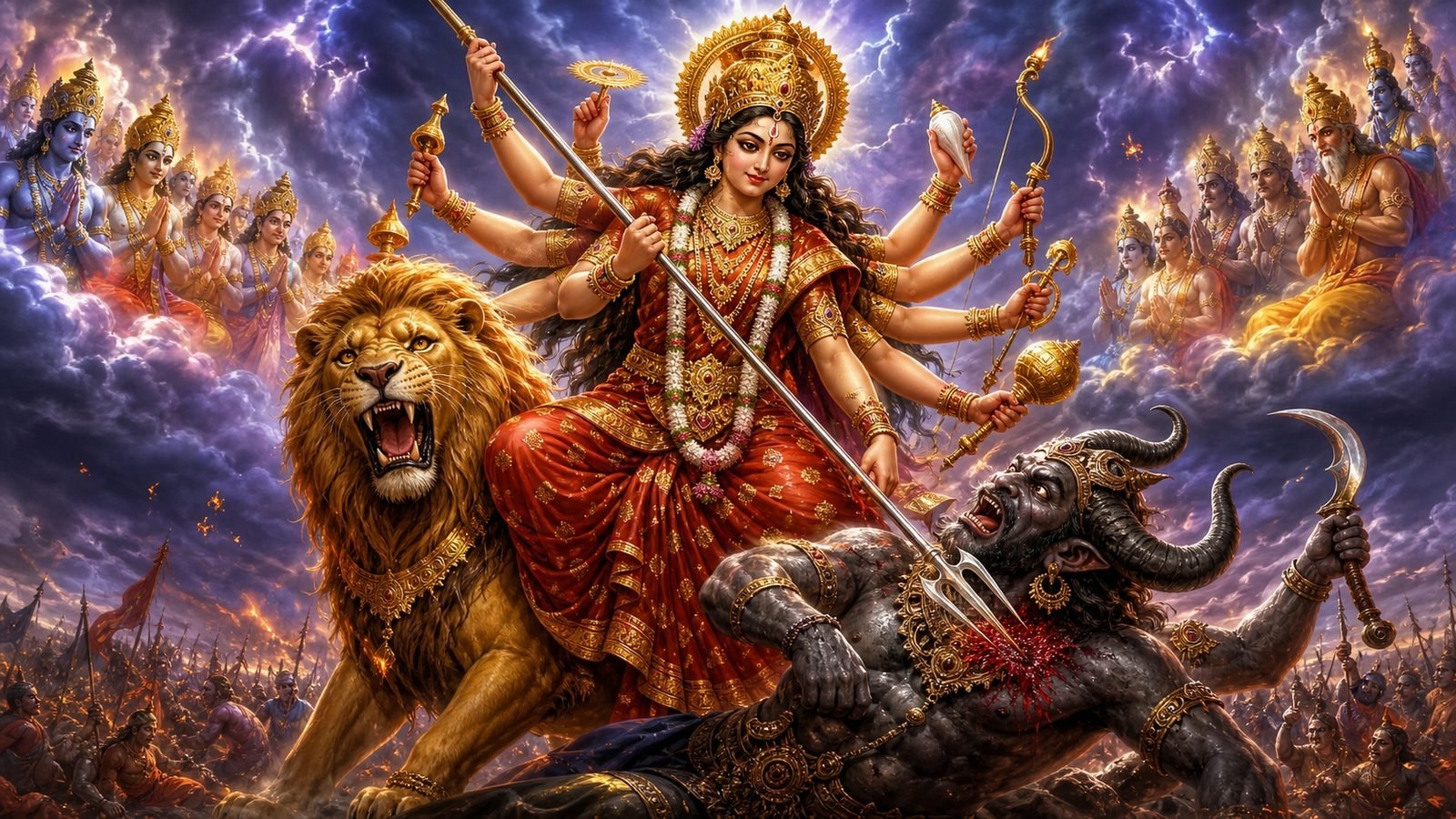
Navratri commemorates the nine-night battle in which Goddess Durga, born from the combined energies of all the gods, fought the buffalo-demon Mahishasura and slew him on the tenth day. The story is told in the Devi Mahatmya, a 700-verse hymn within the Markandeya Purana.
The Devi Mahatmya, also known as the Durga Saptashati or Chandi Path, was composed around the 5th-6th century CE. It recounts how Mahishasura performed severe penance and won a boon that no man or god could ever slay him. Believing himself invincible, he conquered the heavens, drove out the devas, and threw the three worlds into terror.
Unable to defeat him, the gods, Brahma, Vishnu, Shiva and all the devas, released their concentrated anger and energy. From this blazing confluence of light arose a luminous, ten-armed Goddess of unmatched beauty and power: Durga. Each deity gifted her a weapon, Shiva's trishula, Vishnu's chakra, Indra's vajra and more, and Himavan offered her a lion as her mount.
For nine nights, Durga waged a tremendous battle against Mahishasura and his demon armies. On the tenth day, she finally pierced and slew the shape-shifting buffalo-demon, restoring dharma to the cosmos. These nine nights of battle are commemorated as Navratri, and the tenth day of victory as Vijayadashami. The Devi Mahatmya weaves in two more great battles, the slaying of Madhu and Kaitabha, and the destruction of Shumbha and Nishumbha (during which Kali and the Matrikas emerge), framing the whole text as the eternal triumph of divine Shakti over the forces of ego and ignorance.
Who Are the Nine Forms of Navadurga?
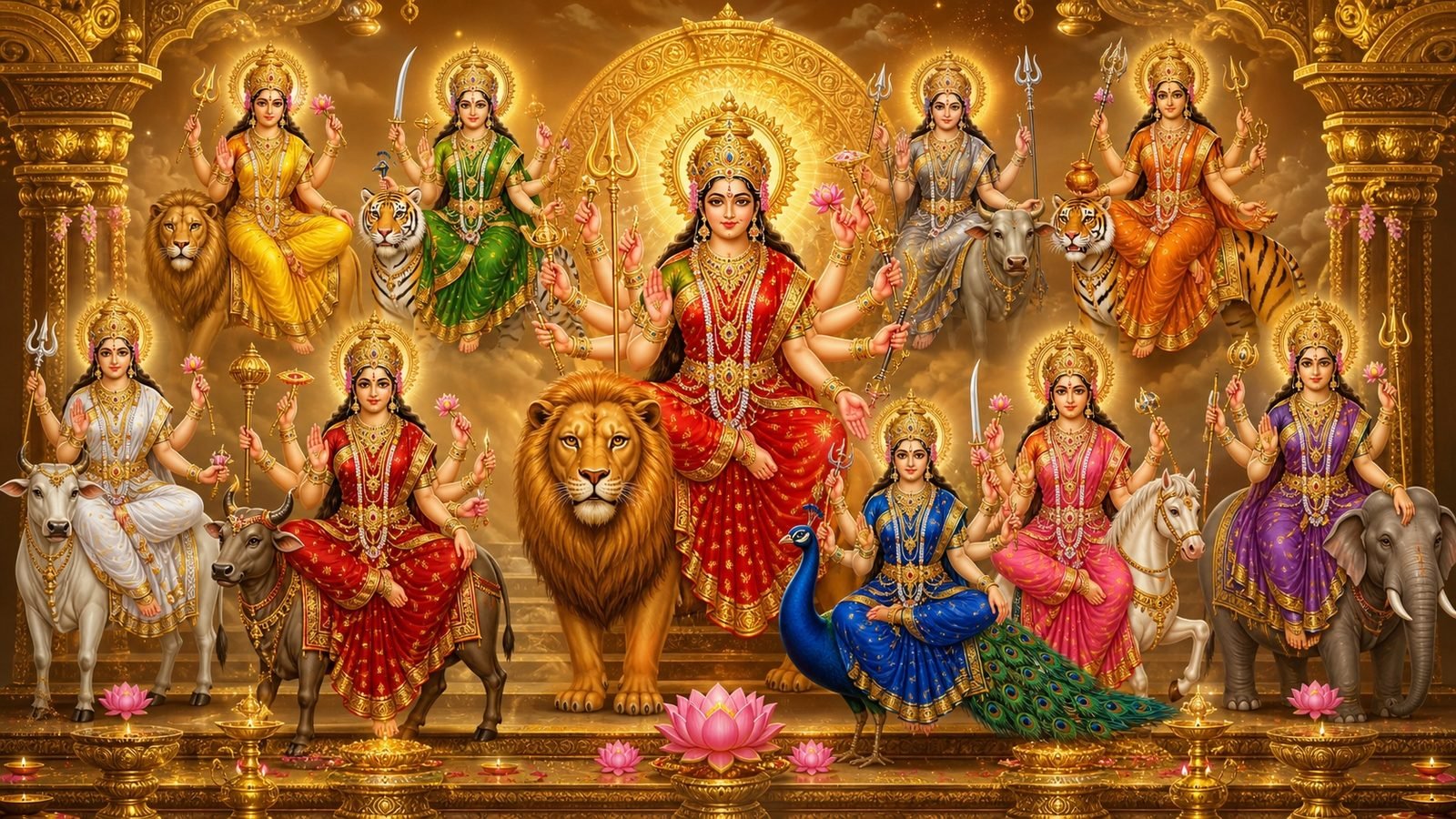
The Navadurga, in order, are Shailaputri, Brahmacharini, Chandraghanta, Kushmanda, Skandamata, Katyayani, Kalaratri, Mahagauri and Siddhidatri: nine manifestations of Durga worshipped on the nine nights of Navratri. The names are enumerated in the popular Devi Kavacham of the Durga Saptashati.
The fixed order traces a spiritual journey from grounding to liberation. Each form has her own day, color, weapon, vahana (mount), bhog (offering) and mantra. The table below summarises them; the profiles that follow describe each goddess.
| Day | Goddess | Color | Bhog / Offering | Mantra |
|---|---|---|---|---|
| Day 1 | Shailaputri | Orange | Pure desi ghee | Om Devi Shailaputryai Namah |
| Day 2 | Brahmacharini | White | Sugar / fruits | Om Devi Brahmacharinyai Namah |
| Day 3 | Chandraghanta | Red | Milk and kheer (ghee sweets) | Om Devi Chandraghantayai Namah |
| Day 4 | Kushmanda | Royal Blue | Malpua | Om Devi Kushmandayai Namah |
| Day 5 | Skandamata | Yellow | Banana | Om Devi Skandamatayai Namah |
| Day 6 | Katyayani | Green | Honey | Om Devi Katyayanyai Namah |
| Day 7 | Kalaratri | Grey | Jaggery (gur) | Om Devi Kalaratryai Namah |
| Day 8 | Mahagauri | Purple | Coconut | Om Devi Mahagauryai Namah |
| Day 9 | Siddhidatri | Peacock Green | Sesame seeds (til) | Om Devi Siddhidatryai Namah |
Note: the exact color sequence can vary slightly year to year depending on the weekday on which Navratri begins; the colors above follow the widely published Sharad Navratri order.
Day 1: Shailaputri (Daughter of the Mountain)
Shailaputri, the "daughter of the Himalayas" (Shaila means mountain), is the first form and an embodiment of nature, stability and rootedness. She rides the bull Nandi, holds a trishula in one hand and a lotus in the other, and is a form of Parvati / Sati reborn. Worshipping her on the first day establishes the firm earth on which the entire sadhana will stand. Offering: pure desi ghee, for a disease-free life. Mantra: Om Devi Shailaputryai Namah.
Day 2: Brahmacharini (The Ascetic)
Brahmacharini is the Goddess of penance, devotion and self-discipline. She walks barefoot, carrying a japa-mala and a kamandalu (water pot), recalling Parvati's severe tapas to win Lord Shiva. She bestows endurance, restraint and steadfast inner resolve. Offering: sugar and fruits, for longevity. Mantra: Om Devi Brahmacharinyai Namah.
Day 3: Chandraghanta (The Bell-Mooned)
Named for the half-moon (chandra) shaped like a bell (ghanta) on her forehead, Chandraghanta is the married, warrior form of the Goddess: ten-armed, golden-skinned, riding a tiger or lioness. Her bell's sound terrifies demons and dispels negativity, while her presence grants courage and serenity. Offering: milk and kheer / ghee sweets. Mantra: Om Devi Chandraghantayai Namah.
Day 4: Kushmanda (Creator of the Cosmic Egg)
Kushmanda is revered as the creatrix who produced the universe (the cosmic egg, anda) with her divine smile, dwelling in the core of the Sun and radiating its light and warmth. Eight-armed (Ashtabhuja), she carries weapons, a rosary and a pot of nectar. She bestows health, strength and vitality. Offering: malpua. Mantra: Om Devi Kushmandayai Namah.
Day 5: Skandamata (Mother of Skanda)
Skandamata is the mother of Skanda (Kartikeya), the commander of the gods, whom she holds on her lap as she sits upon a lotus; hence she is also called Padmasana Devi. She radiates the tenderness of motherhood and the courage of a warrior's mother, granting wisdom, prosperity and salvation. Offering: banana. Mantra: Om Devi Skandamatayai Namah.
Day 6: Katyayani (Daughter of Sage Katyayana)
Katyayani was born in the hermitage of Sage Katyayana, who longed for the Goddess as his daughter; she is the fierce warrior aspect who ultimately slew Mahishasura. Riding a lion, golden and radiant, she removes obstacles and is especially invoked by the unmarried for a worthy life-partner. Offering: honey. Mantra: Om Devi Katyayanyai Namah.
Day 7: Kalaratri (The Dark Night)
Kalaratri is the most ferocious of the Navadurga: dark as night, riding a donkey, with dishevelled hair, a fearless three-eyed gaze, and flames from her breath. Yet she is also called Shubhankari, "the doer of good", for she destroys ignorance, fear and dark forces, granting fearlessness to her devotees. Offering: jaggery (gur). Mantra: Om Devi Kalaratryai Namah.
Day 8: Mahagauri (The Radiantly Fair)
Mahagauri is the supremely pure, luminous form: dazzlingly fair, four-armed, riding a white bull, holding a trishula and damaru. She represents the purity attained after Kalaratri's purifying fire and is said to wash away all sins and fulfil sincere wishes. Offering: coconut. Mantra: Om Devi Mahagauryai Namah.
Day 9: Siddhidatri (Giver of Perfections)
Siddhidatri, the ninth and culminating form, is the bestower of all siddhis (spiritual perfections): the eight classical ones of Anima, Mahima, Garima, Laghima, Prapti, Prakamya, Ishitva and Vashitva. Seated on a lotus, four-armed, she is said to have granted Lord Shiva his powers, becoming with him Ardhanarishvara. She represents the soul's fulfilment and liberation. Offering: sesame seeds (til). Mantra: Om Devi Siddhidatryai Namah.
What Are the Main Navratri Rituals, from Ghatasthapana to Vijayadashami?
Navratri opens with Ghatasthapana, the invocation of the Goddess into a sacred kalash, and moves through nine days of fasting, daily worship and mantra japa. Kanya Pujan honours young girls as the Goddess, Ayudha Puja consecrates tools and books, and Vijayadashami crowns the festival with victory.
Navratri is as much about disciplined practice as about celebration. A handful of core rituals carry the festival from its first dawn to its triumphant tenth day.
Ghatasthapana (Kalash Sthapana)
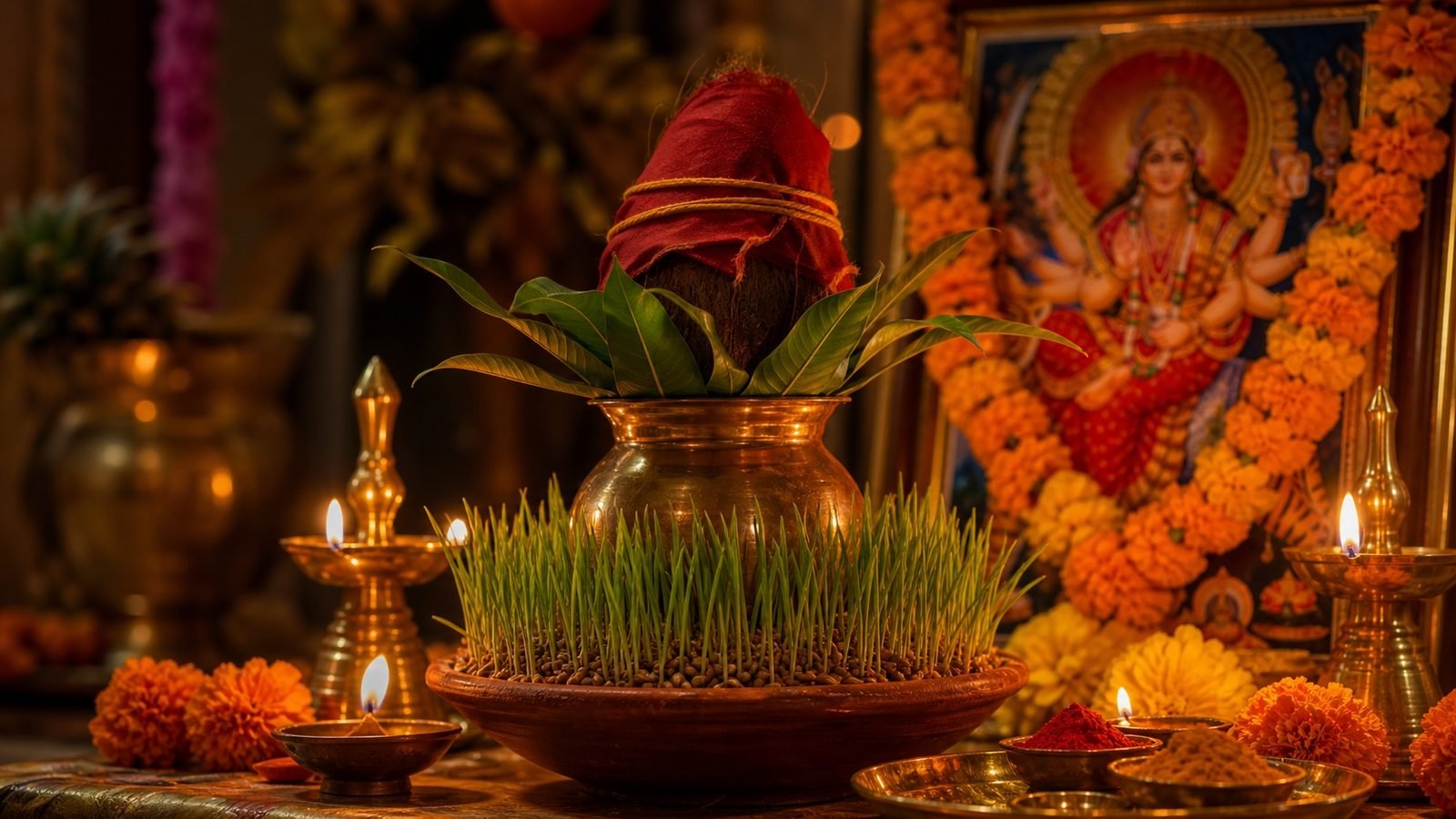
The festival formally opens on the first day with Ghatasthapana, performed in a fixed auspicious muhurta. A clay or metal pot (kalash) is filled with holy water, grains, betel nut and coins, and topped with mango leaves and a coconut wrapped in red cloth; barley seeds are often sown in a bed of soil around it. The Goddess is invoked into this kalash, which is kept lit with an akhand jyoti (unbroken lamp) and worshipped daily through all nine nights. The sprouting barley is read as an omen of prosperity.
Fasting (Vrat)
Many devotees observe a vrat for all nine days, abstaining from grains, pulses, onion, garlic and common salt, and eating only vrat-friendly foods such as kuttu and singhara flour, sabudana, potatoes, fruits, milk and rock salt (sendha namak). The fast purifies the body, sharpens the mind, and turns daily nourishment into an act of devotion. Some fast only on the first and last days, or take a single sattvic meal each day.
Kanya Pujan (Kanjak)
On Ashtami or Navami, devotees perform Kanya Pujan: worshipping young girls (and often a young boy as Batuk Bhairav) as living forms of the Goddess. Their feet are washed, a tilak applied, and they are lovingly served puri, halwa and chana, then given gifts and dakshina. Feeding and honouring nine girls is considered to honour the nine Navadurga themselves.
Ayudha Puja and Saraswati Puja
Especially in South India, the ninth day (Mahanavami) is Ayudha Puja, when tools, instruments, vehicles and books are cleaned and worshipped as receptacles of divine Shakti: a craftsman's gratitude to the energy that powers their work. Saraswati, goddess of learning, is also venerated, and children are often initiated into reading and writing (Vidyarambham) the next day.
Vijayadashami (Dussehra)
The tenth day, Vijayadashami or Dussehra, crowns the festival with the celebration of victory: Durga's over Mahishasura and Rama's over Ravana. Towering effigies of Ravana, Meghnad and Kumbhakarna are set ablaze, the Durga idols are carried for immersion (visarjan), and devotees exchange greetings and begin new ventures on this most auspicious of days.
How Is Navratri Connected to the Das Mahavidya?
While Sharad and Chaitra Navratri celebrate the nine Navadurga, the two Gupt Navratris in Magha and Ashadha are traditionally dedicated to the Das Mahavidya, the ten wisdom goddesses of the Tantric tradition. Away from public festivity, these hidden nights are considered the most potent windows for Tantric upasana.
Beneath the public splendour of Navratri runs a deeper, more esoteric current: the worship of the Das Mahavidya, the ten wisdom goddesses Kali, Tara, Tripura Sundari, Bhuvaneshwari, Bhairavi, Chinnamasta, Dhumavati, Bagalamukhi, Matangi and Kamala. While the Navadurga represent the accessible, exoteric face of Shakti celebrated by all, the Mahavidyas embody her profound, transformative and sometimes fierce wisdom forms approached by serious sadhaks.
During the Gupt Navratris, practitioners undertake intense sadhana of a chosen Mahavidya, observing strict discipline, japa and ritual under the guidance of a guru. The very secrecy (gupt) of these Navratris reflects the inward, initiatory nature of Mahavidya practice, which is traditionally transmitted through diksha rather than displayed in public.
The bridge between the two streams is theological as well as calendrical. Durga and the Navadurga are themselves expressions of the same Adi Shakti who manifests as the Mahavidyas; in the Devi Mahatmya, Kali, the first Mahavidya, emerges directly from Durga's brow to slay Chanda and Munda, earning the name Chamunda. The Navarna mantra of the Saptashati, Om Aim Hreem Kleem Chamundayai Vichche, itself braids together the bija sounds associated with the great goddesses, from Mahasaraswati to Tripura Sundari's gentle stream of grace. Thus Navratri, in its fullest sense, honours the whole spectrum of the Feminine Divine, from the radiant Navadurga of the household altar to the secret Mahavidyas of the Tantric shrine.
How Is Navratri Celebrated Across India?
One Goddess, countless expressions: Bengal and the East celebrate Durga Puja with magnificent pandals, Gujarat dances Garba and Dandiya around the sacred lamp, South India arranges the tiered Golu of dolls, and North India stages Ramlila leading to the burning of Ravana's effigies on Dussehra.
Durga Puja in Bengal, Odisha and the East
In West Bengal, Assam, Odisha and Tripura, the last days of Navratri become Durga Puja, arguably the grandest festival of the East and a UNESCO-recognised cultural heritage. Magnificent themed pandals house exquisitely crafted clay idols of Durga slaying Mahishasura, flanked by Lakshmi, Saraswati, Ganesha and Kartikeya. From Shashthi to Dashami, the days resound with dhak drums, conch shells, the dhunuchi dance, Sandhi Puja, and finally the emotional Sindoor Khela and visarjan (immersion).
Garba and Dandiya in Gujarat
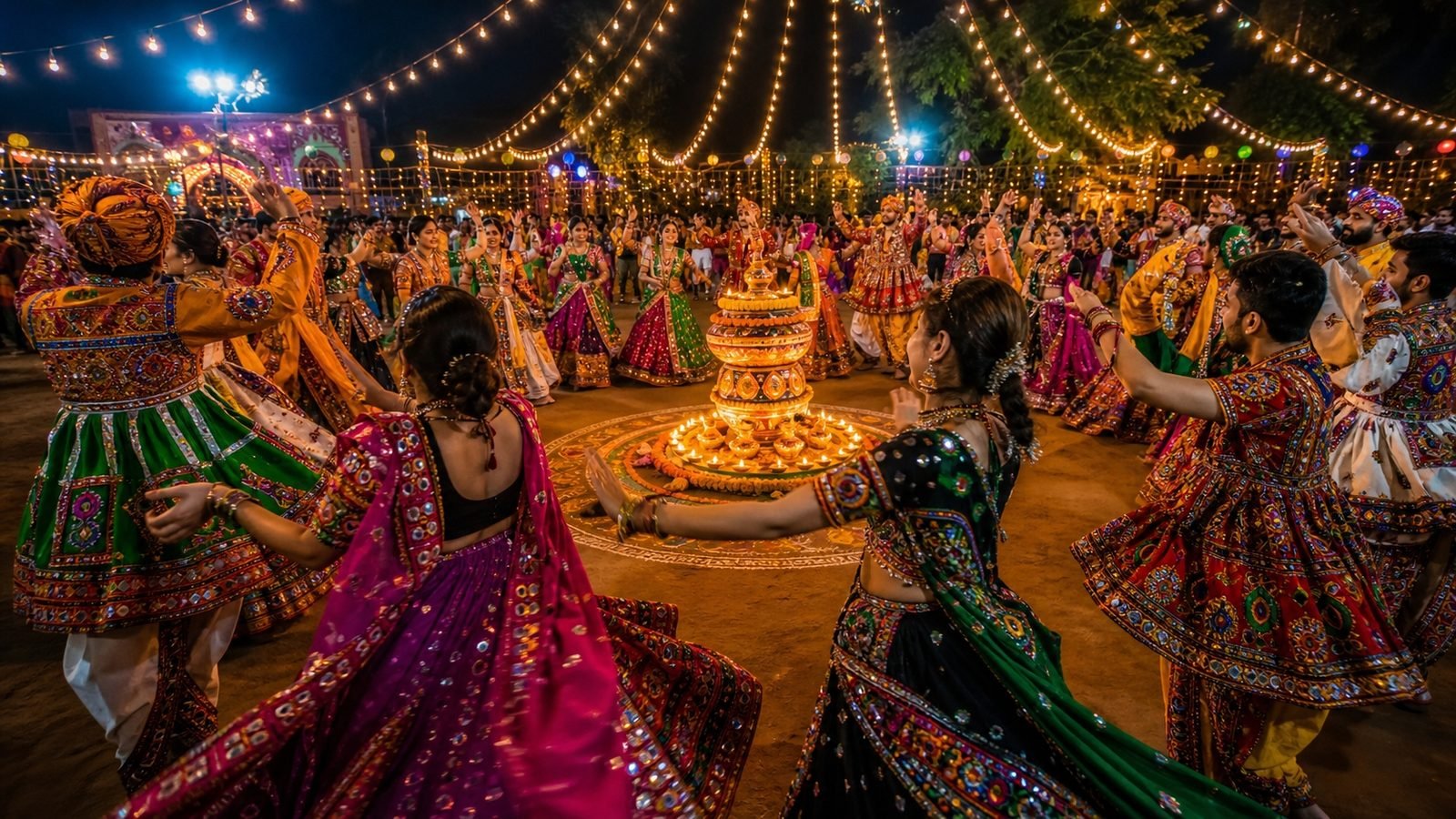
Gujarat turns Navratri into the world's longest dance festival. Around a centrally lit garbo (earthen lamp-pot) symbolising the womb of creation and the Goddess, communities perform Garba in graceful concentric circles, followed by the energetic stick-dance Dandiya Raas through the night. The whirling movement around the lamp is itself a moving meditation on the cosmic dance of Shakti.
Golu / Bommai Kolu in South India
In Tamil Nadu, Karnataka and Andhra Pradesh, homes display the Golu (Bommai Kolu): an artfully arranged tiered staircase of dolls and figurines depicting gods, saints and scenes from daily life. Families visit one another to admire the displays, exchange sundal and gifts, and women sing devotional songs, honouring Durga, Lakshmi and Saraswati across the nine nights.
Ramlila and Dussehra in North India
Across North India, the nine nights host Ramlila, dramatic open-air re-enactments of the Ramayana, building toward Dussehra (Vijayadashami), when colossal effigies of Ravana are burned to celebrate Rama's victory. Mysuru in Karnataka, meanwhile, stages its world-famous royal Dasara, with a caparisoned-elephant procession (Jamboo Savari) carrying the idol of Chamundeshwari.
What Are the Spiritual Benefits of Observing Navratri?
Navratri is a carefully designed spiritual technology: the first three nights invoke Durga and Kali to burn away tamas, the next three invoke Lakshmi to cultivate refined abundance, and the final three invoke Saraswati to bestow sattva and wisdom. Vijayadashami then marks the soul's victory.
The nine nights are traditionally grouped into three sets of three, each governed by a guna and a great goddess. The first three days burn away inertia, impurity and negative tendencies; the middle three cultivate rajas refined into abundance, devotion and noble qualities; the final three bestow clarity and the light of knowledge.
Read as inner sadhana, the nine Navadurga forms chart the ascent of consciousness through the chakras and the gradual conquest of the lower self, from the rooted stability of Shailaputri to the liberating perfection of Siddhidatri. Practitioners report tangible benefits from a sincere Navratri observance:
- Removal of fear, anxiety and negative mental patterns, and the growth of courage and fearlessness
- Purification of body and mind through fasting, sattvic food and disciplined routine
- Heightened focus, devotion and inner peace from sustained japa and prayer
- Protection from obstacles and harmful influences, and a sense of divine grace
- Material and spiritual prosperity: health, wealth, wisdom, and ultimately the aspiration toward moksha
Above all, Navratri reorients the heart toward the Mother. Whatever the outer form of celebration, the inner offering that pleases her most is sincere love and the willingness to surrender the ego at her feet.
Which Mantras Should You Chant During Navratri?
The simplest practice is to chant the mantra of the ruling goddess each day, "Om Devi Shailaputryai Namah" on day one and so on, ideally 108 times on a mala. The single most powerful Navratri mantra is the Navarna Mantra, Om Aim Hreem Kleem Chamundayai Vichche.
Mantra is the soul of Navratri sadhana. Many devotees also recite the Durga Saptashati (Chandi Path), the Durga Chalisa, the Mahishasura Mardini Stotram, or the Argala and Kilaka stotras that frame the Saptashati.
The Navarna (Navakshari) Mantra of the Durga Saptashati is the nine-syllable seed-formula of the Goddess herself:
| Field | The Navarna Mantra |
|---|---|
| Sanskrit | ओं ऐं ह्रीं क्लीं चामुंडायै विच्चे |
| Hindi | ओम् ऐं ह्रीं क्लीं चामुंडायै विच्चे |
| Transliteration | Om Aim Hreem Kleem Chamundayai Vichche |
| Meaning | Salutations to Chamunda (Durga). Aim invokes wisdom (Saraswati), Hreem the cosmic Maya (Mahalakshmi), Kleem the desire-fulfilling power (Mahakali); this is the Navarna mantra of the Durga Saptashati. |
Chant with a calm mind, ideally during Brahma Muhurta (4-6 AM) or at dusk, facing east or north, after lighting a lamp and incense before the Goddess. Consistency and devotion matter far more than speed or quantity. While these mantras are open to all, deeper Tantric and Mahavidya sadhanas are traditionally undertaken with a guru's initiation.
Listen: Subscribe to Musinara Sounds for 432 Hz mantra chants
🕉️ Hear these sacred mantras come alive. Subscribe to Musinara Sounds on YouTube for 432 Hz Devi mantra chants, sung slowly enough to follow and repeat.
Regional Guides in Indian Languages
These festivals are kept differently in every part of India, and the words for them differ too. These guides are written in the language of the households that keep them, not translated from English.
- ज्येष्ठा गौरी - Jyeshtha Gauri 2026, in Marathi - the three days Gauri spends at her mother’s house, with the full vidhi and mahanaivedya
- આસો નવરાત્રી - Aso Navratri 2026, in Gujarati - ghat sthapana, the akhand divo inside the garbo, and what separates garbo from garba
- బతుకమ్మ - Bathukamma 2026, in Telugu - the nine day-names, their naivedyams, and how the flower stack is built
- நவராத்திரி கொலு - Navarathiri Kolu 2026, in Tamil - the odd-numbered padi, the six-fold arrangement of dolls, and Saraswathi Poojai
- ವರಮಹಾಲಕ್ಷ್ಮಿ ಹಬ್ಬ - Varamahalakshmi Habba, in Kannada - kalasha sthapane, the mukhavada, the dora and why nothing is immersed
- नवरात्रि के रंग - Navratri Colours 2026, in Hindi - the nine colours day by day with each night’s Navadurga form and bhog
Planning a temple visit this Navratri? Navratri 2026 at major Devi temples collects the dates, temple notices and crowd advice for Mysuru, Vijayawada, Kolkata, Vaishno Devi, Kamakhya and other shrines.
Frequently Asked Questions
What is the meaning of Navratri?
Navratri means "nine nights" (nava = nine, ratri = night). Across nine nights and ten days, devotees worship the Divine Mother in her nine forms collectively known as Navadurga, fasting, chanting and dancing in her honour, before celebrating Vijayadashami on the tenth day.
How many Navratris are there in a year?
There are four Navratris: Sharad (Shardiya) Navratri in autumn (Ashwin month, the most widely celebrated), Chaitra Navratri in spring (ending in Ram Navami), and two Gupt (secret) Navratris in Magha and Ashadha, observed mainly by Tantric and Mahavidya sadhaks.
Who are the nine forms of Navadurga in order?
Shailaputri, Brahmacharini, Chandraghanta, Kushmanda, Skandamata, Katyayani, Kalaratri, Mahagauri and Siddhidatri, each worshipped on one of the nine days of Navratri.
What is Ghatasthapana?
Ghatasthapana (also called Kalash Sthapana) is the invocation ritual on the first day, where Goddess Durga is invited into a sacred clay or metal pot (kalash) filled with water, grains and a coconut. It marks the formal beginning of Navratri and is kept lit and undisturbed through the nine days.
What is Kanya Pujan?
Kanya Pujan (Kanjak) is the worship of young pre-pubescent girls as living embodiments of the Goddess, usually on Ashtami or Navami. Their feet are washed, they are offered puri, halwa and chana, gifts and dakshina, and blessings are sought from them.
What is the connection between Navratri and the Das Mahavidya?
While Sharad and Chaitra Navratri celebrate the nine Navadurga forms, the two Gupt Navratris are traditionally dedicated to the Das Mahavidya, the ten wisdom goddesses (Kali, Tara, Tripura Sundari and others) of the Tantric tradition. Many sadhaks intensify Mahavidya sadhana during these secret nine nights.
Which scripture tells the story of Durga and Mahishasura?
The Devi Mahatmya (also called Durga Saptashati or Chandi Path), a 700-verse text within the Markandeya Purana (c. 5th-6th century CE), narrates Durga's slaying of Mahishasura, Shumbha and Nishumbha. The Devi Bhagavata Purana further elaborates the Mother's supremacy.
What should I eat while fasting during Navratri?
Vrat food avoids grains, onion, garlic and regular salt. Common options include kuttu (buckwheat) and singhara (water chestnut) flour, sabudana, potatoes, fruits, milk, curd and sendha namak (rock salt). Discipline and devotion matter more than the menu.
What is Vijayadashami / Dussehra?
The tenth day, Vijayadashami (Dussehra), celebrates the victory of good over evil: Durga's triumph over Mahishasura and Rama's over Ravana. Effigies of Ravana are burned, and Saraswati and Ayudha (tools and weapons) receive worship in many regions.
Can anyone chant the Navadurga mantras at home?
Yes. The simple "Om Devi [Name]yai Namah" mantras and the Navarna mantra "Om Aim Hreem Kleem Chamundayai Vichche" can be chanted by anyone with devotion, ideally 108 times daily. Deeper Tantric Mahavidya sadhanas, however, are traditionally taken under a guru's diksha.
Hear the mantra, not just read it: experience the Navadurga and Durga mantras chanted in pure 432 Hz on Musinara Sounds. May the Divine Mother bless your nine nights. Jai Mata Di.
New for the season: Durga Puja 2026 and the Mahishasura Mardini story · free Navratri 2026 ebook