What is Das Mahavidya? The Meaning of the Ten Wisdoms
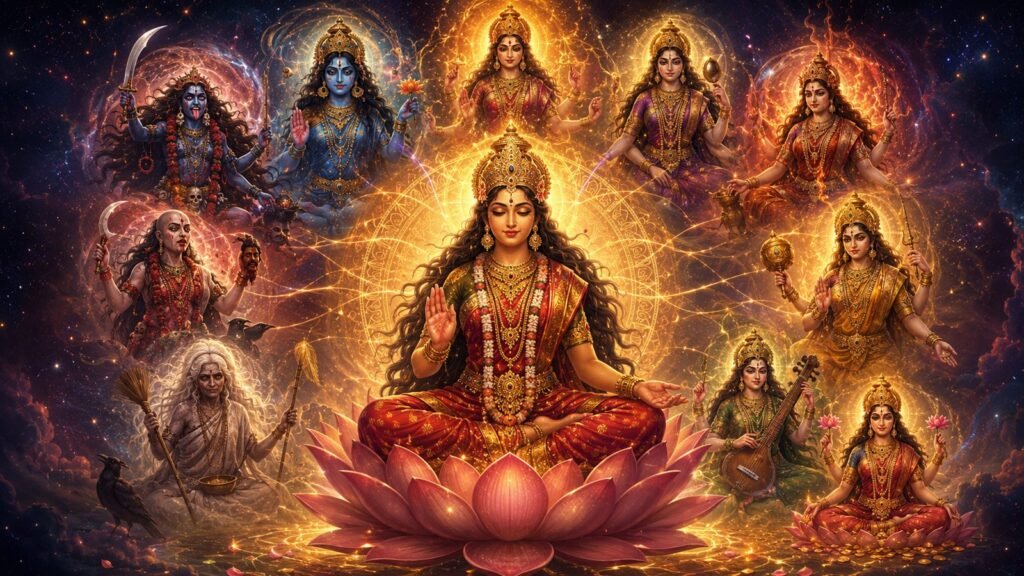
First, the term Das Mahavidya (also written Dasa Mahavidya or Dus Mahavidya) breaks down into three Sanskrit words. "Das" or "Dasa" simply means ten. "Maha" means great. And "Vidya" means wisdom, knowledge or illuminating insight. It shares a root with vid, to know - the same root that gives us "Veda." Together they name the Ten Great Wisdoms. Because each of the ten is a complete path of knowledge, each one leads the seeker to liberation.Crucially, a Mahavidya is not merely a deity to be admired from afar. In the Tantric understanding, each goddess is a vidya - a living wisdom transmitted through her mantra, her form and her sadhana. So to take up the practice of a Mahavidya is to step through a particular doorway into ultimate reality. One seeker may pass through the fierce gate of Kali; another through the serene beauty of Tripura Sundari; another through the silence of Dhumavati. Yet all ten doors open onto the same boundless awareness.Traditionally, then, the ten are named in this order: Kali, Tara, Tripura Sundari, Bhuvaneshwari, Bhairavi, Chinnamasta, Dhumavati, Bagalamukhi, Matangi and Kamala. Since the major scriptures preserve this sequence consistently, it is the order we follow throughout this guide.Moreover, the Mahavidyas span the entire range of existence. Some, then, are saumya (gentle, benevolent) - Tara, Tripura Sundari, Bhuvaneshwari, Matangi and Kamala. Others, however, are ugra (fierce, terrible) - Kali, Bhairavi, Chinnamasta, Dhumavati and Bagalamukhi. Above all, this deliberate inclusion of both the beautiful and the terrifying lies at the heart of the teaching. Because of it, we see that the Divine Mother is not only light and sweetness. She is also darkness, decay and dissolution. Therefore, to know her fully is to embrace all of reality without fear.Adi Parashakti - The Single Source Behind the Ten
Before the ten, there is the One. In Shakta theology, the ultimate reality is Adi Parashakti (also Adi Shakti) - the primordial, supreme energy that is the source of all that exists. Even so, she is not a consort or a helper of the gods. She is the very ground of being. Indeed, Brahma, Vishnu and Shiva themselves arise from her conscious power to perform creation, preservation and dissolution.Indeed, this rise of the Goddess as the supreme being marks a great turning point in the history of Shaktism. Texts such as the Devi Bhagavata Purana - whose final chapters, the Devi Gita, became central scriptures of the tradition - envision the supreme reality as feminine. From this single Adi Parashakti, the ten Mahavidyas pour forth like ten rays from one sun, or ten waves on one ocean. They differ in form, mood and function, yet none is separate from her.Understanding this is essential before approaching the origin legend. When Sati manifests the ten forms, she creates nothing new. Instead she reveals what was always true. After all, she has always been Adi Parashakti, the source of all. In short, the story is a moment of cosmic self-revelation. Here the Mother shows her infinite nature. Yet she does so through a finite, intimate, even domestic scene between husband and wife.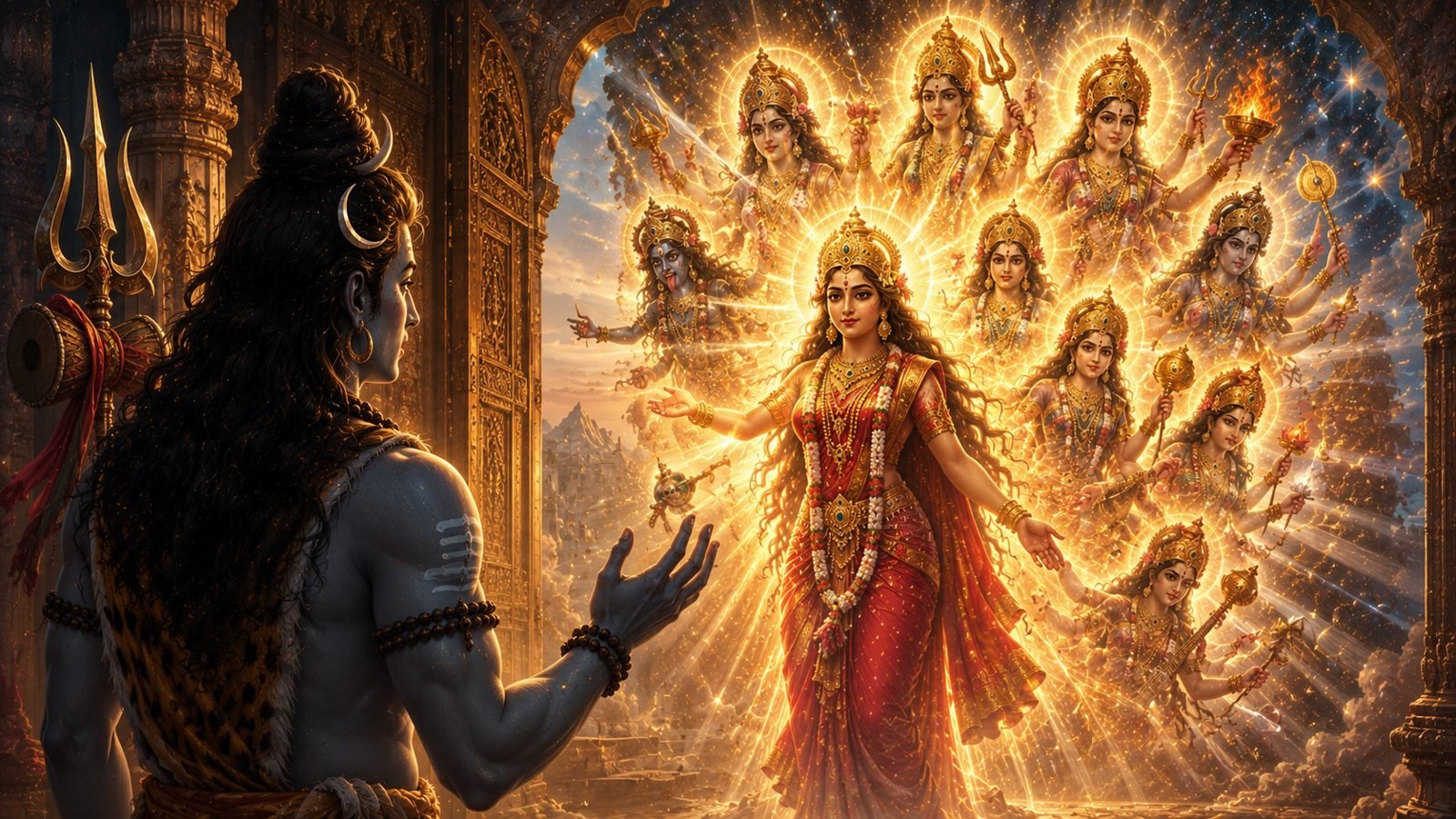
The Origin Legend: Sati and the Ten Forms
The most celebrated account of the Mahavidyas' appearance is told in the Mahabhagavata Purana and echoed in the Brihaddharma Purana and the Devi Bhagavata Purana. It is a story of love, pride, divine anger and ultimate revelation.Sati was the daughter of the powerful king Daksha Prajapati. Yet she married Lord Shiva against her father's wishes, drawn to him by a love that was itself cosmic in nature. In time, Daksha - proud and resentful of his ascetic son-in-law - organised a grand yagna, a great fire-sacrifice, and invited all the gods and sages. Pointedly, he did not invite Shiva, nor his own daughter Sati.When Sati learned of the sacrifice, she determined to attend. She longed to see her family. Moreover, the insult to her husband had kindled her anger. She went to Shiva and asked his permission to go. Shiva refused. He warned her that to attend uninvited, to a ceremony where her husband had been deliberately slighted, could only bring inauspicious results. He would not let her go.Sati's Fury and the Ten Directions
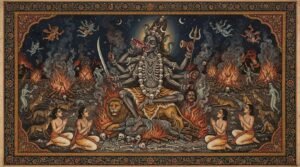
Sati was overcome with a fury that was no ordinary human anger - it was the rising of the cosmic Shakti within her. Enraged that Shiva would deny her, that he failed to recognise her true nature as the Mother of the Universe, her form began to transform. Her gentle appearance fell away and she assumed her true, terrible, all-encompassing divine shape.When Shiva, alarmed, turned to flee in whatever direction he could, Sati multiplied herself. She manifested into ten distinct, overwhelming forms. Then each stationed herself in one of the ten directions. These are north, south, east and west, the four intermediate corners, the zenith above and the nadir below. Wherever Shiva turned, a fierce and radiant goddess stood before him, blocking his path. There was no direction in which the cosmos itself did not confront him as the Goddess.These ten forms were the Das Mahavidya. Surrounded on every side, Shiva understood: this was no mere wife defying him. But Adi Parashakti herself revealing her boundless nature. He yielded. Once Shiva acknowledged her divine status, Sati departed for Daksha's sacrifice. That journey would end in her self-immolation. So it set in motion the later cosmic drama of Shiva's grief and her rebirth as Parvati. But in that single moment of ten-fold manifestation, the wisdom goddesses had entered the world.The Variant Legends
As with most great myths, the origin of the Mahavidyas is told in more than one way, and the variations are themselves illuminating.In one widely repeated variant, the ten forms appear not only to block Shiva but specifically to subdue his resistance jointly. Here the emphasis falls on the goddesses acting in concert. Ten powers cooperate to accomplish what no single form could. So the Divine Mother's strength shows itself as multifaceted and total.The Battlefield and the Tantric Vision
A second family of legends shifts the setting from the domestic scene to the cosmic battlefield. Across these accounts, the Mahavidyas emerge to assist the gods (the devas) when they are overwhelmed by demonic forces. In the Devi Mahatmya, Kali famously sprang from Durga's brow to destroy Chanda, Munda and Raktabija. In the same way, the ten wisdom goddesses manifest as the Mother's emergency army. Each form embodies a particular power that restores cosmic order. This version foregrounds the Mahavidyas as protectors and destroyers of evil.A third strand, found in the Tantras, presents the Mahavidyas less as figures in a narrative. Instead it treats them as eternal cosmic principles. These ten primordial powers were never "born" at all; they simply are. They are the timeless wisdom-energies through which the universe is woven and known. The Rudra Yamala Tantra and Todala Tantra describe their forms, mantras and powers in this register. The Todala Tantra even pairs each Mahavidya with one of the ten avatars of Vishnu. Thus the same supreme power expresses itself through the Goddess and through her masculine incarnations alike.These variants do not contradict so much as complete one another. The Sati legend gives the Mahavidyas an intimate, emotional origin; the battlefield accounts give them a cosmic, protective purpose; and the Tantric vision reveals their ultimate, timeless nature. Together they describe a single truth from three vantage points.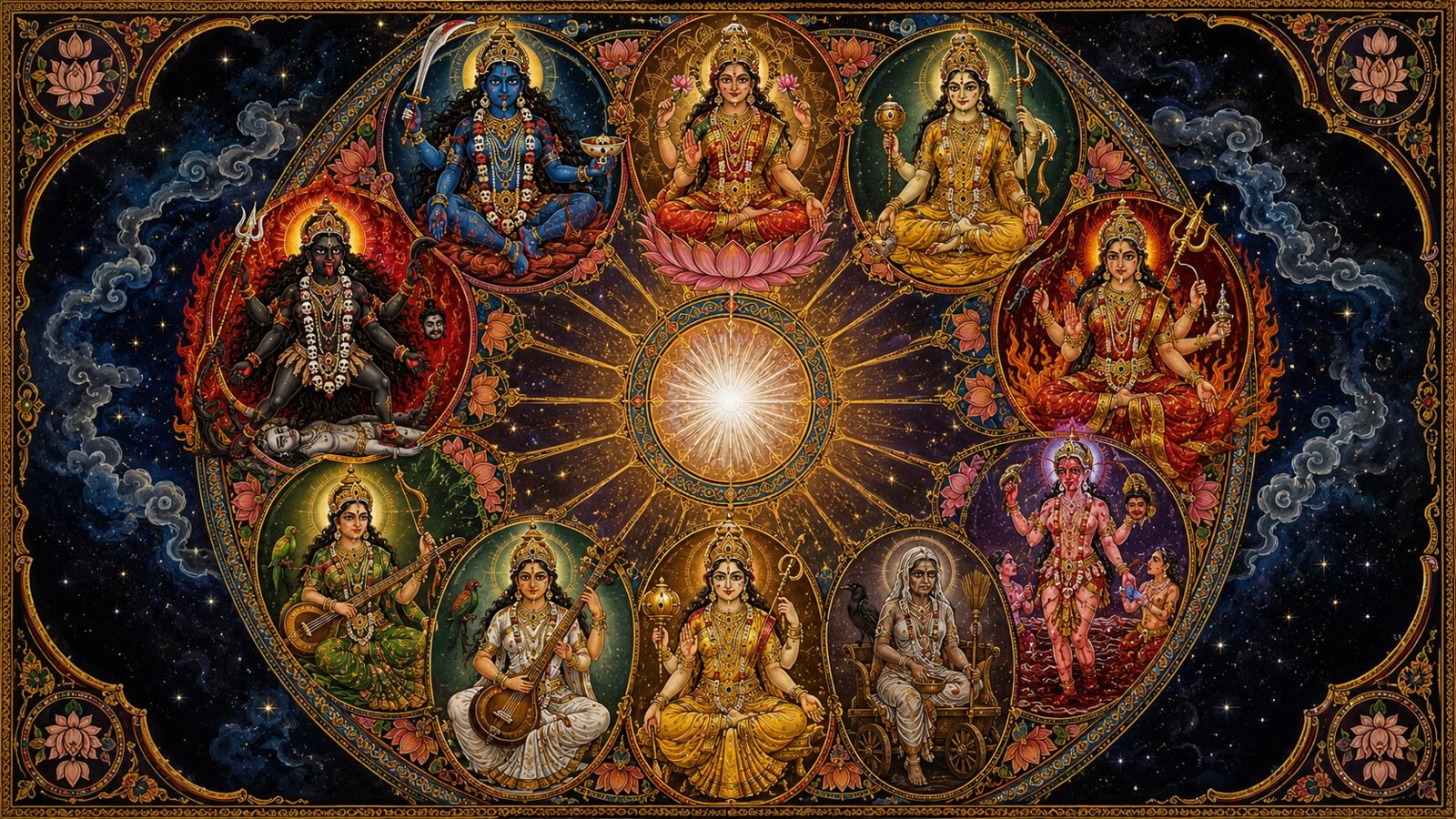
The Ten Mahavidyas at a Glance
The table below summarises the ten goddesses in their traditional order. It gives a representative seed-syllable, or bija, and the cosmic principle each represents. Finally, it names the direction each guarded in the origin legend. Bija mantras and directional correspondences vary across Tantric lineages; those given here reflect widely cited traditions and should be confirmed with a qualified guru before formal practice.| Goddess | Bija / Seed | Represents | Direction |
|---|---|---|---|
| First - Kali | Kreem (क्रीं) | Time, dissolution, fearlessness | Centre / South |
| Second - Tara | Streem / Hum (स्त्रीं / हुं) | Guidance, the saving word, sound | North |
| Third - Tripura Sundari | Shreem / Aim Klim Sauh | Beauty of the three worlds, bliss | Centre (Manidvipa) |
| Fourth - Bhuvaneshwari | Hreem (ह्रीं) | Space, the world as the Mother's body | Zenith / sky |
| Fifth - Bhairavi | Hsraim Hsklrim Hsraum | Tapas, transforming fire, decay | South-east |
| Sixth - Chinnamasta | Shreem Hreem Klim ... Hum Hum Phat | Self-sacrifice, life-force, courage | West |
| Seventh - Dhumavati | Dhum Dhum Dhumavati Thah Thah | Void, the unmanifest, letting go | Nadir / north-west |
| Eighth - Bagalamukhi | Hleem (ह्लीं) | Stillness, the power to stun and protect | South-west |
| Ninth - Matangi | Aim / Hreem Aim Shreem (ऐं) | Speech, art, inner wisdom | North-east |
| Tenth - Kamala | Shreem (श्रीं) | Abundance, grace, auspiciousness | East |
The Ten Goddesses Explained
Each of the ten Mahavidyas carries her own story, mood, mantra and path. Below is a brief profile of each, with a link to her complete guide for deeper study.First Mahavidya - Maa Kali
Kali is the first and supreme of the ten, the very ground from which the others unfold. Black as the formless void and standing upon a recumbent Shiva, she is Time itself - that which devours all names and forms. Her wild appearance is not cruelty but compassion: she severs the ego and the fear of death so the seeker may rest in pure awareness. As the central deity of the Kalikula tradition she embodies the fierce, direct, liberating face of the Divine Mother.Read the full guide:Second Mahavidya - Maa Tara
Tara, the second Mahavidya, is the goddess who ferries the devotee across the ocean of worldly existence (the root tr means to cross over). Closely linked to the seed-sound and the cremation ground of Tarapith, she is the saving Word, the guide who offers knowledge in the darkest hour. Tradition holds that she nursed Shiva after he drank the Halahala poison of the Samudra Manthana, becoming the Mother who heals.Read the full guide:Third Mahavidya - Maa Tripura Sundari
Tripura Sundari, also called Shodashi or Lalita, is the third Mahavidya and the supreme deity of the Srikula tradition. Radiant as molten gold, she is the Beauty of the Three Worlds. She is the blissful union of Shiva and Shakti. Thus she reigns over Manidvipa, the island-jewel abode of the Goddess. Where Kali represents fierce dissolution, Tripura Sundari represents the serene, beauty-filled fullness of realised consciousness.Read the full guide:Fourth Mahavidya - Maa Bhuvaneshwari
Bhuvaneshwari, the fourth Mahavidya, is the Queen of the Worlds whose very body is the manifested cosmos - all fourteen lokas. Golden and calm, holding goad and noose, she is the Mother as infinite space (akasha), the loving container in which all creation appears and dissolves. To meditate on her is to feel the universe held within a boundless, nurturing presence.Read the full guide:Fifth Mahavidya - Maa Bhairavi
Bhairavi, the fifth Mahavidya, is the fierce feminine counterpart of Bhairava and the goddess of tapas - the transforming heat of spiritual discipline. Fiery red, garlanded with skulls and holding a rosary and book, she presides over the relentless wearing-down of the old self that decay and time accomplish. She is the burning austerity that purifies the seeker for higher knowledge.Read the full guide:Sixth Mahavidya - Maa Chinnamasta
Chinnamasta, the sixth Mahavidya, is the self-decapitated goddess. She stands upon a divine couple and holds her own severed head. Meanwhile three streams of blood feed her two attendants and her own mouth. This startling image is one of Tantra's deepest teachings: the simultaneous reality of life, death and the endless circulation of cosmic energy, and the courage of utter self-giving.Read the full guide:Seventh Mahavidya - Maa Dhumavati
Dhumavati, the seventh Mahavidya, is the Smoky One - the widow goddess who rides a crow-bannered, horseless chariot. Old, hungry and clothed in white, she embodies the void, the unmanifest, and everything the world labels inauspicious. Her teaching is profound: by accepting loss, dissolution and emptiness rather than fleeing them, the seeker discovers the freedom that lies beyond all attachment.Read the full guide:Eighth Mahavidya - Maa Bagalamukhi
Bagalamukhi, the eighth Mahavidya, is the goddess who stuns and stills. Brilliant yellow and seizing the tongue of a demon, she is the power of stambhana - the paralysing of hostile forces, restless speech and the agitated mind. Her worship is sought for protection, for victory over enemies and obstacles, and for the deep inner stillness in which true clarity arises.Read the full guide:Ninth Mahavidya - Maa Matangi
Matangi, the ninth Mahavidya, is the Tantric Saraswati - emerald-dark, seated on a throne and holding a veena. She is the goddess of speech, music, art and inner wisdom. But in a deliberately outsider, unconventional form that delights in what orthodoxy rejects. She teaches that the sacred is found beyond purity rules, in the living, expressive power of sound and creativity.Read the full guide:Tenth Mahavidya - Maa Kamala
Kamala (Kamalatmika), the tenth Mahavidya, is the Tantric Lakshmi - golden, lotus-seated and bathed by elephants. She is abundance, grace, fertility and auspiciousness, the gentlest and most accessible of the ten. As the final Mahavidya, she shows that the wisdom journey does not end in renunciation alone. Instead it culminates in a luminous, prosperous engagement with life, lived in harmony with the Divine Mother.Read the full guide: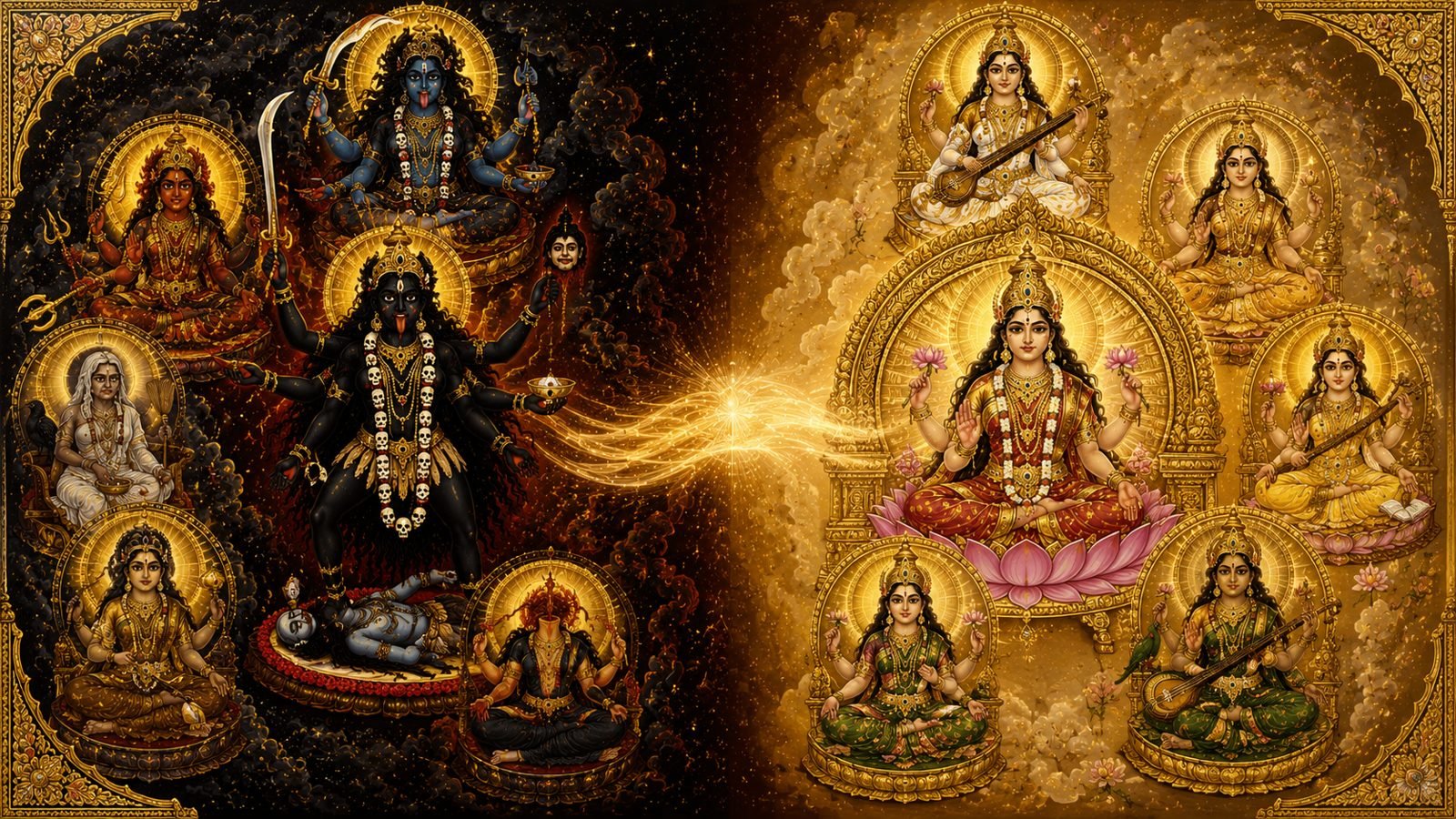
Kalikula and Srikula - The Two Families of the Goddess
Within Shakta Tantra, the worship of the Divine Mother flows through two great streams, and the Mahavidyas are often sorted between them. These two families are called Kalikula (the family of Kali) and Srikula (the family of Sri, that is, of Lakshmi and Tripura Sundari).The Kalikula tradition centres on the fierce, transformative aspect of the Goddess and takes Kali as its supreme deity. Over time it became closely identified with the worship of the Dasa Mahavidya as a whole. Since then it has flourished especially in eastern and northern India, in Bengal, Assam, Mithila and the Himalayas. Its mood is direct, intense and liberation-oriented, unafraid of the cremation ground or the terrifying face of reality.The Srikula tradition centres on the benevolent, beauty-filled aspect of the Goddess and takes Tripura Sundari (Lalita) as its supreme deity. It migrated south and flourished there. In southern India it became famous as Srividya, built around the worship of the Sri Yantra. Thus it stands as one of the most refined and philosophically rich of all Tantric systems.Traditions differ on exactly how the ten divide. Still, one grouping is cited most often. It places Kali, Tara, Bhuvaneshwari and Chinnamasta within the Kalikula family. Tripura Sundari, Bhairavi, Dhumavati, Bagalamukhi, Matangi and Kamala then fall within the Srikula family. Other lineages draw the line differently. What matters is the underlying insight. The seeker approaches the same supreme Mother either through her fierce, dissolving face or through her gracious, abundant face. Together, the ten Mahavidyas hold both within a single embrace.Tantric Significance and the Path of Wisdom
Why ten, and why this particular range from terror to beauty? In the Tantric vision, the ten Mahavidyas map the complete journey of consciousness. They are not a random gallery of goddesses but a graded revelation of the one reality in all its moods.The ten can be read as stages of cosmic wisdom. Kali is the formless, time-devouring absolute from which all begins. Tara is the saving sound and guidance that carries the seeker forward. Tripura Sundari is the blissful beauty of awakened awareness. Bhuvaneshwari is the spaciousness in which all worlds arise. Bhairavi is the fire of discipline that burns away impurity. Chinnamasta is the courageous self-offering that reveals the circulation of life-energy. Dhumavati is the embrace of the void and of loss. Bagalamukhi is the stillness that stuns all agitation. Matangi is the flowering of inner speech and wisdom. And Kamala is the return to abundance and grace, life lived in harmony with the Divine. Read this way, the ten describe a complete arc from dissolution to fulfilment.Each Mahavidya also has practical and even astrological associations. The Todala Tantra famously links each Mahavidya with a planet in one's birth chart. It pairs Kali with Saturn, Tara with Jupiter, Tripura Sundari with Mercury, Bhuvaneshwari with the Moon and Bhairavi with the ascendant. Then it joins Chinnamasta to Rahu, Dhumavati to Ketu, Bagalamukhi to Mars, Matangi to the Sun and Kamala to Venus. Such correspondences are part of the rich symbolic web that surrounds the ten, though spiritual liberation - not material benefit - remains the heart of authentic Mahavidya sadhana.How to Begin Worship and Sadhana
For the sincere seeker drawn to the Mahavidyas, the path begins gently. The following guidance is a respectful starting point, not a substitute for initiation (diksha) from a qualified guru, which the deeper Tantric practices traditionally require.- Begin with Kali. As the first and root Mahavidya, Kali is the natural doorway. Her beej mantra, Om Kreem Kalikayai Namah, is considered universally accessible and safe for beginners to chant with devotion.
- Create a sacred space. Set up a clean altar with an image of the Goddess, a ghee lamp, incense and fresh flowers. Sit on a cotton or wool mat, facing east or, for Kali, south.
- Chant with a mala. Use a rudraksha or crystal mala of 108 beads, moving each bead with the thumb and middle finger - never the index finger, which symbolises ego. Complete at least one full mala (108 repetitions) without interruption.
- Choose auspicious times. The Brahma Muhurta (roughly 4 to 6 AM) and midnight are traditional. Tuesdays, Saturdays, Amavasya (new moon) nights and Navaratri are especially powerful.
- Practise consistency over intensity. A daily commitment, often kept for a forty-day cycle (mandala), matters far more than occasional bursts. Maintain a simple, sattvic diet and a calm, reverent attitude throughout.
- Seek a guru for advanced practice. The fierce Mahavidyas - Dhumavati, Bagalamukhi, Chinnamasta and the higher Tantric mantras of all ten - should be approached only under proper guidance.
A Note on the Mantra
Sound is the gateway to the Mahavidyas. Devotees invoke each goddess through her bija, or seed-syllable, and through longer mantras. For those beginning, though, tradition points to one first step. That is the seed mantra of Kali, the first Mahavidya and the root of all ten. The table below presents it in full.| Sanskrit | Hindi | Transliteration | Meaning |
|---|---|---|---|
| ॐ क्रीं कालिकायै नमः | ओम् क्रीं कालिकायै नमः | Om Kreem Kalikayai Namah | I bow to Goddess Kali, who embodies the seed-syllable Kreem - the primordial sound of transformation and the gateway to the ten wisdom goddesses. |
🕉️ Hear these sacred mantras come alive. Subscribe to Musinara Sounds on YouTube for 432 Hz Devi mantra chants, meditation music, and new devotional videos every week.
Das Mahavidya stands at the heart of this path. Those who turn to Das Mahavidya with sincerity find that Das Mahavidya does not remove every difficulty. But grants the steadiness to meet it.
Frequently Asked Questions
What is the Das Mahavidya?
The Das Mahavidya are the Ten Great Wisdoms - ten Tantric goddesses who are each a complete facet of the one Divine Mother, Adi Parashakti. They are Kali, Tara, Tripura Sundari, Bhuvaneshwari, Bhairavi, Chinnamasta, Dhumavati, Bagalamukhi, Matangi and Kamala, and they range from fierce to gentle, together spanning the whole of cosmic reality.How did the ten Mahavidyas appear?
According to the Mahabhagavata Purana, they appeared at Daksha's sacrifice. Shiva had denied Sati permission to attend. So she revealed her cosmic nature and multiplied into ten forms. Each form guarded one of the ten directions, and Shiva could not leave. Variant legends describe them emerging to assist the gods against demons, or as eternal cosmic principles.What do "Das," "Maha" and "Vidya" mean?
"Das" (or Dasa) means ten, "Maha" means great, and "Vidya" means wisdom or knowledge. Together, Das Mahavidya means the Ten Great Wisdoms. Each goddess is a living wisdom (vidya) that, through her mantra and practice, leads the seeker toward liberation.Who is Adi Parashakti?
Adi Parashakti (also Adi Shakti) is the primordial, supreme cosmic energy - the Divine Mother as the ultimate ground of being from which Brahma, Vishnu and Shiva arise. The ten Mahavidyas are all expressions of this single supreme power.What scriptures describe the Mahavidyas?
Key sources include the Mahabhagavata Purana, the Devi Bhagavata Purana, the Brihaddharma Purana and Shakta Tantras such as the Todala Tantra and Rudra Yamala Tantra. The Brihaddharma and Mahabhagavata Puranas list Shodashi as another name for Tripura Sundari.What is the difference between Kalikula and Srikula?
Kalikula is the family of Kali, centred on the fierce, transformative aspect of the Goddess and closely tied to Dasa Mahavidya worship in eastern and northern India. Srikula is the family of Sri (Tripura Sundari), centred on her benevolent, beautiful aspect, which flourished in the south as Srividya.Are the Mahavidyas fierce or gentle?
Both. Five are considered gentle (saumya) - Tara, Tripura Sundari, Bhuvaneshwari, Matangi and Kamala - while five are fierce (ugra) - Kali, Bhairavi, Chinnamasta, Dhumavati and Bagalamukhi. This balance is intentional: the Divine Mother encompasses all of reality, both beautiful and terrifying.Which Mahavidya should a beginner start with?
Most teachers recommend beginning with Kali, the first and root Mahavidya, using her accessible beej mantra Om Kreem Kalikayai Namah. The fierce goddesses such as Dhumavati and Bagalamukhi, and the deeper Tantric mantras of all ten, traditionally require initiation from a qualified guru.Can the Mahavidyas be worshipped without a guru?
Simple, devotional practices - chanting an accessible beej mantra such as Kali's with a pure heart - can be undertaken by anyone. However, the full Tantric sadhana of the Mahavidyas, especially the fierce forms, traditionally requires diksha (initiation) and ongoing guidance from a guru.What is the significance of the ten directions in the legend?
When Sati manifested the ten forms, each took up one of the ten directions. These were the four cardinal points, the four corners, the zenith and the nadir. So wherever Shiva turned, the Goddess confronted him. Symbolically, this shows that the Divine Mother pervades all of space; there is no direction, and no aspect of reality, that is not her.The origin of the Das Mahavidya is, in the end, the story of how the One reveals herself as the many - how a single act of love and divine self-disclosure unveiled the ten faces of ultimate wisdom. To begin to know even one of them is to begin to know the boundless Mother who is all ten and infinitely more.Part of the Das Mahavidya series. All ten wisdom goddesses, the origin story, their beej mantras and temple guides are collected in one place: Das Mahavidya: The Ten Wisdom Goddesses.