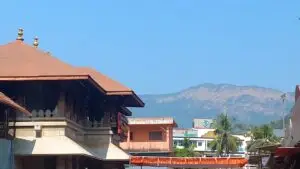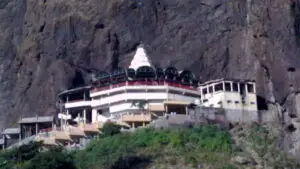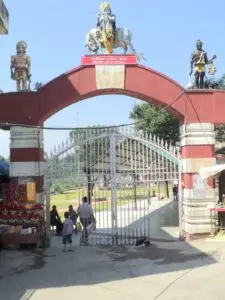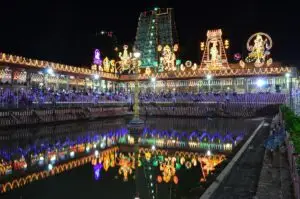
Jwalamukhi Temple (Jwala Ji) in Kangra, Himachal Pradesh, is the Shakti Peetha where Sati's tongue is said to have fallen, and where the Goddess receives worship not as an idol but as nine natural, ever-burning flames rising from the rock. Pilgrims reach it via Gaggal Airport, Jwalamukhi Road railway station or by road from Pathankot, about 105 km away.
Tucked into the folds of the Shivalik hills in the Kangra district of Himachal Pradesh, Jwalamukhi is unlike any other temple in India. Here the Divine Mother is not carved in stone or cast in metal. She receives worship as living fire: a cluster of natural, ever-burning blue flames that rise through the fissured rock of a small cave and have never been seen to go out. For this reason Jwala Ji is counted among the most revered of the Shakti Peethas, the network of sacred sites that mark where the body of the goddess Sati is believed to have fallen across the subcontinent. Devbhoomi Himachal, the "land of the gods," holds many shrines, yet few inspire the wonder of a place where the goddess herself appears as flame.
Tradition holds that this is the spot where Sati's tongue fell to earth, and that the goddess took form here as Jwala, the flaming one. The shrine is older than recorded memory; it appears in connection with kings, emperors and saints, and its eternal flames have drawn the curious and the devout alike, from a doubting Mughal emperor to humble cowherds whose names live on in legend. The Sikh Maharaja Ranjit Singh is said to have crowned its dome in gold, and pilgrims still climb to its modest sanctum chanting the name of Jwala Mai.
This guide is a reverent, carefully sourced companion to Jwala Ji: who the goddess is, the meaning of her nine eternal flames, the famous legend of Emperor Akbar and the golden umbrella, the temple's long history, how worship is conducted, the festivals that fill its courtyards, and everything a pilgrim needs to plan a visit. Where traditions differ, and at a shrine this ancient they often do, this article notes the variation honestly rather than presenting one version as the only truth.
Key Takeaways
- Jwalamukhi is the Shakti Peetha where Sati's tongue is said to have fallen, and the Goddess receives worship as natural eternal flames with no idol in the sanctum.
- Nine sacred flames, the Nav Jyoti, are honoured as nine forms of the Goddess, from Mahakali to Anji Devi, burning without oil, ghee or wick.
- The Akbar legend tells how the emperor failed to extinguish the flames and offered a golden chhatra that the goddess turned into an unknown base metal, still preserved at the temple.
- Maharaja Ranjit Singh is traditionally credited with gilding the temple dome, and the fourteenth-century chronicle Tarikh-i-Firozshahi records a library of about 1,300 manuscripts at the shrine.
- The temple sits about 50 km from Dharamshala and 105 km from Pathankot, with Gaggal (Kangra) Airport and Jwalamukhi Road (Ranital) station as the nearest air and rail links.
Who Is Jwala Ji, the Goddess of the Eternal Flame?
Jwala Ji is a fierce and benevolent form of the Divine Mother whose name means "flame," worshipped at Jwalamukhi not through an idol but as natural, ever-burning fire rising from the rock. She receives veneration as a manifestation of Maa Durga and, in the deepest sense, of Adi Shakti, the primordial feminine energy.
Affectionately called Jwala Mai, Jwala Mata or Jwalamukhi, her name unfolds from Sanskrit: jwala (ज्वाला) means flame or blaze, while mukhi means "mouthed" or "faced." Together, Jwalamukhi describes the goddess of the flaming mouth, she whose presence is fire itself.
What makes Jwala Ji extraordinary is that there is no idol in her sanctum. Across India the Goddess is usually worshipped through an image or a self-manifest stone; at Jwalamukhi, devotees bow before flames that leap from the rock with no fuel, no wick and no human hand to feed them. The goddess is therefore experienced directly as light and heat, as Jyoti, the sacred flame. To stand before the main flame is, for the devotee, to stand in the literal presence of the Mother.
Geologically, the flames are usually explained as natural gas seeping through cracks in the rock and igniting. Devotees and even some observers note that the source has never been conclusively pinned down, and accounts differ on how the fire was first kindled and why it endures at this altitude. For the pilgrim, the science and the sacred sit comfortably together: whatever the mechanism, the flame is honoured as the living form of the Mother.
Where Does Jwalamukhi Stand Among the Shakti Peethas?
Jwala Ji is one of the most important of the Shakti Peethas, the sacred power-centres formed where parts of Sati's body are believed to have fallen to earth. Many popular lists count fifty-one such Peethas, and Jwalamukhi holds a place of particular honour among them because here the goddess is present not merely as a relic-spot but as continuous, visible flame. Our complete guide to the 51 Shakti Peethas maps the entire sacred network.
The official Kangra temple authorities describe the recognition of Jwalamukhi as "paramount" among the Shakti Peethas, and the shrine is grouped with Kangra's other great Devi temples, Brajeshwari (Bajreshwari) at Kangra, Chamunda Devi and Chintpurni, on the region's most beloved pilgrimage circuit.
What Is the Shakti Peetha Legend of Jwalamukhi?
The legend tells that when Sati gave up her life at her father Daksha's sacrifice, the grieving Shiva carried her body across the worlds until Vishnu's Sudarshana Chakra divided it. At Jwalamukhi her tongue (jihva) fell to earth, and the goddess manifested here as eternal flame, the very tongues of fire seen today.
The story of every Shakti Peetha begins with Sati, the daughter of Prajapati Daksha and the first consort of Lord Shiva. According to the widely told tradition, Daksha organised a great yajna, a fire sacrifice, to which he invited all the gods but pointedly excluded Shiva, whom he disdained. Sati, grieved and humiliated by this insult to her husband, went uninvited to her father's sacrifice. Unable to bear the dishonour shown to Shiva, she gave up her life in the sacrificial fire, in some tellings casting herself into the yajna-kunda, in others consuming her own body through yogic fire. The full account is told in our Sati Devi and Daksha Yagna story.
When Shiva learned of Sati's death, his grief turned to a terrible rage. Lifting her lifeless body upon his shoulder, he began the Tandava, a wild and cosmic dance of destruction that threatened all of creation. To save the universe, Lord Vishnu released his Sudarshana Chakra, which severed Sati's body into many pieces. Wherever a part of her fell to the earth, a Shakti Peetha arose, a place forever charged with the power of the Goddess.
At Jwalamukhi, tradition holds that it was Sati's tongue that fell to earth. And so, fittingly, the goddess manifested here not as a body or a stone but as flame: the tongues of fire that flicker eternally through the rock, understood as the very tongue of the Mother. Some accounts add that the flames of Sati's yogic power, and even her garments, fell nearby. The presiding deity is therefore venerated as Jwala, the flaming aspect of Adi Shakti, and the site is honoured as the place where speech, fire and divine energy meet.
The Cowherd, the Cow and King Bhumi Chand
A cherished local legend tells how the shrine first came to light. In ancient times, in the age called Satya Yuga in some tellings, a cowherd noticed that one cow in the herd of the local king, Raja Bhumi Chand, gave no milk in the evening, though she appeared well fed. Watching closely, he saw a radiant young girl emerge from the forest by day to drink the cow's milk before vanishing in a flash of light. He reported the marvel to the king.
Raja Bhumi Chand knew the old tradition that Sati's tongue had fallen somewhere in this region, and he searched long for the sacred spot without success. Some time later the cowherd returned with news that he had seen a flame burning in the mountains. The king found the place, received darshan of the holy flame, and, guided, some say, by a dream, had a temple raised over it. He entrusted the worship to priests of the Bhojak community, whose descendants, by tradition, serve the goddess to this day.
What Do the Nine Eternal Flames (Nav Jyoti) Represent?
The nine flames of Jwalamukhi are honoured as nine distinct forms of the Goddess: Mahakali, Annapurna, Chandi, Hinglaj Bhavani, Vidhyavasini, Mahalakshmi, Saraswati, Ambika and Anji Devi. A single darshan is therefore felt to carry the blessing of nine aspects of the Divine Mother at once.
The heart of Jwalamukhi is its eternal flames. Within the sanctum, the Mother is seen in the form of Nav Jyoti, nine sacred lights that burn through the fissured rock. Some sources and devotees speak of "seven or nine" flames burning at any time; the temple authorities name nine principal jyotis, and this is the most widely followed tradition.
According to the temple, the nine flames represent the following goddesses, each bestowing a particular grace upon those who worship with a sincere heart:
| Sacred Flame (Jyoti) | Aspect and Blessing |
|---|---|
| Mahakali | Goddess of devotion and liberation |
| Annapurna | Goddess of food and nourishment |
| Chandi | Destroyer of enemies and evil |
| Hinglaj Bhavani | Remover of suffering and affliction |
| Vidhyavasini (Vindhyavasini) | Bestower of refuge and protection |
| Mahalakshmi | Goddess of wealth and splendour |
| Saraswati | Bestower of knowledge and learning |
| Ambika | Giver of children and family blessings |
| Anji Devi (Anjana Devi) | Goddess of long life and happiness |
These nine lights are understood together as Nav Durga, the nine forms through which the Mother creates and sustains the universe. Devotees regard the central, largest flame, traditionally honoured as Mahakali, as the principal jyoti of the shrine. No oil, ghee or wick is offered to keep them alight; they are self-sustaining, and this is precisely the wonder that has drawn pilgrims and emperors for centuries.
What Is the Legend of Emperor Akbar and the Golden Chhatra?
The legend tells that Emperor Akbar, after testing the devotee Dhyanu Bhagat, tried to extinguish the eternal flames with water and iron and failed. Humbled, he offered a golden chhatra (umbrella), which the goddess turned into an unknown base metal to break his pride. The transformed umbrella is preserved at the temple.
No story about Jwalamukhi is told more often than this one. It is usually recounted in two linked parts: first the devotion of Dhyanu Bhagat, and then Akbar's own humbling before the goddess.
Dhyanu Bhagat's Devotion
Tradition tells of Dhyanu Bhagat, a devotee said to be from the village of Nadaun, who was travelling with a large company of pilgrims to Jwalamukhi during Akbar's reign. Struck by the size of the procession, the emperor's soldiers brought Dhyanu before the court, where Akbar questioned him about the goddess. When Dhyanu praised Jwala Mai as the mistress of the whole world, Akbar resolved to test her power: he had a horse beheaded and challenged Dhyanu to have the goddess restore it to life.
Dhyanu hurried to Jwalamukhi and prayed with utter sincerity, vowing that if his plea went unanswered he would offer his own head at the goddess's feet. When no sign came, he is said to have cut off his own head in devotion and laid it before the Mother. Moved by such faith, the goddess appeared, restored Dhyanu's head, and revived the horse in Akbar's court.
Pleased with his devotion, she granted a boon of abhaya-daan, the gift of fearlessness, promising that thereafter any devotee who came to her with a sincere heart and offered a coconut in place of a head would have their wishes fulfilled. This, devotees say, is why the coconut remains the goddess's most cherished offering.
The Umbrella That Turned to Base Metal
Impressed, and unsettled, by what he had heard, Akbar is said to have sent men to Jwalamukhi, who reported that flames truly rose from the ground with no fuel, ghee or wick. The emperor first tried to extinguish the eternal flames by force: he had a water channel dug to flood them, yet the goddess kept her flame-form burning. He then tried to smother them under great iron pans or plates. But the flames are said to have torn through the iron and risen again.
Humbled at last, Akbar journeyed to the shrine, in many tellings on foot, to offer a chhatra (parasol or umbrella) of pure gold as a mark of homage. But to break the last of his pride, the goddess transformed the offering: the gold umbrella turned into an unknown base metal, neither gold nor silver, said in temple tradition to be neither iron, copper nor glass. That altered chhatra is preserved in the temple premises to this day and is shown to pilgrims as a witness to the legend. Devotees take from the story a simple lesson: before the Divine Mother, even an emperor's gold is worth nothing without humility and faith.
It is worth noting, as honest tradition does, that several versions of this legend circulate. The details of how the flames were tested, the exact metal of the transformed umbrella, and the sequence of events vary from one telling to another. What remains constant across them all is the message of the goddess's supremacy and the futility of pride before her.
What Is the History of Jwala Ji Temple?
Jwalamukhi has been a living pilgrimage centre for many centuries: legend credits the first temple to Raja Bhumi Chand, the fourteenth-century Tarikh-i-Firozshahi records a library of about 1,300 manuscripts here, and the Sikh Maharaja Ranjit Singh is traditionally credited with gilding the dome after a great victory.
The shrine is associated in legend with the ancient Raja Bhumi Chand, and the surrounding region was long ruled by the Katoch dynasty of Kangra, whose kings were among the temple's patrons. A temple where fire burns of itself was bound to attract attention, and the historical record, woven through with legend, reflects exactly that.
Medieval References and the Lost Library
In the fourteenth century, when the Delhi Sultanate under Firuz Shah Tughlaq campaigned in the Kangra (Nagarkot) area, the Jwalamukhi temple is recorded as having held a substantial library, a collection of around thirteen hundred manuscripts. According to the chronicle Tarikh-i-Firozshahi, the sultan had Hindu scholars translate works from this library from Sanskrit into Persian. This early reference confirms the shrine's prominence and the depth of learning once associated with it. Later, after the Mughal conquest of Kangra fort in 1620 CE, the emperor Jahangir is also recorded to have visited the region, and the temple appears in connection with his time.
Maharaja Ranjit Singh and the Golden Dome
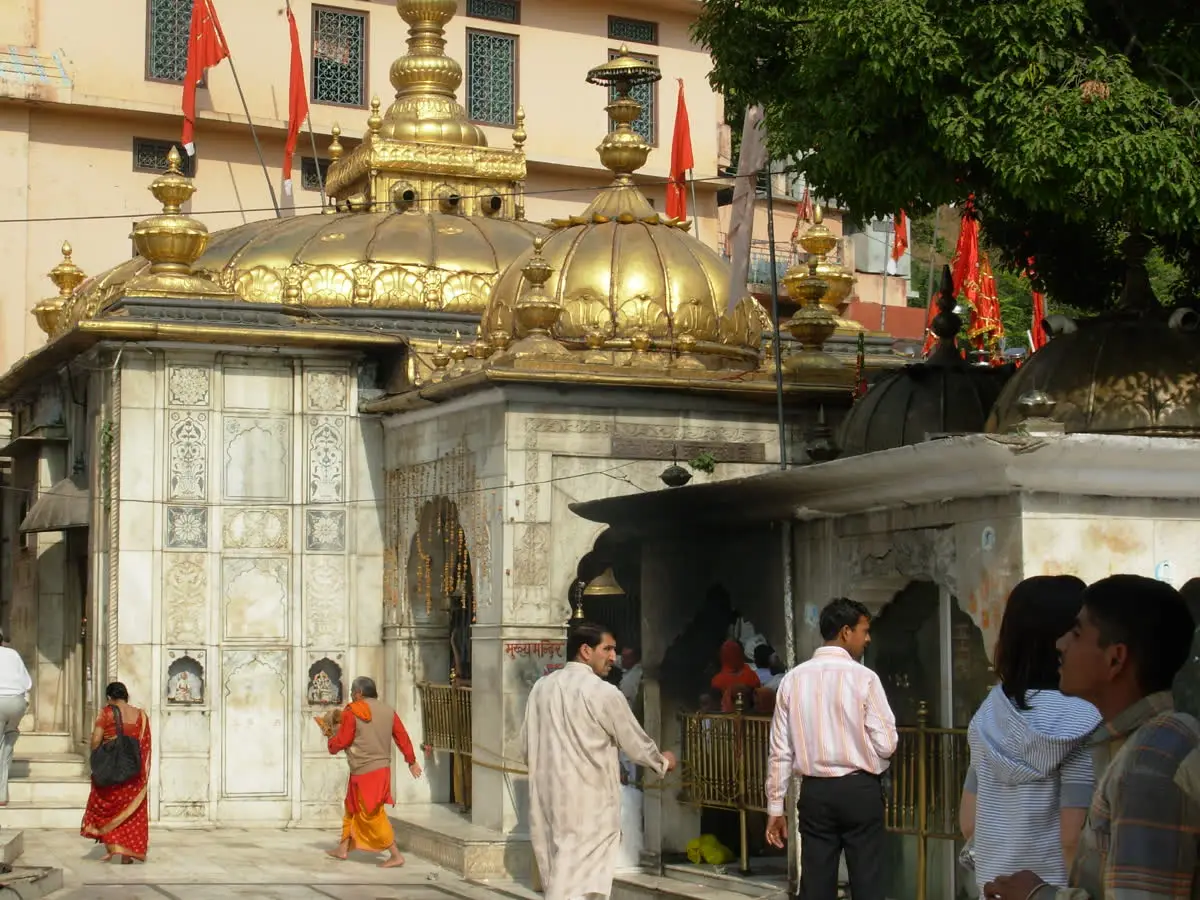
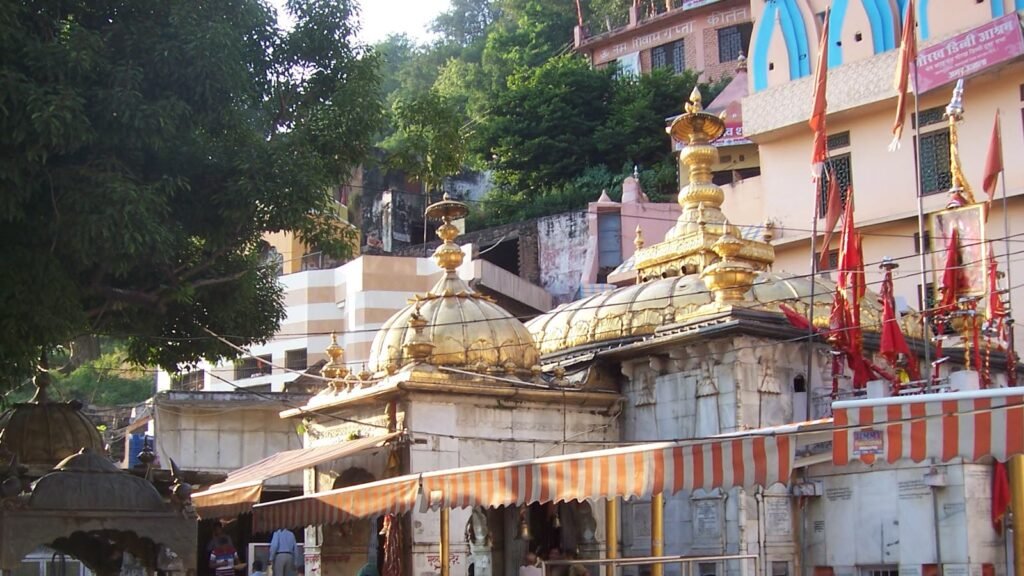
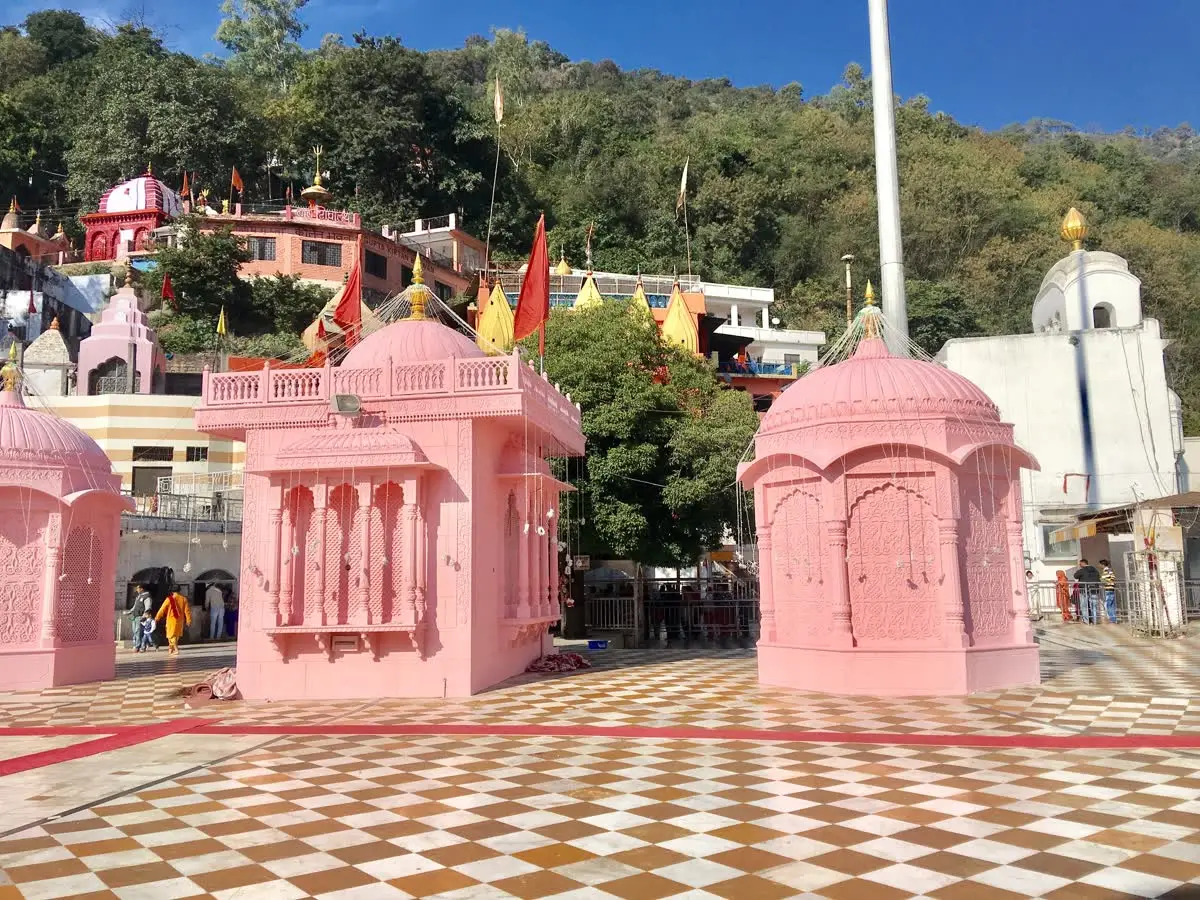
The temple's most famous benefactor was the Sikh ruler Maharaja Ranjit Singh of the Punjab. Temple tradition relates that, following a great military victory, the Maharaja gilded the dome of Jwalamukhi with gold. A widely repeated account holds that gold acquired by the Maharaja was divided among three great shrines: a portion for the dome of the Golden Temple at Amritsar, a portion for Jwalamukhi, and a portion for the Kashi Vishwanath temple at Varanasi. Sources vary on the precise occasion and proportions, and some accounts name the campaign differently; the enduring tradition is that Ranjit Singh's devotion crowned the shrine in gold. The present temple, built in the mandapa style with its small gilded dome, preserves this form. A finely worked silver door, gifted by the Maharaja's family, also adorns the shrine.
Jwalamukhi was woven into the political history of the region as well: in 1809 CE, after Gorkha invaders were driven out of Kangra, a treaty between Maharaja Ranjit Singh and Raja Sansar Chand of the Katoch dynasty is said to have been concluded at the Jwalamukhi temple itself. An idol-form of the goddess was later installed in 1965 by Raja Baldev Singh of the Guler dynasty, and its consecration anniversary is observed each year; yet the heart of worship has always remained the natural flame.
How Is Worship Performed at Jwalamukhi?
Worship at Jwala Ji is performed by hereditary priests of the Bhojak community through the Panchopachar, Dashopachar and Shodashopachar rites, offering water, sandal paste, flowers, incense, lamp and food to the Goddess of fire. The day moves through morning aarti, midday bhog, evening aarti and the night Shayan Aarti.
The hereditary right of worship belongs to priests said to descend from the two Brahmins to whom Raja Bhumi Chand first entrusted the shrine. By their custom the priestly initiation is passed from father to son, and a priest becomes entitled to perform worship after marriage, a lineage that has continued, the temple says, for hundreds of years.
The Mother receives worship through traditional Hindu rites offered in escalating fullness: the Panchopachar (five offerings), Dashopachar (ten offerings) and Shodashopachar (sixteen offerings) methods, which present to the goddess such items as water, sandal paste, flowers, incense, lamp and food (naivedya). Because the deity here is fire, both Swaha (offerings to the deities through Agni) and Swadha (offerings to the ancestors) have a special place in the temple's rituals.
Aarti, Bhog and the Day's Rhythm
The day at Jwalamukhi is marked by a sequence of aartis. The shrine opens early for the morning aarti, a midday bhog is offered to the goddess, an evening aarti is performed at dusk, and the day closes with the Shayan Aarti, the tender "putting to rest" of the Mother at night, accompanied by hymns sung by the priests. The exact timings shift between the summer and winter schedules, given in the visit section below.
Special Pujas and Offerings
- Havan (Om Havan): A fire-sacrifice of special significance here, since the goddess herself is fire; temple tradition speaks of immense merit gained from havan performed at Jwalamukhi.
- Khappar Pujan: Worship performed at the Yogini Kund near the temple entrance, traditionally said to relieve Pitra Dosha and Vastu Dosha.
- Kanya (Kaumari) Pujan: The worship of young girls as living forms of the goddess, believed to bring the Mother's special grace, victory and prosperity.
- The Coconut: Following Dhyanu Bhagat's legend, the coconut (nariyal), along with a red chunri, sweets and flowers, is the goddess's most cherished offering.
As with all sacred practice, devotees are encouraged to approach with humility and sincerity. This guide does not prescribe specific ritual formulas; the recitations used in the shrine are part of the priests' living tradition, and pilgrims are best guided by the temple priests themselves.
Which Mantra Invokes Jwala Ji?
Devotees often invoke the Goddess with a simple beej (seed) salutation to Jwalamukhi: Om Aim Hreem Kleem Jwalamukhyai Namah. It is offered here for reverence rather than as a prescribed ritual formula; pronunciation and usage are best learned from a teacher or the temple priests, and variations of such salutations exist.
| Sanskrit | Hindi | Transliteration | Meaning |
|---|---|---|---|
| ओं ऐं ह्रीं क्लीं ज्वालामुख्यै नमः | ओम ऐं ह्रीं क्लीं ज्वालामुख्यै नमः | Om Aim Hreem Kleem Jwalamukhyai Namah | I bow to Goddess Jwalamukhi, invoked through the sacred seed-sounds Aim, Hreem and Kleem - the powers of speech, divine energy and grace. |
What Is Gorakh Dibbi, and What Else Can You See at Jwalamukhi?
Gorakh Dibbi is a sacred spot within the temple complex, linked to the yogi Gorakhnath, whose wonder is a small kund of water that appears to boil continuously yet remains cold to the touch. Around it, the hill holds a cluster of smaller shrines including Shiva-Shakti, Siddh Nagarjuna and Ashtadashbhuji Devi.
Gorakh Dibbi
Reached by a short flight of steps within the temple precincts, Gorakh Dibbi links to the great yogi Gorakhnath, who is said to have performed penance here. Its central wonder is a small kund (tank) of water that appears to boil and bubble continuously, yet to the touch the water remains cold. Tradition recounts that when a burning incense lamp is shown over the little pool, a flame seems to dance upon the surface of the water itself, a union of fire and water honoured in the scriptures, it is said, as Rudra-Kunda. The sage Nagarjuna is also linked with this spot in local lore.
Other Shrines on the Hill
- Radha-Krishna Temple: A shrine near Gorakh Dibbi dating, by tradition, to the time of the Katoch kings.
- Shiva-Shakti: A short climb above Gorakh Dibbi, where a jyoti (flame) appears together with a Shivling, hence the name uniting Shiva and Shakti.
- Siddh Nagarjuna: Higher still, a spot marked by a stone image and linked to the legend of Gorakhnath and his disciple.
- Ambikeshwar (Manmatt Bhairav): An ancient site near Nagarjuna, honoured as the Bhairava of the Peetha.
- Ashtadashbhuji Devi: An old temple about a mile west of the main shrine, beside a tank where a holy bath is traditionally said to bring healing.
- Tedha Mandir and Bhairav Nath Mandir: Nearby temples of Lord Rama and of Bhairava, set in the wooded surroundings a short distance from the main shrine.
When Are the Festivals and Navratri Melas at Jwalamukhi?
Jwalamukhi comes most vividly alive during Navratri, when great fairs (melas) fill the town: Chaitra Navratri in March to April and Shardiya Navratri in September to October are the two major public melas, while the Gupt Navratris of Magha and Ashadha draw those devoted to deeper sadhana.
Because Jwala Ji is a Shakti shrine of the first rank, the Navratri observances here are especially powerful. The temple keeps all four Navratris through the year:
- Chaitra Navratri: The spring Navratri (March to April), one of the two great public melas at the shrine.
- Shardiya (Sharad) Navratri: The autumn Navratri (September to October), the other major mela, drawing the largest crowds of devotees.
- Gupt Navratri: The two "secret" Navratris of the months of Magha and Ashadha, observed especially by those devoted to deeper sadhana.
Beyond Navratri, the temple observes the New Year Puja in the month of Chaitra (Shukla Pratipada), with flag-hoisting to mark the season's turn, and the birth-anniversary of the idol-form of Mata Jwala Ji on the Chaturthi of the dark fortnight of Phalguna, commemorating the 1965 installation. A general fair is also held in the temple environs each year around July or August.
Throughout these celebrations the temple trust provides a free langar (community meal) to all pilgrims, served three times daily during Navratras and major festivals, in keeping with the goddess's identity as Annapurna, the giver of food.
How Do You Reach Jwalamukhi Temple?
Jwalamukhi lies about 50 km from Dharamshala in the Kangra district of Himachal Pradesh. The nearest airport is Gaggal (Kangra), about 45 to 50 km away; the nearest railhead is Jwalamukhi Road (Ranital) on the Kangra Valley Railway, with Pathankot (about 105 km) as the main broad-gauge junction.
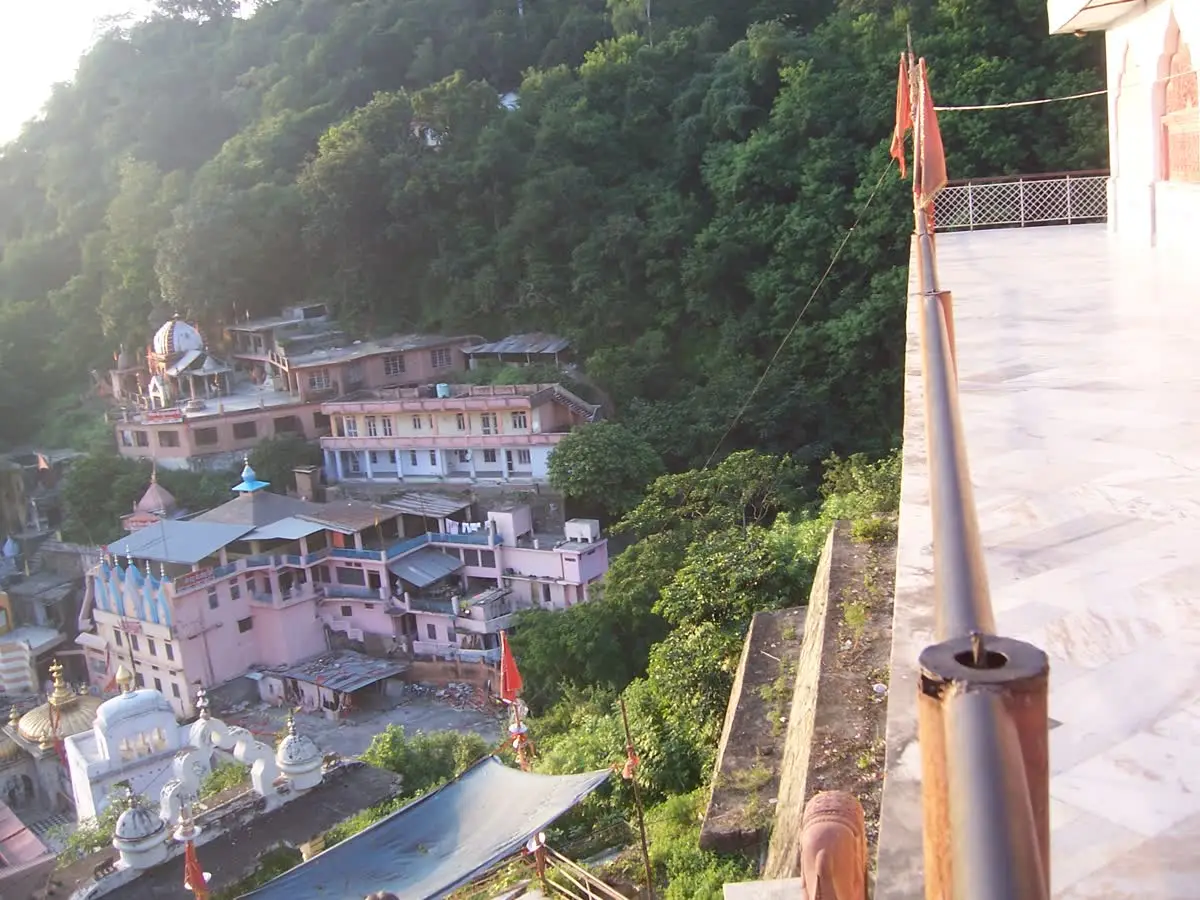
The temple sits at about 600 metres above sea level in the Kalidhar valley of the Shivalik range, in the Jwalamukhi sub-division of Kangra district. Approximate distances reported by the temple authorities include about 105 km from Pathankot, 118 km from Jalandhar, 180 km from Shimla and 200 km from Chandigarh.
| Detail | Information |
|---|---|
| Location | Jwalamukhi town, Kalidhar valley, Kangra district, Himachal Pradesh; about 600 m above sea level, roughly 50 km from Dharamshala |
| Nearest airport | Gaggal Airport (Kangra Airport) near Dharamshala, around 45 to 50 km, with limited domestic flights; Chandigarh and Amritsar serve as larger gateways |
| Rail | Jwalamukhi Road (Ranital) station on the narrow-gauge Kangra Valley Railway is closest; Pathankot (about 105 km) is the most convenient broad-gauge junction |
| Road | Regular buses and taxis from Pathankot, Kangra and Dharamshala; reachable from Chandigarh (about 200 km) and Jalandhar (about 118 km); Himachal state buses serve the route; short walk or auto plus a flight of steps from the bus stand |
| Timings | Summer roughly 4:30 a.m. to 10:00 p.m.; winter roughly 5:00 a.m. to 9:00 p.m.; sanctum closed for bhog around 11:30 a.m. to 12:30 p.m.; Shayan Aarti around 8:00 to 8:40 p.m. in winter and 9:00 to 9:40 p.m. in summer (confirm locally) |
| Entry fee | Free; a free langar is offered daily by the temple trust |
Pilgrim Tips
- The best seasons to visit are spring (March to April) and autumn (September to October), which align with the two great Navratri melas; expect very large crowds during these nine-night festivals.
- Carry simple offerings: a coconut, red chunri, flowers and sweets are traditional and available from stalls near the temple.
- Dress modestly and remove footwear before entering the sanctum; the temple is a place of active worship.
- A free langar (community meal) is offered daily by the temple trust; basic accommodation is available at the temple's Yatri Niwas (Matri Sadan) and in the town.
- Combine your visit with the nearby Kangra Devi circuit: Bajreshwari (Kangra), Chamunda Devi, Chintpurni and the famous Baglamukhi temples are all within reach for a fuller pilgrimage.
Listen: Subscribe to Musinara Sounds for 432 Hz mantra chants
🕉️ Hear these sacred mantras come alive. Subscribe to Musinara Sounds on YouTube for 432 Hz Devi mantra chants, sung slowly enough to follow and repeat.
Plan Your Visit to Jwalamukhi: Timings, Tickets and Travel
The details below were checked on 3 October 2026 against the sources listed under each table. Timings and fees change on festival days, eclipses and special occasions, so confirm with the temple before you travel.
Visiting more than one Devi temple in the Kangra and Una hills? Our Himachal Devi temple circuit sets out the order, distances and days for Naina Devi, Chintpurni, Jwalamukhi, Brajeshwari and Chamunda.
Darshan and Aarti Timings
| Information | Details |
|---|---|
| Temple open, summer | About 6:00 am to 10:00 pm, with a break from about 11:30 am to 12:30 pm. Confirm locally. |
| Temple open, winter | About 7:00 am to 9:30 pm, with a break from about 11:30 am to 12:30 pm. Confirm locally. |
| Aarti, summer | Morning about 5:00 to 5:30 am; bhog 11:30 am to 12:30 pm; evening about 6:00 to 7:00 pm; shayan aarti about 9:00 to 9:40 pm. Confirm locally. |
| Aarti, winter | About 7:00 am and 7:00 pm. Confirm locally. |
| Langar | Lunch about 12:30 to 2:30 pm and dinner about 6:30 to 8:30 pm. Three meals a day during Navratras and major festivals. |
| Darshan during aarti | Darshan is paused during the aarti, which can take nearly two hours. Confirm locally. |
Sources: Kangra Temples, Govt of Himachal Pradesh (Language and Culture / DC Kangra): ..., Kangra Temples, Govt of Himachal Pradesh: Jawalamukhi ji (e-puja management).
Tickets, Darshan Options and Sevas
| Option | Price | Notes |
|---|---|---|
| Prasad packets (e-puja) | Rs 251 and Rs 3,100 | Two packet options on the Kangra Temples portal. Confirm rates on the portal. |
Regular darshan is free. The temple trust serves free langar. The Kangra Temples portal (Government of Himachal Pradesh) offers sign-in for darshan parchi booking, e-puja and live darshan for Jawala Ji, Brajeshwari and Chamunda Ji. The Temple Officer is the Tehsildar, Jwalamukhi (01970-222223); the Commissioner (Temple) is the DC Kangra (01892-222705).
Sources: Kangra Temples, Govt of Himachal Pradesh: Jawalamukhi ji (e-puja management), Kangra Temples, Govt of Himachal Pradesh (Language and Culture / DC Kangra): ....
How to Reach Jwalamukhi
Open Jwalamukhi in Google Maps for live directions.
| Mode | Nearest point | Distance to the temple |
|---|---|---|
| Air | Gaggal (Kangra / Dharamshala) | about 46 to 50 km. Chandigarh airport is about 200 km away. |
| Rail | Jawalaji Road (Ranital), narrow gauge; Pathankot is the broad gauge railhead | Ranital about 20 km; Pathankot about 105 to 140 km |
Sources: District Kangra, NIC (hpkangra.nic.in): Shri Jawalamukhi Mata Temple, HPTDC: The Jawalaji, Jawalamukhi.
Approximate distances and journey times from the cities most pilgrims start from. Road times assume normal traffic; festival weekends take longer.
| From | By road | Road time | Train or flight |
|---|---|---|---|
| Kangra | about 30 to 35 km | ||
| Dharamshala | about 50 to 56 km | Gaggal airport is about 46 to 50 km away | |
| Pathankot | about 105 to 140 km | Pathankot is the broad gauge railhead | |
| Chandigarh | about 200 km | Chandigarh airport is about 200 km away | |
| Delhi | about 480 to 500 km | 10 to 12 hours |
Sources: District Kangra, NIC (hpkangra.nic.in): Shri Jawalamukhi Mata Temple, Himachal Tourism (HP Tourism Dept): Temples, HPTDC: The Jawalaji, Jawalamukhi, District Kangra, NIC: Kangra Pilgrimage.
The temple is well connected by national highway. Buses, taxis and private vehicles are available.
When to Go and How Long to Allow
March to June, or Navratri for the biggest crowds and special ceremonies. The temple is open all year. Fairs are held in March to April and September to October.
Sources: District Kangra, NIC (hpkangra.nic.in): Shri Jawalamukhi Mata Temple, District Kangra, NIC: Kangra Pilgrimage.
Prasadam, Annadanam and Where to Stay
The temple trust serves free langar: lunch about 12:30 to 2:30 pm and dinner about 6:30 to 8:30 pm, with three meals a day during Navratras and major festivals. The temple has a Yatri Niwas (Matri Sadan). Private dharamshalas are also available near the temple.
Source: Kangra Temples, Govt of Himachal Pradesh (Language and Culture / DC Kangra): ....
Temples and Places Near Jwalamukhi
- Shri Brajeshwari Devi, Kangra (about 30 to 35 km): Part of the Kangra Devi temple circuit
Sources: District Kangra, NIC (hpkangra.nic.in): Shri Jawalamukhi Mata Temple, Himachal Tourism (HP Tourism Dept): Temples.
Frequently Asked Questions
Where is the Jwalamukhi Temple located?
Jwala Ji temple stands in the town of Jwalamukhi in the Kangra district of Himachal Pradesh, in the Kalidhar valley of the Shivalik hills, at about 600 metres above sea level. It is roughly 50 km from Dharamshala and about 105 km from Pathankot.
Why is there no idol in the Jwalamukhi Temple?
Jwalamukhi is unique because the goddess receives worship not as an idol but as natural eternal flames that rise from the rock. Tradition holds that Sati's tongue fell here and the goddess took form as flame, so devotees venerate the living fire itself, the Jyoti, as the direct presence of the Mother.
What is the Shakti Peetha legend of Jwala Ji?
When Sati gave up her life at her father Daksha's sacrifice, the grieving Shiva carried her body across the world. Vishnu's Sudarshana Chakra divided her body, and Shakti Peethas arose wherever a part fell. At Jwalamukhi, tradition says her tongue fell to earth, and the goddess manifested as eternal flame.
How many flames burn at the Jwalamukhi Temple?
The temple is known for its nine eternal flames, the Nav Jyoti, each honoured as a form of the Goddess: Mahakali, Annapurna, Chandi, Hinglaj, Vidhyavasini, Mahalakshmi, Saraswati, Ambika and Anji Devi. Some accounts speak of seven or nine flames burning at any time; the nine principal jyotis are the most widely followed tradition.
What is the legend of Akbar and the golden umbrella?
Tradition tells that Emperor Akbar, after the devotion of Dhyanu Bhagat moved the goddess to a miracle, tried to extinguish the flames with water and iron and failed. He then offered a golden chhatra (umbrella). But the goddess turned it into an unknown base metal to humble his pride. That transformed umbrella is said to be preserved in the temple to this day. Details vary across tellings. But all affirm the goddess's supremacy.
Who built and gilded the Jwalamukhi Temple?
Legend credits the original temple to Raja Bhumi Chand. The present mandapa-style shrine's golden dome is traditionally attributed to the Sikh Maharaja Ranjit Singh, who is said to have gilded it after a great victory; his family also gifted the silver door. The Katoch kings of Kangra were long-standing patrons of the shrine.
What is Gorakh Dibbi at Jwalamukhi?
Gorakh Dibbi is a sacred spot within the temple complex, linked to the yogi Gorakhnath. Its wonder is a small kund whose water appears to boil continuously yet remains cold to the touch; tradition calls it Rudra-Kunda. It is reached by a short climb from the main temple.
When is the best time to visit Jwalamukhi?
The most auspicious and vibrant times are the two great Navratri melas: Chaitra Navratri in spring (March to April) and Shardiya Navratri in autumn (September to October). These periods bring large crowds; visitors seeking a quieter darshan may prefer other months. The pleasant hill weather of spring and autumn also makes travel comfortable.
What offerings should I bring to Jwala Ji?
Following the legend of Dhyanu Bhagat, the coconut (nariyal) is the goddess's most cherished offering, presented along with a red chunri, sweets, flowers and incense. These are easily available from stalls near the temple. The temple also offers a free langar to all pilgrims.
How do I reach Jwalamukhi by train and air?
The nearest railhead is Jwalamukhi Road (Ranital) on the Kangra Valley Railway, while Pathankot (about 105 km) is the most convenient broad-gauge junction. The nearest airport is Gaggal (Kangra) Airport near Dharamshala, around 45 to 50 km away; Chandigarh and Amritsar serve as larger gateways with onward road and rail links.
May the eternal flame of Jwala Mai light your path. Whether you come as a curious traveller or a lifelong devotee, the goddess of the eternal flame welcomes all who arrive with a sincere heart. Jai Mata Di.
Official and Reference Sources
- Shri Jwala Mata Mandir - Kangra Temples portal, Government of Himachal Pradesh
Planning a pilgrimage? All twenty Devi temple guides on this site are arranged by region, with practical circuits, in Devi Temples of India. For where each site sits in the disputed lists of 51, 52 and 108, see the Shakti Peeth list.