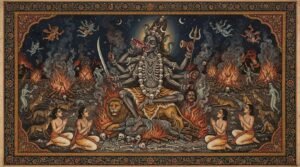
Among the great stotras of the Shakta tradition, few are approached with as much reverence, and as much care, as the Lalita Sahasranamam - the thousand names of Goddess Lalita Tripura Sundari. It is not simply a long list of epithets. Read attentively, it is a complete theology in miniature: a hymn that describes the Goddess from the crown of her head to the soles of her feet, situates her within the geometry of the Sri Chakra, narrates her cosmic victory over darkness, and offers, in each name, a facet of the single radiant reality that Sri Vidya upasakas call Devi.
This guide sets out what the Lalita Sahasranamam is, where it comes from, how it is structured, and what its most celebrated opening names mean. It also considers the benefits attributed to its recitation, the customs around when and how to chant it, and its deep connection to the Sri Yantra and the Panchadashi mantra of Sri Vidya. Readers who wish to first understand the Goddess herself - her form, her legend, and her place among the Mahavidyas - may find it useful to begin with our companion guide to Tripura Sundari and Sri Vidya before returning to this closer study of her thousand names.
A note of humility belongs at the outset, in keeping with the spirit in which this text has always been transmitted. The Lalita Sahasranamam is regarded within the Sri Vidya tradition as a highly potent, even guarded, composition, traditionally recited only after some grounding in its pronunciation and meaning, ideally under the guidance of a qualified guru or temple acharya. What follows is offered as an introduction and a companion for study, not a substitute for that living transmission.
What Is the Lalita Sahasranamam?
The Lalita Sahasranamam, literally "the thousand names of Lalita," is a Sanskrit hymn that enumerates one thousand names of Goddess Lalita Tripura Sundari, the supreme, all-beautiful form of Devi at the centre of Sri Vidya worship. It belongs to a wider category of Hindu devotional literature known as sahasranama - thousand-name hymns composed for various deities - but it holds a place of particular distinction within Shakta practice, being widely regarded as the foremost stotra of the Sri Vidya tradition, second in importance perhaps only to the mantra itself.
Textually, the Lalita Sahasranamam is found within the Brahmanda Purana, one of the eighteen Mahapuranas, specifically within its Uttara Khanda - the third and concluding of the Purana's three khandas (Purva, Madhya and Uttara). Within this section sits a substantial narrative and devotional cycle called the Lalitopakhyana, "the tale of Lalita," which recounts the Goddess's emergence, her defeat of the demon Bhandasura, and the praise offered to her by the sage Agastya and the assembly of gods. The Sahasranamam proper is embedded within this cycle as the hymn of her thousand names, framed by a narrative that explains both its origin and the circumstances under which it was first spoken.
It is worth being plain, in the spirit of intellectual honesty this subject deserves, that the precise dating of the Lalitopakhyana section within the Brahmanda Purana is debated among scholars, with many regarding it as a later interlocation added to an older Puranic core, likely during the medieval consolidation of Sri Vidya as a formal school of Shakta practice. This need not trouble the devotee. Within the tradition itself, the text is received as revealed knowledge - a hymn spoken by higher beings for the benefit of seekers - and it is in that spirit that it has been preserved, recited and passed down for centuries.
The Legend: Hayagriva, Agastya and the Vagdevatas
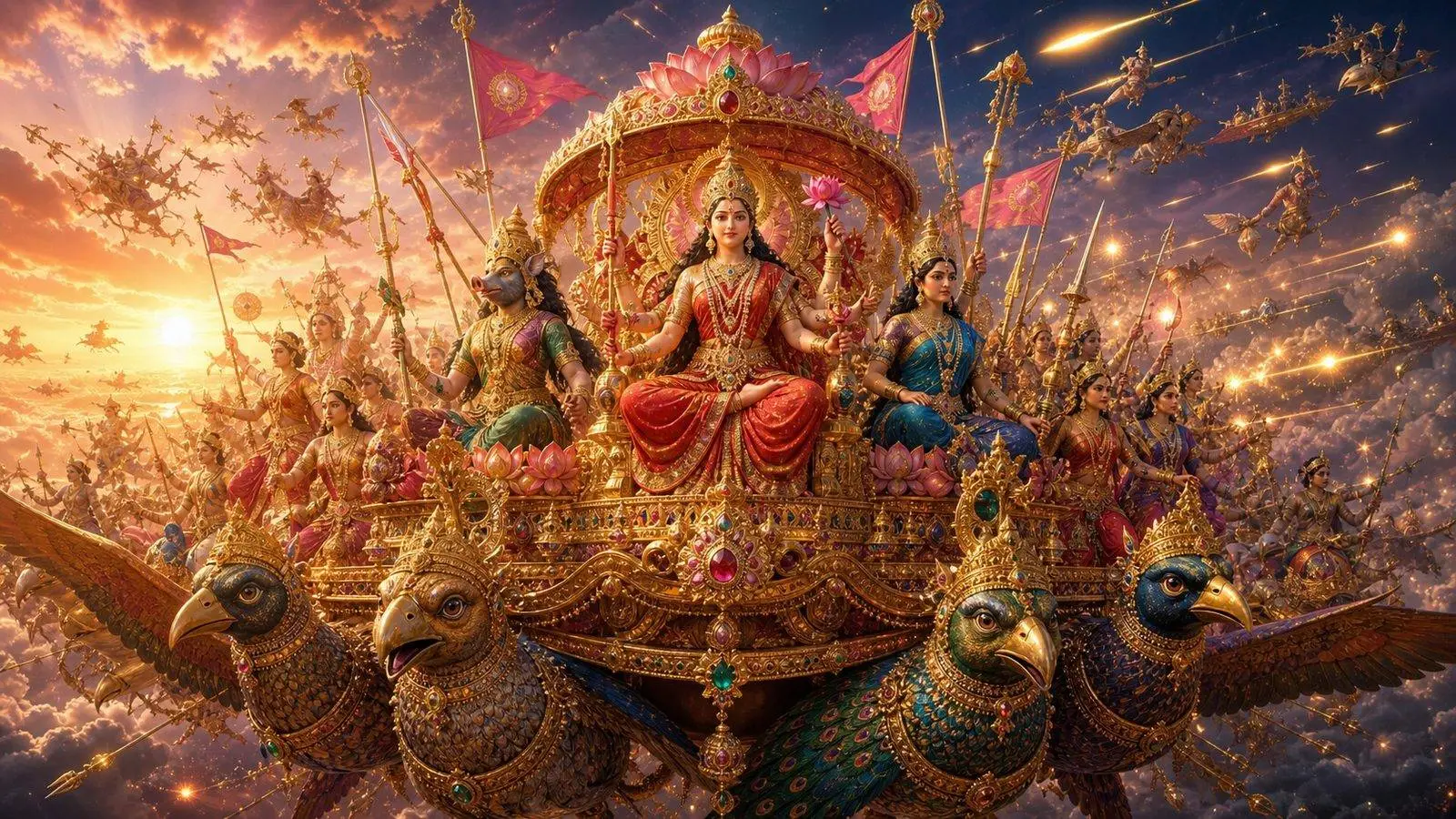
Every major stotra in the Puranic tradition carries a legend explaining how it came to be spoken, and the Lalita Sahasranamam's origin story is among the most evocative in Shakta literature. The tale begins with Bhandasura, a demon born from the ashes of Kamadeva after the god of desire was reduced to cinders by Shiva's third eye. Empowered by a boon, Bhandasura grew tyrannical, oppressing gods and sages alike, until the assembled devas performed a great yajna to call forth a power capable of ending his reign of fear. From the sacrificial fire arose Lalita Tripura Sundari herself - radiant, coral-hued, four-armed, seated upon a throne borne by the five forms of Shiva - who went on to defeat Bhandasura in a war chronicled at length in the Lalitopakhyana, commanding an army led by her generals Dandanatha (Mantrini) and Varahi (Dandini).
It is in the aftermath of this victory, according to the traditional account, that the sage Agastya - troubled by the immensity of what he had witnessed and eager to understand how such a Goddess might be worshipped and praised - approached the sage Hayagriva, the horse-headed incarnation of Vishnu renowned as a repository of Sri Vidya knowledge, and asked him to teach the proper hymn of her praise. Hayagriva is said to have first taught Agastya the Lalita Trishati, the three-hundred-name hymn drawn from the very letters of the Panchadashi mantra, before revealing the fuller, thousand-name Sahasranamam.
A further, particularly striking detail of the legend concerns who actually composed the thousand names. Rather than being spoken by a single sage or deity, the names are said to have been uttered collectively by the Vagdevatas - eight goddesses of speech, sometimes named Vashini, Kameshvari, Modini, Vimala, Aruna, Jayini, Sarveshvari and Kaulini, who serve as attendants of Lalita and preside over speech and language itself. At the Goddess's own command, these eight Vagdevis are said to have distilled her infinite, unspeakable glory into one thousand nameable forms, each name a fragment of her boundless nature rendered accessible to human tongues. Devotees often find this detail meaningful in itself: that the very act of naming the unnameable Goddess required not one voice but eight, working in concert, to even begin to approximate her totality. Readers interested in the deeper background of Devi as the source of all such emanations may enjoy our guide to Adi Parashakti, the supreme divine mother.
Structure of the Text: Dhyana, Nama and Phala Shruti
The Lalita Sahasranamam is not simply a bare list; it is arranged with a clear internal architecture that any serious reader benefits from understanding before approaching the names themselves.
The Dhyana Shloka
The hymn opens with a dhyana shloka - a meditation verse - that fixes the Goddess's form in the mind before her names are recited. The most widely recited of these verses begins "Sindhuraruna-vigraham trinayanam manikya-mauli-sphurat tara-nayaka-shekharam," which may be rendered: "I meditate upon her whose form is red as vermilion, three-eyed, her ruby crown radiant with a crescent moon as its jewel, her face wreathed in a gentle smile, her bosom full, her four hands bearing a noose, a goad, a sugarcane bow and five flower arrows, attended by Brahma, Vishnu and Rudra in feminine form." This single verse does a great deal of work: it establishes her colour, her crown, her weapons of grace rather than violence, and her supremacy even over the great gods of creation, preservation and dissolution, who here appear as her handmaidens.
The Thousand Names Proper
Following the dhyana verses, the Sahasranamam unfolds across roughly 182 to 183 shlokas composed in the anushtubh metre - the classical thirty-two-syllable verse form common to Sanskrit devotional literature - with each verse typically containing between four and six discrete names, arranged so that the cumulative count reaches exactly one thousand. This is itself a matter of some textual variation: different manuscript traditions and commentaries divide the verses slightly differently, and the devotee encountering more than one printed edition should not be alarmed to find small differences in verse breaks, though the sequence and content of the names themselves remain remarkably stable across editions.
Phala Shruti
The hymn concludes with a phala shruti - literally "the hearing of the fruit" - a closing section in which the benefits of reciting the thousand names are described at length: the removal of obstacles, the granting of prosperity and wisdom, protection in this life and liberation beyond it. This closing portion is traditionally recited along with the names themselves, serving both as an assurance to the devotee and as a kind of seal upon the hymn's transmission from Hayagriva to Agastya, and from Agastya onward to every subsequent generation of Sri Vidya practitioners.
A Table of Famous Opening Names
The Lalita Sahasranamam opens with a sequence of names that are especially well known even to those who have not studied the text in full, since they establish the Goddess's throne, her origin from the sacrificial fire, and her divine purpose. The table below sets out several of these celebrated opening names.
| Name (Devanagari / Transliteration) | Meaning |
|---|---|
| श्री माता / Sri Mata | The auspicious mother; the first and most fundamental name, establishing her as mother of the universe |
| श्री महाराज्ञी / Sri Maharajni | The great queen; sovereign ruler of all the worlds |
| श्रीमत्सिंहासनेश्वरी / Srimat Simhasaneshwari | She who rules from the glorious lion-throne, denoting supreme, unshaken authority |
| चिदग्निकुण्डसंभूता / Chidagni Kunda Sambhuta | She who arose from the fire-pit of consciousness, referring to her emergence from the yajna kunda |
| देवकार्यसमुद्यता / Deva Karya Samudyata | She who rose swiftly to accomplish the work of the gods, namely the destruction of Bhandasura |
| उद्यद्भानुसहस्राभा / Udyad Bhanu Sahasrabha | She whose radiance equals a thousand rising suns |
| चतुर्बाहुसमन्विता / Chaturbahu Samanvita | She who is endowed with four arms |
| रागस्वरूपपाशाढ्या / Ragasvarupa Pasadhya | She who bears the noose that is, in essence, the very form of loving attachment |
| क्रोधाकारांकुशोज्ज्वला / Krodhakarankushojjvala | She who bears the goad that is the form of righteous anger, controlling the wayward mind |
| मनोरूपेक्षुकोदण्डा / Manorupekshu Kodanda | She whose bow is made of sugarcane and is, in truth, the very form of the mind |
| पञ्चतन्मात्रसायका / Panchatanmatra Sayaka | She whose five arrows are the five subtle sense-elements (sound, touch, form, taste and smell) |
Read together, this opening sequence already discloses the hymn's method: each weapon and attribute of the Goddess is immediately reinterpreted as a subtle, psychological or cosmic principle. Her noose is attachment, her goad is controlled anger, her bow is the mind itself, and her five flower arrows are the five sense-perceptions through which the world is experienced. Devotion, in other words, is asked to move quickly from the visual image to its inner meaning - a pattern that continues across the full thousand names.
Themes: The Goddess Described from Crown to Foot
One of the most distinctive literary features of the Lalita Sahasranamam, setting it apart from many other sahasranamas, is its extended keshadi-pada varnana - a systematic description of the Goddess's form proceeding from her hair (kesha) down to her feet (pada). Successive clusters of names move through her crown jewel, her forehead marked like the eighth-day moon, her eyebrows shaped like Manmatha's bow, her nose, her smiling lips compared to the bimba fruit, her throat, her shoulders, her arms, her waist marked by three folds, and finally her lotus feet, worshipped by Brahma and Vishnu themselves. This head-to-foot structure is not merely poetic ornament; it reflects a meditative technique still used in Sri Vidya sadhana, in which the practitioner visualises the Goddess's form systematically, part by part, as an aid to steady concentration before or during mantra japa.
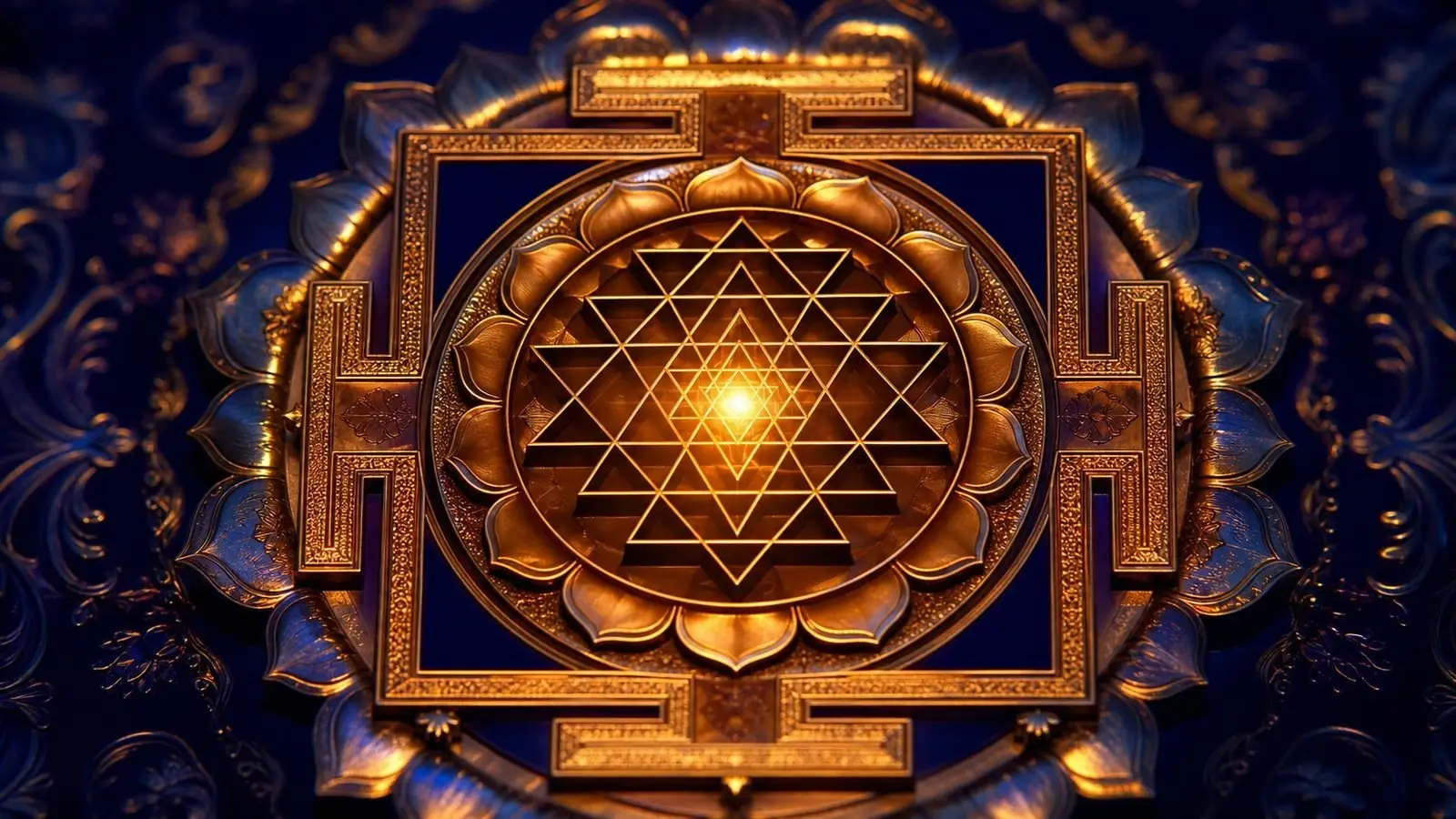
Alongside this physical description, three further themes recur throughout the thousand names. The first is her residence within the Sri Chakra, the sacred geometric diagram of nine interlocking triangles considered her subtlest, most abstract form; many names in the hymn address her presence at specific points within this yantra, from the outermost square enclosure to the innermost bindu, the dimensionless point at the very centre where she is said to dwell inseparably united with Shiva as Kameshwara. The second theme is her role as the singular source of the universe's creation, sustenance and dissolution - names throughout the hymn attribute to her the functions elsewhere distributed among Brahma, Vishnu and Shiva, presenting her not as one goddess among many but as the Parashakti from whom all other divine power, male and female alike, ultimately proceeds. The third theme is her victory over Bhandasura and the darkness he represents, with names recalling her generals, her weapons and her war camp, reminding the reader that her gentleness and her ferocity are not opposites but two expressions of a single protective love.
Her Cosmic Acts and Sovereignty
Later portions of the hymn address the Goddess in her cosmic and sovereign capacities more explicitly, naming her as Rajarajeshwari (empress of empresses), Maharajni (great queen), and Bhandasura-vadhodyukta (she who is intent upon the destruction of Bhandasura). These names collectively assert a theology in which the Goddess is not a subordinate consort awaiting the initiative of a male deity but the absolute, self-sufficient reality - Parabrahman itself in feminine form - a claim central to Shakta philosophy broadly and to Sri Vidya in particular.
Benefits of Reciting the Lalita Sahasranamam
The phala shruti section of the text, along with centuries of accumulated devotional testimony, attributes a wide range of benefits to sincere and regular recitation of the thousand names. Among those most commonly described:
- Removal of obstacles and hardship - the hymn is widely believed to dissolve difficulties in worldly affairs, from financial strain to prolonged illness, when recited with faith and consistency.
- Mental clarity and emotional steadiness - because the hymn systematically reframes desire, anger and sensory experience as aspects of the Goddess herself, regular recitation is said to cultivate an inner equanimity in the practitioner over time.
- Protection from negative influences - traditional belief holds that the vibration of the thousand names, chanted correctly, creates a protective field around the reciter and their household.
- Growth in wisdom and discrimination - several names invoke Lalita as the embodiment of buddhi (intellect) and viveka (discernment), and recitation is associated with clearer decision-making and deeper insight.
- Progress in Sri Vidya sadhana - for those formally initiated into Sri Vidya, the Sahasranamam is considered an essential daily practice alongside japa of the Panchadashi mantra, deepening the practitioner's inner absorption in the Goddess.
- General auspiciousness and family welfare - many households recite the hymn on Fridays and during Navratri specifically to invoke blessings of harmony, prosperity and protection for the family as a whole.
How and When to Recite the Lalita Sahasranamam
Tradition offers fairly consistent guidance on the timing and method of reciting this hymn, though as with most Sanskrit devotional literature, regional and lineage-specific variations exist, and a devotee should feel free to adapt these general customs to what their own family or guru tradition prescribes.
Auspicious Days
Friday (Shukravara) is considered especially favourable for reciting the Lalita Sahasranamam, being traditionally associated with the Goddess in her Lakshmi and Tripura Sundari aspects alike. The nine nights of Navratri are also widely regarded as an ideal period for daily recitation, with many Sri Vidya households observing Lalita Panchami - the fifth day of Sharad Navratri - with particular attention to this hymn. Full moon days (Purnima) are likewise favoured, as is any day set aside specifically for Devi worship. Readers observing the broader nine-night festival may find our guide to Navratri and the nine forms of Navadurga useful for situating this practice within the fuller festival calendar.
Recitation Order and Preceding Texts
Custom generally holds that the Lalita Sahasranamam should be recited after the shorter Lalita Trishati, the three-hundred-name hymn, which is itself often preceded by an invocation of Ganesha and a recitation of the Guru Paduka Stotram in honour of one's teacher. Some traditions also recite the Khadgamala Stotram, a hymn describing the deities residing within each enclosure of the Sri Chakra, either before or after the Sahasranamam, treating the three texts as a connected sequence of Sri Vidya devotional practice.
Method and Etiquette
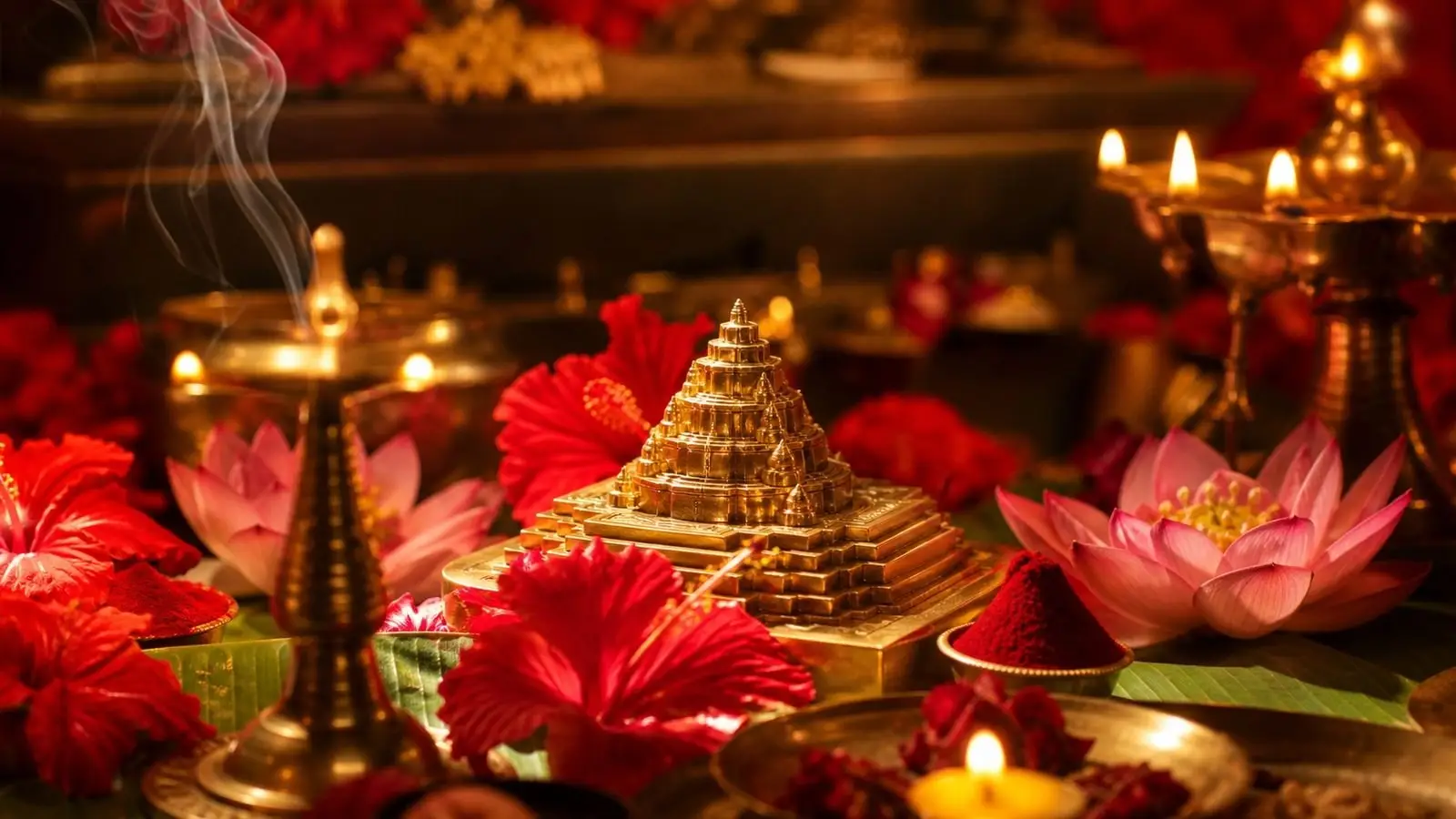
A few simple customs are worth observing. The reciter typically bathes beforehand, sits facing east or north on a clean seat, and maintains a calm, unhurried pace rather than rushing through the thousand names. A photograph or image of Lalita Tripura Sundari, or a Sri Yantra, is often placed before the reciter as a focal point. Because Sanskrit pronunciation genuinely affects the rhythm and, tradition holds, the efficacy of a mantra-dense text like this one, new reciters are strongly encouraged to first learn the correct pronunciation by listening to an experienced reciter, a temple priest, or a qualified guru, rather than relying solely on a printed transliteration.
The Connection to the Sri Yantra and the Panchadashi Mantra
The Lalita Sahasranamam cannot be fully appreciated apart from its place within the wider architecture of Sri Vidya, the school of Shakta practice centred on the Goddess as Tripura Sundari, her geometric form as the Sri Yantra, and her seed-syllable mantra known as the Panchadashi. The Sri Yantra - nine interlocking triangles, four upward-pointing representing Shiva and five downward-pointing representing Shakti, radiating from a central bindu and enclosed within a lotus and a square boundary - is understood as the Goddess's own body rendered in sacred geometry, and dozens of names within the Sahasranamam refer directly to specific triangles, intersections and enclosures of this diagram.
The Panchadashi mantra, a fifteen-syllable formula divided traditionally into three sections (kutas) corresponding to her form as fire, sun and moon, is the mantra proper of Sri Vidya initiation, traditionally received only through formal diksha from a qualified guru. Some lineages extend it to a sixteen-syllable Shodashi mantra by the addition of a further syllable. The Lalita Sahasranamam is often described by practitioners as an elaboration of this very mantra - its thousand names unpacking, across an extended hymn, the compressed meaning held within those fifteen syllables. For this reason, many teachers advise that the Sahasranamam be approached most fruitfully alongside some grounding in Sri Vidya more broadly, including its beej mantras and foundational seed-syllables; readers curious about this dimension of Devi worship may find our guide to the beej mantras of the Goddess a helpful companion.
It is worth noting, again in the interest of intellectual honesty, that Sri Vidya has historically been considered among the more esoteric and carefully guarded branches of Shakta practice, with some traditional teachers holding that the Panchadashi mantra itself should never be recited without formal initiation. The Lalita Sahasranamam, by contrast, is far more widely and openly recited - in temples, in homes, and in devotional gatherings - and is generally understood as accessible to any sincere devotee, whether or not they have received formal Sri Vidya diksha, though deeper contemplative practice building on the hymn is best pursued under proper guidance.
Regional and Textual Variations
As with most widely transmitted Sanskrit texts, small variations exist across manuscript traditions, printed editions and regional recitation customs. Some editions number the concluding phala shruti verses slightly differently, some divide certain shlokas at different points, and pronunciation conventions can differ modestly between South Indian and North Indian recitation styles, particularly around certain conjunct consonants and vowel lengths. None of these variations affect the substance or the sequence of the thousand names themselves, which have remained remarkably stable across the centuries of transmission this hymn has undergone since it first entered wider circulation through Sri Vidya lineages. A devotee encountering a printed text that differs slightly from what they have heard chanted elsewhere need not be troubled; such variation is a normal feature of a long oral and manuscript tradition rather than evidence of corruption or error.
Frequently Asked Questions
What is the Lalita Sahasranamam?
The Lalita Sahasranamam is a Sanskrit hymn of one thousand names dedicated to Goddess Lalita Tripura Sundari, found within the Brahmanda Purana. It is considered the principal devotional stotra of the Sri Vidya tradition, describing the Goddess's form, her cosmic role and her victory over the demon Bhandasura.
Who composed the Lalita Sahasranamam?
According to tradition, the thousand names were spoken by eight goddesses of speech known as the Vagdevatas, at the command of Lalita herself, and were subsequently taught by the sage Hayagriva to the sage Agastya, through whom the hymn entered wider transmission.
How many verses does the Lalita Sahasranamam contain?
The thousand names are traditionally arranged across roughly 182 to 183 verses composed in the anushtubh metre, with each verse typically containing several discrete names. Minor differences in verse division exist between editions, though the names and their sequence remain consistent.
What is the difference between the Lalita Sahasranamam and the Lalita Trishati?
The Lalita Trishati is a shorter hymn of three hundred names, traditionally taught by Hayagriva to Agastya before the fuller Sahasranamam, and is derived from the letters of the Panchadashi mantra. Many practitioners recite the Trishati immediately before the thousand-name hymn as part of a single devotional sequence.
Can anyone recite the Lalita Sahasranamam, or is initiation required?
The Sahasranamam itself is widely and openly recited by devotees without requiring formal Sri Vidya initiation, unlike the Panchadashi mantra, which traditional teachers generally reserve for those who have received diksha from a qualified guru. New reciters are nonetheless encouraged to learn correct pronunciation from an experienced teacher or temple priest.
When is the best time to recite the Lalita Sahasranamam?
Friday, full moon days, and the nine nights of Navratri, particularly Lalita Panchami, are widely considered especially auspicious. Many practitioners also recite it daily as part of a sustained Sri Vidya sadhana, regardless of the specific day.
What is the significance of the Sri Chakra in this hymn?
The Sri Chakra is regarded as the Goddess's own form expressed in sacred geometry, and numerous names within the Sahasranamam refer directly to her presence within specific triangles and enclosures of this yantra, linking the hymn's verbal praise to the visual and meditative dimension of Sri Vidya worship.
What does the opening name Sri Mata mean?
Sri Mata, the very first name in the hymn, means "the auspicious mother," establishing at the outset that the Goddess described throughout the remaining nine hundred and ninety-nine names is to be approached above all as the compassionate mother of the universe.
Is the Lalita Sahasranamam connected to the Devi Mahatmya or Durga Saptashati?
They belong to different textual traditions - the Durga Saptashati centres on Devi's battles with Mahishasura and other demons within the Markandeya Purana, while the Lalita Sahasranamam belongs to the Sri Vidya tradition and the Brahmanda Purana - though both are understood within Shakta theology as praising the same singular, supreme Devi in different aspects and narrative contexts.
What benefits are described in the phala shruti of the Lalita Sahasranamam?
The concluding phala shruti describes benefits including the removal of obstacles and hardship, growth in wisdom and inner steadiness, protection for the reciter and their household, and progress along the path of Sri Vidya sadhana, with sustained and sincere recitation.
Further Reading
Readers seeking additional scholarly and historical context may find the Wikipedia entry on the Lalita Sahasranama a useful starting point for further textual and comparative study.
To recite the thousand names of Lalita Tripura Sundari is to move slowly through a portrait of the Goddess composed with extraordinary care - crown to foot, weapon to meaning, triangle to bindu. Musinara's YouTube channel carries 432 Hz recordings of Devi mantras and stotras, composed for quiet, sustained listening. We warmly invite you to listen and subscribe as a companion to your own study and recitation of this ancient hymn.
Related reading
- The Durga Chalisa: Meaning, Verses and How to Recite the Forty-Verse Hymn to the Mother
- Kanakadhara Stotram: The Legend, Verses and Benefits of Adi Shankaracharya's Hymn to Mahalakshmi
- Devi Kavach, Argala Stotram & Keelak: The Three Sacred Preludes to the Durga Saptashati
- Mahishasura Mardini Stotram (Ayi Giri Nandini): Meaning, Significance & Benefits
Watch and listen to devotional music and mantras on the Musinara YouTube channel.
Official and Reference Sources
- Lalita Sahasranama Stotram, full text - Sanskrit Documents, with purvapithika and phalashruti
New to chanting? Two short guides cover the practicalities: how to chant a mantra (mala, count, pronunciation and the three traditional modes of japa), and Devi worship at home (a simple altar and a ten minute daily sequence).