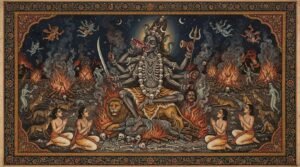
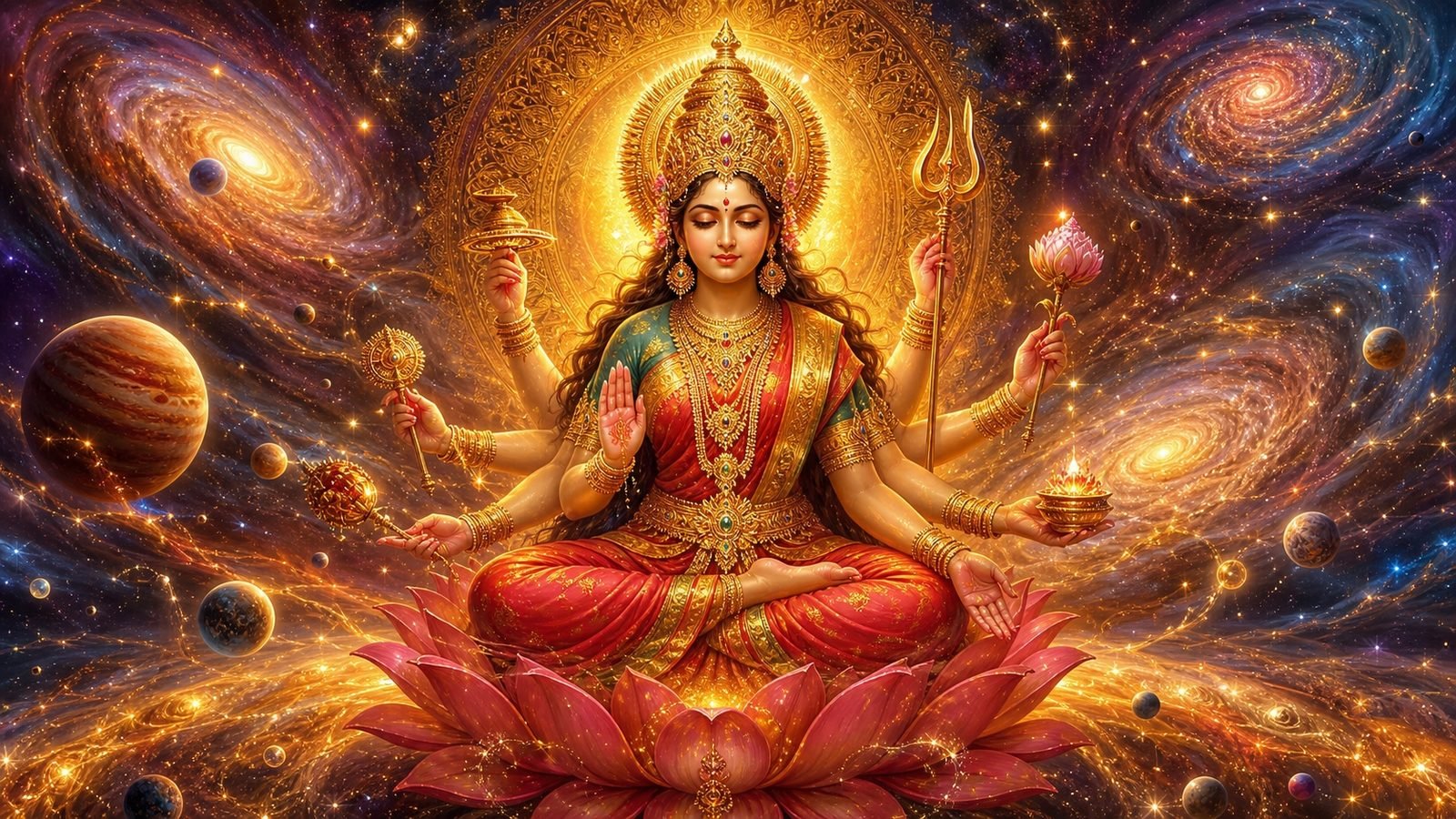
Adi Parashakti is the supreme, primordial Divine Mother of the Shakta tradition: the original creative power from whom the entire universe arises and into whom it dissolves. In Shaktism she stands as Brahman itself, the absolute reality, worshipped in the loving, accessible form of the Mother of the Universe.
Before the first star burned, before time turned its first wheel, before even Brahma, Vishnu and Shiva took their seats over the cosmos, there was the Mother. In the Shakta vision of Hinduism she is called Adi Parashakti: the primordial (adi), supreme (para), creative power (shakti). She is not a goddess among many. She is the ground of all being, adored as Mahadevi and Jagadamba.
To the devotee, every goddess the tradition reveres, from gentle Saraswati to luminous Lakshmi, from radiant Durga to the dark and liberating Kali, is a face, a mood, a ray of this one supreme Shakti. The many are her play; the One is her truth.
This guide explores who Adi Parashakti is, the philosophical vision of Shaktism, the great scriptures that proclaim her supremacy, the relationship of Shiva and Shakti, her principal manifestations, her symbolism, the fruits of her worship, the sacred Navarna mantra, the temples where she is adored, and the festival of Navratri that celebrates her glory. Throughout, the aim is reverence joined to clarity, honouring both the heart of the devotee and the careful mind of the seeker.
Key Takeaways
- Adi Parashakti, also called Adi Shakti and Mahadevi, is the supreme Divine Mother of Shaktism and is identified with Brahman, the absolute reality.
- In the Shakta vision, Durga, Kali, Lakshmi, Saraswati, Parvati and all goddesses are manifestations of this one supreme Mother.
- The Devi Mahatmya (Durga Saptashati), the Devi Bhagavata Purana, the Devi Upanishad and the Lalita Sahasranama are the key scriptures proclaiming her supremacy.
- The Navarna Mantra, Om Aim Hreem Kleem Chamundayai Vichche, is the nine-syllable heart-mantra of the Goddess and one of the most powerful mantras in Shaktism.
- Navratri, the nine nights of the Divine Mother, is her greatest festival, celebrating her victory over Mahishasura on Vijayadashami.
Who Is Adi Parashakti?
Adi Parashakti is the first and supreme power of existence: "adi" means primordial and without beginning, "para" means supreme and transcendent, and "shakti" means the dynamic energy that creates, sustains and transforms. She is the original power from whom all other energies, deities and worlds proceed.
The name unfolds its own meaning. She is also called Adi Shakti, Mahadevi (the Great Goddess), Parama Shakti, and Mula Prakriti, the root nature of all that exists.
In the Shakta understanding, reality has two aspects that are ultimately one: the still, witnessing consciousness, often personified as Shiva, and the creative, dynamic power, Shakti. Adi Parashakti is that power, yet she is not separate from consciousness. She is consciousness in motion, the awareness that becomes the world. A common image is that consciousness without Shakti is like a still ocean, and Shakti is the wave; but the wave is nothing other than the ocean itself. The Mother is at once the maker of the universe and the very substance of which it is made.
She is described as both saguna and nirguna, with form and beyond form. As the formless absolute she is infinite, attributeless, unborn. As the Mother of the Universe she takes on countless forms to receive the love of her children and to act within creation. This is the secret of her worship: the devotee may approach the ineffable Brahman through the warm and accessible relationship of a child with its mother.
What Does Shaktism Teach About the Divine Mother?
Shaktism teaches that the supreme reality, Brahman, is feminine in essence: the Devi. Where other Hindu traditions may see the Goddess as the consort of a male deity, Shaktism holds her as primary. The gods themselves derive their power to act from her, the one Adi Parashakti.
Shaktism is one of the major traditions of Hinduism, alongside Vaishnavism and Shaivism. Its distinctive teaching is bold and beautiful. As the tradition often expresses it, Shiva without Shakti is shava, a lifeless corpse; it is the Mother who animates all.
In this vision the masculine Trimurti, Brahma the creator, Vishnu the preserver and Shiva the dissolver, carry out their cosmic functions only because the feminine Tridevi empowers them. Mahasaraswati grants the power of creation, Mahalakshmi the power of preservation, and Mahakali the power of dissolution. The gods hold the offices; the Goddess is the power by which the offices function. She is therefore rightly called the source, the sustainer and the resting place of the whole cosmos.
This is not a denial of the One; it is a particular path to it. Shaktism is a form of non-dual devotion in which the absolute is realised as the Divine Mother. The seeker does not merely think about Brahman; the seeker loves the Mother, surrenders to her, and through that love awakens to the truth that the Mother and one's own deepest Self are not two. Philosophers of the tradition, and great realised saints, have insisted that this love is itself a form of the highest knowledge.
Which Scriptures Proclaim Adi Parashakti as Supreme?
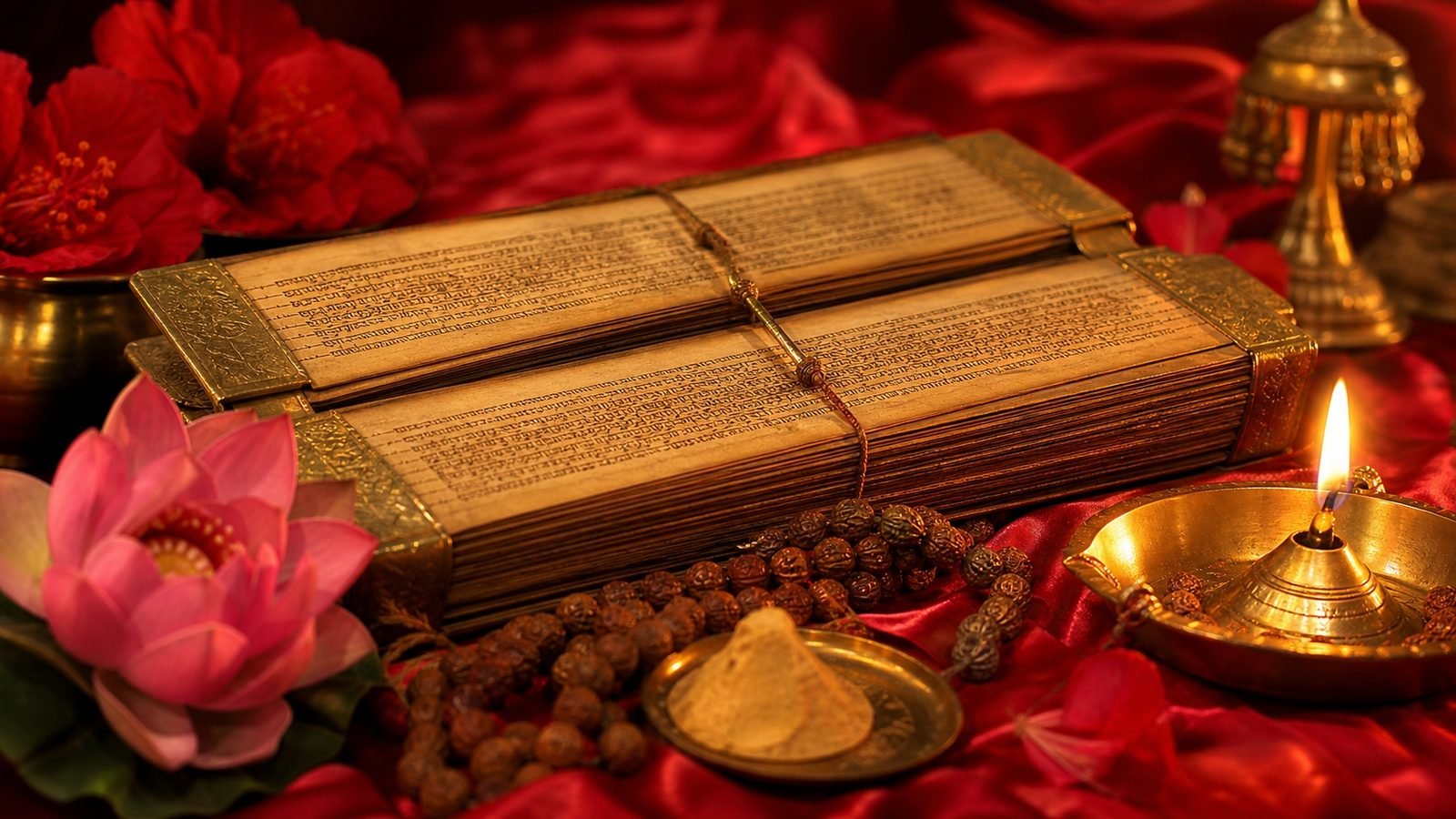
The foremost scripture is the Devi Mahatmya (Durga Saptashati), part of the Markandeya Purana. Alongside it stand the Devi Bhagavata Purana, the Devi Upanishad, the Lalita Sahasranama in the Brahmanda Purana, and the Tripura Rahasya, all of which proclaim the Goddess as the supreme reality.
The supremacy of Adi Parashakti is not a later invention but rests upon a rich and ancient body of scripture.
| Scripture | Where It Is Found | What It Proclaims |
|---|---|---|
| Devi Mahatmya (Durga Saptashati) | Chapters 81-93 of the Markandeya Purana; 700 verses, c. 5th-6th century CE | The Goddess as supreme being and creator of the universe; her victories over Madhu-Kaitabha, Mahishasura, and Shumbha-Nishumbha |
| Devi Bhagavata Purana | A major independent Purana of the Shakta tradition | The Goddess as ultimate reality and consciousness underlying all existence; includes the Devi Gita |
| Devi Upanishad | Among the Shakta Upanishads | The Goddess declares her own identity with Brahman, the source of manifest and unmanifest worlds |
| Lalita Sahasranama | Lalitopakhyana section of the Brahmanda Purana | The thousand names of Lalita Tripura Sundari, identifying her directly with Brahman |
| Tripura Rahasya | A related Shakta philosophical text | The Goddess as supreme consciousness |
The Devi Mahatmya (Durga Saptashati)
The Devi Mahatmya, also known as the Durga Saptashati, Chandi Path or Sapta Shati, is the foundational scripture of Shaktism. It forms chapters 81 to 93 of the Markandeya Purana and comprises seven hundred verses arranged in thirteen chapters, conventionally dated to around the fifth to sixth century CE. It is here, perhaps for the first time in such a sustained way, that the Goddess is celebrated as the supreme being and creator of the universe, the one in whom all other deities find their source.
The text narrates three great mythic cycles in which the Goddess, as Mahakali, Mahalakshmi and Mahasaraswati, vanquishes the demons Madhu and Kaitabha, Mahishasura the buffalo-demon, and the brothers Shumbha and Nishumbha. Read devotionally, these battles are not merely cosmic history; they are an inner allegory of the Mother destroying the ego, delusion and negativity within the seeker. The recitation of the Devi Mahatmya, especially during Navratri, remains one of the most cherished acts of Shakta worship.
The Devi Bhagavata Purana
The Devi Bhagavata Purana is a major scripture that presents the Goddess as the ultimate reality and supreme power of the universe, the consciousness underlying all existence. It elaborates her cosmology, her many forms, and the philosophy of devotion to her, and includes the celebrated Devi Gita, in which the Mother herself teaches the path of knowledge and surrender. For many Shaktas it occupies the place that the Bhagavata Purana holds for Vaishnavas: a comprehensive devotional and philosophical treasury centered on the Devi.
The Devi Upanishad and Lalita Sahasranama
Among the Shakta Upanishads, the Devi Upanishad gives voice to the Goddess proclaiming her own identity with Brahman. In it the gods ask, "Who are you, O Great Goddess?" and she replies that she is essentially Brahman, the source of the manifest and unmanifest worlds. Such texts root the worship of the Mother firmly in the Upanishadic vision of the one infinite reality.
The Lalita Sahasranama, the "Thousand Names of Lalita", is found in the Brahmanda Purana within the section called the Lalitopakhyana, framed as a dialogue between the sage Hayagriva and the sage Agastya. It hymns the Goddess as Lalita Tripura Sundari, the supreme form of the Divine Mother, and several of its names identify her directly with the Brahman of the Upanishads, calling her Brahmamayi, "she who is Brahman", and Chidananda-lahari, "the wave of consciousness and bliss". The related Tripura Rahasya develops the same exalted philosophy of the Goddess as supreme consciousness.
What Are Para Shakti and Apara Shakti?
Para Shakti is the supreme, transcendent power of the Goddess, formless and identical with pure consciousness. Apara Shakti is the same power expressed within creation, as the energies of nature, the deities, the elements and the mind. The two are never separate: the manifest is simply the transcendent in expression.
To understand how the one Mother becomes the many worlds, the tradition speaks of these two aspects of her power. Para Shakti is the Goddess in her highest nature, beyond name, change and limitation, the silent ground from which everything springs.
Apara Shakti is sometimes connected with prakriti, the creative nature composed of the three gunas (sattva, rajas and tamas), through which the universe of forms unfolds. Yet Apara is simply Para in expression, the wave upon the ocean of the supreme. Recognising the manifest world as the play of the one transcendent Mother is itself a doorway to liberation.
What Is the Union of Shiva and Shakti?
Shiva is the unchanging, witnessing consciousness; Shakti is the dynamic creative power. They are not two beings but two aspects of one reality, inseparable like fire and its heat. The tradition says that without Shakti, Shiva is shava, a lifeless corpse: it is the Mother who animates consciousness.
No teaching is more central to the Shakta and Tantric vision than this inseparability. Shiva and Shakti can be distinguished in thought but never truly divided, like the meaning and the word.
It is the Mother who gives consciousness its living dynamism. Conversely, Shakti without the ground of Shiva's awareness would be blind force without illumination. Their union is the source of all that is: depicted in iconography as Ardhanarishvara, the form that is half Shiva and half Shakti in a single body, and contemplated in the heart as the eternal, blissful wholeness from which the universe is born.
For the seeker, this teaching dissolves the false split between the spiritual and the worldly, the still and the active, the masculine and the feminine within. To worship the Mother is to honour the dynamic power of the divine; to know her fully is to rest in the union of power and peace that is the secret of one's own Self.
What Are the Principal Manifestations of Adi Parashakti?
Adi Parashakti manifests chiefly as Durga the invincible protector, Kali the dark liberator, the ten Mahavidyas of the Tantric tradition, and the Tridevi of Saraswati, Lakshmi and Parvati. Each form reveals a different mood and function of the one Mother, and worship of any form reaches her.
Because Adi Parashakti is the source of all feminine divinity, she expresses herself in an endless variety of forms. A few groupings are especially beloved.
Durga, the Invincible Protector
Durga is perhaps the most widely worshipped warrior form of the Goddess. Riding a lion or tiger, bearing weapons in her many arms gifted by the gods, she is the destroyer of demons and the unconquerable protector of the righteous. In the Devi Mahatmya she slays Mahishasura, the buffalo-demon who symbolises brute ego and ignorance. Durga embodies the Mother's readiness to defend her children and to vanquish all that obstructs the path to truth.
Kali, the Dark Liberator
Kali, whose name derives from kala (time), is the fierce and liberating form of the Mother who stands beyond time and devours it. Dark as the infinite void from which all things arise and into which they return, garlanded with the symbols of dissolution, she is far from the merely fearsome figure of popular imagination. To her devotees she is the most compassionate Mother of all: the one who destroys ego, fear and attachment so that the soul may taste the boundless freedom of pure consciousness. In many Tantric texts she is hailed directly as Adi Shakti, the primordial power.
The Das Mahavidyas, the Ten Wisdom Goddesses
The Das Mahavidyas, or ten great wisdom goddesses, are a group of Tantric forms through which the supreme Shakti reveals ten distinct paths of liberating knowledge. They are traditionally named Kali, Tara, Tripura Sundari, Bhuvaneshwari, Bhairavi, Chhinnamasta, Dhumavati, Bagalamukhi, Matangi and Kamalatmika. Ranging from the terrifying to the serene, from the void of Dhumavati to the lotus-abundance of Kamala, the Mahavidyas teach that every experience, light and dark, creation and dissolution, is a face of the one Divine Mother and a doorway to her.
The Tridevi: Saraswati, Lakshmi, Parvati
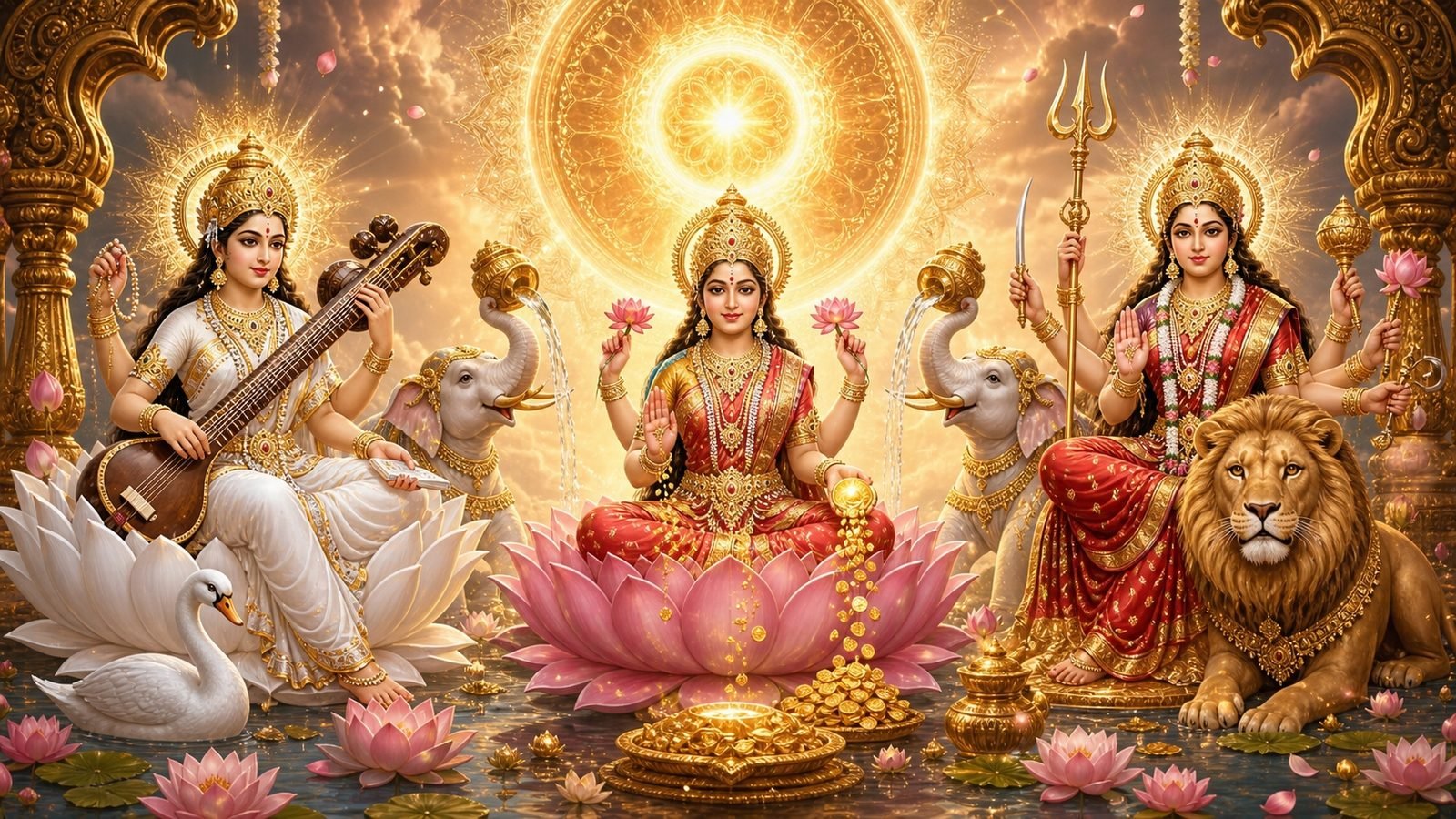
The Tridevi are the three supreme goddesses through whom the Mother governs the cosmos. Saraswati is the power of knowledge, speech, music and creative wisdom; Lakshmi is the power of prosperity, beauty, sustenance and well-being; and Parvati, in her higher aspect as Mahakali or Durga, is the power of strength, devotion and transformation. In Shaktism these three are understood as manifestations of the one Mula Prakriti, Adi Parashakti: the creative (Mahasaraswati), preserving (Mahalakshmi) and dissolving (Mahakali) energies that empower the very gods of the Trimurti.
What Does the Divine Mother's Iconography Mean?
Every detail of the Mother's imagery is a teaching. Her many arms signify omnipotence, her weapons show all cosmic powers gathered in her, her lion mount represents nature mastered by her will, and her gestures of fearlessness (abhaya) and boon-giving (varada) reveal the Mother who removes fear and grants blessing.
The images of the Divine Mother are a visual theology. Her ornaments and rich attire express the abundance of the manifest world, while in her fierce forms the garlands and dark complexion point to the dissolution of all forms back into the formless source.
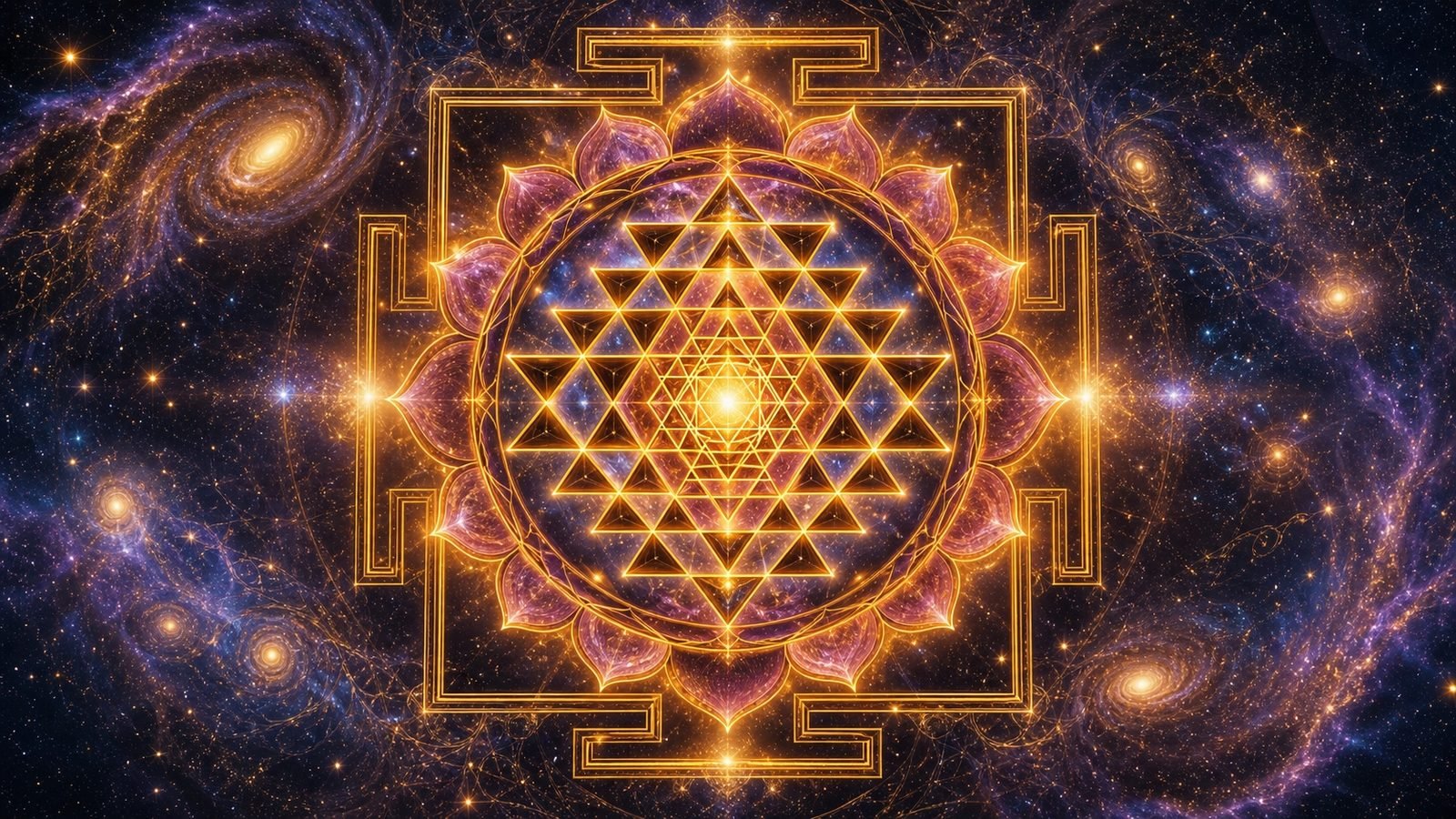
Above all, the Mother is contemplated through the Sri Yantra (Sri Chakra), the supreme geometric diagram of the Goddess as Lalita Tripura Sundari. Its interlocking triangles, the upward representing Shiva and the downward representing Shakti, radiate from a single central point, the bindu, depicting the entire cosmos emanating from the union of consciousness and power. To meditate upon the Sri Yantra is to trace creation back to its source in the Divine Mother.
What Are the Benefits of Worshipping Adi Parashakti?
Devotion to Adi Parashakti stands as a direct path to moksha, liberation from the cycle of birth and death. Her worship is also associated with fearlessness, courage, inner strength, protection from harmful influences, emotional healing, clarity of mind and, when sought with a pure heart, prosperity and well-being.
To worship Adi Parashakti is to turn toward the very source of life and consciousness with the trust of a child toward its mother. The tradition holds that her grace works on every level of the seeker's being, always guiding ultimately toward liberation.
On the spiritual plane, by surrendering the ego to her, the seeker is gradually emptied of self-will and filled with her presence, awakening to the truth that the Self and the Mother are one. The chanting of her names and mantras is said to purify the mind, awaken the inner kundalini energy, and steady the heart in devotion. Yet the tradition is careful to teach that the highest fruit is not any boon but the Mother herself: to love her, to rest in her, and to be liberated in her embrace.
The following are among the benefits devotees associate with sincere worship of the Divine Mother:
- Progress toward liberation (moksha) and union with the supreme reality
- Dissolution of ego, fear and deep-seated negative tendencies
- Awakening of inner spiritual energy and heightened intuition
- Courage, resilience and protection from harm
- Peace of mind, emotional healing and clarity
- Material well-being and prosperity when sought with right intention
What Is the Navarna Mantra?
The Navarna Mantra, Om Aim Hreem Kleem Chamundayai Vichche, is the nine-syllable heart-mantra of the Devi Mahatmya and the seed-formula of the Goddess in her supreme protective form. It gathers the seed sounds of Mahasaraswati, Mahalakshmi and Mahakali into Chamunda, the Mother who slays the inner demons.
Sound is among the most direct means of communion with the Divine Mother, and the Shakta tradition treasures a number of her mantras. The most celebrated of all is the Navarna Mantra, also called the Navakshari (nine-syllable), Chandi, or Chamunda Mantra.
| Field | The Navarna Mantra |
|---|---|
| Sanskrit | ॐ ऐं ह्रीं क्लीं चामुण्डायै विच्चे |
| Hindi | ओम् ऐं ह्रीं क्लीं चामुण्डायै विच्चे |
| Transliteration | Om Aim Hreem Kleem Chamundayai Vichche |
| Meaning | I invoke the Divine Mother as Chamunda: Aim (Mahasaraswati, creative wisdom), Hreem (Mahalakshmi, sustaining power), Kleem (Mahakali, transformative force), united in Chamunda who slays inner demons; Vichche grants the shield of pure consciousness. |
Each syllable of the mantra carries the seed-power of an aspect of the one Goddess, weaving together her creative, sustaining and transforming energies:
| Syllable | Significance |
|---|---|
| Om | The pranava, the primordial cosmic sound from which all vibration arises. |
| Aim | Seed (bija) of Mahasaraswati: knowledge, speech, and the creative impulse. |
| Hreem | Seed of Mahalakshmi / Bhuvaneshwari: cosmic Maya, sustenance, and divine grace. |
| Kleem | Seed of Mahakali: attraction, fulfilment of desire, and transformative power. |
| Chamundayai | Salutation to Chamunda, the form of Durga who slew the demons Chanda and Munda: the destroyer of ego and ignorance. |
| Vichche | The shield (kavacha): may the Goddess awaken and protect the seeker within pure consciousness. |
The deeper meaning of the Navarna mantra is the gathering of the three great Shaktis, Mahasaraswati (Aim), Mahalakshmi (Hreem) and Mahakali (Kleem), into the single supreme Mother, Chamunda, who destroys the inner demons of the seeker, while Vichche prays for her awakening and protection within one's own consciousness. It is, in essence, an invocation of Adi Parashakti herself.
How Do You Practice Sadhana of the Divine Mother?
Sit in a clean, quiet place facing east or north, light a ghee lamp and incense before an image or yantra of the Mother, and chant the Navarna mantra 108 times on a rudraksha or crystal mala. Brahma Muhurta, Tuesdays, Fridays and the nights of Navratri are especially auspicious.
A simple, reverent practice may be approached as follows. Sit on a cotton or woollen mat, settle the breath, bring the heart to stillness, and offer a brief prayer of surrender. Then chant the mantra clearly and steadily, completing one full round of 108 repetitions without interruption.
The mantra may be chanted aloud, whispered, or repeated silently in the mind, the silent form being regarded as the most powerful. Beginners may start with a single mala daily and increase gradually. Traditional Tantric practice of the Mother's more advanced mantras is undertaken under the guidance of a qualified guru and with proper initiation (diksha); the Navarna mantra, however, is widely chanted with devotion by seekers everywhere. As always, sincerity, purity of heart and consistency matter more than quantity.
Where Is Adi Parashakti Worshipped?
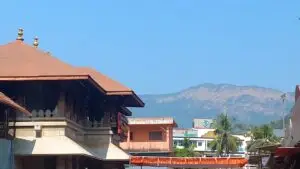
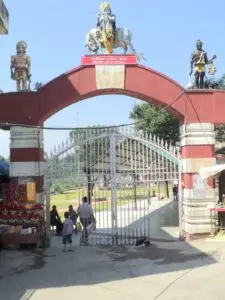
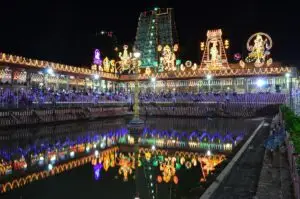
The Divine Mother receives worship across the subcontinent, above all at the Shakti Peethas, the sacred sites where parts of Sati's body fell to earth. The Puranas variously count fifty-one, fifty-two, sixty-four or one hundred and eight such Peethas, with Vaishno Devi, Kamakhya, Kalighat, Dakshineswar and Meenakshi among the most revered centres.
Among the most sacred sites are the Shakti Peethas: places where, according to tradition, parts of the body of Sati fell to earth as Lord Shiva wandered with her form, sanctifying each spot as an abode of the Goddess.
| Temple | Location | Significance |
|---|---|---|
| Vaishno Devi | Trikuta Hills, Jammu and Kashmir | One of the most visited shrines in the world, where the Goddess is worshipped as the unified form of Mahakali, Mahalakshmi and Mahasaraswati |
| Kamakhya Temple | Guwahati, Assam | A foremost Shakti Peetha and the great centre of Tantric worship, revered as the seat of the Goddess's creative, generative power |
| Kalighat and Dakshineswar | Kolkata, West Bengal | Celebrated temples of the Mother as Kali; Dakshineswar is forever linked with Sri Ramakrishna, the great nineteenth-century lover of the Divine Mother |
| Meenakshi Amman Temple | Madurai, Tamil Nadu | A magnificent temple where the Goddess reigns as Meenakshi, the sovereign Mother of the south |
| The 51 Shakti Peethas | Across the subcontinent | From Kamakhya in the east to Hinglaj in the west, a vast network of the Mother's presence drawing pilgrims of every generation |
Why Is Navratri the Festival of Adi Parashakti?
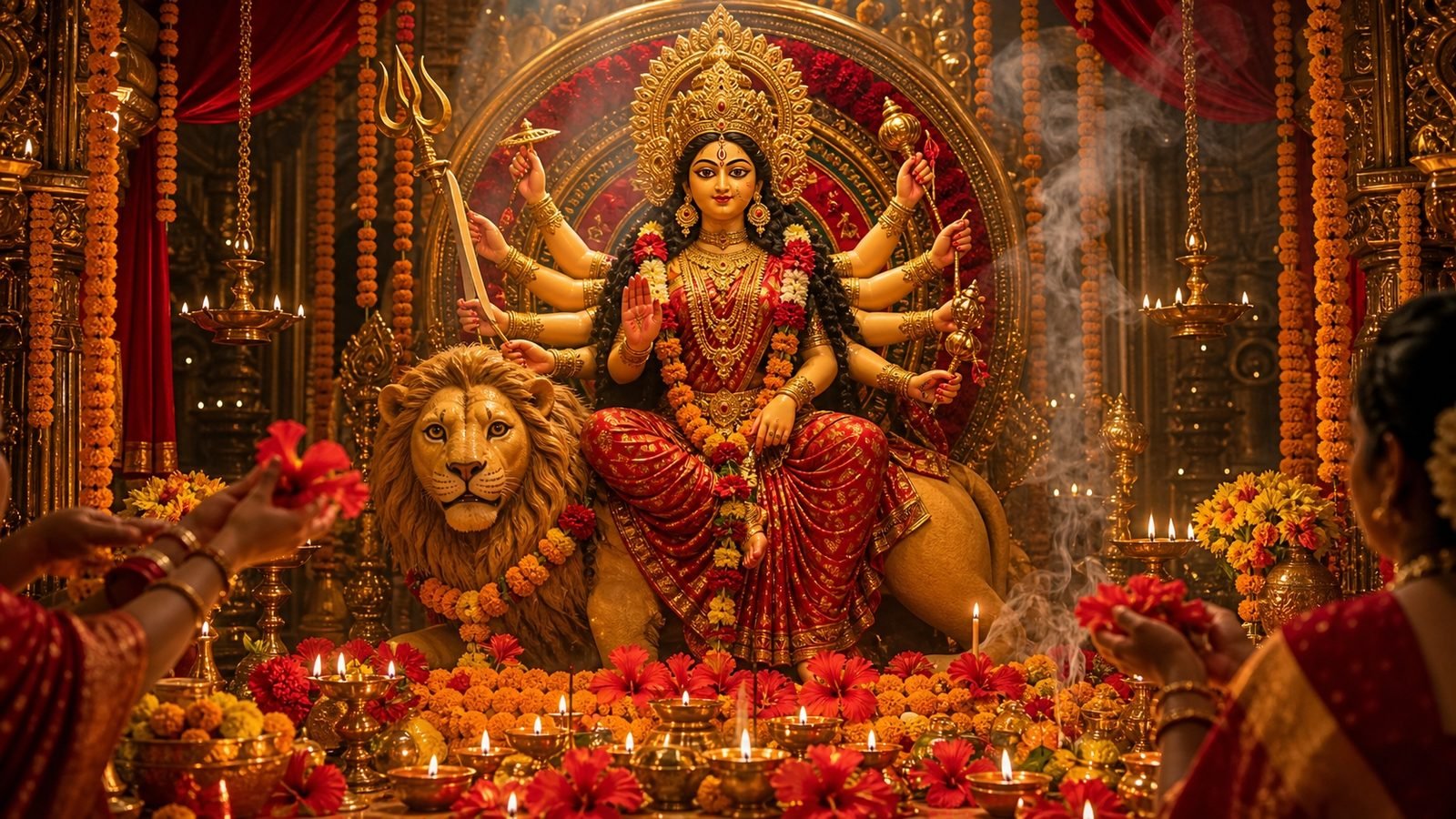
Navratri, the "nine nights", is the great festival of the Divine Mother, celebrated several times a year with the autumn Sharada Navratri as the grandest. It honours the Goddess in her many forms and culminates on Vijayadashami, celebrating her victory over Mahishasura: the triumph of light over darkness.
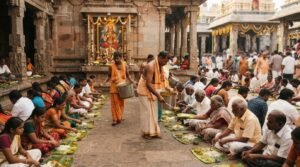
During Navratri devotees commonly worship the Nava Durga, the nine forms of Durga, one on each night; recite the Devi Mahatmya; observe fasts and vigils; chant the Navarna mantra; and adorn the home and temple with lamps, flowers and song.
In Bengal and the east the festival becomes the magnificent Durga Puja, while in Gujarat it overflows into the joyous garba and dandiya dances. Across every region the inner meaning is the same: to invoke the Mother, to surrender the ego, and to invite her victory within the heart of the devotee.
Listen: Subscribe to Musinara Sounds for 432 Hz mantra chants
🕉️ Hear these sacred mantras come alive. Subscribe to Musinara Sounds on YouTube for 432 Hz Devi mantra chants, sung slowly enough to follow and repeat.
Frequently Asked Questions
Who is Adi Parashakti?
Adi Parashakti is the supreme, primordial Divine Mother of the Shakta tradition: the original creative power (Shakti) from whom the entire universe arises and into whom it dissolves. She stands as Brahman, the absolute reality, worshipped in the loving form of the Mother of the Universe.
What is the difference between Adi Parashakti and Adi Shakti?
The two names are used almost interchangeably. "Adi Shakti" means the primordial power, while "Adi Parashakti" adds "Para" (supreme), emphasising her status as the highest, transcendent power. Both refer to the one supreme Divine Mother, Mahadevi.
Is Adi Parashakti the same as Durga, Kali and Parvati?
Yes. In Shaktism, Durga, Kali, Parvati, Lakshmi, Saraswati and all goddesses are understood as manifestations or aspects of the one Adi Parashakti. They are her different moods and functions: the many faces of a single supreme Mother.
Which scriptures describe Adi Parashakti as supreme?
The foremost is the Devi Mahatmya (Durga Saptashati), part of the Markandeya Purana. Others include the Devi Bhagavata Purana, the Devi Upanishad, the Lalita Sahasranama (in the Brahmanda Purana), and the Tripura Rahasya, all of which proclaim the Goddess as the supreme reality.
What is the Navarna Mantra?
The Navarna (or Navakshari) Mantra is "Om Aim Hreem Kleem Chamundayai Vichche", the nine-syllable heart-mantra of the Devi Mahatmya. It gathers the seed-syllables of Mahasaraswati, Mahalakshmi and Mahakali into Chamunda, the supreme protective Mother, and is one of the most powerful mantras in Shaktism.
What does the relationship between Shiva and Shakti mean?
Shiva represents pure, still consciousness and Shakti represents dynamic creative power. They are two aspects of one reality, inseparable like fire and heat. The tradition says that without Shakti, Shiva is shava (lifeless): it is the Mother who gives consciousness its living, creative dynamism.
What are Para Shakti and Apara Shakti?
Para Shakti is the supreme, transcendent, formless power of the Goddess, identical with pure consciousness. Apara Shakti is the same power expressed within creation as the energies of nature and the deities. The two are not separate; the manifest (Apara) is simply the transcendent (Para) in expression.
How can a beginner worship Adi Parashakti at home?
Set up a clean, quiet space with an image or yantra of the Divine Mother, a ghee lamp, incense and flowers. Sit facing east or north, offer a prayer of surrender, and chant the Navarna mantra 108 times with a mala. Reciting her names, observing Navratri, and cultivating devotion are all loved by the Mother.
What is the significance of Navratri?
Navratri, the "nine nights", is the great festival of the Divine Mother, celebrating her worship in her many forms and her victory over the demon Mahishasura on the tenth day (Vijayadashami). It symbolises the triumph of truth over ego and the awakening of the Mother's grace within the devotee.
Can Adi Parashakti be worshipped without form?
Yes. The Goddess is both nirguna (without form) and saguna (with form). Advanced seekers may contemplate her as the formless absolute and pure consciousness, while most devotees approach her through her loving forms, images, names and mantras: both paths lead to the same supreme Mother.
May the Divine Mother, Adi Parashakti, the source of all creation, bless every seeker with fearlessness, wisdom and the peace of her eternal presence.
Part of the Das Mahavidya series. All ten wisdom goddesses, the origin story, their beej mantras and temple guides are collected in one place: Das Mahavidya: The Ten Wisdom Goddesses.