There are hilltop shrines in India that announce themselves from a great distance - a spire visible across a valley, a flight of steps climbing dramatically into cloud - and then there is Naina Devi, whose temple sits with a kind of quiet, watchful poise above the vast blue expanse of Gobind Sagar Lake in Himachal Pradesh's Bilaspur district. The name itself tells you what to expect before you have climbed a single step: naina, the eyes. This is the Shakti Peetha where, tradition holds, the eyes of the goddess Sati fell to earth, and the temple that has grown around that belief has become one of the most visited shrines in the Himalayan foothills, a place where devotees come not merely to see, but to be seen by the Mother in return.
This guide sets out to walk you through everything a devotee or a curious traveller might want to know before making the journey - the legend that anchors the temple within the wider Shakti Peetha tradition, the hilltop setting and its unusual sacred peepal tree, the rhythms of daily aarti and the great melas that draw hundreds of thousands of pilgrims during Navratri, and the practical business of getting there, whether by the modern ropeway or the older path of stone steps that pilgrims have climbed for generations.
Naina Devi belongs to a network of sacred sites scattered across the subcontinent, each one marking a place where, according to the Puranic account, a part of the grieving goddess Sati's body is believed to have fallen. If you are unfamiliar with that wider story, it is worth reading alongside this guide, since it explains why a temple built around a pair of eyes carries such profound weight in Shakta tradition - see our companion guide to the 51 Shakti Peethas and the fuller account of Sati Devi and the Daksha Yagna for the mythological backbone that this temple, and dozens like it, rest upon.
Who Is Naina Devi? The Goddess of the Eyes
Naina Devi is worshipped as a form of Adi Shakti, the primordial goddess, specifically honoured here through the symbolism of the eyes - naina or nayana in Sanskrit and Hindi. Unlike many temples where the goddess is depicted through an elaborately carved, anthropomorphic idol with recognisable facial features, Naina Devi is worshipped in aniconic form: a pindi, a naturally occurring stone formation, marked with vermilion and dressed in a small pair of eyes fashioned in gold or silver, placed where a face would be. This is a detail that surprises many first-time visitors expecting a conventional murti, and it is worth sitting with, because it captures something essential about Shakti worship in these Himalayan shrines - the goddess here is approached less as a sculpted figure and more as a living, watching presence, her power concentrated in the very organ of sight itself.
The sanctum actually houses three pindis, commonly understood by devotees and local priests as representing the goddess in her three principal aspects - Maha Kali, Maha Lakshmi, and Maha Saraswati - the same triad that appears across many Devi temples in the hills, echoing the same threefold structure found in the Devi Mahatmya's vision of the goddess as destroyer, sustainer, and knowledge itself. Naina Devi is regarded as a form of Durga, and by extension of the same Adi Parashakti who animates every one of her manifestations, whether fierce as Kali or gentle as Saraswati.
Devotees visiting Naina Devi typically come with very immediate, human petitions - for the health of a child, for the resolution of an eye ailment (the symbolism of sight is taken quite literally by many pilgrims), for success in an undertaking, or simply to fulfil a long-held family tradition of an annual visit. It is common in this part of Himachal Pradesh, and in neighbouring Punjab, for families to consider Naina Devi their kul devi, their ancestral guardian goddess, visiting for every major life event: a child's first haircut (mundan), a wedding, or the birth of a grandchild.
Naina Devi Within the Himachal Shakti Circuit
Himachal Pradesh is unusually rich in Shakti Peethas and major Devi shrines, forming what devotees often speak of as a circuit worth completing across several journeys: Naina Devi in Bilaspur, Chintpurni in Una district, Jwalamukhi in Kangra, Chamunda Devi near Dharamshala, and Brajeshwari Devi in Kangra town itself. Many pilgrims from Punjab, Haryana, and Delhi plan a single extended trip covering three or four of these shrines together, since the distances between them are modest by Indian pilgrimage standards - a day's travel, at most, separates most pairs.
Naina Devi is frequently the first stop on this circuit for pilgrims travelling up from the plains, both because of its relative accessibility from Chandigarh and Anandpur Sahib, and because many devotees consider it auspicious to begin a Devi darshan tour at the shrine associated with the eyes - the very faculty by which one perceives the divine in every subsequent temple visited.
The Legend: How Sati's Eyes Came to Rest at Naina Devi
The story of Naina Devi cannot be separated from the larger, sorrowful narrative of Sati, the daughter of King Daksha and the first consort of Lord Shiva. According to the Puranic account, Daksha organised a great yagna and deliberately excluded his daughter and her husband Shiva out of long-simmering resentment toward the ascetic god. Sati, humiliated by her father's public insult and unable to bear the dishonour done to her husband, immolated herself in the sacrificial fire - an act that gives us the very word sati and stands at the origin of the entire Shakti Peetha tradition.
Shiva, consumed by grief and rage on learning of her death, lifted Sati's body and began the Tandava, his cosmic dance of destruction, carrying her charred remains across the heavens, threatening to unmake creation itself in his sorrow. To calm this destructive dance and restore cosmic balance, Lord Vishnu released his Sudarshana Chakra, cutting through Sati's body as Shiva carried it, so that her remains fell to earth in pieces across the subcontinent. Wherever a fragment fell, a Shakti Peetha - a seat of the goddess's power - is said to have been established, each one accompanied by a form of Bhairava, Shiva himself in a guardian aspect, watching over the site.
At Naina Devi, tradition holds that it was the eyes of the goddess - nayana - that fell upon this particular hilltop above what is now Bilaspur district. Different Peetha lists across regional and textual traditions vary somewhat as to exactly which body parts correspond to exactly which sites - a variation well known to serious students of the Shakti Peetha tradition and something this guide addresses more fully in its companion piece on the 51 Shakti Peethas - but the naming itself, Naina Devi, "Goddess of the Eyes," is so directly bound up with this particular legend that it leaves little ambiguity locally about which fragment this shrine commemorates.
The Guardian Bhairava
As with every Shakti Peetha, tradition associates Naina Devi with an accompanying form of Bhairava, without whom the Peetha's protective structure is considered incomplete. At Naina Devi, this guardian aspect is worshipped, though in a considerably lower-key manner than the goddess herself - many pilgrims focus their darshan almost entirely on the main sanctum and may not visit a separate Bhairava shrine at all, a pattern common to several of the Himachal Peethas, where the Devi's presence dominates the pilgrim's attention far more than at some of the larger Peethas elsewhere in India where an explicit, separately worshipped Bhairava temple stands close by.
The Sacred Peepal Tree
One detail that recurs in almost every account of Naina Devi's origin is the ancient peepal tree that stands within the temple precincts, considered by devotees to be self-manifested (swayambhu) rather than deliberately planted, and treated with the same reverence accorded to the pindis themselves. Local legend holds that the site of the temple was originally discovered when a herdsman or a wandering sadhu noticed unusual, luminous activity around this very tree - some versions of the story describe a cow that, of its own accord, would climb the hill each day and release its milk at the foot of the peepal, refusing to yield milk anywhere else, until the herdsman investigated and uncovered signs of the goddess's presence at the spot. This is a very common motif across Devi temple origin stories throughout India - a cow or a similarly humble animal drawing human attention to a sacred site through unexplainable behaviour - and it reflects a recurring theme in Shakta lore: that the goddess often chooses to reveal herself first to the simplest, most unpretentious of devotees, rather than to kings or scholars.
The peepal tree today is wrapped in red thread by devotees making vows, and circling it a fixed number of times is considered an important part of a thorough darshan at Naina Devi, alongside the visit to the main sanctum itself.
Architecture and the Sanctum
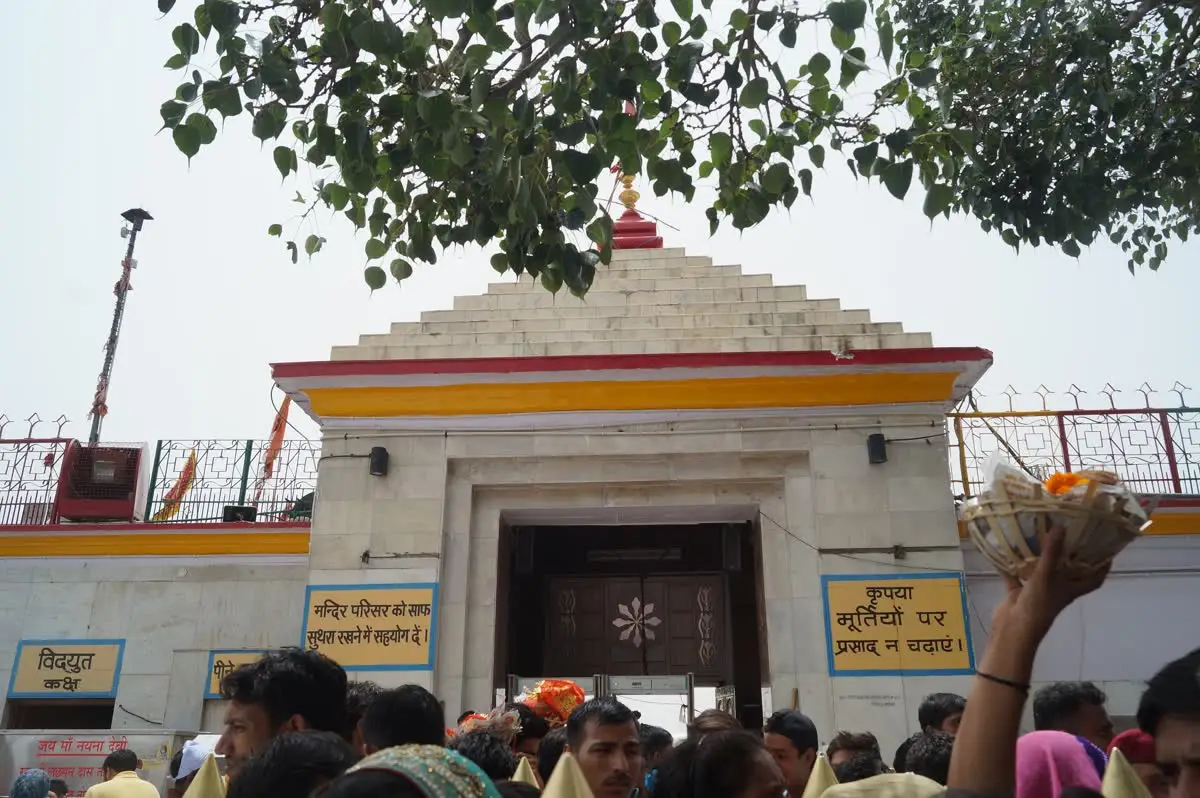
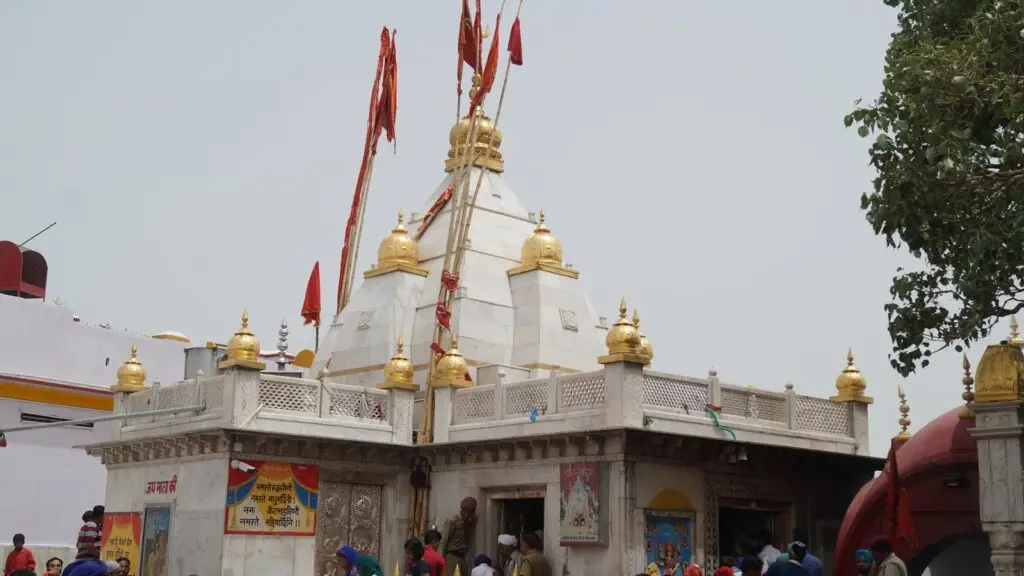
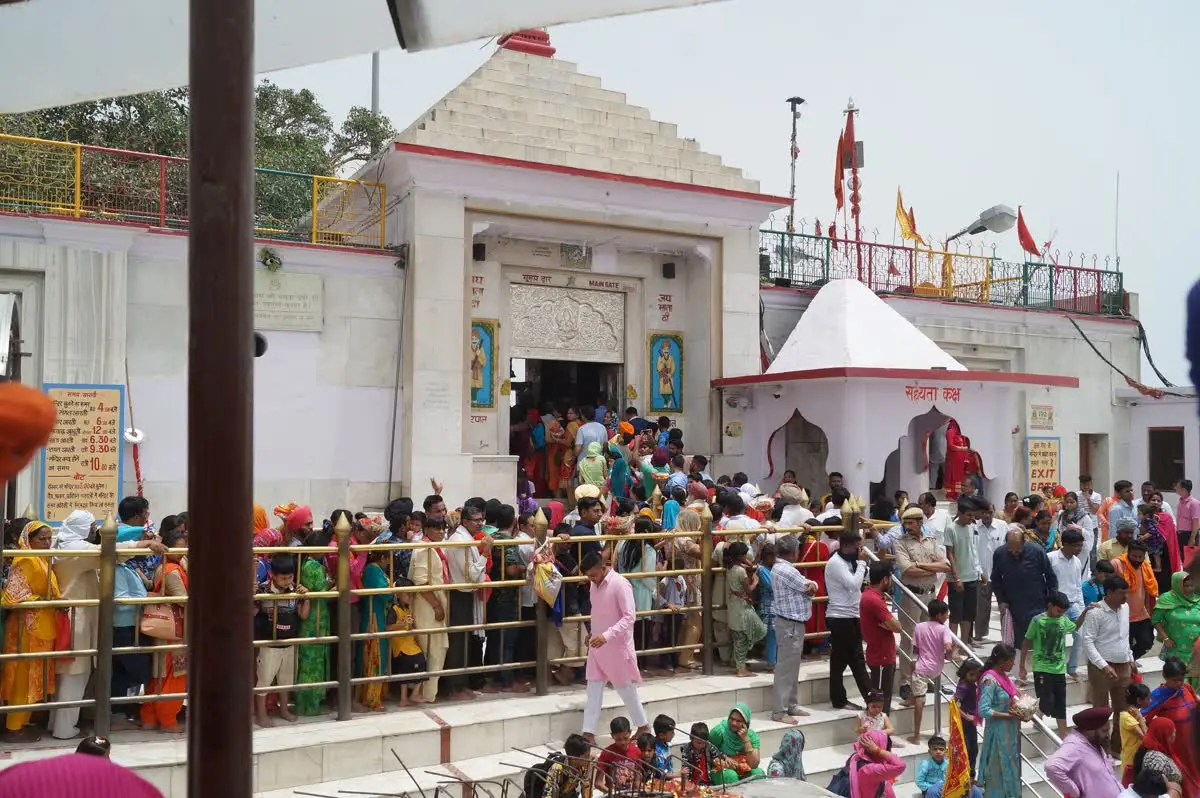
The temple complex at Naina Devi has been rebuilt and expanded many times across the centuries, and what stands today is best understood as a living, working shrine rather than a preserved architectural monument - its priority has always been function and accessibility for the enormous number of pilgrims who visit, rather than an unbroken historical structure. The main temple building is relatively modest and unadorned by the standards of some of North India's grander temple towns, with whitewashed walls, a modest shikhara (spire), and a courtyard that during major melas becomes almost impossibly crowded with devotees waiting in long, switchback queues for their turn at darshan.
The sanctum sanctorum houses the three pindis described earlier, kept behind a low railing that allows pilgrims a close but respectful view rather than physical contact, a fairly standard arrangement at high-footfall Devi shrines where crowd management during peak season is a genuine logistical necessity. Silver or gold coverings, donated by wealthy devotees over the years, adorn parts of the sanctum, and the pindis themselves are regularly dressed in fresh red chunris (ceremonial cloths) donated by pilgrims, a small act of devotion that many visitors specifically travel prepared to perform.
Surrounding the main sanctum are smaller shrines dedicated to other deities commonly found alongside Devi temples in this region - often including Lord Ganesha, Lord Hanuman, and a shrine associated with Bhairava - along with space for the enormous queue management infrastructure the temple trust has built up over recent decades: covered waiting areas, drinking water points, and a network of railings designed to keep the pilgrim flow orderly even when tens of thousands arrive on a single festival day.
The Historic Connection to Anandpur Sahib and the Sikh Gurus
One of the more historically interesting dimensions of Naina Devi is its proximity to Anandpur Sahib, one of Sikhism's most sacred sites, and the strong local tradition connecting the tenth Sikh Guru, Guru Gobind Singh, to this hill. According to widely repeated local accounts, Guru Gobind Singh spent time in meditation in the vicinity of Naina Devi and is associated in popular memory with composing or reciting verses in praise of the Devi during his time in this region - a tradition that has led to a meaningful, ongoing overlap between Sikh and Hindu pilgrims visiting this stretch of Himachal Pradesh, since Anandpur Sahib itself lies only a short distance away and is very often combined with a Naina Devi visit in a single itinerary. This shared regional reverence, cutting gently across community lines, is one of the quietly distinctive features of pilgrimage in this part of Himachal Pradesh.
The Ropeway: A Modern Path to an Ancient Shrine
For much of its history, reaching Naina Devi meant a demanding climb - several hundred stone steps rising steeply from the base of the hill, a genuine physical undertaking, particularly in the summer heat or during the crush of festival crowds. That climb remains an option today, and many devotees still choose it deliberately as an act of physical devotion, treating the exertion of the ascent as part of the offering itself.
However, the introduction of a ropeway (cable car) service connecting the base to the temple complex has transformed accessibility for elderly pilgrims, those with mobility difficulties, and families travelling with small children. The ropeway journey takes only a few minutes and offers, as a considerable bonus, sweeping aerial views over Gobind Sagar Lake and the surrounding hills that are, by any measure, spectacular - many visitors describe the ropeway ride itself as a highlight of the trip, quite apart from its practical convenience. During major melas, ropeway queues can themselves become lengthy, so pilgrims planning a festival-season visit should factor in additional waiting time whichever route they choose.
Devotees who prefer the traditional stepped path will find it well maintained, with shaded rest points and small shops selling water, prasad, and devotional items along the way - a fairly standard feature of established Himalayan pilgrim routes.
Darshan and Aarti Timings
Naina Devi's temple gates typically open quite early in the morning, and the general daily rhythm - as at most major North Indian Devi shrines - follows a pattern of an opening aarti soon after the doors are unlocked, a long stretch of the day given over to general darshan for the steady stream of pilgrims, and a closing aarti in the evening before the sanctum is shut for the night.
| Ritual | Typical Timing | Notes |
|---|---|---|
| Temple opens / morning aarti | Around 4:00-5:00 am | Timings shift somewhat with season |
| General darshan hours | Through the day, into the evening | Longer queues on weekends and during Navratri |
| Evening aarti | Around 7:00-8:00 pm | May shift earlier in winter months |
| Temple closes | Shortly after evening aarti | Extended hours during major melas |
Timings, fees and travel details checked against official sources in October 2026 are in Plan Your Visit below.
These timings should be treated as a general guide rather than a fixed schedule, since they can shift with the season, with festival crowds, and with decisions made by the temple management trust from time to time. Devotees planning a visit, particularly around Navratri or Shravan Ashtami, are strongly advised to verify current darshan and aarti timings with the temple trust or a recent, reliable local source before travelling, since festival-season hours in particular are often extended well beyond the routine daily schedule to accommodate the volume of pilgrims.
Festivals and Melas at Naina Devi
Naina Devi transforms twice each year into one of Himachal Pradesh's largest pilgrim gatherings, during the Chaitra and Ashwin Navratri periods, when the hilltop and the town below swell with devotees arriving from Himachal Pradesh, Punjab, Haryana, Chandigarh, and further afield.
| Festival / Mela | Approximate Timing | What Happens |
|---|---|---|
| Chaitra Navratri Mela | March-April (spring Navratri) | Nine days of continuous worship, large crowds, temporary markets and stalls along the pilgrim route |
| Ashwin (Sharad) Navratri Mela | September-October (autumn Navratri) | The larger of the two Navratri gatherings; peak crowd days around Ashtami and Navami |
| Shravan Ashtami Mela | July-August, during Shravan month | A significant additional mela tied to the monsoon month sacred to Shiva and Devi worship alike |
| Weekly/monthly local gatherings | Every Sunday and on specific tithis | Smaller but steady crowds; less waiting time than major melas |
During the peak Navratri days, the approach roads to the temple, the ropeway queues, and the stepped pilgrim path can all see extremely heavy crowds, and local authorities typically implement traffic diversions, additional bus services from Anandpur Sahib and Bilaspur, and expanded medical and security arrangements to manage the flow safely. Devotees who prefer a quieter, more contemplative darshan experience often choose to visit outside these peak windows, on an ordinary weekday, when the sanctum is calm and queues are short.
- Carry minimal luggage during mela days, since security checks intensify considerably
- Wear comfortable footwear suited to either the stepped climb or standing in ropeway queues
- Keep a small, sealed offering of coconut, chunri, or flowers ready, as these are commonly available for purchase near the base as well
- Elderly or unwell pilgrims are strongly encouraged to use the ropeway during mela days rather than attempt the stepped climb amid crowds
How to Reach Naina Devi Temple
Naina Devi's location in Bilaspur district places it within comfortable reach of Chandigarh, the principal gateway city for this part of Himachal Pradesh, as well as the historic town of Anandpur Sahib just across the Punjab border.
By Air
The nearest major airport is Chandigarh International Airport, roughly 90 kilometres from the temple, well connected by domestic flights from Delhi, Mumbai, and other major Indian cities, as well as some international routes. From Chandigarh, taxis and buses run regularly toward Anandpur Sahib and onward to the Naina Devi base. Some pilgrims travelling from further afield also use Shimla Airport, though this involves a longer road journey and considerably less frequent flight connectivity, making Chandigarh the far more practical choice for most travellers.
By Train
The nearest railway stations are Anandpur Sahib and Nangal Dam, both a short distance from the base of the Naina Devi hill, well served by trains connecting to the wider Northern Railway network via Ambala and Chandigarh. Chandigarh railway station itself, though somewhat further away, is a major junction with far more extensive long-distance connectivity, and many pilgrims prefer to travel to Chandigarh by train and complete the remaining distance by road.
By Road
Naina Devi is well connected by road to Chandigarh (around 90 km), Anandpur Sahib (around 10-15 km), Bilaspur town, and Una. Regular bus services run from Chandigarh, Anandpur Sahib, and Bilaspur to the base of the temple hill, from where pilgrims proceed either by the stepped path or the ropeway. Self-driven or hired taxis are a comfortable option, particularly for families or groups, and the roads, while hilly in the final stretch, are generally well maintained.
| Mode | Nearest Access Point | Approximate Distance |
|---|---|---|
| Air | Chandigarh International Airport | ~90 km |
| Rail | Anandpur Sahib / Nangal Dam station | ~10-15 km |
| Road | Chandigarh via NH-503/state highways | ~90 km |
| Road | Anandpur Sahib | ~10-15 km |
As with all timing and distance details in this guide, road conditions and travel durations in the Himalayan foothills can vary with weather, particularly during the monsoon, so it is worth checking current conditions before setting out, especially between June and September.
Nearby Attractions and Where to Stay
The single most significant nearby destination is Anandpur Sahib, one of Sikhism's five Takhts and the site where the Khalsa was founded by Guru Gobind Singh in 1699 - an immensely important pilgrimage site in its own right, and a natural pairing with a Naina Devi visit given the short distance between them and the shared regional history described earlier in this guide.
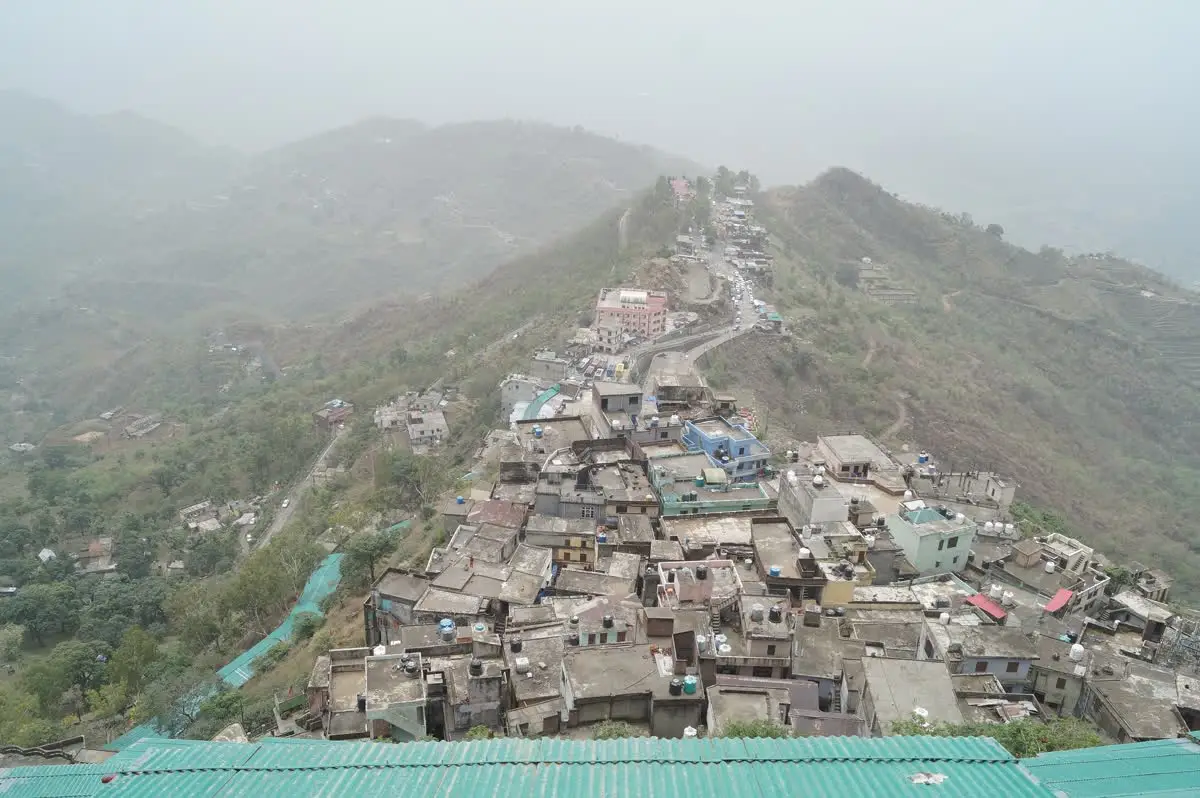
Gobind Sagar Lake itself, the vast reservoir created by the Bhakra Dam and visible in sweeping panorama from the Naina Devi hilltop, offers boating and scenic viewpoints for travellers wishing to extend their stay by a day. The Bhakra Dam, one of the largest gravity dams in the world, lies within a reasonable day-trip distance and is of considerable interest to visitors curious about India's post-independence infrastructure history.
Bilaspur town itself, rebuilt on higher ground after the old town was submerged by the creation of Gobind Sagar Lake, offers modest but comfortable accommodation, markets, and further temples worth a visit for pilgrims extending their stay. For those continuing along the wider Himachal Devi circuit, Chintpurni Temple, dedicated to Mata Chhinnamastika Devi in neighbouring Una district, makes a natural and popular next stop, typically reachable within a few hours' drive.
Accommodation near Naina Devi ranges from simple dharamshalas (pilgrim guesthouses) maintained by the temple trust and various charitable organisations, offering basic but clean rooms at modest rates, to a growing number of private hotels and guesthouses in Bilaspur town and along the approach roads, catering to a range of budgets. During major melas, availability tightens considerably, and advance booking is strongly recommended; on ordinary days, finding a room on arrival is usually straightforward.
- Dharamshalas near the temple base, run by the temple trust - simple, inexpensive, ideal for pilgrims prioritising proximity
- Private hotels and guesthouses in Bilaspur town, a short drive away, offering more comfort and amenities
- Accommodation in Anandpur Sahib, for pilgrims combining both sites in one trip
Naina Devi in the Wider Shakti Tradition
Naina Devi's place within the broader landscape of Devi worship in India is best understood not as an isolated regional cult but as one thread within an immense, interconnected tapestry of Shakti devotion stretching from Kashmir to Kanyakumari, Gujarat to Assam. The same Adi Parashakti worshipped here as the goddess of the eyes is worshipped elsewhere as Maa Kali in her fierce, time-devouring aspect, as the serene Tripura Sundari in her form as supreme beauty, and in dozens of other regional and pan-Indian forms - each a facet of the same formless, infinite Mother approached through a particular story, a particular hilltop, a particular pair of eyes fallen long ago upon a Himalayan ridge.
Understanding Naina Devi properly, then, means holding two things at once: the intimate, local devotion of families who have visited this specific hill for generations, treating the goddess here as their own particular kul devi, and the wider mythological and theological frame of the Shakti Peetha tradition, which links this hilltop to fifty other sacred sites scattered across the subcontinent, each one a fragment of the same primordial sacrifice and the same undying grief and love that gave rise to Shakti worship as we know it today. Pilgrims wishing to deepen their understanding of that wider frame will find it valuable to read the full account of the 51 Shakti Peethas and the foundational story of Sati and the Daksha Yagna alongside this guide.
Further Reading
Plan Your Visit to Naina Devi: Timings, Tickets and Travel
The details below were checked on 3 October 2026 against the Shri Naina Devi Ji temple trust and the other sources listed under each table. Timings and fees change on festival days, eclipses and special occasions, so confirm with the temple before you travel.
Visiting more than one Devi temple in the Kangra and Una hills? Our Himachal Devi temple circuit sets out the order, distances and days for Naina Devi, Chintpurni, Jwalamukhi, Brajeshwari and Chamunda. For what happens here during Navratri 2026 (11 to 19 October), see Navratri 2026 at major Devi temples.
Darshan and Aarti Timings
| Information | Details |
|---|---|
| Darshan, normal days | 4:00 am to 10:00 pm |
| Darshan, Navratras | 2:00 am to 12:00 midnight |
| Ropeway, March to September | 8:00 am to 7:00 pm |
| Ropeway, October | 8:00 am to 6:30 pm |
| Ropeway, November | 8:15 am to 5:30 pm |
| Ropeway, December to February | 9:00 am to 5:30 pm |
| Ropeway maintenance closure | 1st and 3rd Wednesday of each month (Thursday if Wednesday is a public holiday). Timings may vary during festivals. |
| Midday aarti break during melas | Darshan paused 12:00 to 12:30 pm during the August 2026 mela |
Sources: Shri Naina Devi Ji temple trust: Shri Naina Devi Ji Official Website, Shri Naina Devi Ji temple trust: General Information, NainaDevi Ropeways (Ganpati Ropeways Pvt Ltd), operator: Naina Devi Ropeway T..., Rupnagar district (Punjab) NIC site: Shri Naina Devi Temple, Amar Ujala: Naina Devi mela (Shravan Ashtami) arrangements.
Tickets, Darshan Options and Sevas
The temple trust lists no paid darshan tier. The trust takes donations, langar permission and accommodation bookings online. From the bus stand, pilgrims reach the temple by palki, on foot or by ropeway. Bookings are handled on online.srinainadevi.com. The trust portal also takes donations (online.srinainadevi.com/donation.php) and langar permission (online.srinainadevi.com/occasion-langer/). Accommodation quotas are released month by month. Helpline 1800 180 80 69, landline 01978-288048, WhatsApp 9805252008; the call centre works 24 hours. Musinara is not connected with the temple and does not take bookings.
Sources: Shri Naina Devi Ji temple trust: Shri Naina Devi Ji Official Website, Shri Naina Devi Ji temple trust: How To Reach, Shri Naina Devi Ji temple trust: General Information, Shri Naina Devi Ji temple trust (online portal): Accommodation booking.
Temple Rules and Dress Code
- There is no formal dress code, but avoid short or revealing clothes.
Source: Shri Naina Devi Ji temple trust: General Information.
How to Reach Naina Devi
Open Naina Devi in Google Maps for live directions.
| Mode | Nearest point | Distance to the temple |
|---|---|---|
| Air | Chandigarh airport | about 100 km by road |
| Rail | Anandpur Sahib (Punjab); the trust also lists Nangal | about 20 to 25 km |
| Bus | Naina Devi bus stand; from there take a palki or walk to the temple | the walk takes about half an hour |
Sources: Shri Naina Devi Ji temple trust: How To Reach, Rupnagar district (Punjab) NIC site: Shri Naina Devi Temple, Shri Naina Devi Ji temple trust: Shri Naina Devi Ji Official Website.
Approximate distances and journey times from the cities most pilgrims start from. Road times assume normal traffic; festival weekends take longer.
| From | By road | Road time | Train or flight |
|---|---|---|---|
| Chandigarh | about 100 to 108 km | Chandigarh airport is the nearest | |
| Delhi | about 350 km | Fly to Chandigarh | |
| Anandpur Sahib | about 20 km, of which about 8 to 13 km is hill road | Nearest railway station | |
| Kiratpur Sahib | about 30 km, of which about 13 to 18 km is hill road | ||
| Nangal | about 36 km | Nangal railway station |
Sources: Shri Naina Devi Ji temple trust: Shri Naina Devi Ji Official Website, Shri Naina Devi Ji temple trust: How To Reach, Rupnagar district (Punjab) NIC site: Shri Naina Devi Temple.
State transport buses run from important cities of Punjab and Himachal Pradesh, and taxis are available from Anandpur Sahib and Chandigarh. At the Naina Devi bus stand you can take a palki, walk or use the ropeway. The ropeway ride takes about 10 minutes each way; cabins carry up to 6 people and leave about every 15 minutes. Tickets are sold at the counter and online through the operator. The temple stands at 1,177 m.
When to Go and How Long to Allow
The walk from the bus stand to the temple takes about half an hour.
Source: Rupnagar district (Punjab) NIC site: Shri Naina Devi Temple.
Prasadam, Annadanam and Where to Stay
The trust runs a langar, and permission to host a langar is booked on the trust portal. Several langars served meals during the Shravan Ashtami mela in August 2026. The temple trust takes accommodation bookings on its online portal. Rooms are released in monthly quotas.
Sources: Shri Naina Devi Ji temple trust: Shri Naina Devi Ji Official Website, Amar Ujala: Naina Devi mela (Shravan Ashtami) arrangements, Shri Naina Devi Ji temple trust (online portal): Accommodation booking.
Temples and Places Near Naina Devi
- Anandpur Sahib (Takht Sri Kesgarh Sahib) (about 20 km): Gateway town and nearest railway station
- Bhakra Dam (about 20 km): Dam on the Sutlej river
- Nangal (about 36 km): Town with a railway station
Sources: Shri Naina Devi Ji temple trust: How To Reach, Shri Naina Devi Ji temple trust: Shri Naina Devi Ji Official Website.
Frequently Asked Questions
Where is Naina Devi Temple located?
Naina Devi Temple stands atop a hill in Bilaspur district, Himachal Pradesh, overlooking Gobind Sagar Lake. It lies a short distance from Anandpur Sahib in Punjab and around 90 kilometres from Chandigarh.
Why is the temple called Naina Devi?
The name comes from naina or nayana, meaning eyes. Tradition holds that this hilltop is the Shakti Peetha where the eyes of the goddess Sati fell after Lord Vishnu's Sudarshana Chakra cut through her body as Shiva carried her in grief.
What does the deity look like inside the sanctum?
Unlike many temples, Naina Devi has no elaborately carved idol. The goddess is worshipped as a pindi, a natural stone form marked with vermilion and adorned with a pair of eyes, alongside two further pindis representing Maha Kali, Maha Lakshmi, and Maha Saraswati together.
Is Naina Devi one of the 51 Shakti Peethas?
Yes, Naina Devi is widely counted among the Shakti Peethas associated with Sati's body, specifically linked to her eyes. As with several Peethas, some regional lists and textual traditions vary slightly on exact attributions, which is common across this ancient tradition.
What is the significance of the peepal tree at the temple?
The ancient peepal tree within the temple precincts is considered self-manifested and central to the site's origin legend, in which unusual activity around the tree first drew attention to the sacred spot. Devotees tie red thread to it and consider circling it part of a complete darshan.
Is there a ropeway to Naina Devi Temple?
Yes, a ropeway connects the base of the hill to the temple complex, offering a quick alternative to the traditional stepped climb and sweeping views over Gobind Sagar Lake. Many pilgrims, especially the elderly, prefer it during festival crowds.
When is the best time to visit Naina Devi for a mela?
The largest gatherings occur during Chaitra Navratri (March-April) and Ashwin Navratri (September-October), along with a significant Shravan Ashtami mela in July-August. Devotees seeking a quieter darshan often prefer ordinary weekdays outside these periods.
What are the typical darshan and aarti timings at Naina Devi?
The temple typically opens for morning aarti around 4:00-5:00 am and closes after evening aarti around 7:00-8:00 pm, though these hours shift with season and extend considerably during major melas. It is best to verify current timings with the temple trust before travelling.
How do I reach Naina Devi from Chandigarh?
From Chandigarh, the most common route is by road via Anandpur Sahib, a journey of roughly 90 kilometres. Regular buses and taxis run this route, and pilgrims can also travel by train to Anandpur Sahib or Nangal Dam and continue by road from there.
Can Naina Devi be combined with a visit to Anandpur Sahib?
Yes, the two sites lie only a short distance apart and are very commonly visited together, both because of the practical proximity and the historic connection between Guru Gobind Singh and this hill, which is remembered warmly by pilgrims of both Sikh and Hindu tradition.
Standing before the pindis of Naina Devi, high above a lake that itself covers what was once a living valley, a pilgrim is reminded that devotion, like the landscape here, holds both loss and renewal within the same view. If this guide has drawn you closer to the goddess of the eyes, Musinara invites you to carry that stillness further - listen on YouTube to our 432 Hz recordings of Devi chants, a gentle companion for reflection before or after your own journey up the hill.
Related reading
- Bhramaramba Devi Temple, Srisailam: The Complete Guide to the Bee Goddess's Shakti Peetha
- Brajeshwari Devi Temple, Kangra: The Complete Shakti Peetha Guide
- Mansa Devi & Chandi Devi: The Hilltop Goddesses of Haridwar (with Maya Devi Shakti Peetha)
- Ambaji Temple: The Shakti Peetha Where the Heart of Sati Fell (Gujarat)
Official and Reference Sources
- Shri Naina Devi Ji Temple Trust - the temple trust under the Himachal Pradesh government
Planning a pilgrimage? All twenty Devi temple guides on this site are arranged by region, with practical circuits, in Devi Temples of India. For where each site sits in the disputed lists of 51, 52 and 108, see the Shakti Peeth list.