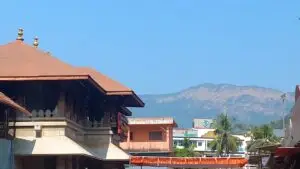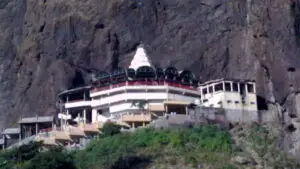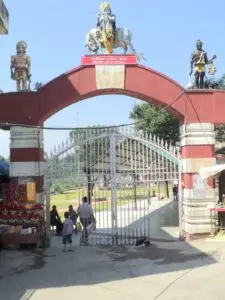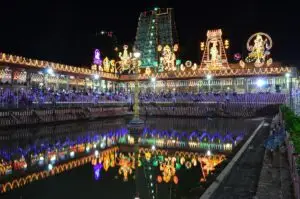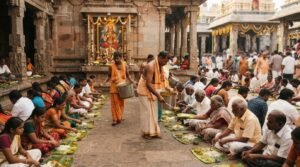
Ambaji Temple, in the Banaskantha district of northern Gujarat, is the Shakti Peetha where the heart (hrudaya) of Sati is believed to have fallen. Uniquely, its sanctum holds no idol at all. The gold-inscribed Shri Visa Yantra, a sacred geometric diagram, is veiled, adorned and worshipped as the living presence of the Divine Mother herself.
High on the Arasur Hills of the Aravalli Range, where Gujarat gives way to Rajasthan and the Saraswati river is said to rise, Arasuri Ambaji stands among the most revered goddess shrines in India. It is counted among the fifty-one Shakti Peethas, the sacred sites formed where parts of Sati's body came to rest upon the earth. Because the heart is the very seat of feeling and love, pilgrims speak of Ambaji as the place where the Mother's compassion is most tenderly present.
This guide walks reverently through Ambaji's legend, its unusual mode of worship, the sacred hill of Gabbar honoured as the Goddess's original abode, the great Bhadarvi Poonam fair that draws millions on foot, and a practical account of how to reach and visit. Where traditions differ, those variations are noted honestly, so that pilgrim and reader alike may approach this Mahashakti Peetha with both devotion and understanding.
Key Takeaways
- Ambaji Temple in Banaskantha district, Gujarat, is honoured as the Shakti Peetha where the heart of Sati fell.
- The sanctum contains no idol; the veiled Shri Visa Yantra, inscribed on gold, is worshipped as the Goddess herself.
- Gabbar Hill, about 4 to 5 km from the temple, is revered as the original abode of Maa Amba and holds her sacred footprints and an eternal flame.
- The Bhadarvi Poonam fair, on the full moon of Bhadrapada (late August or September), draws millions of devotees, many walking on foot in padayatras.
- The nearest railhead is Abu Road (about 20 to 22 km) and the nearest major airport is Ahmedabad (about 180 to 185 km).
Ambaji Temple at a Glance
| Detail | Information |
|---|---|
| Location | Ambaji town, Banaskantha district, northern Gujarat, on the Arasur Hills (about 480 m elevation), near the Gujarat-Rajasthan border |
| Presiding deity | Arasuri Amba, worshipped through the Shri Visa Yantra (no idol in the sanctum) |
| Shakti Peetha tradition | Heart (hrudaya) of Sati; some lists mention the right arm or shoulder |
| Nearest airport | Sardar Vallabhbhai Patel International Airport, Ahmedabad, roughly 180-185 km |
| Nearest railway | Abu Road (about 20-22 km); Palanpur (about 65 km) |
| By road | About 180-185 km from Ahmedabad (4 to 5 hours); about 45 km from Mount Abu |
| Darshan timings | Early morning to night with a midday break; aarti morning, noon and evening; confirm the current schedule with the temple trust |
| Major festivals | Bhadarvi Poonam fair, Navratri, full-moon (Poonam) days |
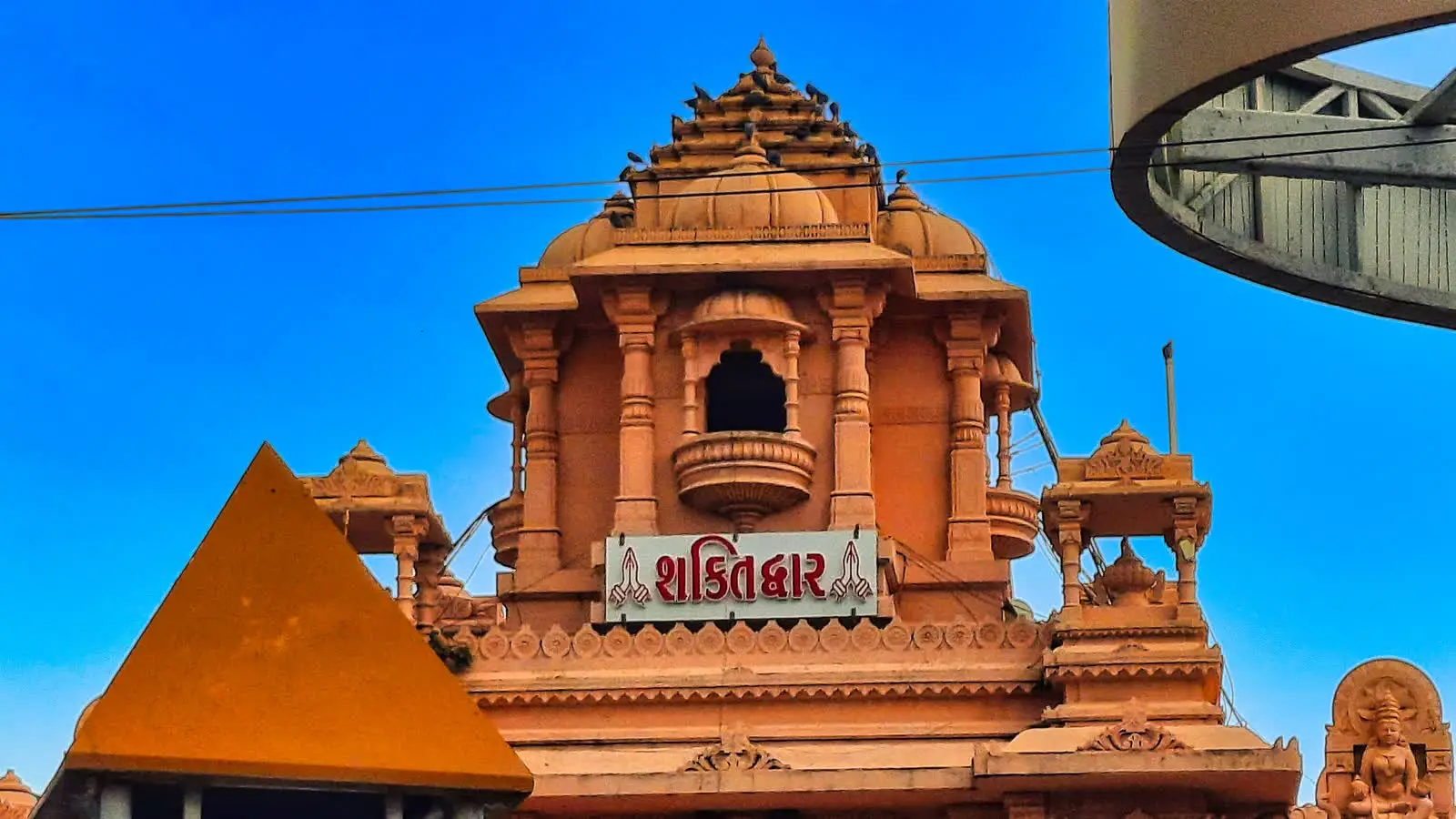
Why Is Ambaji Counted Among the 51 Shakti Peethas?
Ambaji is a Shakti Peetha because tradition holds that a part of the goddess Sati's body, her heart, fell here when Lord Vishnu's Sudarshana Chakra severed her form. The Shakti Peethas are the shrines that mark these sacred spots, and Ambaji is honoured among the principal Shakti pilgrimage centres of India.
The temple sits at roughly 480 metres above sea level on the Arasur Hills, near the source of the Saraswati river and close to the Gujarat-Rajasthan border. Because it is dedicated to Shakti in her Arasuri Amba form and belongs to the network of the fifty-one Shakti Peethas, it holds a place of very high sanctity within the Shakta tradition. It is often described as a Mahashakti Peetha, one of the greatest seats of the Goddess.
The town of Ambaji has grown up entirely around the shrine. It is a temple town in the truest sense, its rhythms set by the aarti bells, the arrivals of pilgrim groups, and the seasons of festival and fair. In recent years the Gujarat government has announced large redevelopment plans, including a proposed corridor linking the main temple with Gabbar Hill, reflecting the site's growing importance as a pilgrimage destination.
Where the Traditions Vary
It is worth noting honestly that lists of the Shakti Peethas differ between texts, and the body part assigned to a given site can vary. For Ambaji, most sources record that the heart of Sati fell here; some traditions instead mention the right arm or shoulder. Rather than treat one version as the only truth, devotees generally hold to the heart tradition while acknowledging that scriptural lists are not perfectly uniform. This humility before the sources is itself part of the pilgrim spirit.
What Is the Legend of Sati's Heart at Ambaji?
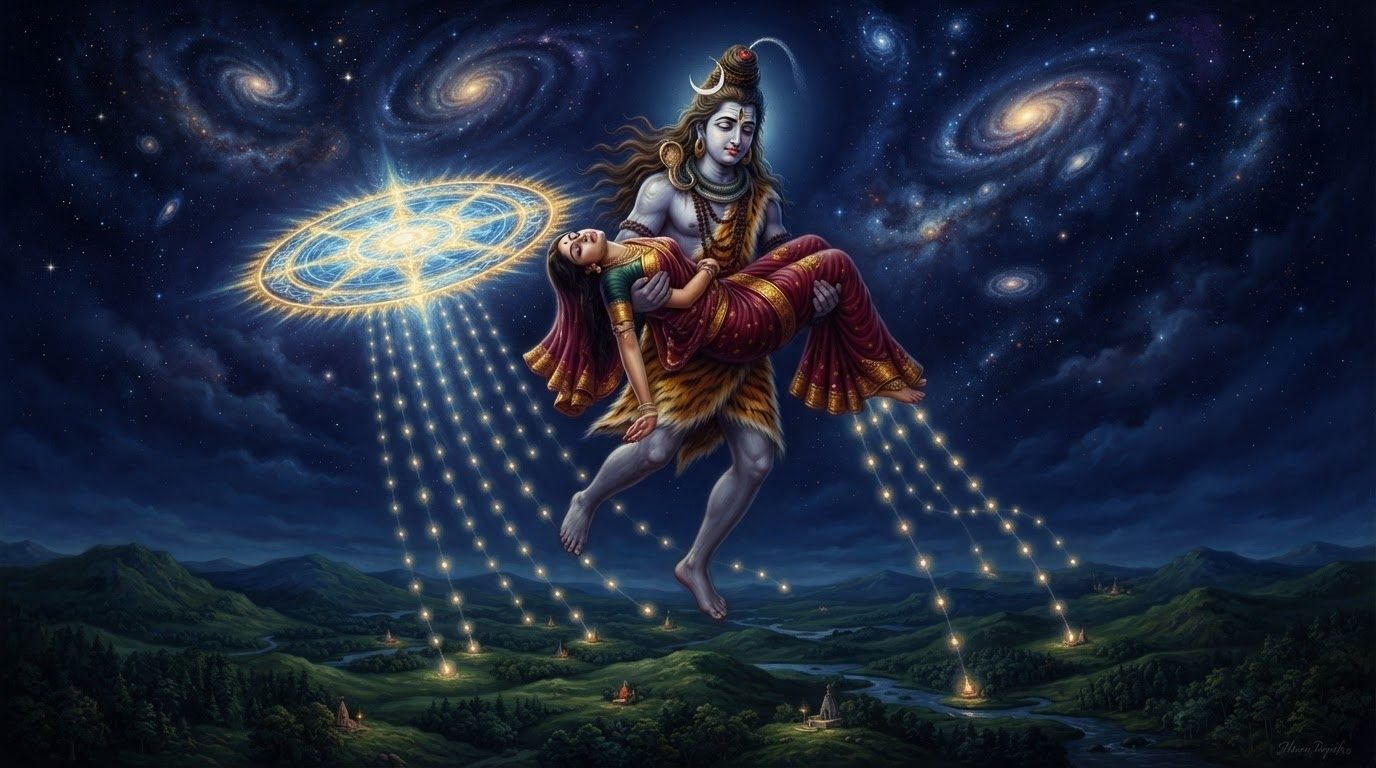
The legend holds that when Sati gave up her life at her father Daksha's yagna, the grieving Shiva carried her body across the cosmos. Vishnu's Sudarshana Chakra severed the body into many parts, and the heart of Sati came to rest on the Arasur Hills, sanctifying Ambaji forever.
The story begins with Sati, the daughter of King Daksha and the first consort of Lord Shiva. Daksha organised a great sacrificial rite but pointedly did not invite Shiva. Sati went to the ceremony despite this slight and there endured her father's contempt for her husband. Unable to bear the insult to Shiva, she gave up her life in the sacred fire, an act from which the very name Sati has come to be associated with the story. You can read the full account in our guide to the Sati Devi and Daksha Yagna story.
When Shiva learned of her death, his grief was boundless. He lifted the lifeless body of Sati upon his shoulder and began to wander the cosmos in a dance of sorrow and destruction, the tandava, which threatened to unmake the balance of the worlds. To restore order and release Shiva from the grip of his grief, Lord Vishnu sent forth his Sudarshana Chakra, which severed Sati's body into many parts. Wherever a part came to rest upon the earth, that place became a Shakti Peetha, sanctified forever by the presence of the Goddess.
At the spot that is now Ambaji, tradition holds that the heart of Sati fell. From that moment the hills of Arasur became a seat of the Divine Mother, worshipped as Arasuri Amba. In this way the legend binds together sorrow and grace: from the great grief of Shiva and the sacrifice of Sati arose sacred places where devotees for millennia have come to feel the nearness of the Mother.
What Is the Shri Visa Yantra and Why Is There No Idol at Ambaji?
The Shri Visa Yantra is a sacred geometric diagram inscribed on gold and enshrined in the Ambaji sanctum in place of an idol. It is worshipped as the Goddess herself, kept veiled, never gazed upon directly with the naked eye, and adorned daily so devotees behold the form of Amba.
A yantra is a sacred diagram that holds, in its lines and forms, the concentrated energy and presence of the divine. At Ambaji the Yantra is regarded as the Goddess herself, not merely a symbol of her. The Visa Yantra is understood to be inscribed in a precise arrangement of triangles and interlocking figures, associated with the number that gives it its name. It is kept in the inner sanctum and is not shown openly; it is considered too potent and too sacred for casual sight. Photography of the Yantra is strictly prohibited.
Instead, the Yantra is dressed and decorated each day so that what the devotee beholds appears as the radiant form of the Mother: adorned with fine cloth, a crown, a nose-ring and ornaments, framed by lamplight. In this way the formless is given a form for the eye of devotion, while the true object of worship remains the sacred diagram beneath. This is a profound teaching in itself, that the Divine Mother is ultimately beyond form, and that the images we cherish are gracious concessions to human longing.
Why Worship the Formless?
The worship of a yantra rather than an idol places Ambaji within the deeper current of Shakta and tantric practice, where the Goddess is honoured as the primordial energy from which all forms arise, a truth also expressed in the origin story of the Das Mahavidyas. To bow before the veiled Visa Yantra is to acknowledge that the Mother cannot be contained in any single shape.
She is the living power behind the sun, the earth, the Saraswati's waters and the beating of the heart itself. Many pilgrims describe their darshan at Ambaji as one of feeling rather than seeing, fitting for the Peetha of the heart.
What Does the Ambaji Temple Look Like and How Is Daily Worship Performed?
The main temple is built of white marble and crowned with a gold-plated spire, with silver-plated doors and a spacious courtyard. Inside, the veiled Shri Visa Yantra receives a full daily cycle of worship, with several aarti ceremonies from the morning awakening of the Goddess to the evening lamp offering.
Each aarti draws crowds of devotees whose voices rise together in praise. An eternal flame, the Akhand Jyot, is maintained in the temple's Chachar Chowk courtyard, a continuous light that expresses unbroken devotion. The traditional prasad of Ambaji is mohanthal, a rich gram-flour sweet, offered and distributed to pilgrims.
Around the temple, the town offers rest houses, shops selling offerings and religious articles, and facilities for the vast numbers who arrive during festival seasons. Yet even amid the bustle, the heart of the experience remains simple: to stand before the Mother, to hear the aarti, and to receive her blessing.
What Is Gabbar Hill and Why Do Pilgrims Climb It?
Gabbar Hill, about 4 to 5 km from the main Ambaji temple, is honoured as the original abode of the Goddess, the place where Amba first made her home. Pilgrims climb it to venerate the Charan Paduka, a rock formation bearing the Mother's footprints, and an ancient eternal flame.
The name Gabbar comes from the local word for mountain, and the hill is treated as a tirth, a sacred crossing place, in its own right. Many pilgrims regard a visit to Ambaji as incomplete without also climbing Gabbar. Atop the hill, the sacred footprints are often described as lying beneath a revered tree, and the Akhand Jyot burning there is said to have been kept alight for a very long time, symbolising the ceaseless presence of the Mother on her ancient hill. The summit offers sweeping views over the town of Ambaji and the forested folds of the Aravallis.
How Do You Climb Gabbar Hill?
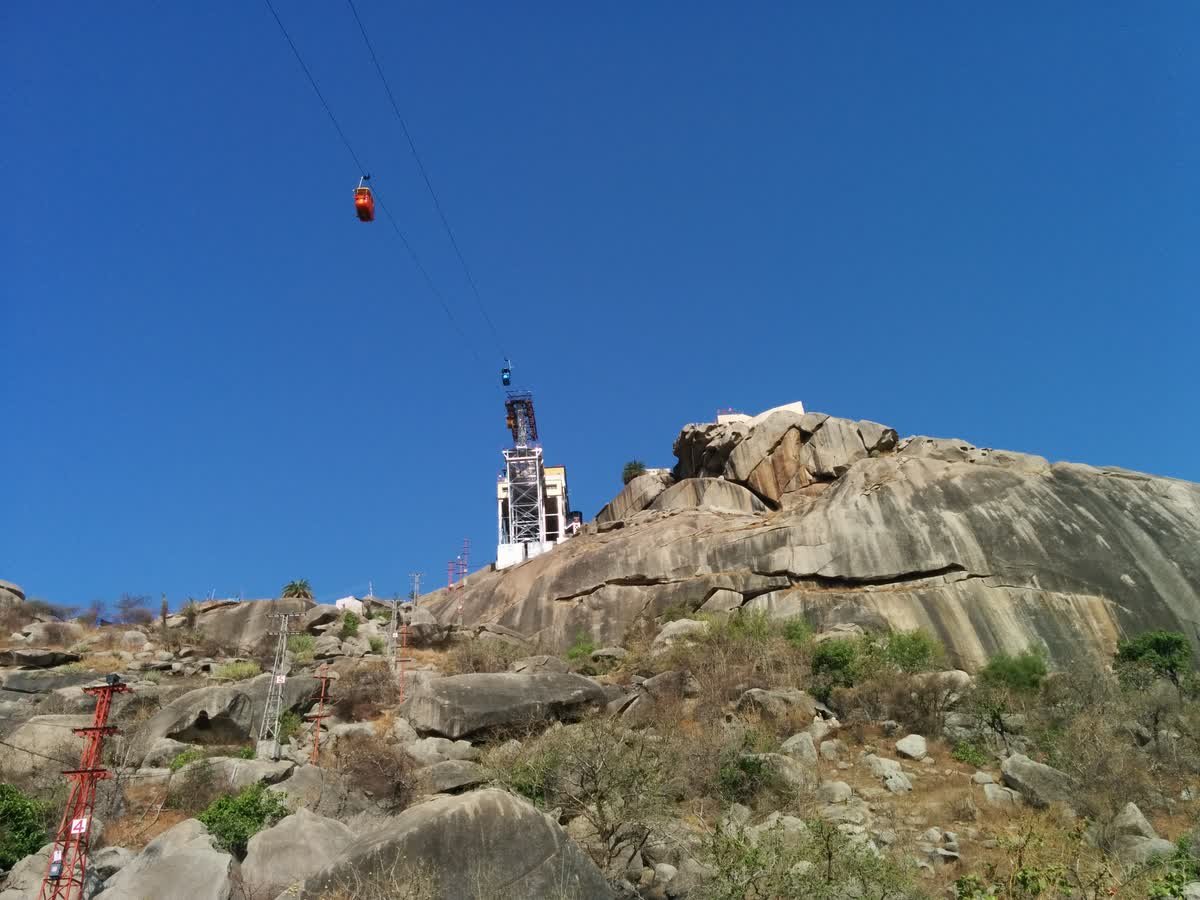
The traditional ascent is by a long flight of steps, commonly described as several hundred stairs, a climb that is itself an act of devotion for many pilgrims. For those who cannot manage the steps, a ropeway introduced in the late 1990s carries visitors up and down the hill, offering an easier journey and fine aerial views of the temple town and surrounding hills.
Ticket prices for the ropeway are modest and are set by the operating authority. It is best to check the current fare and timings on arrival, as these are updated from time to time.
When Is the Bhadarvi Poonam Fair and What Happens During Navratri?
The Bhadarvi Poonam fair is held on the full-moon day of the Hindu month of Bhadrapada, usually in late August or September. It is among the largest religious congregations in Gujarat, drawing devotees often counted in the millions, many of whom walk to Ambaji on foot in long padayatras.
During the fair the whole town is illuminated and adorned, glowing at night in a way that pilgrims often compare to Diwali. Free food and water are offered along the pilgrim routes by countless volunteers and community kitchens, and the roads fill with the sound of devotional song. It is a time of extraordinary collective devotion, when the ordinary distinctions of daily life dissolve into a single stream of pilgrims moving toward Ambaji.
Navratri, the nine nights of the Goddess, is likewise a high season at Ambaji. The temple town resounds with garba, the traditional circular dance of Gujarat performed in the Goddess's honour, and with Bhavai folk theatre. To be at Ambaji during Navratri is to witness worship expressed as joyous movement and music, the devotees dancing through the night in praise of Amba.
How Should You Plan Around the Crowds?
Because the Bhadarvi Poonam fair and Navratri draw such immense crowds, pilgrims who wish for a quieter darshan may prefer to visit outside these peak periods. Those who come specifically for the fair should plan for long queues, heavy traffic, and the need to book accommodation well in advance. Full-moon days (Poonam) through the year are also considered especially auspicious for a visit.
Which Mantras Are Chanted for Maa Amba?
Devotees of Maa Amba commonly chant the Navarna mantra, the Om Jai Ambe Gauri aarti, the Durga beej mantra and verses from the Devi Mahatmya. These are general invocations of the Divine Mother in her Amba and Durga forms, widely used rather than unique to Ambaji, and are offered here in a spirit of devotion.
Pronunciation and small textual variations exist between regions and lineages, so these should be taken as reverent guides rather than fixed scripture. Devotees who wish to chant may do so with a clean mind and heart, ideally after bathing, seated calmly and facing the temple or an image of the Mother if one is kept at home. Sincerity of feeling matters far more than perfection of form.
| Sanskrit (Devanagari) | Transliteration | Meaning |
|---|---|---|
| ॐ ऐं ह्रीं क्लीं चामुण्डायै विच्चे | Om Aim Hreem Kleem Chamundayai Vichche | The revered Navarna (Chandi) mantra invoking the Goddess as Chamunda through the seed sounds of wisdom (Aim), power (Hreem) and desire (Kleem); chanted widely in Durga worship. |
| ॐ जय अम्बे गौरी | Om Jai Ambe Gauri | The opening line of the beloved aarti to the Mother, hailing Amba Gauri; sung across India and especially dear to devotees of Amba. |
| ॐ दुं दुर्गायै नमः | Om Dum Durgayai Namah | A widely used beej (seed) mantra saluting Goddess Durga, invoking her protection and grace. |
| या देवी सर्वभूतेषु शक्तिरूपेण संस्थिता | Ya Devi Sarva-bhuteshu Shakti-rupena Samsthita | A famous verse from the Devi Mahatmya: to the Goddess who abides in all beings as the very form of power, we bow again and again. |
How Many Pilgrims Come for Bhadarvi Poonam?
The Bhadarvi Poonam fair is Ambaji’s largest gathering of the year. Final counts for the last three fairs:
| Year | Fair dates | Devotees | Source |
|---|---|---|---|
| 2023 | - | 45.54 lakh | Gujarat Samachar |
| 2024 | 12 to 18 September | 32.54 lakh | Gujarat government, via Connect Gujarat |
| 2025 | 1 to 7 September | Over 43 lakh | Sandesh |
Running tallies are released day by day during the fair and are often quoted as if they were totals, so we give only the closing figures. 2024 was noticeably lower than the years either side of it. None of the reports we found explain why, so we have not guessed.
How Do You Reach Ambaji Temple?
Open Ambaji Temple in Google Maps · Open Gabbar hill in Google Maps for live directions from where you are.
Ambaji is reached most easily via Abu Road railway station, about 20 to 22 km away, or by road from Ahmedabad, about 180 to 185 km. The nearest major airport is Ahmedabad's Sardar Vallabhbhai Patel International Airport, with onward taxi and bus connections taking roughly four to five hours.
The town lies in the far north of Gujarat, close to the Rajasthan border, and is well connected by road. The following distances are approximate and drawn from commonly cited figures; road times vary with traffic and conditions.
| Mode / Detail | Information |
|---|---|
| Nearest airport | Sardar Vallabhbhai Patel International Airport, Ahmedabad, roughly 180-185 km; taxis and buses run onward to Ambaji (around 4 to 5 hours by road) |
| Nearest railway station | Abu Road (Rajasthan), about 20-22 km, connected to Delhi, Mumbai, Jaipur and Ahmedabad; taxis and buses run regularly to Ambaji |
| Alternative railhead | Palanpur, about 65 km; a direct Ahmedabad-Ambaji rail line has been under construction, so check the current status before relying on it |
| By road from Ahmedabad | About 180-185 km, roughly 4 to 5 hours, via Mahesana and Palanpur |
| By road from Mount Abu | About 45 km; from Abu Road about 20 km |
| Buses | State transport and private buses serve Ambaji from Ahmedabad, Palanpur, Mount Abu and other towns; good road access for cars and coaches |
| Gabbar Hill | About 4-5 km from the main temple; reach by taxi, auto or bus, then climb the stairway or take the ropeway (confirm fares and hours locally) |
| Darshan timings | Generally open early morning to night with a midday break; aarti morning, noon and evening; timings shift by season and festival, so confirm with the temple trust |
Tips for Pilgrims
- Dress modestly and respectfully, as befits a place of worship.
- Photography inside the sanctum, and of the Visa Yantra, is prohibited; follow all posted rules.
- Remove footwear before entering the temple; cloakroom facilities are usually available.
- Carry water and stay hydrated, especially if climbing Gabbar in the heat.
- During Bhadarvi Poonam and Navratri, expect very large crowds and long queues; plan travel and stay in advance.
- Do try the mohanthal prasad, the temple's traditional offering.
What Is the Spiritual Significance of Ambaji?
Ambaji's significance rests on two truths: it is the Peetha of the heart, where Sati's heart is believed to rest, and it is a rare shrine where the formless Goddess is worshipped through a yantra rather than an idol. Pilgrims come here to feel the Mother's love rather than merely see her form.
To make the journey to Ambaji is, in the language of the tradition, to come to the heart of the Mother. Pilgrims often speak of the shrine as a place of tenderness and healing, where grief may be laid down and the soul may feel held. The Peetha of the heart is, fittingly, a Peetha of love.
The worship of the veiled Visa Yantra carries its own quiet teaching. It reminds the devotee that the Divine Mother is finally beyond all form, the formless energy that animates the whole of creation, and that the beautiful adorned darshan we behold is a gift to human longing rather than a limit upon the infinite. To worship at Ambaji is to bow before both the visible grace and the invisible power of Shakti.
Whether one comes for the great fair walking many miles on foot, or quietly on an ordinary day to stand a few moments before the Mother, Ambaji offers the same essential blessing: the sense of returning home to the source of love. It is this that has drawn pilgrims to the Arasur hills for centuries, and that continues to draw them still.
A Closing Note
Ambaji stands as a luminous reminder that the Divine Mother is worshipped not only in beautiful images but in the formless power behind all things. At this Peetha of the heart, where the veiled Visa Yantra shines beneath its ornaments and the eternal flame burns on Gabbar's ancient hill, the pilgrim is invited simply to feel the nearness of Amba. May all who journey here, in body or in spirit, receive the blessing of her boundless love.
Listen: Subscribe to Musinara Sounds for 432 Hz mantra chants
🕉️ Hear these sacred mantras come alive. Subscribe to Musinara Sounds on YouTube for 432 Hz Devi mantra chants, sung slowly enough to follow and repeat.
Plan Your Visit to Ambaji: Timings, Tickets and Travel
The details below were checked on 3 October 2026 against the Ambaji Devasthan Trust and the other sources listed under each table. Timings and fees change on festival days, eclipses and special occasions, so confirm with the temple before you travel.
For what happens here during Navratri 2026 (11 to 19 October), see Navratri 2026 at major Devi temples.
Darshan and Aarti Timings
| Information | Details |
|---|---|
| Morning aarti | 7:30 am to 8:00 am |
| Morning darshan | 8:00 am to 11:30 am |
| Rajbhog (midday offering) | 12:00 noon. Darshan is closed around this time. |
| Afternoon darshan | 12:30 pm to 4:30 pm |
| Evening aarti | 7:00 pm to 7:30 pm |
| Evening darshan | 7:30 pm to 9:00 pm |
| Gabbar ropeway | Operates in daytime; hours vary by season, check at the base station. |
Sources: Ambaji Devasthan Trust: Shri Arasuri Ambaji Mata Devasthan Trust home page, DeshGujarat: Ambaji Temple modifies darshan timings at beginning of Gupt Navr..., Udan Khatola (Usha Breco Ltd): Ambaji Gabbar ropeway tickets and timings.
Tickets, Darshan Options and Sevas
| Option | Price | Notes |
|---|---|---|
| Gabbar ropeway, adult ticket | Rs 125 (including GST) | Fare listed by the ropeway operator, Usha Breco (Udan Khatola). Check at the counter whether it covers the return trip. |
| Gabbar ropeway, child ticket | Rs 70 (including GST) | Fare listed by the ropeway operator. |
| Combined ropeway ticket (Girnar, Pavagadh, Ambaji) | Rs 974 adult (above 110 cm); Rs 499 child (90 to 110 cm) | Valid for 90 days, according to the operator. Fares may be revised. |
| Prasad: Ambaji chikki | Rs 100 | Can be ordered online on the official site. |
| Prasad: Ambaji mohanthal | Rs 125 | Mohanthal is the daily rajbhog sweet, according to the trust. |
| Prasad kit | Rs 155 | 2 mohanthal, 2 chikki, a magazine, sindoor and a red thread. |
Regular darshan is held at the times above, and no ticket is listed for it. The trust has not listed a paid special-darshan scheme. Bookings are handled on ambajitemple.in. The official site offers live darshan (Gabbar Darshan), online donation, online prasad orders, an e-store and a mobile app with live darshan, aarti timings and prasad booking. Ropeway tickets can be booked on udankhatola.com. Musinara is not connected with the temple and does not take bookings.
Sources: Udan Khatola (Usha Breco Ltd): Ambaji Gabbar ropeway tickets and timings, Ambaji Devasthan Trust: Order Prasad, Ambaji Devasthan Trust: Shri Arasuri Ambaji Mata Devasthan Trust home page.
Temple Rules and Dress Code
- The main shrine has a Shree Yantra instead of an idol. The trust notes that it is worshipped with eyes covered.
- Wheelchairs and help for senior citizens are available at VIP Plaza.
- As of 3 October 2026, the Gabbar light and sound show is suspended.
Sources: Ambaji Devasthan Trust: Ambaji Temple page, Ambaji Devasthan Trust: Shri Arasuri Ambaji Mata Devasthan Trust home page.
How to Reach Ambaji
| Mode | Nearest point | Distance to the temple |
|---|---|---|
| Air | Sardar Vallabhbhai Patel International Airport, Ahmedabad | about 185 km |
| Rail | Abu Road | about 20 km |
| Bus | Ambaji bus station (GSRTC) | in town |
Sources: Ambaji Devasthan Trust: Shri Arasuri Ambaji Mata Devasthan Trust home page, Ambaji Devasthan Trust: Ambaji Temple page, Wikipedia: Ambaji (Wikipedia).
Approximate distances and journey times from the cities most pilgrims start from. Road times assume normal traffic; festival weekends take longer.
| From | By road | Road time | Train or flight |
|---|---|---|---|
| Ahmedabad | about 185 to 190 km | about 3.5 to 4.5 hours | Train to Abu Road, then about 20 km by road; Ahmedabad airport is the nearest |
| Palanpur | about 65 km | about 1.5 to 2 hours | Palanpur has a railway station |
| Abu Road (station) | about 20 km | about 30 to 45 minutes | Nearest railway station |
| Mount Abu | about 45 km | about 1 to 1.5 hours |
Sources: Ambaji Devasthan Trust: Ambaji Temple page, Wikipedia: Ambaji (Wikipedia), Ambaji Devasthan Trust: Shri Arasuri Ambaji Mata Devasthan Trust home page.
Frequent buses run to Ambaji from Ahmedabad, Palanpur and Mount Abu. Ambaji has a GSRTC bus station, and taxis are available from Abu Road station. Gabbar hill can be reached by 999 steps or by the ropeway.
When to Go and How Long to Allow
The trust calls the monsoon the most beautiful season. Summer temperatures are about 30 to 45 degrees C and winter temperatures about 10 to 36 degrees C. Full moon (Purnima) days and Bhadarvi Poonam draw very large crowds.
Source: Ambaji Devasthan Trust: Ambaji Temple page.
Prasadam, Annadanam and Where to Stay
Mohanthal and chikki prasad are sold at the temple and on the official site. Prices are in the table above. Dharamshalas and hotels are available in Ambaji town. For queries, the trust office can be reached on 02749-262236.
Sources: Ambaji Devasthan Trust: Order Prasad, Ambaji Devasthan Trust: Contact Us.
Temples and Places Near Ambaji
- Gabbar Hill (Gabbar Shaktipeeth): Reached by 999 steps or by ropeway. Mataji no Zulo and a Kal Bhairav temple are on the hill.
- Mansarovar Kund: A sacred kund associated with the temple.
- Mount Abu (about 45 km): Hill station.
Sources: Ambaji Devasthan Trust: Gabbar Shaktipeeth page, Ambaji Devasthan Trust: Ambaji Temple page.
Frequently Asked Questions
Which part of Sati fell at Ambaji?
According to the most widely held tradition, the heart (hrudaya) of Sati fell at Ambaji, making it a Mahashakti Peetha of the heart. Some sources instead mention the right arm or shoulder; devotees generally honour the heart tradition while acknowledging that scriptural lists differ.
Is there an idol of the Goddess at Ambaji Temple?
No. Ambaji is unusual in having no idol or statue in its sanctum. The sacred Shri Visa Yantra is worshipped as the principal deity, kept veiled and decorated to appear as the form of the Mother.
What is the Shri Visa Yantra?
The Shri Visa Yantra is a sacred geometric diagram enshrined at Ambaji and worshipped as the Goddess herself. It is never seen directly with the naked eye, and photography of it is strictly prohibited; it is adorned daily so that devotees behold the form of Amba.
Where is Ambaji Temple located?
Ambaji is in the Banaskantha district of northern Gujarat, on the Arasur Hills of the Aravalli Range, near the Gujarat-Rajasthan border and close to the source of the Saraswati river, at about 480 metres elevation.
What is Gabbar Hill and why is it important?
Gabbar Hill, about 4-5 km from the main temple, is honoured as the original abode of the Goddess. Pilgrims venerate the footprints of Amba (Charan Paduka) and an eternal flame there. It can be reached by a long stairway or by ropeway.
When is the Bhadarvi Poonam fair held?
The Bhadarvi Poonam fair is held on the full-moon day of the Hindu month of Bhadrapada, usually falling in late August or September. It is one of Gujarat's largest religious gatherings, with many pilgrims arriving on foot.
How do I reach Ambaji by train?
The nearest railway station is Abu Road, about 20-22 km away, connected to Delhi, Mumbai, Jaipur and Ahmedabad. Taxis and buses run from Abu Road to Ambaji. Palanpur (about 65 km) is another nearby railhead.
How far is Ambaji from Ahmedabad?
Ambaji is about 180-185 km from Ahmedabad by road, roughly four to five hours' drive via Mahesana and Palanpur. The nearest major airport is also at Ahmedabad.
Can I take photographs inside the Ambaji temple?
Photography inside the sanctum, and especially of the Shri Visa Yantra, is prohibited. Please follow all posted rules and the guidance of temple staff.
What is the best time to visit Ambaji?
For grand festival atmosphere, visit during Bhadarvi Poonam or Navratri, though these bring huge crowds. For a calmer darshan, visit outside peak periods; full-moon days through the year are considered especially auspicious. The cooler months are generally most comfortable for travel and for climbing Gabbar.
Ambaji is at its fullest during the nine nights. See our Gujarati guide to આસો નવરાત્રી ૨૦૨૬ અને ઘટ સ્થાપના વિધિ.
Official and Reference Sources
- Ambaji Temple, official - Shri Arasuri Ambaji Mata Devsthan Trust
Planning a pilgrimage? All twenty Devi temple guides on this site are arranged by region, with practical circuits, in Devi Temples of India. For where each site sits in the disputed lists of 51, 52 and 108, see the Shakti Peeth list.