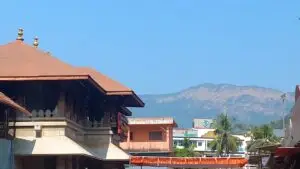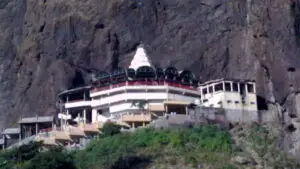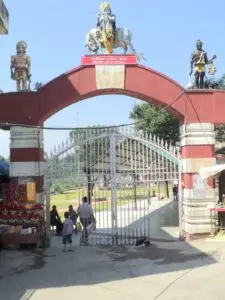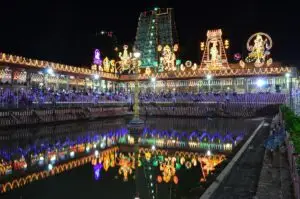
The Vindhyavasini Devi Temple at Vindhyachal, in Mirzapur district of Uttar Pradesh, is a revered Shakti Peetha and Siddha Peetha on the southern bank of the Ganga. Here the Mother Goddess is worshipped as Vindhyavasini, "she who dwells in the Vindhyas," identified with Yogamaya, the divine sister-power of Krishna, and famed for answering prayers swiftly.
For countless generations, pilgrims have climbed these ancient slopes to seek her darshan, drawn by a living faith that the Mother here dwells visibly close to her children. Where the great Vindhya mountains rise above the river plains, the Goddess chose her eternal home, and devotees say she has never left it.
What makes Vindhyachal singular among the sacred geographies of India is this closeness. The Goddess is named in scripture from the Devi tradition, from the Devi Mahatmya to the Bhagavata Purana, and her presence is woven through the deepest layers of Hindu memory. This guide walks you through her legend, the famous Trikon Parikrama linking three shrines into a sacred triangle, her worship and offerings, the festivals of Navratri and Kajali, a Devi mantra you can chant, and a practical plan for reaching Vindhyachal. May the Mother of the Vindhyas bless your reading and your journey.
Key Takeaways
- Vindhyavasini Devi Temple stands at Vindhyachal in Mirzapur district, Uttar Pradesh, on the southern bank of the Ganga, about 65-70 km from Varanasi.
- The Goddess is identified with Yogamaya, born to Nanda and Yashoda on the night of Krishna's birth, who escaped Kamsa and withdrew to the Vindhya hills.
- Vindhyachal is honoured as both a living Shakti Peetha and a powerful Siddha Peetha where prayer and sadhana are believed to bear fruit swiftly.
- The Trikon Parikrama is a sacred circuit of roughly eight kilometres linking the Vindhyavasini, Kali Khoh and Ashtabhuja temples into a holy triangle.
- Navratri in both Chaitra and Ashwin is the grandest festival here, alongside the distinctive Kajari folk-song tradition of Kajali Teej.
Who Is Maa Vindhyavasini?
Vindhyavasini is the Mother Goddess in her form as the resident deity of the Vindhya Range. Her name joins Vindhya, the mountains, with vasini, "she who dwells in." In the Shakta tradition she is not a minor regional goddess but a manifestation of the supreme Mahadevi, the ultimate reality in its totality.
Devotees approach her under several loving names. She is Yogamaya, the illusory and creative power of the Divine; Mahishasura Mardini, the slayer of the buffalo demon; and, in local affection, Kajala Devi, a name tied to the Kajari folk songs sung in her honour. Across Vindhyachal she is also simply Maa, Mother, the nearest and most intimate form of address.
A note on identification: tradition speaks of Vindhyavasini in more than one voice. Some texts and worshippers identify her with Durga and the benevolent Yogamaya; others, in the Shakta layering of the site, associate her presence with the energies of Kali and the great Goddess as a whole. These are complementary devotional understandings rather than contradictions, and a respectful pilgrim will hear all of them at Vindhyachal.
What Is the Yogamaya Legend of Vindhyavasini?
According to the Bhagavata Purana, Yogamaya was born to Nanda and Yashoda on the night of Krishna's birth and was exchanged with him to protect him from Kamsa. When the tyrant tried to kill her, she slipped from his grasp, rose into the sky as the eight-armed Durga, warned him of his doom, and withdrew to the Vindhya mountains.
The story begins not in the Vindhyas at all, but in the prison of Mathura. Kamsa had been warned by a heavenly voice that the eighth child of his sister Devaki and her husband Vasudeva would bring about his death. In terror he imprisoned them and slew each infant as it was born.
When the eighth child, Krishna, an avatar of Vishnu, was about to be born, the divine plan unfolded. On that same night, Yogamaya took birth as the daughter of the cowherd Nanda and his wife Yashoda in Gokul, as Vishnu himself had ordained. Through divine arrangement the infants were exchanged: Vasudeva carried baby Krishna across the Yamuna to Gokul for safety and brought back the newborn girl to the prison cell.
When Kamsa came to destroy this eighth child, the Goddess revealed her true nature. She slipped upward from his hands and rose into the sky as the Devi, appearing, in the words of the tradition, as the eight-armed goddess Durga fully equipped with weapons. She warned the tyrant that the one destined to kill him had already been born elsewhere, and that slaughtering helpless children would avail him nothing. Then she vanished.
Tradition holds that, having delivered her warning, Yogamaya withdrew to the Vindhya mountains and chose them as her permanent dwelling. It is from this act of choosing, vasa, to reside, that she is forever called Vindhyavasini. The shrine at Vindhyachal is honoured as the place where that promise of presence still abides.
The Second Sacred Account: The Slayer of Mahishasura
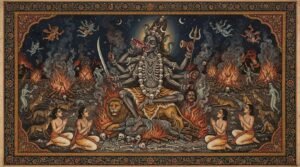
Alongside the Yogamaya narrative, an equally cherished tradition links Vindhyavasini to the victory over the buffalo demon Mahishasura. In this account the Goddess, after vanquishing the demon who could not be slain by any god or man, chose the Vindhya hills as the seat from which to bless the world, earning the titles Vindhyavasini and Mahishasura Mardini together. Both accounts converge on the same truth: the Mother triumphs over evil and remains, lovingly, near.
What Do the Scriptures Say About Vindhyavasini?
Vindhyavasini is named in the Devi Mahatmya, also called the Durga Saptashati, set within the Markandeya Purana. Her Yogamaya episode appears in the tenth canto of the Bhagavata Purana, and the Vishnu Purana also speaks of this divine power who assumes forms such as Durga, Ambika and Bhadrakali.
The Devi Mahatmya, the celebrated hymn to the Goddess, presents the Mahadevi who manifests in many forms to protect dharma. Within this text the Goddess is understood as the Ultimate Reality, and her residence in the Vindhyas belongs to the wider devotional landscape it celebrates.
Vindhyachal itself is remembered across the Puranic and epic literature. References to the Vindhya region and to the Goddess's dwelling appear in the broad stream of texts including the Mahabharata and Puranic accounts, and a later regional work, the Vindhya Mahatmya, celebrates the holiness of the site in detail. The temple is counted among the sacred Shakta seats of India, and local and pilgrimage histories describe royal patronage over the ages and an unbroken practice of worship.
A note for the careful reader: dating ancient temple origins precisely is difficult, and figures sometimes quoted for the antiquity of the shrine come from local tradition rather than firm archaeological record. What is beyond dispute is that Vindhyachal has been a major centre of Goddess worship for a very long time and remains one of the most visited Devi shrines in northern India today.
Why Is Vindhyachal Called a Shakti Peetha and Siddha Peetha?
Vindhyachal is venerated as a Shakti Peetha, one of the sacred seats of the Goddess that mark her abiding presence across the subcontinent, and as a powerful Siddha Peetha, a place where spiritual discipline, mantra practice and heartfelt prayer are believed to bear fruit with unusual speed. This reputation draws sadhakas and ordinary devotees alike.
Here, it is said, the Mother listens closely and grants the sincere wish. Because of this, Vindhyachal has long been a place of intense sadhana, especially during the nine nights of Navratri, when practitioners undertake mantra repetition, fasting and night-long worship. The atmosphere of the town during these days, with its lamps, chanting and rivers of pilgrims moving between shrines, reflects a faith that the divine feminine energy is tangibly present and responsive. To understand how such seats of the Goddess arose across Bharat, read our complete guide to the 51 Shakti Peethas and the story of Sati Devi and the Daksha Yagna.
Vindhyachal holds a further distinction that devotees treasure: it is described as the one place where the three great forms of the Goddess, the powers represented by Lakshmi, Kali and Saraswati, each have a distinct shrine within a single sacred neighbourhood. Vindhyavasini herself, Kali at Kali Khoh, and the eight-armed Goddess at Ashtabhuja together complete the spectrum of divine feminine grace. This sacred trinity gives rise to the celebrated Trikon Parikrama.
What Is the Trikon Parikrama at Vindhyachal?
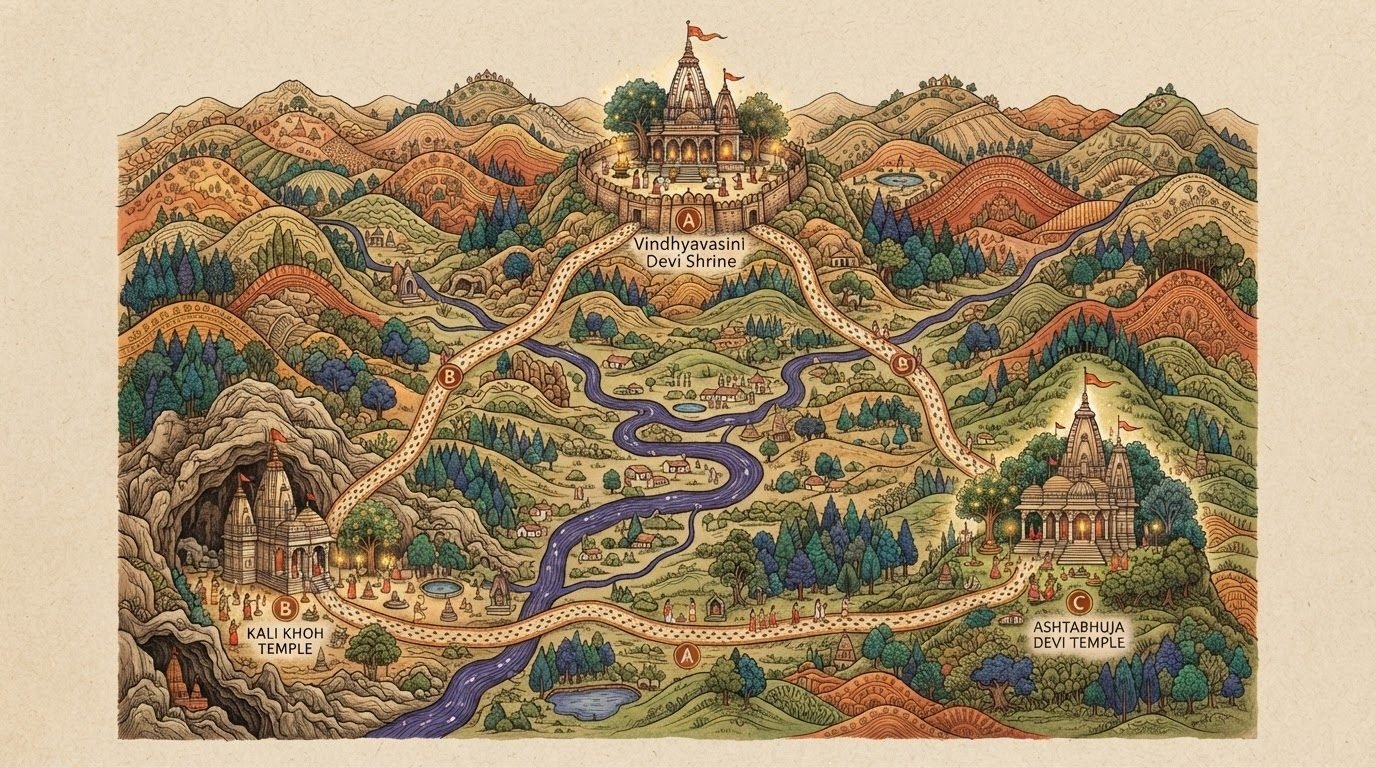
The Trikon Parikrama, also written Trikona Parikrama, is a sacred circumambulation of roughly eight kilometres that links three temples of the Goddess into a holy triangle: Maa Vindhyavasini, Kali Khoh and Ashtabhuja Devi. Completing the circuit honours the Mother in her threefold fullness as giver of prosperity, destroyer of obstacles and bestower of wisdom.
Pilgrims understand the journey as a narrative of the soul: one begins by seeking well-being and a sound foundation, then asks for the strength to overcome inner and outer obstacles, and finally attains the wisdom to use both rightly. For this reason the Trikon Parikrama is regarded as a holistic spiritual endeavour rather than three separate temple visits.
| Shrine | Aspect of the Goddess | Distance from Main Temple | What Devotees Seek |
|---|---|---|---|
| Maa Vindhyavasini Temple | Lakshmi aspect | Starting point | Prosperity, well-being, sankalpa for the circuit |
| Kali Khoh Temple | Kali (Mahakali) aspect | About 2 km | Protection, courage, removal of obstacles |
| Ashtabhuja Devi Temple | Saraswati aspect | About 3 km | Knowledge, the arts, enlightenment |
1. Maa Vindhyavasini Temple: The Beginning (Lakshmi Aspect)
The circuit traditionally begins at the main shrine of Maa Vindhyavasini in the temple town beside the Ganga. Here the central image of the Goddess, a graceful figure in dark stone draped in red and gold and crowned with finery, receives the first prayers of the parikrama. Devotees take a sankalpa, a spiritual vow to complete the circuit, and seek the Mother's blessing for prosperity and well-being before setting out. In the Trikon framework she is honoured in the aspect associated with Lakshmi, abundance and auspicious beginnings.
2. Kali Khoh Temple: The Cave of the Fierce Mother (Kali Aspect)
From the main temple the path leads to Kali Khoh, an ancient cave shrine dedicated to Mahakali, set within a natural rock formation. The cave is cool and dim, charged with a sense of raw spiritual power. Tradition associates this shrine with Kali's annihilation of the demon Raktabija, the asura whose every fallen drop of blood spawned a new demon, until the Goddess drank his blood before it could touch the earth and so destroyed him utterly. Worship here is sought for protection, courage and the removal of obstacles. The walking distance is commonly given as around two kilometres from the main temple.
3. Ashtabhuja Devi Temple: The Hilltop of Wisdom (Saraswati Aspect)
The third point of the triangle is the Ashtabhuja Devi Temple, set on a hillock and reached after a climb that rewards the pilgrim with panoramic views over Vindhyachal. The Goddess here is worshipped in her eight-armed (ashta-bhuja) form, associated with the powers of Saraswati: knowledge, the arts and enlightenment. In local tradition this hill is linked to Yogamaya's refuge after escaping Kamsa, deepening the Krishna connection of the whole circuit. The temple lies roughly three kilometres from the Vindhyavasini shrine; reaching it completes the parikrama and, symbolically, the devotee's journey from prosperity through protection to wisdom.
Smaller Shrines Along the Way
Pilgrims who walk the Pad Parikrama, the circuit on foot, pass numerous smaller but cherished shrines that enrich the journey: guardian deities such as Batuk Bhairav, several Hanuman temples that grant strength for the road, and Shiva shrines that offer rest and blessing. Pausing at these adds layers of meaning to the walk, so that every step becomes a prayer.
Should You Walk or Take a Vehicle?
The Trikon Parikrama can be undertaken on foot, which takes roughly three to four hours and is considered the more meritorious way, or by vehicle, which takes one to two hours and suits the elderly, the unwell or those short of time. Parking is available near the three principal temples. Whichever way you choose, undertake it with patience: at Vindhyachal the journey itself is the worship.
How Do You Worship Maa Vindhyavasini and What Offerings Are Made?
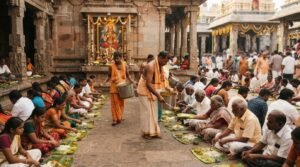
Worship at Vindhyavasini is warm, continuous and deeply participatory. Through the day the Goddess is honoured with a sequence of aartis and shringar (adornment), and pilgrims join the rhythm of lamps, bells and chanting that fills the sanctum. The most precious offering, as in all true devotion, is a sincere heart and the surrender of ego.
Devotees also bring traditional gifts that express their love for the Mother:
- Red chunari, the sacred red cloth, draped in the Goddess's honour
- Fresh flowers, especially marigolds, and garlands
- Coconut, fruits and seasonal sweets as prasad
- Sindoor (vermilion), bangles and items of shringar offered to the Devi
- Incense, camphor and the lighting of lamps (diyas)
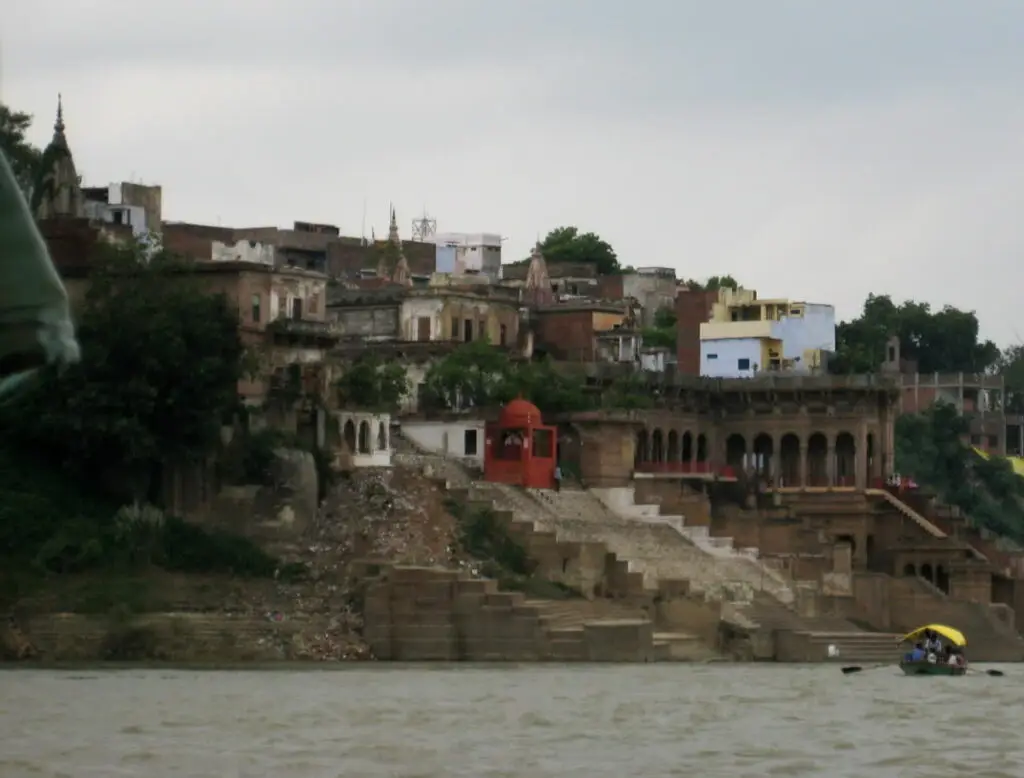
Many pilgrims combine their darshan of Vindhyavasini with a holy dip in the Ganga, which flows close beside the temple town, purifying themselves before approaching the Mother. Tuesdays and Saturdays, the new-moon (Amavasya) nights, and above all the days of Navratri are considered especially auspicious for worship.
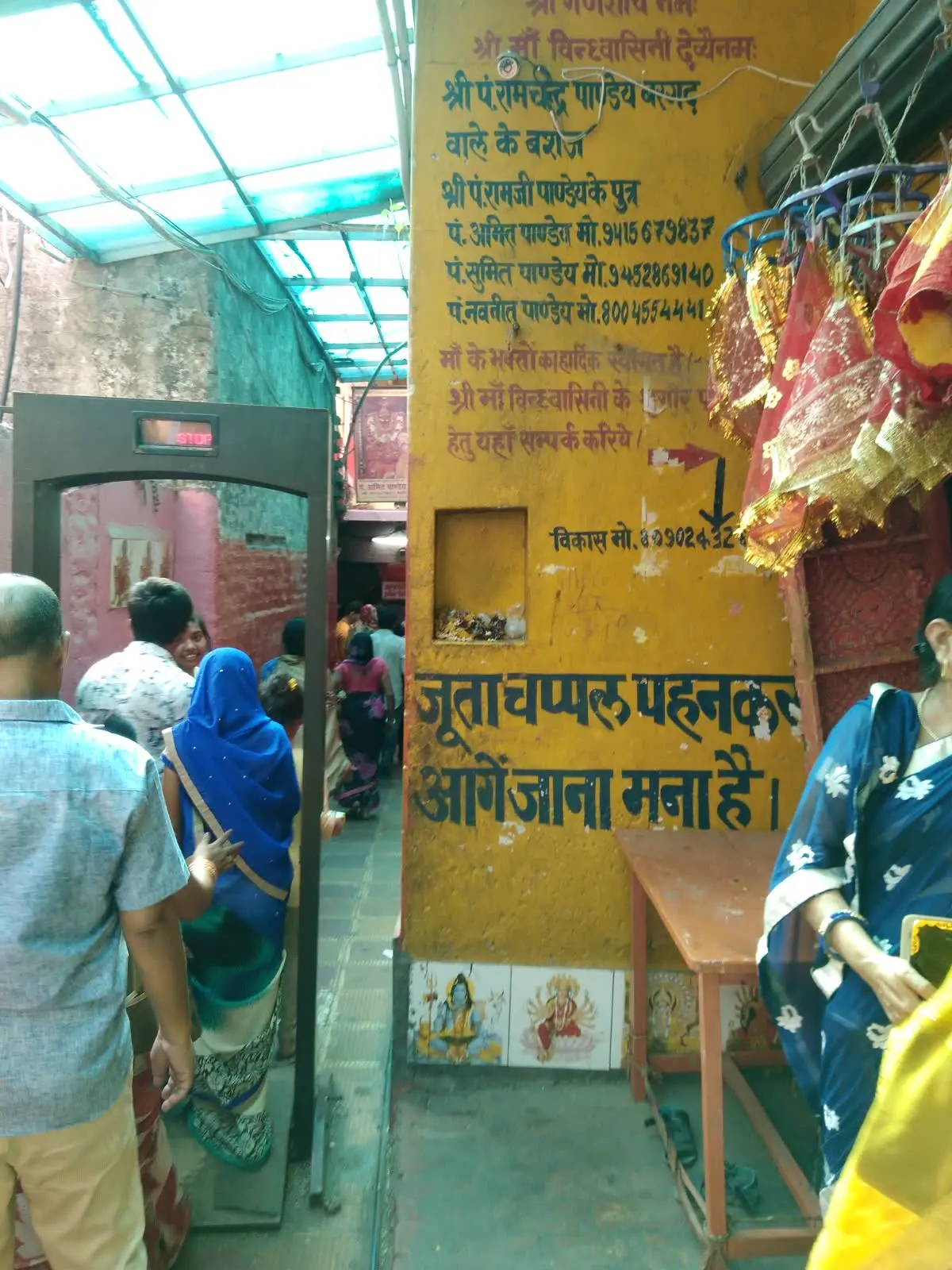
A respectful word on practice: rituals such as special pujas, havan or guided sadhana are best performed under the guidance of the temple's authorised priests. Avoid unofficial intermediaries, dress modestly, remove footwear before entering, and keep your valuables secure in the crowds. Approach the sanctum in the spirit of a child coming home to the Mother.
Which Mantra Should You Chant for Vindhyavasini?
Chanting the Goddess's name with devotion is itself a complete worship. The widely chanted Navarna Mantra, also called the Navakshari Mantra, the nine-syllable mantra of the Devi from the Durga Saptashati tradition, is dear to worshippers of the Goddess in all her forms, including Vindhyavasini. It is offered here with reverence; for formal initiation into any mantra practice, seek a qualified guru.
| Sanskrit | ॐ ऐं ह्रीं क्लीं चामुण्डायै विच्चे |
|---|---|
| Hindi | ओम् ऐं ह्रीं क्लीं चामुण्डायै विच्चे |
| Transliteration | Om Aim Hreem Kleem Chamundayai Vichche |
| Meaning | Salutations to Chamunda, the Divine Mother, invoked through the seed-sounds Aim (wisdom), Hreem (cosmic power and grace) and Kleem (fulfilment): a prayer for protection, strength and the awakening of divine consciousness. |
Many devotees also simply repeat "Jai Maa Vindhyavasini" or "Jai Mata Di" as a heartfelt salutation. Chant in a calm, clean space, ideally in the early morning or at twilight, with steady attention and love. Consistency and sincerity matter far more than quantity.
Which Festivals Are Celebrated at Vindhyachal?
Navratri, observed in both Chaitra (spring) and Ashwin (autumn), is the grandest celebration at Vindhyachal, drawing enormous crowds for nine nights of worship. The town is also famed for its Kajari folk-song tradition around Kajali Teej, and Tuesdays, Saturdays and new-moon nights carry special observances through the year.
Navratri: The Nine Nights of the Mother
Navratri is observed with full intensity during both Chaitra (around March-April) and Ashwin or Sharad (around September-October). Through these nine nights the town is transformed: decorated with lamps and flowers, alive with chanting, and thronged by enormous crowds of devotees. Pilgrims undertake the Trikon Parikrama in great numbers, and many keep night-long vigils and fasts. During major pilgrimage seasons the temple draws millions of visitors, placing it among the most attended Devi shrines in India.
Kajali Teej and the Kajari Tradition
Vindhyachal carries a distinctive folk-devotional tradition tied to Kajari, also called Kajali: the seasonal songs of the monsoon, of separation and longing, sung especially around the festival of Kajali Teej. In the month of Jyeshtha (around June, before the rains), a celebrated Kajali singing competition has long been associated with the place, and the Goddess is affectionately remembered here as Kajala Devi. This living musical heritage binds the sacred and the seasonal, the temple and the surrounding villages, in a single devotional voice.
Other Sacred Occasions
Beyond these, the new-moon nights, eclipse days and the weekly Tuesdays and Saturdays are observed with special worship. Pilgrims also flock to Vindhyachal in connection with the great gatherings of the region, including the Kumbh and Magh melas at nearby Prayagraj, often adding Vindhyavasini's darshan to their pilgrimage.
How Do You Reach Vindhyachal and Plan Your Visit?
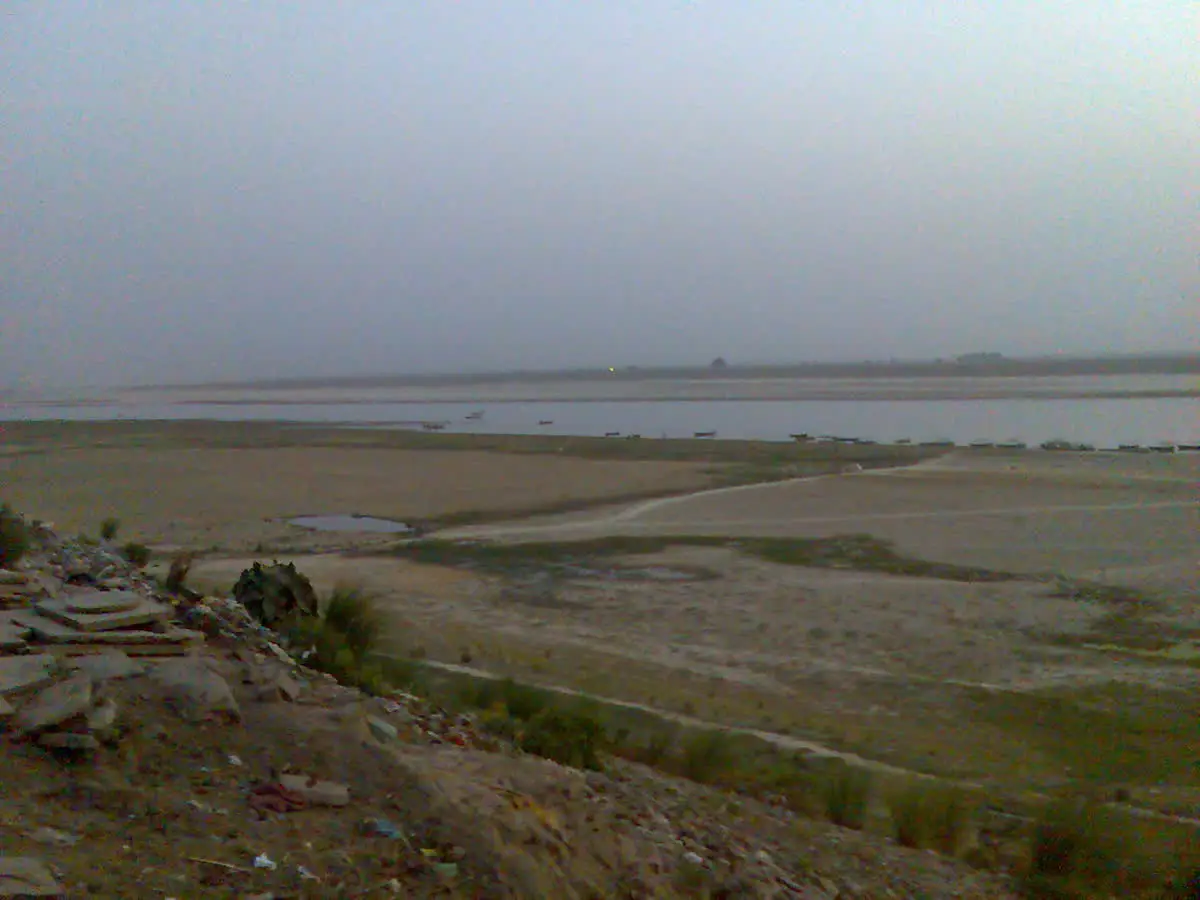
Vindhyachal lies in Mirzapur district of Uttar Pradesh, on the southern bank of the Ganga, well connected by air, rail and road. The nearest airport is Varanasi (70-75 km), the nearest station is Vindhyachal (BDL) about 1 km away, and the temple town sits close to Varanasi, making it an easy addition to a Kashi pilgrimage.
| Location | Vindhyachal, Mirzapur district, Uttar Pradesh, on the southern bank of the Ganga |
|---|---|
| Nearest airport | Lal Bahadur Shastri International Airport, Varanasi (Babatpur), approximately 70-75 km; Prayagraj airport is an alternative from the west |
| Nearest railway station | Vindhyachal (BDL), about 1 km from the temple; Mirzapur (MZP) about 8-9 km; Varanasi Junction around 65-70 km |
| By road | NH-19/NH-2 (Grand Trunk Road corridor); about 65-70 km (1.5-2 hours) from Varanasi, under 10 km from Mirzapur town |
| Timings (indicative) | Darshan through the day with short breaks for aarti and shringar in the morning, early afternoon and evening; extended during Navratri; confirm with temple administration |
| Entry | Darshan is open to all devotees; engage only authorised temple priests for special pujas |
How Do You Reach Vindhyachal by Air?
- Nearest airport: Lal Bahadur Shastri International Airport, Varanasi (Babatpur), approximately 70-75 km away.
- From the airport, hire a prepaid taxi or cab to Vindhyachal; the road journey takes roughly two hours depending on traffic.
- Prayagraj (Allahabad) airport is another option for travellers approaching from the west.
How Do You Reach Vindhyachal by Train?
- Nearest station: Vindhyachal railway station (code BDL), on the Delhi-Howrah and Mumbai-Howrah routes, about 1 km from the temple.
- Alternative railhead: Mirzapur railway station (MZP), roughly 8-9 km from the temple, with wide connectivity.
- Varanasi Junction is a major hub around 65-70 km away, well linked to Vindhyachal by road and rail.
How Do You Reach Vindhyachal by Road?
- Vindhyachal is connected via National Highway 2 (the Grand Trunk Road corridor / NH-19) and well served by state and private buses, taxis and shared cars.
- From Varanasi the drive is approximately 65-70 km (about 1.5-2 hours); from Mirzapur town it is a short hop of under 10 km.
- Ongoing development of the Vindhya Corridor around the main temple is widening the parikrama path and improving pilgrim facilities.
Suggested Visit Plan and the Trikon Parikrama Route
- Begin with a holy dip in the Ganga, then take darshan at the main Maa Vindhyavasini Temple and make your sankalpa to complete the circuit.
- Proceed to Kali Khoh Temple (about 2 km) to worship Mahakali in the cave shrine.
- Continue to the hilltop Ashtabhuja Devi Temple (about 3 km from the main temple) to complete the sacred triangle.
- Pause at the smaller wayside shrines en route if walking, and return to close the parikrama.
What Are the Temple Timings?
Darshan is generally available through the day with short breaks for aarti and shringar, commonly in the morning, the early afternoon and the evening. Several aartis are performed daily, including an early Mangala aarti before dawn and a late shayan (resting) aarti at night; timings are extended and adjusted during Navratri and major festivals. As temple schedules can change, confirm the current darshan and aarti timings with the official temple administration before your visit.
Practical Tips for a Reverent Visit
- Visit early morning or evening for cooler weather and a calmer darshan; avoid the harsh midday heat in summer.
- Wear comfortable, easily removable footwear and modest clothing suited to a place of worship.
- Carry water, especially if walking the Pad Parikrama, and pace yourself on the Ashtabhuja climb.
- Keep valuables secure and be patient in the large crowds, particularly during Navratri.
- Engage only authorised temple priests for any special puja, and be cautious of unofficial agents.
- Combine your pilgrimage with nearby Varanasi (Kashi) and Prayagraj for a fuller spiritual journey through the heart of sacred Bharat.
What Is the Spiritual Significance of Vindhyavasini?
To stand before Vindhyavasini is to encounter the Mother in her most accessible and merciful form: the Goddess who, having triumphed over evil, chose to remain among her children rather than withdraw beyond reach. Her story teaches that divine protective power is present, near and responsive to the one who calls with faith.
Her legend carries a quiet, profound teaching: even in the darkest prison of fear, grace can slip free and rise into the open sky. The Mother answers the one who calls with faith, and she dwells not in some distant heaven but in the hills above the Ganga, close to her children.
The Trikon Parikrama distils this into a map of the inner life. We seek a stable foundation of well-being; we ask for the courage to face and dissolve our obstacles; and we pray for the wisdom to hold both rightly. Lakshmi, Kali and Saraswati, prosperity, power and knowledge, are not three separate goddesses competing for our attention but the single Mother revealing the wholeness she wishes to give. To complete the circuit with devotion is to ask for nothing less than a complete and balanced life, surrendered at her feet.
Whether you come as a lifelong devotee, a curious seeker or a traveller drawn by the beauty of the Vindhyas above the Ganga, may your darshan of Maa Vindhyavasini fill you with fearlessness, gratitude and peace. Jai Maa Vindhyavasini.
Listen: Subscribe to Musinara Sounds for 432 Hz mantra chants
🕉️ Hear these sacred mantras come alive. Subscribe to Musinara Sounds on YouTube for 432 Hz Devi mantra chants, sung slowly enough to follow and repeat.
Plan Your Visit to Vindhyavasini: Timings, Tickets and Travel
The details below were checked on 3 October 2026 against the sources listed under each table. Timings and fees change on festival days, eclipses and special occasions, so confirm with the temple before you travel.
Darshan and Aarti Timings
| Information | Details |
|---|---|
| Darshan during the Navratri fair 2026 | About 20 of 24 hours open, with roughly one hour daily for shringar and another for maintenance (KTV Varanasi) |
Source: KTV Varanasi: Vindhyachal Navratri fair preparations (Hindi).
Tickets, Darshan Options and Sevas
The Mirzapur district page lists no entry fee or paid darshan scheme.
Source: District Mirzapur, NIC: Vindhyachal Dham.
Temple Rules and Dress Code
- Navratri 2026: entry into the garbhgriha (sanctum) and touching the Devi's feet will not be allowed, according to KTV Varanasi.
- Navratri 2026: life jackets are compulsory for devotees on boats at the ghats, and floating barricades are in place because of high Ganga water.
Source: KTV Varanasi: Vindhyachal Navratri fair preparations (Hindi).
How to Reach Vindhyavasini
Open Vindhyavasini in Google Maps for live directions.
| Mode | Nearest point | Distance to the temple |
|---|---|---|
| Air | Lal Bahadur Shastri International Airport, Varanasi (Babatpur) | about 72 km |
| Rail | Vindhyachal (BDL); Mirzapur (MZP) has more trains | Vindhyachal about 1 km; Mirzapur about 9 km |
| Bus | State transport buses from Prayagraj and Varanasi |
Sources: District Mirzapur, NIC: Vindhyachal Dham, Wikipedia: Vindhyachal railway station.
Approximate distances and journey times from the cities most pilgrims start from. Road times assume normal traffic; festival weekends take longer.
| From | By road | Road time | Train or flight |
|---|---|---|---|
| Varanasi | about 63 to 65 km | 1.5 to 2 hours | Trains on the Delhi to Howrah and Mumbai to Howrah lines stop at Vindhyachal; Varanasi airport is about 72 km away |
| Prayagraj | about 85 km | Vindhyachal station has trains to both Prayagraj and Varanasi | |
| Mirzapur | about 8 km | Mirzapur station is about 9 km away |
Sources: District Mirzapur, NIC: Vindhyachal Dham, Wikipedia: Vindhyachal, Wikipedia: Vindhyachal railway station.
Road access is via NH 2 (Delhi to Kolkata road). From Varanasi, turn south at Gopiganj (25 km) or Aurai (19 km) and cross the Ganga by the Shastri Bridge on SH 5.
When to Go and How Long to Allow
Crowds peak at Chaitra and Ashwin Navratri. A Kajali competition is held in Jyeshtha (June).
Sources: Wikipedia: Vindhyachal, Wikipedia: Yogamaya.
Temples and Places Near Vindhyavasini
- Ashtabhuja Devi (Mahasaraswati), hilltop shrine (about 3 to 8 km): Part of the trikon parikrama
- Kali Khoh (Mahakali cave): Part of the trikon parikrama
Sources: District Mirzapur, NIC: Tourist Places, Wikipedia: Vindhyachal, Wikipedia: Yogamaya.
Frequently Asked Questions
Where is the Vindhyavasini Devi Temple located?
The Vindhyavasini Devi Temple is at Vindhyachal in Mirzapur district, Uttar Pradesh, on the southern bank of the river Ganga, amid the Vindhya hills. It is about 8-9 km from Mirzapur town and roughly 65-70 km from Varanasi.
Who is the goddess Vindhyavasini?
Vindhyavasini means "she who dwells in the Vindhyas." She is the Mother Goddess who chose the Vindhya mountains as her abode, identified in tradition with Yogamaya, the divine power born to Yashoda, and with Durga, and revered as a form of the supreme Mahadevi.
What is the Yogamaya legend connected to Vindhyavasini?
According to the Bhagavata Purana and Devi tradition, Yogamaya was born to Nanda and Yashoda on the night Krishna was born and exchanged with him to protect him from Kamsa. When Kamsa tried to kill her, she slipped from his grasp, rose as the eight-armed Durga, warned him of his doom, and withdrew to the Vindhya hills, becoming Vindhyavasini.
What is the Trikon Parikrama at Vindhyachal?
The Trikon Parikrama is a sacred circuit, about eight kilometres in all, that links three temples of the Goddess into a holy triangle: Maa Vindhyavasini (Lakshmi aspect), Kali Khoh (Mahakali aspect) and Ashtabhuja Devi (Saraswati aspect). Completing it honours the Mother in her threefold fullness.
Is Vindhyachal a Shakti Peetha?
Yes. Vindhyachal is venerated as a Shakti Peetha and is also widely regarded as a powerful Siddha Peetha, a place where prayer and spiritual practice are believed to bear fruit swiftly. It is one of the most revered Devi shrines in northern India.
What are the Vindhyavasini temple timings and main aartis?
Darshan is generally available through the day with breaks for aarti and shringar in the morning, early afternoon and evening. Daily aartis include an early Mangala aarti before dawn and a night-time shayan (resting) aarti, with extended hours during Navratri. Confirm current timings with the official temple administration before visiting.
Which festivals are celebrated at Vindhyachal?
Navratri, in both Chaitra and Ashwin, is the grandest celebration, drawing huge crowds. Vindhyachal is also known for its Kajari (Kajali) folk-song tradition around Kajali Teej in the month of Jyeshtha, when the Goddess is honoured as Kajala Devi. Tuesdays, Saturdays and new-moon nights are also auspicious.
What offerings can I bring to Maa Vindhyavasini?
Devotees commonly offer red chunari, flowers and garlands (especially marigolds), coconut, fruits and sweets, sindoor and items of shringar, and incense and lamps. The most valued offering of all is sincere devotion and surrender.
How do I reach Vindhyachal from Varanasi?
From Varanasi (about 65-70 km), you can travel by taxi or bus along NH-19/NH-2 in roughly 1.5-2 hours, or by train to Vindhyachal station (BDL). The nearest airport is Lal Bahadur Shastri International Airport, Varanasi, about 70-75 km away.
Can I do the Trikon Parikrama by vehicle?
Yes. The Trikon Parikrama can be completed by vehicle in about one to two hours, which suits the elderly, the unwell or those short of time, with parking near the three main temples. Performing it on foot (Pad Parikrama), which takes three to four hours, is considered more meritorious.
ॐ जय माँ विंध्यवासिनी - Jai Maa Vindhyavasini
Official and Reference Sources
- Vindhyachal Dham, District Mirzapur - National Informatics Centre, Government of India
Planning a pilgrimage? All twenty Devi temple guides on this site are arranged by region, with practical circuits, in Devi Temples of India. For where each site sits in the disputed lists of 51, 52 and 108, see the Shakti Peeth list.