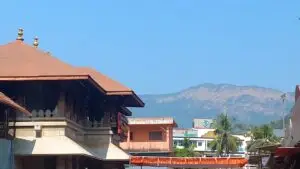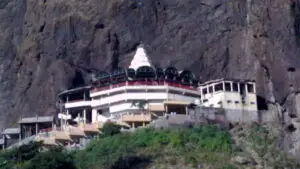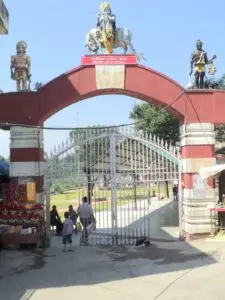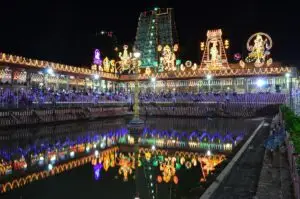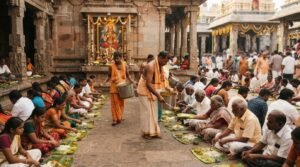
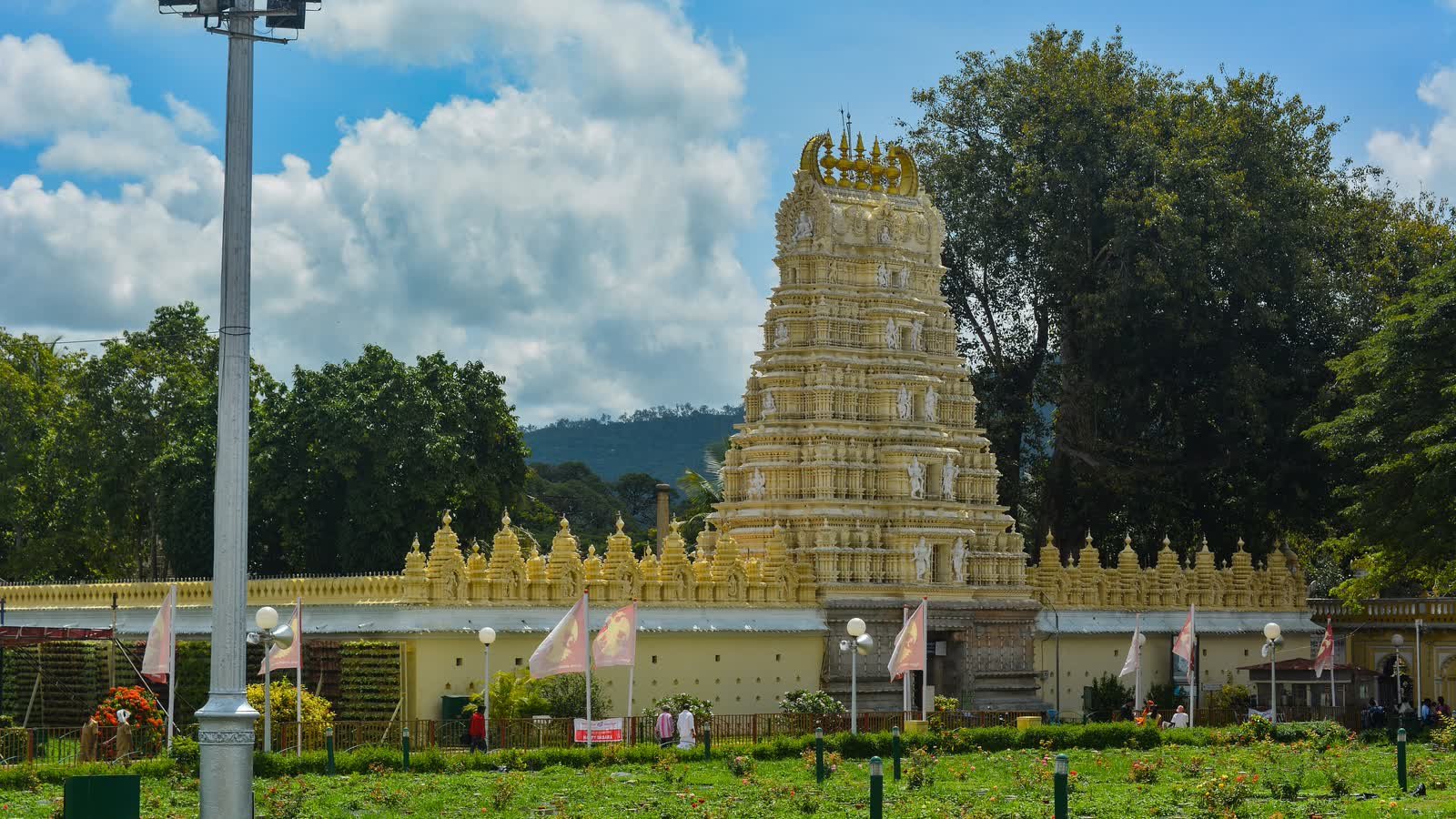
The Chamundeshwari Temple crowns Chamundi Hills, about 13 km from Mysuru in Karnataka, at an elevation of around 3,300 feet. It is dedicated to Chamundeshwari, the fierce form of the Divine Mother who slew the buffalo-demon Mahishasura here, and it is revered as one of the eighteen Maha Shakti Peethas and the Kuladevi shrine of the Wadiyar kings.
Rising more than three thousand feet above the royal city, the temple sits like a diadem of devotion where the air is cooler and the plains of Karnataka unfold in every direction. Here the fierce and compassionate Mother has been worshipped for centuries as Nada Devi, the goddess of the land itself. To her the Wadiyar kings bowed as their family deity, and to her the people of Mysuru still climb, step by sacred step, carrying flowers, fears and prayers.
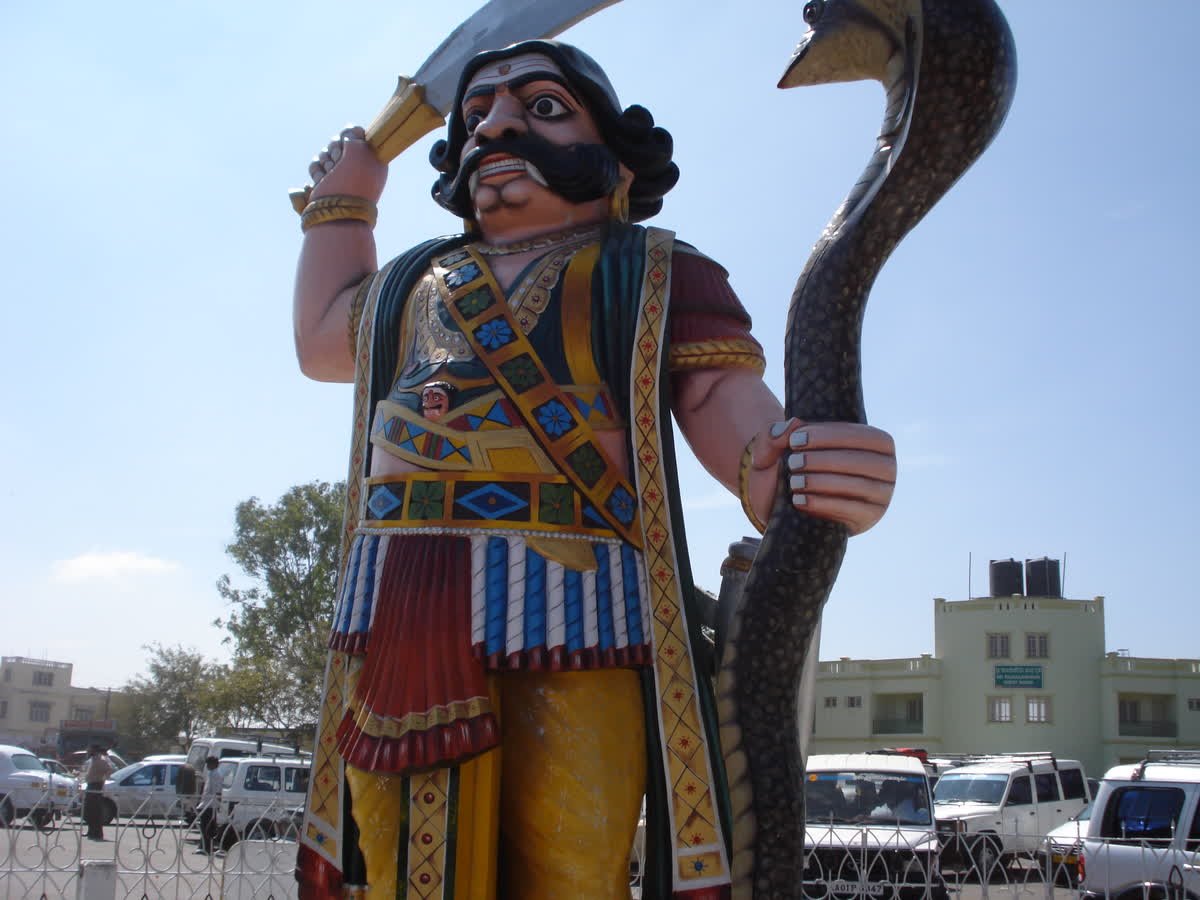
The temple is inseparable from one of the most beloved stories in the Shakta tradition: the slaying of Mahishasura. It was on this very hill, tradition holds, that the Divine Mother ended the demon's tyranny, and from his name, Mahishuru, the very name of Mysuru is said to have descended. A towering, brightly painted statue of Mahishasura now stands near the summit, sword and serpent in hand, a vivid reminder that this is the place where light overcame darkness.
This guide walks you reverently through it all: the Mahishasura legend and its scriptural roots, the temple's status as a Shakti Peetha and Krauncha Pitha, the long arc of royal patronage from the Hoysalas to the Wadiyars, the grandeur of Mysuru Dasara, the famous thousand-step climb past the great Nandi, a table of traditional Chamunda and Durga mantras, and a complete how-to-reach section so you can plan your darshan with confidence.
Key Takeaways
- Chamundeshwari Temple stands atop Chamundi Hills, about 13 km from Mysuru, Karnataka, at roughly 3,300 feet above sea level.
- Tradition holds that the Goddess slew the buffalo-demon Mahishasura on this hill, and the name Mysuru descends from Mahishuru, "the town of Mahisha."
- The temple is counted among the eighteen Maha Shakti Peethas, where the hair of Sati is said to have fallen, and is also called Krauncha Pitha.
- The thousand-step stairway (built 1659) and the great monolithic Nandi (around 1664) are credited to Dodda Devaraja Wodeyar of the Mysuru royal house.
- Chamundeshwari is the Kuladevi of the Wadiyars and the presiding deity of Mysuru Dasara, Karnataka's state festival, with its famous Jamboo Savari elephant procession.
Who Is Goddess Chamundeshwari?
Chamundeshwari, also spelled Chamundi, is a fierce, protective form of the Divine Mother: a manifestation of Durga and a regional expression of Chamunda, the goddess who destroys the demons Chanda and Munda. In her sanctum she is enshrined as a seated Ashtabhuja image bearing eight arms that hold the divine weapons gifted by the gods.
She is at once terrifying to evil and infinitely tender to her devotees. Across Karnataka she is lovingly called Nada Devi, the goddess of the nadu, the land or state. This title is not merely poetic. For the Kingdom of Mysore she functioned as a guardian of the realm, the deity in whose name the kingdom's fortunes were entrusted. To this day her festival anchors the state celebration of Mysuru Dasara, underscoring how deeply her identity is woven into Karnataka's cultural fabric.
Chamunda, Durga and Chamundeshwari
In the classical Devi tradition, names flow into one another. Durga is the supreme warrior-goddess assembled from the combined energies of the gods; Chamunda is the fierce form who slays Chanda and Munda; and Chamundeshwari is the presiding goddess of this Mysuru shrine, understood by devotees as encompassing all of these aspects. Sources vary in emphasis: some stress her identity as Durga the Mahishasura-slayer, others her identity as Chamunda, and the temple tradition reverently holds both together rather than separating them. Devotees of the fierce Mother may also wish to read our complete guide to Maa Kali, whose energies flow through the same Shakta current.
Why Is Mysuru Named After Mahishasura?
According to tradition, the buffalo-demon Mahishasura ruled this region from Chamundi Hills until the Goddess slew him. The place ruled by Mahisha came to be called Mahishuru, "the town of Mahisha," which softened through Kannada pronunciation into Mysuru and was later anglicised by the British to Mysore.
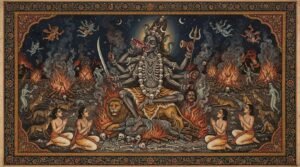
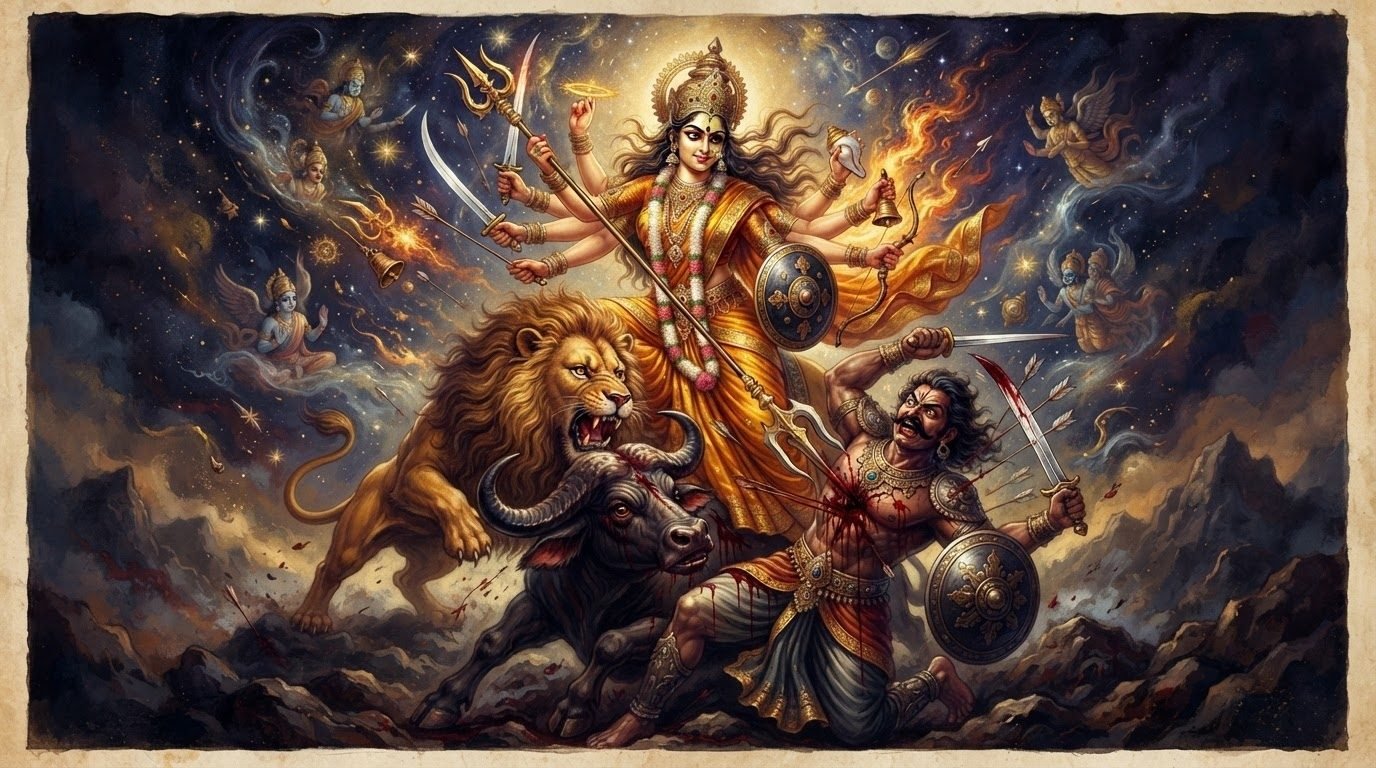
The story at the heart of this hill is one of the great narratives of the Shakta tradition. Mahishasura had won a boon that made him nearly invincible, and he grew so arrogant that he terrorised both gods and mortals. Unable to defeat him individually, the gods pooled their radiant energies, and from that combined light arose the Goddess: Durga, who would come to be revered here as Chamundeshwari, armed with a weapon from each deity and mounted upon a lion.
The battle that followed is told with vivid imagery. To escape the Goddess, Mahishasura shifted form again and again, becoming a lion, an elephant and a serpent, before finally taking the shape of a buffalo. The Mother pursued him relentlessly through every disguise and at last vanquished him, in many retellings severing his head with the Sudarshana Chakra. Light triumphed over the long night of his cruelty. To stand on Chamundi Hills, then, is to stand at the mythic birthplace of the city's very name.
A Note on Sources and Variations
The Mahishasura narrative is rooted in the Devi Mahatmya, also called the Durga Saptashati, a celebrated section of the Markandeya Purana, where the Goddess's victory over Mahishasura is recounted in detail. Local Mysuru tradition then anchors that universal story to this particular hill. Different texts and regional accounts differ in small details: the exact sequence of the demon's transformations, the weapon of the final blow, and which name of the Goddess is foregrounded. The essential meaning, however, is constant: the Divine Mother's power to dissolve evil and protect dharma.
Is Chamundeshwari Temple a Shakti Peetha?
Yes. Chamundeshwari Temple is widely revered as one of the eighteen Maha Shakti Peethas and is listed in the Ashtadasha Shakti Peetha Stotram attributed to Adi Shankaracharya. Tradition holds that the hair of Sati fell at Chamundi Hills, and the shrine is also known as Krauncha Pitha, after the region's ancient name, Krauncha Puri.
The Shakti Peethas are the network of sacred sites linked to the goddess Sati. According to the well-known mythology, when Sati immolated herself and the grieving Shiva carried her body across the cosmos, parts of her form fell to earth at various places, each becoming a seat of the Mother's living power. You can read the full narrative in our story of Sati Devi and the Daksha Yagna and explore the wider network in our guide to the 51 Shakti Peethas.
Devotees should note that the various lists of Shakti Peethas, the 51, the 18 and others, differ across traditions. Chamundeshwari's place in the eighteen Maha Shakti Peethas is the most commonly cited, and it is the basis on which pilgrims revere it as one of the most powerful Shakta seats in South India.
Companion Shrines on and around the Hill
The sacred landscape extends beyond the main sanctum. On the hill stand the Sri Mahabaleshwara temple and a Narayanaswamy temple, while at the foothill in Uttanahalli is the Jwalamukhi Sri Tripura Sundari temple. By local tradition this goddess is regarded as the sister of Chamundeshwari, who came to her aid on the battlefield, in some accounts against the blood-seeded demon Raktabija. Many pilgrims pair a visit to these shrines with their darshan of the Mother above. Those drawn to the goddess of supreme beauty can learn more in our complete guide to Maa Tripura Sundari.
Who Built the Chamundeshwari Temple?
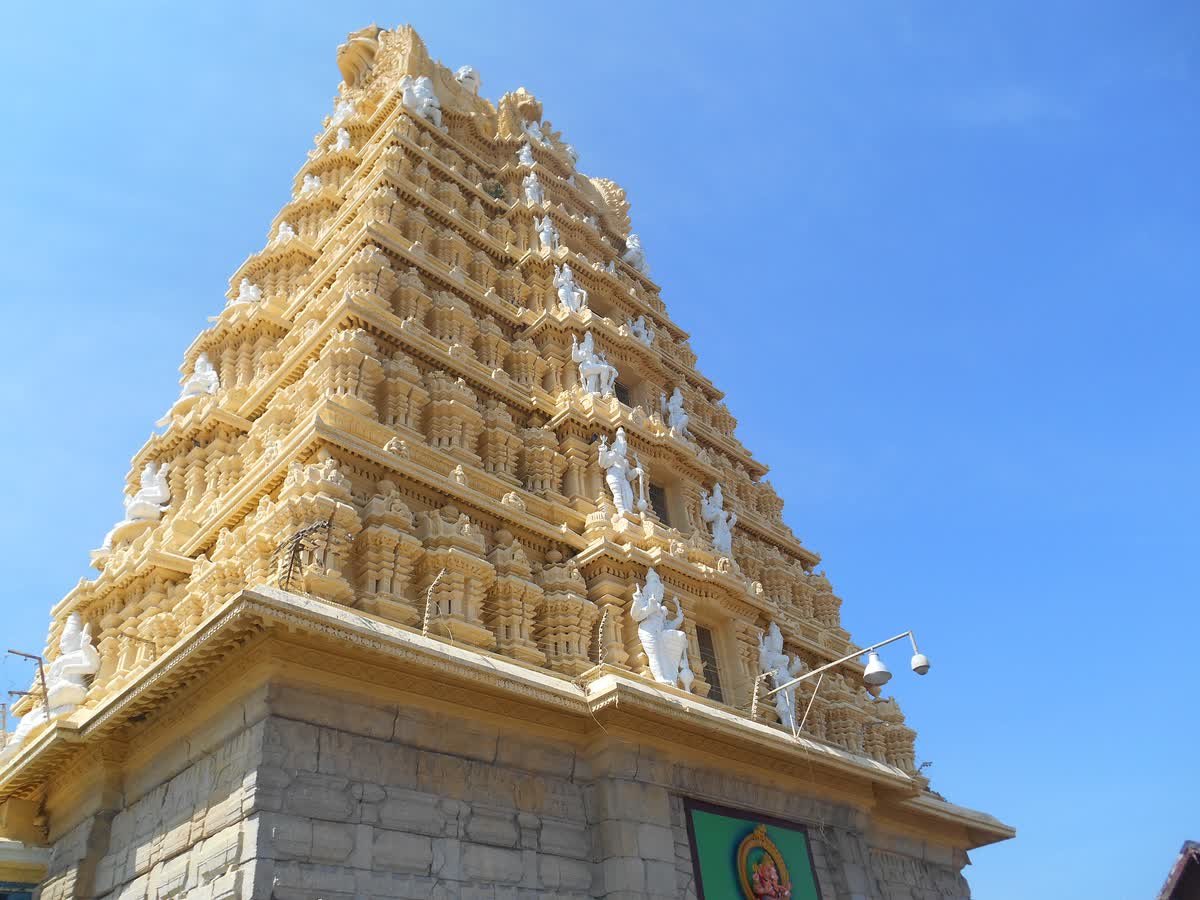
The original shrine is generally attributed to the Hoysala dynasty around the 12th century, while the towering gopuram is widely credited to rulers of the Vijayanagara Empire in later centuries. Successive dynasties added, enhanced and maintained the temple, so that what stands today is the accumulated devotion of many generations.
It is with the Wadiyars (Wodeyars) of Mysuru, however, that the temple's modern identity is most closely bound. The Wadiyar kings did not merely patronise Chamundeshwari; they revered her as their Kuladevi, the tutelary goddess of the royal house, the divine guardian under whose protection the Kingdom of Mysore flourished. Their devotion shaped the temple's calendar, its rituals, and above all its grand festival traditions.
Building the Sacred Hill
| Year | Contribution | Credited To |
|---|---|---|
| 1659 | Monumental stone staircase of around a thousand steps up the hill | Dodda Devaraja Wodeyar |
| Around 1664 | The great monolithic Nandi carved from a single block of black granite, near the upper stretch of the climb | Dodda Devaraja Wodeyar |
| 1827 | Major enhancements, including the beautifully ornamented entrance gopuram | Maharaja Krishnaraja Wodeyar III |
This continuity of royal care is why the temple feels at once ancient and alive. The Wadiyar family's connection endures in ceremony: members of the royal lineage continue to participate in key observances, and the goddess remains the symbolic heart of Mysuru's most famous celebration.
What Will You See on the Thousand-Step Climb?
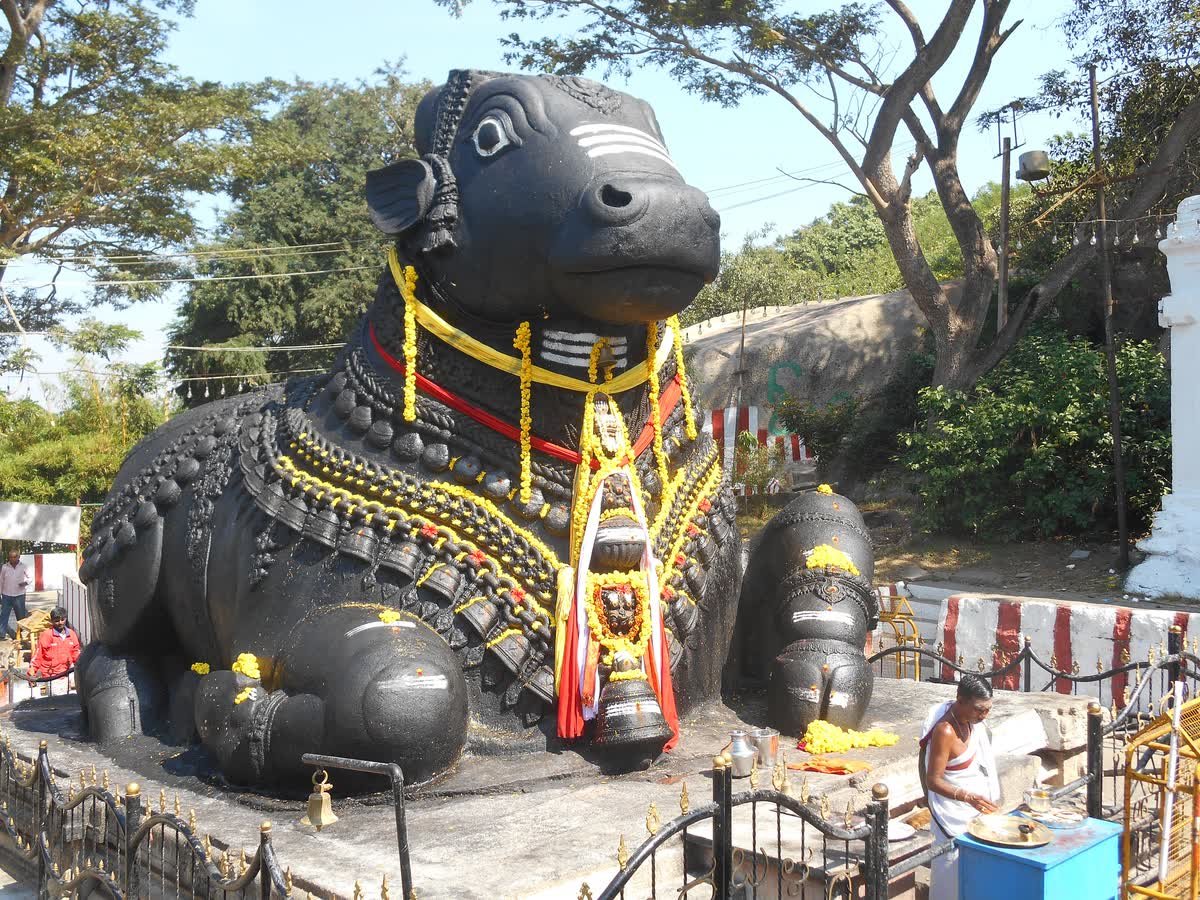
The traditional ascent is the historic stairway of roughly a thousand steps, often cited as 1,000 to 1,008 and more, cut into the hillside in 1659. Along the way pilgrims pass the celebrated monolithic Nandi about two-thirds of the way up, and near the summit the towering painted statue of Mahishasura and the Dravidian gopuram of the temple itself.
The Chamundeshwari Temple is built in the Dravidian style, its tall, intricately sculpted gopuram visible from far below and serving as a beacon for arriving pilgrims. Within the sanctum sits the eight-armed image of the Mother, the focus of daily worship, abhisheka and adornment. The temple complex hums with activity from the early-morning rituals onward, and on auspicious days the crowds swell into the lakhs.
The Thousand-Step Climb
For the traditionally minded pilgrim, the proper approach is on foot. The climb is itself an act of devotion: many ascend barefoot, pausing to rest, chant and take darshan of shrines along the way. Allow a comfortable amount of time, carry water, and go early to beat the heat. Those who prefer not to climb can reach the summit by the well-maintained road.
The Great Nandi and the Mahishasura Statue
About two-thirds of the way up the steps stands the celebrated monolithic Nandi, Shiva's bull mount, carved from a single piece of black granite and traditionally measured at roughly 4.9 metres tall and 7.6 metres long, glistening with oil and garlanded by devotees. Near the summit rises the other great landmark of the hill: the towering, vividly painted statue of Mahishasura, depicted holding a cobra in one hand and a sword in the other. Far from celebrating the demon, the statue marks the place of his defeat and frames the entire pilgrimage within the legend that gives the hill, and the city, its name.
Which Mantras Are Chanted for Chamundeshwari and Durga?
The following table presents traditional mantras associated with the fierce protective Mother: the Chamunda (Navarna) mantra and classical Durga verses, together with Devanagari, transliteration and a plain-language meaning. These are widely chanted forms drawn from the broader Shakta and Durga tradition rather than mantras unique to this temple; pronunciation and usage are best learned from a qualified teacher or guru.
| Mantra | Sanskrit (Devanagari) | Transliteration | Meaning |
|---|---|---|---|
| Chamunda / Navarna Mantra | ॐ ऐं ह्रीं क्लीं चामुण्डायै विच्चे | Om Aim Hreem Kleem Chamundayai Vichche | Salutations to Goddess Chamunda, invoked through the seed-sounds of wisdom (Aim), divine power (Hreem) and grace (Kleem); the celebrated nine-syllabled mantra of the Devi. |
| Chamundeshwari Namaskara | ॐ श्री चामुण्डेश्वर्यै नमः | Om Sri Chamundeshwaryai Namah | I bow with reverence to Sri Chamundeshwari, the auspicious presiding Mother of Chamundi Hills. |
| Durga Invocation (traditional shloka) | या देवी सर्वभूतेषु शक्तिरूपेण संस्थिता | Ya Devi Sarva-Bhuteshu Shakti-Rupena Samsthita | To that Goddess who abides in all beings in the form of power, salutations again and again (a beloved verse from the Devi Mahatmya). |
| Mahishasura Mardini epithet | ॐ महिषासुरमर्दिन्यै नमः | Om Mahishasura-Mardinyai Namah | Salutations to the Slayer of the demon Mahishasura, the Mother who destroys evil and restores dharma. |
Please note: spellings and transliterations of Sanskrit mantras vary across regions and lineages. The verses above are offered for devotional understanding; they are not presented as the exclusive or "official" temple mantras, and certain practices traditionally call for initiation (diksha) from a guru.
What Is the Connection Between Chamundeshwari and Mysuru Dasara?
Goddess Chamundeshwari is the presiding deity of Mysuru Dasara, recognised as the state festival of Karnataka and called Nada Habba, the festival of the land. During Navaratri the temple idol is adorned in nine distinct forms evoking the Navadurgas, and on Vijayadashami her idol rides through Mysuru in the famous Jamboo Savari elephant procession.
If there is one season when Chamundi Hills and the city below blaze with devotion, it is Navaratri. Dasara celebrates the Mother's victory over evil and the triumph of good, and it draws visitors from across the country and the world.
Jamboo Savari: The Royal Elephant Procession
The crowning event of Mysuru Dasara is the Jamboo Savari (Jumbo Savari) on Vijayadashami, the tenth day. A magnificently caparisoned lead elephant carries a golden howdah bearing the idol of Goddess Chamundeshwari through the streets of Mysuru in a grand procession of decorated elephants, horses, music and folk performers. It is one of India's most spectacular living royal traditions, and it directly honours the goddess of the hill.
Other Sacred Observances
- Ashada Shukravara: the Fridays of the month of Ashadha are considered especially auspicious, when lakhs of devotees throng the temple for the Mother's blessings.
- Chamundi Jayanti: observed in connection with the consecration of the goddess's utsava (festival) idol; the deity is traditionally taken in a golden palanquin around the temple.
- Ammanavara Vardhanthi: a commemorative observance honoured at the temple as part of its annual cycle.
During Navaratri, on the day dedicated to Kalaratri, priceless jewels historically donated by the Maharajas are brought from the district treasury to adorn the idol, a vivid expression of the royal house's enduring bond with its Kuladevi. If you can time your pilgrimage with Dasara, you will witness Karnataka's spiritual heart at its most resplendent; if you prefer quiet darshan, the off-season weekday mornings are far more serene.
How Do You Reach Chamundeshwari Temple?
Open Chamundeshwari Temple in Google Maps for live directions from where you are.
Chamundeshwari Temple sits atop Chamundi Hills, roughly 13 km from the heart of Mysuru. The nearest airport is Mysuru (Mandakalli), the main gateway is Bengaluru International Airport about 180 km away, and Mysuru Junction railway station lies about 13 km from the temple. From the city you ascend either by the summit road or on foot up the historic steps.
| Location | Chamundi Hills, about 13 km from Mysuru city, Karnataka, at around 3,300 feet elevation |
|---|---|
| Nearest airport | Mysuru (Mandakalli) Airport (MYQ), roughly 20 km, limited domestic flights; Kempegowda International Airport, Bengaluru (BLR), about 180 km, is the main gateway |
| Nearest railway station | Mysuru Junction, about 13 km from the temple, with frequent trains from Bengaluru and across India |
| By road | Bengaluru-Mysuru highway (about 150 km); KSRTC and private buses to Mysuru; motorable road to the summit with parking |
| Timings (indicative) | Morning, afternoon and evening sessions, broadly 7:30 a.m.-2:00 p.m., 3:30 p.m.-6:00 p.m. and 7:30 p.m.-9:00 p.m.; confirm before visiting |
| Entry | Darshan open to all; special and VIP darshan and online ticketing are managed by the temple authority |
By Air
- Nearest airport: Mysuru (Mandakalli) Airport, IATA code MYQ, south of the city and roughly 20 km from the temple, with limited domestic connectivity.
- Main gateway airport: Kempegowda International Airport, Bengaluru (BLR), about 180 km away, offering extensive domestic and international flights; from there, reach Mysuru by taxi, bus or train, then proceed to the hill.
- From either airport, prepaid taxis and app-based cabs are readily available to Mysuru and onward to Chamundi Hills.
By Train
- Mysuru Junction (Mysore Railway Station) is the nearest railhead, about 13 km from the temple, with frequent trains from Bengaluru and connections across India.
- From the station, hire an auto-rickshaw, taxi or cab to the foot of Chamundi Hills or directly to the summit by road.
By Road
- Mysuru is linked to Bengaluru (about 150 km) by the well-developed Bengaluru-Mysuru highway; the drive is popular and scenic.
- KSRTC and private buses run regularly to Mysuru from Bengaluru and other Karnataka cities; city buses and taxis then serve Chamundi Hills.
- A motorable road climbs the hill all the way to the temple, ideal for families, elders and those who prefer not to take the steps; parking is available near the summit.
Should You Take the Steps or the Road?
Pilgrims have two classic ways up. The thousand-step stairway (built 1659) is the traditional, merit-bearing ascent, best attempted early in the morning, ideally barefoot for the devout, with frequent rests and water. The summit road is the easier, all-weather option, comfortable for any age and convenient when carrying offerings or travelling with children and elders. Many visitors climb up by steps for the experience and return by road, or vice versa.
What Are the Darshan Timings?
Temple timings are set by the temple administration and can change on festival days, so always confirm current hours before you travel. As commonly published, darshan is offered in three daily sessions, with abhisheka in the early morning and evening, and free prasada meals provided to devotees around midday.
| Session | Indicative Hours |
|---|---|
| Morning darshan | Around 7:30 a.m. to 2:00 p.m. |
| Afternoon darshan | Around 3:30 p.m. to 6:00 p.m. |
| Evening darshan | Around 7:30 p.m. to 9:00 p.m. |
| Abhisheka | Early morning and evening |
| Prasada meals | Around midday, free for devotees |
Practical Tips for Your Visit
- Dress modestly and respectfully, as is appropriate for a sacred Shakti shrine.
- Special and VIP darshan arrangements and online ticketing are managed by the temple authority; check the official channels for current options and fees.
- Weekends, Ashadha Fridays, Navaratri and Dasara draw very large crowds; plan extra time, or choose a weekday morning for a calmer visit.
- Combine your darshan with the giant Nandi, the Mahishasura statue, the viewpoints over Mysuru, and the nearby Mahabaleshwara and Tripura Sundari shrines.
- Carry water, sun protection and small change for offerings; respect photography rules inside the sanctum as posted.
What Does Chamundeshwari Mean for Pilgrims Today?
For devotees, Chamundeshwari is far more than a regional deity or a historical landmark. As Nada Devi she is the protectress of the land; as the slayer of Mahishasura she is the power that destroys the inner demons of ego, fear and ignorance as surely as she ended the demon's outer tyranny. To climb her hill and stand before her eight-armed form is to ask the Mother to cut away whatever binds the heart.
Her worship belongs to the great Shakta current of Hinduism, in which the Divine Feminine is honoured as the active, creative power of the universe. The pairing of the fierce slayer with the loving Kuladevi of kings reminds pilgrims that the same energy which destroys evil also nurtures and protects those who surrender to her. This is the quiet teaching beneath the grandeur of Dasara and the spectacle of the elephant procession.
Whether you come during the blaze of Navaratri or on an ordinary misty morning, a visit to Chamundeshwari Temple is an encounter with living devotion: a tradition kept alive across nearly a thousand years of kings, craftsmen, priests and ordinary pilgrims who have all climbed the same hill to seek the same Mother. Plan your pilgrimage, climb the sacred steps, behold the Mother who slew Mahishasura, and let the goddess of the land bless your journey.
Listen: Subscribe to Musinara Sounds for 432 Hz mantra chants
🕉️ Hear these sacred mantras come alive. Subscribe to Musinara Sounds on YouTube for 432 Hz Devi mantra chants, sung slowly enough to follow and repeat.
Plan Your Visit to Chamundeshwari: Timings, Tickets and Travel
The details below were checked on 3 October 2026 against the Sri Chamundeshwari Temple / Development Authority and the other sources listed under each table. Timings and fees change on festival days, eclipses and special occasions, so confirm with the temple before you travel.
The Karnataka Devi temple circuit links Chamundeshwari, Horanadu, Sringeri, Kollur and Kateel in a five-day route by road. For what happens here during Navratri 2026 (11 to 19 October), see Navratri 2026 at major Devi temples.
Darshan and Aarti Timings
| Information | Details |
|---|---|
| Darshan and pooja (daily) | 7:30 am to 2:00 pm, 3:30 pm to 6:00 pm and 7:30 pm to 9:00 pm |
| Abhisheka | 6:00 am to 7:30 am and 6:00 pm to 7:30 pm; on Fridays 5:00 am to 6:30 am |
| Dasoha (free meals) | 7:30 am to 10:00 am, 12:00 noon to 3:30 pm and 7:30 pm to 9:00 pm |
| Prasadam with abhishekam tickets | 7:30 am to 10:30 am and 7:30 pm to 9:00 pm |
| Usual time for darshan | 30 minutes to 1 hour; it can take 2 to 3 hours on festival days |
Sources: Sri Chamundeshwari Temple / Development Authority: Sri Chamundeshwari Temple ..., Sri Chamundeshwari Temple: E-Seva Booking page, Trawell: Chamundi Hill Temple, Mysore.
Tickets, Darshan Options and Sevas
| Option | Price | Notes |
|---|---|---|
| Saree seva, Chandika Homa and Mritunjaya Homa | Shown on the e-seva page | These sevas can be booked on the temple e-seva page. Saree seva needs the original bill receipt. Take a printout of an online booking to the temple. |
General darshan is free. Dasoha (free meals) is served three times a day. In the 2026 Ashada season, more than 8.45 lakh devotees took free darshan. Bookings are handled on chamundeshwaritemple.in. Sevas, rooms and tickets can also be booked through the Karnataka HRCE portal (itms.kar.nic.in/hrcehome), which is linked from the temple website. Musinara is not connected with the temple and does not take bookings.
Sources: Sri Chamundeshwari Temple: E-Seva Booking page, Sri Chamundeshwari Temple / Development Authority: Sri Chamundeshwari Temple ..., Star of Mysore: 2026 Ashada season atop Chamundi Hill: 8.61 lakh visit Hill T....
Temple Rules and Dress Code
- Plastic carry bags are not allowed; the temple is a No Plastic Zone.
- Footwear is not permitted during darshan.
Sources: Sri Chamundeshwari Temple / Development Authority: Sri Chamundeshwari Temple ..., Sri Chamundeshwari Temple: E-Seva Booking page, Star of Mysore: KSRTC plans large-scale transport operation.
How to Reach Chamundeshwari
| Mode | Nearest point | Distance to the temple |
|---|---|---|
| Air | Mysuru Airport | about 12 from Mysuru Palace |
| Rail | Mysuru Junction | about 13 km |
| Bus | Mysuru City Bus Stand (KSRTC) | about 13 km |
Sources: Karnataka Tourism: Mysuru Palace (How to reach), Trawell: Chamundi Hill Temple, Mysore, Sri Chamundeshwari Temple / Development Authority: Sri Chamundeshwari Temple ..., Wikipedia: Chamundeshwari Temple.
Approximate distances and journey times from the cities most pilgrims start from. Road times assume normal traffic; festival weekends take longer.
| From | By road | Road time | Train or flight |
|---|---|---|---|
| Mysuru | about 13 km | Mysuru Junction is about 13 km from the temple | |
| Bengaluru | about 145 km to Mysuru city | 2.5 to 3 hours to Mysuru, depending on traffic |
Sources: Sri Chamundeshwari Temple / Development Authority: Sri Chamundeshwari Temple ..., Wikipedia: Chamundeshwari Temple, karnataka.com: Bengaluru-Mysuru Expressway, India TV News: Bengaluru to Mysore distance, travel time and scenic stops.
KSRTC buses run from Mysuru city bus stand to the hill about every 20 minutes. A motorable road goes to the top, and walkers can climb a flight of about 1,000 steps. Traffic arrangements on the hill change on busy days, so check locally before driving up.
When to Go and How Long to Allow
Dawn and dusk are good times to visit. September to October (Dasara) is peak season, and Fridays in Ashada (July to August) are very crowded. Darshan takes 30 minutes to 1 hour on normal days. Allow more time on festival days.
Sources: Star of Mysore: 2026 Ashada season atop Chamundi Hill: 8.61 lakh visit Hill T..., Trawell: Chamundi Hill Temple, Mysore.
Prasadam, Annadanam and Where to Stay
Dasoha (free meals) is served three times a day at the times listed above. Prasadam is given with abhishekam tickets in the morning and evening windows. Rooms can be booked through the Karnataka HRCE portal linked from the temple website.
Sources: Sri Chamundeshwari Temple / Development Authority: Sri Chamundeshwari Temple ..., Sri Chamundeshwari Temple: E-Seva Booking page.
Temples and Places Near Chamundeshwari
- Mysore Zoo (about 8 km): In Mysuru city, about 8 km from the hill
Source: Trawell: Chamundi Hill Temple, Mysore.
Frequently Asked Questions
Where is the Chamundeshwari Temple located?
The Chamundeshwari Temple stands atop Chamundi Hills, about 13 km from the city of Mysuru in Karnataka, at an elevation of around 3,300 feet above sea level. It is one of the most visited pilgrimage sites in South India.
Why is Mysuru named after Mahishasura?
According to tradition, the buffalo-demon Mahishasura ruled the region from Chamundi Hills until the Goddess slew him. The place ruled by Mahisha came to be called Mahishuru, which evolved through Kannada pronunciation into Mysuru and was later anglicised by the British to Mysore.
Is Chamundeshwari Temple a Shakti Peetha?
Yes. It is widely revered as one of the eighteen Maha Shakti Peethas and is listed in the Ashtadasha Shakti Peetha Stotram attributed to Adi Shankaracharya. Tradition holds that the hair of Sati fell here. It is also called Krauncha Pitha after the region's old name, Krauncha Puri. Note that the various lists of Shakti Peethas differ across traditions.
Who built the Chamundeshwari Temple and the thousand steps?
The original shrine is generally attributed to the Hoysalas (around the 12th century), with the gopuram credited to the Vijayanagara era. The stairway of about a thousand steps was built in 1659 and the great Nandi around 1664, both traditionally credited to Dodda Devaraja Wodeyar, while Krishnaraja Wodeyar III made major enhancements, including the entrance gopuram, in 1827.
How many steps lead to the Chamundeshwari Temple?
The historic stone stairway has roughly a thousand steps (commonly cited as 1,000 to 1,008 and sometimes more) cut into the hillside in 1659. Many devotees climb barefoot as an act of devotion, while others reach the summit by the motorable road.
What are the Chamundeshwari Temple darshan timings?
Timings are set by the temple administration and may change on festival days. As commonly published, darshan is offered in morning, afternoon and evening sessions (broadly around 7:30 a.m.-2:00 p.m., 3:30 p.m.-6:00 p.m., and 7:30 p.m.-9:00 p.m.), with early-morning and evening abhisheka. Always confirm current hours before visiting.
What is the connection between Chamundeshwari and Mysuru Dasara?
Goddess Chamundeshwari is the Kuladevi of the Wadiyar royal house and the presiding deity honoured during Mysuru Dasara, Karnataka's state festival (Nada Habba). The famous Jamboo Savari procession on Vijayadashami carries her idol in a golden howdah atop a caparisoned elephant through the city.
What is the Mahishasura statue on Chamundi Hills?
It is a large, vividly painted statue of the buffalo-demon Mahishasura near the summit, shown holding a cobra in one hand and a sword in the other. It marks the place of his defeat by the Goddess and frames the pilgrimage within the legend that gives the hill and the city their names.
What is the best time to visit Chamundeshwari Temple?
Navaratri and Dasara (usually September-October) are the most spectacular but also the most crowded times. For a calmer darshan, a weekday morning outside festival season is ideal. The hilltop is cooler and especially pleasant in the early hours.
Can I reach the temple without climbing the steps?
Yes. A well-maintained road climbs all the way to the summit, suitable for families, elders and anyone who prefers not to take the stairs. Buses, taxis and autos serve the hill, and parking is available near the temple. Many pilgrims climb up by steps and return by road, or vice versa.
ಮನೆಯಲ್ಲಿ ನಡೆಯುವ ಕರ್ನಾಟಕದ ಪ್ರಮುಖ ವ್ರತಕ್ಕಾಗಿ - ವರಮಹಾಲಕ್ಷ್ಮಿ ಹಬ್ಬ.
Official and Reference Sources
- Chamundeshwari Temple, official - Shri Chamundeshwari Development Authority, Government of Karnataka
Planning a pilgrimage? All twenty Devi temple guides on this site are arranged by region, with practical circuits, in Devi Temples of India. For where each site sits in the disputed lists of 51, 52 and 108, see the Shakti Peeth list.