There is a particular tenderness in the idea of a goddess whose entire divinity is bound up with feeding the hungry. Among the many forms the Mother takes across Hindu tradition - fierce and sword-bearing, serene and lotus-seated, terrible and garlanded with skulls - Annapurna stands apart for the sheer intimacy of her gift. She does not merely bless the harvest from a distance; she stands at the hearth itself, ladle in hand, ensuring that no one who comes to her door leaves without a full plate.
This guide traces Annapurna's identity as a form of Parvati, the extraordinary legend in which even Shiva, the great ascetic, is said to have begged alms at her door in Kashi, her iconography of the jewelled bowl and ladle, the Annapurna Stotram composed by Adi Shankaracharya, her mantra with full meaning, and the practical worship - kitchen rituals, Annapurna Jayanti, and the great temples where her presence is felt most strongly, from Varanasi to Karnataka to the heart of Indore.
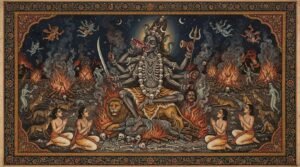
Annapurna's story sits within the broader understanding of the Devi as Kali, Durga, and Parvati - one Shakti appearing in countless forms suited to the need of the moment. Where other forms of the Goddess grant courage, protection, or liberation, Annapurna grants something so basic that it is easy to overlook how sacred it truly is: enough to eat, every single day.
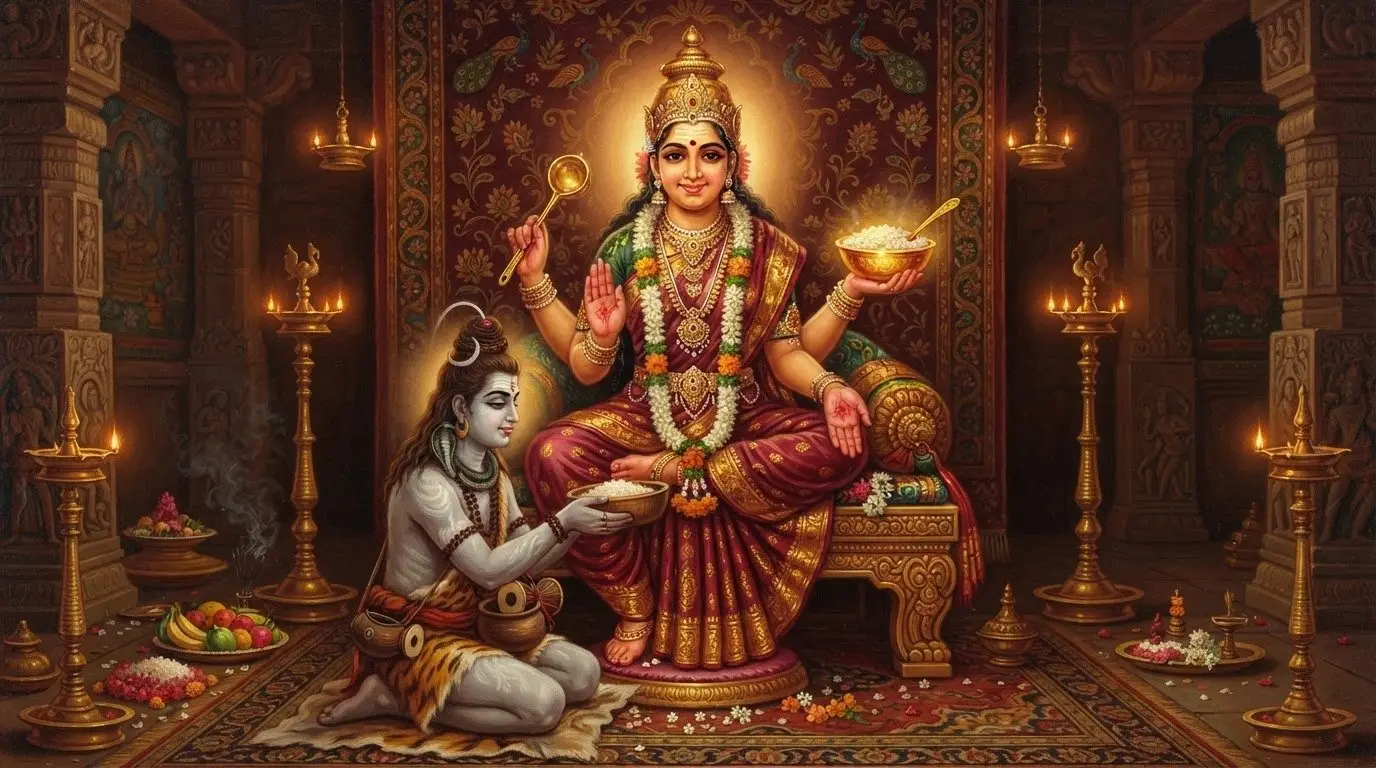
Who Is Goddess Annapurna?
Annapurna - from anna, food or grain, and purna, complete or full - is worshipped as the goddess of nourishment, the one who ensures that the granaries of the world, and the stomachs of its people, are never empty. She is understood in mainstream Shakta and Shaiva tradition as a form of Parvati, the consort of Shiva, worshipped specifically in her aspect as provider and sustainer rather than as warrior or ascetic.
Her worship carries a particular kind of universality. While many forms of the Goddess are approached for specific, sometimes dramatic requests - victory over enemies, release from bondage, the destruction of a particular obstacle - Annapurna is invoked for something every living being needs continuously and without exception. This has made her one of the most quietly beloved figures in the Hindu devotional landscape: a household that lights a lamp before her image each morning is not asking for a miracle so much as giving thanks for, and gently ensuring the continuance of, an everyday grace so constant it is easy to take for granted.
She is inseparably associated with the city of Kashi (Varanasi), where her temple stands beside that of Kashi Vishwanath, and where the relationship between Shiva and Annapurna is dramatised in one of the most charming legends in the entire Shaiva-Shakta tradition.
Annapurna and the Wider Devi Tradition
Because Annapurna is understood as an aspect of Parvati rather than an independent goddess with her own separate mythology, her worship often sits alongside - rather than in place of - broader Parvati and Durga worship. She is one face of the Adi Parashakti, approached specifically in her nurturing, domestic aspect, much as a mother is approached differently depending on whether a child needs comfort, discipline, or simply dinner on the table.
The Legend: How Shiva Came to Beg at Annapurna's Door
The most celebrated Annapurna legend, told and retold across generations in Kashi and well beyond it, begins with an argument - or, in gentler tellings, a philosophical debate - between Shiva and Parvati about the nature of the material world.
Shiva, the great renunciate, is said to have declared that the entire visible world, including food itself, was maya - illusion, a veil over the true, formless reality of Brahman, and therefore ultimately without substance or importance. Parvati, playful and also deeply wise, disagreed, and to demonstrate her point, she is said to have withdrawn from the world entirely, causing all food to vanish. Without her sustaining presence as Prakriti, the material energy that gives form and nourishment to all creation, the three worlds began to starve. Even the gods, unable to perform their duties or maintain the cosmic order, suffered the pangs of hunger, since no ritual offering, no grain, no substance of any kind remained available anywhere in creation.
Shiva himself, wandering and eventually witnessing the suffering this caused even to beings who depended entirely on him, came to understand that food was not mere illusion to be dismissed but a necessary and sacred support of all existence - that spirit and matter, Purusha and Prakriti, Shiva and Shakti, cannot truly be separated, since one gives meaning and the other gives form and sustenance. Chastened and humbled, Shiva is said to have gone to Kashi, where Parvati had taken the form of Annapurna and set up a kitchen to feed the suffering multitudes who had gathered there. He came before her not as the supreme ascetic god but as a simple mendicant, holding out his begging bowl, and asked her for alms.
Delighted and moved by his humility, Annapurna filled his bowl with her own hands, feeding him just as she fed every other hungry being who came to her door. This act became the founding legend of her presence in Kashi: that even Shiva, the Lord who needs nothing, chose to receive nourishment from her hands, thereby affirming for all time that reverence for food and for the one who provides it is not opposed to renunciation, but a necessary part of it. To this day, one of the most treasured icons in the tradition shows precisely this moment - Shiva standing with his begging bowl before Annapurna, who ladles rice into it with quiet, maternal grace.
This story carries a teaching many devotees find deeply practical: it dignifies the labour of the kitchen, the discipline of feeding others, and the sanctity of the ordinary meal, placing it on the same plane as the loftiest philosophical or ascetic pursuit. It is a favourite theme for discourse during festivals connected to food, harvest, and household abundance.
Iconography: The Jewelled Bowl and the Golden Ladle
Annapurna's iconography is immediately recognisable and consistent across regional depictions, centred entirely on her act of feeding.
| Element | Description | Symbolic Meaning |
|---|---|---|
| Golden or jewelled bowl (patra) | Held in the left hand, filled with rice or grain | Inexhaustible abundance; the granary of creation that never runs dry |
| Ladle or spoon (kalchul / chamcha) | Held in the right hand, often extended in a giving gesture | The active, continuous act of nourishing and giving |
| Attire | Rich red saree, often with gold brocade | Auspiciousness, fertility, and the warmth of domestic life |
| Ornaments and crown | Elaborate gold jewellery, sometimes a crown | Her royal, cosmic stature as Parvati despite her humble, homely act |
| Seated posture | Often seated gracefully, sometimes with Shiva standing before her as a mendicant | The reversal of hierarchy in the Kashi legend - the ascetic humbled before the giver of food |
| Complexion | Traditionally depicted as fair or golden-hued in most classical images | Radiance and the purity of sustenance freely given |
Some depictions show her standing rather than seated, actively ladling food into a bowl held by a devotee or by Shiva himself, emphasising the living, continuous nature of her giving rather than a static, iconic pose. In many Kashi-region images, she is shown with a third eye and a crescent moon in her hair, underlining her identity as fully continuous with Parvati and, by extension, with Durga and the wider Shakti tradition.
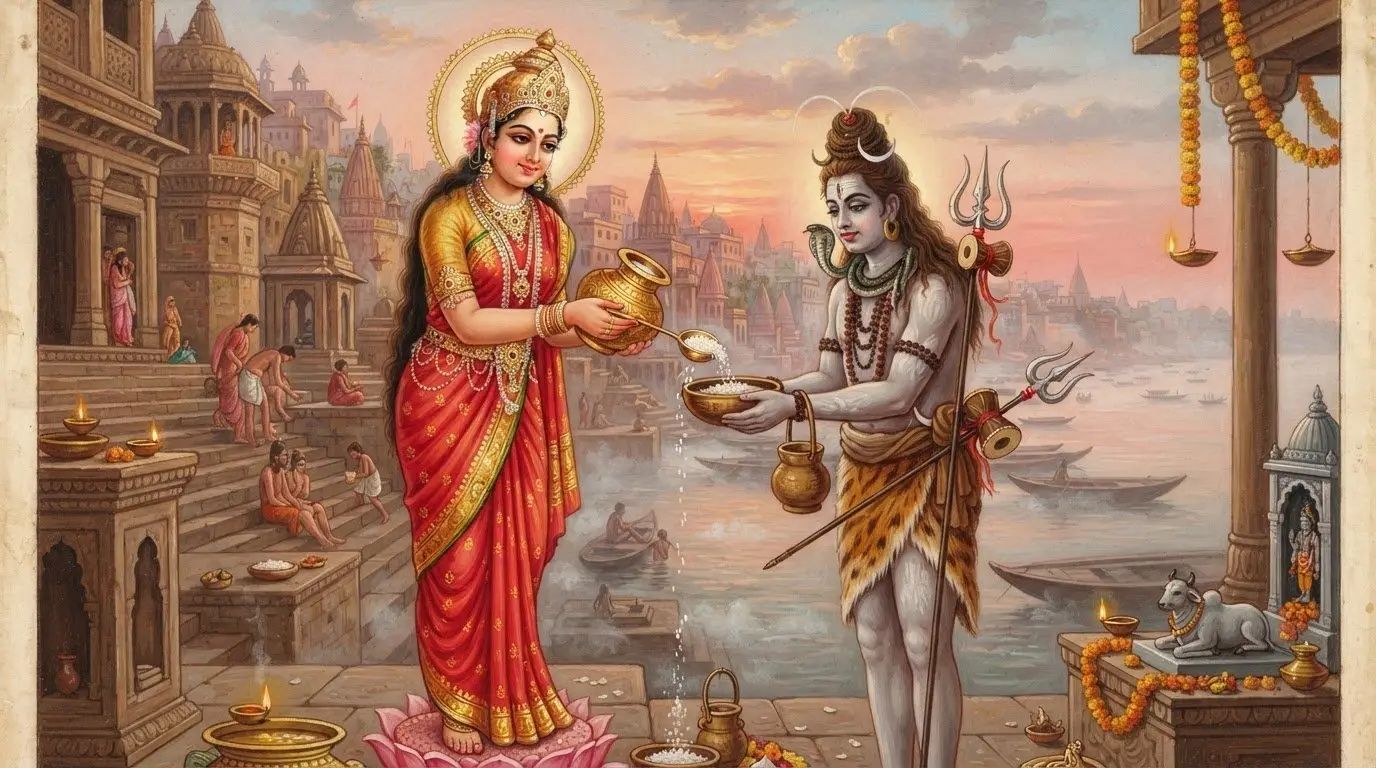
The Kashi Vishwanath-Annapurna Connection
Nowhere is Annapurna's worship more central than in Varanasi, the city classical tradition regards as Shiva's own eternal abode. The Annapurna Devi Temple stands immediately adjacent to the Kashi Vishwanath Temple, connected by a narrow lane, and the two shrines are, in the practice of most pilgrims, treated as a single devotional circuit rather than two separate visits.
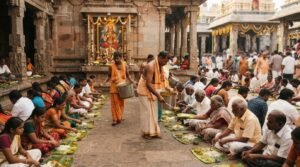
Local tradition holds that no pilgrimage to Kashi Vishwanath is complete without also seeking Annapurna's darshan, since it is she, in her role as the city's nourishing mother, who is said to feed and sustain the entire population of Kashi - residents, ascetics, and pilgrims alike - ensuring that no one in the sacred city goes hungry. This is more than pious sentiment; historically, the temple complex has run continuous annadana (food charity) traditions, feeding pilgrims and the poor as a direct, living expression of the goddess's nature.
A particularly cherished custom at the Annapurna Temple in Varanasi involves the distribution of small metal or clay replicas of her jewelled bowl, kept by devotees at home as a token of her blessing upon the household kitchen, ensuring - in the devotee's understanding - that the kitchen itself never runs short. During certain festival periods, the temple is known for a spectacular annakut (mountain of food) offering, in which enormous quantities of prepared food are stacked before the deity in a visual celebration of abundance before being distributed to devotees.
Forms and Aspects of Annapurna
Though Annapurna is best known through her singular Kashi form, the tradition recognises several related aspects and regional expressions of her nature, each emphasising a slightly different facet of nourishment and abundance.
Annapurneshwari
In South India, particularly in Karnataka, the goddess is more often addressed as Annapoorneshwari, "the Sovereign Lady of Food," a name that foregrounds her queenly authority over sustenance rather than only her maternal gentleness. The Horanadu temple, discussed further below, is dedicated to her under precisely this name, and her iconography there follows the same essential form - bowl and ladle - while incorporating regional Karnataka temple traditions and Kannada devotional hymns alongside the Sanskrit stotras.
Relationship to Other Nourishing and Domestic Forms of the Goddess
Annapurna is often considered alongside other domestic and nurturing forms of Devi, such as Gruhalakshmi (the goddess of the well-run household) and the food-and-wealth-granting aspects of Goddess Lakshmi, though the two are worshipped somewhat differently: Lakshmi is generally approached for wealth and prosperity in the broader sense, while Annapurna is invoked specifically for the assurance of food and the sanctity of the kitchen itself. Some households maintain images of both side by side, treating them as complementary rather than overlapping.
The Ashtakam and Regional Hymns
Beyond the Adi Shankara stotram, several shorter hymns known as Annapurna Ashtakams (eight-verse hymns) circulate in regional devotional literature, particularly in Kashi's own oral and printed pilgrim traditions, each elaborating her generosity in slightly different poetic language. These regional variations are a reminder that, as with much of living Devi worship, no single canonical text holds exclusive authority - devotees are encouraged to use whichever hymn resonates most, provided it is recited with sincerity and, where uncertain, checked against a knowledgeable source for accuracy.
The Annapurna Stotram and Sahasranam by Adi Shankara
Among the most treasured compositions dedicated to this goddess is the Annapurna Stotram, traditionally attributed to Adi Shankaracharya, the eighth-century philosopher-saint credited with numerous devotional hymns to the Divine Mother across her many forms. The stotram is short, lyrical, and deeply beloved, built around the refrain "Annapoorne Sadapoorne," addressing the goddess as the one who is Anna-purna - full of food - and Sada-purna - eternally, perpetually full, a completeness that never diminishes no matter how much is given away.
The stotram's central verses ask Annapurna for bhiksha (alms), echoing Shiva's own posture in the Kashi legend, and frame the devotee's spiritual practice itself as a kind of daily begging at the door of the Divine Mother - asking not only for food to sustain the body, but for the deeper nourishment of wisdom, detachment, and liberation. This layering of the literal and the spiritual is characteristic of Shankara's devotional poetry throughout his hymns to the Goddess, in which ordinary human needs become doorways to profound philosophical truths.
Alongside the stotram, an Annapurna Sahasranama - a litany of a thousand names of the goddess - is also recited by devoted practitioners, particularly in Kashi and in traditional Shakta households that maintain a daily practice of nama-japa (recitation of divine names). As with most sahasranama literature, the thousand names elaborate every conceivable aspect of the goddess's nature - her forms, her powers, her relationship to Shiva, her cosmic and domestic roles - offering the devotee a vast vocabulary through which to address her.
Selected Verses and Mantra
| Devanagari | Transliteration | Meaning |
|---|---|---|
| अन्नपूर्णे सदापूर्णे शङ्करप्राणवल्लभे। ज्ञानवैराग्यसिद्ध्यर्थं भिक्षां देहि च पार्वति॥ | Annapoorne Sadapoorne Shankara-prana-vallabhe, Jnana-vairagya-siddhyartham bhikshaam dehi cha Parvati | O Annapurna, ever full, beloved of Shankara's very breath, O Parvati, grant me alms for the attainment of wisdom and dispassion |
| ॐ ह्रीं श्री अन्नपूर्णायै नमः | Om Hreem Shreem Annapoornayai Namah | Salutations to Goddess Annapurna, invoking her auspicious, abundant grace through the beeja sounds Hreem and Shreem |
| माता च पार्वती देवी पिता देवो महेश्वरः। बान्धवाः शिवभक्ताश्च स्वदेशो भुवनत्रयम्॥ | Mata cha Parvati Devi pita Devo Maheshwarah, Bandhavah Shiva-bhaktash-cha swadesho bhuvana-trayam | My mother is the Goddess Parvati, my father is Lord Maheshwara; devotees of Shiva are my kin, and the three worlds are my homeland - a verse of surrender often recited alongside Annapurna worship |
The mantra "Om Hreem Shreem Annapoornayai Namah" is the most commonly used for personal japa, whether recited during kitchen worship, before a meal, or as part of a longer daily sadhana. As with any Sanskrit mantra carrying beeja syllables - comparable in structure to the beej mantras of the goddess used throughout Shakta practice - devotees are encouraged to learn correct pronunciation and any specific initiatory context from a qualified guru or temple priest rather than relying solely on written transliteration.
Benefits of Worshipping Annapurna
Devotees turn to Annapurna for a cluster of related, deeply practical blessings, almost all oriented toward sufficiency, gratitude, and freedom from want.
- Assurance that the household will never lack food or basic sustenance, even during difficult financial periods
- Growth in gratitude for what one already has, tempering excessive craving or anxiety about scarcity
- Blessings for those in the business of feeding others - cooks, restaurateurs, farmers, and those engaged in food charity or annadana
- Improved health and digestion, since food properly received and offered with awareness is considered more nourishing in both body and spirit
- Harmony within the home, since a well-run, abundant kitchen is traditionally regarded as the emotional centre of a household
- A subtle spiritual reminder that all material abundance flows from, and should be offered back to, the Divine Mother rather than hoarded or taken for granted
- Support for those observing austerities or fasts, who often invoke Annapurna specifically when resuming normal eating after a vrat
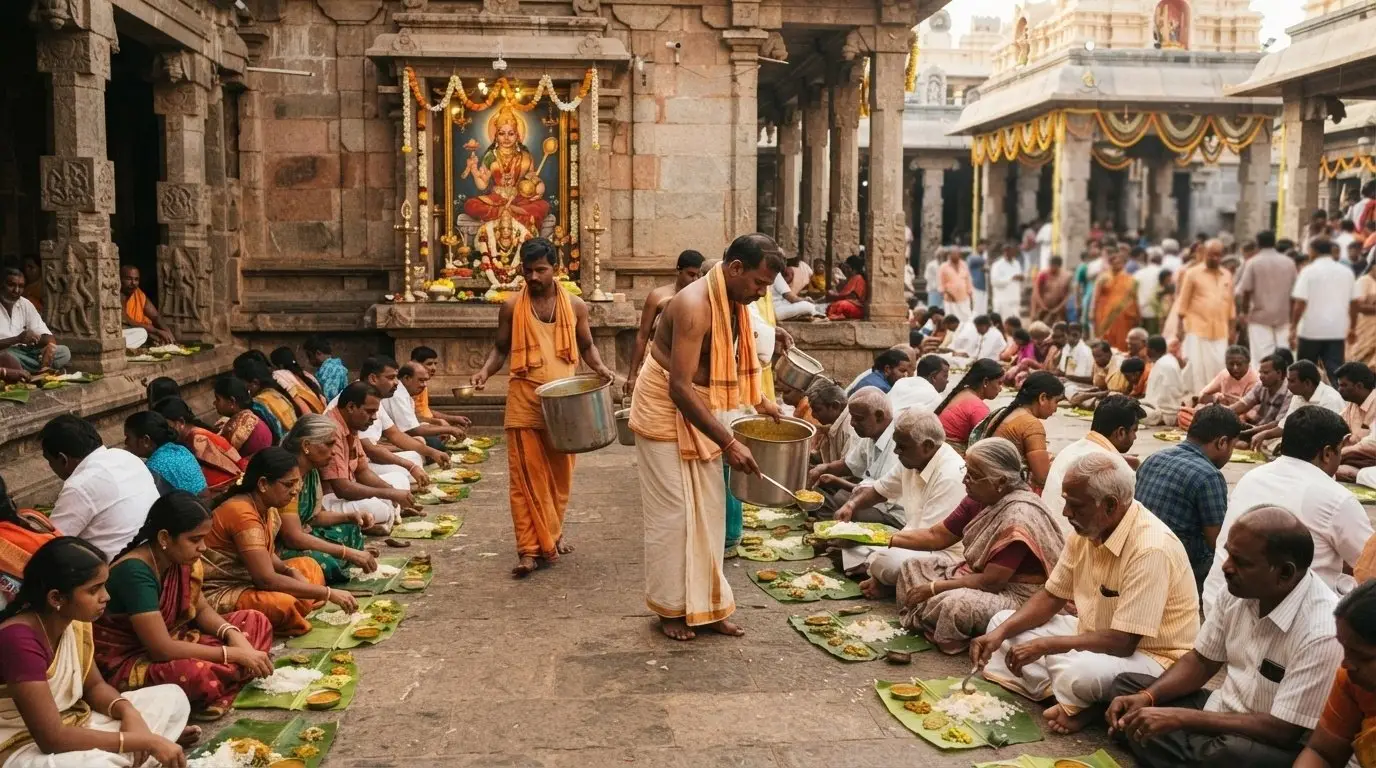
How to Worship Annapurna: Kitchen Rituals and Festival Days
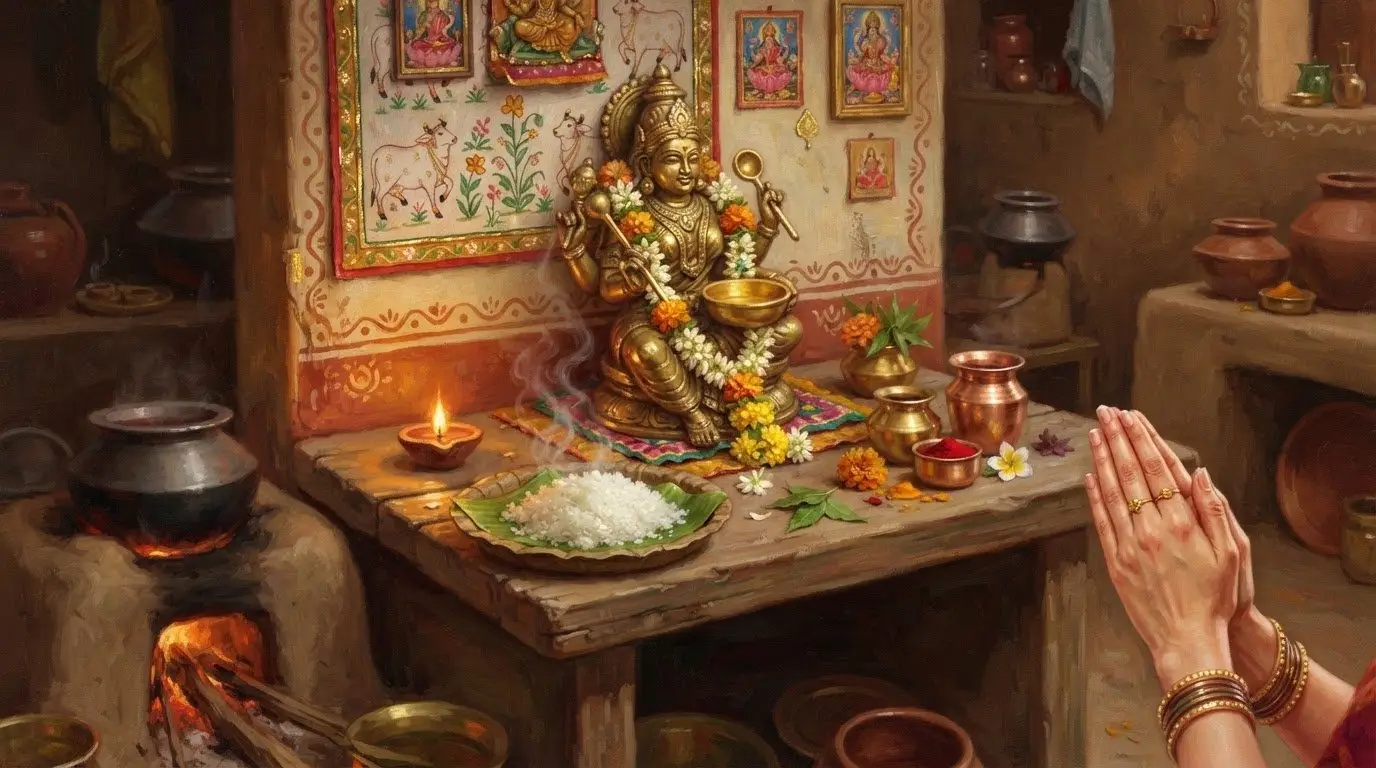
Annapurna's worship is distinguished by how thoroughly it is woven into the daily rhythm of the household kitchen rather than confined to a separate shrine room, though many homes maintain both.
Daily and Weekly Kitchen Worship
Many households keep a small image of Annapurna near the stove or in the kitchen itself, and it is customary to offer the first portion of any freshly cooked meal to her image before the family eats, a practice believed to sanctify the food and ensure the kitchen's continued abundance. Lighting a small lamp before this image each morning, and reciting the mantra "Om Hreem Shreem Annapoornayai Namah" a few times before beginning to cook, is a simple, sustainable daily practice observed in many Shakta and general Hindu households, independent of any specific festival calendar.
Annapurna Jayanti
Annapurna Jayanti, generally observed on the full moon day (Purnima) of the Hindu month of Margashirsha (typically falling in late November or December), is considered her principal festival day, marking her manifestation to feed the starving three worlds in the Kashi legend. On this day, devotees typically:
- Prepare an elaborate spread of food, often including rice dishes, sweets, and a wide variety of dishes representing abundance
- Offer the first portion to Annapurna's image with full ritual honours, including a proper puja with flowers, incense, and a lit lamp
- Distribute food generously to family, neighbours, and, in keeping with the goddess's own nature, to those in need
- Recite the Annapurna Stotram and, where the household tradition supports it, the Sahasranama
- Undertake or renew charitable food donations (annadana) as a direct enactment of her blessing
Akshaya Tritiya and Other Occasions
Many households also honour Annapurna during Akshaya Tritiya, the auspicious spring festival whose very name means "imperishable third," since the day's themes of inexhaustible abundance align closely with her nature. New utensils, particularly the traditional rice-measuring vessel or a small brass bowl representing her patra, are sometimes purchased on this day and kept in the kitchen as a token of her continuing presence. Some families also invoke her at the start of a new home's kitchen, at a child's first solid-food ceremony (annaprashana), or whenever a new cooking hearth or stove is installed, treating each of these transitions as an opportunity to invite her blessing afresh.
Major Temples of Goddess Annapurna
Annapurna Temple, Kashi (Varanasi)
The most celebrated Annapurna shrine anywhere, standing immediately beside the Kashi Vishwanath Temple in the old city. The temple houses a striking image of the goddess adorned in gold, and typically permits darshan only at certain hours of the day, with special extended darshan during Annapurna Jayanti when enormous queues form. The narrow lanes surrounding the temple are themselves part of the pilgrimage experience, thick with the smell of prasad, flowers, and incense.
Sri Annapoorneshwari Temple, Horanadu, Karnataka
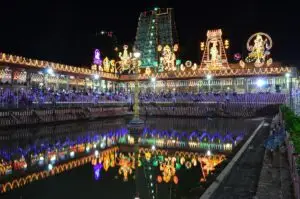
Set amid the forested hills of the Western Ghats in Chikkamagaluru district, the Horanadu Annapoorneshwari Temple is one of South India's most visited Devi shrines, renowned for the continuous, free annadana it offers to every pilgrim who arrives, regardless of background - a living embodiment of the goddess's core promise that none who come to her shall go hungry. The temple's remote, scenic setting adds to its reputation as a place of particular spiritual potency.
Annapurna Temple, Indore
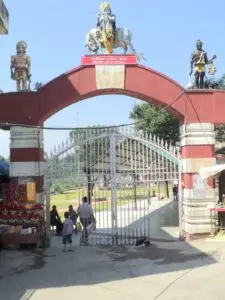
In the heart of Indore, Madhya Pradesh, the Annapurna Temple is built in a South Indian architectural style unusual for the region, with a tall, intricately sculpted gopuram visible from a distance. It draws large numbers of local devotees for daily worship as well as substantial crowds during Navratri and Annapurna Jayanti, and is considered one of the city's principal devotional landmarks.
| Temple | Location | Notable For |
|---|---|---|
| Annapurna Temple | Varanasi, Uttar Pradesh | Adjoining Kashi Vishwanath; origin site of the Shiva-Annapurna legend |
| Sri Annapoorneshwari Temple | Horanadu, Karnataka | Continuous free annadana; scenic Western Ghats setting |
| Annapurna Temple | Indore, Madhya Pradesh | Distinctive South Indian-style gopuram; major Navratri crowds |
Devotees planning a visit to any of these temples are advised, as with any pilgrimage, to verify current darshan timings, festival schedules, and any special queue arrangements directly with the temple authorities before travelling, since these details can change from year to year.
Further Reading
Frequently Asked Questions
Who is Goddess Annapurna?
Goddess Annapurna is the Hindu deity of food and nourishment, worshipped as a form of Parvati. Her name combines anna (food) and purna (complete), reflecting her role as the eternal, inexhaustible provider of sustenance to all beings.
What is the story of Shiva begging alms from Annapurna?
According to the well-known Kashi legend, Shiva declared the material world, including food, to be illusion, prompting Parvati to withdraw as Prakriti and cause food to vanish everywhere. When even the gods began to starve, Shiva humbled himself, went to Kashi as a mendicant, and received alms from Annapurna's own hands, affirming the sanctity of nourishment.
Why is the Annapurna Temple located next to Kashi Vishwanath?
The Annapurna Temple stands beside Kashi Vishwanath because the legend that gives rise to her worship took place in Kashi, where she is believed to continuously feed and sustain the city's residents and pilgrims. Most devotees treat darshan of both deities as a single, connected pilgrimage.
What is the Annapurna Stotram?
The Annapurna Stotram is a devotional hymn traditionally attributed to Adi Shankaracharya, addressing the goddess with the refrain "Annapoorne Sadapoorne" and asking her for alms that grant both physical sustenance and spiritual wisdom and detachment.
What is the meaning of "Om Hreem Shreem Annapoornayai Namah"?
This mantra is a salutation to Goddess Annapurna, combining the beeja sounds Hreem and Shreem, associated with auspiciousness and abundance, with a direct offering of reverence to her. It is commonly recited during kitchen worship or personal daily practice.
When is Annapurna Jayanti celebrated?
Annapurna Jayanti is typically observed on the full moon day of the Hindu month of Margashirsha, usually falling in late November or December. Devotees mark the day with elaborate food offerings, charitable food distribution, and recitation of her stotram, though exact dates should be verified against the current year's lunar calendar.
How is Annapurna worshipped in an ordinary household kitchen?
Many households keep a small image of Annapurna near the stove and offer the first portion of any freshly cooked meal to her before the family eats. A brief daily recitation of her mantra and a lit lamp are common, simple practices independent of any specific festival.
Which are the most important Annapurna temples in India?
The most significant Annapurna temples are located in Varanasi (adjoining Kashi Vishwanath), Horanadu in Karnataka (known for continuous free annadana), and Indore in Madhya Pradesh (notable for its South Indian-style architecture).
Is Annapurna the same as Parvati?
Yes, Annapurna is regarded as a form of Parvati, specifically her aspect as the nurturing giver of food and sustenance. She is not typically worshipped as an entirely separate, independent goddess but as one of Parvati's many meaningful names and forms.
What are the benefits of worshipping Goddess Annapurna?
Devotees seek Annapurna's blessing for assured sufficiency of food, freedom from financial and material want, gratitude for existing abundance, and harmony within the home. She is also invoked by those engaged in feeding others, including cooks and those undertaking charitable food service.
To stand before Annapurna, even briefly, is to be reminded that abundance begins not with accumulation but with the willingness to give, ladle in hand, to whoever is hungry. Musinara's 432 Hz recordings of devotional chants to the Divine Mother, including hymns in her honour, are offered as a quiet companion for kitchen worship or evening reflection - you are warmly invited to listen on YouTube and let her presence settle gently into your own home.
Related reading
- Goddess Durga: The Complete Guide to the Invincible Mother
- Goddess Gayatri: The Mother of the Vedas and Her Mantra
- The Durga Chalisa: Meaning, Verses and How to Recite the Forty-Verse Hymn to the Mother
- Santoshi Maa: The Story, Vrat Katha and Complete 16-Friday Worship Guide
Watch and listen to devotional music and mantras on the Musinara YouTube channel.
New: Shakambhari and Annapurna: when the Goddess descended as food