यह लेख हिंदी में भी उपलब्ध है: नवरात्रि 2026 के रंग
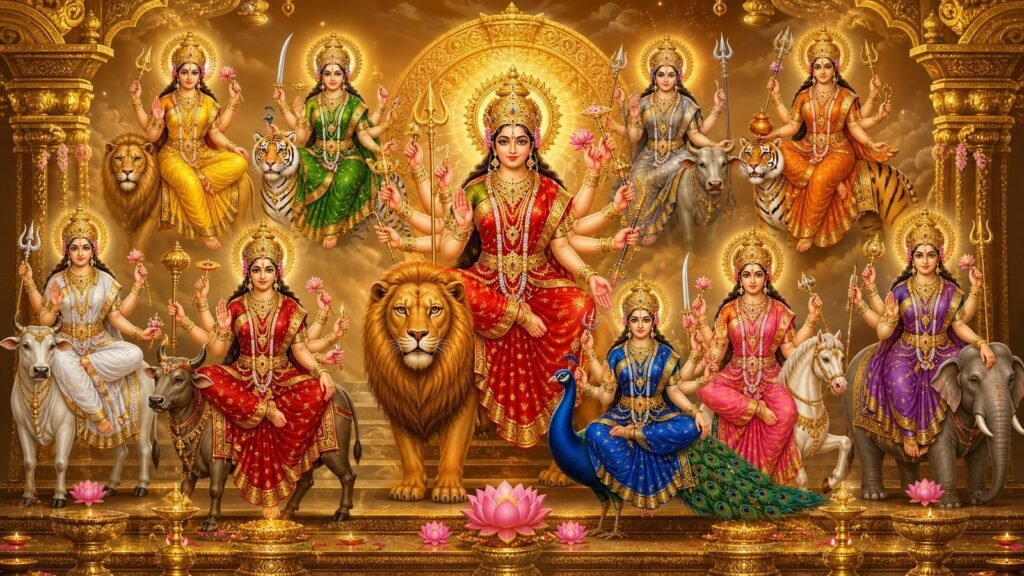
Sharad Navratri 2026 runs from Sunday 11 October to Monday 19 October, with Vijayadashami on Tuesday 20 October. The nine colours for 2026 are orange, white, red, royal blue, yellow, green, grey, purple and peacock green, in that order. Each colour belongs to the weekday on which its tithi falls, and each day is dedicated to one of the nine forms of the Navadurga.
Every autumn the same question travels through households, offices and WhatsApp groups across India: what colour do we wear tomorrow? The nine colours of Navratri have become one of the most joyful public expressions of the festival, worn to the pandal, to the office, to Garba. Yet very few of the lists circulated each year explain where the colours come from, or why they shift from one year to the next.
They shift because they are not fixed to the day of the festival at all. They are fixed to the day of the week. This guide gives the full 2026 sequence with dates, the Navadurga form worshipped on each night, her mantra in Devanagari and English, and the traditional bhog offered at her feet, along with the reasoning that lets you work the colours out for any year yourself.
Key Takeaways
- Sharad Navratri 2026 begins on Sunday 11 October and ends on Monday 19 October, with Vijayadashami on Tuesday 20 October.
- The colours follow the seven weekdays, which is why the sequence changes every year. Navratri 2026 opens on a Sunday, so it opens in orange.
- Because nine nights exceed a seven-day week, the final two days take purple and peacock green, colours added to complete the cycle.
- Each night belongs to one of the Navadurga, from Shailaputri on the first to Siddhidatri on the ninth.
- Each form receives her own bhog, from pure ghee on the first night to sesame seeds on the ninth.
Navratri 2026 Colours: The Complete Nine-Day List
| Day | Date | Colour | Goddess | Bhog | Traditionally sought |
|---|---|---|---|---|---|
| 1 | Sun 11 Oct | Orange | Shailaputri | Pure ghee | Freedom from illness |
| 2 | Mon 12 Oct | White | Brahmacharini | Sugar | Long life |
| 3 | Tue 13 Oct | Red | Chandraghanta | Kheer or milk | Release from sorrow |
| 4 | Wed 14 Oct | Royal Blue | Kushmanda | Malpua | Clarity of decision |
| 5 | Thu 15 Oct | Yellow | Skandamata | Banana | Good health |
| 6 | Fri 16 Oct | Green | Katyayani | Honey | Radiance and grace |
| 7 | Sat 17 Oct | Grey | Kalaratri | Jaggery | Freedom from fear |
| 8 | Sun 18 Oct | Purple | Mahagauri | Coconut | Fulfilment of wishes |
| 9 | Mon 19 Oct | Peacock Green | Siddhidatri | Sesame seeds | Protection and siddhi |
Why Do the Navratri Colours Change Every Year?
The colours are assigned to the days of the week, not to the nights of the festival. Sunday is orange, Monday white, Tuesday red, Wednesday royal blue, Thursday yellow, Friday green and Saturday grey. Navratri simply begins wherever the lunar calendar places Pratipada, and the colours follow from there.
| Weekday | Colour | Reasoning in tradition |
|---|---|---|
| Sunday | Orange | The colour of the rising sun and of Surya, warmth and vitality |
| Monday | White | The moon and Soma, purity and stillness |
| Tuesday | Red | Mangala, the planet of courage and vigour |
| Wednesday | Royal Blue | Budha, intellect and depth |
| Thursday | Yellow | Brihaspati, wisdom and auspicious counsel |
| Friday | Green | Shukra, growth, beauty and fertility |
| Saturday | Grey | Shani, gravity, endurance and the ash of detachment |
In 2026, Pratipada falls on Sunday 11 October. The festival therefore opens in orange and runs through the week in order. Because nine nights are longer than a seven-day week, the eighth and ninth days need colours the week cannot supply, and tradition assigns purple and peacock green to complete the cycle. This is also why you will occasionally see the last two days listed differently by different almanacs. The first seven are settled by the weekday and are not in dispute.
If you would like to work out any future year for yourself, find the date of Ghatasthapana in a reliable panchang, note its weekday, and read down the table above.
The Nine Nights, One by One
The still-life images in this section are illustrations made for this guide, built from each day’s colour and bhog. They are not photographs of a particular puja.
Each night belongs to one form of the Navadurga. The sequence is not decorative. It is an ascent, beginning with the solid ground of the mountain and ending in the boundless attainment of Siddhidatri, and the colours track that journey.
Day 1, Sun 11 Oct - Orange - Shailaputri
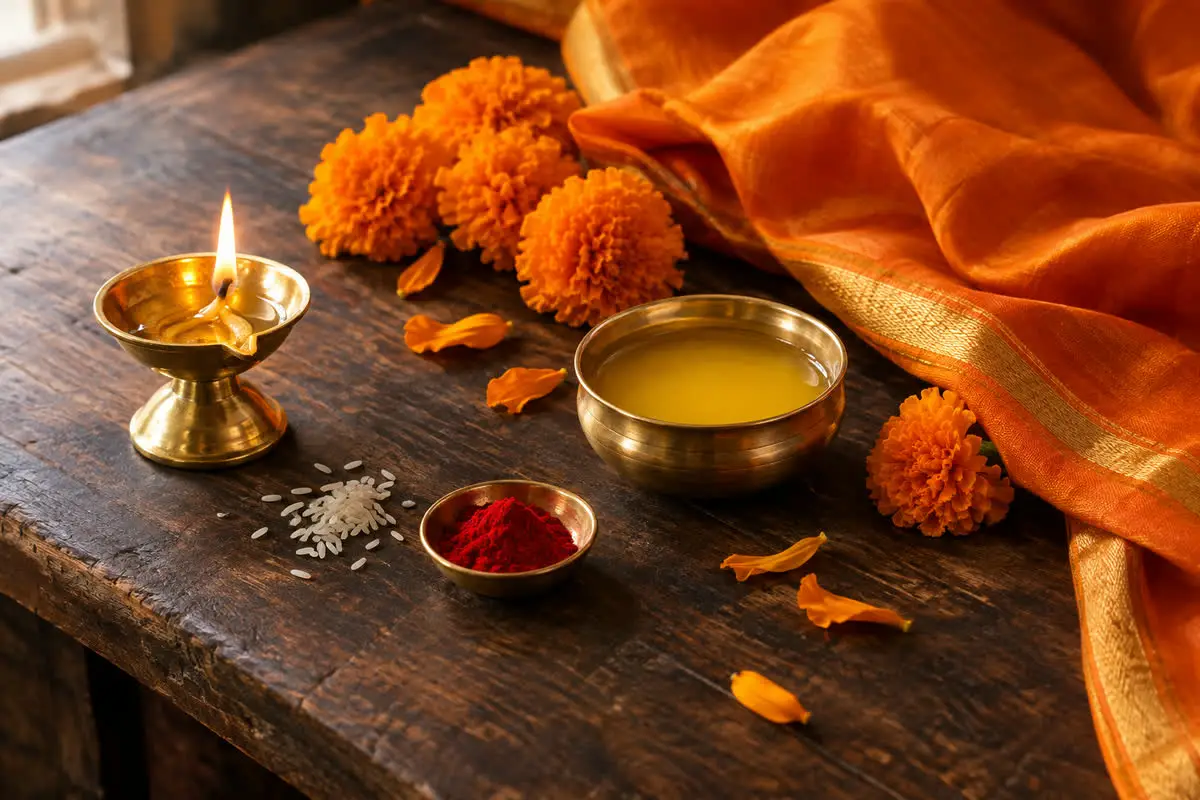
Shailaputri is Sati returned to the world as the daughter of Himavan, lord of the mountains. She rides Nandi with a trident in one hand and a lotus in the other, and she is the ground on which the whole festival stands. Orange is the first light striking a mountain ridge at dawn: warmth, vitality and the energy to begin.
Mantra: ॐ देवी शैलपुत्र्यै नमः
Om Devi Shailaputryai Namah
Bhog: Pure ghee. Traditionally sought: freedom from illness.
Day 2, Mon 12 Oct - White - Brahmacharini
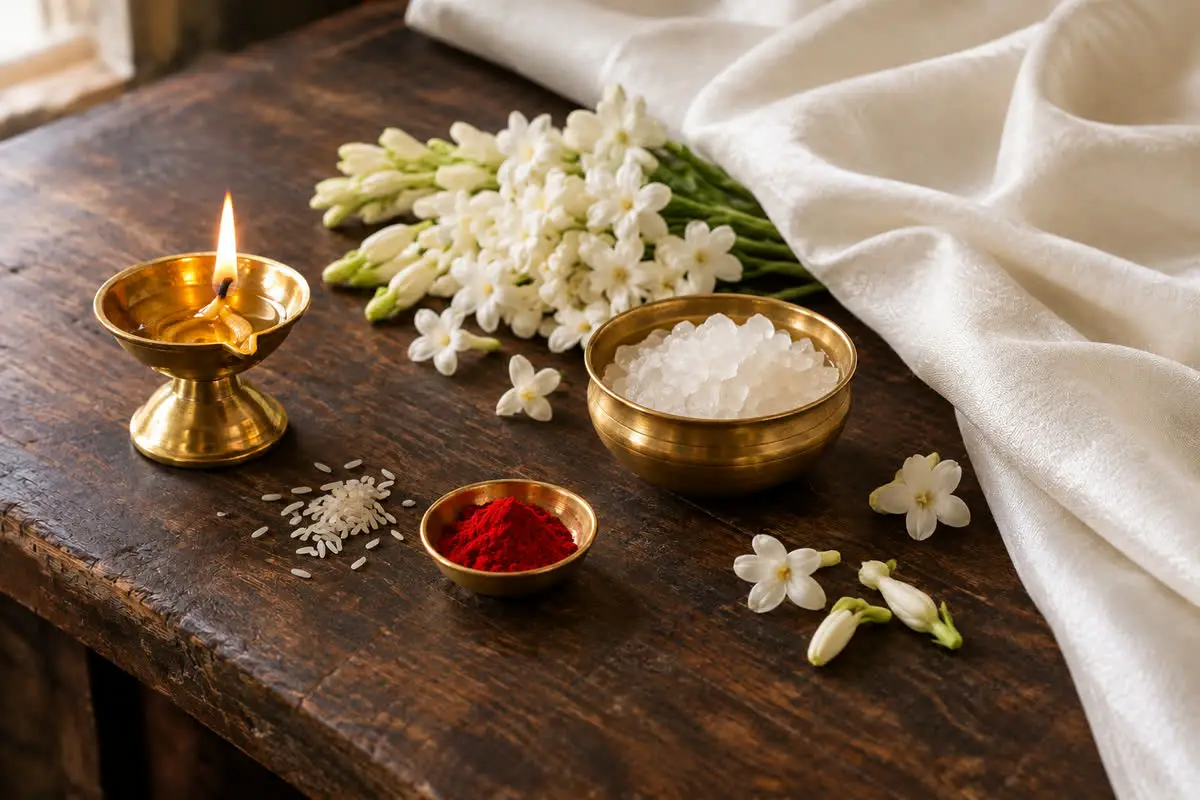
Brahmacharini walked barefoot through years of tapas to win Shiva, holding only a rosary and a water pot, eating nothing but leaves and then not even those. She is discipline without ornament. White is the colour of that stripped-back stillness, of a vow kept when no one is watching.
Mantra: ॐ देवी ब्रह्मचारिण्यै नमः
Om Devi Brahmacharinyai Namah
Bhog: Sugar. Traditionally sought: long life.
Day 3, Tue 13 Oct - Red - Chandraghanta
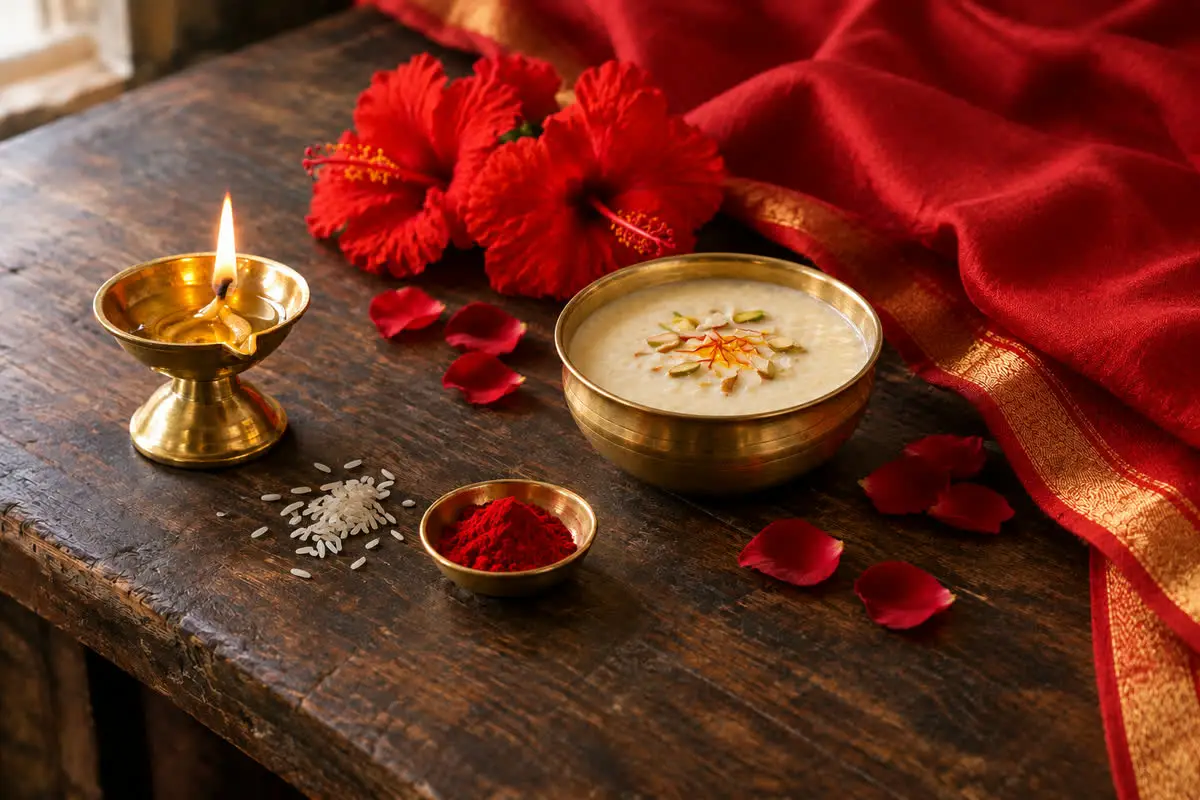
Chandraghanta wears the half moon on her brow shaped like a temple bell, and when that bell sounds the demons scatter. Ten-armed and riding a tiger, she is the Mother who answers a threat without hesitation. Red is her courage, and the colour worn on the day one needs it.
Mantra: ॐ देवी चन्द्रघण्टायै नमः
Om Devi Chandraghantayai Namah
Bhog: Kheer or milk. Traditionally sought: release from sorrow.
Day 4, Wed 14 Oct - Royal Blue - Kushmanda
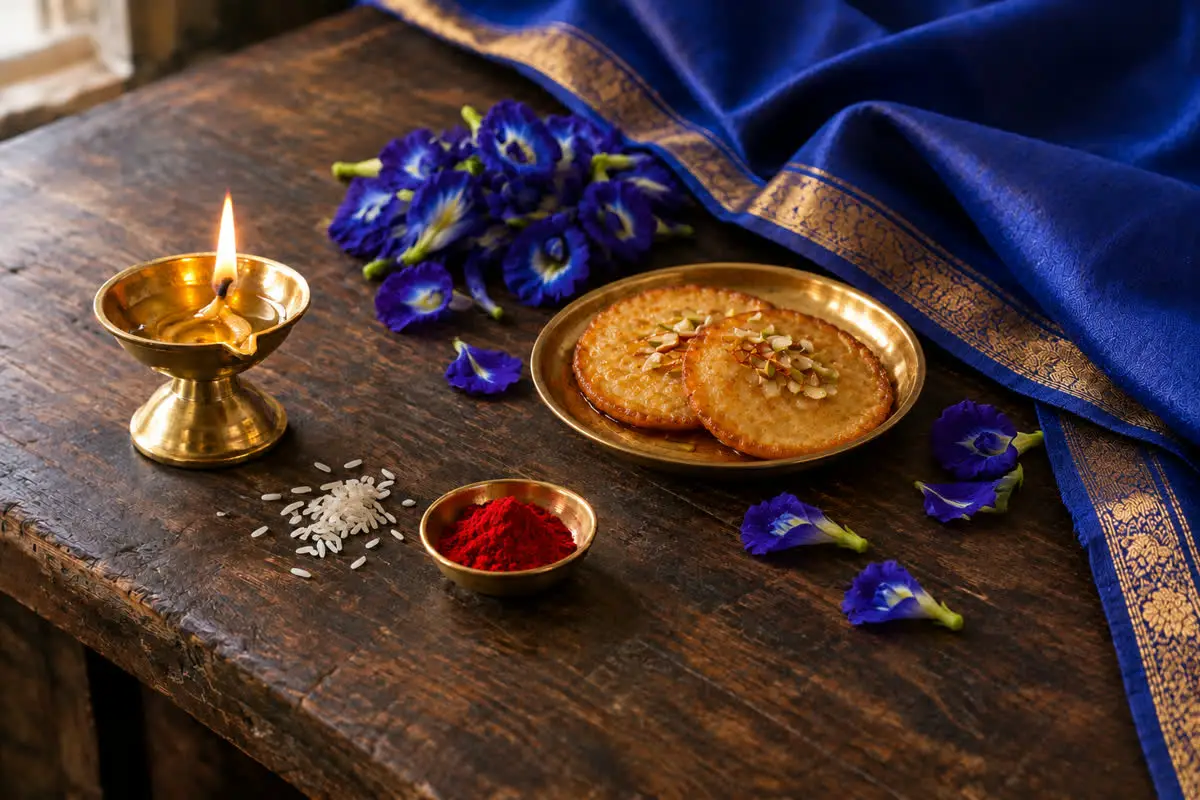
Kushmanda smiled, and from that smile came the cosmic egg and everything within it. She dwells at the core of the sun, the only form who can bear that heat. Royal blue is the depth of the space her smile filled, the darkness that existed before there was light to see it by.
Mantra: ॐ देवी कूष्माण्डायै नमः
Om Devi Kushmandayai Namah
Bhog: Malpua. Traditionally sought: clarity of decision.
Day 5, Thu 15 Oct - Yellow - Skandamata
Skandamata holds the infant Skanda on her lap, and in doing so she becomes the Mother worshipped through her child. Devotees say her grace is easiest to receive because she is already softened by motherhood. Yellow is that warmth, the ordinary sunlight on a child face.
Mantra: ॐ देवी स्कन्दमातायै नमः
Om Devi Skandamatayai Namah
Bhog: Banana. Traditionally sought: good health.
Day 6, Fri 16 Oct - Green - Katyayani
Katyayani was born in the hermitage of the sage Katyayana from the gathered anger of all the gods, and it is she who cuts down Mahishasura. Unmarried girls have invoked her for a good husband since the time of the Gopis. Green is renewal, growth, and the fertile earth she rose to defend.
Mantra: ॐ देवी कात्यायन्यै नमः
Om Devi Katyayanyai Namah
Bhog: Honey. Traditionally sought: radiance and grace.
Day 7, Sat 17 Oct - Grey - Kalaratri
Kalaratri is the darkest and fiercest of the nine: hair unbound, riding a donkey, a form so terrible that fear itself flees her. She is also called Shubhankari, the doer of good, because what she destroys is never the devotee. Grey is the ash-light of the hour before dawn, when the night breaks.
Mantra: ॐ देवी कालरात्र्यै नमः
Om Devi Kalaratryai Namah
Bhog: Jaggery. Traditionally sought: freedom from fear.
Day 8, Sun 18 Oct - Purple - Mahagauri
Mahagauri is Kalaratri washed clean. Tradition says the Goddess bathed in the Ganga and emerged radiant, the fierceness burnt away and only luminosity left. Purple carries that dignity, the colour of something that has passed through fire and come out shining.
Mantra: ॐ देवी महागौर्यै नमः
Om Devi Mahagauryai Namah
Bhog: Coconut. Traditionally sought: fulfilment of wishes.
Day 9, Mon 19 Oct - Peacock Green - Siddhidatri
Siddhidatri grants the eight siddhis, and is worshipped by gods, sages and seekers alike; even Shiva is said to have received his powers from her. Seated on a lotus, she completes the ascent that began on the mountain. Peacock green is iridescence, the colour that changes as you turn it, holding every other colour inside it.
Mantra: ॐ देवी सिद्धिदात्र्यै नमः
Om Devi Siddhidatryai Namah
Bhog: Sesame seeds. Traditionally sought: protection and siddhi.
How to Use the Colours in Practice
The colours are a devotional convention rather than a scriptural injunction. No verse of the Devi Mahatmya prescribes them, and no one is failing the Goddess by wearing something else. What they offer is a way of carrying the festival into an ordinary day: a red dupatta on Chandraghanta day, a yellow shirt to the office on Skandamata day, the whole family in white on the second night.
- Wear the colour, or simply keep it near you: a cloth on the altar, a flower of that shade, a thread at the wrist.
- Offer the bhog for that day, then share it as prasad. The offering matters more than its cost.
- Chant the mantra of that night, ideally one mala of 108, at dawn or at dusk.
- Light the lamp before the kalash each evening, and keep it burning through the nine nights if you are able.
- If you miss a colour or a whole day, simply continue from where you are. Devotion is not a test of attendance.
Listen Through the Nine Nights
Sound is the oldest offering. If you keep only one practice through Navratri, let it be the Durga beej mantra, chanted as a full mala of one hundred and eight with the lamp lit before you.
Regional Guides in Indian Languages
These festivals are kept differently in every part of India, and the words for them differ too. These guides are written in the language of the households that keep them, not translated from English.
- ज्येष्ठा गौरी - Jyeshtha Gauri 2026, in Marathi - the three days Gauri spends at her mother’s house, with the full vidhi and mahanaivedya
- આસો નવરાત્રી - Aso Navratri 2026, in Gujarati - ghat sthapana, the akhand divo inside the garbo, and what separates garbo from garba
- బతుకమ్మ - Bathukamma 2026, in Telugu - the nine day-names, their naivedyams, and how the flower stack is built
- நவராத்திரி கொலு - Navarathiri Kolu 2026, in Tamil - the odd-numbered padi, the six-fold arrangement of dolls, and Saraswathi Poojai
- ವರಮಹಾಲಕ್ಷ್ಮಿ ಹಬ್ಬ - Varamahalakshmi Habba, in Kannada - kalasha sthapane, the mukhavada, the dora and why nothing is immersed
- नवरात्रि के रंग - Navratri Colours 2026, in Hindi - the nine colours day by day with each night’s Navadurga form and bhog
Planning a temple visit this Navratri? Navratri 2026 at major Devi temples collects the dates, temple notices and crowd advice for Mysuru, Vijayawada, Kolkata, Vaishno Devi, Kamakhya and other shrines.
Frequently Asked Questions
What are the nine colours of Navratri 2026?
Orange on 11 October, white on the 12th, red on the 13th, royal blue on the 14th, yellow on the 15th, green on the 16th, grey on the 17th, purple on the 18th and peacock green on the 19th.
When does Navratri 2026 start and end?
Sharad Navratri 2026 begins on Sunday 11 October with Ghatasthapana and ends on Monday 19 October. Vijayadashami, or Dussehra, falls on Tuesday 20 October.
Why are the Navratri colours different every year?
Because each colour belongs to a weekday, not to a night of the festival. Sunday is orange, Monday white, Tuesday red, and so on. Navratri 2026 opens on a Sunday, so it opens in orange.
Which colours are for Ashtami and Navami in 2026?
Ashtami falls on Sunday 18 October and takes purple; Navami falls on Monday 19 October and takes peacock green. These two sit outside the seven weekday colours, which is why almanacs occasionally list them differently.
Is it compulsory to wear the Navratri colours?
No. The colours are a devotional custom, not a scriptural requirement. They are a way of carrying the festival into daily life, and no worship is diminished by wearing something else.
What bhog is offered on each day of Navratri?
Ghee on the first day, then sugar, kheer, malpua, banana, honey, jaggery, coconut and sesame seeds through to the ninth. Each is offered to that night Navadurga form and then shared as prasad.
Which goddess is worshipped on each day of Navratri?
Shailaputri, Brahmacharini, Chandraghanta, Kushmanda, Skandamata, Katyayani, Kalaratri, Mahagauri and Siddhidatri, in that order, one for each of the nine nights.
Continue Your Journey
- Navratri and the Nine Forms of Navadurga
- Goddess Durga: Mantras, Forms and Worship
- The Durga Chalisa, verse by verse
- Durga Saptashati, the Devi Mahatmya
- Devi Kavach, Argala Stotram and Keelak
- Mahishasura Mardini Stotram: Ayi Giri Nandini
May the Mother walk with you through all nine nights. Jai Mata Di.
Stay in Touch
An occasional note when there is a new chant or a mantra worth sharing. No spam, and you can unsubscribe at any time.