Of all the nights in the Hindu calendar when a household deliberately makes itself ready to receive a guest, none is approached with quite the same mixture of scrubbed floors, lit lamps and open doors as Diwali night, when Goddess Lakshmi is believed to walk the earth and enter homes that have prepared a fitting welcome for her. Lakshmi Puja, performed on Amavasya, the moonless night of the Hindu month of Kartik, is the devotional and domestic centrepiece of the entire Diwali festival, observed with remarkable consistency from modest one-room homes to the accounting ledgers of large trading houses.
This is not a puja that unfolds only in a temple, under a priest's direction, at a fixed hour set by an institution. It is, above all, a home ritual, led as often by a grandmother or a shopkeeper as by an appointed priest, and it carries a logic that rewards understanding rather than mere imitation: why the home must be clean before the goddess is invoked, why Ganesha is worshipped in the same breath as Lakshmi, why the muhurat matters so much that families will sit up past midnight to catch the right window, and why, at the end of it all, a lamp is left burning through the night.
This guide sets out the full significance of Lakshmi Puja on Diwali, the story behind the night, how the auspicious muhurat is calculated, the samagri and setup required, a complete step-by-step vidhi, the principal mantras and the beloved Om Jai Lakshmi Mata aarti, customary do's and don'ts, the regional variations found across India, and the benefits devotees associate with this most anticipated night of household worship.
- The Significance of Lakshmi Puja on Diwali
- The Story: Why Lakshmi Visits on This Night
- Muhurat: Choosing the Right Time
- Samagri: Items Needed for Lakshmi Puja
- The Lakshmi-Ganesha-Kubera Setup
- Step-by-Step Lakshmi Puja Vidhi
- Mantras and the Lakshmi Aarti
- Do's and Don'ts
- Regional Variations
- Benefits of Lakshmi Puja
- Frequently Asked Questions
The Significance of Lakshmi Puja on Diwali
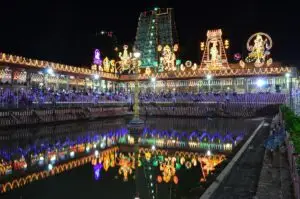
Diwali, the festival of lights, spans several days, but its central night - Amavasya, the new-moon night of the Hindu month of Kartik, typically falling in October or November - belongs specifically to Lakshmi, goddess of wealth, fortune and auspiciousness. This is a deliberate pairing of symbolism: Amavasya is the darkest night of the lunar month, and it is precisely into this darkness that homes send out the greatest concentration of light, in the form of diyas, candles and, in recent decades, strings of electric lamps. The theological reading offered across most households is straightforward and moving in its simplicity - light is set out not merely to celebrate, but to guide the goddess of prosperity through the darkness to the door of a home that wants her.
For traders and merchant communities in particular, Lakshmi Puja on Diwali marks something close to a financial new year. New account books (known in various regions as chopda or vahi) are opened and worshipped, old debts are customarily settled, and business premises are cleaned and decorated with as much or more care than private homes, since the coming year's commercial fortune is felt to depend partly on how well this single night's puja is performed. Readers wishing to understand Lakshmi's fuller iconography, her many forms, and her place within Hindu theology more broadly will find our companion guide to Goddess Lakshmi a useful foundation before turning to the specific ritual detail in this article.
It is worth noting that the exact date of Amavasya, and therefore of Lakshmi Puja, shifts each year according to the lunar calendar, and can occasionally fall across two conflicting dates in different regional almanacs when the tithi (lunar day) straddles sunset differently. Readers should always verify the current year's date and muhurat against a reliable, locally published panchang or a trusted priest, rather than assume the date from a previous year.
The Story: Why Lakshmi Visits on This Night
Several interlocking narrative threads converge to explain why this particular night belongs to Lakshmi. The most commonly told is bound up with the return of Rama to Ayodhya after fourteen years of exile and his defeat of Ravana, an event Diwali as a whole commemorates in North India; the city's citizens are said to have lit rows of lamps (the word deepavali itself means "a row of lamps") to welcome their king home, and this same light is understood, in the Lakshmi-focused telling, to welcome the goddess of prosperity into a kingdom, and by extension every home, newly restored to order and righteousness (dharma).
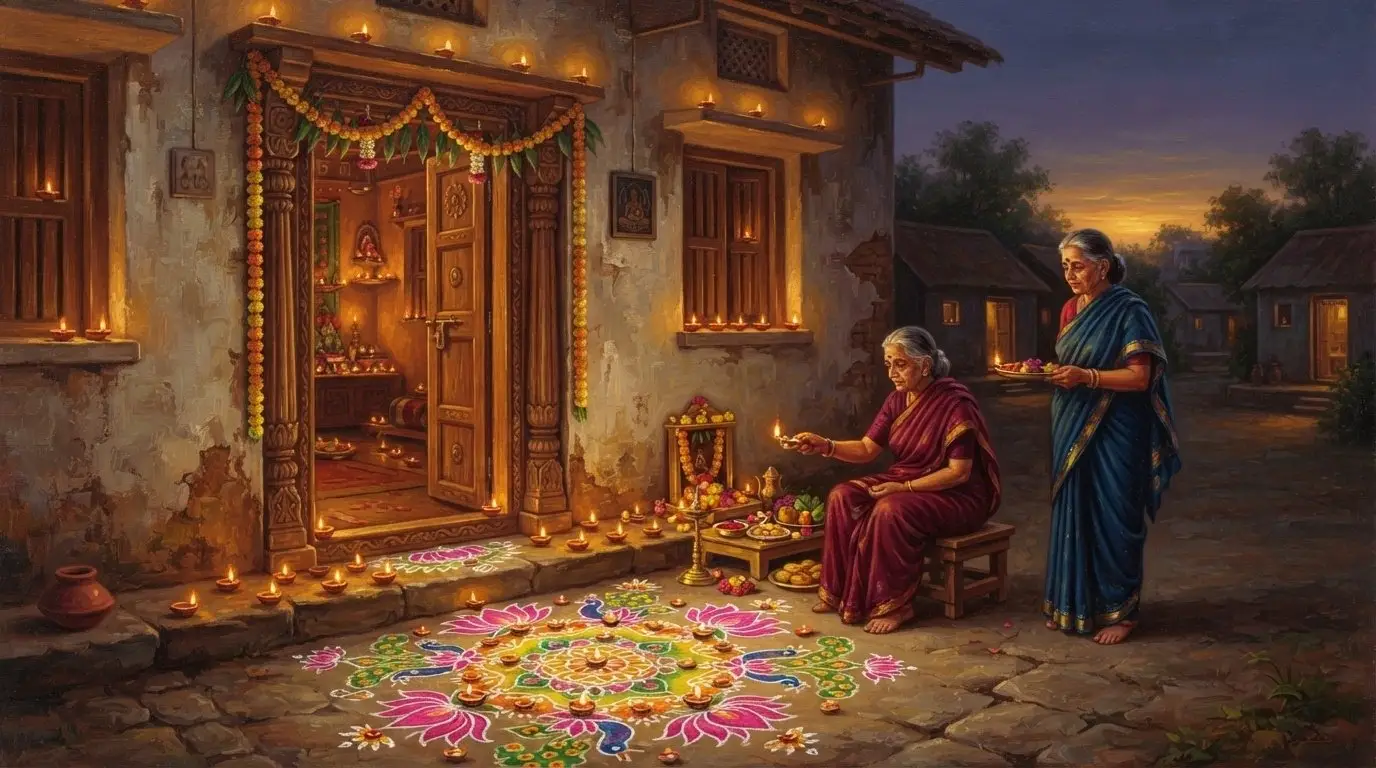
A second, widely repeated belief, more folk than scriptural in character, holds that on this Amavasya night Lakshmi descends to the earthly realm and visits homes in search of a place to reside for the coming year. She is said to be drawn to homes that are spotlessly clean, brightly lit, and filled with the sound of devotion - and to pass by, without entering, homes that are dark, cluttered or quarrelsome. This belief is the direct explanation for the intensity of pre-Diwali cleaning that grips Indian households in the days leading up to the festival, often described locally as a more thorough clean than at any other point in the year, and for the custom of leaving doors and windows open and lamps burning through the night, so that the goddess, finding the way lit and the entrance open, does not turn away.
A further layer of the story connects Lakshmi Puja to the Samudra Manthan, the churning of the cosmic ocean by the gods and demons, from which Lakshmi is said to have emerged bearing prosperity and auspiciousness for the universe; some tellings place her emergence on this very night, reinforcing the association between Diwali, Amavasya darkness, and the goddess's arrival out of that darkness bearing light and abundance. Readers drawn to the deeper mantra tradition associated with Lakshmi and her fellow goddesses may also enjoy our guide to the beej mantras of the goddess, which explains the seed-sound "Shreem" central to much of the worship described later in this guide.
Muhurat: Choosing the Right Time
Timing is treated with unusual seriousness in Lakshmi Puja, more so than in most household rituals, because tradition holds that the goddess should be welcomed during a specific auspicious window rather than at any convenient hour.
Pradosh Kaal and the Evening Window
The most widely followed muhurat logic centres on Pradosh Kaal, the period beginning roughly at sunset and extending for the following two to two-and-a-half hours, into early evening twilight. Within this broader evening window, astrologers further calculate more precise auspicious sub-periods based on the prevailing lagna (ascendant), most often favouring a period when Vrishabha Lagna (Taurus ascendant) or Simha Lagna (Leo ascendant) is rising, both considered especially favourable for wealth-related worship. Many households simply follow the specific timing published by a trusted local priest, temple, or panchang for that year rather than calculating the astrology themselves.
A Note on Verifying the Date
Because Diwali dates shift with the lunar calendar, and because in some years the Amavasya tithi spans two consecutive evenings in different regional reckonings, it is essential to verify the current year's exact date and the recommended muhurat window against an up-to-date, locally published panchang, a temple calendar, or a family priest, rather than relying on a fixed date carried over from memory or from a previous year's guide. This caution is especially relevant since some years see genuine, published disagreement between regional almanacs about which evening is correct, and following local, community-specific guidance is generally considered the safest course.
Samagri: Items Needed for Lakshmi Puja
Preparation of the samagri, the ritual items, is generally completed well before the muhurat begins, so that the puja itself can proceed without interruption once the auspicious window opens.
| Item | Purpose |
|---|---|
| Idols or images of Lakshmi, Ganesha and (optionally) Saraswati | Central deities of the puja |
| A wooden platform (chowki) with a red or yellow cloth | Seat for the deities |
| Kalasha (a small metal or clay pot) filled with water, topped with mango leaves and a coconut | Represents auspiciousness and the presence of the divine |
| Rice grains (akshata), often mixed with turmeric | Offered as a base and as an auspicious offering |
| Roli, chandan (sandalwood paste) and haldi (turmeric) | For tilak and marking the kalasha and idols |
| Cotton wicks, oil or ghee, and diyas | Lighting the lamps that are central to the entire festival |
| Incense sticks (agarbatti) and dhoop | Fragrant offering during worship |
| Flowers, especially lotus and marigold | Offered to Lakshmi and Ganesha |
| Fresh fruits and sweets (mithai) | Offered as naivedya (food offering) |
| Coins, currency notes, and account books or a ledger | Placed before the goddess to be blessed for the coming year |
| Cotton or silk cloth (a new piece, if possible) | Offered to the goddess as a garment |
| A small mirror, comb and other items of adornment | Traditional offerings to Lakshmi as goddess of beauty and grace |
| Panchamrit (a mixture of milk, curd, honey, ghee and sugar) | Used for the abhishekam or ritual bathing of the idols where practised |
| A bell (ghanti) | Rung during aarti |
Most households assemble these items over the days preceding Diwali, and it is entirely acceptable to adapt the list modestly to what is locally available; the sincerity and neatness of the arrangement matters more than an exhaustive inventory.
The Lakshmi-Ganesha-Kubera Setup
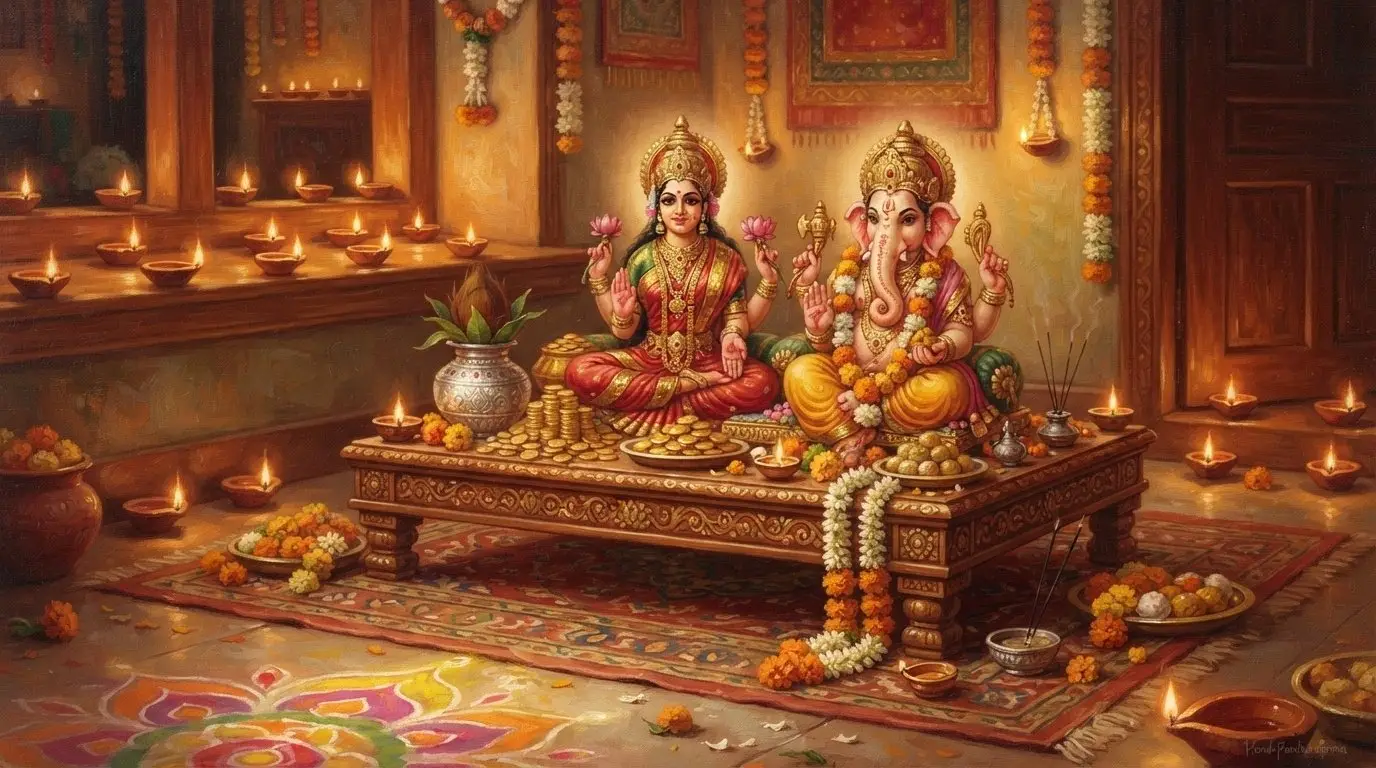
A distinctive feature of Diwali's Lakshmi Puja, compared with Lakshmi worship on an ordinary Friday, is that she is almost never worshipped entirely alone. Ganesha, the remover of obstacles, is placed to her left or right on the same platform and worshipped first, following the standard Hindu convention that Ganesha is invoked at the start of any auspicious undertaking to ensure it proceeds without hindrance. The pairing also carries a gentler moral reading offered by many households: wealth (Lakshmi) without wisdom and the discernment to use it well (represented by Ganesha, and by his association with intellect) is considered incomplete or even dangerous, so the two are worshipped together as a reminder that prosperity should be paired with good sense.
A third figure, Kubera, the treasurer of the gods and guardian of material wealth, is frequently included in the setup, particularly in business and trading households, sometimes as a small idol or image, and sometimes represented simply by the account books and cash box placed before the goddess. Some households also include a small image of Saraswati, goddess of knowledge, completing a trio understood to represent wealth, wisdom and the practical skill needed to manage both. The idols are conventionally arranged facing east or north, with the worshipper seated facing the deities, ideally in the north-east or north direction, which is traditionally regarded as Kubera's own direction and generally favourable for wealth-related ritual.
Step-by-Step Lakshmi Puja Vidhi
While regional and family customs vary in detail, the following sequence represents the widely followed core structure of Lakshmi Puja on Diwali night.
- Cleaning and preparation. Complete all household cleaning, decoration and rangoli well before the muhurat begins; this is considered part of the puja itself, not merely preparation for it.
- Bathing and fresh attire. The worshipper and family members bathe and wear clean, ideally new, clothing before the ritual begins.
- Setting up the altar. Arrange the chowki with a fresh cloth, place the kalasha, and position the idols of Lakshmi and Ganesha (and Kubera or Saraswati, where included) as described above.
- Lighting the first lamp. A ghee or oil lamp is lit before the idols, generally the very first light kindled in the puja space, followed by the lighting of diyas throughout the home.
- Invocation (avahan). The deities are formally invoked into the idols or images with a short prayer, inviting their presence for the worship that follows.
- Tilak and akshata. A tilak of roli or chandan is applied to the idols, the kalasha, and account books, followed by an offering of akshata (rice mixed with turmeric).
- Abhishekam (optional). Where practised, small metal idols are gently bathed with panchamrit and then plain water, dried, and redressed or adorned.
- Offering flowers, incense and dhoop. Flowers are offered individually to each deity, followed by the lighting of incense and dhoop, waved gently before the idols.
- Naivedya. Fruits and sweets are offered as food, generally covered briefly with a cloth or basil leaf before being uncovered and offered.
- Chanting mantras. The core Lakshmi mantras, given in the next section, are recited, typically a fixed number of times such as 108, using a rosary where preferred.
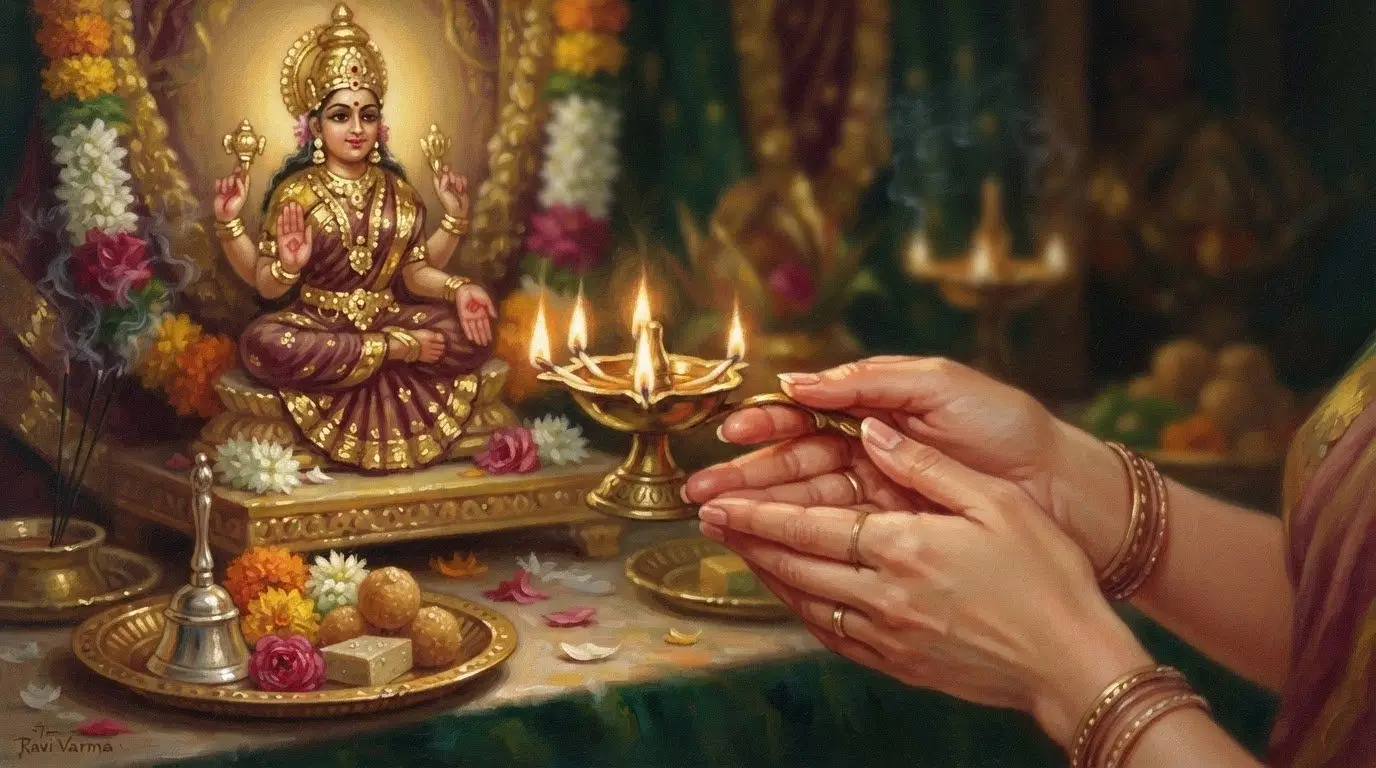
- Aarti. The Om Jai Lakshmi Mata aarti is sung, accompanied by the ringing of a bell and the waving of a lit lamp (aarti thali) in a clockwise motion before each deity.
- Distribution of prasad. The offered sweets and fruits are distributed among family members and, where customary, shared with neighbours.
- Lighting diyas throughout the home and outside. After the formal puja, the household lights diyas in every room, along windowsills, and at the entrance, and many families leave at least one lamp burning through the night.
- Fireworks and celebration. In many regions, the evening continues with fireworks and family celebration, though increasing numbers of households now choose quieter, less polluting observances.
Mantras and the Lakshmi Aarti
Mantra recitation forms the devotional heart of the puja, understood as inviting the goddess's attention and blessing through sacred sound rather than through the visual offerings alone.
| Devanagari | Transliteration | Meaning |
|---|---|---|
| ॐ श्रीं महालक्ष्म्यै नमः | Om Shreem Mahalakshmyai Namah | Salutations to the great goddess Lakshmi; "Shreem" is her beej (seed) mantra, associated with abundance, grace and prosperity. |
| ॐ ह्रीं श्रीं क्लीं महालक्ष्म्यै नमः | Om Hreem Shreem Kleem Mahalakshmyai Namah | A longer invocatory form combining three beej sounds associated with maya, wealth and attraction, used in more elaborate worship sequences. |
| या देवी सर्वभूतेषु लक्ष्मीरूपेण संस्थिता। नमस्तस्यै नमस्तस्यै नमस्तस्यै नमो नमः॥ | Ya Devi Sarvabhuteshu Lakshmi-rupena Samsthita, Namastasyai Namastasyai Namastasyai Namo Namah | To the Goddess who dwells in all beings in the form of Lakshmi (prosperity), salutations to her, again and again. A verse from the Devi Mahatmya, widely recited across Devi worship. |
The single most beloved devotional song of the evening, however, is not a Sanskrit mantra but a Hindi bhajan composed in the nineteenth century, sung in homes across North India as the aarti draws to its close: Om Jai Lakshmi Mata. Its refrain, repeated between verses describing the goddess's grace, beauty and generosity toward her devotees, runs simply: "Om jai Lakshmi mata, maiya jai Lakshmi mata" - "Victory to Mother Lakshmi." The aarti is sung while the lamp is waved before the goddess's image, and the moment is generally regarded as the emotional high point of the entire puja, drawing in family members of every age to sing together.
Readers interested in a longer, more contemplative Sanskrit hymn to the goddess, suitable for daily recitation beyond Diwali night itself, may wish to explore our dedicated guide to the Mahalakshmi Ashtakam, an eight-verse hymn traditionally attributed to Indra, with full lyrics and line-by-line meaning.
Do's and Don'ts
- Do complete all cleaning and clutter removal before the puja; an untidy home is widely held to be actively unwelcoming to the goddess.
- Do keep the main door and, where safe, windows open or unlatched during the evening, symbolising an open invitation.
- Do keep at least one lamp burning through the night where safely possible, rather than extinguishing every light immediately after the puja.
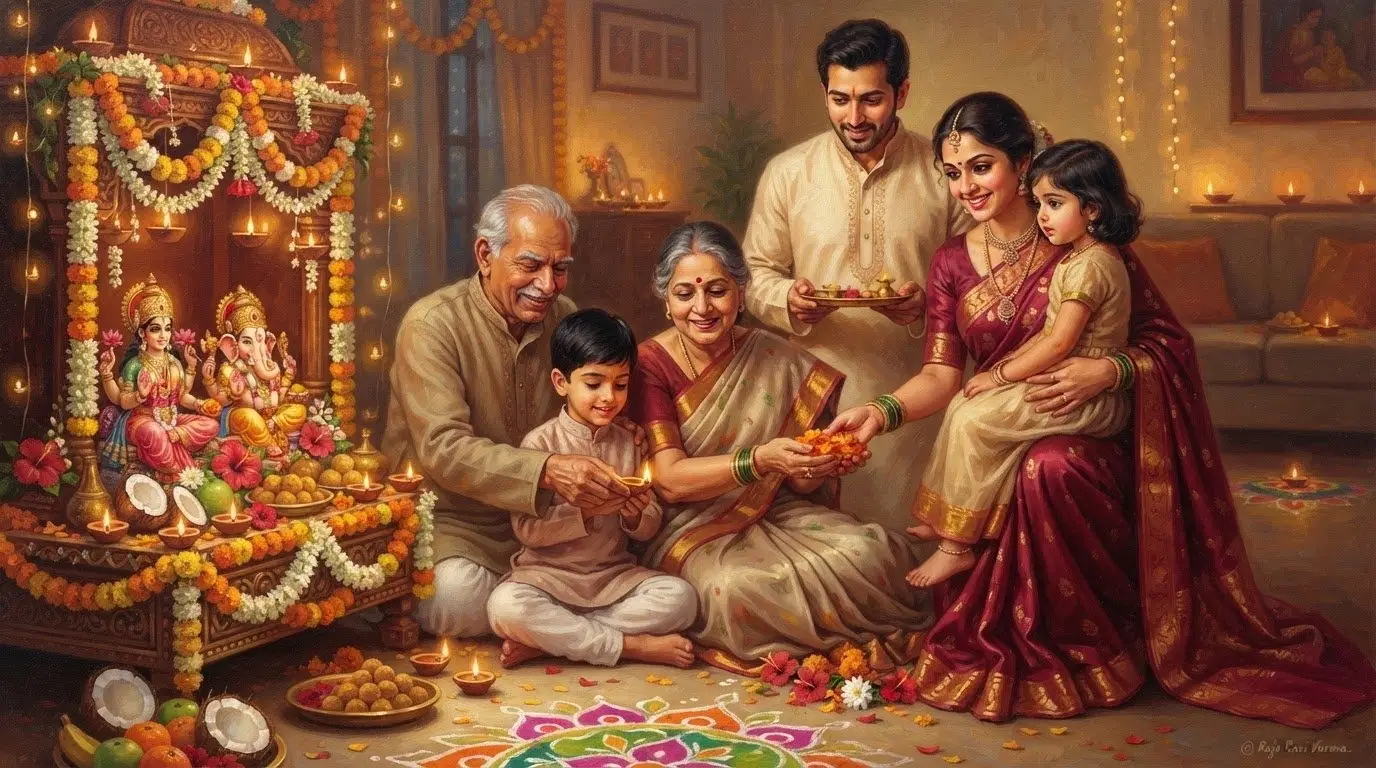
- Do involve the whole family in the aarti and lamp-lighting; the ritual is traditionally understood as a shared household act rather than a solitary one.
- Don't sweep, or discard rubbish and dust, out of the front door after nightfall on Diwali itself; many households believe this symbolically sweeps prosperity back out with it, and prefer to complete all sweeping before dusk.
- Don't argue, raise voices, or allow discord within the home during the evening, since a quarrelsome household is traditionally held to discourage the goddess from entering.
- Don't leave the idols or kalasha unattended once the puja has begun until the aarti is complete.
- Don't worship in worn or unwashed clothing; freshly laundered or new attire is preferred.
- Do exercise caution and responsibility with lamps, candles and any fireworks, keeping water or a fire extinguisher within reach, particularly in homes with children, pets or elderly family members.
Regional Variations
While the broad shape of Lakshmi Puja on Diwali night is recognised across the subcontinent, several regions observe genuinely distinct customs on the same night or the surrounding days.
Bengal, Odisha and Assam: Kali Puja
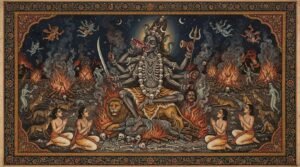
In Bengal, Odisha and Assam, the Amavasya night of Diwali is dedicated principally to Kali Puja rather than to Lakshmi worship in the North Indian style, honouring Goddess Kali with elaborate clay idols, tantric-influenced ritual, and, in many public pandals, worship continuing through the night. Households in these regions still generally observe Lakshmi worship as part of the wider festival season, often a few days earlier on Kojagari Lakshmi Puja, held on the full-moon night (Purnima) following Durga Puja, but the Amavasya night itself belongs to Kali in this cultural sphere. Readers curious about this fierce, contrasting form of the Devi may find our guide to Maa Kali a useful companion to understanding how Bengal's Diwali night differs from the rest of India.
South India: Naraka Chaturdashi and Local Custom
In much of South India, particularly Tamil Nadu, Karnataka and Andhra Pradesh, considerable emphasis falls on Naraka Chaturdashi, the day preceding Amavasya, which commemorates Krishna's defeat of the demon Narakasura and is marked by an early oil bath before sunrise, considered highly auspicious and cleansing. Lakshmi Puja on the Amavasya itself is still widely observed, often folded into the broader Diwali worship of the household deity, though the day is somewhat less singularly built around Lakshmi than in North Indian trading communities, and the emphasis on new account books is comparatively less pronounced outside mercantile families.
Western India: The Trading Calendar
In Gujarat and among trading communities more broadly, Lakshmi Puja on Diwali carries particularly strong commercial significance, marking the start of a new financial year (Bestu Varas the following day in the Gujarati calendar), with elaborate worship of account books, cash boxes and business premises, often exceeding the scale of the domestic home puja.
Benefits of Lakshmi Puja
Devotees and households associate a consistent set of benefits with sincere observance of Lakshmi Puja on Diwali night.
- Prosperity and financial stability - the most widely sought benefit, understood as blessing for the coming year's income, business and savings.
- Removal of obstacles to wealth - through the accompanying worship of Ganesha, difficulties believed to block the arrival or retention of prosperity are addressed alongside the request for wealth itself.
- Domestic harmony - the emphasis on a clean, orderly, peaceful home as a precondition for the goddess's presence encourages households to resolve disputes and restore order before the festival.
- A sense of renewal - the ritual of new clothes, cleaned homes, opened account books and fresh beginnings gives the night a strong psychological quality of a fresh start, independent of its devotional content.
- Strengthened family bonds - because the puja is almost always performed together as a household, it functions as an occasion for the whole family, including distant relatives who travel home for the festival, to gather and participate jointly.
- Continuity of tradition - for many families, performing the puja in the same manner as previous generations is itself valued as a form of connection to ancestors and cultural continuity, distinct from any specific material request.
Frequently Asked Questions
What is the correct date for Lakshmi Puja each year?
Lakshmi Puja falls on Amavasya, the new-moon night of the Hindu month of Kartik, which shifts each year according to the lunar calendar and typically occurs in October or November. The exact date and recommended muhurat should always be verified against a current, locally published panchang or a trusted priest, since regional almanacs can occasionally differ.
Why is Ganesha worshipped alongside Lakshmi on Diwali?
Ganesha is invoked at the start of any auspicious undertaking to remove obstacles, and his presence beside Lakshmi is also read as a reminder that wealth should be paired with wisdom and good judgement in its use, rather than pursued or held without discernment.
What is Pradosh Kaal, and why does it matter for Lakshmi Puja?
Pradosh Kaal is the period beginning around sunset and extending through early evening twilight, considered the most auspicious window for Lakshmi Puja. Astrologers further refine the exact recommended minutes within this window each year based on the prevailing lagna, which is why families are advised to follow a current year's published muhurat rather than a fixed clock time.
What items are essential if a full samagri list is not available?
At minimum, a clean altar space, images or idols of Lakshmi and Ganesha, a lit lamp, some flowers, and a sincere recitation of even a short mantra such as Om Shreem Mahalakshmyai Namah are considered sufficient; elaborate samagri enhances the ritual but sincerity and cleanliness matter more than a complete inventory.
Can Lakshmi Puja be performed without a priest?
Yes. Lakshmi Puja on Diwali night is overwhelmingly a home ritual led by family members, and it is entirely traditional and acceptable for a household to perform the full vidhi themselves, provided it is done with attention, cleanliness and sincerity.
Why do people avoid sweeping the house after dark on Diwali?
Many households believe that sweeping or removing rubbish through the front door after nightfall on Diwali symbolically sweeps prosperity back out of the home with it, and prefer to complete all cleaning before dusk, leaving only the lighting of lamps for the evening itself.
What is the significance of opening new account books on Diwali?
For trading and business communities, Diwali marks the start of a new financial year in several regional calendars, and opening fresh account books before Lakshmi on this night is believed to invite prosperity and honest, orderly dealings into the coming year's commerce.
How is Diwali night different in Bengal compared to North India?
In Bengal, Odisha and Assam, the Amavasya night of Diwali is dedicated principally to Kali Puja rather than Lakshmi worship in the North Indian style, with Lakshmi more commonly honoured a few days earlier during Kojagari Lakshmi Puja on the full-moon night following Durga Puja.
What should be done with the puja prasad afterwards?
The fruits and sweets offered during the puja are distributed among family members as prasad and, in many households, shared with neighbours and visitors, as a way of extending the evening's blessing beyond the immediate family.
Is it necessary to keep a lamp burning all night on Diwali?
Many households consider it auspicious to keep at least one lamp burning through the night as a continued welcome to the goddess, though this should always be balanced with basic fire safety, particularly in homes with children, pets or flammable decorations nearby.
However elaborate or simple the setup, the heart of Lakshmi Puja on Diwali remains the same small act repeated in millions of homes on the same dark night - a lamp lit, a door left open, and a family gathered to ask, together, for the year ahead to be gentle and abundant. If you would like the Om Jai Lakshmi Mata aarti and the Mahalakshmi mantras to accompany your own puja this year, Musinara offers 432 Hz recordings of both on our YouTube channel, recorded to sit quietly alongside your family's lamps.
Related reading
- Navratri and the Nine Forms of Navadurga: Nine Nights of the Divine Mother
- The Durga Chalisa: Meaning, Verses and How to Recite the Forty-Verse Hymn to the Mother
- Lalita Sahasranamam: Meaning, Structure and Benefits of the Thousand Names
- Goddess Durga: The Complete Guide to the Invincible Mother
In Bengal, Assam and Odisha the same night belongs to Kali. If your household keeps both, see our guide to Kali Puja 2026 and how it differs from Lakshmi Puja.