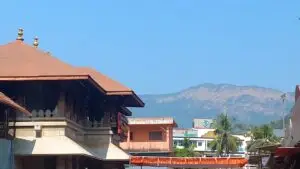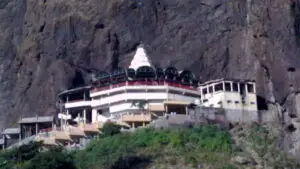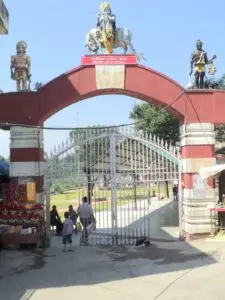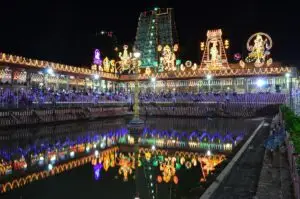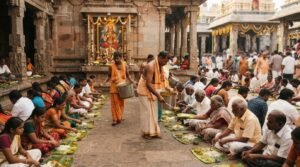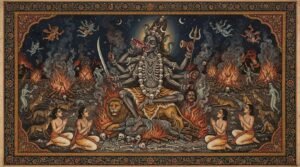
Kalighat and Dakshineswar are the two most revered Kali temples of Bengal, both located in Kolkata. Kalighat is an ancient Shakti Peetha where the toes of Sati's right foot fell, the shrine that gave Kolkata its name. Dakshineswar, built by Rani Rashmoni in 1855, is where Sri Ramakrishna realised the Divine Mother Bhavatarini face to face.
On the broad floodplain of the Hooghly, where the Ganga slows on her way to the sea, Bengal has cherished the worship of the Dark Mother for longer than memory records. Among all her shrines, two stand above the rest in fame and footfall: Kalighat in the crowded heart of south Kolkata, and Dakshineswar on the open eastern bank of the river. Together they welcome millions of pilgrims every year, and together they tell the story of how Maa Kali became the beloved guardian deity of this land.
These two temples are not rivals but companions. Kalighat is ancient, one of the fifty-one Shakti Peethas sanctified by the fall of Sati's right toes, the very shrine that lent Kolkata its name. Dakshineswar is younger, raised in 1855 by the indomitable Rani Rashmoni, yet it became the cradle of a spiritual renaissance when a young priest named Gadadhar, whom the world would come to know as Sri Ramakrishna Paramahamsa, wept before the image of Bhavatarini until the Mother herself answered.
This guide walks you through both temples with reverence and accuracy: their histories and legends, the deities enshrined within, the saint whose realization reshaped modern Hinduism, a side-by-side comparison, a Kali mantra to carry on the journey, and practical details for darshan, festivals and travel between the two.
Key Takeaways
- Kalighat is one of the 51 Shakti Peethas, where the toes of Sati's right foot are said to have fallen, and its goddess Kalika gave Kolkata its name.
- The present Kalighat temple was completed in 1809 by the Sabarna Roy Choudhury family, though the shrine appears in Bengali literature from the fifteenth century.
- Dakshineswar Kali Temple was raised between 1847 and 1855 by Rani Rashmoni, following a dream of the Divine Mother, and enshrines Kali as Bhavatarini.
- Sri Ramakrishna served as priest at Dakshineswar, attained God-realization there, and inspired Swami Vivekananda and the worldwide Ramakrishna movement.
- The two temples sit about 13 to 16 km apart in Kolkata and are linked directly by the Metro Blue Line, so pilgrims can comfortably visit both in one day.
Why Is Bengal the Heartland of Kali Worship?
Bengal turns to Kali the way most of India turns to Lakshmi. On the night of Diwali, while lamps are lit for the goddess of fortune elsewhere, Bengal, Assam and Odisha worship the fierce and tender Mother who dances upon time itself. This devotion has ancient roots, from Tantric lineages and medieval poet-saints like Ramprasad Sen to the great nineteenth-century awakening centred on Dakshineswar.
Kolkata alone holds two temples that have become synonymous with the Goddess. Kalighat represents continuity: a living shrine on a site venerated for many centuries, woven into the oldest layers of the city's identity. Dakshineswar represents renewal: a grand temple complex barely two centuries old that became the stage for one of the most extraordinary spiritual lives in modern history.
To visit both is to experience the full arc of Bengal's relationship with Kali, the timeless and the transformative, the Peetha and the place of realization. Pilgrims often pair the two in a single journey, and this guide is arranged to help you do exactly that, beginning with the elder of the two shrines.
What Makes Kalighat Kali Temple So Sacred?
Kalighat is sacred on three counts: it is counted among the 51 Shakti Peethas where the toes of Sati's right foot fell, it enshrines the fierce yet compassionate goddess Kalika, and it is the shrine from which Kolkata itself most likely took its name. Few temples in India carry such weight of legend, history and living devotion at once.
How Old Is Kalighat?
Kalighat is among the oldest and most revered Kali temples in India. Its name appears in literary works centuries old, in the fifteenth-century Manasar Bhasan and in seventeenth-century Bengali poetry, testifying to a shrine already famous long before the present structure stood. The temple pilgrims see today was completed in 1809 by the Sabarna Roy Choudhury family of Barisha, the original zamindars of the villages that grew into Kolkata.
A beloved tradition tells of a devotee named Atmaram who, guided by a beam of light from the waters of the Bhagirathi-Hooghly, discovered a stone in the shape of a human toe together with a self-manifested Shiva lingam known as Nakuleshwar. He began worshipping them on the riverbank, and from that humble shrine grew the great temple of Kalighat. In 2024, after more than two centuries, the temple received its first major modern renovation.
Why Is Kalighat a Shakti Peetha?
Kalighat is counted among the fifty-one Shakti Peethas, the sacred sites where parts of the body of the goddess Sati are said to have fallen to earth. The story is one of the most moving in Hindu tradition. Sati, daughter of Daksha and consort of Shiva, gave up her life when her father insulted her husband at a great sacrifice. Overcome with grief, Shiva took up her body and began the Tandava, the cosmic dance of destruction that threatened to unmake the worlds. You can read the full story in our guide to the Sati and Daksha Yagna legend.
To halt the dance and release Shiva from his sorrow, Vishnu sent forth his Sudarshana Chakra, which divided Sati's body into many parts. Wherever a part came to rest, a Shakti Peetha was consecrated. According to the Devi Bhagavata Purana, the Kalika Purana and the Shakti Peetha tradition, the toes of Sati's right foot fell at Kalighat, and so this place became forever sacred to the Goddess. Explore all these holy sites in our complete guide to the 51 Shakti Peethas.
Who Is the Goddess Kalika, and Did She Name Kolkata?
The presiding deity of Kalighat is Kalika, a singular and striking image: a face of black-touched stone with three large eyes, a long protruding golden tongue, and four hands. She is fierce in aspect yet adored as the most compassionate of mothers, the one who devours fear and ego so that the devotee may stand free. Counted among the ten Mahavidyas of the Tantric tradition, Kalika at Kalighat receives worship in the full intensity of the Shakta path.
It is from this Kalika and her ghat, the riverside landing, that the area took the name Kalighat. By the most widely held account, the great metropolis itself drew its name from it: Kalikata, anglicised to Calcutta and today Kolkata. To stand before Kalika, then, is to stand at the namesake source of the city.
What Does the Temple Look Like?
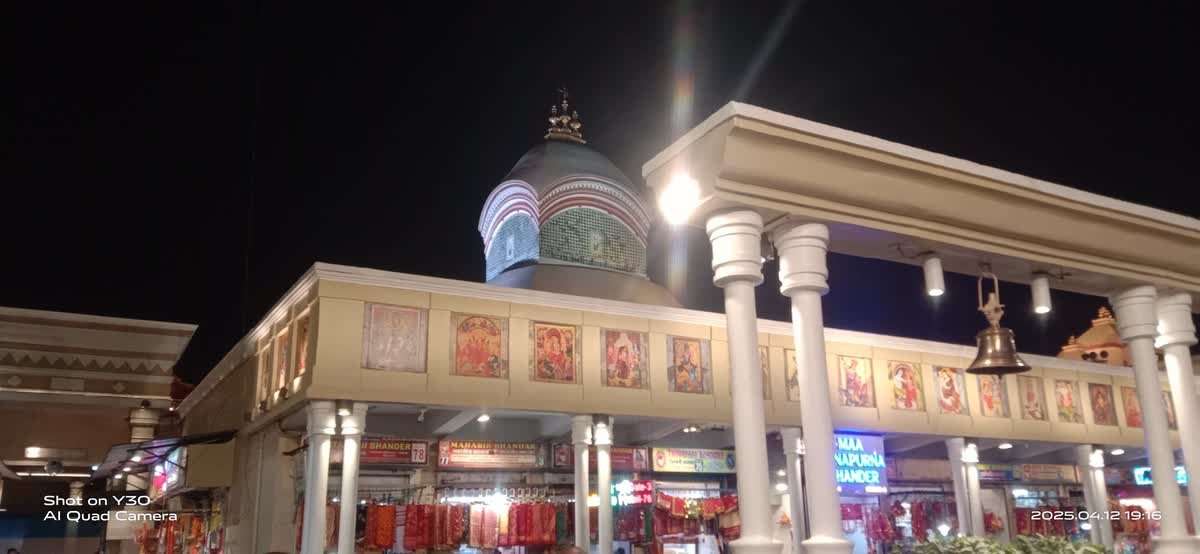
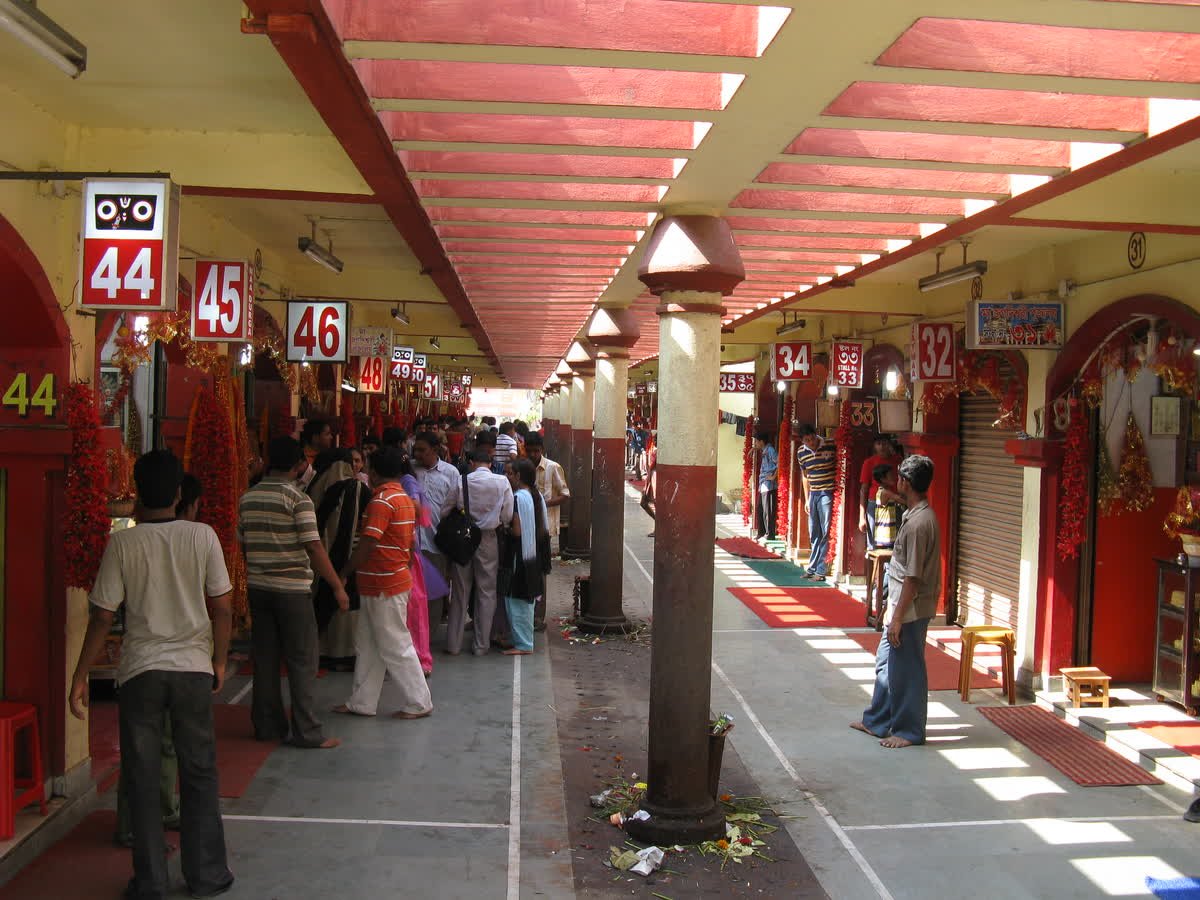
The temple is built in the classic Bengali aatchala style, a curved, eight-roofed form crowned with finials, rising on a substantial masonry base. The sanctum holding the image of Kalika is the spiritual centre, approached through a busy courtyard alive with priests, garland-sellers and the unceasing flow of devotees.
Within the wider complex stand the Nakuleshwar Shiva temple, the shrine of Radha-Govinda, the Harkath tala (the sacrificial post), the Sosthi tala, and the natmandir, the pillared hall before the sanctum. The nearby Adi Ganga, an old course of the river, completes the sacred geography.
Who Built Dakshineswar Kali Temple and Why?
Dakshineswar Kali Temple was built by Rani Rashmoni, a wealthy zamindar and ardent devotee of Kali, between 1847 and 1855, and consecrated in 1855. Tradition holds that the Divine Mother appeared to her in a dream, asking her to install the Goddess in a beautiful temple on the banks of the Ganga instead of journeying to Kashi.
The Dream of Rani Rashmoni
The story of Dakshineswar begins on the eve of a pilgrimage. Rani Rashmoni had prepared to travel to Kashi (Varanasi) when, tradition says, the Divine Mother came to her in a dream and told her there was no need to journey to Banaras. She should instead install an image of the Goddess in a splendid temple on the Ganga and arrange for her worship there. Moved by the vision, Rashmoni acquired land on the eastern bank of the Hooghly and built the great temple complex.
That Rani Rashmoni, a woman and a member of a community then considered low in the rigid social order, founded so magnificent a temple was itself remarkable. Her devotion, generosity and quiet defiance of convention made Dakshineswar a temple open in spirit as well as in stone.
Who Is Bhavatarini?
The presiding deity of Dakshineswar is Bhavatarini, a tender name for Kali meaning "she who liberates her devotees from the ocean of worldly existence (bhava)." She is a form of Adya Kali, the primordial Shakti. The image stands upon the reclining form of Shiva, set upon a thousand-petalled silver lotus, the classic iconography of the Goddess as the dynamic power that animates even the divine. Before this image the young Ramakrishna would spend his days and nights in longing.
The Navaratna Temple and the Twelve Shiva Temples
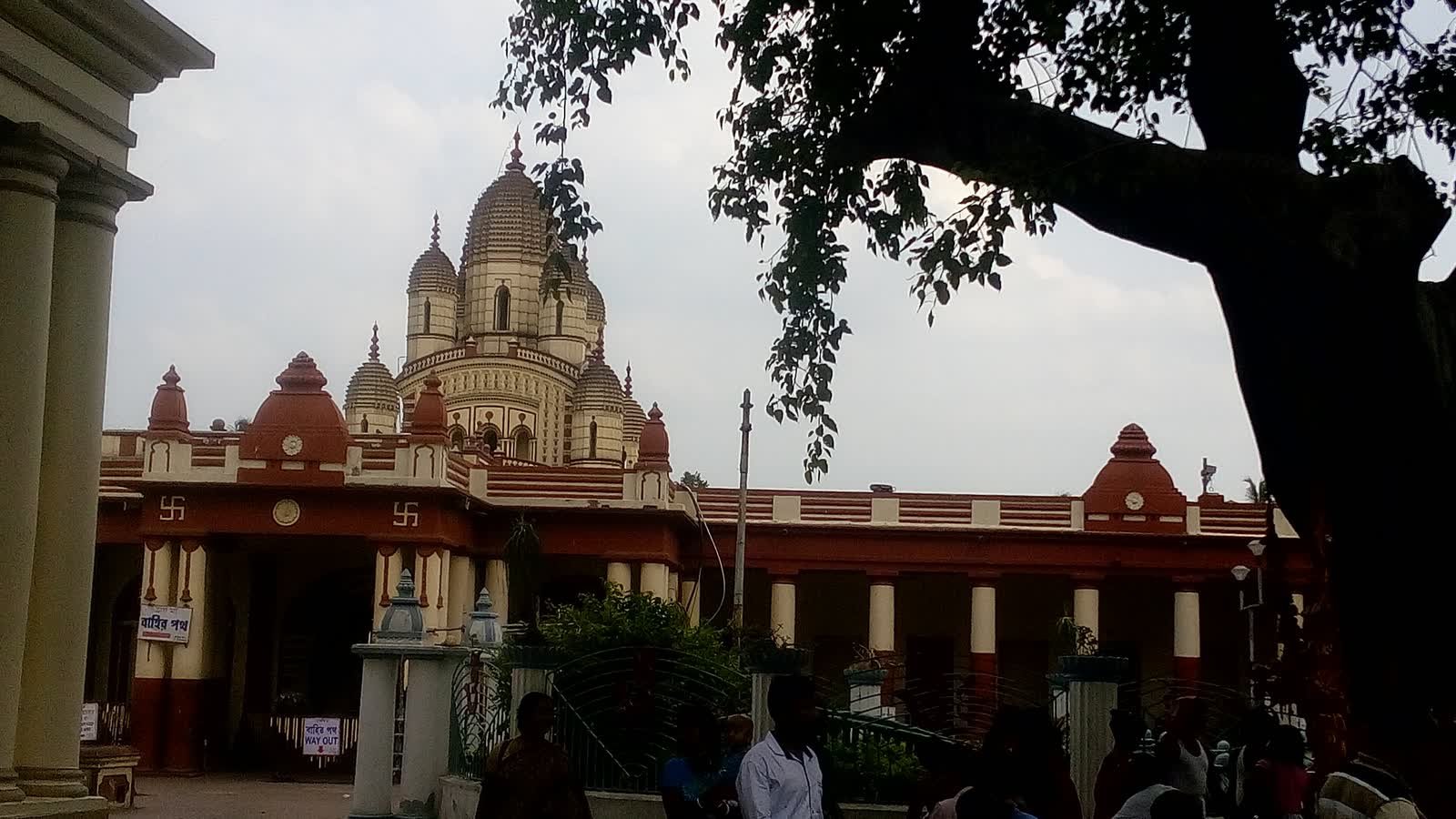
Dakshineswar is a masterpiece of Bengal temple architecture in the navaratna or "nine-jewelled" style. The three-storeyed, south-facing temple carries nine spires across its upper two storeys, stands on a high platform reached by a flight of steps, measures roughly fourteen metres square, and rises more than thirty metres high.
Along the riverfront stretches one of the most distinctive features of the complex: a row of twelve identical temples, each enshrining a Shiva lingam, arranged in two groups flanking the bathing ghat. Beyond them stand a temple to Radha-Krishna, the bathing ghat on the Ganga, the residence and shrine of Rani Rashmoni, and the modest room where Sri Ramakrishna lived, today a place of pilgrimage in its own right.
What Is Sri Ramakrishna's Connection to Dakshineswar?
Sri Ramakrishna served as priest of the Kali temple at Dakshineswar from the 1850s. There he undertook years of intense sadhana, attained God-realization through many spiritual paths, and taught the harmony of all religions. His life at Dakshineswar inspired Swami Vivekananda and gave rise to the worldwide Ramakrishna movement.
The Priest Who Longed for the Mother
In 1855, a young man named Gadadhar Chattopadhyay came to the newly built Dakshineswar temple, first assisting his elder brother Ramkumar, the head priest, and soon taking up the worship of Bhavatarini himself. He was not content with ritual alone. He wanted to see the Mother, to know her as a living presence and not merely a stone image. His longing grew so consuming that he could neither eat nor sleep, weeping before the Goddess and crying out for a single glimpse of her.
Tradition recounts that at the height of this anguish he seized a sword kept in the sanctum, ready to end a life that seemed unbearable without her. In that instant the Mother revealed herself as a boundless ocean of luminous consciousness that swept over him. From that day his God-realization deepened through years of intense sadhana at Dakshineswar.
Sadhana, Realization and the Harmony of Religions
Ramakrishna's spiritual practice was extraordinary in both depth and breadth. Over more than a decade he pursued numerous paths, the Tantric, the Vaishnava and the Vedantic, and by his own testimony realized God through each. He later took instruction in Islam and reflected on the life of Christ, declaring from direct experience that the many religions are so many paths to the one Reality. This message of harmony, born in the temple room at Dakshineswar, would echo across the world.
Vivekananda and the Ramakrishna Movement
Among the seekers drawn to Dakshineswar was a brilliant, sceptical young man named Narendranath Datta. Tested and transformed by the saint's love and spiritual power, he became Ramakrishna's foremost disciple and, as Swami Vivekananda, carried the message of Vedanta to the West, most famously at the 1893 Parliament of the World's Religions in Chicago.
Together with Sarada Devi, Ramakrishna's wife and spiritual companion revered as the Holy Mother, this circle gave rise to the Ramakrishna movement and the Ramakrishna Math and Mission, with its great centre at nearby Belur Math. Dakshineswar thus stands not only as a temple but as the wellspring of a worldwide spiritual current.
How Do Kalighat and Dakshineswar Compare?
Kalighat is the ancient Shakti Peetha in south Kolkata, built in the Bengali aatchala style and enshrining the self-manifested Kalika. Dakshineswar is the nineteenth-century navaratna temple on the Hooghly's eastern bank, enshrining Bhavatarini and forever linked to Sri Ramakrishna. The table below sets them side by side.
| Aspect | Kalighat Kali Temple | Dakshineswar Kali Temple |
|---|---|---|
| Antiquity | Among the oldest Kali shrines; present temple completed 1809, with literary references centuries earlier | Comparatively modern; built between 1847 and 1855 |
| Founder | Sabarna Roy Choudhury family of Barisha | Rani Rashmoni, a zamindar and devotee of Kali |
| Presiding deity | Kalika, a fierce, swayambhu (self-manifested) form | Bhavatarini, "she who liberates the universe," a form of Adya Kali |
| Sacred status | One of the 51 Shakti Peethas (Sati's right toes) | A great Kali temple, not a Shakti Peetha |
| Architecture | Bengali aatchala (eight-roofed) style | Navaratna (nine-spired) style on a raised platform |
| Setting | Dense old quarter of south Kolkata, near the Adi Ganga | Open riverfront on the eastern bank of the Hooghly |
| Saintly link | Centuries of Shakta and Tantric devotion | Sri Ramakrishna's sadhana and God-realization |
| Subsidiary shrines | Nakuleshwar Shiva, Radha-Govinda and others | Twelve Shiva temples, a Radha-Krishna temple, bathing ghats |
In short: Kalighat is the ancient Shakti Peetha that names the city and embodies the raw, living continuity of Shakta devotion; Dakshineswar is the grand riverside temple where, in living memory, a saint saw the Mother face to face. Each completes the other.
What Is the Spiritual Significance of These Kali Temples?
Kalighat and Dakshineswar embody two faces of Kali's truth. At Kalighat, the worshipper meets Kali as the immemorial Peetha-power rooted in the soil of Bengal. At Dakshineswar, the worshipper meets Kali as the intimate Mother who answers the cry of the heart, proven in the living realization of Sri Ramakrishna.
To the devotee, Kali is far more than her fierce iconography suggests. Her dark form is the formless void beyond creation, her sword cuts away ignorance and ego, and her lolling tongue and garland of severed heads proclaim victory over the fear of death itself. She is Adi Shakti, the primordial energy from which Brahma, Vishnu and Shiva arise, the Mother who both destroys and protects. She stands first among the ten great wisdom goddesses described in our Das Mahavidya origin story.
For the seeker, a pilgrimage to both temples is a movement from awe to intimacy: from the towering mystery of the Shakti Peetha to the tender accessibility of the Mother who liberates. Many pilgrims find that the two temples, taken together, teach the whole of Bengal's wisdom about the Goddess.
Which Kali Mantra Should You Chant at These Temples?
The Beej (seed) mantra of Maa Kali, Om Kreem Kalikayai Namah, is the mantra most devotees carry to Kalighat and Dakshineswar. Its seed syllable Kreem holds her entire essence: the energy of Kali, the fire of transformation and the vibration of dissolution. Chant it with devotion before darshan at either temple.
| Aspect | Kali Beej Mantra |
|---|---|
| Sanskrit | ॐ क्रीं कालिकायै नमः |
| Hindi | ओम् क्रीं कालिकायै नमः |
| Transliteration | Om Kreem Kalikayai Namah |
| Meaning | I bow to Goddess Kalika (Kali), who embodies the seed syllable Kreem - the primordial sound of transformation, fierce compassion and divine power. |
Traditionally the mantra is chanted 108 times using a rudraksha mala, facing south or east, ideally during the Brahma Muhurta (the pre-dawn hour) or at midnight. Beginners may start with a single mala daily and increase gradually. This universally accessible Beej mantra needs no initiation; deeper Tantric mantras are given by a guru through diksha.
What Has Changed at Kalighat Recently?
Kalighat has just had its largest renovation in two centuries. In 2024 the temple, established in 1809, received its first major restoration of the modern era, at a budget of about ₹200 crore: ₹165 crore from the Kolkata Municipal Corporation and ₹35 crore from the Reliance Foundation. The work kept the temple’s terracotta aath-chala architecture intact rather than rebuilding it. (Source.)
Getting there has changed too. On 14 April 2025 Chief Minister Mamata Banerjee opened a skywalk to the temple, 435 metres long and 10.5 metres wide. It was budgeted at ₹77 crore and finished at about ₹90 crore after delays. (Source.)
How Do You Reach Kalighat and Dakshineswar?
Open Kalighat in Google Maps · Open Dakshineswar in Google Maps for live directions from where you are.
Both temples lie within Kolkata and are easy to reach by air, train or road. The city is served by Netaji Subhas Chandra Bose International Airport, the major railheads of Howrah Junction and Sealdah, and an extensive Metro and bus network. The Metro Blue Line connects the two shrines directly.
| Detail | Kalighat Kali Temple | Dakshineswar Kali Temple |
|---|---|---|
| Location | Kalighat Road, central-south Kolkata, near the Adi Ganga | Dakshineswar Road, eastern bank of the Hooghly, north Kolkata |
| Nearest airport | Netaji Subhas Chandra Bose International Airport, about 17 km; prepaid taxis and app cabs available | Same airport, about 20 km; taxis and Metro connect it |
| Rail | Kalighat Metro Station (Blue Line), a five-minute walk; Howrah and Sealdah serve as railheads | Dakshineswar Metro station and suburban Dakshineswar railway station nearby; Howrah roughly 10 km |
| Road | Buses, autos and taxis from every part of the city | Regular buses from Esplanade; ferry crossing from Belur Math |
| Timings | Generally open from around 5:00 a.m. until late evening, with a short midday interval; hours extend on festivals | Summer roughly 5:30 a.m. to 11:30 a.m. and 3:30 p.m. to 9:00 p.m.; winter roughly 6:00 a.m. to 12:30 p.m. and 3:00 p.m. to 8:30 p.m.; confirm on festival days |
| Entry fee | Free | Free |
How Do You Travel Between the Two Temples?
The two temples sit at opposite ends of the city, Dakshineswar in the north by the river and Kalighat in the south. But a single Metro corridor and plentiful taxis make pairing them in one day entirely practical.
| Quick Facts | Details |
|---|---|
| Distance apart | Roughly 13 to 16 km across the city; allow 45 to 90 minutes by road depending on traffic |
| By Metro | Kalighat (Blue Line) to Dakshineswar (Blue Line): a direct north-south Metro corridor connects both |
| By taxi / cab | App cabs and yellow taxis run between the two; the most comfortable option for pilgrims |
| By river | Ferries on the Hooghly link Dakshineswar with Belur Math and central ghats for a scenic leg |
| Suggested plan | Begin early at Dakshineswar (riverside, cooler mornings), then travel south to Kalighat by midday |
Tips for a Smooth Darshan
- Visit early on weekday mornings to avoid the heaviest crowds, especially at Kalighat.
- Dress modestly; both are active places of worship with deep ritual life.
- Be wary of unofficial "guides" and priests who press for large donations; offer only what you wish.
- Keep footwear and valuables at the designated stalls; photography inside sanctums is usually restricted.
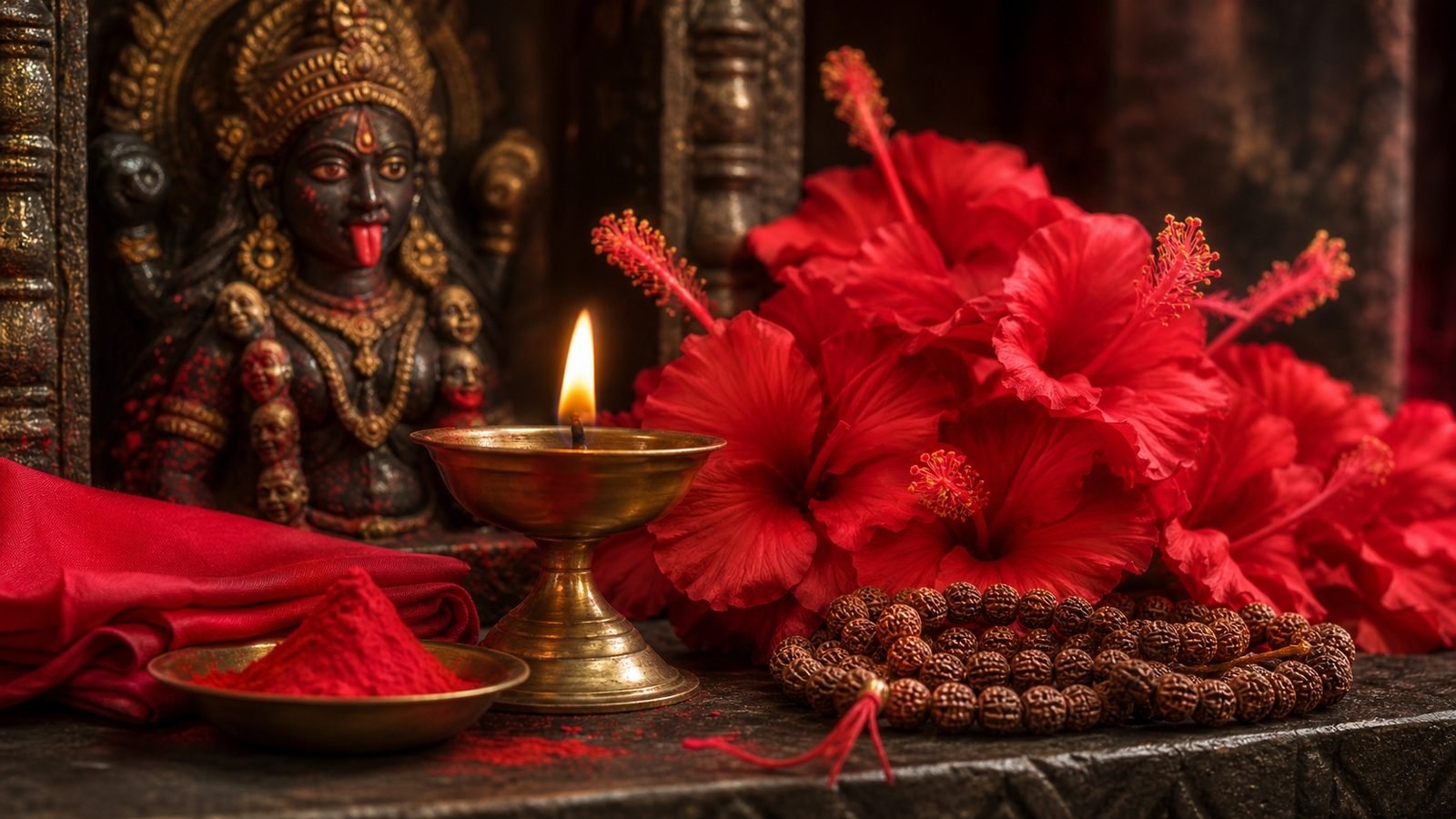
- Red hibiscus flowers, sweets, coconut and a red cloth are traditional offerings to the Goddess.
- Plan around festival days for the most vibrant atmosphere. But expect very large crowds and longer queues.
When Are the Major Festivals at Kalighat and Dakshineswar?
The greatest festival at both temples is Kali Puja, held on the new-moon night of Kartik (October to November), coinciding with Diwali. Dakshineswar also observes Snana Yatra and Phalaharini Kali Puja in May to June, while Navratri, Amavasya nights, Tuesdays and Saturdays draw large gatherings year-round.
Kali Puja (Diwali)
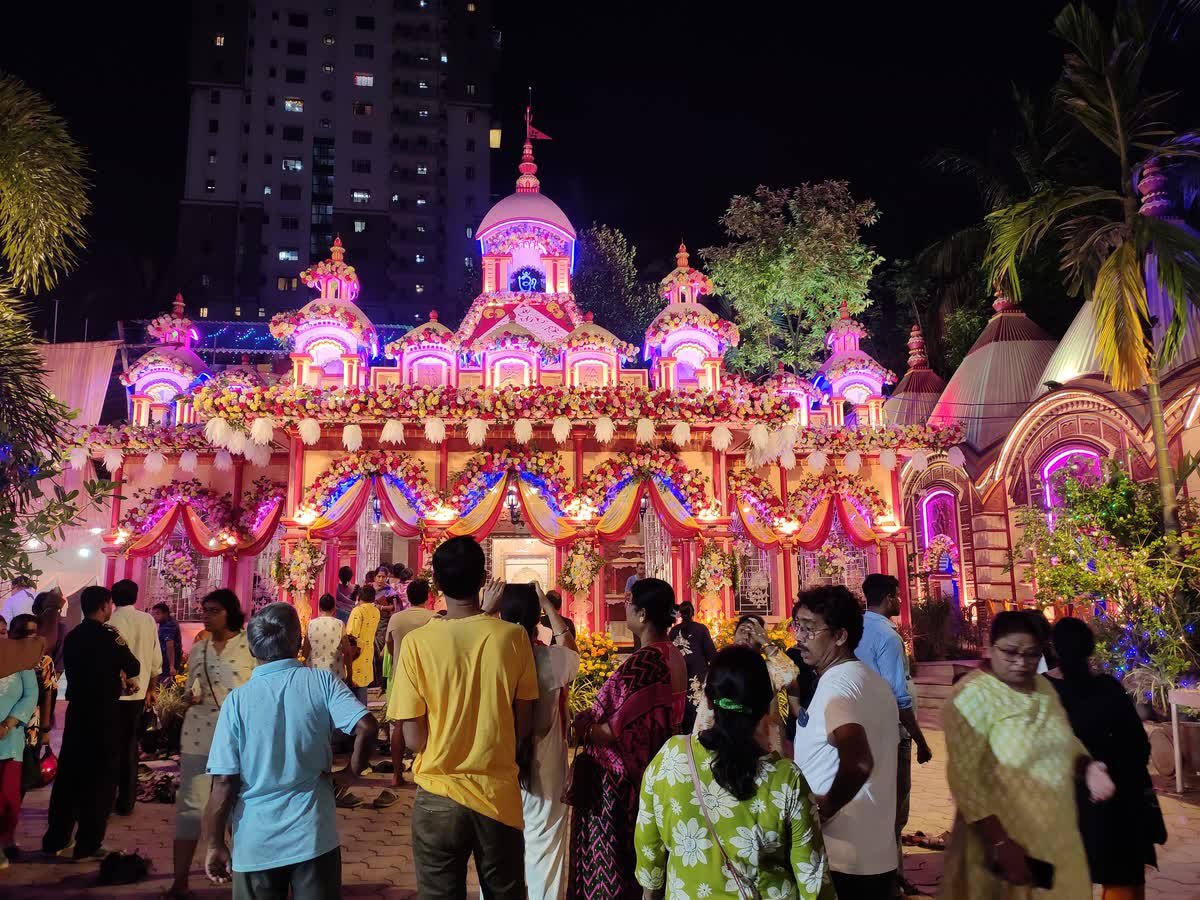
On the new-moon night of the month of Kartik, while much of India worships Lakshmi, Bengal turns to Kali. The temples are illuminated, special pujas continue through the dark hours, and the whole city pulses with devotion as elaborate pandals rise across Kolkata. Pilgrims who can brave the crowds find it the most powerful night of the year to seek the Mother's grace.
Snana Yatra and Phalaharini Kali Puja
At Dakshineswar, the annual Snana Yatra, the ceremonial bathing of the deity, falls in the Bengali month of Jyaistha (May to June) and is observed with great devotion. The same season brings Phalaharini Kali Puja, held on the new-moon night of Jyaistha. For devotees of Sri Ramakrishna this day carries special meaning, associated with the worship the Master offered to Sarada Devi as the living Divine Mother.
Navaratri and Other Occasions
Navaratri, particularly its early nights dedicated to the fierce forms of the Goddess, draws large gatherings, as do Amavasya (new-moon) nights and Tuesdays and Saturdays, traditionally sacred to Kali. Throughout the year, both temples maintain a daily rhythm of aarti, bhog (sanctified food) and worship that the visiting pilgrim is warmly welcome to share.
Listen: Maa Kali mantra chanting by Musinara Sounds - 432 Hz devotional music for your darshan journey
🕉️ Hear these sacred mantras come alive. Subscribe to Musinara Sounds on YouTube for 432 Hz Devi mantra chants, sung slowly enough to follow and repeat.
Plan Your Visit to Kalighat: Timings, Tickets and Travel
The details below were checked on 3 October 2026 against the sources listed under each table. Timings and fees change on festival days, eclipses and special occasions, so confirm with the temple before you travel.
For what happens here during Navratri 2026 (11 to 19 October), see Navratri 2026 at major Devi temples.
Darshan and Aarti Timings
| Information | Details |
|---|---|
| Temple opens | 5:00 am |
| Afternoon closure | About 2:00 pm to 5:00 pm, when bhog is offered |
| Evening closing | Between 9:00 pm and 11:30 pm, depending on the day. Timings vary, so confirm locally. |
| Busy days | Tuesdays and Saturdays are crowded. Hours may change on festival days. |
Sources: Incredible India (Ministry of Tourism, Govt of India): Kalighat Temple Kolkata, Kolkata Tourism (kolkatatourism.travel): Kalighat Kali Temple Kolkata, YatraDham: Kalighat Temple Timings, Darshan Pass & History.
Tickets, Darshan Options and Sevas
| Option | Price | Notes |
|---|---|---|
| General darshan | Free | No entry fee. |
Darshan is free. There is no entry fee. General darshan is by queue. Timings are not published on an official temple website, so confirm them locally on the day.
Sources: Kolkata Tourism (kolkatatourism.travel): Kalighat Kali Temple Kolkata, YatraDham: Kalighat Temple Timings, Darshan Pass & History.
Temple Rules and Dress Code
- Dress modestly. Sarees or other traditional wear are best. Shorts, sleeveless tops and short skirts are not suitable.
Source: YatraDham: Kalighat Temple Timings, Darshan Pass & History.
How to Reach Kalighat
| Mode | Nearest point | Distance to the temple |
|---|---|---|
| Air | Netaji Subhas Chandra Bose International Airport (Dum Dum) | |
| Rail | Howrah Junction and Sealdah are the main stations | |
| Bus | Kalighat bus station, on the Shyama Prasad Mukherjee Road side |
Sources: Kolkata Tourism (kolkatatourism.travel): Kalighat Kali Temple Kolkata, Incredible India (Ministry of Tourism, Govt of India): Kalighat Temple Kolkata.
Approximate distances and journey times from the cities most pilgrims start from. Road times assume normal traffic; festival weekends take longer.
| From | By road | Road time | Train or flight |
|---|---|---|---|
| Howrah station | Metro: Green Line from Howrah to Esplanade, then the Blue Line to Kalighat or Jatin Das Park. Check current fares and timings with Kolkata Metro. | ||
| Sealdah station | Metro: Green Line from Sealdah to Esplanade, then the Blue Line to Kalighat or Jatin Das Park. Check current fares and timings with Kolkata Metro. |
Sources: YoMetro: Kalighat Kali Temple nearest metro station, TrackMyMetro: Howrah to Kalighat metro route, TrackMyMetro: Kalighat to Sealdah metro route.
The nearest metro stations are on the Blue Line: Jatin Das Park and Kalighat, each about a 7 minute walk from the temple. A skywalk, 435 m long and 10.5 m wide, opened on 14 April 2025. It has entry points on S P Mukherjee Road and Hazra Road, leads to Kali Temple Road, and has lifts, escalators and stairs. Buses run towards south Kolkata along Shyama Prasad Mukherjee Road.
When to Go and How Long to Allow
October to February is more comfortable. January is the coolest month and May the warmest. Weekday mornings are usually quieter. Tuesdays, Saturdays and festival days are crowded.
Sources: Incredible India (Ministry of Tourism, Govt of India): Kalighat Temple Kolkata, Kolkata Tourism (kolkatatourism.travel): Kalighat Kali Temple Kolkata, YatraDham: Kalighat Temple Timings, Darshan Pass & History.
Temples and Places Near Kalighat
- Jatin Das Park metro station: Blue Line station, about 7 minutes on foot
- Kalighat metro station: Blue Line station, about 7 minutes on foot
Source: YoMetro: Kalighat Kali Temple nearest metro station.
Plan Your Visit to Dakshineswar: Timings, Tickets and Travel
The details below were checked on 3 October 2026 against the Dakshineswar Kali Temple Board of Trustees and the other sources listed under each table. Timings and fees change on festival days, eclipses and special occasions, so confirm with the temple before you travel.
Darshan and Aarti Timings
| Information | Details |
|---|---|
| Mangal aarti | 4:00 am |
| Morning darshan | 6:30 am to 12:30 pm |
| Afternoon closure | 12:30 pm to 3:30 pm. Annabhog is offered at 12:30 pm. |
| Evening darshan | 3:30 pm to 7:30 pm |
| Sandhya aarti | 6:30 pm |
| Shital bhog and shayan | 8:00 pm |
| Timing changes | The Board of Trustees can change the timings when required. Check dakshineswarkalitemple.org. |
Source: Dakshineswar Kali Temple Board of Trustees: Dakshineswar Kali Temple official....
Tickets, Darshan Options and Sevas
| Option | Price | Notes |
|---|---|---|
| Entry | Free | No entry fee. |
There is no entry fee. Devotees follow the darshan queues. Bookings are handled on dakshineswarkalitemple.org. The official website does not offer online darshan booking. Temple office: phone (033) 2564-5222; email dakshineswarkalitemple@yahoo.com; address Dakshineswar, Kolkata 700035. Musinara is not connected with the temple and does not take bookings.
Sources: Kolkata Tourism (kolkatatourism.travel): Dakshineswar Kali Temple Kolkata, Dakshineswar Kali Temple Board of Trustees: Dakshineswar Kali Temple official....
Temple Rules and Dress Code
- Remove footwear at the designated stalls and deposit bags before entry.
- Photography is prohibited inside the sanctum.
- Dress modestly, keep silence and follow the darshan queues.
- Do not carry leather items or large bags near the sanctum.
Source: Dakshineswar Kali Temple Board of Trustees: Dakshineswar Kali Temple official....
How to Reach Dakshineswar
| Mode | Nearest point | Distance to the temple |
|---|---|---|
| Air | Netaji Subhas Chandra Bose International Airport (Dum Dum) | about 15 km, 30 to 40 minutes by road |
| Rail | Dakshineswar railway station (Sealdah to Dankuni line), joined to the temple by a skywalk | |
| Bus | Dakshineswar Bus Terminal, near the metro station |
Sources: Kolkata Tourism (kolkatatourism.travel): Dakshineswar Kali Temple Kolkata, Yogoda Satsanga Society of India: How to Reach Dakshineswar YSS Ashram, Dakshineswar Kali Temple Board of Trustees: Dakshineswar Kali Temple official..., Wikipedia: Dakshineswar metro station.
Approximate distances and journey times from the cities most pilgrims start from. Road times assume normal traffic; festival weekends take longer.
| From | By road | Road time | Train or flight |
|---|---|---|---|
| Howrah station | about 15 to 20 km | Take a taxi from the station, or a local train to Uttarpara and then the ferry across the river. | |
| Sealdah station | Take a Dankuni-bound local train from Sealdah to Dakshineswar station, then walk or use the skywalk. | ||
| Kolkata airport (CCU) | about 15 km | 30 to 40 minutes | |
| Esplanade (central Kolkata) | Blue Line metro from Esplanade to Dakshineswar took about 32 minutes when the line opened in 2021 (Outlook Traveller). |
Sources: Kolkata Tourism (kolkatatourism.travel): Dakshineswar Kali Temple Kolkata, Yogoda Satsanga Society of India: How to Reach Dakshineswar YSS Ashram, Dakshineswar Kali Temple Board of Trustees: Dakshineswar Kali Temple official..., Outlook Traveller: Dakshineswar Connected to Kolkata by Metro Rail.
Dakshineswar metro station is the northern end of the Blue Line, about 300 m from the temple and next to Dakshineswar railway station. A skywalk from the railway station leads to the temple gate. It is 340 m long and 10 m wide, with escalators and lifts. Ferries run from Ma Bhabotarini Jetty Ghat, about 350 m from the metro station, to Uttarpara, Belur Math, Bagbazar and Howrah. The temple website also mentions a ferry between Chandni Ghat and Belur Math. Parking is available near the skywalk.
When to Go and How Long to Allow
Tuesdays and Saturdays are the busiest days. The main festivals are Phalaharini Kali Puja (Jyeshtha new moon), Dipanwita Kali Puja (Kartika new moon, the most widely celebrated) and Ratanti Kali Puja (Magha Krishna Chaturdashi).
Sources: Dakshineswar Kali Temple Board of Trustees: Dakshineswar Kali Temple official..., Kolkata Tourism (kolkatatourism.travel): Dakshineswar Kali Temple Kolkata.
Prasadam, Annadanam and Where to Stay
Annabhog is offered to the Goddess at 12:30 pm and Shital Bhog at 8:00 pm.
Source: Dakshineswar Kali Temple Board of Trustees: Dakshineswar Kali Temple official....
Temples and Places Near Dakshineswar
- Belur Math: Across the Hooghly river, reached by ferry
- Ma Bhabotarini Jetty Ghat: About 350 m from the metro station; ferries to Belur Math, Uttarpara, Bagbazar and Howrah
Sources: Dakshineswar Kali Temple Board of Trustees: Dakshineswar Kali Temple official..., Wikipedia: Dakshineswar metro station.
Frequently Asked Questions
Why is Kalighat one of the 51 Shakti Peethas?
According to the Devi Bhagavata and Kalika Puranas, the toes of Sati's right foot fell at Kalighat when Vishnu's Sudarshana Chakra divided her body. Each place where a part fell became a Shakti Peetha, and Kalighat is among the most revered of them.
Did Kolkata get its name from Kalighat?
By the most widely held account, yes. The presiding goddess Kalika and her ghat gave the area the name Kalighat, and from it the city took the name Kalikata, anglicised to Calcutta and now Kolkata.
Who built the Dakshineswar Kali Temple and when?
It was built by Rani Rashmoni, a zamindar and great devotee of Kali, between 1847 and 1855, and consecrated in 1855 following a vision of the Divine Mother who asked her to build on the banks of the Ganga.
Who is Bhavatarini?
Bhavatarini is the presiding deity of Dakshineswar, a form of Adya Kali whose name means "she who liberates her devotees from the ocean of worldly existence." The image stands upon the reclining Shiva on a thousand-petalled silver lotus.
What is Sri Ramakrishna's connection to Dakshineswar?
Sri Ramakrishna served as priest of the Kali temple at Dakshineswar from the 1850s. There he undertook intense sadhana, attained God-realization through many spiritual paths, and taught the harmony of all religions, inspiring Swami Vivekananda and the Ramakrishna movement.
How many Shiva temples are at Dakshineswar?
Twelve. A row of twelve identical temples, each housing a Shiva lingam, lines the riverfront in two groups flanking the bathing ghat, alongside a Radha-Krishna temple and Rani Rashmoni's shrine.
Which Kali mantra can I chant at these temples?
The Beej mantra Om Kreem Kalikayai Namah (ॐ क्रीं कालिकायै नमः) is universally accessible and ideal for devotees. Chant it 108 times with a mala, facing south or east; deeper Tantric mantras traditionally require initiation from a guru.
How do I travel between Kalighat and Dakshineswar?
They are about 13 to 16 km apart and linked directly by the Kolkata Metro Blue Line, as well as by taxis and app cabs; ferries on the Hooghly also serve Dakshineswar. Most pilgrims comfortably visit both in one day.
When is the best time to visit Kalighat and Dakshineswar?
Early weekday mornings are calmest. The most spiritually charged time is Kali Puja on the new-moon night of Kartik (around Diwali), though crowds are very large; Tuesdays, Saturdays and Amavasya nights are also auspicious.
What should I offer to the Goddess at these temples?
Red hibiscus flowers are especially dear to Kali, along with sweets, coconut, fruit and a red cloth. The most valued offering, tradition says, is sincere devotion and the surrender of the ego.
May the Divine Mother grant you a blessed darshan at both her sacred shrines. Jai Maa Kali.
Planning a visit for the festival? Both temples are at their most intense on Kali Puja night. See Kali Puja 2026: date, midnight muhurat and vidhi.
Official and Reference Sources
- Dakshineswar Kali Temple, official site - the temple trust, carrying Rani Rashmoni’s Deed of Dedication
- Belur Math, Ramakrishna Math and Mission - the headquarters of the Order founded in Sri Ramakrishna’s name
- Incredible India: Kalighat Temple - Ministry of Tourism, Government of India
Planning a pilgrimage? All twenty Devi temple guides on this site are arranged by region, with practical circuits, in Devi Temples of India. For where each site sits in the disputed lists of 51, 52 and 108, see the Shakti Peeth list.