
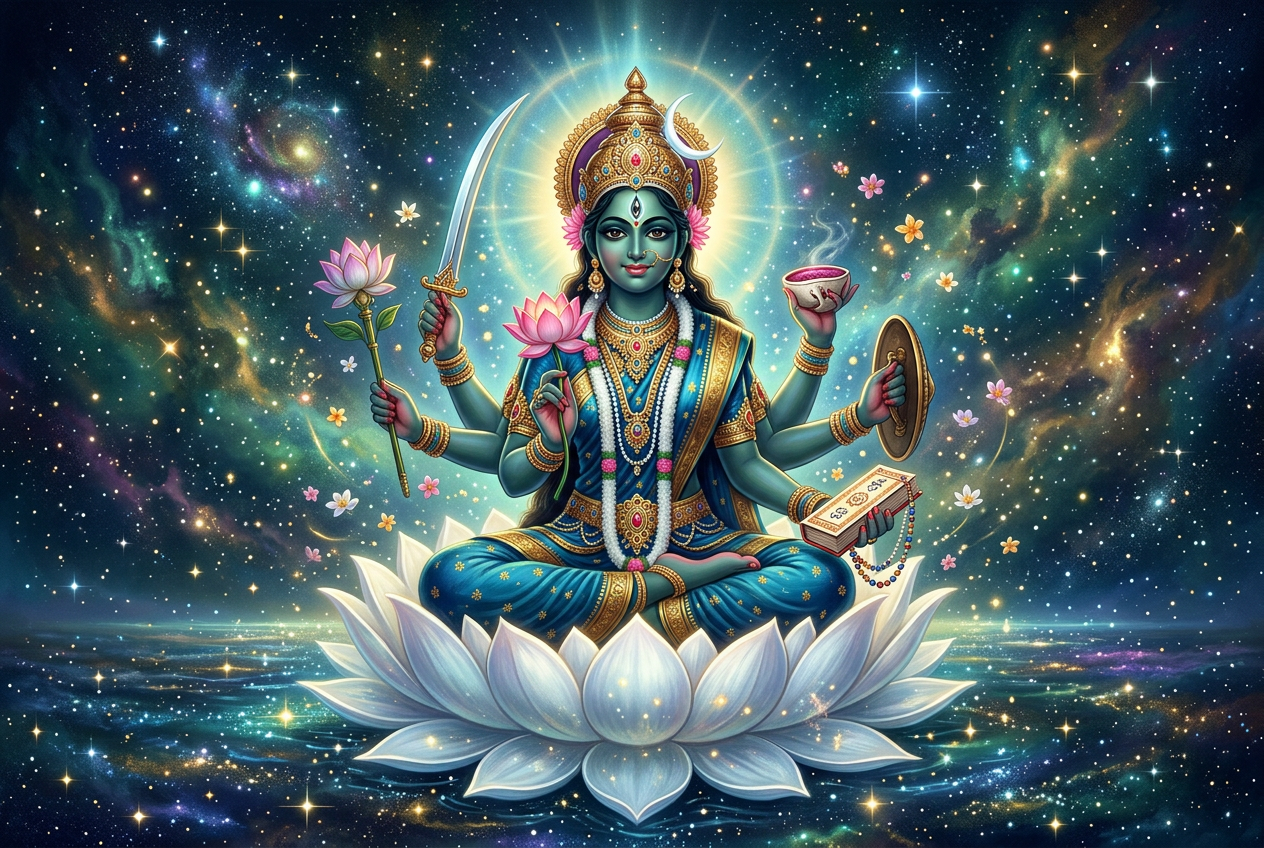
Introduction to Maa Tara
Maa Tara is the second of the Das Mahavidyas, known as the Star Goddess who carries souls across the ocean of worldly existence. Her name derives from the Sanskrit root 'tri' meaning to cross over. Just as a star guides a lost traveler through darkness, Maa Tara guides spiritual seekers toward liberation.
In the Tantric tradition, Tara is considered almost identical to Kali in power but differs in temperament. While Kali destroys through fierce dissolution, Tara saves through compassionate guidance. She is also called Neela Saraswati (the Blue Saraswati), bestowing both spiritual wisdom and worldly knowledge.
Uniquely among Hindu deities, Tara shares a profound connection with Buddhism. The Buddhist Tara (Green Tara and White Tara) is one of the most widely worshipped bodhisattvas in Tibetan Buddhism. Scholars believe the Hindu and Buddhist Tara traditions either share a common origin or deeply influenced each other, making her a bridge between the two great spiritual traditions.
Formation and Incarnation of Maa Tara
The Tara Tantra describes her origin during the churning of the cosmic ocean (Samudra Manthan). When the deadly poison Halahala emerged and threatened to destroy creation, Shiva swallowed it to save the universe. As the poison burned his throat, turning it blue, Tara appeared from the cosmic void to nurse him back to health - literally suckling Shiva like a mother nurses an infant. This motherly act is why the stone image at Tarapith depicts Tara nursing infant Shiva.
Another tradition from the Todala Tantra states that Tara manifested when Kali, after destroying the demons, continued her dance of destruction and threatened to destroy the entire cosmos. The gods prayed to the supreme consciousness, and Tara emerged to calm Kali and restore cosmic balance. This narrative establishes Tara as the balancing force to Kali's fierce dissolution.
Regional Worship Traditions
West Bengal, particularly the Birbhum district, is the heartland of Tara worship. The Tarapith temple, located beside an active cremation ground, is the most important Tara shrine and one of the most powerful Tantric centers in India. The legendary saint Bamakhyapa (Bamakhepa), known as the 'mad saint of Tarapith,' lived here in the 19th century, practicing extreme forms of Tantric sadhana.
In Assam, Tara is worshipped within the Kamakhya temple complex and in various independent shrines. The Neel Parbat (Blue Mountain) region near Kamakhya has ancient connections to Tara worship. In Odisha, the Tara Tarini temple near Berhampur is a major pilgrimage site where Tara is worshipped alongside her sister Tarini.
In Tibet and Nepal, Tara is one of the most beloved deities. The Tibetan Buddhist tradition recognizes 21 forms of Tara, with Green Tara (for protection) and White Tara (for longevity) being most popular. This cross-cultural presence makes Tara one of the most widely worshipped feminine deities in Asia.
Importance and Benefits of Worshipping Maa Tara
Tara worship offers unique benefits centered on guidance, protection, and intellectual development. She is especially invoked for: safe passage through dangerous situations (physical and spiritual); overcoming fear of the unknown; academic and intellectual success; development of eloquence and communication skills; protection during travel; spiritual liberation through compassionate guidance; and healing of grief and emotional pain.
The Tantric texts emphasize that Tara is particularly gracious to those in desperate situations. When all other paths seem blocked, Tara opens the way. Her mantra is considered a 'rescue mantra' - effective in emergencies and crisis situations. She is also worshipped by students, scholars, and writers for intellectual clarity and success in examinations.
Beej Mantra of Maa Tara
| Sanskrit | ॐ ह्रीं स्त्रीं हुं फट् |
|---|---|
| Hindi | ओम् ह्रीं स्त्रीं हुं फट् |
| Transliteration | Om Hreem Streem Hum Phat |
| Meaning | I invoke divine grace (Hreem), the protective power of Tara (Streem), fierce energy (Hum), and the power to break through obstacles (Phat). |
Tara's Beej Mantra is compact but extremely powerful. 'Streem' is Tara's unique bija carrying her specific energy of protection, guidance, and salvation. The ending 'Phat' is an astra (weapon) bija that cuts through obstacles and negative forces. This mantra is particularly effective for removing fear, gaining knowledge, and developing eloquence.
Chant facing east during early morning or at night. Use a white crystal mala for best results. This mantra can be chanted during emergencies for immediate protection.
Mool Mantra of Maa Tara
| Sanskrit | ॐ ह्रीं त्रीं हुं फट् स्वाहा तारायै नमः |
|---|---|
| Hindi | ओम् ह्रीं त्रीं हुं फट् स्वाहा तारायै नमः |
| Transliteration | Om Hreem Treem Hum Phat Swaha Tarayai Namah |
| Meaning | I invoke the grace of Tara through the sounds of divine maya (Hreem), her guiding power (Treem), fierce protection (Hum), obstacle destruction (Phat), offered into sacred fire (Swaha). I bow to Tara. |
The Mool Mantra adds 'Treem' - another unique Tara bija that specifically invokes her guiding, star-like quality. This extended mantra is used for deeper sadhana and long-term transformation rather than emergency protection.
How to Chant Tara Mantras
Sit facing east on a white or blue cloth. Light a ghee lamp and white flowers as offering. Tara's sacred color is blue, so blue flowers and cloth enhance the practice. Use a crystal or white sandalwood mala.
Chant the Beej Mantra 108 times with clear pronunciation. Tara responds especially to heartfelt, emotional chanting rather than mechanical repetition. Visualize a blue star above your head radiating protective light. Best times: early morning (before sunrise), evening twilight, and midnight. Tuesdays and Saturdays are most auspicious.
Tara Mantra Sadhana
A 21-day Tara sadhana is the traditional minimum period. Set up a small altar with Tara's image surrounded by blue flowers. Begin each session with three deep breaths and the invocation 'Om Tarayai Namah' three times.
During the sadhana, maintain a sattvic (pure) diet. Avoid conflict and negative speech. Many practitioners report that Tara appears in dreams during the sadhana period, offering guidance and reassurance. The completion of a Tara sadhana often coincides with resolution of long-standing problems and a deep sense of being 'guided' in life decisions.
Core Sanskrit Root Words
The Sanskrit roots of Tara's names reveal her essence as the compassionate guide who carries devotees across the ocean of suffering.
- तार (Tara) - Star - she who carries across, the guiding light
- स्त्रीं (Streem) - Tara's unique seed syllable - the sound of salvation and protection
- नील (Neela) - Blue - Tara's sacred color representing infinite sky and ocean
- सरस्वती (Saraswati) - Goddess of knowledge - Tara is called Neela Saraswati
- तारिणी (Tarini) - She who saves/delivers - a sister form of Tara
- उग्र (Ugra) - Fierce - Ugra Tara is the wrathful protective form
- करुणा (Karuna) - Compassion - Tara's primary quality
- बोधिसत्त्व (Bodhisattva) - Enlightened being - Tara's status in Buddhist tradition
Major Temples of Maa Tara
Tarapith Temple (Birbhum, West Bengal)
The most important Tara temple in India, located beside a cremation ground. The stone image depicts Tara nursing infant Shiva. Associated with the legendary saint Bamakhyapa. Major Tantric pilgrimage center with active sadhana traditions.
- By Air: Kazi Nazrul Islam Airport, Durgapur (90 km) or Kolkata Airport (260 km).
- By Train: Rampurhat Junction (6 km) - regular trains from Kolkata Howrah (5-6 hours).
- By Road: NH-14 from Kolkata (260 km). Regular bus services from Kolkata, Shantiniketan, and Durgapur.
Tara Tarini Temple (Ganjam, Odisha)
Ancient hilltop temple overlooking the Rushikulya River. One of the oldest Shakti Peethas where the breast of Sati is said to have fallen. Twin goddesses Tara and Tarini are worshipped together. Spectacular views and spiritual atmosphere.
- By Air: Biju Patnaik International Airport, Bhubaneswar (170 km).
- By Train: Berhampur station (30 km) - well connected to major Indian cities.
- By Road: Located at Purushottampur, 30 km from Berhampur. Local buses and taxis available.
Ugra Tara Temple (Guwahati, Assam)
Ancient temple dedicated to the fierce form of Tara. Located near the famous Kamakhya Temple on Nilachal Hill. The temple has a natural spring considered sacred, and the Ugra Tara form is invoked for protection against specific dangers.
- By Air: Lokpriya Gopinath Bordoloi International Airport (18 km).
- By Train: Guwahati Junction (5 km). Auto-rickshaws available.
- By Road: Located in Uzan Bazar area of Guwahati. Accessible by city bus and auto-rickshaw.
Festivals and Celebrations
The primary Tara festival is observed at Tarapith during the annual Tara Puja, which falls in the month of Vaishakh (April-May). During this festival, thousands of devotees gather for all-night vigils of mantra chanting and worship. The cremation ground beside the temple becomes a site of intense Tantric practice.
Navaratri is also significant for Tara worship, particularly the second night dedicated to the fierce forms of the goddess. The Ambubachi Mela at Kamakhya (June) includes special Tara worship. Full moon nights (Purnima) are considered auspicious for Tara chanting, as the moon represents Tara's cooling, nurturing energy.
Listen to the Mantra
Watch the mantra video on YouTube
Frequently Asked Questions
What is Maa Tara's Beej Mantra?
The Beej Mantra is 'Om Hreem Streem Hum Phat' (ॐ ह्रीं स्त्रीं हुं फट्). 'Streem' is Tara's unique seed syllable invoking her protective and guiding energy.
What is the connection between Hindu Tara and Buddhist Tara?
Both traditions worship Tara as a compassionate female deity who rescues beings from danger. Scholars believe they share a common origin or deeply influenced each other. Hindu Tara is a Mahavidya; Buddhist Tara is a Bodhisattva.
Where is Tarapith temple located?
Tarapith is in Birbhum district, West Bengal, about 260 km from Kolkata. Nearest railway station: Rampurhat Junction (6 km).
What are the benefits of chanting Tara mantra?
Protection in dangerous situations, intellectual development, eloquence, safe travel, overcoming fear, grief healing, and spiritual guidance toward liberation.
Which day is best for Tara worship?
Tuesdays and Saturdays are most auspicious. Full moon nights are excellent. Early morning before sunrise and midnight are the ideal times.
Can Tara mantra be chanted in emergencies?
Yes, Tara's Beej Mantra is specifically considered a 'rescue mantra' effective in crisis situations. It can be chanted mentally in any emergency for immediate protection.
What is the difference between Tara and Kali?
Both are powerful Mahavidyas. Kali destroys through fierce dissolution of ignorance. Tara saves through compassionate guidance. Kali is dark; Tara is blue. Kali represents time; Tara represents the guiding star.
What color is associated with Maa Tara?
Blue (Neela) is Tara's sacred color. She is called Neela Saraswati. Blue flowers, cloth, and visualization enhance Tara worship. Her blue complexion represents the infinite sky and ocean.
Who was Bamakhyapa of Tarapith?
Bamakhyapa (Bamakhepa, 1837-1911) was a legendary Tantric saint of Tarapith known for his ecstatic, unconventional devotion to Tara. He lived in the cremation ground and was known for miraculous powers and childlike innocence.
How to start Tara mantra practice?
Begin by chanting 'Om Hreem Streem Hum Phat' 108 times daily facing east. Use a crystal mala. Maintain pure diet. Practice for minimum 21 days. Listen to Musinara Sounds Tara Beej Mantra recording for correct pronunciation.
Explore the Ten Mahavidyas
Get More Sacred Knowledge
Subscribe for weekly mantra guides, temple pilgrimages, and spiritual wisdom.
Hear the Mantra, Not Just Read It
Subscribe to Musinara Sounds for 432 Hz mantra recordings and meditation music.
Subscribe on YouTube