
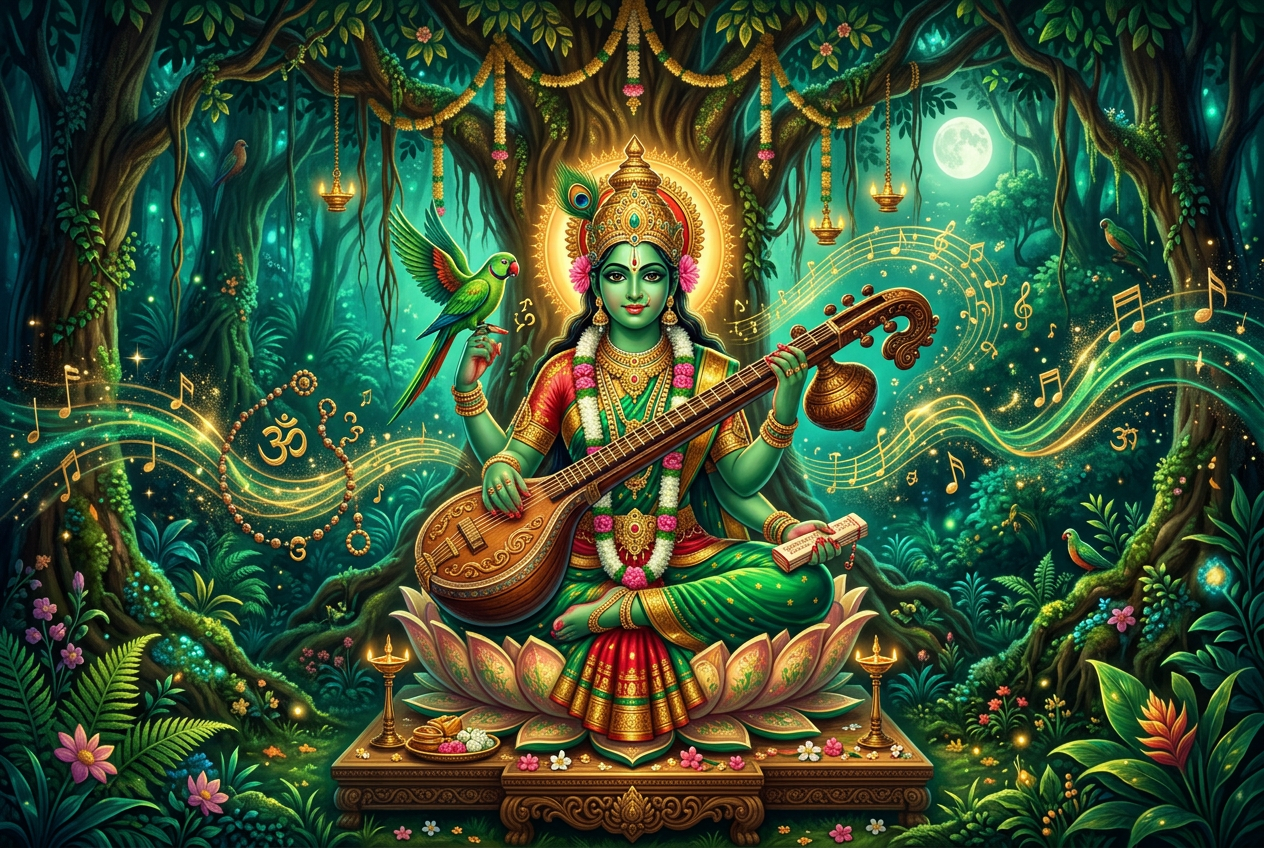
Introduction to Maa Matangi
Maa Matangi is the ninth Mahavidya, known as the Tantric Saraswati - the goddess of speech, music, knowledge, and the arts. While conventional Saraswati represents refined, classical knowledge, Matangi embodies the wild, untamed creative power that flows through the margins of society.
She is the 'Outcast Goddess' who accepts ucchishta (leftover food offerings) and dwells outside conventional boundaries. This unconventional aspect teaches that the divine is not limited to pure, pristine settings - it flows everywhere, including through the rejected, marginalized, and unconventional.
Depicted with an emerald-green complexion, Matangi carries the celestial veena and a parrot, symbolizing mastery of music and speech. She is invoked by musicians, writers, poets, scholars, artists, and anyone seeking vak-siddhi - the supernatural mastery of speech and creative expression. Wednesdays are especially auspicious for her worship.
Formation and Incarnation
The Todala Tantra narrates that once Vishnu and Lakshmi visited Shiva and Parvati. During the meal, some food fell from Shiva's mouth to the ground. From this ucchishta (leftover), a beautiful maiden emerged with green complexion, holding a veena. Parvati recognized her as Matangi and established her worship.
Another tradition connects Matangi to the Chandala (outcast) communities. The Matanga clan were traditionally musicians and performers outside the caste system. Matangi is their divine patroness - the goddess who sanctifies the 'impure' and reveals that the highest art often emerges from the lowest social positions. This radical teaching challenges rigid social hierarchies.
Importance and Benefits
Matangi worship is essential for: mastery of speech, eloquence, and vak-siddhi; musical talent and excellence in all performing arts; writing ability and literary success; academic achievement and intellectual clarity; public speaking and communication power; creative breakthroughs and artistic inspiration; throat chakra (Vishuddha) activation; and gaining knowledge that transcends conventional boundaries.
She is the Mahavidya of creative expression in all forms. Musicians play better after Matangi worship. Writers find their words flow. Speakers command attention. Students excel in examinations. She removes the blocks that prevent authentic creative expression.
Beej Mantra of Maa Matangi
| Sanskrit | ॐ ह्रीं क्लीं हुं मातंगयै फट् स्वाहा |
|---|---|
| Hindi | ओम् ह्रीं क्लीं हुं मातंगयै फट् स्वाहा |
| Transliteration | Om Hreem Kleem Hum Matangyai Phat Swaha |
| Meaning | I invoke Matangi with divine grace (Hreem), attractive power (Kleem), and fierce energy (Hum). I cut through creative blocks (Phat) and offer into sacred fire (Swaha). |
Matangi's mantra combines three powerful seed syllables. Hreem opens divine grace, Kleem attracts success and audience, and Hum provides the fierce energy needed for breakthrough creativity. The ending Phat cuts through blocks and Swaha offers everything into the fire of creation.
Chant before any creative work - writing, performing, speaking, painting. Use a crystal or green mala. Offer green items - betel leaves, green bananas. Wednesdays are most auspicious. Musicians should chant before performing.
Mool Mantra of Maa Matangi
| Sanskrit | ॐ ह्रीं ऐं श्रीं नमो भगवती उच्छिष्ट चण्डालिनी श्री मातंगेश्वरी सर्वजनवश्यंकरी स्वाहा |
|---|---|
| Hindi | ओम् ह्रीं ऐं श्रीं नमो भगवती उच्छिष्ट चण्डालिनी श्री मातंगेश्वरी सर्वजनवश्यंकरी स्वाहा |
| Transliteration | Om Hreem Aim Shreem Namo Bhagavati Ucchishta Chandalini Shri Matangeshwari Sarvajanavashyamkari Swaha |
| Meaning | I bow to the divine Ucchishta Chandalini, the great Matangeshwari who brings all people under her influence. Grace (Hreem), Knowledge (Aim), Prosperity (Shreem). Swaha. |
This elaborate Mool Mantra invokes Matangi by her full title - Ucchishta Chandalini (the outcast goddess who accepts leftover offerings). 'Sarvajanavashyamkari' means 'she who brings all people under her influence' - this is the vashikarana (attraction/influence) aspect of Matangi's power.
Core Sanskrit Root Words
Matangi's names reveal her as the goddess who sanctifies the margins and empowers creative expression.
- मातंग (Matanga) - An elephant - wisdom, arts, and the Matanga community of musicians
- वाक् सिद्धि (Vak Siddhi) - Mastery of speech - supernatural power over words and communication
- उच्छिष्ट (Ucchishta) - Leftover food - the unconventional offering Matangi accepts
- चण्डालिनी (Chandalini) - Woman of the Chandala (outcast) class - the goddess beyond social boundaries
- वीणा (Veena) - Indian stringed instrument - symbol of divine music
- शुक (Shuka) - Parrot - symbol of speech repetition and mimicry (mantra)
- विशुद्ध (Vishuddha) - Throat chakra - center of speech that Matangi governs
Major Temples
Meenakshi Amman Temple (Matangi Shrine) (Madurai, Tamil Nadu)
Within the vast Meenakshi temple complex, a shrine dedicated to Matangi (known locally as Raja Matangi) maintains traditions of her worship. The connection between Meenakshi (the fish-eyed goddess) and Matangi highlights the unconventional beauty of the divine feminine.
- By Air: Madurai Airport (12 km).
- By Train: Madurai Junction - major railway hub in South India.
- By Road: Located in the heart of Madurai city. Auto-rickshaws from anywhere in the city.
Raja Matangi Temple (Thanjavur, Tamil Nadu)
An important Matangi temple in the cultural capital of Tamil Nadu, known for Carnatic music traditions. The temple is particularly visited by musicians before concerts and performances. Special pujas on Wednesdays.
- By Air: Trichy Airport (55 km).
- By Train: Thanjavur Junction - connected to Chennai and Madurai.
- By Road: Located in Thanjavur city center. Auto-rickshaws available.
Matangi Shrine (Kamakhya Complex) (Guwahati, Assam)
A shrine within the Kamakhya temple complex dedicated to Matangi, maintaining the northeastern Tantric tradition of her worship. Connected to the Bengali literary and musical traditions of goddess worship.
- By Air: Lokpriya Gopinath Bordoloi International Airport (20 km).
- By Train: Guwahati Junction (8 km).
- By Road: Nilachal Hill, 8 km from city center.
Festivals and Celebrations
Matangi is worshipped on Wednesdays throughout the year, with special significance during the Wednesdays of Ashwin (September-October) and Magha (January-February). Navaratri's ninth night is dedicated to her as the culmination of the fierce goddesses before the final benevolent form.
Saraswati Puja (Vasant Panchami, January-February) also includes Matangi worship in Tantric traditions, as she is the Tantric counterpart of Saraswati. Music festivals and artistic gatherings often begin with Matangi invocations.
Listen to the Mantra
Watch the mantra video on YouTube
Frequently Asked Questions
Who should worship Maa Matangi?
Musicians, writers, artists, poets, scholars, teachers, public speakers, students, and anyone seeking mastery over creative expression and communication.
What is vak-siddhi?
Vak-siddhi is the supernatural power of speech - the ability to speak with such clarity and authority that words manifest into reality. Matangi's mantra is the primary means of attaining this power.
Why is Matangi called the 'outcast goddess'?
She accepts ucchishta (leftover food) and is connected to the Chandala communities. This teaches that the divine is not limited to pure settings - the highest art and wisdom often emerge from the margins of society.
What is the connection to Saraswati?
Matangi is the Tantric form of Saraswati. While Saraswati represents classical, refined knowledge, Matangi represents wild, unconventional creative power. She is called Neela Saraswati by some traditions.
Which day is best for Matangi worship?
Wednesdays (Budhvar) are most auspicious, as Wednesday is ruled by Mercury (Budh), the planet of communication. Green items should be offered.
What color is associated with Matangi?
Emerald green is her sacred color. Green flowers, betel leaves, green fruits, and green cloth are used in worship. Her complexion is emerald green.
Can Matangi help with creative blocks?
Yes, she is specifically the goddess who removes creative blocks and opens the flow of artistic inspiration. Chant her mantra before any creative work for best results.
What instruments are sacred to Matangi?
The veena is her primary instrument. All stringed instruments are associated with her. Musicians of any instrument can worship Matangi for improved performance.
What is the significance of the parrot?
The parrot (shuka) represents the ability to repeat and transmit sacred sounds perfectly - the essence of mantra practice. It also symbolizes the power of speech to convey beauty and meaning.
How to start Matangi practice?
Chant 'Om Hreem Kleem Hum Matangyai Phat Swaha' 108 times on Wednesdays before creative work. Use crystal mala. Offer green flowers. Listen to Musinara Sounds Matangi recording for correct pronunciation.
Explore the Ten Mahavidyas
Get More Sacred Knowledge
Subscribe for weekly mantra guides, temple pilgrimages, and spiritual wisdom.
Hear the Mantra, Not Just Read It
Subscribe to Musinara Sounds for 432 Hz mantra recordings and meditation music.
Subscribe on YouTube