
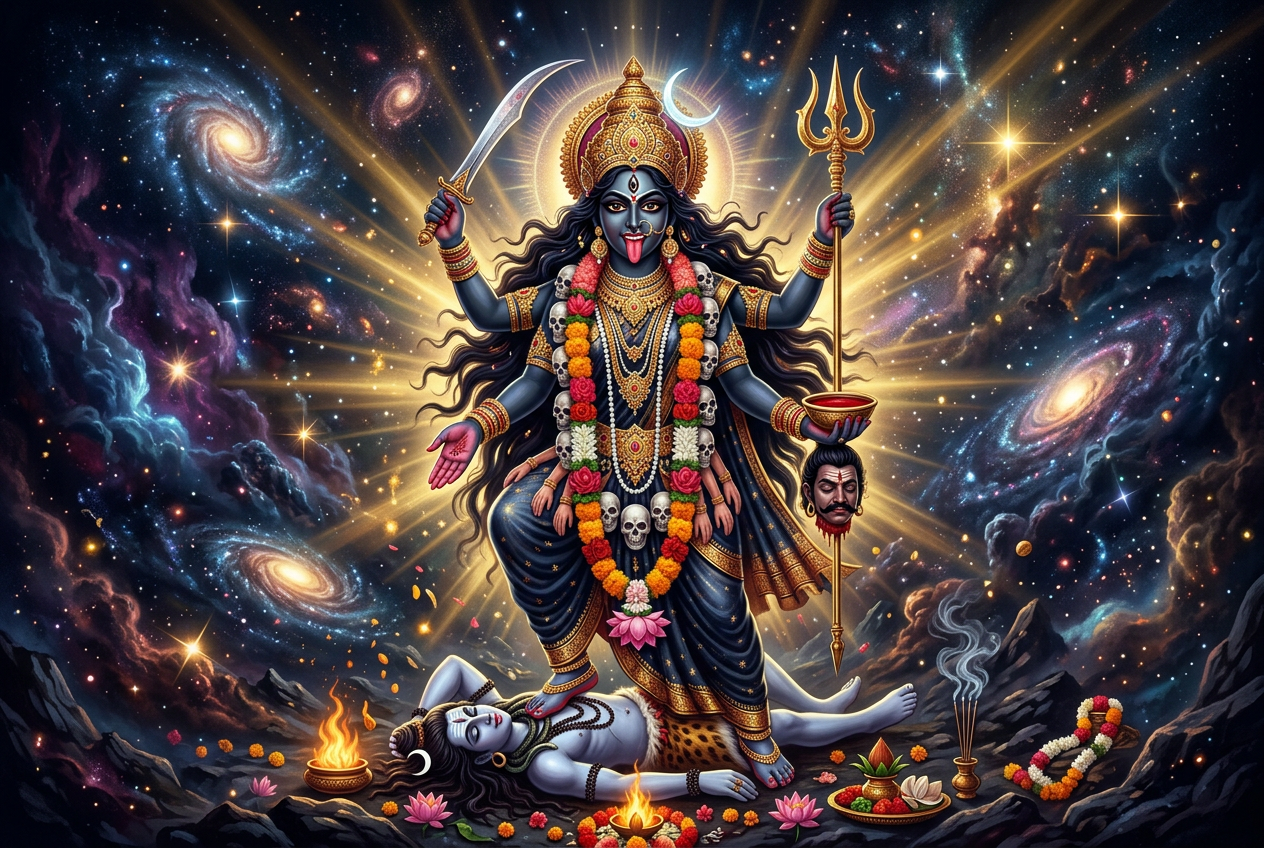
Introduction to Maa Kali
Maa Kali is the first and most powerful of the Das Mahavidyas - the ten wisdom goddesses of the Hindu Tantric tradition. Her name derives from the Sanskrit root 'kala' meaning time, and she is revered as the supreme mistress of time, creation, preservation, and dissolution. Far from the fearsome image often portrayed in popular culture, Maa Kali represents the most compassionate form of the Divine Mother - one who destroys ignorance, ego, and attachment so that the devotee may experience the infinite bliss of pure consciousness.
In the Tantric cosmology, Kali stands at the apex of all divine forms. She is Adi Shakti, the primordial energy from which the entire universe manifests. The Mahanirvana Tantra declares her as the source of Brahma, Vishnu, and Shiva themselves. Her dark complexion symbolizes the formless void beyond all creation - the infinite space from which everything emerges and into which everything dissolves.
For practitioners of mantra meditation, Kali's Beej Mantra is considered one of the most powerful sonic formulas in the entire Vedic tradition. Chanting her mantra with devotion is said to dissolve fear at its root, awaken inner strength, and grant both material protection and spiritual liberation.
Formation and Incarnation of Maa Kali
The most widely known account of Kali's manifestation appears in the Devi Mahatmya, a section of the Markandeya Purana composed around the 5th-6th century CE. According to this sacred text, during the great battle between the gods and the demon armies led by Shumbha and Nishumbha, Goddess Durga was engaged in fierce combat with the demon generals Chanda and Munda.
As Durga's fury intensified, her face became dark as ink, and from her furrowed brow emerged Kali - black-skinned, emaciated, wearing a garland of skulls, draped in tiger skin, with a gaping mouth and a lolling tongue. She devoured the demon armies, crushing their elephants and chariots between her teeth, and presented the heads of Chanda and Munda to Durga, earning the title 'Chamunda.'
Another account from the Linga Purana describes how Shiva requested Parvati to destroy the demon Daruka, who had received a boon that only a female could slay him. Parvati entered Shiva's body and absorbed the poison stored in his throat, transforming into Kali. The Vamana Purana narrates yet another origin - when Parvati shed her dark outer sheath to become Gauri (the fair one), the discarded dark form became Kaushiki, who later manifested as Kali.
Historical and Scriptural Background
Kali's worship has ancient roots stretching back thousands of years. The earliest references appear in the Atharva Veda, where Kali is mentioned as one of the tongues of the fire god Agni. The Mundaka Upanishad also lists Kali among the seven flickering tongues of Agni.
The Devi Mahatmya (circa 5th-6th century CE) elevated Kali to a major deity, while the later Tantric texts - particularly the Mahanirvana Tantra, Kularnava Tantra, and Kali Tantra - systematized her worship with detailed ritual procedures, mantra practices, and philosophical frameworks. The Todala Tantra specifically names her as the first among the Das Mahavidyas.
The Shakta tradition regards Kali as the supreme reality - not merely a goddess among many, but the ultimate ground of being. The great philosopher Abhinavagupta of Kashmir Shaivism integrated Kali worship into his non-dual philosophical framework. During the medieval period, poet-saints like Ramprasad Sen (18th century Bengal) composed devotional songs that remain central to Bengali spiritual culture today.
Regional Worship Traditions
Bengal stands as the heartland of Kali worship. The annual Kali Puja during Diwali night is one of the biggest festivals in West Bengal, where elaborate pandals are constructed throughout Kolkata. The tradition was greatly popularized by Sri Ramakrishna Paramahamsa, the 19th-century mystic who served as priest at the Dakshineswar Kali Temple.
Assam holds an equally deep connection through the Kamakhya Temple in Guwahati, one of the most powerful Shakti Peethas. The annual Ambubachi Mela attracts hundreds of thousands of Tantric practitioners. In Odisha, Kali is worshipped as Tara Tarini at the famous hilltop temple near Berhampur.
In South India, Kali is known by regional names - Kottravai in Tamil Nadu, Bhadrakali in Kerala, and Mahakali in Karnataka. The Kodungallur Bhagavathy Temple in Kerala hosts one of the most intense Kali festivals in India. Beyond India, Kali worship has spread to Nepal, Bangladesh, Sri Lanka, and through the Indian diaspora worldwide.
Importance and Benefits of Worshipping Maa Kali
The worship of Maa Kali offers profound benefits across spiritual, psychological, and material dimensions. On the spiritual plane, Kali worship is considered the fastest path to liberation (moksha) in the Tantric tradition. Her mantras dissolve the bonds of karma and free the soul from the cycle of birth and death.
Psychologically, Kali worship helps practitioners confront and overcome deep-seated fears. Her terrifying form represents the courage to face what we most fear - death, loss, the unknown. By meditating on Kali, devotees develop fearlessness and inner strength.
The key benefits include: removal of fear, anxiety, and negative thought patterns; protection from enemies and harmful influences; awakening of Kundalini energy; development of courage and willpower; dissolution of ego; material prosperity when approached with right intention; healing of emotional wounds; and development of intuitive wisdom.
Beej Mantra of Maa Kali
| Sanskrit | ॐ क्रीं कालिकायै नमः |
|---|---|
| Hindi | ओम् क्रीं कालिकायै नमः |
| Transliteration | Om Kreem Kalikayai Namah |
| Meaning | I bow to Goddess Kalika (Kali), who embodies the seed syllable Kreem - the primordial sound of transformation and divine power. |
The Beej Mantra of Maa Kali is one of the most potent sonic formulas in the Vedic tradition. The seed syllable 'Kreem' combines the energy of Kali (Ka), the fire of transformation (Ra), the power of desire fulfillment (Ee), and the cosmic vibration (M). When chanted 108 times, this mantra creates powerful resonance aligning the practitioner's consciousness with Kali's transformative energy.
The recommended practice is to chant during Brahma Muhurta (4:00-6:00 AM) or at midnight, facing south or east, using a rudraksha or crystal mala. This is the same mantra featured in the Musinara Sounds recording at 432 Hz.
Mool Mantra of Maa Kali
| Sanskrit | ॐ क्रीं क्रीं क्रीं हुं हुं ह्रीं ह्रीं दक्षिणे कालिके क्रीं क्रीं क्रीं हुं हुं ह्रीं ह्रीं स्वाहा |
|---|---|
| Hindi | ओम् क्रीं क्रीं क्रीं हुं हुं ह्रीं ह्रीं दक्षिणे कालिके क्रीं क्रीं क्रीं हुं हुं ह्रीं ह्रीं स्वाहा |
| Transliteration | Om Kreem Kreem Kreem Hum Hum Hreem Hreem Dakshine Kalike Kreem Kreem Kreem Hum Hum Hreem Hreem Swaha |
| Meaning | I invoke Dakshina Kali through the triple seed sounds of transformation (Kreem), fierce energy (Hum), and divine grace (Hreem). I offer this prayer into the sacred fire. |
The Mool Mantra addresses Kali as Dakshina Kali - the benevolent, south-facing form. It combines three powerful seed syllables: Kreem (transformation), Hum (Shiva's fierce bija for protection), and Hreem (Maya/Bhuvaneshwari bija for grace). The triple repetition amplifies power exponentially. This mantra is traditionally given during initiation (diksha).
How to Chant Kali Mantras
Sit in a comfortable posture on a cotton mat. Face south (Kali's direction) or east. Light a ghee lamp and incense. Hold your mala in your right hand, moving each bead with middle finger and thumb. Never use the index finger as it represents ego.
Chant each mantra clearly at moderate pace. You may chant aloud (vachika), whisper (upamshu), or mentally (manasika). Complete one full mala (108 repetitions) without interruption. Best times: Brahma Muhurta (4-6 AM), midnight, Tuesday and Saturday evenings, Amavasya nights, and Navaratri. For beginners, start with 1 mala daily and increase gradually.
Kali Mantra Sadhana
Kali Mantra Sadhana spans a dedicated period, traditionally 40 days (mandala). Preparation Phase (Days 1-3): Observe vegetarian diet, set up altar with Kali's image, lamp, and flowers. Begin with 1 mala sessions.
Intensive Phase (Days 4-36): Chant minimum 3 malas (324 repetitions) daily at fixed time. Maintain dietary discipline. Practice brahmacharya. Keep a journal of experiences.
Completion Phase (Days 37-40): Increase to 5 malas daily. On the final day, perform a simple havan offering the merit to Kali. During sadhana, practitioners often report vivid dreams, heightened intuition, emotional purification, and periods of deep inner silence.
Core Sanskrit Root Words
Understanding the Sanskrit roots behind Kali's names and mantras deepens both intellectual and experiential dimensions of practice.
- काल (Kala) - Time, death - Kali is the feminine form meaning 'She who is Time'
- क्रीं (Kreem) - Kali's seed syllable combining Ka (Kali), Ra (fire), Ee (Mahamaya), M (dissolution)
- शक्ति (Shakti) - Divine feminine power, cosmic energy
- तन्त्र (Tantra) - Loom/weave - systematic framework for spiritual practice
- साधना (Sadhana) - Spiritual practice, disciplined effort toward realization
- महाविद्या (Mahavidya) - Great wisdom/knowledge - the ten forms of the supreme goddess
- बीज (Bija) - Seed - a condensed mantra containing the essence of a deity
- मोक्ष (Moksha) - Liberation from the cycle of birth and death
- कुण्डलिनी (Kundalini) - The coiled serpent energy at the base of the spine
- दीक्षा (Diksha) - Initiation - formal transmission of mantra from guru to disciple
Major Temples of Maa Kali in India
Dakshineswar Kali Temple (Kolkata, West Bengal)
Built in 1855 by Rani Rashmoni on the banks of the Hooghly River. Sri Ramakrishna Paramahamsa served as priest here and attained enlightenment. The main deity is Bhavatarini (a form of Kali). The complex includes 12 Shiva temples and Ramakrishna's room.
- By Air: Netaji Subhas Chandra Bose International Airport (20 km). Prepaid taxi or Metro to Dakshineswar station.
- By Train: Dakshineswar station (Kolkata Circular Railway). Also accessible from Howrah Junction (10 km).
- By Road: Dakshineswar Road via NH-12. Regular buses from Esplanade. Ferry from Belur Math.
Kalighat Kali Temple (Kolkata, West Bengal)
One of the 51 Shakti Peethas where Sati's right toe fell. Among the oldest and most revered Kali temples. The temple gives its name to Kalighat area and indirectly to Kolkata.
- By Air: Netaji Subhas Chandra Bose International Airport (17 km).
- By Train: Kalighat Metro Station (Blue Line) - 5 minutes walk.
- By Road: Central-south Kolkata on Kalighat Road. Auto-rickshaws and buses from all parts of city.
Kamakhya Temple (Guwahati, Assam)
Atop Nilachal Hill, the most important Shakti Peetha and center of Tantric worship. Worships the yoni of Sati. The annual Ambubachi Mela attracts Tantric practitioners worldwide.
- By Air: Lokpriya Gopinath Bordoloi International Airport (20 km).
- By Train: Guwahati Junction (8 km). Auto-rickshaws available.
- By Road: Nilachal Hill, 8 km from city center. Shared sumos and taxis run regularly.
Tarapith Temple (Birbhum, West Bengal)
Major center for Tantric Kali worship associated with saint Bamakhyapa. The adjoining cremation ground is one of the most active Tantric practice sites in India.
- By Air: Kazi Nazrul Islam Airport, Durgapur (90 km) or Kolkata (260 km).
- By Train: Rampurhat Junction (6 km). Regular trains from Kolkata Howrah.
- By Road: 260 km from Kolkata via NH-14. Regular bus services available.
Festivals and Celebrations
Kali Puja is celebrated on the new moon night of Kartik, coinciding with Diwali (October-November). While North India celebrates Diwali with Lakshmi puja, Bengal, Assam, and Odisha worship Kali. Elaborate clay idols are worshipped through the night and immersed in rivers the next day.
Navaratri is also important, particularly the first three nights dedicated to Kali-Durga's fierce forms. Phalaharini Kali Puja marks Sri Ramakrishna's vision at Dakshineswar. Ratanti Kali Puja on the 14th day of Magh is considered especially powerful for Tantric sadhana.
Listen to the Mantra
Watch the mantra video on YouTube
Frequently Asked Questions
What is the Beej Mantra of Maa Kali?
The Beej Mantra is 'Om Kreem Kalikayai Namah' (ॐ क्रीं कालिकायै नमः). The seed syllable 'Kreem' contains her entire essence. Chant 108 times daily for practice.
How many times should I chant Kali mantra daily?
Beginners: 108 times (1 mala). Intermediate: 3 malas (324 times). Advanced: 5-11 malas. Consistency matters more than quantity.
Which day is best for Kali worship?
Tuesday and Saturday are most auspicious. New moon nights (Amavasya) are especially powerful. Ideal times: midnight or Brahma Muhurta (4-6 AM).
What are the benefits of chanting Kali mantra?
Removal of fears, protection from negative energies, Kundalini awakening, courage, ego dissolution, material prosperity, emotional healing, and spiritual liberation.
Where is the most famous Kali temple in India?
Dakshineswar Kali Temple in Kolkata, associated with Sri Ramakrishna. Other major temples: Kalighat (Kolkata), Kamakhya (Guwahati), Tarapith (Birbhum).
What is the meaning of Om Kreem Kalikayai Namah?
'Om' is universal sound. 'Kreem' combines Ka (Kali), Ra (fire), Ee (Mahamaya), M (dissolution). 'Kalikayai' means 'to Goddess Kali.' 'Namah' means 'I bow.'
Can beginners chant Kali mantra without a guru?
Yes, the Beej Mantra 'Om Kreem Kalikayai Namah' is universally accessible. Advanced Tantric mantras traditionally require diksha from a guru.
What is the difference between Kali and Mahakali?
Kali typically refers to Dakshina Kali - the benevolent form. Mahakali is the cosmic, supreme form with ten arms who destroyed Raktabija, representing absolute divine feminine power.
What offerings does Maa Kali accept?
Red hibiscus flowers, red cloth, sweets (sandesh, luchi), coconut, fruits, and incense. The most valued offering is sincere devotion and ego surrender.
How to do Kali mantra sadhana at home?
Set up a clean space with Kali's image, ghee lamp, incense. Sit facing south. Chant 108 times using rudraksha mala. Practice daily for 40 days minimum. Listen to Musinara Sounds 432 Hz recording for pronunciation.
Explore the Ten Mahavidyas
Get More Sacred Knowledge
Subscribe for weekly mantra guides, temple pilgrimages, and spiritual wisdom.
Hear the Mantra, Not Just Read It
Subscribe to Musinara Sounds for 432 Hz mantra recordings and meditation music.
Subscribe on YouTube