
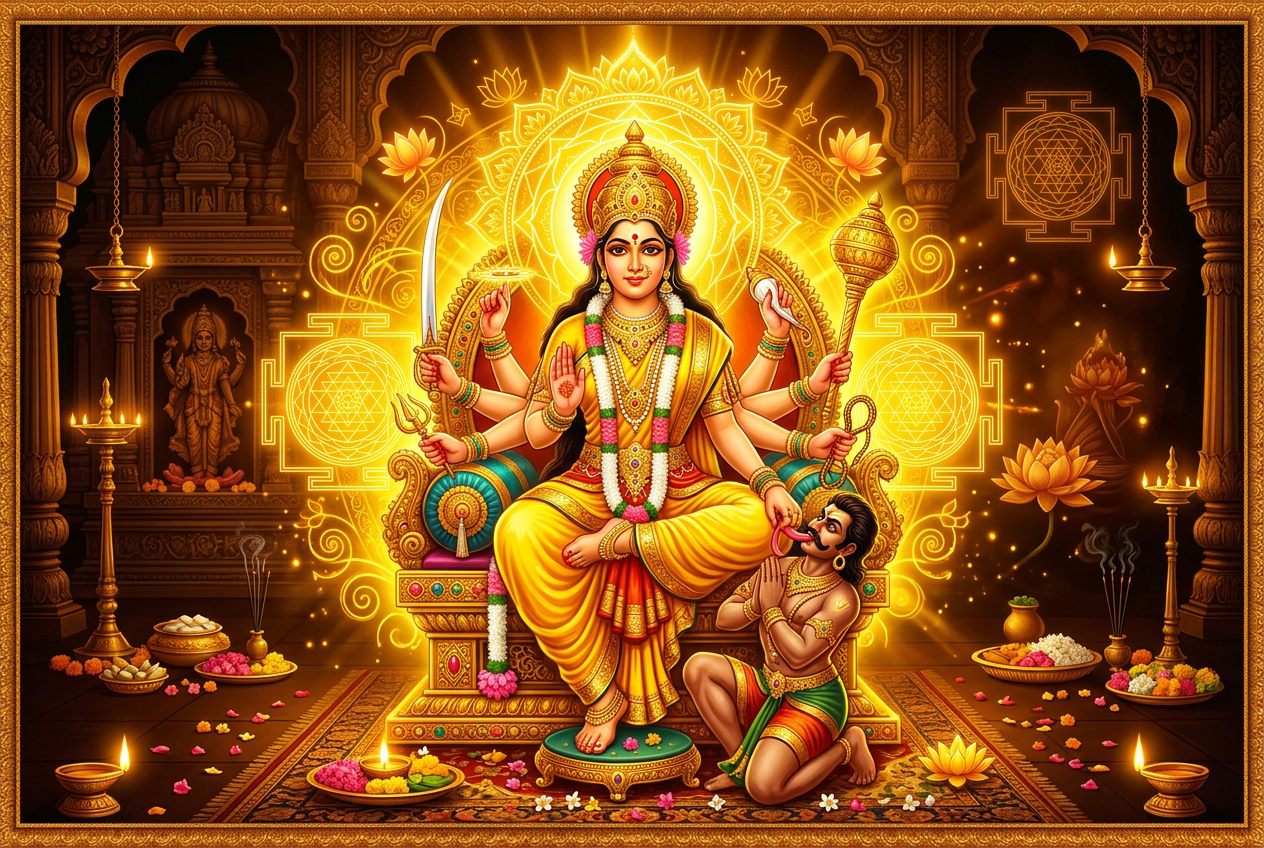
Introduction to Maa Bagalamukhi
Maa Bagalamukhi is the eighth Mahavidya, known as the Pitambara Devi (She who wears yellow). She is the goddess of stambhana shakti - the power to paralyze, stun, and immobilize. In her iconography, she pulls the tongue of a demon with one hand and raises a club with the other, symbolizing her power to silence hostile speech and defeat enemies.
Dressed entirely in yellow and seated on a golden throne in an ocean of nectar, Bagalamukhi is the most widely worshipped Mahavidya for practical, worldly purposes. She is invoked for victory in legal disputes, protection from enemies, and the power of decisive, commanding speech.
Yellow is her sacred color in every aspect - devotees wear yellow, offer yellow flowers, turmeric, and yellow sweets, and practice on yellow cloth. This solar color represents the brilliance of truth that overwhelms all falsehood.
Formation and Incarnation
The Bagalamukhi Stotra describes her origin: during a great cosmic storm that threatened to destroy creation, Lord Vishnu meditated at the Haridra Sarovar (Turmeric Lake), and from its golden waters emerged Bagalamukhi, who immediately stilled the storm with her power of stambhana.
This origin story reveals her core nature - the power to suddenly, completely stop destructive forces. Just as she stopped the cosmic storm, she can stop enemies, hostile speech, legal opponents, and negative circumstances. Her emergence from turmeric-colored water explains the centrality of yellow in her worship.
Importance and Benefits
Bagalamukhi is the most practical of all Mahavidyas and is widely worshipped for: victory in court cases and legal disputes; silencing enemies, critics, and slanderers; protection from black magic and evil eye; stopping hostile speech and gossip; developing commanding speech (vak siddhi); winning debates and arguments; protection in competitive situations; and political success.
She is the Mahavidya of power and dominion in worldly affairs. While other Mahavidyas focus on spiritual liberation, Bagalamukhi unabashedly helps her devotees win, succeed, and dominate in the material world - though always in service of dharma (righteous action).
Beej Mantra of Maa Bagalamukhi
| Sanskrit | ॐ ह्लीं बगलामुखी नमः |
|---|---|
| Hindi | ओम् ह्लीं बगलामुखी नमः |
| Transliteration | Om Hleem Bagalamukhi Namah |
| Meaning | I bow to Bagalamukhi, invoking her through Hleem - the stambhana bija that paralyzes negativity and hostile forces. |
The bija 'Hleem' is unique to Bagalamukhi - it is the stambhana (paralyzing) bija. Unlike 'Kleem' which attracts, 'Hleem' stops and freezes. This mantra is particularly used before court hearings, difficult negotiations, or situations where hostile forces need to be neutralized.
Tuesdays are especially auspicious. Wear yellow clothing, use a turmeric (haldi) mala, offer yellow flowers and turmeric, and chant facing east. The mantra is most powerful when chanted 108, 324, or 1,008 times before a challenging situation.
Mool Mantra of Maa Bagalamukhi
| Sanskrit | ॐ ह्लीं बगलामुखी सर्वदुष्टानां वाचं मुखं पदं स्तम्भय जिह्वां कीलय बुद्धिं विनाशय ह्लीं ॐ स्वाहा |
|---|---|
| Hindi | ओम् ह्लीं बगलामुखी सर्वदुष्टानां वाचं मुखं पदं स्तम्भय जिह्वां कीलय बुद्धिं विनाशय ह्लीं ॐ स्वाहा |
| Transliteration | Om Hleem Bagalamukhi Sarvadushtanam Vacham Mukham Padam Stambhaya Jihvam Kilaya Buddhim Vinashaya Hleem Om Swaha |
| Meaning | O Bagalamukhi, paralyze the speech, face, and feet of all evil-doers. Nail their tongues. Destroy their hostile intellect. Hleem Om Swaha. |
This powerful Mool Mantra explicitly commands the paralysis of hostile forces. 'Stambhaya' means paralyze, 'Kilaya' means nail/pin down, 'Vinashaya' means destroy. It is used in specific situations where active hostile forces need to be neutralized. Traditionally chanted during court cases, enemy situations, or black magic attacks.
Core Sanskrit Root Words
Bagalamukhi's terminology centers on power, speech, paralysis, and victory.
- स्तम्भन (Stambhana) - Paralyzing, immobilizing - Bagalamukhi's primary power
- पीताम्बरा (Pitambara) - She who wears yellow - Bagalamukhi's epithet
- ह्लीं (Hleem) - Stambhana bija - the sound of immobilization
- जिह्वा (Jihva) - Tongue - she who controls speech by grasping the tongue
- वाक् (Vak) - Speech - Bagalamukhi governs the power of speech
- हरिद्रा (Haridra) - Turmeric - her sacred substance and origin lake
- मुद्गर (Mudgara) - Club/mace - her weapon for striking down enemies
Major Temples
Bagalamukhi Temple (Datia, Madhya Pradesh)
The most famous and powerful Bagalamukhi temple in India. This temple is known for granting wishes related to victory, legal matters, and protection. Politicians, lawyers, and businesspeople visit regularly. Elaborate yellow-themed worship is a daily occurrence.
- By Air: Gwalior Airport (75 km).
- By Train: Datia Junction - connected to Delhi, Jhansi, and Gwalior.
- By Road: NH-44 from Jhansi (30 km) or Gwalior (75 km). Regular buses available.
Bagalamukhi Temple (Kangra, Himachal Pradesh)
An ancient temple in the Kangra Valley known for its powerful Tantric tradition. The temple is particularly busy on Tuesdays and during Navaratri. The Himalayan setting adds spiritual energy to the worship.
- By Air: Kangra Airport (Gaggal) (15 km).
- By Train: Kangra Mandir station (3 km) on Pathankot-Jogindernagar narrow gauge.
- By Road: Kangra town on NH-20. Well connected to Dharamshala (20 km) and Pathankot (85 km).
Pitambara Peeth (Datia, Madhya Pradesh)
Also known as the Pitambara Shakti Peeth, this temple complex includes both Bagalamukhi and Dhumavati shrines. It is considered the most powerful center for Bagalamukhi worship in the world. Special havans and mantra recitations are performed daily.
- By Air: Gwalior Airport (75 km).
- By Train: Datia Junction.
- By Road: Adjacent to the main Bagalamukhi Temple in Datia.
Festivals and Celebrations
Bagalamukhi Jayanti (birthday) falls in the month of Vaishakh (April-May) and is the primary festival. Elaborate pujas, havans, and mantra recitation sessions lasting several days are organized at major temples.
Navaratri's eighth night is significant for Bagalamukhi worship. Tuesdays throughout the year are her primary worship day, with special significance during the Tuesdays of Shravana (July-August). Basant Panchami (spring festival) is also connected to Bagalamukhi due to the yellow color association.
Listen to the Mantra
Watch the mantra video on YouTube
Frequently Asked Questions
What is Bagalamukhi mantra used for?
Victory in legal disputes, silencing enemies, protection from slander and black magic, stopping hostile speech, developing commanding speech, and winning competitive situations.
Why is yellow important in Bagalamukhi worship?
Yellow represents the sun's brilliance - truth that overwhelms falsehood. She emerged from a turmeric (yellow) lake. Devotees wear yellow, offer yellow flowers and turmeric, and use yellow mala beads.
Can Bagalamukhi help in court cases?
Yes, she is the most widely invoked deity for legal victory. Chant the Beej Mantra 108 times before court hearings wearing yellow clothes. Many lawyers and litigants worship at Datia temple specifically for this purpose.
What is the Stambhan Mantra?
The Mool Mantra beginning 'Om Hleem Bagalamukhi...' is the Stambhan Mantra - it commands the paralysis of hostile forces, speech, and intellect of enemies. Used in specific situations against active threats.
Where is the most powerful Bagalamukhi temple?
Pitambara Peeth in Datia, Madhya Pradesh is considered the most powerful. Thousands visit weekly for legal, business, and protection-related prayers.
What is Hleem mantra?
'Hleem' is Bagalamukhi's unique seed syllable - the stambhana (paralyzing) bija. Unlike 'Kleem' which attracts, Hleem stops and freezes hostile forces. It is found only in Bagalamukhi mantras.
Which day is best for Bagalamukhi worship?
Tuesdays (Mangalvar) are most auspicious. Wear yellow, offer turmeric and yellow flowers. Basant Panchami and Navaratri's eighth night are also significant.
Is Bagalamukhi worship ethical?
Yes, when used for righteous purposes (dharma). Bagalamukhi defeats adharma (unrighteousness). She is not invoked for unjust harm but for protection, justice, and victory of truth over falsehood.
What mala is used for Bagalamukhi?
A turmeric (haldi) mala is most traditional. Yellow sandalwood or yellow crystal mala are also used. The mala should be stored in yellow cloth when not in use.
How to start Bagalamukhi practice?
Wear yellow, chant 'Om Hleem Bagalamukhi Namah' 108 times on Tuesdays facing east. Offer yellow flowers and turmeric. Listen to Musinara Sounds Bagalamukhi recording at 432 Hz for correct pronunciation.
Explore the Ten Mahavidyas
Get More Sacred Knowledge
Subscribe for weekly mantra guides, temple pilgrimages, and spiritual wisdom.
Hear the Mantra, Not Just Read It
Subscribe to Musinara Sounds for 432 Hz mantra recordings and meditation music.
Subscribe on YouTube