
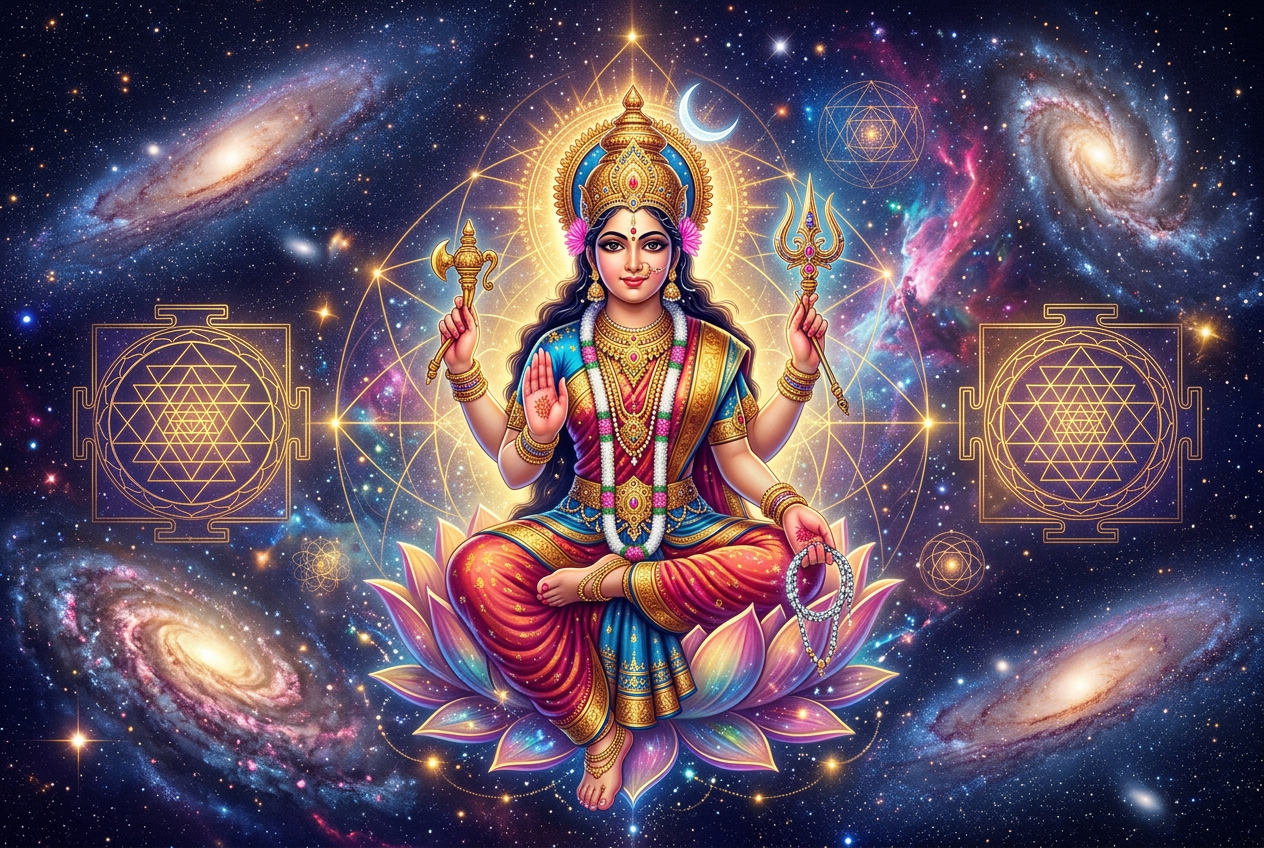
Introduction to Maa Bhuvaneshwari
Maa Bhuvaneshwari is the fourth Mahavidya, whose name means 'Queen of the Universe' (Bhuvana = world/universe, Ishwari = queen/sovereign). She represents the cosmic space (akasha) within which the entire creation exists. While Kali governs time and Tripura Sundari governs beauty, Bhuvaneshwari governs space - the fundamental dimension that allows all existence to unfold.
Her bija mantra 'Hreem' is one of the most widely used seed syllables in Hindu worship. It is the sound of Maya - the creative power that projects the universe from the void of pure consciousness. Bhuvaneshwari is depicted as a beautiful goddess with a crescent moon in her hair, holding a goad (ankusha) and noose (pasha), representing the power to attract what is needed and release what is not.
Of all the Mahavidyas, Bhuvaneshwari is perhaps the most accessible and benign. She is the infinite sky that embraces everything without judgment - the cosmic mother whose love is as vast as space itself.
Formation and Incarnation
According to the Devi Bhagavata Purana, Bhuvaneshwari manifested at the very beginning of creation when Brahma, the creator god, was unable to proceed with his task because there was no space in which to create. He meditated deeply, and from the primordial void, Bhuvaneshwari appeared, creating the three worlds with her mere glance and giving Brahma the space to create within.
Another tradition holds that Bhuvaneshwari is the 'playground' of the supreme consciousness - she is the space in which the cosmic dance of Shiva-Shakti unfolds. The Todala Tantra describes her as the 'container' of the cosmos, just as the sky contains everything - sun, moon, stars, earth - without being affected by any of it.
Importance and Benefits
Bhuvaneshwari worship offers expansiveness in every dimension of life: freedom from mental constriction; ability to see the bigger picture; overcoming claustrophobia and feelings of limitation; sovereignty over one's circumstances; opening new opportunities and possibilities; development of cosmic perspective; material wealth and land acquisition (she is the goddess of space); and deep peace arising from the experience of inner spaciousness.
She is particularly helpful for those feeling trapped, limited, or stuck in any area of life - career, relationships, or spiritual progress. Her mantra literally 'opens space' for new possibilities.
Beej Mantra of Maa Bhuvaneshwari
| Sanskrit | ॐ ह्रीं भुवनेश्वर्यै नमः |
|---|---|
| Hindi | ओम् ह्रीं भुवनेश्वर्यै नमः |
| Transliteration | Om Hreem Bhuvaneshwaryai Namah |
| Meaning | I bow to the Queen of the Universe, invoking her through Hreem - the Maya bija, the sound of cosmic creation. |
The bija 'Hreem' is the most important mantra sound in Tantric practice after 'Om.' It is called the Maya Bija because it is the sound from which the manifest universe arises. Regular chanting creates expansiveness in consciousness and removes feelings of limitation.
This mantra is excellent for beginning practitioners as it is gentle, benevolent, and universally beneficial. Chant facing east at dawn, using any mala. There are no strict restrictions for this mantra - Bhuvaneshwari is the most approachable of all Mahavidyas.
Mool Mantra of Maa Bhuvaneshwari
| Sanskrit | ॐ ह्रीं श्रीं दुं भुवनेश्वर्यै नमः |
|---|---|
| Hindi | ओम् ह्रीं श्रीं दुं भुवनेश्वर्यै नमः |
| Transliteration | Om Hreem Shreem Dum Bhuvaneshwaryai Namah |
| Meaning | I invoke the Queen of the Universe through divine grace (Hreem), prosperity (Shreem), and cosmic protection (Dum). |
The Mool Mantra adds Shreem (prosperity) and Dum (Durga's protective bija), making it effective for both material success and spiritual protection. This combination represents Bhuvaneshwari's complete power - she creates the space (Hreem), fills it with abundance (Shreem), and protects it (Dum).
Core Sanskrit Root Words
Bhuvaneshwari's names and symbols encode teachings about space, creation, and sovereignty.
- भुवन (Bhuvana) - World, universe, realm of existence
- ईश्वरी (Ishwari) - Queen, sovereign ruler, supreme goddess
- ह्रीं (Hreem) - Maya bija - the creative sound of cosmic manifestation
- आकाश (Akasha) - Space, ether - the fifth element that Bhuvaneshwari governs
- माया (Maya) - Creative illusion - the power that projects the universe
- अंकुश (Ankusha) - Goad - the power to attract and direct
- पाश (Pasha) - Noose - the power to bind and release
Major Temples
Bhuvaneshwari Temple (Kamakhya Complex) (Guwahati, Assam)
Within the vast Kamakhya temple complex on Nilachal Hill, a dedicated shrine to Bhuvaneshwari represents one of the oldest traditions of her worship. The temple is part of the most important Shakti Peetha in India.
- By Air: Lokpriya Gopinath Bordoloi International Airport (20 km).
- By Train: Guwahati Junction (8 km).
- By Road: Nilachal Hill, 8 km from Guwahati city center.
Bhuvneshwar Nath Temple (Varanasi, Uttar Pradesh)
An ancient temple in the sacred city of Varanasi dedicated to Bhuvaneshwari. Located near the ghats, it maintains traditional worship practices and hosts special pujas during Navaratri.
- By Air: Lal Bahadur Shastri Airport, Varanasi (25 km).
- By Train: Varanasi Junction (Cantt) - well connected to all major cities.
- By Road: Located in the old city near Dashashwamedh Ghat.
Bhuvaneshwari Peetham (Mattancherry, Kerala)
A significant Shakti temple in Kerala where Bhuvaneshwari is the primary deity. Known for elaborate tantric rituals following the Kerala Shakta tradition, which has preserved unique worship forms.
- By Air: Cochin International Airport (35 km).
- By Train: Ernakulam Junction (10 km).
- By Road: Located in Mattancherry area of Kochi. Auto-rickshaws and buses available.
Festivals and Celebrations
Bhuvaneshwari is particularly worshipped during the fourth night of Navaratri, which represents the transition from fierce forms (Kali, Tara) to graceful forms. Special pujas involving the worship of the directions (dik puja) are performed, acknowledging her sovereignty over all space.
Akshaya Tritiya (April-May) is also auspicious for Bhuvaneshwari worship, as this day represents inexhaustible abundance and new beginnings. The full moon in the month of Vaishakh is dedicated to her cosmic form.
Listen to the Mantra
Watch the mantra video on YouTube
Frequently Asked Questions
What is Bhuvaneshwari's Beej Mantra?
'Om Hreem Bhuvaneshwaryai Namah' (ॐ ह्रीं भुवनेश्वर्यै नमः). 'Hreem' is the Maya bija - the sound of cosmic creative power.
What does Hreem mantra do?
Hreem creates expansion in consciousness, removes feelings of limitation, opens new possibilities, enhances creative visualization, attracts abundance, and develops a cosmic perspective on life.
What are benefits of Bhuvaneshwari worship?
Freedom from mental constriction, sovereignty over circumstances, new opportunities, material wealth (especially property/land), deep inner peace, and expansive consciousness.
Is Bhuvaneshwari the same as Parvati?
Bhuvaneshwari is a specific Mahavidya form of the supreme goddess. While Parvati is Shiva's consort, Bhuvaneshwari represents the cosmic space that contains Shiva-Shakti and the entire creation.
Which day is best for Bhuvaneshwari worship?
All days are suitable as she is the most universally approachable Mahavidya. Full moon days and Akshaya Tritiya are especially powerful. Dawn is the best time.
Can this mantra help with feeling stuck?
Yes, Bhuvaneshwari's mantra is specifically effective for those feeling trapped or limited. It literally 'opens space' for new possibilities in career, relationships, and spiritual growth.
What is the Maya Bija?
'Hreem' is called the Maya Bija because it is the seed sound of cosmic illusion/creation. Maya is the power that projects the universe from consciousness, and Hreem is its sonic expression.
What mala should I use?
Any mala is suitable - crystal, rudraksha, or sandalwood. There are no strict restrictions. Bhuvaneshwari is gentle and accessible to all practitioners regardless of level.
What are Bhuvaneshwari's symbols?
Goad (ankusha) for attracting what is needed, noose (pasha) for releasing what is not, crescent moon for cosmic cycles, and gestures of blessing (abhaya) and boon-granting (varada).
How to start Bhuvaneshwari practice?
Chant 'Om Hreem Bhuvaneshwaryai Namah' 108 times daily facing east at dawn. No dietary restrictions required. Excellent for beginners. Listen to Musinara Sounds recording.
Explore the Ten Mahavidyas
Get More Sacred Knowledge
Subscribe for weekly mantra guides, temple pilgrimages, and spiritual wisdom.
Hear the Mantra, Not Just Read It
Subscribe to Musinara Sounds for 432 Hz mantra recordings and meditation music.
Subscribe on YouTube