Few devotional legends carry quite the tenderness of the story behind the Kanakadhara Stotram. It begins not in a temple or a royal court but at the threshold of the poorest house in a village, with a wandering student-monk, an embarrassed woman with nothing to give, and a single shrivelled gooseberry offered in place of alms. What follows - a hymn composed on the spot, and a shower of gold said to have answered it - has made this stotra one of the most beloved and most recited prayers to the goddess of fortune anywhere in the Hindu world.
The Kanakadhara Stotram is a Sanskrit hymn of some eighteen to twenty-one verses, composed by the philosopher-saint Adi Shankaracharya in praise of Mahalakshmi, the goddess of wealth, abundance and grace. Its name comes directly from the miracle at its centre: kanaka, gold, and dhara, a stream or shower - "the stream of gold." Verse after verse circles around a single recurring image, the goddess's kataksha, her sidelong glance, pleading that even a fleeting portion of that glance might fall upon the one reciting the hymn.
This guide sets out the legend in full, what is known and unknown about its composition, the shape and likely verse count of the stotram, a selection of its most celebrated lines in Devanagari with transliteration and meaning, the central theme of Lakshmi's glance that runs through nearly every verse, and the benefits and practical guidance devotees have long associated with reciting it.
- The Legend: A Single Amla and a Shower of Gold
- Who Composed the Kanakadhara Stotram?
- Structure and Overview of the Verses
- Selected Verses: Devanagari, Transliteration and Meaning
- Themes: Lakshmi's Kataksha, the Sidelong Glance
- Benefits of Reciting the Kanakadhara Stotram
- How and When to Recite It
- Pronunciation and Rules
- Frequently Asked Questions
The Legend: A Single Amla and a Shower of Gold
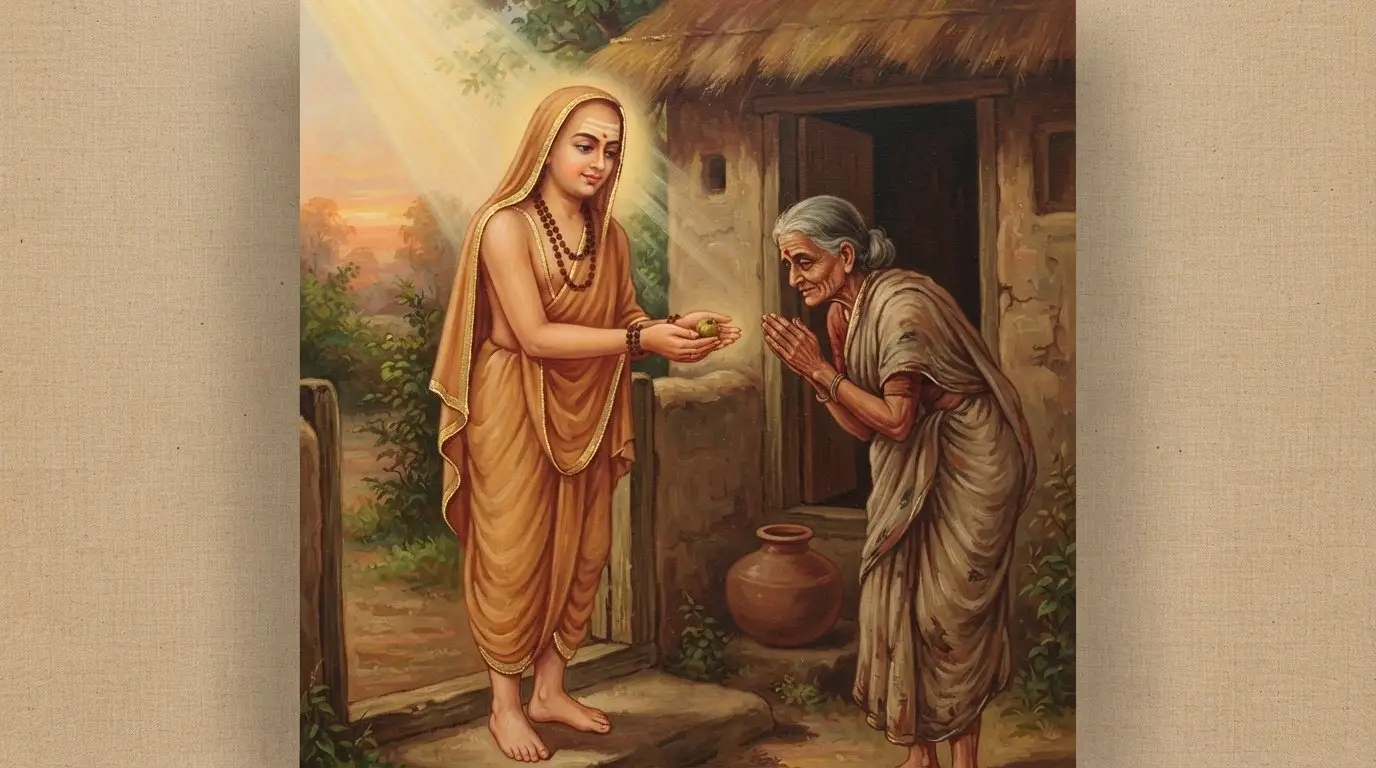
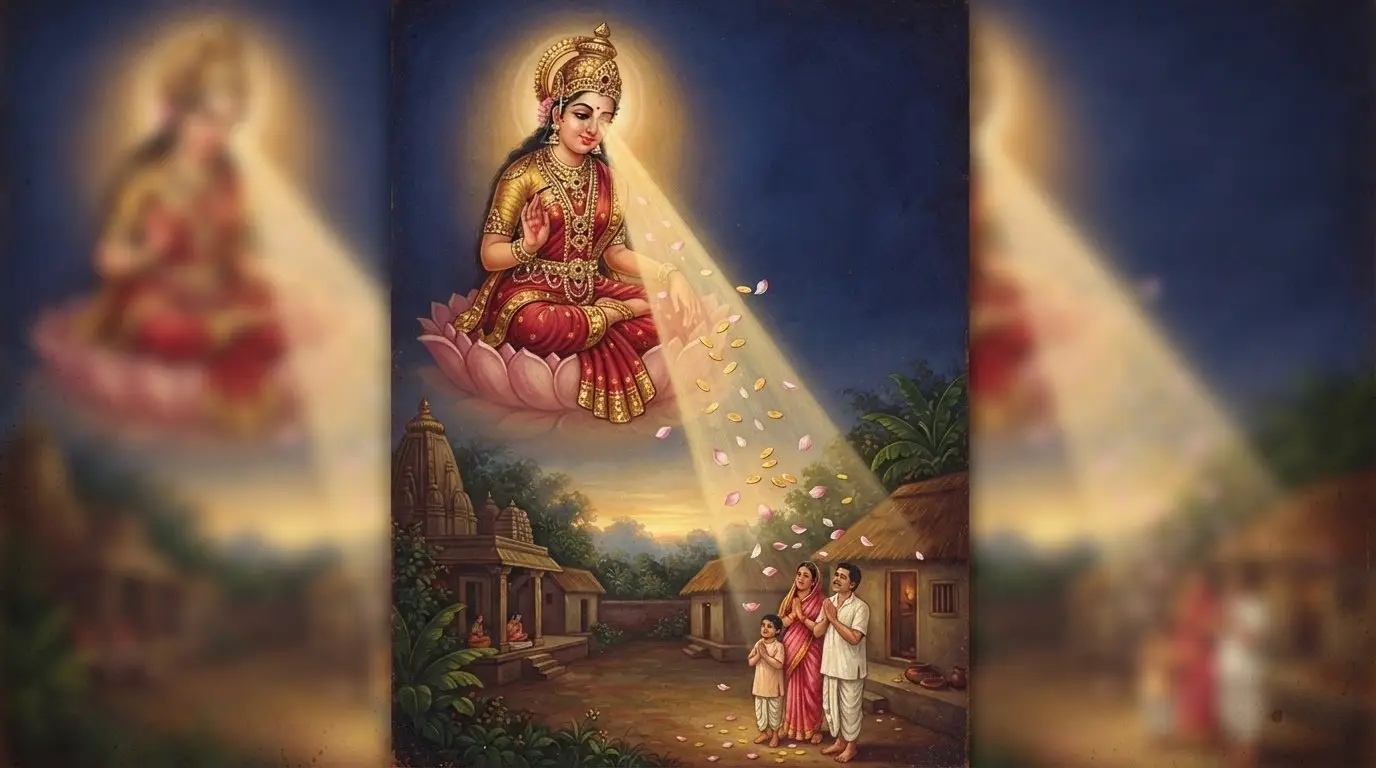
According to tradition, the young Adi Shankara, still a brahmachari studying under his guru Govinda Bhagavatpada, observed the strict ascetic custom of going door to door each day to beg a small portion of food, taking only what was freely offered and never more than was needed. In the course of these rounds he came one day to the door of an extremely poor Brahmin household in a small village. The woman of the house, hearing a mendicant's call for bhiksha, searched desperately through her home for something, anything, to offer, and found nothing at all except a single dried amla - the Indian gooseberry, a fruit of no material value whatsoever, and by tradition the very last item of food remaining in the house.
Mortified at having nothing better to give, and in tears at her own poverty, she nonetheless came to the door and placed the single amla into the young monk's begging bowl with as much reverence as if it had been the richest offering imaginable. It was this - not the fruit itself, but the totality of her devotion and the depth of her shame at having so little - that is said to have moved Shankara profoundly. Rather than walking on, he stood at her threshold and, moved to compassion, composed extempore a hymn addressed directly to Mahalakshmi, pleading with the goddess to look with favour upon this woman whose devotion so far outweighed her material means.
As he recited, tradition holds, the goddess herself appeared, or her grace descended in visible form, and a shower of golden amlas - gooseberries transformed to solid gold - rained down into the woman's courtyard, transforming her fortune in a single moment as completely as her poverty had defined her life until then. It is this image, gold descending like rain, that gives the hymn its name: Kanakadhara, the stream of gold.
Some retellings add a further, theologically rich detail: that Lakshmi at first hesitated to bless the household, since by the strict logic of accumulated karma the woman had not, in this life, built up the merit that would ordinarily be required to justify such wealth - at which point Shankara is said to have redoubled his praise, verse after verse, until the goddess relented and let her compassion outweigh the ordinary arithmetic of merit. Whether or not this detail belongs to the earliest versions of the story, it captures something the hymn itself repeats constantly: that Lakshmi's glance is a matter of grace freely given, not a transaction earned through ritual or wealth already possessed.
Who Composed the Kanakadhara Stotram?
The Kanakadhara Stotram is attributed to Adi Shankaracharya, the eighth-century philosopher-saint credited with systematising Advaita Vedanta, establishing the network of monastic centres associated with his name across India, and composing a remarkable body of devotional Sanskrit poetry alongside his philosophical commentaries - works ranging from the celebrated Soundarya Lahari and Bhaja Govindam to numerous shorter stotras addressed to Devi, Shiva and Vishnu. Tradition places the composition of the Kanakadhara Stotram in his youth, during the period of study and wandering that preceded his formal initiation into sannyasa, which is part of why the legend behind it carries such an unusually personal, spontaneous quality compared with some of his later, more structured philosophical hymns.
As with a great deal of ancient hagiography, the precise historical details of the episode cannot be independently verified; the story is preserved through oral tradition and later hagiographical works such as the various Shankara Vijayam texts rather than through contemporary documentation. This is worth noting honestly rather than glossing over, in keeping with the same intellectual care one should bring to any traditional account of a revered figure's life. It does nothing, however, to diminish the hymn's devotional power or its long-standing popularity; the Kanakadhara Stotram has been recited by devotees of Lakshmi for centuries regardless of how the historical particulars of its composition are weighed, in much the same way that our complete guide to Goddess Lakshmi treats her many hymns and forms as living devotional practice first and historical artefact second.
Structure and Overview of the Verses
The Kanakadhara Stotram is generally printed as somewhere between eighteen and twenty-one verses, depending on the edition and the particular matha or regional tradition from which it is published; a small number of editions include an additional dedicatory or benefits verse at the close, which accounts for most of the variation in verse count. This kind of minor textual variation is entirely normal for a Sanskrit stotra transmitted across many centuries and many regional printing traditions, and readers should not be troubled by finding slightly different verse totals cited in different places.
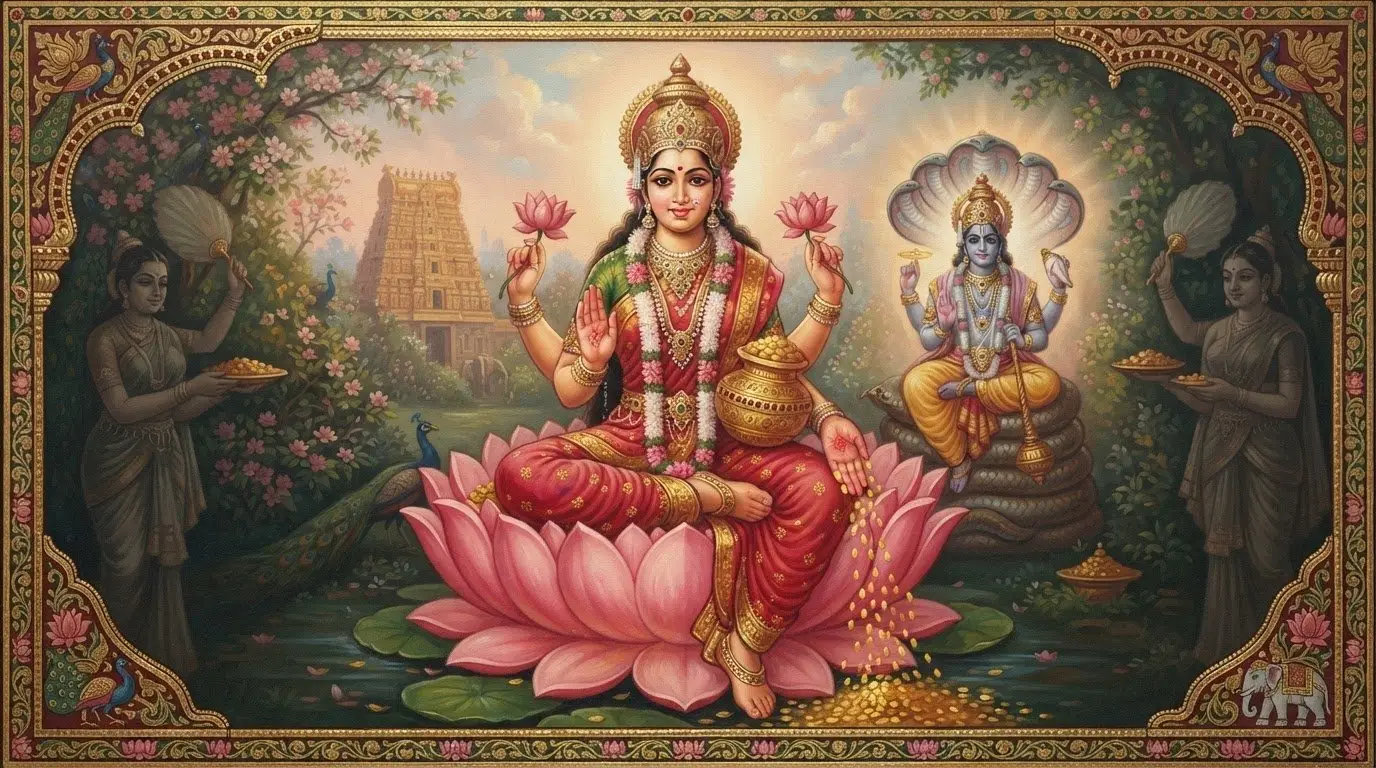
The hymn is composed in an ornate, flowing Sanskrit metre well suited to Shankaracharya's characteristically dense, compound-rich poetic style - long, cascading Sanskrit compounds (samasa) built up across each line, a hallmark of his devotional poetry more broadly. Thematically, the verses move through praise of Mahalakshmi's form, her intimate relationship with Vishnu (addressed throughout by his many names - Hari, Mukunda, Madhusudana, the conqueror of Madhu), her association with the lotus, and, above all, the recurring image of her glance: her kataksha or apanga, the sidelong look through which, tradition holds, fortune, wisdom and grace are bestowed upon the world. Nearly every verse closes on some variation of the plea that this glance, even briefly, might fall upon the one reciting the hymn. In its closing verses, the stotram shifts into the phala-shruti, the customary "fruits of recitation" passage found at the end of many Sanskrit hymns, describing the blessings promised to a devotee who recites it with sincerity and faith.
Selected Verses: Devanagari, Transliteration and Meaning
The verses below are among the most widely quoted lines of the Kanakadhara Stotram, chosen to illustrate its central themes - the goddess's form, her glance, and the benefits promised to the devotee - presented as commonly published rather than under one single, universally fixed numbering, since minor variation exists between editions.
| Devanagari | Transliteration | Meaning |
|---|---|---|
| अङ्गं हरेः पुलकभूषणमाश्रयन्ती भृङ्गाङ्गनेव मुकुलाभरणं तमालम्। अङ्गीकृताखिलविभूतिरपाङ्गलीला माङ्गल्यदास्तु मम मङ्गलदेवतायाः॥ | Angam hareh pulaka-bhushanam ashrayanti, bhringanganeva mukulabharanam tamalam, angikritakhila-vibhutir apanga-leela, mangalyadastu mama mangala-devatayah | May the playful sidelong glance of the goddess of auspiciousness - a glance that adorns Hari's body thrilled with devotion, as a female bee alights upon a budding tamala tree, and which has taken to itself every form of fortune - bestow auspiciousness upon me. This is the celebrated opening verse of the stotram. |
| आमीलिताक्षमधिगम्य मुदा मुकुन्दमानन्दकन्दमनिमेषमनङ्गतन्त्रम्। आकेकरस्थितकनीनिकपक्ष्मनेत्रं भूत्यै भवेन्मम भुजङ्गशयाङ्गनायाः॥ | Amilitaksham adhigamya muda Mukundam ananda-kandam animesham ananga-tantram, aakekara-sthita-kaninika-pakshma-netram, bhutyai bhavenmama bhujanga-shayanganayah | May the glance of she who reclines upon the serpent-couch - her half-closed, unblinking eyes turned in joy towards Mukunda, the very root of bliss, lost in tender rapture - bring prosperity to me. |
| विश्वामरेन्द्रपदविभ्रमदानदक्षमानन्दहेतुरधिकं मुरविद्विषोऽपि। ईषन्निषीदतु मयि क्षणमीक्षणार्धं इन्दीवरोदरसहोदरमिन्दिराया:॥ | Vishvamarendra-pada-vibhrama-dana-daksham, ananda-hetur-adhikam Muravidvishopi, ishan-nisheedatu mayi kshanam ikshanardham, indivarodara-sahodaram indirayah | May even a fleeting half-glance of Indira - capable of granting even the splendour of Indra's own throne, and a greater source of joy than she gives even to the foe of Mura himself, akin in hue to the heart of a blue lotus - rest upon me for a moment. |
| बाह्वन्तरे मधुजितः श्रितकौस्तुभे या हारावलीव हरिनीलमयी विभाति। कामप्रदा भगवतोऽपि कटाक्षमाला कल्याणमावहतु मे कमलालयायाः॥ | Bahvantare Madhu-jitah shrita-Kaustubhe ya, haravaliva harinilamayi vibhati, kama-prada bhagavato'pi kataksha-mala, kalyanam avahatu me Kamalalayayah | May the garland of Kamala's sidelong glances - which shines upon the chest of Madhu's conqueror beside the Kaustubha gem like a string of sapphires, and which grants desires even to the Lord himself - bring auspiciousness to me. |
| स्तुवन्ति ये स्तुतिभिरमूभिरन्वहं त्रयीमयीं त्रिभुवनमातरं रमाम्। गुणाधिका गुरुतरभाग्यभागिनो भवन्ति ते भुवि बुधभाविताशयाः॥ | Stuvanti ye stutibhir amubhir anvaham, trayimayim tribhuvana-mataram Ramam, gunadhika gurutara-bhagya-bhagino, bhavanti te bhuvi budha-bhavitashayah | Those who daily praise Rama, embodiment of the three Vedas and mother of the three worlds, with these hymns, become endowed with superior virtues and greater fortune, and are held in high regard by the wise upon this earth. This is the closing phala-shruti verse describing the fruits of recitation. |
Themes: Lakshmi's Kataksha, the Sidelong Glance
If a single image unites nearly every verse of the Kanakadhara Stotram, it is the kataksha - Lakshmi's sidelong or oblique glance, as distinct from a direct, sustained gaze. This is not incidental imagery; it reflects a deep and consistent strand of thought about the goddess's nature found across Lakshmi's wider mythology and iconography. Lakshmi is traditionally described as chanchala, restless or unsteady, a quality tied directly to the nature of wealth and fortune themselves, which move, change hands and shift with the same fluid unpredictability as a glance that does not linger. A devotee does not, in this hymn, ask to hold the goddess permanently in place; the request throughout is far humbler - simply that her glance, even fleetingly, might turn towards the one praying.
This humility mirrors, quite precisely, the humility at the centre of the legend itself. The poor woman in the story did not ask Shankara for anything; she gave what little she had without expectation, and it was the sincerity of that offering, rather than any claim to deserve wealth, that moved both the sage and, by extension, the goddess to respond. The stotram's repeated plea for a mere glance rather than a demand for riches outright carries the same spirit: fortune, the hymn suggests again and again, is not something to be seized by right but something received as grace, best approached with the same open-handed humility the woman showed at her own door.
A second recurring thread runs through the hymn's constant pairing of Lakshmi with Vishnu, addressed variously as Hari, Mukunda, Madhusudana and the conqueror of Madhu. Many verses describe her glance as directed first and foremost at him - a look of devoted, tender attention between consort and Lord - and the devotee's plea is, in effect, to receive some overflow of that same loving attention, a glance meant for another that nonetheless might extend, even briefly, to the one reciting the hymn. This framing keeps wealth itself embedded within a relationship of devotion rather than treating it as an isolated, purely material aim; the closing phala-shruti verse reinforces this directly by describing Lakshmi as trayimayi, "she who embodies the three Vedas," binding prosperity together with wisdom and dharma rather than presenting it as a reward separate from spiritual life.
It is also worth noting how unusual this hymn is within Shankaracharya's wider body of work precisely because of its occasion. Much of his devotional poetry reads as considered, structured theological composition, written with the settled authority of an established teacher; the Kanakadhara Stotram, by contrast, carries the traditional flavour of something composed in a single moment of unplanned compassion, at a stranger's doorway, with no audience beyond the woman herself. That immediacy is part of why devotees so often describe reciting it as feeling less like formal liturgy and more like overhearing an act of spontaneous kindness - which is, after all, exactly what the legend describes it as having been.
Benefits of Reciting the Kanakadhara Stotram
- Relief from financial hardship - the stotram is most widely recited by devotees seeking relief from poverty, debt or sustained financial difficulty, drawing directly on the legend of transformed fortune at its heart.
- Invoking Lakshmi's grace for stability and prosperity - beyond sudden windfalls, many devotees recite it as a steady practice for building lasting financial stability rather than seeking quick or dramatic change.
- Support before new ventures - it is commonly recited before starting a new business, signing a significant contract, or moving into a new home, treated as an invocation of auspicious beginnings.
- A dharmic relationship with wealth - because the hymn consistently frames prosperity alongside wisdom and devotion rather than as an end in itself, regular recitation is said to cultivate a healthier, less anxious relationship with money and material security.
- Encouragement in humility and self-worth - the legend's central figure is a woman of no means at all, and many devotees find in the story itself a quiet reassurance that devotion and sincerity matter more than material standing in the eyes of the Divine Mother.
- A devotional practice independent of outcome - many long-time reciters describe the discipline of daily recitation as valuable in itself, deepening their connection to Lakshmi and to Adi Shankaracharya's poetic devotion, regardless of any specific material result.
- Traditionally paired with Akshaya Tritiya and Diwali sadhana - its recitation is especially popular around these two occasions, when Lakshmi worship is already at its most intensive across Hindu households.
How and When to Recite It
Friday
Friday is very widely regarded as Lakshmi's day across Hindu tradition, and it is by far the most commonly recommended day for reciting the Kanakadhara Stotram, whether as a single weekly practice or as part of a longer daily sadhana that is given special emphasis each Friday.
Morning, or the Quiet of Dusk
Recitation in the early morning, ideally during Brahma muhurta before the household grows busy, is preferred by many devotees for its stillness and clarity of mind. A good number of households also recite it at dusk, just before or alongside the lighting of the evening lamp, treating the hymn as part of the transition from the day's activity into the quiet of the evening.
Count: Once Daily, or 108 Times
For ordinary daily practice, reciting the stotram once through in its entirety is considered entirely sufficient. Devotees undertaking a more concentrated period of sadhana - commonly when facing an acute financial difficulty, or beginning a new venture - sometimes recite it 108 times in a single sitting using a mala, most often of lotus seed or crystal, though this is a more intensive practice generally reserved for a defined period rather than sustained indefinitely.
A Fixed Period of Sadhana
A widely followed alternative is to recite the stotram a set number of times daily for a fixed period - commonly twenty-one or forty-one consecutive days - a structure many devotees find more sustainable than an indefinite, open-ended commitment, and one that gives the practice a clear beginning and end.
Auspicious Occasions
The stotram is recited with particular devotion on Akshaya Tritiya, the day associated with imperishable prosperity; on Diwali, especially during the main Lakshmi Puja of Amavasya night; and on Varalakshmi Vratam Fridays, observed mainly in South India, when Lakshmi worship is already at its most elaborate. Devotees exploring Lakshmi's other principal forms and hymns during these occasions may also find our guide to the eight Ashta Lakshmi forms a useful companion for understanding the full range of her blessings beyond wealth alone.
Pronunciation and Rules
The Kanakadhara Stotram's ornate, compound-heavy Sanskrit is considerably denser than the vernacular ease of a chalisa, and new reciters generally benefit far more from hearing it chanted by an experienced pandit, or from a trusted audio recording, before attempting it unaided - the long samasa compounds typical of Shankaracharya's style read very differently, and far more naturally, once their internal breath-pauses have been learned by ear rather than worked out from the printed page alone.
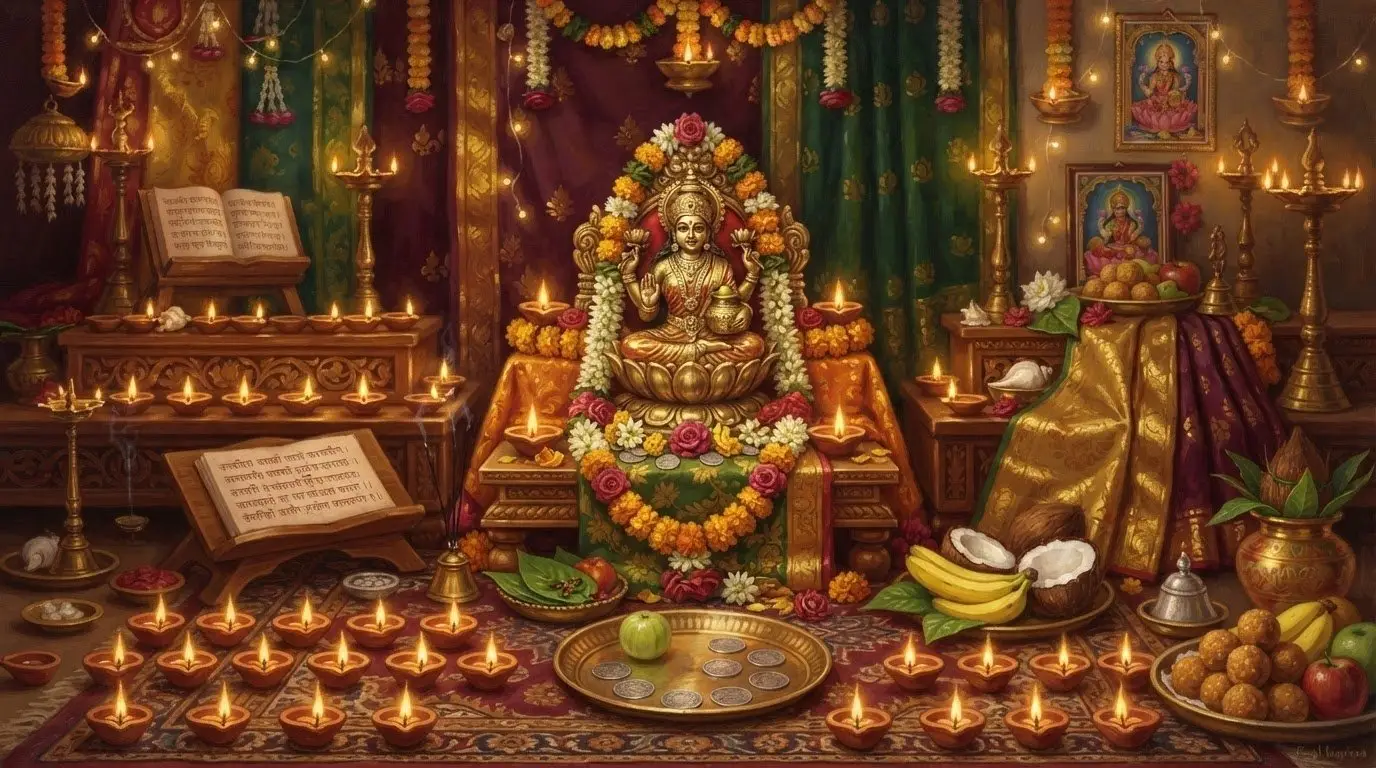
A simple, clean seat facing east, a lit ghee lamp, and an offering of a lotus flower or marigold before an image of Lakshmi are the customary preparations. Some devotees also place a single amla, rice grains or a few coins near the image as a quiet echo of the fruit at the centre of the legend itself. Sincerity and humility matter more than mechanical repetition or perfect pronunciation from the very first attempt - a lesson the story of the poor woman's single offering makes plain from the outset. As with any Sanskrit stotra, learning the finer points of correct recitation from a qualified guru, temple priest or experienced elder is always the wiser course for a devotee reciting it seriously for the first time, and minor differences in verse order or count between regional editions are a normal feature of the text's long transmission rather than any cause for concern.
Further reading: for background on Adi Shankaracharya's life and his broader body of devotional and philosophical work, see the [Wikipedia entry on Adi Shankara](https://en.wikipedia.org/wiki/Adi_Shankara).
Frequently Asked Questions
What does Kanakadhara mean?
Kanakadhara combines kanaka, gold, and dhara, a stream or shower, meaning "the stream of gold" - a direct reference to the shower of golden amlas said to have fallen in answer to the hymn.
Who composed the Kanakadhara Stotram and why?
It was composed by Adi Shankaracharya, traditionally said to be in his youth, as an extempore hymn to Mahalakshmi after a desperately poor woman offered him a single dried amla, the only food remaining in her house, as alms.
What is the story behind the Kanakadhara Stotram?
A poor Brahmin woman, having nothing else to give the young mendicant Shankara, offered him a single amla with great devotion despite her shame at its poverty. Moved by her sincerity, Shankara composed this hymn on the spot, and tradition holds that Lakshmi answered by raining gold amlas into her courtyard.
How many verses are there in the Kanakadhara Stotram?
Most editions contain between eighteen and twenty-one Sanskrit verses, with the variation largely accounted for by whether a closing dedicatory or benefits verse is included - a normal feature of the text's transmission across different regional traditions.
What is Lakshmi's kataksha and why does the stotram mention it so often?
Kataksha refers to the goddess's sidelong or oblique glance, understood as the mechanism through which her grace and fortune are bestowed. Nearly every verse of the stotram pleads for this glance rather than demanding wealth directly, reflecting the belief that prosperity is received as grace rather than claimed as of right.
What are the benefits of reciting the Kanakadhara Stotram?
Devotees recite it primarily for relief from financial hardship and for lasting prosperity and stability, as well as before new business ventures or moving into a new home, and for cultivating a more grounded, dharmic relationship with wealth generally.
Which day is best for reciting the Kanakadhara Stotram?
Friday, widely regarded as Lakshmi's day, is the most commonly recommended day, though many devotees also recite it daily, particularly in the morning or at dusk.
How many times should the Kanakadhara Stotram be recited?
Once through daily is considered sufficient for ordinary practice; some devotees undertake a more intensive sadhana of 108 recitations in a single sitting, or commit to reciting it daily for a fixed period such as twenty-one or forty-one days.
Is the Kanakadhara Stotram suitable for beginners?
Yes, though its dense Sanskrit compounds are more demanding than a simple chalisa, and new reciters benefit from first hearing it chanted by an experienced pandit or trusted recording to learn its natural rhythm before reciting it unaided.
What is the difference between the Kanakadhara Stotram and the Mahalakshmi Ashtakam?
The Kanakadhara Stotram is attributed to Adi Shankaracharya and centres almost entirely on the image of Lakshmi's glance and the legend of the golden amlas, while the Mahalakshmi Ashtakam is a separate eight-verse hymn with its own distinct origin and imagery; both are widely recited by devotees of Lakshmi and are often learned together rather than treated as alternatives to one another.
The gooseberry offered at a poor woman's door, and the gold said to have answered it, remain one of the gentlest teachings in the entire devotional tradition: that grace responds to sincerity long before it responds to merit. Musinara records the Kanakadhara Stotram and Lakshmi's other principal hymns at 432 Hz, and you are warmly invited to listen and chant along on our YouTube channel, particularly on Fridays and through the bright, gold-lit nights of Diwali.
Related reading
- The Durga Chalisa: Meaning, Verses and How to Recite the Forty-Verse Hymn to the Mother
- Lalita Sahasranamam: Meaning, Structure and Benefits of the Thousand Names
- Devi Kavach, Argala Stotram & Keelak: The Three Sacred Preludes to the Durga Saptashati
- Mahishasura Mardini Stotram (Ayi Giri Nandini): Meaning, Significance & Benefits
Watch and listen to devotional music and mantras on the Musinara YouTube channel.
New to chanting? Two short guides cover the practicalities: how to chant a mantra (mala, count, pronunciation and the three traditional modes of japa), and Devi worship at home (a simple altar and a ten minute daily sequence).