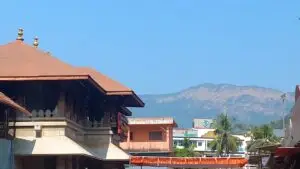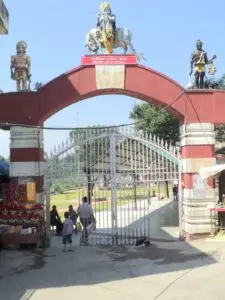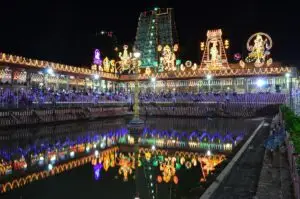
On the southern bank of the river Tunga, where the water runs clear enough in places to show the fish gliding beneath it, stands the oldest and, in the reckoning of many, the foremost of the four cardinal mathas established by Adi Shankaracharya. The Sringeri Sharada Peetham is not merely a temple town in the Western Ghats of Karnataka; it is the seat of an unbroken teaching lineage now well over a millennium old, the place where the philosopher-saint chose to enshrine Goddess Sharada - Saraswati in her form as the giver of learning - and where the succession of Jagadgurus he began continues to this day.
This guide takes the unhurried route through Sringeri's layered history: the legend of why Shankaracharya selected this particular bend of the Tunga, the story of the goddess's image changing from sandalwood to gold, the singular architecture of the neighbouring Vidyashankara temple with its zodiac-aligned pillars, the guru parampara that gives the Peetham its enduring authority, its festivals, its daily rhythms of worship, and the practical matters of reaching this quiet hill town for those planning a pilgrimage of their own.
Readers already familiar with Sharada's place among the great goddesses of learning may wish to read alongside this guide our companion piece on Goddess Saraswati, of whom Sharada is understood as a direct manifestation, and those drawn to the tantric dimension of the Peetham's worship, discussed later in this article, may also find our guide to Maa Tripura Sundari and the Sri Vidya tradition a useful companion.
Who Is Sharadamba, and Why Is the Peetham So Significant?
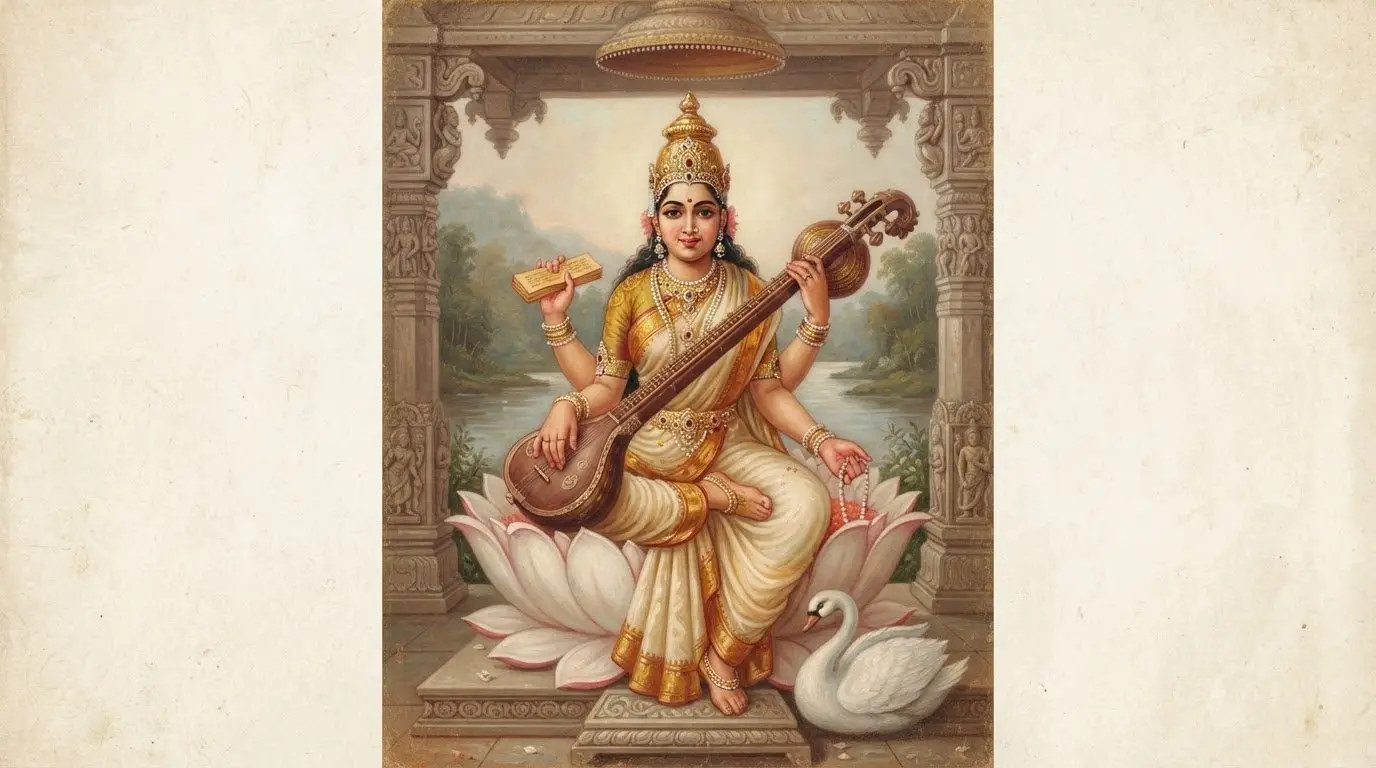
Sharadamba - also called Sharada Devi or simply "the Mother of Sringeri" - is worshipped here as a form of Saraswati, the goddess of learning, speech, music and the arts. Her name derives from Sharada, one of Saraswati's classical epithets, associated in some traditions with autumn (sharad) and, more broadly, with the clarity and discernment that ripen through disciplined study, much as the autumn sky clears after the monsoon. At Sringeri she is enshrined not as a consort figure standing beside a male deity, but as the presiding Devi of the entire institution, worshipped in her own right as the source of vidya - knowledge in its fullest sense, encompassing both worldly learning and the liberating knowledge (jnana) that is the goal of Vedantic practice.
What sets Sringeri apart from most temple towns devoted to Saraswati is the institution built around the goddess: the matha, or monastic seat, established by Adi Shankaracharya as the first and, by the traditional reckoning of most followers of the Smarta and Advaita traditions, the most senior of the four cardinal mathas he founded at the four directional extremities of the subcontinent. Sringeri is the Dakshinamnaya Peetham, the seat of the southern tradition (amnaya), paired in the classical scheme with the Rigveda, the Aitareya Upanishad, and the mahavakya "Prajnanam Brahma" - "Consciousness is Brahman." The other three cardinal mathas, at Dwaraka in the west, Puri in the east, and Jyotirmath (Badrinath) in the north, complete a fourfold institutional structure through which Shankaracharya intended his non-dualist philosophy, Advaita Vedanta, to be preserved and transmitted across the length and breadth of India.
Readers exploring the wider architecture of Shakta philosophy that underlies goddess worship of this kind may find useful context in our guide to Adi Parashakti, the Supreme Divine Mother, since Sharada at Sringeri is understood within the tradition as one radiant expression of that same primordial consciousness, here specifically emphasising its aspect as the illuminator of knowledge.
It is worth noting, as the tradition itself is careful to acknowledge, that the precise dating of Adi Shankaracharya's life remains a matter of some scholarly disagreement, with traditional accounts placing him in the eighth century CE and some historians proposing dates a little later; the Sringeri matha's own chronicles favour the earlier, traditional dating. This guide follows the tradition's own account while noting, in the interest of intellectual honesty, that readers wishing to explore the historical debate in depth are best served by consulting scholarly sources alongside the devotional record.
The Legend of the Cobra, the Frog, and Shankaracharya's Choice of Sringeri
Nearly every account of Sringeri's founding begins with a small, vivid scene witnessed on the banks of the Tunga. As the story is told, Adi Shankaracharya, travelling through the Western Ghats in the course of his digvijaya - his philosophical tour establishing Advaita Vedanta across India - came upon a striking sight at this particular bend of the river: a cobra, its hood spread wide, sheltering a frog about to give birth from the fierce heat of the midday sun, rather than preying upon it as its nature would ordinarily dictate.
Shankaracharya read in this improbable scene a profound sign. A place where even natural enmity - the eternal opposition between predator and prey - could be suspended, he reasoned, must be a site of extraordinary spiritual power (punya bhoomi), a ground so saturated with sanctity that it softened even instinct itself. He resolved, the tradition holds, to establish his first matha at precisely this spot, and so Sringeri - a name many traditional sources connect to Rishyashringa, the sage associated with this stretch of forest and honoured at a nearby shrine in the village of Kigga, though the etymology is treated by scholars as uncertain - became the seed from which the entire network of Advaita mathas would grow.
As with much of Shankaracharya's traditional biography, the precise historical details of this founding - the exact date, the sequence of his travels, even certain particulars of the cobra-and-frog episode as told in different regional versions - are transmitted primarily through guru parampara and devotional memory rather than independently dated documentary record. Devotees seeking the fuller oral tradition are encouraged to hear it directly from the pontiffs or resident scholars at Sringeri, where the story is preserved with detail no written summary can fully capture.
The Sandalwood Image, the Sri Chakra, and the Gold Icon
The story of Sharadamba's own image at Sringeri unfolds in stages that devotees often recount as a lesson in the relationship between outer form and inner sanctity. Having chosen the site, Shankaracharya is held to have installed a Sri Chakra - the geometric yantra of nine interlocking triangles that lies at the heart of Sri Vidya, the tantric tradition of goddess worship centred on the supreme feminine principle - beneath or before the image of the goddess, consecrating the sanctum according to the rigorous ritual science of Sri Vidya rather than through simpler iconographic worship alone. This installation is considered one of the foundational acts establishing Sringeri's sanctity, and it links the Peetham to the same tantric current explored at length in our guide to Maa Tripura Sundari and the Sri Chakra, the Devi most closely associated with Sri Vidya worship.
Tradition holds that Shankaracharya himself first installed and consecrated an image of the goddess carved from sandalwood (chandana), a material valued for its fragrance and its association with purity and coolness - qualities considered fitting for a goddess of serene, illuminating wisdom. Some centuries later, according to the succession of pontiffs at the matha, a subsequent Jagadguru - accounts differ on precisely which one, and readers are again encouraged to seek the matha's own detailed chronicle for the fuller narrative - installed a new image of the goddess fashioned from gold or a gold-covered material, seated upon a simhasana (lion throne) beneath a canopy, in the form in which she is worshipped and beheld by pilgrims today. The gold Sharadamba image shows the goddess seated in padmasana, four-armed, holding a japamala (rosary) and a manuscript (representing the Vedas) in her upper hands, with her lower hands held in gestures of blessing and reassurance - an iconography that visually announces her as the source of both disciplined practice and liberating knowledge.
The original sandalwood image, tradition holds, continues to be preserved and worshipped at the matha, with the two images - sandalwood and gold - together forming a layered testimony to Sringeri's long history of continuous worship, each renewal understood not as a replacement of the goddess's presence but as a fresh vessel for a sanctity that never lapsed.
The Vidyashankara Temple: Architecture Aligned to the Zodiac
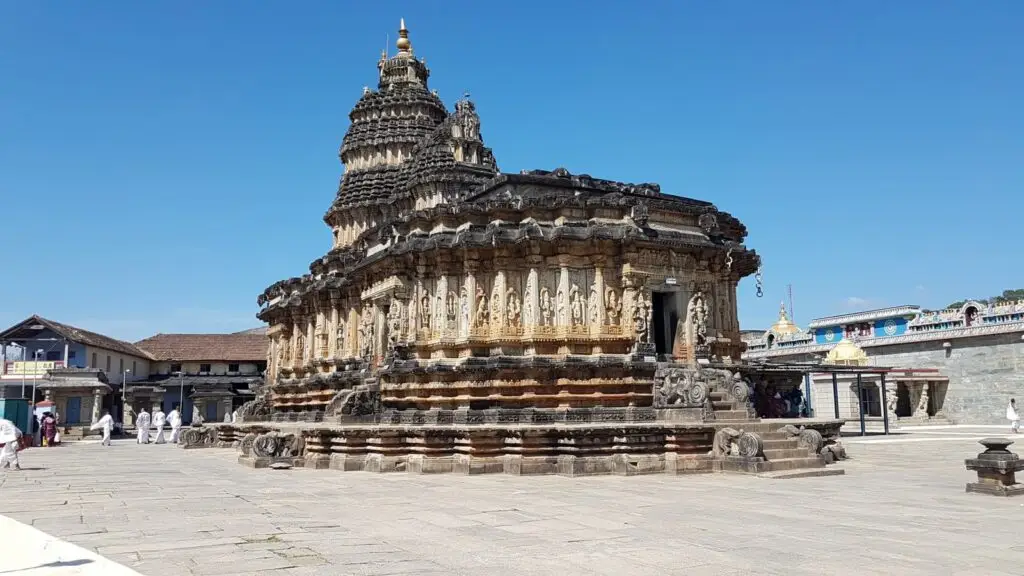
Adjoining the Sharadamba shrine, and forming one of Sringeri's most remarkable architectural features, stands the Vidyashankara temple, built in the fourteenth century under the patronage of the Vijayanagara empire in memory of Vidyashankara Bharati, one of the early Jagadgurus of the Sringeri Peetham. Constructed in a distinctive blend of Hoysala and Vijayanagara styles, the temple is celebrated less for its size than for a genuinely unusual feature of its design: twelve pillars within the mandapa, each carved and positioned to correspond to one of the twelve rashis (zodiac signs) of Vedic astronomy.
According to long-standing local tradition, the temple was engineered so that the sun's rays, entering through a specific opening, fall upon the pillar corresponding to the current solar month (surya masa), effectively turning the structure into a functioning solar calendar carved in stone - a claim that has drawn considerable interest from historians of Indian temple architecture and astronomy alike, even as some of its finer astronomical claims remain a subject of ongoing study and discussion among scholars. Whatever the precise mechanics, the temple's twelve-pillared design stands as one of the more striking instances in Indian sacred architecture of astronomical symbolism made structural rather than merely decorative.
The Vidyashankara temple also houses a Shiva linga and is understood as the samadhi shrine of the pontiff after whom it is named, linking Sringeri's architecture directly to the guru parampara discussed in more detail below - a reminder that at Sringeri, the worship of the goddess and the veneration of the teaching lineage are never entirely separate currents but two expressions of a single continuous sanctity.
The Tunga River, the Sanctum, and the Wider Temple Complex
The river Tunga, flowing gently past the temple complex, is itself treated as a participant in Sringeri's sanctity rather than mere scenery. Pilgrims traditionally bathe in its waters before darshan, and the ghats along its bank - quiet, shaded by old trees, and often visited by fish that devotees feed as an act of merit - form one of the most memorable and photographed aspects of a visit to Sringeri. The river's clean, unhurried character is frequently described by visitors as setting the tone for the entire pilgrimage: a place for reflection rather than spectacle.
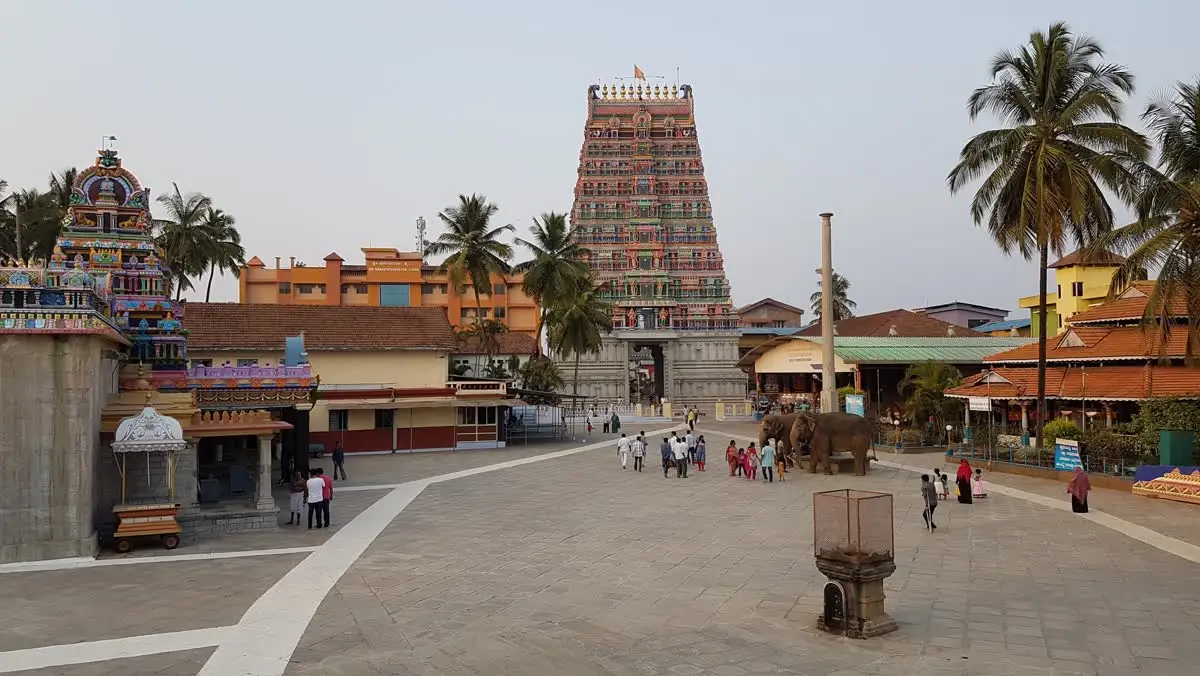
The temple complex itself extends well beyond the Sharadamba and Vidyashankara shrines. A separate temple to Vidya Ganapati, the elephant-headed remover of obstacles worshipped here in his aspect connected with learning, stands within the same precincts, and pilgrims customarily seek his blessing before proceeding to Sharadamba, in keeping with the widespread convention across Hindu temples of honouring Ganapati first. The matha's residential and administrative buildings, including the quarters of the presiding Jagadguru and the institutions of Sanskrit and Vedic learning maintained by the Peetham, occupy the surrounding grounds, giving Sringeri the character less of a single monument than of a living campus where worship, scholarship and monastic governance continue side by side, much as they have for centuries.
The Guru Parampara: Jagadgurus of Sringeri
Perhaps the single most distinctive feature of the Sringeri Sharada Peetham, setting it apart from temples devoted to Devi elsewhere in India, is its institutional continuity: an unbroken succession of pontiffs, each styled Jagadguru Shankaracharya, stretching back - by the matha's own reckoning - to Adi Shankaracharya himself, who is traditionally held to have installed his disciple Sureshvaracharya (also known as Sureshvara) as the first pontiff of Sringeri.
Each Jagadguru in this lineage is regarded not merely as an administrator of the institution but as a living exemplar of the Advaita teaching the Peetham exists to preserve, and the succession from guru to designated successor (generally a disciple chosen and trained over years, formally anointed before the incumbent's passing) is treated with the same gravity that the tradition accords to the transmission of scriptural knowledge itself. The current and recent Jagadgurus of Sringeri, including His Holiness Sri Bharati Tirtha Mahaswamiji and His Holiness Sri Vidhushekhara Bharati Mahaswamiji as his designated successor, continue this tradition, presiding over the daily worship of Sharadamba, the ongoing scholarly and educational institutions maintained by the matha, and the guidance sought by devotees from across India and beyond.
| Aspect of the Parampara | Description |
|---|---|
| Founding pontiff | Sureshvaracharya (Sureshvara), traditionally held to be a direct disciple of Adi Shankaracharya |
| Title borne by each pontiff | Jagadguru Shankaracharya of Sringeri Sharada Peetham |
| Nature of succession | A chosen and trained successor is formally anointed, generally before the incumbent's passing, preserving institutional continuity |
| Role of the Jagadguru | Presides over worship of Sharadamba, heads the matha's scholarly and Vedic institutions, and offers spiritual guidance to devotees |
| Notable historical pontiff | Vidyashankara Bharati, commemorated in the architecturally distinctive Vidyashankara temple |
Devotees seeking an audience with the presiding Jagadguru, or wishing to understand the finer points of the succession and the matha's philosophical positions in greater depth, are encouraged to approach the matha's own offices directly, since protocols for such audiences are set by the institution itself and may vary according to the pontiff's schedule and the season.
Festivals: Navaratri, Sharan Navaratri, and Vidyarambham
Sringeri's festival calendar reflects both its Shakta character as Sharadamba's seat and its scholarly identity as a centre of Vedic learning, and nowhere is this combination clearer than in its observance of Navaratri.
Sharad Navaratri, the autumn nine-night festival honouring the Devi in her nine forms, is celebrated at Sringeri with particular elaborateness, and the matha's version of the festival is often referred to locally as Sharan Navaratri, reflecting the season (sharad) in which it falls and its close association with Sharadamba herself. Across the nine nights, the goddess is adorned in a sequence of different alankaram (ornamentation), special abhishekams (ceremonial bathing of the deity) are conducted, and Vedic recitation and classical music programmes are held within the temple precincts, drawing scholars, musicians and devotees from across South India. The festival culminates in Vijayadashami, the tenth day, marking the goddess's triumph and traditionally regarded as an especially auspicious day for beginning new learning.
It is on or around this Vijayadashami day that Sringeri hosts one of its most cherished observances: Vidyarambham, the ceremony formally initiating young children into the world of learning by having them trace their first letters, guided by an elder or priest, often in a tray of rice or sand, before the image of Sharadamba herself. Families travel to Sringeri specifically for this rite, considering it especially auspicious to have a child's very first act of writing take place in the presence of the goddess of learning at her own foremost shrine - a practice that gives Vidyarambham at Sringeri a significance well beyond the local community.
Beyond Navaratri, Sringeri also observes Ganesh Chaturthi with due prominence at the Vidya Ganapati shrine, along with the Rathotsava (chariot festival) and Shankara Jayanti, the birth anniversary of Adi Shankaracharya, marked with special programmes reflecting the matha's identity as the seat of his teaching.
| Occasion | Approximate Timing | Notable Observance |
|---|---|---|
| Sharan Navaratri (Sharad Navaratri) | September-October | Nine nights of alankaram, abhishekam, Vedic and classical music programmes |
| Vijayadashami | End of Navaratri (September-October) | Considered especially auspicious for Vidyarambham and new learning |
| Vidyarambham | Often on or around Vijayadashami | Children's first-letters ceremony before Sharadamba |
| Shankara Jayanti | Typically April-May, per the lunar calendar | Birth anniversary observance for Adi Shankaracharya |
| Ganesh Chaturthi | August-September | Special worship at the Vidya Ganapati shrine |
| Rathotsava | Varies by year, per temple almanac | Processional chariot festival through Sringeri town |
As with all festivals governed by the lunisolar Hindu calendar, exact dates shift from year to year, and pilgrims planning a visit around any of these occasions should verify the specific dates for their year of travel with the Sringeri matha's own offices or its official pilgrim information channels.
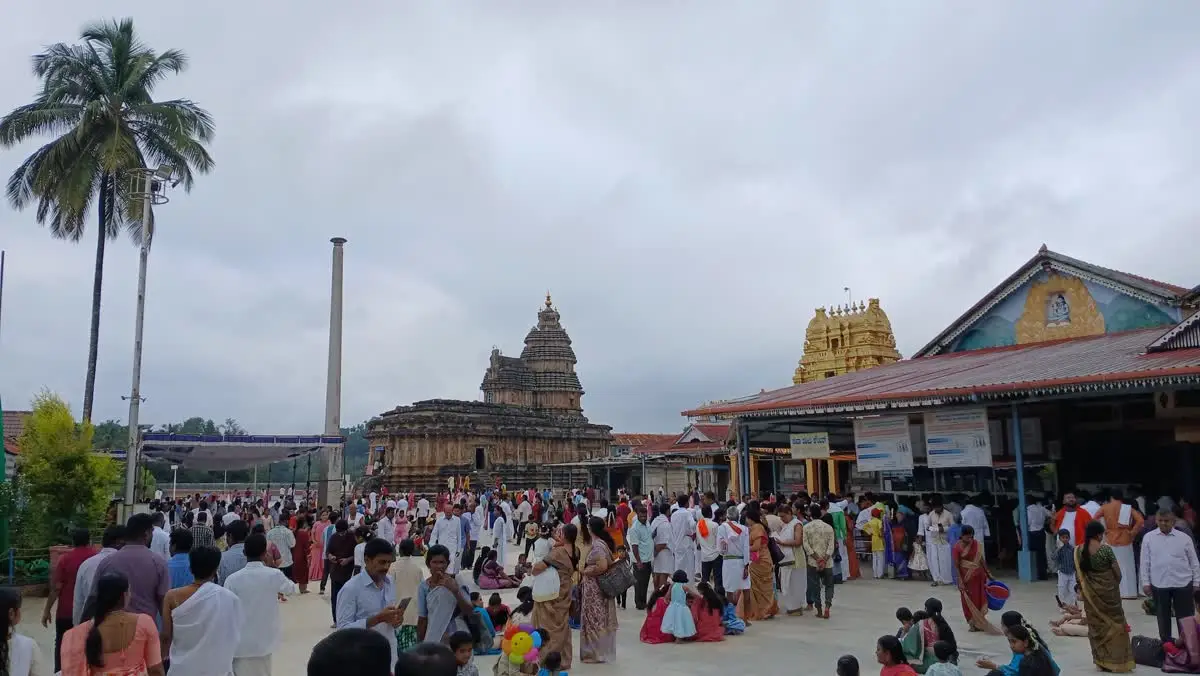
Darshan and Pooja Timings
Sringeri maintains a structured daily schedule of worship, balancing periods open to public darshan with the closed intervals required for the elaborate ritual programme conducted within the sanctum. The timings below reflect the temple's typical daily rhythm, though, as with all temple schedules, these are subject to periodic revision and special arrangements during festivals, and pilgrims are strongly advised to confirm current timings with the matha before travelling.
| Aspect | Typical Timing |
|---|---|
| Morning darshan | Approximately 6:00 AM to 2:00 PM |
| Vidyashankara and Torana Ganapati temples | Approximately 7:00 AM to 1:00 PM and 5:00 PM onward |
| Evening darshan | Approximately 5:00 PM to 9:00 PM |
| Special abhishekam and sevas | Generally in the early morning hours; specific bookings through the matha's seva counter |
Timings, fees and travel details checked against official sources in October 2026 are in Plan Your Visit below.
Devotees wishing to sponsor a particular seva or abhishekam, or to seek a private audience with the presiding Jagadguru, should approach the matha's administrative office on arrival or, where possible, make arrangements in advance through the Peetham's official channels.
How to Reach Sringeri
Sringeri's location in the Western Ghats means it is reached by road for the final stretch regardless of how a pilgrim approaches from further afield, and the drive itself, through areca and coffee plantations and forested hill country, is often described as a gentle prelude to the pilgrimage rather than mere transit.
| Mode | Details |
|---|---|
| By Air | The nearest airport is Mangaluru International Airport, roughly 95-100 km away, connected to Sringeri by road (approximately 2.5-3 hours). Bengaluru's Kempegowda International Airport, considerably further at around 330 km, is also used by travellers combining Sringeri with a longer Karnataka itinerary. |
| By Train | Mangaluru railway station, around 120 km away, and Shivamogga (Shimoga) railway station, roughly 95 km away, are the two nearest major railheads, each connected onward to Sringeri by regular bus and taxi services. |
| By Road | Sringeri is well connected by government and private bus services from Mangaluru, Shivamogga, Chikmagalur, Udupi and Bengaluru; the drive from Bengaluru (around 330 km) typically takes 7-8 hours, while Shivamogga and Mangaluru are each roughly 2.5-3 hours away by road. |
These distances and durations should, as always, be reconfirmed close to the date of travel, since road conditions in the Western Ghats can vary with the season, particularly during the monsoon months of June to September.
Nearby Attractions and Where to Stay
Sringeri's setting in the Western Ghats offers pilgrims a number of worthwhile detours beyond the Peetham itself. The Rishyashringa temple at Kigga, a short drive away, honours the sage traditionally associated with this region and is often visited by pilgrims extending their Sringeri trip by a day. The Sringeri Ghat road toward Agumbe, renowned as one of Karnataka's most scenic mountain passes and among the wettest inhabited places in India during the monsoon, draws visitors interested in the region's dense Western Ghats rainforest, while Kudremukh National Park, a somewhat longer drive away, appeals to those with an interest in trekking and wildlife amid some of the range's highest peaks.
Accommodation in Sringeri itself is oriented substantially around pilgrim needs, with the matha maintaining guesthouses and dining halls (bhojanashalas) that serve devotees at modest cost, alongside a growing number of private lodges and small hotels in the town catering to a wider range of budgets. Given Sringeri's popularity during Navaratri and Vidyarambham, advance booking is advisable, and many pilgrims stay at least one night to attend both morning and evening darshan unhurried.

Benefits of Worship and Why Devotees Visit Sringeri
Pilgrims and scholars alike describe a visit to Sringeri as offering something distinct from darshan at more overtly dramatic Shakti sites: a devotional atmosphere oriented specifically toward clarity of mind, discipline in study, and the removal of obstacles to genuine understanding, rather than toward the fiercer, more immediately protective blessings sought at goddess temples associated with warrior or tantric forms of the Devi. Students, musicians, writers and anyone embarking on serious study are traditionally encouraged to seek Sharadamba's blessing, and the Vidyarambham ceremony in particular has, over centuries, made Sringeri a site especially associated with the beginning of a child's formal education.
Beyond the specific blessing of learning, devotees describe the wider experience of Sringeri - its unhurried pace, the presence of an actively maintained scholarly and monastic tradition, and the sense of continuity embodied in an unbroken guru parampara stretching back well over a thousand years - as itself a form of teaching, quietly instructive about the value of sustained, patient discipline over dramatic or hurried spiritual shortcuts. Those drawn to the more advanced tantric dimension of Sharadamba's worship through the Sri Chakra installed at her sanctum are, as at any Sri Vidya site, strongly advised to pursue such practice only under the guidance of a qualified guru, since correct initiation, pronunciation and ritual sequence are considered essential rather than optional in this demanding tradition - a point also emphasised in our guide to Maa Matangi, another of the Mahavidyas closely associated with speech, learning and the arts, and a natural companion study for readers drawn to Sharadamba's own domain.
Plan Your Visit to Sringeri: Timings, Tickets and Travel
The details below were checked on 3 October 2026 against the Sringeri Sharada Peetham and the other sources listed under each table. Timings and fees change on festival days, eclipses and special occasions, so confirm with the temple before you travel.
The Karnataka Devi temple circuit links Chamundeshwari, Horanadu, Sringeri, Kollur and Kateel in a five-day route by road. For what happens here during Navratri 2026 (11 to 19 October), see Navratri 2026 at major Devi temples.
Darshan and Aarti Timings
| Information | Details |
|---|---|
| Sharadamba temple | 6:00 am to 2:00 pm and 4:00 pm to 9:00 pm |
| Maha-Mangalarati | 10:00 am, 12:00 noon and 7:30 pm |
| Other temples in the complex | 6:00 am to 1:00 pm and 5:00 pm to 8:00 pm |
| Guru darshanam | 10:30 am to 11:30 am daily |
| Chandramoulishwara puja by the Jagadguru | Weekdays 9:00 to 10:00 pm; Fridays 8:30 to 10:00 pm |
| Nitya annadana | 12:15 pm to 2:30 pm and 7:15 pm to 8:30 pm |
Sources: Sringeri Sharada Peetham: Temple Timings, Sringeri Sharada Peetham: Pilgrim Facilities.
Tickets, Darshan Options and Sevas
| Option | Price | Notes |
|---|---|---|
| Sevas during Sharannavaratri | Shown on the seva portal | Sevas can be booked on the Peetham seva portal, seva.sringeri.net. |
Darshan is free. Timings change with events and the Jagadguru's schedule. Bookings are handled on seva.sringeri.net. Seva portal for Navaratri sevas. The Peetham website also links an accommodation portal, yatri.sringeri.net. Musinara is not connected with the temple and does not take bookings.
Sources: Sringeri Sharada Peetham: Sri Sharada Sharannavaratri Mahotsava 2026, Sringeri Sharada Peetham: Temple Timings.
How to Reach Sringeri
Open Sringeri in Google Maps for live directions.
| Mode | Nearest point | Distance to the temple |
|---|---|---|
| Air | Mangaluru Airport | about 100 km |
| Rail | Udupi or Shivamogga Town | about 79 (Udupi), about 99 (Shivamogga Town) |
| Bus | Sringeri bus station | in the town |
Sources: Trawell: How to Reach Sringeri, Sringeri Sharada Peetham: Travel and weather (how to reach).
Approximate distances and journey times from the cities most pilgrims start from. Road times assume normal traffic; festival weekends take longer.
| From | By road | Road time | Train or flight |
|---|---|---|---|
| Bengaluru | about 315 to 360 km | about 8 hours | |
| Mangaluru | about 110 km | about 4 hours | Mangaluru airport is about 100 km away |
| Shivamogga | about 90 to 105 km | about 3 hours | Shivamogga Town station is about 99 km from Sringeri |
| Mysuru | about 260 km | about 7 hours |
Sources: Sringeri Sharada Peetham: Travel and weather (how to reach), Karnataka Tourism: Sringeri (how to reach), Trawell: How to Reach Sringeri.
Buses run to Sringeri from Bengaluru, Mangaluru, Udupi, Mysuru, Shivamogga, Chikkamagaluru, Dharmasthala, Kollur and Koppa. Private taxis and mini-buses are also available.
Prasadam, Annadanam and Where to Stay
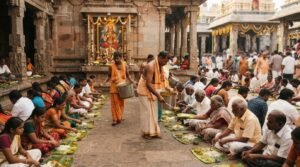
Nitya annadana is served free to all devotees from 12:15 to 2:30 pm and from 7:15 to 8:30 pm. The Peetham runs guest houses: Sri Shankara Kripa, Sri Sharada Kripa, Yatri Nivas, Sri Bharathi Tirtha Vihara, Sri Shankara Sadana, Sri Srinivasa Kripa and Sri Bharati Tirtha Krupa. A minimum kannikai (contribution) is collected, and dormitories are available for groups. Rooms are allotted at the Information Office near the temple entrance, usually on a first come, first served basis. The Peetham also links an online accommodation portal (yatri.sringeri.net), so confirm availability before you travel. Contact: +91-08265-252525.
Sources: Sringeri Sharada Peetham: Pilgrim Facilities, Sringeri Sharada Peetham: Sri Sharada Sharannavaratri Mahotsava 2026.
Frequently Asked Questions
What is the Sringeri Sharada Peetham, and why is it called the first matha?
It is the monastic seat established by Adi Shankaracharya on the bank of the river Tunga in present-day Karnataka, generally regarded as the first and, by many accounts, the most senior of the four cardinal mathas he founded at the four directions of India. It is the Dakshinamnaya (southern) Peetham, associated with the Rigveda.
Who is the presiding deity at Sringeri, and how is she connected to Saraswati?
The presiding deity is Sharadamba, or Sharada Devi, worshipped as a form of Saraswati, the goddess of learning, speech and the arts. She is enshrined as the presiding Devi of the entire institution rather than as a consort figure.
Why did Adi Shankaracharya choose Sringeri as the site for his first matha?
Tradition recounts that he witnessed a cobra sheltering a frog about to give birth from the sun's heat on the bank of the Tunga at this spot - a suspension of natural enmity he read as a sign of the site's extraordinary spiritual power, prompting him to establish his matha there.
What is the significance of the two images of the goddess at Sringeri?
Tradition holds that Shankaracharya first installed an image of the goddess carved from sandalwood, later followed, according to the matha's succession of pontiffs, by a gold image seated on a lion throne - the form in which she is worshipped today. Both images are understood as continuous vessels for the same unbroken sanctity.
What makes the Vidyashankara temple architecturally significant?
Built in the fourteenth century in memory of an early Jagadguru, its mandapa contains twelve pillars, each associated with one of the twelve zodiac signs, with local tradition holding that sunlight falls on the corresponding pillar during its solar month - an unusual instance of astronomical symbolism built directly into temple architecture.
What is Vidyarambham, and why is it performed at Sringeri?
Vidyarambham is the ceremony initiating a child into formal learning by guiding their hand to trace their first letters, typically in rice or sand, in the presence of the deity. Many families travel specifically to Sringeri for this rite, considering it especially auspicious to begin a child's education before Sharadamba, the goddess of learning herself.
How do I reach Sringeri from Mangaluru or Bengaluru?
From Mangaluru, Sringeri is roughly 95-100 km by road, about 2.5-3 hours' drive. From Bengaluru, it is a longer journey of around 330 km, typically 7-8 hours by road; regular bus services connect Sringeri to both cities, as well as to Shivamogga and Chikmagalur.
What are the typical darshan timings at the Sharadamba temple?
Darshan is typically available from around 6:00 AM to 2:00 PM and again from about 5:00 PM to 9:00 PM, with the Vidyashankara and Torana Ganapati temples following a somewhat different schedule; pilgrims should confirm current timings with the matha before travel, especially around festivals.
Is Sringeri connected to the Sri Vidya tantric tradition?
Yes - Adi Shankaracharya is held to have installed a Sri Chakra at Sharadamba's sanctum, linking Sringeri to the broader Sri Vidya tradition centred on Tripura Sundari. Devotees interested in this more advanced dimension of worship are advised to seek guidance from a qualified guru.
What is the guru parampara of Sringeri, and who leads the Peetham today?
It is the unbroken succession of Jagadgurus beginning, by tradition, with Sureshvaracharya, a direct disciple of Adi Shankaracharya. The lineage continues through a formally trained and anointed successor at each transition, with the current and recent pontiffs continuing to preside over worship, scholarship, and the guidance of devotees.
For further reading on the broader institutional history of the four cardinal mathas, see the Wikipedia entry on the Sringeri Sharada Peetham.
To stand on the banks of the Tunga at Sringeri, before an image of the goddess first carved in sandalwood and later renewed in gold, is to feel something of the patient continuity that has sustained this Peetham for well over a thousand years - a teaching lineage and a mother's blessing, offered together to anyone who seeks clarity. If Sharadamba's quiet devotion to learning has stirred something in you, Musinara's channel offers 432 Hz recordings of Saraswati and Devi mantras for reflective listening - we invite you to listen on YouTube and carry a measure of Sringeri's stillness into your own study and practice.
Related reading
- Tulja Bhavani Temple, Tuljapur: A Complete Guide to the Kuldevi of the Marathas
- Kanaka Durga Temple, Vijayawada: A Complete Guide to the Goddess of Indrakeeladri
- Mahalakshmi Temple, Kolhapur: A Complete Guide to Ambabai, the Karavir Nivasini
- Bhramaramba Devi Temple, Srisailam: The Complete Guide to the Bee Goddess's Shakti Peetha
Official and Reference Sources
- Sringeri Sharada Peetham, official - the matha established by Adi Shankaracharya
Planning a pilgrimage? All twenty Devi temple guides on this site are arranged by region, with practical circuits, in Devi Temples of India. For where each site sits in the disputed lists of 51, 52 and 108, see the Shakti Peeth list.