In the crowded, radiant company of India's goddesses - ancient, scripture-bound, carved into temple stone for a thousand years - Santoshi Maa is something of a newcomer, and that is precisely what makes her so beloved. She is the goddess of the ordinary household: the one a daughter-in-law turns to when a marriage feels heavy, when a household is short of money, when patience has worn thin and hope needs a shape to hold onto. Her name means contentment, and her worship asks for very little except sincerity, a Friday, and a willingness to give up sour food for a while.
This guide sets out to tell her story properly - who she is, how her worship spread across India within living memory, the vrat katha of the long-suffering daughter-in-law that devotees still recite today, and the precise vidhi of the sixteen Friday fasts, including the one rule almost every devotee has heard of but few understand fully: the avoidance of khatta, anything sour. We will also look at her iconography, her mantra and aarti in Devanagari with meaning, the udyapan that closes the vrat, and the temples where her worship has taken firm root.
Santoshi Maa belongs to a living, still-evolving stream of devotion within the wider ocean of Shakta worship - the reverence for the Adi Parashakti, the one Mother who takes a thousand forms to meet her children exactly where they are. Santoshi Maa is one of her gentlest, most approachable faces.
Who Is Santoshi Maa? The Mother of Contentment
Santoshi Maa's name comes from the Sanskrit santosha, meaning contentment, satisfaction, or the peace that comes from having enough. She is worshipped as the giver of that very quality - not necessarily wealth without measure, but sufficiency: the sense that one's needs are met, that struggle has an end, that the household is at peace. For a devotee facing debt, a stalled marriage proposal, a difficult mother-in-law, or a long period of professional stagnation, this is an enormously practical form of grace to ask for.
Unlike Lakshmi, Durga, or Kali, Santoshi Maa does not appear in the Puranas, the Devi Mahatmya, or any of the classical Sanskrit textual corpus that anchors most Devi worship. Her cult is comparatively young - most scholars and devotees trace her widespread popularity to the twentieth century, and specifically to a wave of devotion that crested with the release of a certain film in 1975. This does not make her worship any less genuine or any less powerful in the eyes of her devotees; it simply means her story belongs to a different kind of history - one of folk tradition, oral vrat kathas passed between women, and eventually cinema, rather than of Vedic hymn or Puranic episode. It is worth being honest about this distinction, because it is part of what makes Santoshi Maa such a fascinating case study in how Hindu devotional practice continues to grow new branches even in the modern era.
Daughter of Ganesha - A Family the Devotee Can Relate To
The most widely told account of Santoshi Maa's origin places her as the daughter of Lord Ganesha, born from the divine energy generated when his sons Shubh and Labh (Auspiciousness and Profit) pestered him to play with them the way other children play with their sisters. Moved by their persistent affection, Ganesha is said to have created Santoshi Maa from a flame or from his own divine radiance so that Shubh and Labh might have a sister to shower with love, and she in turn could shower blessings upon her nephews and their descendants - that is, upon the ordinary devotee.
This lineage matters enormously to devotees, because it plants Santoshi Maa firmly within a family devotees already know and trust. Ganesha is the remover of obstacles, worshipped first before any undertaking; his sons represent the very things every household prays for, wellbeing and prosperity. To be Ganesha's daughter is to inherit some of that same nearness to ordinary human concerns - marriage, money, children, harmony at home. Some regional tellings make her a niece of Kartikeya instead, or connect her more loosely to the broader Devi tradition without specifying an exact parentage, but the Ganesha-daughter narrative is by far the most widespread, especially in North and Central India, where her worship is most concentrated.
The 1975 Film That Carried Her Across India
If Santoshi Maa's origin is folk legend, her explosive popularity is a matter of cinema history. The 1975 Hindi film Jai Santoshi Maa, directed by Vijay Sharma and produced on a modest budget, became one of the surprise blockbusters of Indian film that year, running alongside the far more lavishly produced Sholay and, in many cinemas, outperforming expectations by a wide margin. Audiences - overwhelmingly women - attended in devotional dress, removed their footwear before entering the theatre, showered the screen with flower petals and coins, and returned again and again, treating the screening itself as an act of darshan rather than mere entertainment.
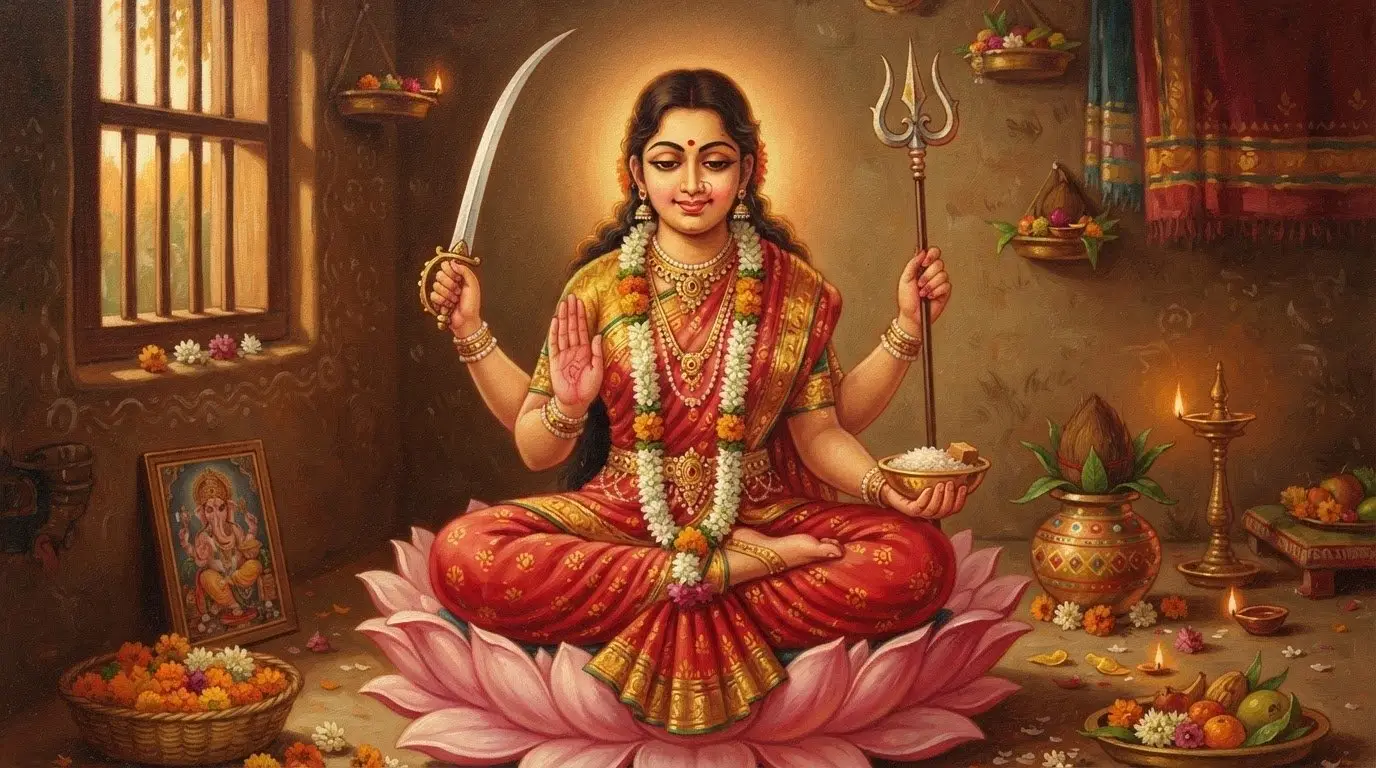
The film dramatised the vrat katha of Santoshi Maa: the trials of a devoted wife, her cruel sisters-in-law, and the goddess's eventual intervention to reward patient faith. Its songs, especially the aarti "Jai Santoshi Maa, Maiya Jai Santoshi Maa," became fixtures of household devotion almost overnight, sung in homes that had never before observed a Santoshi Maa vrat. Within a few years, her image - seated on a lotus, red-robed, holding a trishul and a bowl of rice and jaggery - was as familiar in Hindu households across India as far older, textually established goddesses. This is a striking example of how devotional practice in living Hinduism is not static; new forms of the Devi continue to emerge and take root when they answer a real, felt need in the hearts of ordinary worshippers, particularly women managing the daily burdens of household life.
Iconography: Reading Santoshi Maa's Form
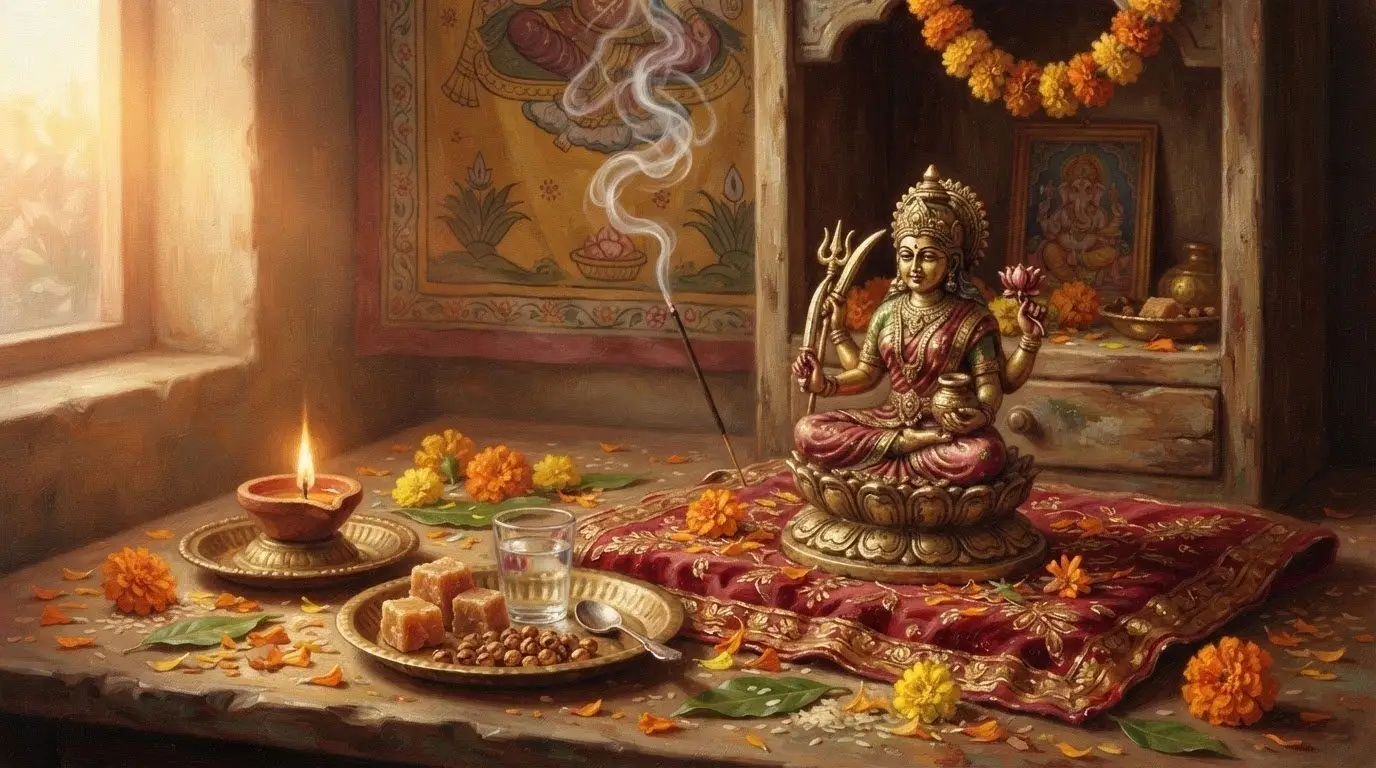
Santoshi Maa's standard iconography, now fairly consistent across calendar art, temple murtis, and devotional posters, carries clear symbolic meaning in every element.
| Element | Description | Symbolic Meaning |
|---|---|---|
| Colour of attire | Red and gold saree, sometimes yellow | Auspiciousness, marital wellbeing, festive energy |
| Vahana / seat | Lotus throne, occasionally shown seated on a lion in some regional depictions | Purity rising above worldly mud; occasional Shakti/Durga association |
| Trishul (trident) | Held in one upper hand | Destruction of the three kinds of suffering (adhyatmika, adhibhautika, adhidaivika) |
| Sword (khadga) | Held in another hand | Cutting through ignorance, ego, and obstacles to peace |
| Bowl of rice and jaggery (gur-chana) | Held in a lower hand or placed before her | Sufficiency, nourishment, the promise that no devotee's home will go hungry |
| Abhaya or varada mudra | One hand raised in blessing or granting boons | Protection and the granting of wishes to sincere devotees |
| Crown and ornaments | Gold crown, necklaces, bangles | Royal, motherly authority - she is queen of the household she protects |
Devotees often note that her combination of weapon (trishul, sword) and homely offering (rice, jaggery, gram) captures her dual character precisely: she is fierce enough to cut through a devotee's real hardships, yet gentle enough to be worshipped with the simplest kitchen foods rather than elaborate ritual apparatus. This is part of her appeal - she does not ask for grandeur, only for constancy.
The Santoshi Maa Vrat Katha: The Story of the Devoted Daughter-in-Law
The vrat katha of Santoshi Maa is recited aloud at the close of every Friday's worship, and it is worth setting out here in some detail, because the story itself teaches the very qualities the vrat is meant to cultivate: patience, faith, and restraint in the face of provocation.
There are several regional variants, but the core narrative, as told in most printed vrat katha pamphlets and repeated in the 1975 film, runs as follows.
In a certain town there lived seven brothers in one household. Six of them were prosperous and well settled, but the youngest brother was poor, and his wife bore the brunt of the family's contempt. Her sisters-in-law mocked her, gave her only the leftover, burnt scraps of food to eat, and made her carry out the most menial household chores while their own husbands prospered and their own comforts multiplied. The youngest brother himself was often away, working far from home to try and improve his fortune, leaving his wife to endure the household's cruelty largely alone.
One day, an elderly woman - in some tellings a neighbour, in others a wandering ascetic or a form of Santoshi Maa herself in disguise - noticed the young wife's tears and asked why she wept. When she explained her suffering, the old woman told her of a vrat that could change her fortune entirely: the worship of Santoshi Maa on sixteen consecutive Fridays. She explained the method - the offering of jaggery and roasted gram (gur-chana), the avoidance of anything sour for the duration of the vrat, and the sincere recitation of the goddess's katha.
The young wife began the vrat with deep faith, observing every Friday with care despite her difficult circumstances. Slowly, small signs of change appeared. A letter arrived from her husband, the first in a long while. Then money began to arrive - modest at first, then more substantial, as her husband's fortunes turned in the distant town where he worked. The sisters-in-law, seeing this unexpected good fortune, grew envious and suspicious, certain that some deception was afoot.
Then came the story's crucial test of faith. The young wife's husband was due to return home, bringing with him the wealth he had earned. On the very Friday of his homecoming - one of her sixteen vrat Fridays - her sisters-in-law, in a fit of jealousy and spite, served her a meal that secretly contained something sour, tricking her into breaking her fast without her knowledge. Because the vow had been broken, even unknowingly, the goddess's grace momentarily withdrew: the wife's husband was robbed on his journey home and arrived empty-handed, and the household's fortunes reversed once more.
Devastated but not despairing, the young wife recognised what had happened. She approached Santoshi Maa in heartfelt prayer, admitting the lapse - though it had been no fault of her own volition - and begging forgiveness, vowing to complete the vrat properly and with full attentiveness this time. Moved by her sincerity, patience, and lack of anger even toward those who had wronged her, Santoshi Maa restored the family's fortune, and by the vrat's conclusion the young wife's household was more prosperous and more harmonious than any of her brothers-in-law's. Her patience was rewarded, her tormentors were humbled, and her husband and she lived thereafter in comfort and peace.
Regional retellings add smaller episodes - miracles along the way, further tests, sometimes a young son restoring the family's honour - but the core arc stays consistent: patience under suffering, a vow kept with sincerity, an unwitting test, and the goddess's generous restoration of what was lost, and more besides.
Devotees are encouraged to read or listen to this katha at the close of each Friday's puja, since the narration itself is considered part of the ritual observance rather than mere illustration.
The Sixteen Friday Vrat: Vidhi Step by Step
The Santoshi Maa vrat is one of the more accessible vratas in the Hindu calendar, requiring no elaborate materials, no priest, and no fixed astrological muhurat - only sincerity and consistency across sixteen consecutive Fridays. It can be started by anyone, of any age or gender, though it is most commonly undertaken by women, particularly those seeking marital harmony, family prosperity, or resolution of a specific difficulty.
When to Begin
Most guidance holds that the vrat should begin on any Friday that feels auspicious to the devotee - many choose the first Friday of a Hindu month, or the Friday nearest a new moon, though this is a matter of personal and regional custom rather than fixed rule. What matters far more than the starting date is the resolve to see all sixteen Fridays through without a single lapse, since (as the katha illustrates) an interrupted vrat is considered to weaken its effect, though it can always be resumed with sincere repentance and, in some traditions, restarted from the beginning.
Samagri - What You Will Need
- A small image or idol of Santoshi Maa, or a picture set up on a clean altar
- A kalash (small water vessel) if performing a fuller version of the puja
- Gur (jaggery) and roasted chana (Bengal gram) - the signature offering
- Fresh flowers, preferably marigold
- Incense sticks (agarbatti) and a diya (oil lamp)
- Roli/kumkum, akshat (unbroken rice grains) for tilak
- A copy or recollection of the Santoshi Maa vrat katha to read aloud
- Prasad to distribute after worship - the same gur-chana, or a simple sweet made without sour ingredients
Step-by-Step Method
- Wake before sunrise, bathe, and wear clean clothes, ideally in a auspicious colour such as red or yellow.
- Clean the puja space and place the image of Santoshi Maa facing east or north on a raised platform covered with a clean cloth.
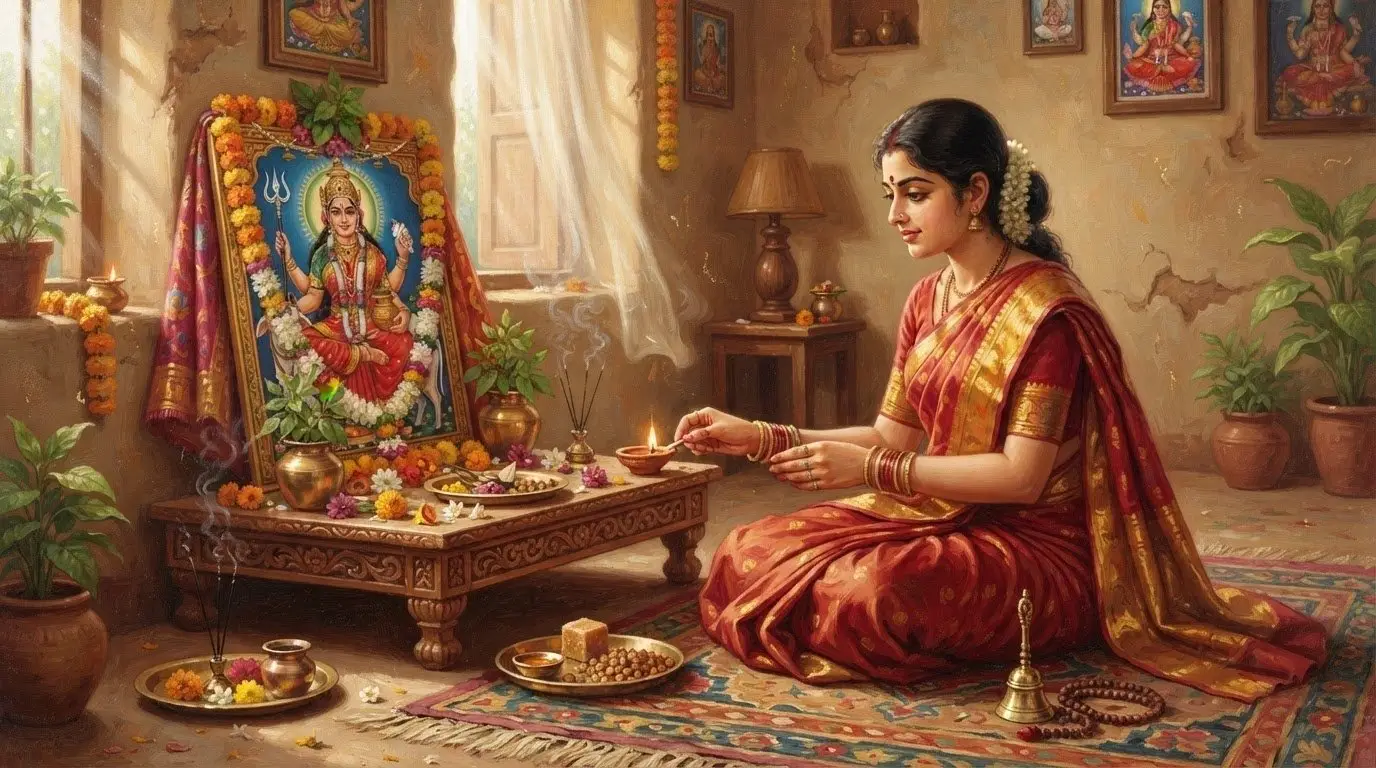
- Light the diya and incense, and offer fresh flowers to the goddess.
- Apply roli and akshat to the idol or picture, and offer the gur-chana as bhog (food offering), along with any other sattvic sweets prepared without sour ingredients.
- Recite the Santoshi Maa mantra (see below) as many times as feels comfortable - many devotees do 108 repetitions using a mala, though a simple, heartfelt recitation without counting is equally acceptable.
- Read or listen to the Santoshi Maa vrat katha in full, ideally with other family members present, or at minimum silently to oneself.
- Perform the aarti, "Jai Santoshi Maa," with a lit lamp, and conclude with a short personal prayer stating one's intention for undertaking the vrat.
- Observe a fast through the day - many devotees take a single simple meal, free of anything sour, in the evening after the puja is complete; others observe a stricter fast, taking only fruit or milk.
- Distribute the gur-chana prasad to family members and, where possible, to others, since sharing prasad is considered to multiply the vrat's merit.
- Repeat this same process on the following fifteen Fridays without interruption.
The Crucial Rule: Avoiding Khatta (Sour Foods)
No detail of the Santoshi Maa vrat is more strictly emphasised, nor more widely known even among those unfamiliar with the rest of the ritual, than the prohibition on khatta - sour food - throughout the sixteen weeks of the vow, and particularly on the vrat day itself. This includes obvious items such as lemon, tamarind, curd-based sour preparations, pickles, vinegar, and any dish deliberately soured, as well as, in the stricter traditional reading, tomatoes and certain fermented foods.
The origin of this rule is inseparable from the vrat katha itself: it was precisely a sour dish, slipped to the devoted wife by her jealous sisters-in-law, that broke her vow unknowingly and brought temporary misfortune upon her household. The prohibition is therefore not an arbitrary dietary restriction but a ritual re-enactment of vigilance - a reminder to the devotee to guard the vow carefully, to be mindful of what one consumes, and, symbolically, to keep one's inner disposition sweet rather than "sour" with resentment, envy, or anger during the period of the vrat. Many teachers of the tradition extend this symbolism further, counselling devotees to avoid sour speech and sour relationships - quarrels, gossip, bitterness - for the duration of the vow, treating the dietary rule as an outward expression of an inward discipline.
Because this rule is easy to break unintentionally (through a shared meal, a sauce, or a dish one did not prepare oneself), most guidance encourages devotees to control their own kitchen and food sources carefully during the sixteen weeks, exactly as the katha warns.
Udyapan: Completing the Vrat
Once all sixteen Fridays have been observed without interruption, the vrat is formally concluded with an udyapan - a closing ceremony of gratitude and completion. The udyapan typically involves:
- A more elaborate puja than the weekly observance, sometimes with a priest presiding
- Preparing a larger quantity of gur-chana prasad, along with other sattvic sweets and a full meal free of sour ingredients
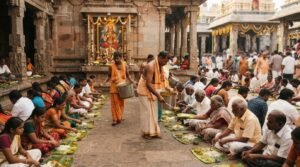
- Inviting eight young girls, or a small group of family and neighbours, to be fed as part of the ceremony - a practice rooted in the wider Devi tradition of honouring the feminine principle in living form
- Distributing gifts, prasad, and a portion of the food to those present and, where possible, to those less fortunate
- A final, heartfelt reading of the vrat katha and aarti, offering thanks for the vow's successful completion, whether or not the specific wish has yet been fulfilled
The udyapan marks the vrat's formal close, though many devotees, having experienced its benefits, choose to begin another cycle of sixteen Fridays soon after, treating the practice as an ongoing part of their devotional life rather than a one-time petition.
The Santoshi Maa Mantra and Aarti
While Santoshi Maa does not have an ancient Sanskrit stotra of the kind composed for older goddesses, a simple, widely used mantra and a much-loved aarti have become standard parts of her worship, both largely popularised alongside the growth of her devotional following in the twentieth century.
| Devanagari | Transliteration | Meaning |
|---|---|---|
| ॐ जय सन्तोषी माता, मैया जय सन्तोषी माता | Om Jai Santoshi Mata, Maiya Jai Santoshi Mata | Victory to Mother Santoshi, victory to the Mother of Contentment |
| ॐ श्री सन्तोषी माता नमः | Om Shri Santoshi Mata Namah | Salutations to the auspicious Mother Santoshi - a simple, repeatable invocation used during mala recitation |
| सुनो सन्तोषी माता, कहानी अपनी सुनो जरा | Suno Santoshi Mata, kahani apni suno zara | Listen, Mother Santoshi, hear a little of my story - the devotee's plea before narrating personal troubles or the vrat katha |
The mantra "Om Shri Santoshi Mata Namah" is the form most commonly used for repeated japa, whether counted on a mala of 108 beads or simply repeated with attention while performing daily chores. It carries none of the complexity of Vedic beeja mantras - much like the beej mantras of the goddess found in older Shakta traditions, it is meant to be a direct, heartfelt address rather than an esoteric formula, and devotees are encouraged simply to say it with sincerity rather than worry over exact pronunciation.
The aarti "Jai Santoshi Maa," sung at the close of every Friday puja, opens with the refrain given above and continues through several verses recounting her compassion, her power to remove sorrow, and her willingness to answer even the humblest prayer. It is typically sung together as a family, with a lit aarti lamp circled before the goddess's image, and closes with the customary gesture of passing one's hands over the flame and then over one's own head, drawing the goddess's blessing inward.
Benefits of Worshipping Santoshi Maa
Devotees who undertake the Santoshi Maa vrat with sincerity report - and the tradition itself promises - a range of benefits, most of them oriented toward the practical, domestic concerns that define her worship.
- Relief from financial hardship and the steady arrival of sufficiency rather than sudden, unstable wealth
- Resolution of marital discord and improved harmony within extended families, particularly between daughters-in-law and their husband's relatives
- Removal of obstacles delaying an auspicious marriage for unmarried devotees or their children
- Protection and wellbeing for children, echoing her association with Ganesha's sons Shubh and Labh
- A settled, patient mind, capable of enduring hardship without succumbing to bitterness or despair
- Growth in personal discipline, since the sixteen-week commitment itself trains the will and the palate alike
- A deepened sense of gratitude, since the vrat's central virtue - santosha, contentment - is cultivated by the very act of observing it faithfully
Devotees across India describe these benefits in different registers - some as material rescue from debt or discord, others as an inward transformation that makes existing circumstances easier to bear. Both readings coexist comfortably within the tradition.
Santoshi Maa Today: Temples and Regional Practice
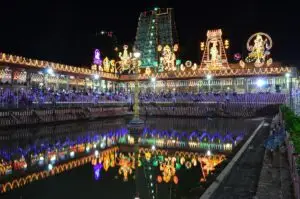
Santoshi Maa temples are considerably younger than the great Shakti Peethas and ancient Devi shrines of India, almost all having been established after her devotional following surged in the mid-1970s, yet several have become significant pilgrimage sites in their own right.
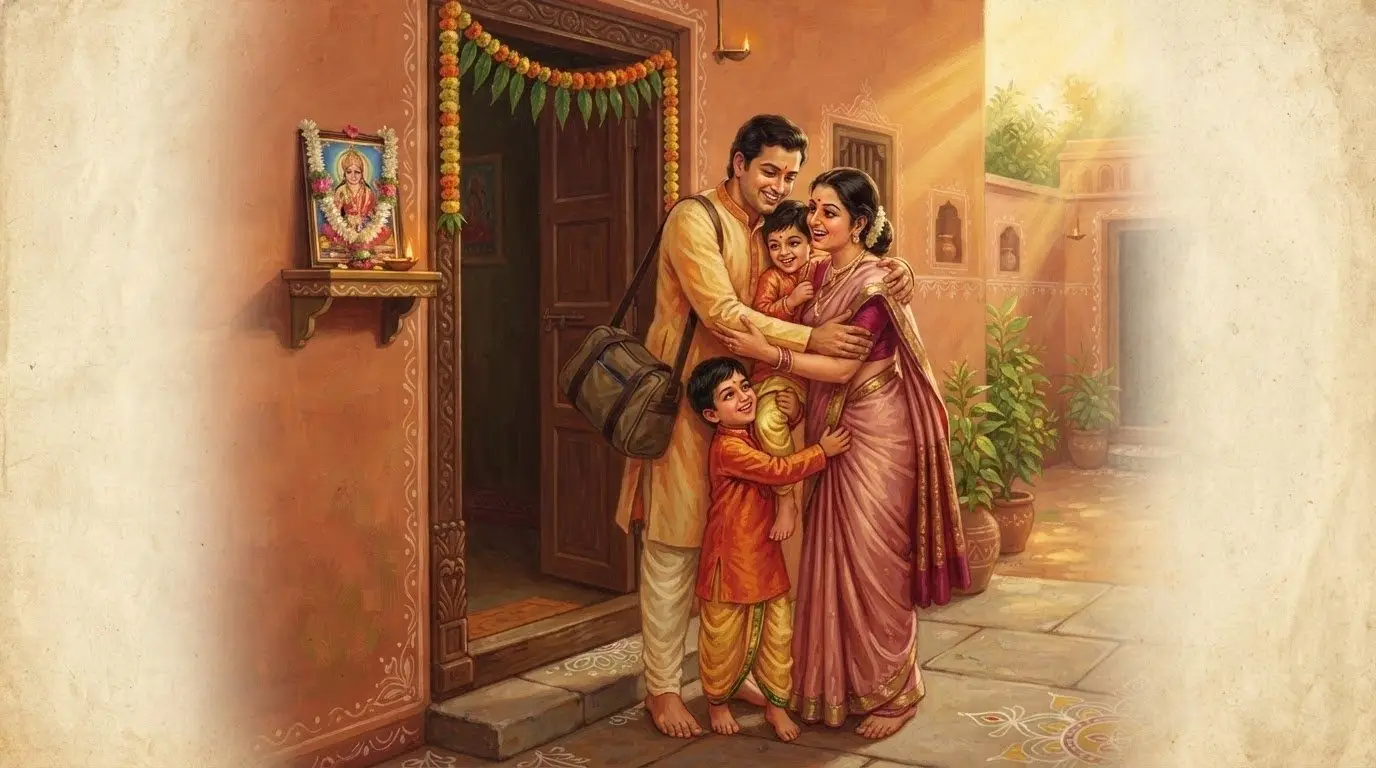
Prominent Santoshi Maa temples include shrines in Jodhpur, Rajasthan, where a well-known temple draws large Friday crowds; in Varanasi, alongside the city's many older Devi and Shiva shrines; and numerous smaller temples across Maharashtra, Gujarat, Uttar Pradesh, and Madhya Pradesh, often built by local devotee communities in gratitude for wishes fulfilled. Many households maintain that a home altar, kept with sincerity, is entirely sufficient - there is no requirement to visit a temple to observe the sixteen-Friday vrat.
Her worship also sits comfortably alongside the wider devotional calendar. Some devotees choose to align the completion of their vrat cycle with festivals such as Navratri, when the whole household is already oriented toward Devi worship, though this is a matter of personal preference rather than fixed requirement. Because Santoshi Maa's iconography and role echo, in gentler form, the protective and abundance-granting aspects also found in figures such as the Goddess Lakshmi, many households worship the two together, particularly around festivals connected with prosperity and domestic wellbeing.
Some scripturally strict readers of Hindu tradition have, at times, questioned Santoshi Maa's place within classical Devi worship, precisely because her cult has no ancient textual basis. Most devotees and temple priests regard this as beside the point - the Devi tradition has always accommodated new forms through which the one Mother answers her children, and Santoshi Maa's rapid, grassroots popularity is itself taken as evidence of her grace. As with any living devotional practice, the finer points of pronunciation or a specific udyapan ceremony are best clarified with a knowledgeable elder or a local temple pujari familiar with regional custom.
Further Reading
Frequently Asked Questions
Who is Santoshi Maa in Hindu tradition?
Santoshi Maa is a Hindu goddess of contentment and satisfaction, popularly regarded as the daughter of Lord Ganesha, created to be a companion for his sons Shubh and Labh. Her worship rose to widespread popularity across India in the twentieth century, particularly following the 1975 film Jai Santoshi Maa.
Is Santoshi Maa mentioned in ancient scriptures like the Puranas?
No, Santoshi Maa does not appear in the classical Puranas or earlier Sanskrit textual tradition. Her cult is a comparatively recent folk devotional development, though her worship draws on the same broader current of Shakti reverence found throughout Hindu tradition.
How many Fridays does the Santoshi Maa vrat require?
The standard vrat requires sixteen consecutive Fridays observed without interruption. Devotees begin on any Friday that feels auspicious and continue the same method of worship, fasting, and katha recitation across all sixteen weeks.
What foods must be avoided during the Santoshi Maa vrat?
The vrat requires strict avoidance of khatta, or sour foods, including lemon, tamarind, curd-based sour dishes, pickles, and vinegar, for the entire duration of the vow and especially on the vrat day itself. This rule comes directly from the vrat katha, in which a sour dish unknowingly broke the devotee's vow.
What is gur-chana and why is it offered to Santoshi Maa?
Gur-chana is a simple offering of jaggery (gur) and roasted Bengal gram (chana), considered Santoshi Maa's favoured bhog. It reflects her homely, accessible nature - she asks for humble kitchen offerings rather than elaborate ritual items.
Can men observe the Santoshi Maa vrat, or is it only for women?
While the vrat is most commonly associated with women, particularly married women and daughters-in-law seeking domestic harmony, there is no scriptural restriction preventing men from observing it. Anyone with sincere devotion and a genuine intention may undertake the sixteen-Friday vow.
What happens if a Friday is missed during the vrat?
Traditional guidance holds that missing a Friday, especially through an unintentional lapse such as consuming something sour unknowingly, weakens the vrat's effect, much as happened in the vrat katha. Most guidance suggests observing the missed week with heartfelt repentance and, in stricter interpretations, restarting the full cycle of sixteen Fridays.
What is udyapan and is it compulsory?
Udyapan is the closing ceremony performed after all sixteen Fridays are completed, involving a fuller puja, distribution of prasad, and often feeding young girls or family members. It is considered an important, though not strictly compulsory, way of formally concluding the vrat with gratitude.
Where can I find temples dedicated to Santoshi Maa?
Notable Santoshi Maa temples exist in Jodhpur, Varanasi, and various towns across Maharashtra, Gujarat, and Madhya Pradesh, most established after her devotional popularity grew in the 1970s. Many devotees, however, observe the entire vrat at a home altar without needing to visit a temple at all.
How is the Santoshi Maa aarti performed?
The aarti "Jai Santoshi Maa" is sung at the close of Friday worship with a lit lamp circled before the goddess's image, typically by the whole family together, followed by the customary gesture of passing one's hands over the flame and then over one's head to receive her blessing.
Santoshi Maa's worship endures because it asks so little of ceremony and so much of the heart - a Friday kept faithfully, a bowl of jaggery and gram, and patience carried quietly through difficulty. For those wishing to bring her presence more fully into a Friday puja or a quiet evening of reflection, Musinara's 432 Hz recordings of devotional chants offer a gentle companion for this practice - you are warmly invited to listen on YouTube and let her aarti settle into the rhythm of your own home.
Related reading
- Goddess Durga: The Complete Guide to the Invincible Mother
- Goddess Gayatri: The Mother of the Vedas and Her Mantra
- Goddess Annapurna: The Complete Guide to the Mother Who Feeds the World
- Goddess Saraswati: The Complete Guide to the Goddess of Knowledge, Speech and the Arts
Watch and listen to devotional music and mantras on the Musinara YouTube channel.