Long before a child is handed a pencil, or a musician tunes a first string, a quieter invocation has already taken place in homes and schools across India - a small prayer to Goddess Saraswati, asking that the mind be made clear enough to receive what it is about to learn. She is the gentlest of the great goddesses, and in many ways the most intimate: not a deity of thunder or conquest, but of the moment just before understanding arrives, when a confused thought settles into a clear one.
Saraswati is worshipped as the goddess of knowledge, speech, music and the arts, the consort of Brahma the creator, and one of the three great goddesses of the Tridevi alongside Lakshmi and Parvati. Her presence spans an unusually long arc of Indian religious history - she is named in the Rigveda as a river and as Vak, the power of speech, long before she takes the white-sari, veena-holding form recognised today in classrooms, concert halls and temple sanctums.
This guide gathers what a devotee, student, or curious reader needs in one place: her iconography and what each symbol means, her Vedic origins, her principal mantras in Devanagari with transliteration and meaning, the benefits ascribed to her worship, the customs of Vasant Panchami and Saraswati Puja, and the major temples where her presence is felt most strongly - from Sringeri to Basara to Kollur.
- Who Is Goddess Saraswati?
- Iconography and Symbolism
- Vedic Origins: The River, the Word, the Goddess
- Saraswati's Mantras: Sound as a Path to Wisdom
- Benefits of Worshipping Saraswati
- How to Worship Saraswati
- Major Temples of Saraswati
- Festivals of the Goddess of Learning
- Frequently Asked Questions
Who Is Goddess Saraswati?
In the Hindu tradition, three goddesses are said to preside over the essential functions that keep existence in motion - Lakshmi over prosperity and abundance, Parvati (in her many forms) over strength and household order, and Saraswati over knowledge, memory, discernment and creative expression. Together they form the Tridevi, the feminine counterpart to the Trimurti of Brahma, Vishnu and Shiva. Saraswati is conventionally described as the consort or shakti of Brahma, the creator god, and this pairing is telling: creation, in Hindu cosmology, is never a brute act of will alone - it requires vidya, knowledge, and vak, the articulate word, to give it shape. Without Saraswati's clarity, even Brahma's power to create would remain formless potential.
She is called by many names that describe her different aspects: Vagdevi or Vani (goddess of speech), Sharada (the autumnal one, associated with the goddess as bestower of learning, and the namesake of her celebrated seat at Sringeri), Bharati, Brahmi, and Vidyadatri (giver of knowledge). Unlike some goddesses who are approached chiefly for protection or for the granting of material wishes, Saraswati is sought for something quieter and, in its own way, more demanding: the capacity to learn, to remember accurately, to speak truthfully and well, and to create something of lasting value - a poem, a raga, a proof, a piece of considered argument.
It is worth noting for the intellectually curious reader that Saraswati also has a tantric and Mahavidya-adjacent dimension that is less commonly discussed in the mainstream devotional context. Within the Dasha Mahavidya tradition, the goddess Matangi is frequently understood as a tantric form of Saraswati - presiding over speech, music, and the outcaste or unconventional aspects of wisdom that lie outside brahminical orthodoxy. Readers interested in this more esoteric face of the goddess of learning may wish to explore our companion guide on Maa Matangi, which traces how the gentle Sharada of the classroom and the fierce, boundary-dissolving Matangi of the tantric texts are understood as two expressions of the same underlying principle of sound and knowledge - a principle that ultimately traces back to Adi Parashakti, the undivided source from which every form of the Devi, gentle or fierce, is said to arise.
Iconography and Symbolism
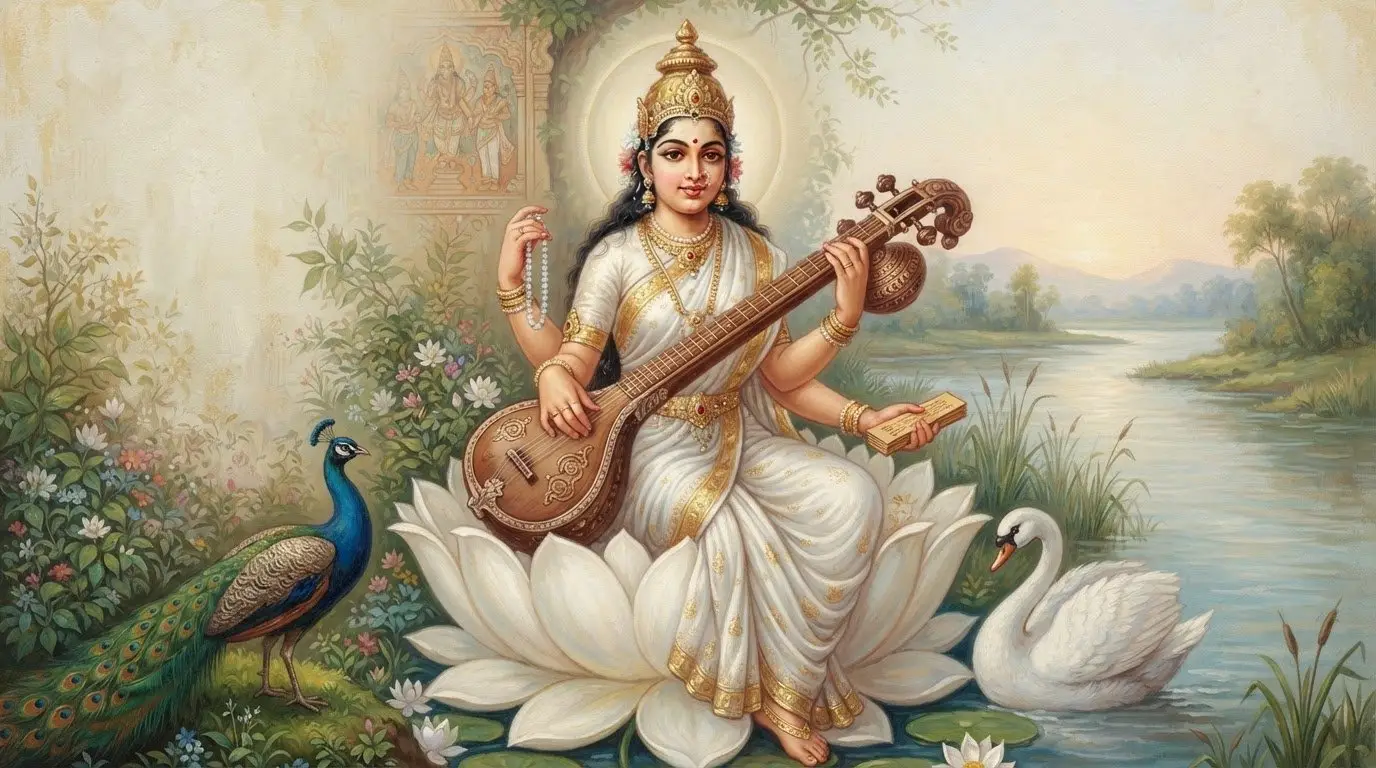
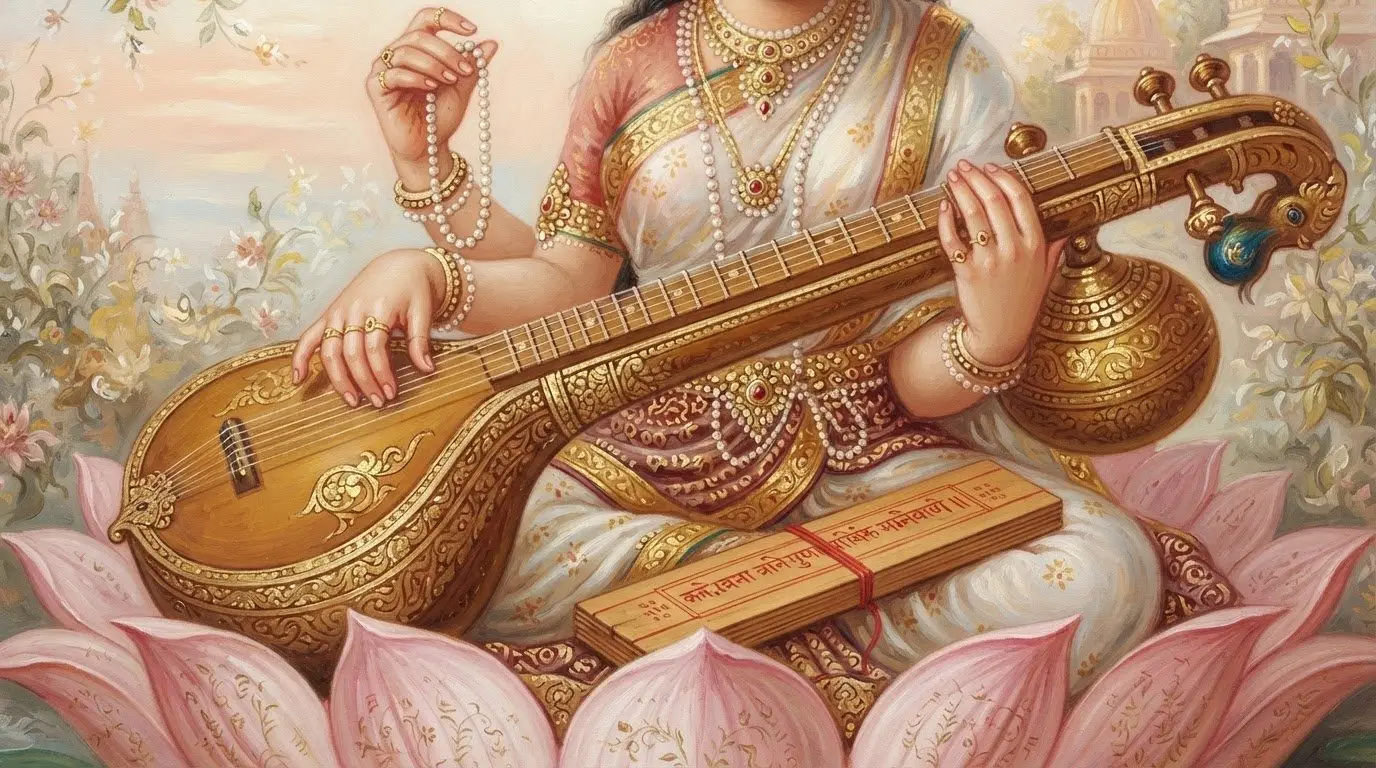
Saraswati's visual form is unusually consistent across regions and centuries compared to many other Hindu deities, and each element of that form carries a specific teaching.
The white sari and complexion. Saraswati is almost always shown dressed in white, or occasionally the palest yellow, and her complexion is described as fair or luminous. White in Indian symbolism denotes purity, sattva (the quality of clarity and balance), and the absence of the distracting colour of desire or aggression. A mind fit to receive true knowledge, the iconography suggests, must first be made clear and undisturbed - much as clean water reflects the sky only when it is still.
The veena. In two of her four hands, Saraswati holds a veena, a stringed instrument of great antiquity in Indian classical music. The veena represents the arts in general and music in particular, but it carries a subtler meaning too: knowledge, in this tradition, is not merely accumulated information but something that must be tuned, like an instrument, before it can produce anything of beauty. A scholar without aesthetic sense, or a musician without disciplined study, is only half of what Saraswati represents.
The book (pustaka). Often a palm-leaf manuscript or a copy of the Vedas rests in another hand, symbolising formal learning, scripture and the accumulated wisdom of tradition. It is frequently shown resting on a lotus rather than being actively read, suggesting that scripture is a foundation to draw upon rather than something to be worshipped mechanically.
The mala. A string of crystal or rudraksha beads in her upper hand represents japa, the repetition of mantra, and by extension spiritual discipline - the reminder that even intellectual and artistic gifts are meant to be placed in service of something higher than personal ambition.
The swan (hamsa). Saraswati's vahana, or vehicle, is the hamsa, usually translated as a swan, though the word can also refer to a wild goose in older texts. The hamsa is credited in folklore with the ability to separate milk from water when the two are mixed - a discernment (viveka) that is precisely what Saraswati is asked to cultivate in her devotees: the ability to separate what is true, useful and beautiful from what is false, wasteful or merely loud.
The peacock. In many South Indian depictions, particularly those associated with her form as Sharada, a peacock appears beside or beneath her seat. The peacock is sometimes read as a caution against vanity and pride - qualities that can easily attach themselves to intellectual or artistic accomplishment - with the goddess seated serenely above or apart from that temptation, undistracted by her own brilliance.
The white lotus. Saraswati is typically seated, rather than standing, upon a white lotus in full bloom. The lotus growing untouched out of muddy water is one of the most recurrent symbols in Indian religious art, representing the possibility of purity and clarity of mind arising even amid the confusions of worldly life.
Vedic Origins: The River, the Word, the Goddess
Saraswati's history is unusual among Hindu deities in that it can be traced with some clarity through layers of textual development, from a geographical feature to a principle of cosmic speech, and only later to the anthropomorphic goddess familiar today.
The Saraswati River
In the earliest layer of the Rigveda, Saraswati is celebrated as a mighty river - by some accounts the greatest of the Vedic rivers, described in hymns such as the Nadistuti Sukta as flowing "pure in her course from the mountains to the sea." Vedic civilisation flourished substantially along the banks of this river, and hymns praise it for nourishing the land, the people and the ritual sacrifices performed on its banks. Archaeologists and geologists have long debated the precise identity of this river with the present-day, largely dried-up channel associated with the Ghaggar-Hakra system in north-western India and Pakistan, a question that remains genuinely contested among specialists and is best approached with intellectual honesty rather than certainty in either direction. What is clear textually is that a river of great sanctity, life-giving and purifying, bore this name in the earliest strand of Vedic memory, and it is from this literal, nourishing river that the later goddess draws her deepest roots.
From River-Goddess to Vak, the Word
As Vedic religion developed, Saraswati's identity gradually widened from the river itself to encompass the qualities associated with it - purification, nourishment, and, increasingly, inspired speech. She becomes closely identified with Vak, the Vedic goddess and principle of speech, sacred utterance and articulate sound. In the Rigveda's celebrated Vak Sukta, speech itself is praised as a goddess who pervades heaven and earth, who gives strength to those who understand her, and who chooses whom she will dwell within. Over time, Saraswati absorbs much of Vak's identity, becoming the goddess of the spoken and composed word - the deity invoked before the recitation of the Vedas, before the utterance of a mantra, and before any act of formal learning.
Consolidation as Goddess of Knowledge
By the time of the later Puranas, Saraswati has taken on the full form familiar today: the wife or creative energy (shakti) of Brahma, the deity of the arts, learning, eloquence and wisdom, distinct from but related to Lakshmi (wealth) and Durga or Parvati (power). Various Puranic narratives describe Brahma creating Saraswati to help him in the work of creation, and in some tellings she instructs him in the recitation of the Vedas - a lovely reversal in which the creator god himself must be taught by the goddess of knowledge before creation can proceed in an ordered way. This layered history - river, word, goddess - is part of what gives Saraswati worship its particular character: unlike deities whose myths centre on cosmic battle, hers centres on the slow, cumulative refinement of sound, memory and understanding.
Saraswati's Mantras: Sound as a Path to Wisdom
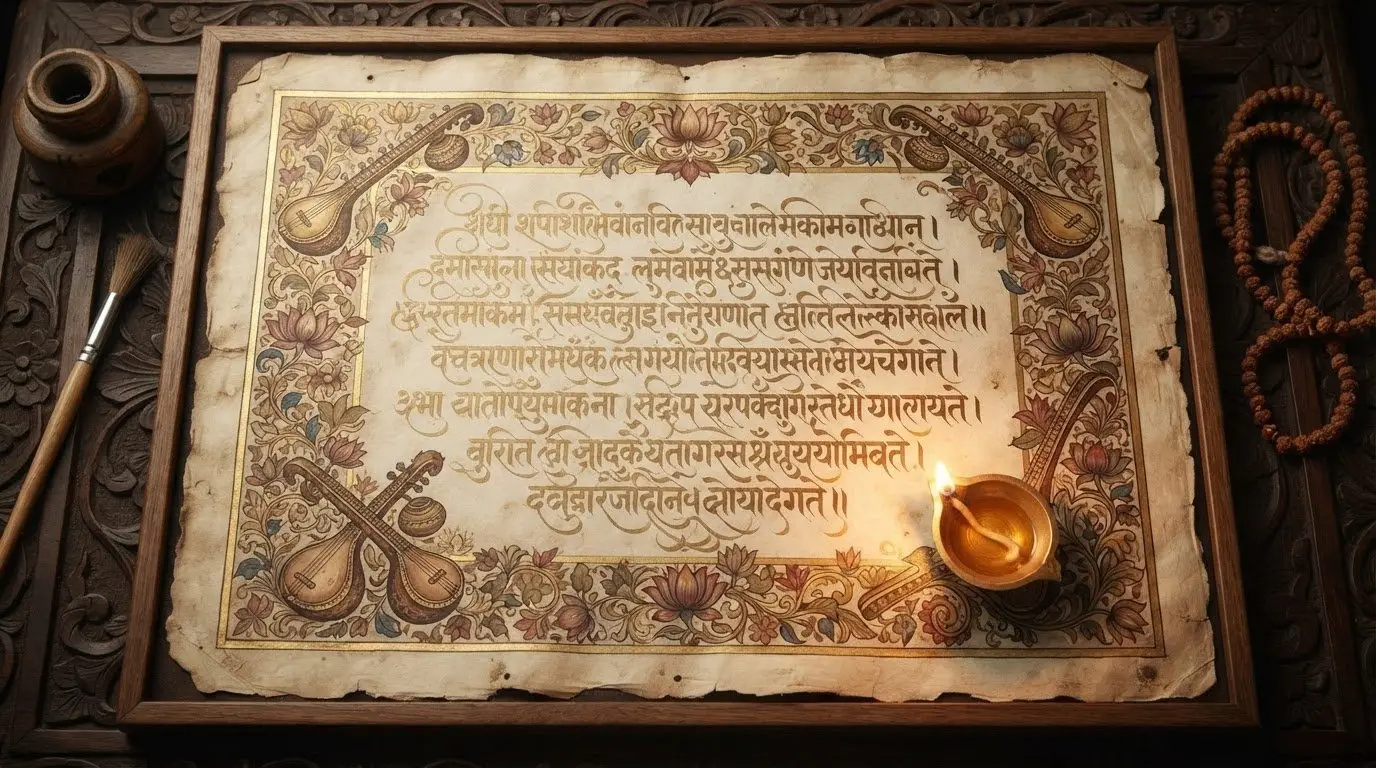
Mantra recitation is central to Saraswati worship, on the understanding that she is, in her deepest nature, the presiding deity of sound itself - so invoking her correctly is thought to be a discipline of the ear and the tongue as much as of the mind. The table below gathers her most widely used mantras.
| Devanagari | Transliteration | Meaning |
|---|---|---|
| ॐ ऐं सरस्वत्यै नमः | Om Aim Saraswatyai Namah | Salutations to Goddess Saraswati; "Aim" is her beej (seed) mantra, associated with speech, learning and creative intelligence. |
| ॐ सरस्वत्यै विद्महे ब्रह्मपुत्र्यै धीमहि तन्नो देवी प्रचोदयात् | Om Saraswatyai Vidmahe Brahmaputryai Dhimahi Tanno Devi Prachodayat | We seek to know Saraswati; we meditate upon the daughter of Brahma; may that Goddess illumine and guide our understanding. This is the Saraswati Gayatri, recited before study. |
| ॐ ह्रीं सरस्वत्यै स्वाहा | Om Hreem Saraswatyai Swaha | A shorter invocatory mantra combining the maya beej "Hreem" with an offering (svaha), used in some regional and ritual traditions. |
Alongside these shorter formulas, the single most beloved Saraswati verse recited across India - in schools, before examinations, and at the opening of Saraswati Puja - is the shloka beginning "Ya Kundendu":
> या कुन्देन्दुतुषारहारधवला या शुभ्रवस्त्रावृता
> या वीणावरदण्डमण्डितकरा या श्वेतपद्मासना।
> या ब्रह्माच्युतशङ्करप्रभृतिभिर्देवैः सदा वन्दिता
> सा मां पातु सरस्वती भगवती निःशेषजाड्यापहा॥
Yā kundendu-tuṣāra-hāra-dhavalā yā śubhra-vastrāvṛtā, yā vīṇā-vara-daṇḍa-maṇḍita-karā yā śveta-padmāsanā, yā brahmāchyuta-śaṅkara-prabhṛtibhir devaiḥ sadā vanditā, sā māṁ pātu sarasvatī bhagavatī niḥśeṣa-jāḍyāpahā.
The verse describes the goddess as white as jasmine, the moon, and a garland of frost, robed in pure white cloth, her lovely hands adorned with the finest veena, seated upon a white lotus, forever venerated by Brahma, Vishnu (Achyuta) and Shiva (Shankara) and other gods - and prays that this goddess, Bhagavati Saraswati, protect the reciter and remove all dullness and inertia (jadya) of the mind. It is this last phrase, niḥśeṣa-jāḍyāpahā - "the remover of all dullness, without remainder" - that explains why the verse is recited so widely by students hoping to shake off mental fog before an examination or a difficult piece of study.
Devotees are also warmly encouraged to explore the wider family of goddess beej mantras - the single-syllable seed sounds that Tantric tradition holds to be the compressed essence of each deity's power - in our detailed guide to the beej mantras of the goddess, which explains how "Aim," Saraswati's own beej, relates to the beej sounds of other forms of the Devi.
A note on practice: while these mantras are widely published and safe for general recitation, correct pronunciation of Sanskrit - particularly the aspirated and retroflex consonants - is best learned directly from a qualified teacher, priest or guru rather than from text alone, since subtle errors in sound are believed in this tradition to change the character of the invocation.
Benefits of Worshipping Saraswati
Devotees approach Saraswati for a fairly specific and consistent set of aspirations, distinct from the wealth-focused prayers offered to Lakshmi or the protection sought from more fierce forms of the goddess.
- Clarity of memory and comprehension - students preparing for examinations, competitive tests or viva-voce assessments are among her most frequent devotees, seeking not shortcuts but a settled, receptive mind.
- Eloquence and confidence in speech - public speakers, teachers, lawyers and performers invoke her before addressing an audience, asking for words that are both true and well-formed.
- Skill in the arts - musicians, painters, writers, dancers and craftspeople regard her as the patron of creative discipline, often initiating formal training (vidyarambham) in her presence.
- Discernment (viveka) - beyond raw information, her blessing is sought for the capacity to distinguish the essential from the trivial, much as her hamsa is said to separate milk from water.
- Removal of mental dullness - the phrase niḥśeṣa-jāḍyāpahā captures a benefit distinct from intelligence in the ordinary sense: an easing of confusion, procrastination and mental fatigue.
- Harmony between knowledge and humility - because pride is understood to corrode learning, her worship is traditionally accompanied by a reminder to remain a lifelong student.
How to Worship Saraswati
Daily and Weekly Practice
Many households, and almost all schools and music academies in India, keep a small image or picture of Saraswati near the place where children study or where instruments are practised. It is customary not to place books, musical instruments or writing implements on the floor, and to touch them respectfully to the forehead if they are accidentally stepped over - a small daily gesture of regard for Vidya, learning itself, as something sacred rather than merely useful. Friday is considered auspicious for her worship in several regional traditions, alongside the specific festival days described below.
Vasant Panchami and Saraswati Puja
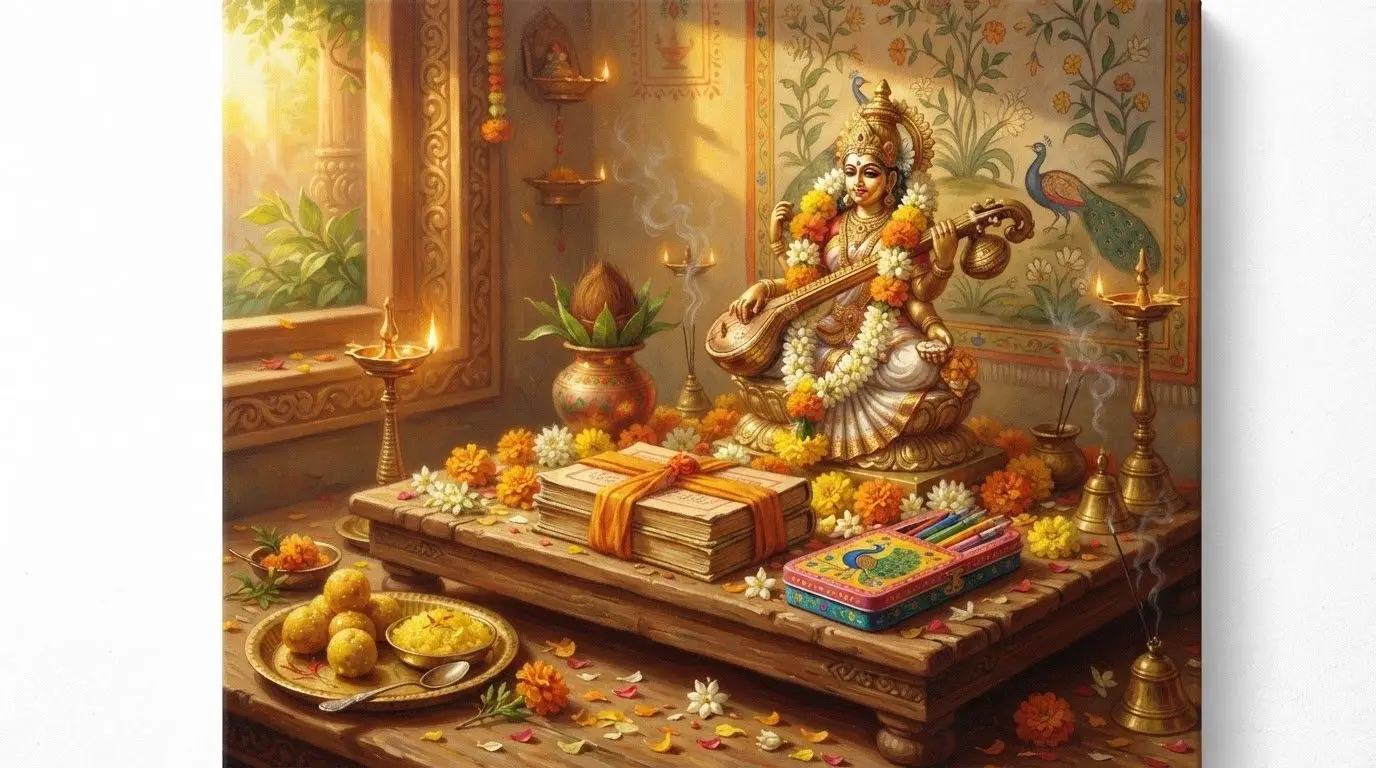
The principal annual festival dedicated to the goddess is Vasant Panchami (also spelled Basant Panchami), which falls on the fifth day of the bright fortnight of the Hindu month of Magha, typically in late January or early February, marking the first stirrings of spring. On this day, schools, colleges, music schools and homes across northern, eastern and central India install an image of Saraswati, usually in yellow and white, the colours of the season's mustard blossoms, and conduct a puja that typically includes:
- Cleaning and decorating the space, often with fresh mango leaves and marigold or white flowers
- Offering white flowers, particularly jasmine, along with yellow flowers such as marigold
- Placing books, pens, musical instruments and art materials before the goddess to be blessed
- Offering yellow sweets, especially those made with saffron, kesar or besan, and a preparation of yellow rice (boondi or kesar chawal)
- Reciting the Ya Kundendu shloka, the Saraswati Gayatri, and Om Aim Saraswatyai Namah
- Vidyarambham - the initiation of young children into learning, in which a child's finger is guided by an elder to trace their first letters, often in a tray of rice, in the goddess's presence
Vasant Panchami, which falls in the month of Magha and marks the first stirring of spring, is the day given wholly to Saraswati. Yellow is worn, yellow flowers are offered, and children are traditionally taught their first letters before her image in the rite known as Vidyarambham. Instruments, pens and books are laid at her feet the evening before and left unopened until the puja is done.
In several regions, particularly Bengal, Odisha, Assam and parts of Bihar, Saraswati Puja is celebrated with considerable public grandeur, with elaborately crafted clay idols installed in pandals, much as Durga is honoured during autumn Navratri, and immersed (visarjan) a day or two later.
Offerings and Etiquette
- White or yellow flowers are preferred over red, which is more commonly associated with fiercer goddesses.
- Sweets made with milk, saffron and yellow lentils are traditional prasad.
- Loud, percussive worship is generally avoided in favour of a calm, unhurried atmosphere; soft devotional singing or veena recitals are considered especially pleasing to her.
- It is customary to avoid writing, reading for pleasure, or beginning new lessons on the day immediately following Vasant Panchami in some traditions, as a mark of rest for both student and books - though this varies regionally and is worth confirming with a local family elder or priest.
Major Temples of Saraswati
Unlike many goddesses who have hundreds of independent temples, Saraswati's most celebrated shrines tend to be fewer but especially revered, often bound up with the history of learning and monastic scholarship in India.
Sringeri Sharadamba Temple, Karnataka
Founded, by tradition, by the great philosopher-saint Adi Shankaracharya in the 8th century, the Sharadamba (or Sharada) temple at Sringeri in Karnataka's Chikkamagaluru district is among the most revered seats of Saraswati worship in India. The temple is closely associated with the Sringeri Sharada Peetham, one of the four principal monastic centres (mathas) established by Shankaracharya, and the deity here is worshipped as Sharada, a form of Saraswati particularly linked with the transmission of Vedic and philosophical knowledge across generations of scholars. We explore this remarkable institution and its temple traditions in much greater depth in our dedicated guide to the Sringeri Sharada Peetham.
Basara Saraswati Temple (Gnana Saraswati Temple), Telangana
Set on the banks of the Godavari river in Nirmal district, Telangana, the Basara temple is one of only two prominent Saraswati shrines in India and is especially beloved for its vidyarambham ceremonies, where thousands of children have their first letters written in this Devi's presence, typically on and around Vasant Panchami. The temple's setting beside the river gently echoes Saraswati's own Vedic identity as a river-goddess, tying her ancient and her present forms together in a single place of pilgrimage.
Mookambika Temple, Kollur, Karnataka
The temple at Kollur in Udupi district, on the western coastal belt of Karnataka, enshrines the goddess Mookambika, understood locally as a combined form of Saraswati, Lakshmi and Parvati, with the sanctum representing all three great goddesses in a single presiding deity. It is an important pilgrimage centre, particularly for those seeking blessings in education and the arts, and draws devotees from across South India, especially Kerala.
Other Notable Shrines
Smaller but locally significant Saraswati shrines exist across the country, including within larger temple complexes dedicated to other deities, where she is frequently installed as a subsidiary deity presiding over a temple's associated Sanskrit school (pathashala) or library. Many Vedic schools and traditional gurukulas maintain a small Saraswati shrine as the first place a new student is brought before beginning formal study.
Festivals of the Goddess of Learning
- Vasant Panchami (Basant Panchami) - the principal festival, described in detail above, celebrated on Magha Shukla Panchami, typically late January to mid-February.
- Saraswati Puja during Navratri - in many South Indian and some North Indian households, the eighth and ninth days of Sharadiya Navratri (Durga Ashtami and Navami) are set aside for Ayudha Puja and Saraswati Puja respectively, when books and instruments are again placed before the goddess and left unused for the day, to be reverently taken up again on Vijayadashami.
- Vidyarambham - while technically an individual rite of passage rather than a fixed calendar festival, this initiation ceremony is so closely tied to Vasant Panchami and Navratri that it is often treated as part of the festival cycle, particularly in Kerala and at temples such as Basara.
Frequently Asked Questions
Who is Goddess Saraswati married to?
Saraswati is traditionally regarded as the consort or shakti of Brahma, the creator god within the Hindu Trimurti. Their pairing reflects the idea that creation requires knowledge and articulate speech in order to take ordered form.
What is Saraswati the goddess of?
She is the goddess of knowledge, learning, speech, memory, wisdom, music and the fine arts. She is one of the three goddesses of the Tridevi, alongside Lakshmi (wealth) and Parvati (power and domestic order).
What is the best mantra to chant for Saraswati before exams?
The Saraswati Gayatri (Om Saraswatyai Vidmahe Brahmaputryai Dhimahi Tanno Devi Prachodayat) and the Ya Kundendu shloka are the two most widely chanted verses before examinations and study sessions, alongside the simple Om Aim Saraswatyai Namah.
Why does Saraswati sit on a white lotus and not a peacock?
While a peacock is often shown near her seat, particularly in South Indian art, Saraswati herself is generally depicted seated on a white lotus rather than riding the peacock. The lotus represents purity of mind rising untouched above worldly confusion; the nearby peacock is usually read as a gentle caution against vanity, over which the goddess sits serenely detached.
What does the swan (hamsa) represent in Saraswati's iconography?
The hamsa is credited in tradition with the mythical ability to separate milk from water, symbolising viveka, or discernment - the capacity to distinguish true and valuable knowledge from what is false or superficial, which is central to what Saraswati's blessing confers.
When is Vasant Panchami celebrated, and what should be done on this day?
Vasant Panchami falls on the fifth day of the bright fortnight of the Hindu month of Magha, typically in late January or early February; the exact date shifts each year with the lunar calendar and is worth verifying against a current panchang. Devotees typically wear yellow, worship Saraswati with white and yellow flowers, place books and instruments before her image, and initiate young children into their first letters.
Is it appropriate for non-students to worship Saraswati?
Yes. While students are her most visible devotees, anyone engaged in writing, teaching, music, research, public speaking or any creative or intellectual discipline traditionally seeks her blessing, since her domain extends to eloquence, artistic skill and clarity of thought generally, not only formal academic study.
What is the difference between Saraswati and Matangi?
Saraswati, in her familiar Puranic form, is the serene, classical goddess of learning and the arts associated with Brahma. Matangi is often understood within the tantric Dasha Mahavidya tradition as her more esoteric counterpart, presiding over speech and knowledge from outside conventional social and ritual boundaries. Our guide to Maa Matangi explores this relationship in depth for readers drawn to the tantric dimension of the goddess of speech.
Which flowers and colours are offered to Saraswati?
White flowers, particularly jasmine, and yellow flowers such as marigold are the traditional offerings, echoing the goddess's own white attire and the yellow mustard-blossom season of Vasant Panchami. Red flowers, more closely associated with fiercer goddesses, are generally avoided.
Can Saraswati be worshipped alongside Lakshmi and Durga in the same puja?
Yes; in fact many household and temple traditions, particularly during Navratri and Diwali, honour all three goddesses of the Tridevi together, understanding knowledge, prosperity and strength as complementary rather than competing blessings. Some temples, such as Mookambika at Kollur, enshrine all three as a single combined deity.
Saraswati's blessing is, in the end, a quiet one - not the roar of victory but the settling of a distracted mind into clarity, and the steady development of a skill or an understanding over years of unhurried practice. If you would like to bring her presence into your own study, music practice or daily reflection, Musinara offers 432 Hz recordings of her mantras and stotras on our YouTube channel, recorded to be listened to slowly, the way this goddess herself seems to prefer to be approached.
Related reading
- Goddess Durga: The Complete Guide to the Invincible Mother
- Goddess Lakshmi: The Complete Guide to Her Forms, Mantras and Worship
- Goddess Gayatri: The Mother of the Vedas and Her Mantra
- Goddess Annapurna: The Complete Guide to the Mother Who Feeds the World
Watch and listen to devotional music and mantras on the Musinara YouTube channel.
In Tamil homes she is கலைமகள், and the ninth night of Navarathiri is hers. See நவராத்திரி கொலு ௨௦௨௬ மற்றும் சரஸ்வதி பூஜை.