Prosperity, in the Hindu devotional imagination, is never a single, undifferentiated thing. Wealth without health is hollow; courage without victory is unfulfilled; knowledge without the patience to apply it achieves little. This is the intuition behind Ashta Lakshmi - the eight forms of Goddess Lakshmi - each governing a distinct and necessary domain of a flourishing life. Together they compose a fuller picture of what it means to prosper than any single image of gold coins alone could offer.
For the devotee who has already come to know Lakshmi as the consort of Vishnu and the goddess who rose from the churned ocean of milk, the Ashta Lakshmi framework is the natural next layer of understanding - a way of seeing her not as one static figure but as eight complementary energies, each addressed by her own name, mantra and iconography. This guide sets out each of the eight forms in turn, their symbolism and blessings, the Ashtalakshmi Stotram recited in their honour, and the practical customs of worshipping them, including a visit to the dedicated Ashtalakshmi temple on the Chennai coastline. Readers new to Lakshmi herself may wish to begin with our broader complete guide to Goddess Lakshmi before returning here for this more detailed study of her eightfold form.
What Is Ashta Lakshmi?
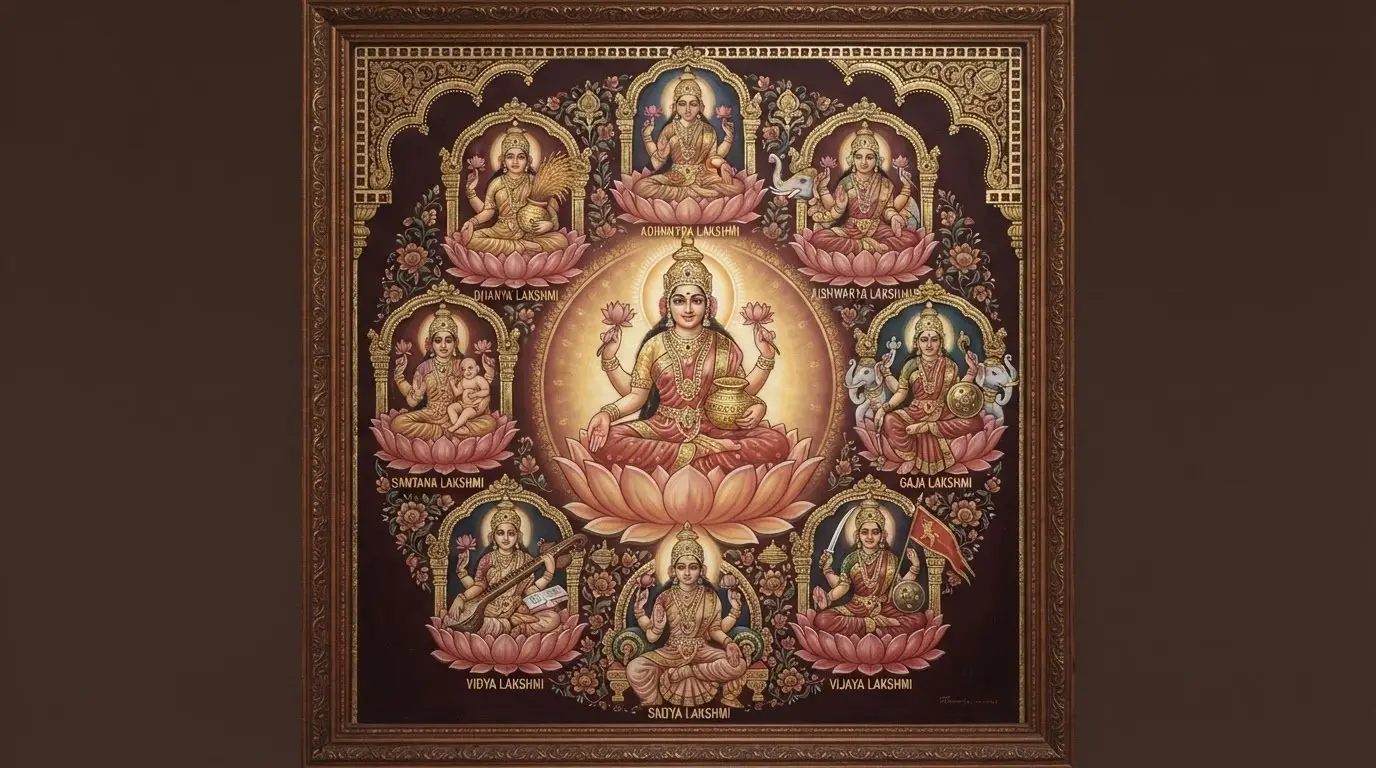
Ashta Lakshmi, from the Sanskrit ashta ("eight") and Lakshmi, refers to a group of eight goddesses, each a distinct aspect or emanation of the single goddess Lakshmi, together governing the eight recognised forms of wealth and wellbeing that a complete life requires. The framework does not appear as a fixed, singular list in the earliest Puranic sources; rather, it developed and stabilised over centuries, particularly through the Sanskrit hymn known as the Ashtalakshmi Stotram, whose eight verses each address one form by name.
This is worth stating plainly at the outset, in the spirit of intellectual honesty: while the Ashtalakshmi Stotram provides the most widely accepted enumeration of the eight forms, some regional traditions substitute one or two names for others, particularly Vidya Lakshmi and Aishwarya Lakshmi, and the exact ordering can differ between texts and temple traditions. What remains consistent is the underlying idea - that Lakshmi's grace operates across eight distinguishable domains rather than as a single undifferentiated force, and that a devotee may invoke her specifically according to the kind of flourishing they seek.
The concept resonates particularly strongly in Tamil Nadu and broader South Indian devotional practice, where the Ashtalakshmi Stotram is recited widely, and where the dedicated Ashtalakshmi Kovil in Chennai has, since its consecration in 1976, become one of the region's most visited Lakshmi shrines.
The Eight Forms of Lakshmi at a Glance
The table below sets out the eight forms as most commonly enumerated in the Ashtalakshmi Stotram tradition, together with the domain each governs and her characteristic iconography.
| Form (Devanagari / Transliteration) | Blessing / Domain | Iconography |
|---|---|---|
| आदि लक्ष्मी / Adi Lakshmi (also Maha Lakshmi) | Primordial, original form; the source from which the other seven emanate | Four-armed, golden-hued, seated on a lotus throne, holding a lotus and in a gesture of blessing |
| धन लक्ष्मी / Dhana Lakshmi | Monetary wealth and material abundance | Six-armed, red-complexioned, holding a discus, conch, gold vessel and lotus, gold coins flowing from her palm |
| धान्य लक्ष्मी / Dhanya Lakshmi | Agricultural abundance, grain and food security | Green-hued, holding sheaves of paddy/grain, a lotus and a mace, seated amid harvested crops |
| गज लक्ष्मी / Gaja Lakshmi | Royal power, cattle wealth, rainfall and animal prosperity | Flanked by two elephants pouring water from golden pots over her head, holding lotuses |
| संतान लक्ष्मी / Santana Lakshmi | Progeny, children's wellbeing and family continuity | Depicted with children or an infant on her lap, holding a mace and lotus, radiating maternal warmth |
| वीर/धैर्य लक्ष्मी / Veera Lakshmi or Dhairya Lakshmi | Courage, valour and steadiness amid adversity | Eight-armed, holding weapons including a discus, conch, bow, arrow and sword alongside a lotus |
| विजय लक्ष्मी / Vijaya Lakshmi (also Jaya Lakshmi) | Victory, success in undertakings and overcoming obstacles | Eight-armed, seated on a lotus, holding a sword, shield and lotus, granting triumph in effort |
| विद्या/ऐश्वर्य लक्ष्मी / Vidya Lakshmi or Aishwarya Lakshmi | Knowledge, wisdom, and overall sovereignty/prosperity of life | Four- or eight-armed, holding a book or lotus, sometimes shown with additional symbols of royal aishwarya (sovereignty) |
Some enumerations list Aishwarya Lakshmi (sovereignty and all-round prosperity) as the eighth form rather than Vidya Lakshmi (knowledge), and a few older regional lists include her in place of Dhairya Lakshmi. This variation is not considered a contradiction within tradition so much as evidence that different lineages have emphasised different aspects of the same eightfold principle over time.
The Symbolism of Eight and the Roots of the Tradition
The number eight recurs across Hindu cosmology in ways that make its application to Lakshmi feel deliberate rather than arbitrary. Tradition speaks of ashta dikpalas (eight guardians of the directions), ashta siddhis (eight supernatural attainments available to the advanced yogi), and ashta dravyas used in fire ritual. Against this backdrop, an eightfold Lakshmi maps neatly onto an existing cultural grammar in which completeness is often expressed through groups of eight rather than through a single totalising figure. Wealth, in this worldview, was never going to be captured by one image alone; it required a set, much as the eight siddhis together describe the full range of yogic accomplishment rather than any single power.
The individual iconographic elements of several Ashta Lakshmi forms are considerably older than the eightfold grouping itself. Gaja Lakshmi, for instance, appears on punch-marked coins and stone carvings that predate the Common Era by centuries, long before any text organised her alongside seven sibling forms. Dhana Lakshmi's association with Vishnu's chakra and shankha likewise draws on iconographic conventions that stretch back through early Vaishnava temple art. What the Ashtalakshmi Stotram achieved, most scholars of devotional literature agree, was not the invention of these forms from nothing but their consolidation into a single coherent hymn and devotional programme - gathering strands of Lakshmi worship that had existed in scattered form across different regions and periods into one accessible, memorable sequence that a household or temple could adopt whole.
This history matters for how a devotee approaches the tradition today. It is not a contradiction to find, in an older temple mural or a regional folk retelling, a slightly different eighth name, or an alternate ordering of the verses - these reflect the natural, centuries-long process by which devotional frameworks consolidate gradually rather than descending fully formed from a single source. What has remained remarkably stable, across every regional variation, is the underlying architecture: eight named forms, each serving a distinct and recognisable human need, unified under the single figure of the goddess who rose from the ocean of milk.
Understanding Each Form in Depth
Adi Lakshmi: The Primordial Source
Adi Lakshmi, sometimes simply called Maha Lakshmi in this context, is regarded as the original, unmanifest form from which the remaining seven forms emanate, much as white light contains within it every colour of the spectrum. She is typically shown four-armed, seated in full lotus posture upon a lotus throne, one hand raised in abhaya mudra offering reassurance, another in varada mudra offering boons. Devotees approaching the Ashta Lakshmi as a complete practice generally begin their worship with Adi Lakshmi, treating her not as one among equals but as the root form containing the other seven within her.
Dhana Lakshmi: Wealth and Material Abundance
Dhana Lakshmi is the form most closely aligned with the popular image of Lakshmi as bestower of money and material success. She is frequently depicted with six arms, holding a chakra (discus) and shankha (conch) - both borrowed from Vishnu's own iconography, underscoring her inseparability from him - alongside a kalasha (pot) of gold and a lotus, with a stream of coins flowing from a lower hand. Devotees invoke her particularly when beginning new business ventures, seeking loans to be repaid smoothly, or praying for relief from financial hardship.
Dhanya Lakshmi: The Grain Goddess
Dhanya Lakshmi governs agricultural and food abundance, reflecting the reality that in an agrarian civilisation, wealth without grain security means little. She is shown holding sheaves of paddy or other grain, sometimes accompanied by a pot of rice, and green or golden-yellow tones dominate her depiction rather than the red and gold more typical of Dhana Lakshmi. Farmers and households alike traditionally invoke her at harvest festivals to ensure the year's food supply remains full and untainted.
Gaja Lakshmi: Royal and Animal Prosperity
Gaja Lakshmi is among the most ancient iconographic forms in the entire Ashta Lakshmi group, with carved depictions surviving from well before the Common Era on early Indian coins and stupa reliefs. She is shown flanked by elephants (gaja) pouring water over her from raised trunks, a motif connected both to royal consecration rituals (in which kings were similarly anointed) and to the monsoon rains upon which agricultural life depended. She is understood to bestow prosperity connected to livestock, land and sovereignty.
Santana Lakshmi: Blessings of Progeny
Santana Lakshmi is invoked specifically by couples seeking children, or by parents praying for the continued health and wellbeing of children already born. She is typically depicted seated with an infant on her lap or with children gathered near her, her expression warm and maternal rather than regal or commanding. Worship of Santana Lakshmi is often combined with vows (vratas) undertaken over an extended period, and many temples maintain a specific shrine or sub-sanctum where couples pray for this blessing.
Veera Lakshmi / Dhairya Lakshmi: Courage and Steadiness
Veera Lakshmi, also called Dhairya Lakshmi (dhairya meaning patience or fortitude), governs courage, valour and the inner steadiness required to face hardship without collapsing into fear. She is depicted with eight arms bearing an array of weapons - discus, conch, bow, arrow, sword and shield among them - reflecting a martial character distinct from the gentler forms elsewhere in the group. She is invoked not only by those literally facing conflict but by anyone confronting a difficult period requiring emotional and mental resilience.
Vijaya Lakshmi: Victory in Endeavour
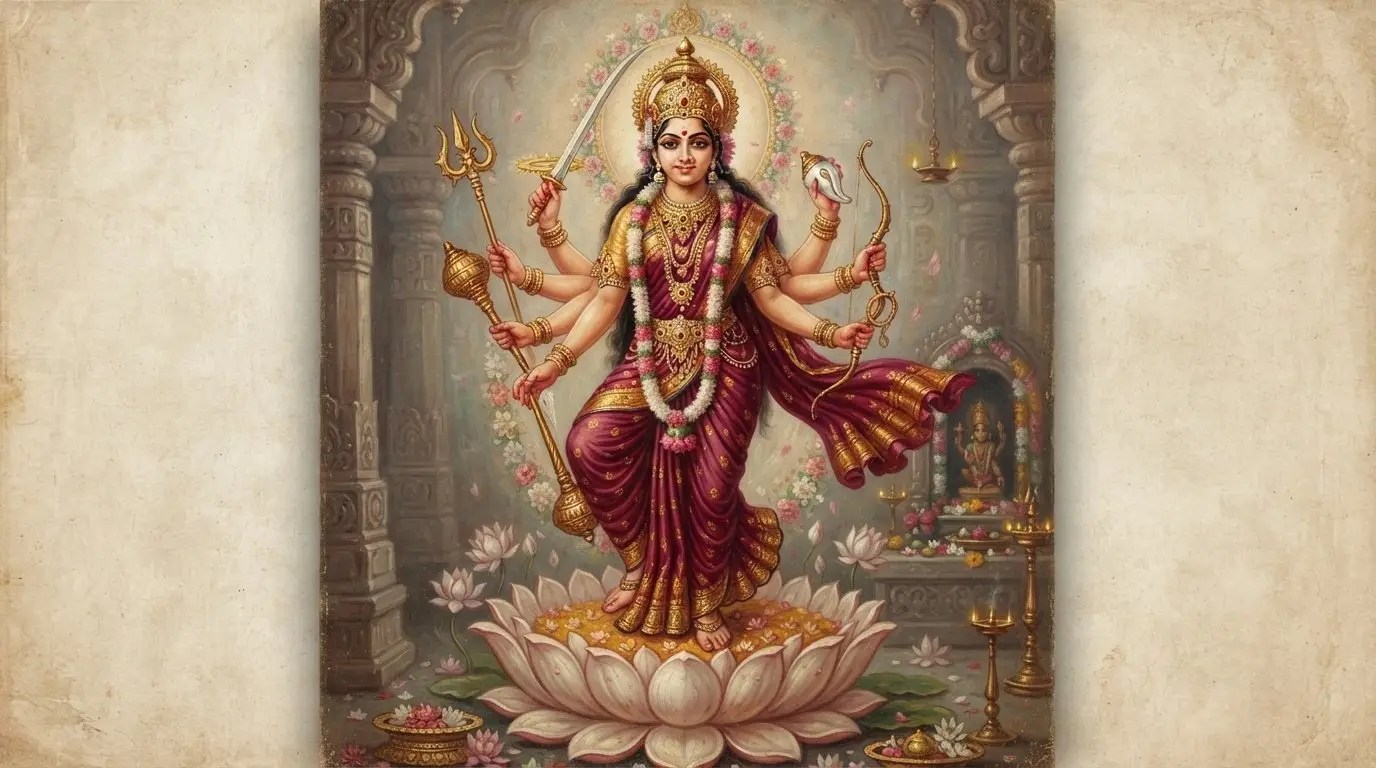
Vijaya Lakshmi, sometimes called Jaya Lakshmi, is invoked specifically at the outset of new undertakings - examinations, competitions, court cases, business negotiations, or any endeavour whose outcome remains uncertain. She is typically shown eight-armed, holding a sword and shield among her lotus-bearing hands, and her name, meaning simply "victorious," reflects her narrow but keenly sought function within the eightfold group. Many devotees recite her specific verse from the Ashtalakshmi Stotram before travelling for an important meeting or sitting an examination.
Vidya Lakshmi / Aishwarya Lakshmi: Knowledge and Sovereignty
The eighth form varies most between traditions. Where Vidya Lakshmi is named, she governs knowledge, learning and education, often shown holding a book or palm-leaf manuscript alongside her lotus, and is invoked by students and scholars. Where Aishwarya Lakshmi is named instead, she governs aishwarya - overall sovereignty, majesty and the complete flourishing of a prosperous life encompassing all the preceding seven forms in balance. Some households and temples worship both under this eighth position on different occasions, treating the distinction as a matter of emphasis rather than exclusion.
The Ashtalakshmi Stotram
The Ashtalakshmi Stotram is the principal Sanskrit hymn through which devotees address each of the eight forms individually, typically in eight verses followed by a concluding phalashruti verse describing the merit of recitation. Each verse opens by invoking one specific form by name and closes with a common refrain of salutation. While the full stotram is lengthy, its structure and opening refrain are widely known even among devotees who have not memorised the entire hymn.
| Devanagari (Refrain) | Transliteration | Meaning |
|---|---|---|
| आदिलक्ष्मी नमस्तुभ्यं, धनलक्ष्मी नमोऽस्तु ते... | Aadi Lakshmi namastubhyam, Dhana Lakshmi namo'stu te... | "Salutations to Adi Lakshmi, salutations to Dhana Lakshmi..." - the invocatory refrain naming each form in sequence |
| जय पद्मालये (in some verse endings) | Jaya Padmalaye | "Victory to she who dwells upon the lotus" - a common closing phrase honouring Lakshmi's lotus seat |
| ॐ श्रीं महालक्ष्म्यै नमः (used with each form's name inserted) | Om Shreem [Form-name] Lakshmyai Namah | The general mantra template devotees use to address any one of the eight forms individually in personal practice |
Because the stotram is a devotional hymn rather than a beej mantra proper, tradition holds it should ideally be learned in full and chanted with correct intonation from a teacher, temple priest, or a reliable audio recording, rather than pieced together solely from written transliteration. Devotees frequently recite it on Fridays, during Varalakshmi Vratam, and throughout the nine nights of Navratri, when different forms of Devi are honoured on successive days. Those interested in the broader architecture of Sanskrit seed-sounds that underlie hymns like this one may find our guide to the Beej Mantras of the Goddess a useful companion reading, and readers seeking the complete verse-by-verse text of a related and equally celebrated hymn should see our Mahalakshmi Ashtakam: Lyrics and Meaning guide.
How to Worship the Eight Forms
Worship of Ashta Lakshmi can be approached in two ways: as a unified practice honouring all eight forms together, or as a targeted practice invoking one specific form according to a particular need.
- Unified worship - devotees recite the full Ashtalakshmi Stotram, ideally on a Friday or during Navratri, offering a single lamp, flowers and naivedya (food offering) before an image depicting all eight forms together, as is common in printed calendar art and temple murals.
- Targeted worship - a devotee facing a specific concern, such as an upcoming examination, may focus specifically on Vijaya Lakshmi's verse and mantra that day, while a couple seeking children might focus their sustained practice on Santana Lakshmi.
- Friday practice - as with Lakshmi worship generally, Friday remains the preferred day, with a lit diya, fresh flowers (lotus where available), and a simple naivedya of fruit or kheer.
- Sequential recitation - some practitioners recite each of the eight names and verses in sequence across eight consecutive days or eight consecutive Fridays, treating it as an extended vrata (vow) rather than a single sitting.
- Chanting count - where a specific beej-style mantra for one form is used (as opposed to the full stotram), 108 repetitions using a mala is the customary count, performed with the same care given to any Lakshmi mantra practice.
As with all Sanskrit mantra and stotra practice, correct pronunciation matters, and devotees new to the Ashtalakshmi Stotram are encouraged to learn it from a qualified guru, temple priest, or a carefully sourced audio recording before committing it to memory, since written transliteration alone can obscure subtleties of rhythm and stress that are part of the hymn's traditional transmission.
Benefits of Worshipping the Ashta Lakshmi
Because each of the eight forms addresses a distinct human need, devotees often describe the benefits of Ashta Lakshmi worship as broader and more evenly distributed across life than worship focused solely on wealth in the narrow sense. Considered together, the tradition holds that sincere and sustained devotion to all eight forms yields:
- A rounded prosperity rather than a lopsided one - money without health, or knowledge without courage to use it, is considered an incomplete blessing, and the eightfold structure is designed precisely to guard against such imbalance.
- Protection through Veera and Dhairya Lakshmi - an inner steadiness that helps a devotee meet setbacks, illness, or conflict without being overwhelmed by fear.
- Success in ventures through Vijaya Lakshmi - particularly valued before examinations, interviews, litigation, competitive selection processes and business negotiations.
- Domestic continuity through Santana Lakshmi - blessings connected to children, family harmony and the long-term wellbeing of the household across generations.
- Food and agricultural security through Dhanya Lakshmi - historically central to agrarian communities, and still invoked today at harvest time and for general nourishment and health.
- Sound judgement through Vidya or Aishwarya Lakshmi - clarity of mind, learning, and the wisdom to use wealth and position well rather than being corrupted by them.
- A sense of underlying unity through Adi Lakshmi - the reminder that all seven other blessings ultimately flow from, and return to, a single source, discouraging the devotee from chasing one domain of prosperity while neglecting the spiritual ground beneath all of them.
As with all Lakshmi worship, tradition is consistent in framing these as blessings that accompany right conduct, honest effort and generosity, rather than replacing them. A devotee who worships Dhana Lakshmi while behaving dishonestly in business, or who invokes Santana Lakshmi while neglecting the children already in their care, is understood to be working against the very energies they are attempting to invoke.
Festivals and Occasions for Ashta Lakshmi Worship
While the Ashtalakshmi Stotram can be recited at any time, several occasions across the Hindu calendar are considered especially suited to honouring the eight forms, either collectively or individually.
Navratri and the Nine Nights
During Navratri, the nine nights dedicated to the Devi in her various forms, many households and temples weave Ashta Lakshmi worship into the festival's broader structure, particularly on the days traditionally associated with Lakshmi within the Navadurga sequence. Since Navratri already organises worship around the principle of the goddess appearing in successive, distinct forms, the Ashta Lakshmi framework fits naturally alongside it. Readers interested in how the nine nights are structured more broadly may find our guide to Navratri and the Navadurga a useful point of comparison.
Varalakshmi Vratam
Observed on the Friday before the full moon in the Tamil month of Aadi (roughly July-August), Varalakshmi Vratam is one of the principal occasions on which South Indian devotees, particularly married women, recite the Ashtalakshmi Stotram in full, honouring Vara Lakshmi - "the Lakshmi who grants boons" - alongside the other seven forms as part of the day's elaborate kalasha-based ritual.
Diwali and Akshaya Tritiya
Diwali remains the single most significant annual occasion for Lakshmi worship generally, and many households include the Ashtalakshmi Stotram in their Diwali puja sequence alongside the more commonly known Lakshmi aarti. Akshaya Tritiya, an auspicious spring day considered favourable for new financial undertakings and gold purchases, is particularly associated with Dhana Lakshmi and Aishwarya Lakshmi, with many families choosing this day specifically to begin new business ventures or make significant purchases under her blessing.
Harvest Festivals
Pongal in Tamil Nadu and comparable harvest festivals such as Makar Sankranti and Bihu elsewhere in India carry a natural affinity with Dhanya Lakshmi, the grain goddess, since these festivals mark the gathering of the year's harvest and give thanks for agricultural abundance. Some rural communities specifically address Dhanya Lakshmi during these celebrations even where the wider festival is not formally understood as a Lakshmi occasion.
The Ashtalakshmi Temple, Chennai
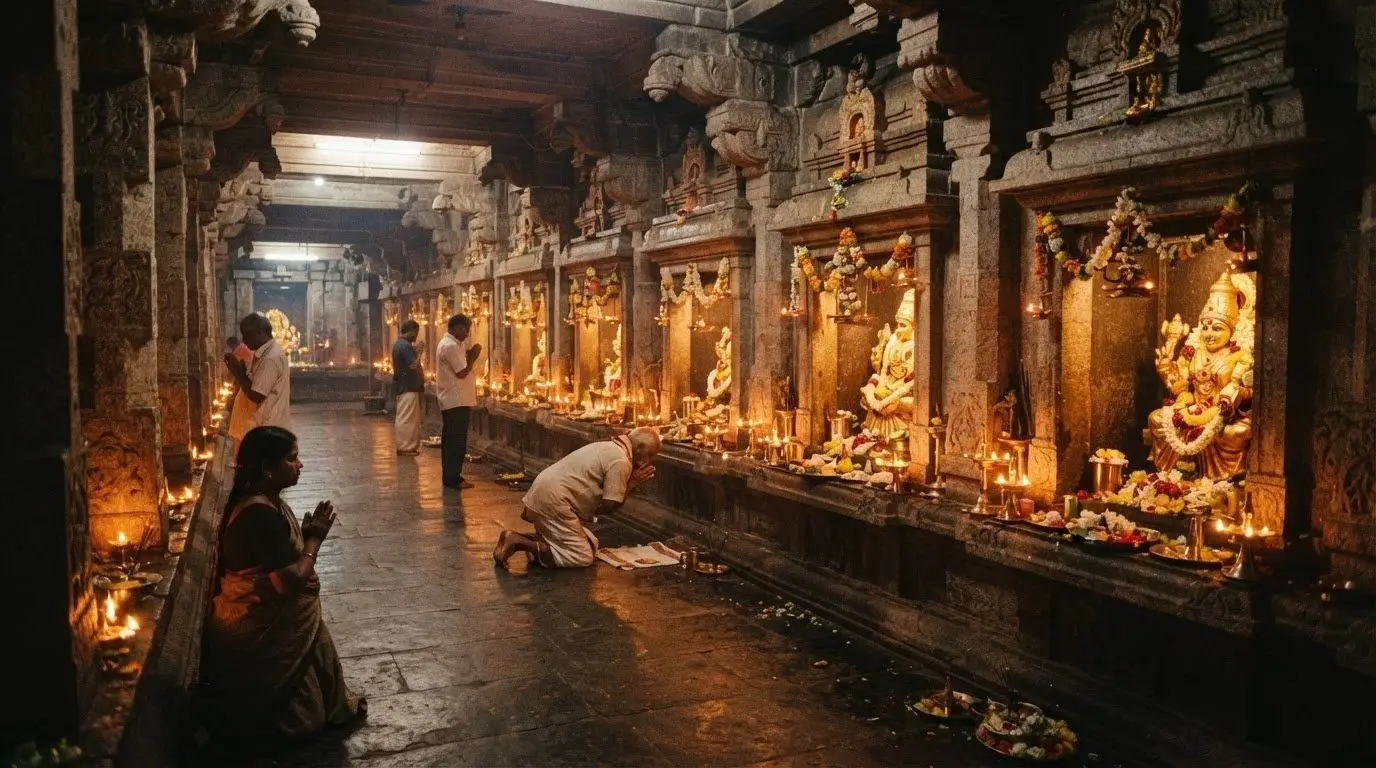
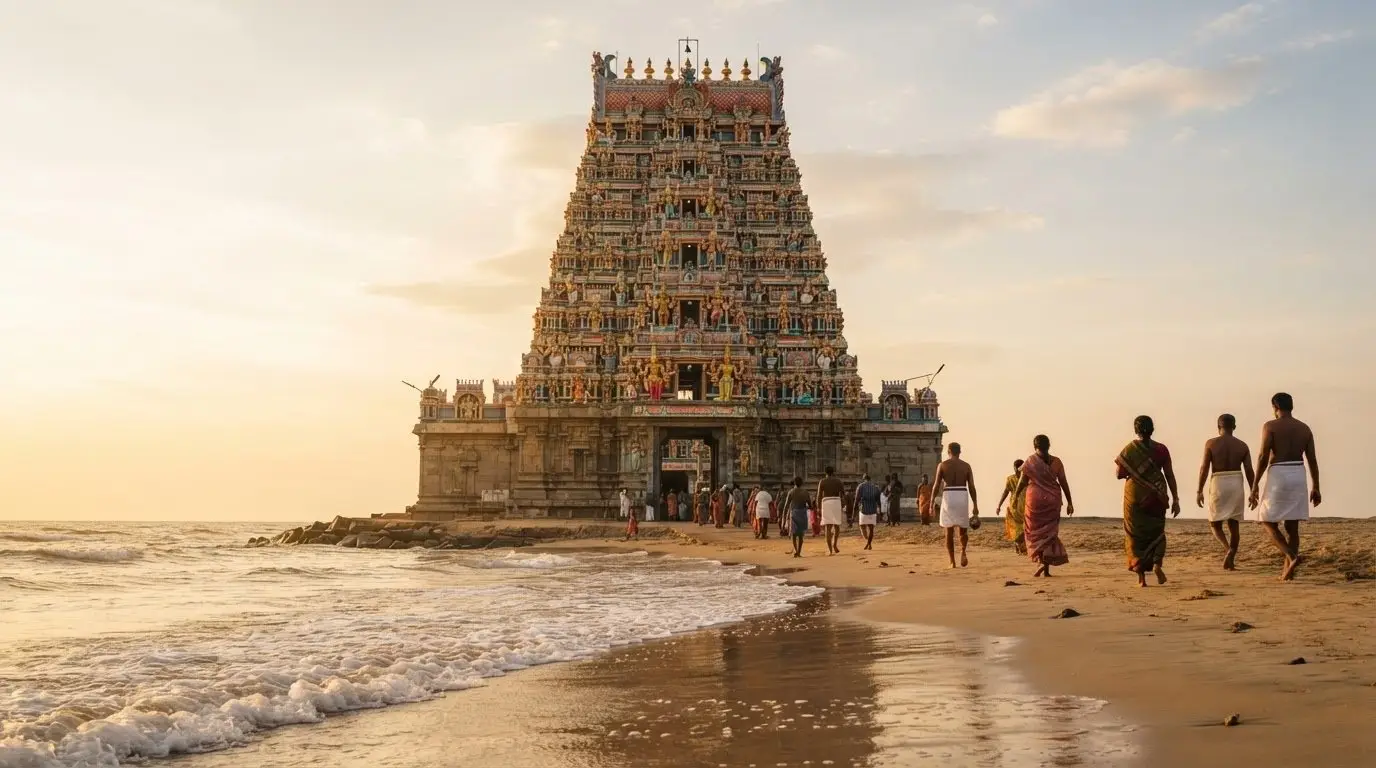
The most well-known dedicated site for this eightfold worship is the Ashtalakshmi Kovil, located along the East Coast Road near Besant Nagar in Chennai, overlooking the Bay of Bengal. Consecrated in 1976, the temple is architecturally distinctive for housing each of the eight forms in her own individual shrine, spread across the temple's multiple storeys, allowing a devotee to complete worship of all eight forms within a single visit - a considerable convenience compared with the alternative of seeking out eight separate temples across the country.
The temple's coastal setting adds a particular tranquillity to the pilgrimage; many visitors describe the sound of the sea as a natural accompaniment to the ascent through the shrine's several levels. It has, in the decades since its consecration, become one of South India's most visited Lakshmi-related pilgrimage sites, drawing particularly large crowds on Fridays, during Navratri, and around Varalakshmi Vratam in the Tamil month of Aadi (roughly July-August). While the temple is comparatively modern by the standards of South Indian temple architecture - many of which trace their sanctums back over a millennium - its purpose-built design specifically to honour the Ashta Lakshmi framework makes it a uniquely important site for devotees of this particular aspect of the goddess.
Visitors typically combine a trip to the Ashtalakshmi Kovil with other prominent Chennai-area temples given its proximity to the city, and pilgrims travelling from further afield generally arrive via Chennai's international airport or main railway stations, with the temple itself a short drive along the coastal road from most central Chennai neighbourhoods.
The Chennai temple's model has also travelled with the Indian diaspora: several Hindu temples in North America and elsewhere, particularly in areas with significant South Indian communities, now include a dedicated Ashtalakshmi shrine or sub-temple following a broadly similar design of eight individual sanctums. While these diaspora shrines vary in scale and are generally more recent still than the Chennai original, they reflect how firmly the eightfold framework has taken root as a distinct, popular devotional practice in its own right, separate from generic Lakshmi worship, over the past half-century.
Practical Notes for Visiting
- Best time to visit - early morning or early evening, avoiding the height of the afternoon sun given the temple's exposed coastal position.
- Dress code - as with most South Indian temples, modest traditional attire is expected, and some inner sanctums may request footwear to be left outside.
- Combine with - the nearby Ashtalakshmi Kovil is often visited alongside other East Coast Road temples and Besant Nagar's Elliot's Beach, making it easy to build into a half-day itinerary.
- Verify festival timings - as with any temple, specific aarti and darshan timings can shift around major festivals, and visitors are advised to confirm current timings with the temple directly before travelling.
Frequently Asked Questions
What are the eight forms of Ashta Lakshmi?
The most widely accepted list includes Adi Lakshmi, Dhana Lakshmi, Dhanya Lakshmi, Gaja Lakshmi, Santana Lakshmi, Veera or Dhairya Lakshmi, Vijaya Lakshmi, and Vidya or Aishwarya Lakshmi. Some regional traditions vary slightly on the final one or two names, particularly regarding whether knowledge (Vidya) or general sovereignty (Aishwarya) completes the group.
Is Ashta Lakshmi different from Goddess Lakshmi?
No. The eight forms are understood as aspects or emanations of the single goddess Lakshmi, each governing a distinct domain of prosperity and wellbeing, rather than eight independent deities. For a fuller picture of Lakshmi herself, see our complete guide to Goddess Lakshmi.
Which form of Lakshmi should I worship for financial problems?
Dhana Lakshmi is specifically associated with monetary wealth and is the form most commonly invoked for financial difficulties, though many devotees simply recite the full Ashtalakshmi Stotram, addressing all eight forms together.
Which Lakshmi form is worshipped for having children?
Santana Lakshmi is specifically invoked by couples seeking children or praying for the continued health and wellbeing of children already born.
What is the Ashtalakshmi Stotram?
It is a Sanskrit devotional hymn, traditionally composed of eight verses, each addressing one of the eight forms of Lakshmi by name, followed by a concluding verse describing the benefits of recitation. It is widely recited on Fridays, during Navratri and during Varalakshmi Vratam.
Where is the main Ashtalakshmi temple located?
The principal dedicated temple, the Ashtalakshmi Kovil, is located on the East Coast Road near Besant Nagar in Chennai, Tamil Nadu, overlooking the Bay of Bengal. It was consecrated in 1976 and houses all eight forms in individual shrines across several storeys.
How old is the Ashta Lakshmi tradition?
While the Gaja Lakshmi and general Lakshmi iconography date back over two thousand years, the specific eightfold Ashta Lakshmi framework as commonly known today, particularly through the Ashtalakshmi Stotram, is understood to have developed and stabilised over subsequent centuries and became especially prominent through South Indian devotional practice.
Can I worship just one of the eight forms rather than all of them?
Yes. While unified worship of all eight is common, particularly using the full stotram, devotees frequently focus on a single form according to their specific need, such as Vijaya Lakshmi before an examination or important undertaking.
What is the difference between Gaja Lakshmi and Dhana Lakshmi?
Gaja Lakshmi is associated with royal power, rainfall, and animal or land-based prosperity, and is recognisable by the elephants flanking her, whereas Dhana Lakshmi governs monetary and material wealth specifically, typically shown with coins flowing from her hand alongside Vishnu's chakra and shankha.
Do all Hindu traditions agree on the exact list of eight forms?
Not entirely. While the Ashtalakshmi Stotram provides the most widely followed enumeration, some regional and temple traditions substitute Aishwarya Lakshmi for Vidya Lakshmi, or otherwise vary slightly in ordering and naming, reflecting centuries of regional devotional development rather than a single fixed canon.
Further Reading
Readers interested in broader scholarly and historical context may find the Wikipedia entry on Ashtalakshmi a useful starting point for textual and regional variations in this tradition.
To sit with each of the eight forms in turn - wealth, grain, courage, victory, knowledge, progeny, royal grace and the primordial source from which they all arise - is to recognise how expansive Lakshmi's blessing truly is. Musinara's YouTube channel carries 432 Hz recordings of the Ashtalakshmi Stotram and related mantras, composed for quiet, sustained listening and repetition. We warmly invite you to listen and subscribe as part of your own devotional practice.
Related reading
- Goddess Durga: The Complete Guide to the Invincible Mother
- Goddess Gayatri: The Mother of the Vedas and Her Mantra
- Goddess Annapurna: The Complete Guide to the Mother Who Feeds the World
- Santoshi Maa: The Story, Vrat Katha and Complete 16-Friday Worship Guide
Watch and listen to devotional music and mantras on the Musinara YouTube channel.