The Devi Kavacham, Argala Stotram and Keelakam are the three angas, or limbs, recited before the Durga Saptashati. The Kavacham is the armour that protects the reciter, the Argala is the bolt that removes obstacles and opens blessings, and the Keelakam is the key that unlocks the full power of the seven hundred verses.
Before a devotee begins the sacred journey through the thirteen chapters of the Durga Saptashati, tradition asks for these three short but essential prayers to be recited first. Drawn from the wider Markandeya Purana tradition, they are not casual add-ons but the doorway through which the full power of the Saptashati is unlocked. Recited in their proper order, they prepare the body, purify the intention, and align the sadhaka with the grace of the Goddess before the main path begins.
This guide explains what each prelude is, its purpose and presiding deity, the correct order of recitation, when and how to chant them, the benefits described in tradition, and the rules a devotee should observe. Selected verses are given in tables with transliteration and meaning. Because Sanskrit pronunciation carries real spiritual weight, learning the proper svara and rhythm from a qualified guru or temple priest is strongly encouraged.
Key Takeaways
- The three angas of the Durga Saptashati are the Devi Kavacham (armour), Argala Stotram (bolt) and Keelakam (key), always recited in that order before the main path.
- The Kavacham names Brahma as rishi and Chamunda as devata; the Argala names Vishnu and Mahalakshmi; the Keelakam names Shiva and Mahasaraswati.
- The Argala Stotram is famous for its refrain 'Rupam dehi jayam dehi yasho dehi dvisho jahi'.
- Tradition holds that Shiva placed a spiritual lock (keela) on the Chandi hymn, which the Keelakam removes for the sincere devotee.
- The three preludes may also be chanted on their own as a shorter daily practice, especially during Navratri.
What Are the Three Angas of the Durga Saptashati?
The three angas are the supporting prayers recited immediately before the Durga Saptashati so that a formal recitation, or parayan, is spiritually complete. The word anga means limb: just as a body needs limbs to act, the Chandi Path is given its protective and enabling limbs through the Kavacham, the Argala and the Keelakam.
The Durga Saptashati, also called the Devi Mahatmya or Chandi Path, forms part of the Markandeya Purana and comprises seven hundred verses across thirteen chapters. It narrates the Goddess's three great victories, over Madhu-Kaitabha, over Mahishasura, and over Shumbha-Nishumbha, as told by the sage Markandeya. Some ritual manuals list additional angas such as the Ratri Suktam, Devi Suktam, and various Nyasas, but the three preludes that are universally recited immediately before the main path are the Kavacham, the Argala, and the Keelakam.
A Simple Way to Remember Their Roles
- Kavacham (armor): protects every part of the body and the mind of the reciter.
- Argala (bolt or latch): removes obstacles and unlatches the flow of blessings and boons.
- Keelakam (pin or key): unlocks the concealed power of the Saptashati so that recitation bears fruit.
Each of these three preludes carries its own viniyoga, a short opening declaration naming the sage who received it, the meter, the presiding deity, and the purpose of the recitation. In all three cases the stated purpose is the same: sapta-shati-patha-angatvena, that is, as a limb of the recitation of the Saptashati, for the pleasure of Jagadamba, the Mother of the World.
| Prelude | Role and Tradition |
|---|---|
| Devi Kavacham | Armor; protection of body and mind. Rishi: Brahma. Devata: Chamunda. |
| Argala Stotram | Bolt/latch; removal of obstacles, blessings and boons. Rishi: Vishnu. Devata: Mahalakshmi. |
| Keelakam | Pin/key; unlocks the hidden power of the Saptashati. Rishi: Shiva. Devata: Mahasaraswati. |
| Durga Saptashati | The main path of 700 verses in 13 chapters, from the Markandeya Purana. |
What Is the Devi Kavacham, the Divine Armor?
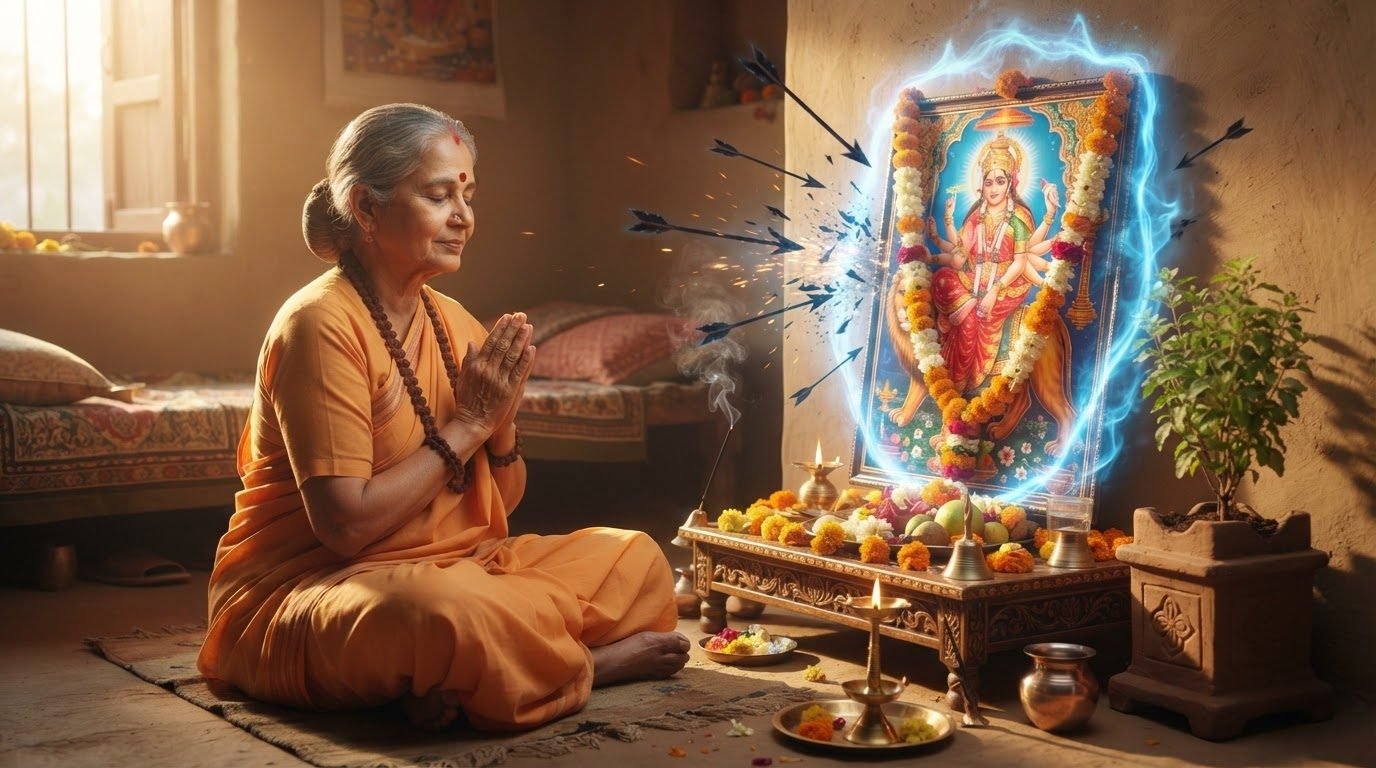
The Devi Kavacham, also called the Chandi Kavach or Devyah Kavacham, is the first prelude, a prayer in which the Goddess is invoked to protect the devotee limb by limb, direction by direction, and faculty by faculty. Its name means armor, and it is regarded as the beej, the seed, of the Saptashati.
Because a seed comes before the plant, the Kavacham is recited before the Argala and the Keelakam. In this prayer, no part of the seeker remains unguarded.
Who Received the Kavacham, and Who Presides Over It?
The Kavacham appears in the tradition of the Markandeya Purana and is framed as a teaching given by Brahma to the sage Markandeya. Its opening viniyoga names Brahma as the rishi (sage), Anushtup as the chandas (meter), and Chamunda as the presiding devata, the fierce protectress whose nature is explored in our complete guide to Maa Kali. It begins with the reverent salutation, Om Namah Chandikayai, and then lists the nine forms of Durga, the Navadurga, before invoking a host of goddesses to guard the body.
What Does the Kavacham Actually Do?
The most striking feature of the Kavacham is its head-to-foot protection. Different goddesses are assigned to guard the ten directions, and then a long sequence of verses places a divine protector on each part of the body, from the crown and forehead to the eyes, ears, tongue, throat, chest, navel, thighs, knees, and feet. It even asks the Goddess to guard the subtle faculties, the vital breaths (prana, apana, vyana, udana, samana), the mind, intellect, and ego, and the very qualities of sattva, rajas, and tamas.
The concluding verses promise that one who wears this armor daily, reciting it with faith at the three junctions of the day, becomes fearless, undefeated in the three worlds, freed from untimely death, and finally attains the supreme abode. The armor is described as difficult to obtain even for the gods.
Selected Verses of the Devi Kavacham
| Sanskrit (Devanagari) | Transliteration (IAST-style) | Meaning |
|---|---|---|
| प्रथमं शैलपुत्री च द्वितीयं ब्रह्मचारिणी। तृतीयं चन्द्रघण्टेति कूष्माण्डेति चतुर्थकम्॥ | prathamam shailaputri cha dvitiyam brahmacharini tritiyam chandraghanteti kushmandeti chaturthakam | The first is Shailaputri, the second Brahmacharini, the third is called Chandraghanta, and the fourth Kushmanda. (The Kavacham opens by naming the nine Durgas.) |
| प्राच्यां रक्षतु मामैन्द्री आग्नेय्यामग्निदेवता। दक्षिणेऽवतु वाराही नैर्ऋत्यां खड्गधारिणी॥ | prachyam rakshatu mam aindri agneyyam agnidevata dakshine 'vatu varahi nairrityam khadgadharini | May Aindri protect me in the east and Agnidevata in the south-east; may Varahi guard the south and the sword-bearing Goddess the south-west. |
| शिखामुद्योतिनि रक्षेदुमा मूर्ध्नि व्यवस्थिता। मालाधरी ललाटे च भ्रुवौ रक्षेद् यशस्विनी॥ | shikham udyotini rakshed uma murdhni vyavasthita maladhari lalate cha bhruvau rakshed yashasvini | May Udyotini protect the tuft of hair and Uma the crown of the head; may Maladhari guard the forehead and Yashasvini the eyebrows. |
| जपेत्सप्तशतीं चण्डीं कृत्वा तु कवचं पुरा। | japet saptashatim chandim kritva tu kavacham pura | One should recite the Chandi Saptashati only after first having recited the Kavacham. (Establishes the Kavacham as the first prelude.) |
Note on variations: manuscripts of the Kavacham range between roughly forty-seven and sixty-one verses depending on the edition. The widely printed Gita Press and Drik Panchang versions carry fifty-six verses. Minor spelling and verse-count differences exist between regional recensions; the meaning and structure remain consistent.
What Is the Argala Stotram Used For?
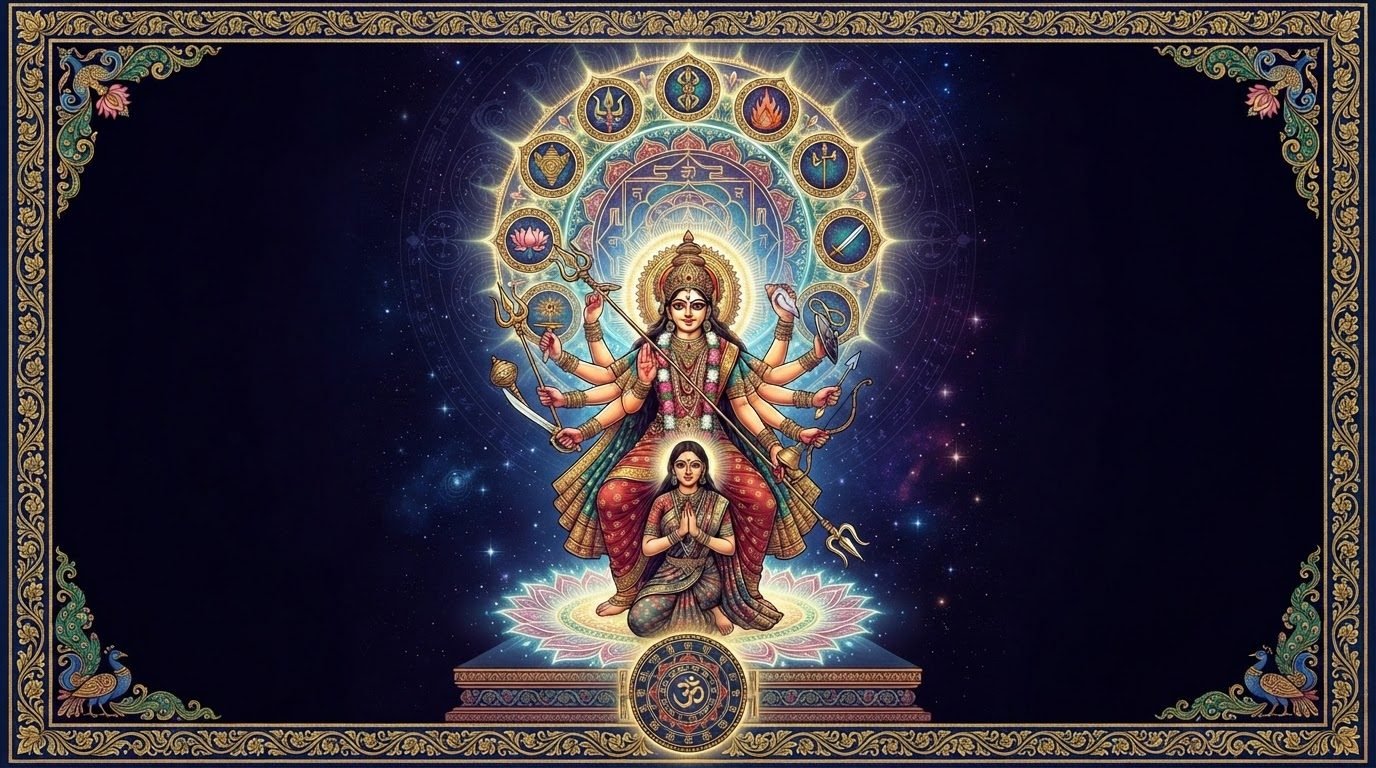
The Argala Stotram is the second prelude, recited after the Kavacham and before the Keelakam, and it is used to remove obstacles and unlatch the flow of the Goddess's grace. The word argala means a bolt, latch, or locking-chain, and the hymn is personified as Shakti herself.
If the Kavacham is the armor, the Argala is the fastening that secures it, and paradoxically the mechanism that opens the flow of blessings. It is one of the most beloved and frequently chanted prayers in the entire Chandi Path.
Who Received the Argala, and Who Presides Over It?
Like the other angas, the Argala is set within the Markandeya Purana tradition and spoken by the sage Markandeya. Its viniyoga names Vishnu as the rishi, Anushtup as the meter, and Mahalakshmi as the presiding devata, the nurturing sovereign whose gentle Mahavidya form is honoured as Maa Kamala. It too opens with Om Namah Chandikayai and begins with the famous invocation, Jayanti Mangala Kali Bhadrakali Kapalini, saluting the Goddess by her many names.
What Is the Famous Refrain of the Argala?
What makes the Argala instantly recognizable is its recurring refrain, which closes verse after verse: Rupam dehi jayam dehi yasho dehi dvisho jahi, meaning "Grant me beauty (or a fitting form), grant me victory, grant me glory, and destroy my enemies." This four-fold prayer, repeated many times, is the heart of the stotram and the reason it is treasured by those who seek both worldly wellbeing and spiritual strength.
Later verses ask for good fortune, health, supreme happiness, learning, and a worthy life-partner, and the closing verse promises that whoever recites this hymn and then the great hymn (the Saptashati itself) obtains the reward of the seven hundred verses.
Selected Verses of the Argala Stotram
| Sanskrit (Devanagari) | Transliteration (IAST-style) | Meaning |
|---|---|---|
| ॐ जयन्ती मङ्गला काली भद्रकाली कपालिनी। दुर्गा क्षमा शिवा धात्री स्वाहा स्वधा नमोऽस्तु ते॥ | om jayanti mangala kali bhadrakali kapalini durga kshama shiva dhatri svaha svadha namo 'stu te | Om. Salutations to you who are Jayanti, Mangala, Kali, Bhadrakali, Kapalini, Durga, Kshama, Shiva, Dhatri, Svaha and Svadha. (The opening invocation of the Argala.) |
| मधुकैटभविद्राविविधातृवरदे नमः। रूपं देहि जयं देहि यशो देहि द्विषो जहि॥ | madhukaitabha-vidravi-vidhatr-varade namah rupam dehi jayam dehi yasho dehi dvisho jahi | Salutations to you who drove away Madhu and Kaitabha and granted a boon to the Creator. Grant me a fitting form, grant victory, grant glory, and destroy my enemies. |
| विद्यावन्तं यशस्वन्तं लक्ष्मीवन्तं जनं कुरु। रूपं देहि जयं देहि यशो देहि द्विषो जहि॥ | vidyavantam yashasvantam lakshmivantam janam kuru rupam dehi jayam dehi yasho dehi dvisho jahi | Make me a person endowed with learning, fame and prosperity. Grant me a fitting form, grant victory, grant glory, and destroy my enemies. |
| देहि सौभाग्यमारोग्यं देहि मे परमं सुखम्। रूपं देहि जयं देहि यशो देहि द्विषो जहि॥ | dehi saubhagyam arogyam dehi me paramam sukham rupam dehi jayam dehi yasho dehi dvisho jahi | Grant me good fortune and health, grant me supreme happiness. Grant a fitting form, grant victory, grant glory, and destroy my enemies. |
Note on variations: the number of verses in the Argala Stotram varies (commonly around twenty-five to twenty-seven verses across editions). In some recensions the wording of individual epithets differs slightly. The core refrain and its meaning are stable throughout.
What Does the Keelakam Unlock?
The Keelakam is the third and final prelude, understood as the key that releases the concealed potency of the seven hundred verses. The word keela means a pin, nail, wedge, or bolt, and keelaka refers to that which pins down or, when removed, unlocks.
It is recited after the Kavacham and the Argala, and immediately before the chapters of the Saptashati begin. In many traditions the Ratri Suktam follows the Keelakam and then the main path.
Who Received the Keelakam, and Who Presides Over It?
Set within the same Markandeya Purana tradition, the Keelakam's viniyoga names Shiva as the rishi, Anushtup as the meter, and Mahasaraswati as the presiding devata. It opens with Om Namah Chandikayai and a salutation to Shiva, the one of pure knowledge who bears the half-moon.
What Is the Meaning of the Pin?
The inner teaching of the Keelakam is subtle. Tradition holds that Lord Shiva, wishing to keep the full power of the Chandi hymn from being obtained too easily, placed a keela, a spiritual lock, upon it. The Keelakam explains how the sincere devotee, through steady recitation and right understanding, removes that lock.
The text states that one who recites the Saptashati after nishkilana, unlocking, attains perfection: such a person becomes accomplished, gains freedom from fear wherever they wander, is not subject to untimely death, and upon death attains liberation. It also praises the Goddess as the source of prosperity, sovereignty, good fortune, health, the destruction of enemies, and ultimately moksha.
Selected Verses of the Keelakam
| Sanskrit (Devanagari) | Transliteration (IAST-style) | Meaning |
|---|---|---|
| ॐ विशुद्धज्ञानदेहाय त्रिवेदीदिव्यचक्षुषे। श्रेयःप्राप्तिनिमित्ताय नमः सोमार्धधारिणे॥ | om vishuddha-jnana-dehaya trivedi-divya-chakshushe shreyah-prapti-nimittaya namah somardha-dharine | Om. Salutations to Shiva, whose body is pure knowledge, whose three divine eyes are the three Vedas, who is the cause of attaining the highest good, and who bears the half-moon. |
| सर्वमेतद्विजानीयान्मन्त्राणामभिकीलकम्। सोऽपि क्षेममवाप्नोति सततं जाप्यतत्परः॥ | sarvam etad vijaniyan mantranam abhikilakam so 'pi kshemam avapnoti satatam japya-tatparah | One should know all this to be the keelaka (locking-pin) of the mantras. Even so, one devoted to constant recitation attains welfare. |
| न मन्त्रो नौषधं तत्र न किञ्चिदपि विद्यते। विना जाप्येन सिद्ध्येत सर्वमुच्चाटनादिकम्॥ | na mantro naushadham tatra na kinchid api vidyate vina japyena siddhyet sarvam uchchatanadikam | There is no other mantra, no herb, and nothing else needed there; through recitation alone all objectives are accomplished. |
| ज्ञात्वा प्रारभ्य कुर्वीत न कुर्वाणो विनश्यति। | jnatva prarabhya kurvita na kurvano vinashyati | Having understood this, one should begin and carry it out; one who acts without understanding comes to ruin. (Hence the stress on right knowledge and guidance.) |
Note on variations: the Keelakam is short, commonly fourteen verses. Interpretations of the keela (whether Shiva locked the hymn to restrict casual use, or whether the keelaka is a technical device of the mantra) differ among commentators. The practical instruction, recite with knowledge and devotion, is consistent.
What Is the Correct Order of Recitation?
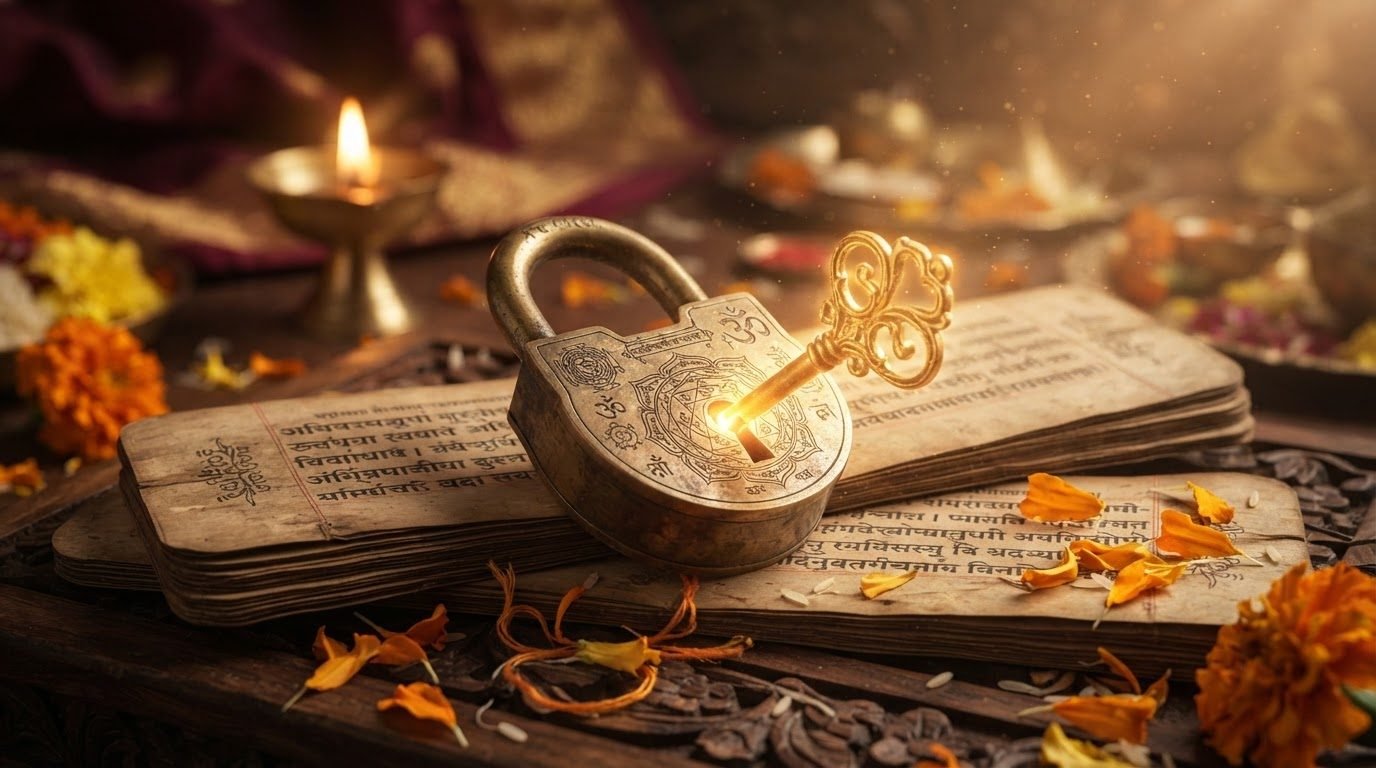
The correct order is Devi Kavacham first, then the Argala Stotram, then the Keelakam, and only after these the thirteen chapters of the Durga Saptashati. This sequence is not arbitrary; it follows a clear inner logic that ritual tradition preserves carefully.
- Devi Kavacham first: because it is the beej (seed) of the Saptashati, and a seed always precedes what grows from it. It also arms the reciter before anything else.
- Argala Stotram second: armor needs a bolt or latch. The Argala fastens the protection of the Kavacham and opens the flow of blessings.
- Keelakam third: a lock needs a key. The Keelakam removes the spiritual pin that guards the hymn's power, so the main recitation can bear full fruit.
- Durga Saptashati (Chandi Path) last: the thirteen chapters are then recited. In many manuals the Ratri Suktam is chanted after the Keelakam, followed by the chapters, and the path is sealed with concluding prayers such as the Devi Suktam, Rahasya, and Aparadha Kshamapana.
A short mnemonic: armor, then bolt, then key, then the sacred story. Kavach protects, Argala opens, Keelak unlocks, and the Saptashati reveals.
When and How Should You Recite the Three Angas?
The three angas are best recited during Navratri, on Ashtami and Navami, on Tuesdays, Fridays and new or full moon days, and in the calm early morning after bathing. They are chanted seated facing east or north, before a lamp and an image of the Goddess, in their fixed order.
When to Recite
- Navratri: the nine nights of the Goddess are the most auspicious time; many devotees recite the full path daily during Chaitra and Sharadiya Navratri.
- Ashtami and Navami: the eighth and ninth lunar days are especially favored for Chandi Path.
- Tuesdays, Fridays, and Amavasya or Purnima: recognized as favorable for Devi worship.
- Brahma Muhurta or the early morning after bath: the calm pre-dawn hours suit steady recitation; the Kavacham commends recitation at the three sandhyas (junctions) of the day.
How to Recite
- Bathe and wear clean clothes; sit facing east or north on a clean woolen or cotton mat.
- Set up a simple altar with an image or yantra of the Goddess, a lit ghee or oil lamp, incense, and flowers.
- Begin with a short sankalpa (statement of intention) and salutation, then recite the Kavacham, Argala, and Keelakam in order.
- Follow with the Saptashati chapters if performing the full path; otherwise the three angas may be recited on their own as a shorter daily practice.
- Chant clearly and unhurriedly. You may recite aloud, in a whisper, or mentally, keeping the mind on the Goddess and the meaning.
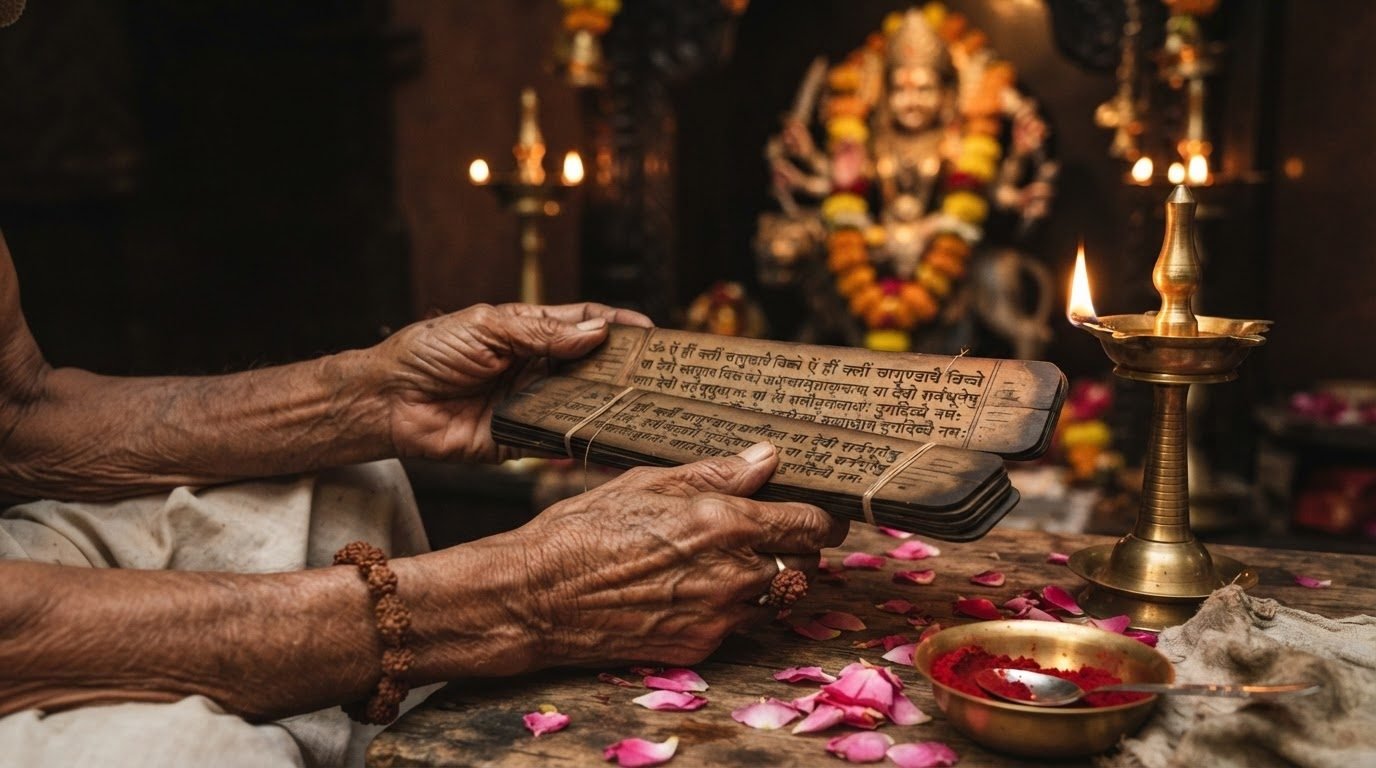
Because the potency of these prayers rests heavily on correct Sanskrit pronunciation, meter, and the accompanying nyasa, it is wise to first learn them from a qualified guru, temple priest, or a trusted recorded rendition, rather than relying on the written text alone.
What Are the Benefits of Reciting the Three Preludes?
Tradition attributes protection, fearlessness, the four-fold boon of form, victory, glory and freedom from enemies, and finally the unlocking of the Saptashati's full power to the three angas. These benefits are drawn from the closing (phalashruti) verses of each text, whether the angas are recited as preludes or on their own.
Benefits Emphasized by the Kavacham
- All-round protection of body, mind, and vital faculties, and safety in the ten directions.
- Fearlessness, freedom from untimely death, and being undefeated in the three worlds.
- Destruction of diseases, harmful influences, black magic, and malefic entities, and a long, dignified life.
Benefits Emphasized by the Argala
- The four-fold boon of the refrain: a fitting form, victory, glory, and the removal of enemies.
- Good fortune, health, supreme happiness, learning, and prosperity.
- Attaining the full reward of the seven hundred verses when followed by the Saptashati.
Benefits Emphasized by the Keelakam
- Unlocking the concealed power of the Saptashati so recitation becomes fully effective.
- Accomplishment (siddhi), sovereignty, good fortune, and health.
- Freedom from fear while travelling, protection from untimely death, and liberation (moksha) at the end of life.
Across all three, the deeper benefit is inner: steadiness of mind, purification of intention, and a growing intimacy with the Divine Mother that transforms both outer circumstances and inner character.
What Rules and Etiquette Should You Observe?
The essential rules are purity, order, completeness and correct pronunciation: bathe beforehand, keep the fixed sequence of Kavach, Argala, Keelak, never skip the viniyoga, finish each prelude in one sitting, and learn the chanting from a qualified guide. Consistency and faith matter more than elaborate performance.
- Maintain physical and mental purity: bathe beforehand, keep the space clean, and approach with a calm, reverent attitude.
- Preserve the order: always recite Kavach, then Argala, then Keelak, before the Saptashati. The sequence is integral to the tradition.
- Do not skip the viniyoga: the opening declaration naming the rishi, meter, and deity is part of each prelude.
- Recite completely: avoid leaving a prelude unfinished once begun; complete each in a single sitting where possible.
- Guard pronunciation: mispronunciation is traditionally discouraged; learn the correct chanting from a guru or priest, especially for the nyasa portions.
- Consistency and faith: regular, faith-filled recitation is valued above occasional elaborate performance.
- Observe personal discipline: many devotees keep a sattvic (vegetarian) diet and simple conduct during a mandala of recitation, particularly through Navratri.
- Seek guidance for elaborate rituals: a full Chandi Path with homa and specific sankalpa is best done under the direction of a knowledgeable priest.
Where Do the Angas Fit in the Chandi Path Tradition?
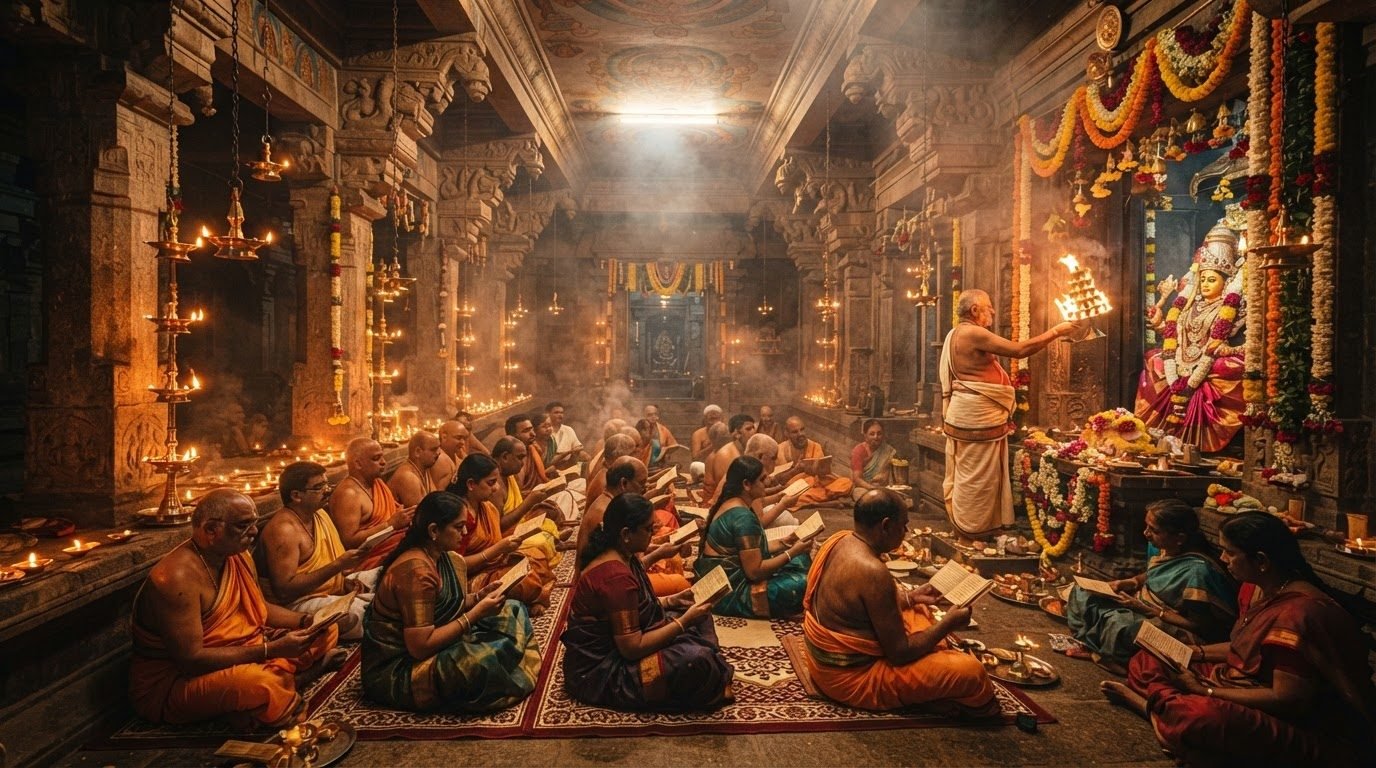
The angas are the ritual grammar that surrounds the Durga Saptashati, arranged by generations of teachers so that any devotee, priest or householder, can approach the Goddess in a complete and protected way. The Saptashati itself has been recited for well over a millennium as a central scripture of Shakta worship, the same tradition that reveres the Das Mahavidyas.
The three angas embody a beautiful progression: first you put on armor, then you fasten and open it with a bolt, then you turn the key that releases the treasure within. This mirrors the inner journey of the sadhaka, from seeking protection, to opening the heart to grace, to finally unlocking the transformative power of the Mother's story of victory over darkness. Understood this way, the preludes are not obstacles to get through before the real recitation; they are themselves a graduated prayer that prepares the seeker to receive what the Saptashati offers.
A Closing Note
The Devi Kavacham, Argala Stotram, and Keelakam are far more than a formality before the Durga Saptashati. They are the armor, the bolt, and the key that prepare the devotee to enter the Mother's story fully protected and fully open. Recited in their proper order, with clean intention and correct chanting learned from a knowledgeable guide, they turn a reading into a sacred rite. May the Divine Mother grant every seeker her protection, her blessings, and the unlocking of her boundless grace.
Listen: Subscribe to Musinara Sounds for 432 Hz mantra chants
🕉️ Hear these sacred mantras come alive. Subscribe to Musinara Sounds on YouTube for 432 Hz Devi mantra chants, sung slowly enough to follow and repeat.
Frequently Asked Questions
What are Devi Kavach, Argala Stotram, and Keelak?
They are the three angas (limbs) recited before the Durga Saptashati. The Devi Kavacham is the armor that protects the reciter, the Argala Stotram is the bolt that removes obstacles and grants blessings, and the Keelakam is the key that unlocks the full power of the Saptashati. All three belong to the Markandeya Purana tradition.
What is the correct order of recitation?
Recite the Devi Kavacham first, then the Argala Stotram, then the Keelakam, and only after these the thirteen chapters of the Durga Saptashati. In many manuals the Ratri Suktam is added after the Keelakam and before the main path.
Why is the Kavacham recited before the Argala and Keelak?
Because the Kavacham is considered the beej (seed) of the Saptashati, and a seed naturally comes first. It also arms and protects the reciter before the other prayers begin.
What is the famous refrain of the Argala Stotram?
The recurring refrain is Rupam dehi jayam dehi yasho dehi dvisho jahi, meaning "Grant me a fitting form, grant victory, grant glory, and destroy my enemies." It closes most verses of the stotram.
What does Keelak mean and why is it important?
Keela means a pin, nail, or wedge, and keelaka is that which pins down or, when removed, unlocks. Tradition holds that Shiva placed a spiritual lock on the Chandi hymn; the Keelakam is the prayer that unlocks its concealed power for the sincere devotee.
Can I recite the three angas without reciting the whole Saptashati?
Yes. Many devotees chant the Kavacham, Argala, and Keelakam as a shorter daily practice on their own. When performing a full path, however, they are recited as preludes to the seven hundred verses.
Who are the presiding deities of the three preludes?
The Kavacham has Brahma as rishi and Chamunda as devata; the Argala has Vishnu as rishi and Mahalakshmi as devata; the Keelakam has Shiva as rishi and Mahasaraswati as devata. All are recited for the pleasure of Jagadamba, the Mother of the World.
When is the best time to recite them?
Navratri is the most auspicious period, along with Ashtami, Navami, Tuesdays, Fridays, and new or full moon days. The early morning or the three sandhyas (junctions) of the day are recommended times for steady, attentive recitation.
Do I need a guru to learn these prayers?
It is strongly encouraged. Correct Sanskrit pronunciation, meter, and the accompanying nyasa carry spiritual significance, so learning from a qualified guru, temple priest, or trusted recording is far better than relying on written text alone.
Are there different versions of these texts?
Yes. Verse counts and minor wording vary between regional recensions and printed editions (for example the Kavacham commonly has 56 verses, the Argala around 25 to 27, and the Keelakam 14). The structure, meaning, and famous refrains remain consistent across versions.
New to chanting? Two short guides cover the practicalities: how to chant a mantra (mala, count, pronunciation and the three traditional modes of japa), and Devi worship at home (a simple altar and a ten minute daily sequence).