Introduction
Few narratives in the Hindu tradition run as deep as the Sati Devi story. It tells of the Divine Mother's first descent into mortal form, of her boundless love for Lord Shiva, and of the cosmic tragedy at Daksha's Yagna. That tragedy gave birth to the sacred Shakti Peethas. Few legends carry such emotional depth and theological weight. This single story binds together the worship of Shiva and Shakti. Moreover, it explains the origin of India's holiest goddess shrines. Above all, it reveals the eternal truth that the Divine Feminine can never truly die.
Sati was no ordinary woman. She was Adi Shakti herself, the primordial energy of the cosmos. Willingly she took birth as the daughter of Daksha Prajapati, so that she might unite with Shiva and uphold the order of creation. Her life, her marriage against her father's wishes, and her ultimate self-immolation in the fire of yoga form the foundation of the Shakta tradition. Several Puranas carry this tale. The Shiva Purana, the Devi Bhagavata Purana, the Mahabhagavata Purana, the Linga Purana and the Kalika Purana each illuminate a facet of it.
This devotional guide follows Sati's journey from her divine birth to her grief-stricken departure. Along the way we witness Shiva's cosmic dance of mourning. We then see how Vishnu's Sudarshana Chakra scattered her sacred body across the land. Finally, we rejoice in her return as Parvati. Along the way we will explore the spiritual lessons, mantras, temples, and festivals that keep her memory alive for millions of devotees today.
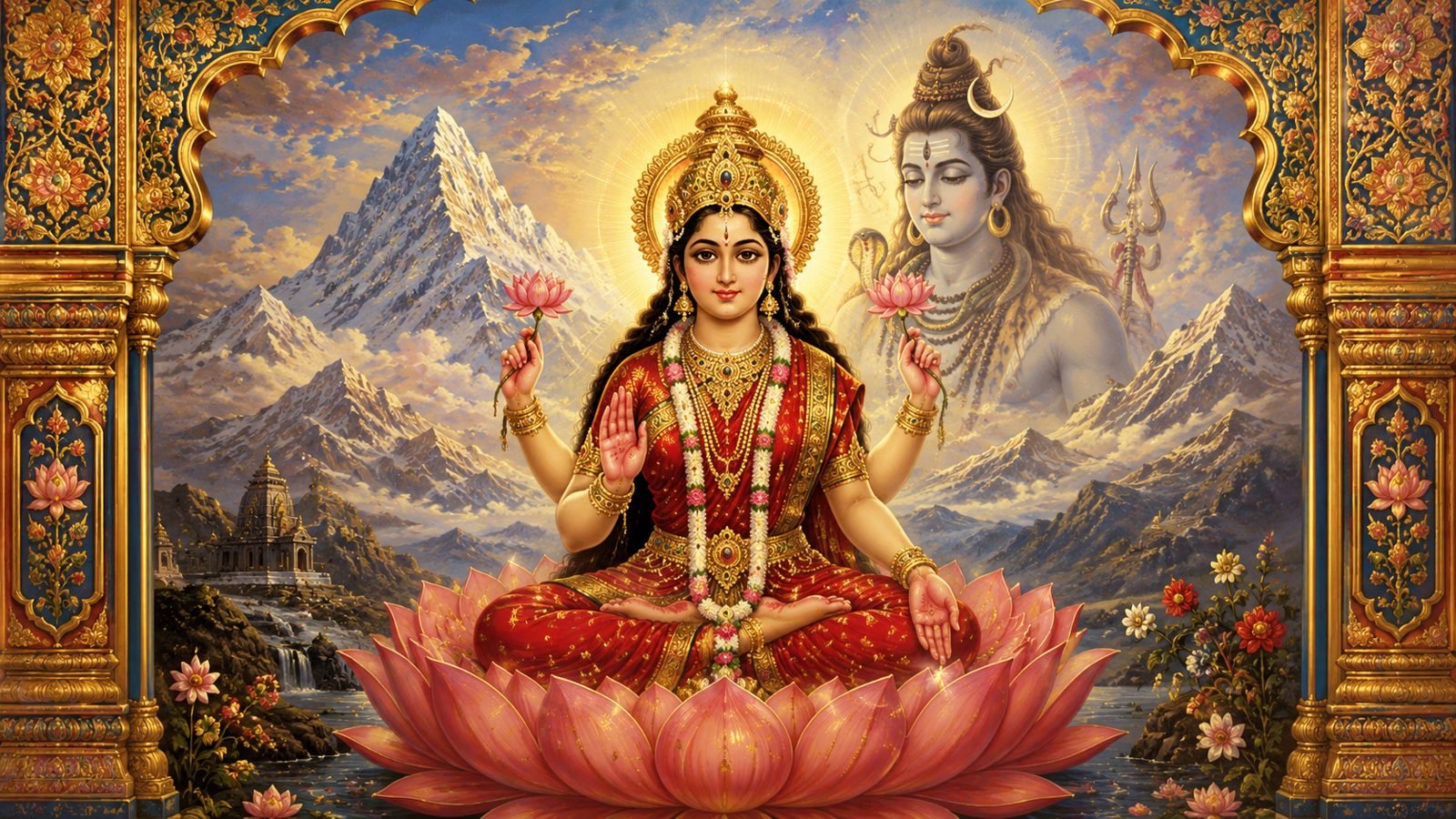
Who Is Sati Devi? The First Incarnation of Adi Shakti
To understand Sati, one must first understand Adi Shakti - the primordial, formless power that animates all of existence. In the Shakta cosmology, the universe is the play of two inseparable principles: Shiva, pure consciousness, and Shakti, dynamic energy. Without Shakti, even Shiva is described as inert (shava). Sati Devi is the very first form in which this supreme Shakti chose to take a body, descending from her transcendent state to walk the earth.
The name 'Sati' means 'the virtuous one' or 'she who is the truth' (sat). Devotees also know her as Dakshayani, 'the daughter of Daksha.' The Devi Bhagavata Purana and the Mahabhagavata Purana describe her as the Mahadevi, the Great Goddess. She appears so that the cosmic union of Shiva and Shakti can return to the world. She is therefore venerated as the original consort of Shiva and the spiritual ancestor of all later goddess forms, including Parvati, Durga, and Kali.
Why the Goddess Chose to Be Born
According to Shakta tradition, Shiva had withdrawn into deep ascetic meditation, indifferent to the world of creation. For the cosmic order to flourish, Shakti needed to draw him back into the dance of life. The Goddess therefore vowed to incarnate as the daughter of a great devotee so that she could win Shiva as her husband. Daksha Prajapati and his wife Prasuti, called Virini in some texts, performed intense penance. They prayed that the Great Goddess herself would take birth as their child. In time, the Devi granted their wish.
Birth of Sati and Her Marriage to Lord Shiva
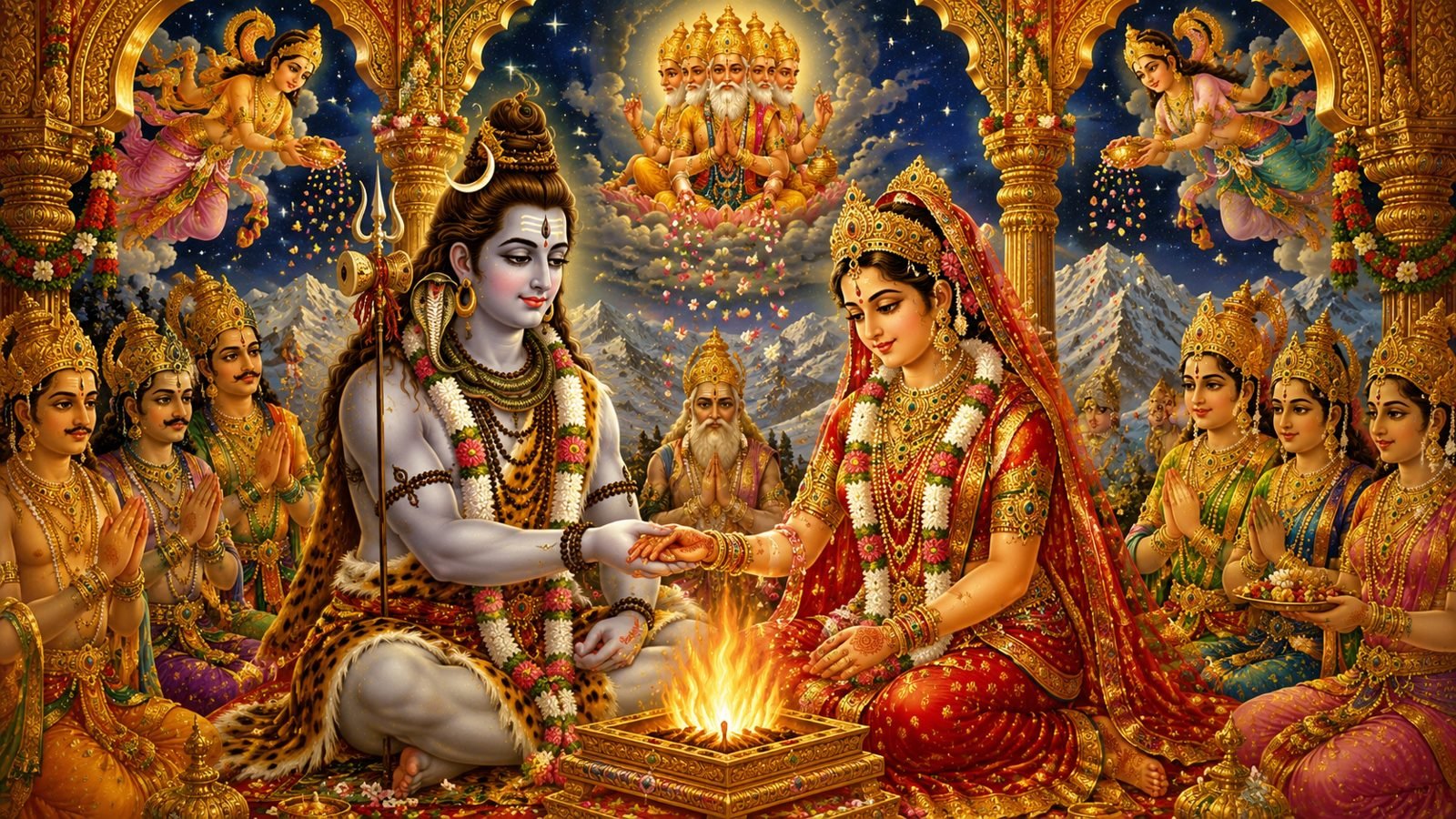
Daksha was a Prajapati, an agent of creation and a son of Lord Brahma, immensely powerful and proud of his lineage and ritual orthodoxy. When the Goddess was born to him as Sati, the heavens rejoiced, for they knew that Adi Shakti had taken human form. From childhood, Sati's heart was fixed upon Shiva. While other children played, she meditated upon the Lord of Kailash and longed for nothing but union with him.
As Sati grew, her devotion to Shiva deepened into single-minded resolve. The Shiva Purana relates that she undertook severe austerities to attain him - fasting, meditating, and worshipping Shiva with unbroken concentration. Pleased by her unparalleled devotion, Shiva appeared before her and accepted her as his bride. The Puranas describe Brahma himself officiating parts of the celestial wedding. So the union of the ascetic Lord with the Daughter of Daksha became one of the most sacred marriages in all of Hindu lore.
Daksha's Disapproval
Daksha, however, was displeased. To his ritual-minded sensibility, Shiva seemed an unconventional figure. Here was an ascetic who dwelt in cremation grounds, smeared with ash and garlanded with serpents. Ghosts and ganas surrounded him, and he cared nothing for worldly status or Daksha's brand of orthodoxy. The proud Prajapati could not reconcile his daughter's choice with his own notions of propriety. The marriage took place, yet resentment took root in Daksha's heart. The Devi Bhagavata Purana adds that a curse fell on him, so that he felt enmity toward his own beloved daughter. This only deepened the coming tragedy.
The Daksha Yagna and the Great Insult
Time passed, and Daksha's pride only grew. So he resolved to perform a magnificent yagna, a grand Vedic fire sacrifice. Tradition calls it the Brihaspati-sava, held on the banks of the Ganga at Kanakhala, near present-day Haridwar. He invited all the gods, sages, kings, and celestial beings to attend and receive their sacrificial portions. Deliberately, and with calculated insult, he did not invite his own daughter Sati or her husband Lord Shiva.
The Shiva Purana and the Devi Bhagavata Purana describe the slight in painful detail. Daksha publicly disparaged Shiva as a kapalin - a skull-bearer, a haunter of cremation grounds, an inauspicious being unworthy of receiving a share of the sacrifice. To deny Shiva his rightful portion in a yagna was, in the cosmic order, a grave transgression, for Shiva is the very Lord of all sacrifice.
Sati's Decision to Attend
From Kailash, Sati perceived the great gathering at her father's home. She saw the celestial beings travelling toward the yagna and her heart yearned to attend her father's sacrifice. Shiva counselled against it, warning her that to go uninvited - and to a place where her husband had been insulted - would bring only sorrow. But Sati, moved by a daughter's love and by indignation at the disrespect shown to her Lord, insisted on going to confront her father. Shiva, honouring her will, allowed her to depart with his ganas as escort.
Sati's Self-Immolation in the Fire of Yoga
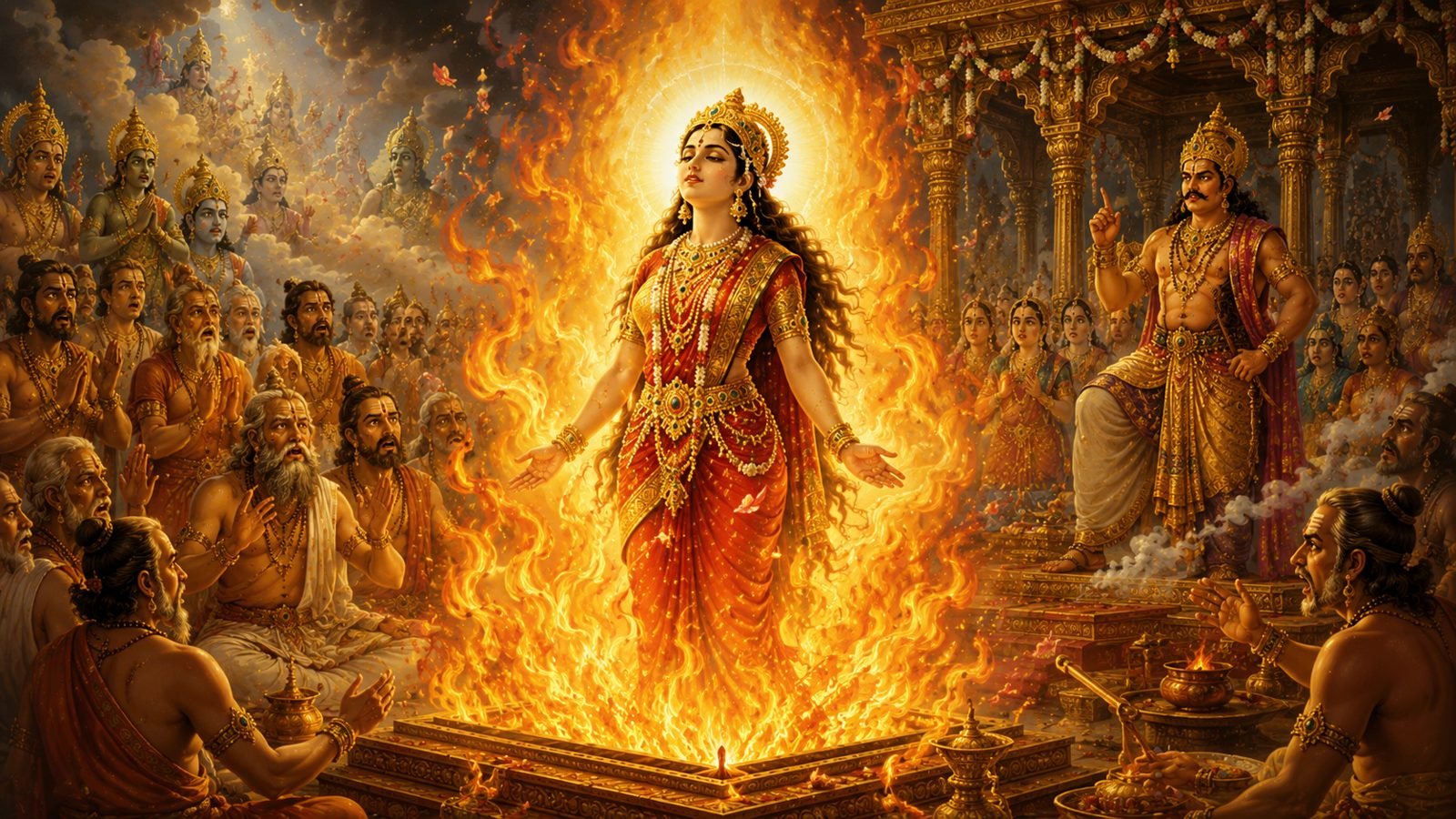
When Sati arrived at the sacrificial grounds, she found that no portion had been offered to Shiva, and that her father received her with coldness and contempt. Before the assembled gods and sages, Daksha heaped abuse upon Shiva, mocking the Lord she revered above all. Sati's grief turned to righteous fury. She rebuked her father for his arrogance and declared that she could no longer bear to carry a body born of one who insulted her divine husband.
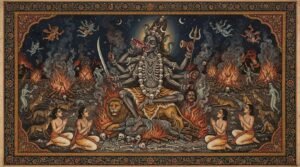
The scriptures agree on the climax, though they describe it in different ways. The Shiva Purana and Devi Bhagavata Purana preserve the most widely held account. In it, Sati invoked her inner yogic fire, the power of her own divine will. Then she consumed her mortal body in its flames, casting off the form Daksha had given her. In some tellings she leapt into the sacrificial fire itself. Either way, the Goddess withdrew her presence from the body, leaving the assembly stunned and the universe trembling.
Her act was not despair but a sovereign refusal - the Divine Mother rejecting a lineage that had dishonoured the sacred. From this supreme act of self-surrender flows the deepest theology of Sati. Love and honour are inseparable. Therefore the Goddess will not abide where Shiva is scorned.
Shiva's Grief and the Cosmic Dance of Destruction
When word of Sati's death reached Kailash, Shiva's sorrow shook the three worlds. The all-renouncing Lord, who had taken Sati as his beloved, was overcome by a grief and wrath beyond measure. The Shiva Purana describes how he tore a lock of his matted hair and struck it upon the ground. From it arose the terrifying warrior Virabhadra. The fierce goddess Bhadrakali came with him, and a host of ganas followed.
Virabhadra and the ganas descended upon Daksha's sacrifice and laid it waste. The yagna was destroyed, the assembled deities scattered, and Daksha himself was beheaded. Yet Shiva, the supremely compassionate, later relented. Then the chastened gods and Daksha's followers sought his forgiveness. Shiva restored the slain to life and gave Daksha the head of a goat, though some accounts say he restored him whole. So the sacrifice went forward at last, and Shiva received his rightful share. The lesson is unmistakable: arrogance toward the divine brings ruin. But sincere repentance meets with grace.
The Tandava of Sorrow
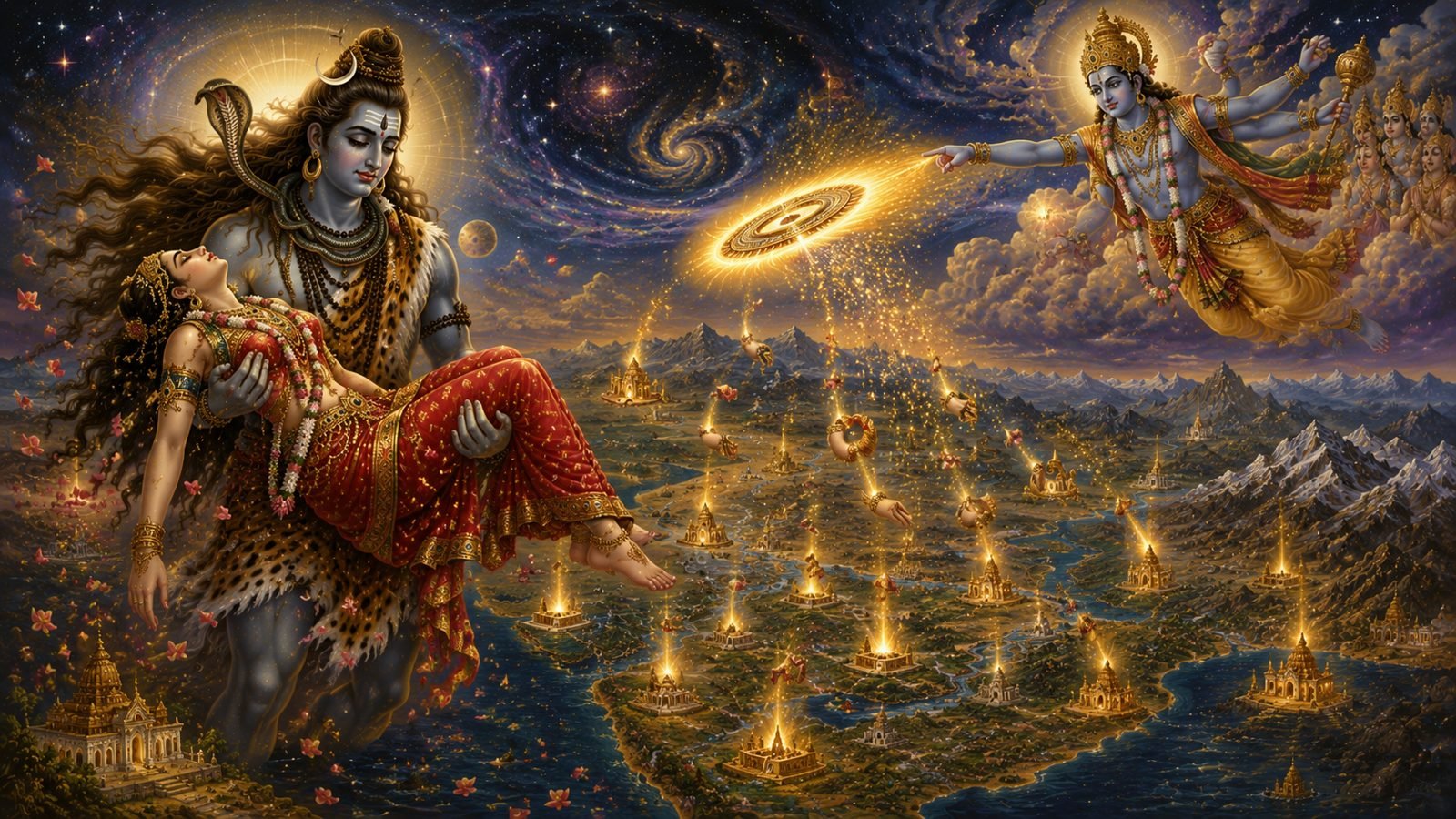
Most poignant of all is the image of Shiva carrying the lifeless body of Sati. Inconsolable, the Lord lifted her form upon his shoulder. Then he wandered across the cosmos in a frenzy of grief, performing the wild and terrible Tandava. The vibrations of that cosmic dance threatened to dissolve all creation. The very order of the universe began to unravel beneath the weight of the Lord's mourning. So the gods grew fearful that his sorrow would destroy the worlds themselves.
Vishnu's Sudarshana Chakra and the Birth of the Shakti Peethas
To save the cosmos from dissolution and to gently release Shiva from his all-consuming grief, Lord Vishnu intervened. As Shiva wandered with Sati's body, Vishnu followed and, with his Sudarshana Chakra, severed the corpse piece by piece. As each part of the Goddess's sacred body fell to the earth, Shiva's attachment to the physical form lessened. So the Tandava at last subsided, and balance returned to creation.
But the places where the limbs, ornaments, and parts of Sati's body fell did not become ordinary ground. Each became charged with the living presence of the Goddess. Each turned into a Shakti Peetha, a 'seat of Shakti'. There the Divine Mother sits eternally enthroned. In this way, the very dismemberment of Sati's body became a cosmic act of consecration, scattering the Goddess's power across the sacred geography of the land.
How Many Shakti Peethas Are There?
Traditions vary on the exact number. The popular and most widely cited tradition counts 51 Shakti Peethas, corresponding to the letters of the Sanskrit alphabet. The Devi Bhagavata Purana, however, enumerates 108 Peethas. Other texts such as the Matsya Purana give larger lists still. Some traditions name a smaller set of four, the Adi Shakti Peethas, as supreme. These holy sites are spread across India, Nepal, Bangladesh, Pakistan, and Sri Lanka, marking the sacred body of the Goddess across the subcontinent.
Famous Body-Part Sites
- Kamakhya (Nilachal Hill, Guwahati, Assam) - where the yoni (womb) of Sati is said to have fallen; the most revered seat of Tantric Shakti worship.
- Kalighat (Kolkata, West Bengal) - where the toes of Sati's right foot fell; the temple that gives Kolkata its name.
- Vishalakshi at Varanasi, Jwalamukhi in Himachal Pradesh (the tongue, manifest as eternal flames), and Hinglaj in Pakistan (the head/Brahmarandhra) are among other celebrated Peethas.
Rebirth as Parvati: The Goddess Returns
Sati's story does not end in sorrow. Having cast off the body born of Daksha, Adi Shakti vowed to return to Shiva in a new form. After many ages, the Goddess returned as Parvati, whom devotees also call Uma, Gauri and Haimavati. She came as the daughter of Himavan, king of the Himalayas, and his queen Mena. From her earliest childhood, just as Sati had, Parvati's heart was fixed upon Shiva alone.
Parvati then undertook long and intense austerities. Her tapasya burned so fierce that it earned her the name Aparna. Thus she once again won the love of the great ascetic Lord. Their reunion restored the eternal union of Shiva and Shakti, and from this divine marriage came the cosmic order anew, along with their sons Ganesha and Kartikeya. Thus the Goddess who left the world as Sati returned to it as Parvati, demonstrating the deathless, ever-returning nature of the Divine Feminine.
Spiritual Significance and Lessons of the Sati Devi Story
Beyond its dramatic events, the Sati Devi story carries layers of spiritual meaning that have nourished devotees for centuries.
- The inseparability of Shiva and Shakti: The tale dramatizes the central truth of Shakta and Shaiva thought - that consciousness (Shiva) and energy (Shakti) are one. Sati's departure brings Shiva to the brink of dissolution; her return as Parvati restores cosmic harmony.
- Devotion above ritual: The Devi Bhagavata Purana contrasts Daksha's hollow ritual pride with Sati's living devotion. True worship is love and surrender, not mere outward ceremony or social status.
- Honour and self-respect: Sati's act is a declaration that the dignity of the divine - and of the sincere devotee - must never be compromised, even by one's own family.
- Sacredness of the land: The Shakti Peethas teach that the earth itself is the body of the Goddess, sanctifying pilgrimage and rooting the Divine Feminine in physical geography.
- The deathless Mother: Sati's rebirth as Parvati reveals that the Goddess can never truly die; she withdraws and returns, eternal and ever-present.
Worship and Mantras of the Goddess
Devotees honour Sati and her eternal Shakti through prayer, fasting, pilgrimage to the Shakti Peethas, and the chanting of sacred mantras. Because Sati is Adi Shakti herself, she is invoked through the universal Shakti seed-syllable Hreem and through the celebrated Navarna (Chandi) mantra of the Devi Mahatmya. The following authentic mantras are widely recited to invoke the grace of the Divine Mother.
Shakti Beej Mantra (Hreem)
| Sanskrit | ह्रीं |
|---|---|
| Hindi | ह्रीं |
| Transliteration | Hreem |
| Meaning | Hreem is the supreme seed (bija) syllable of the Goddess - the Maya-bija that embodies the Divine Mother in her powers of creation, preservation, and dissolution. It is regarded as the Goddess's equivalent of Om and is the prime mantra of Shakti. |
Navarna / Chandi Mantra of the Divine Mother
| Sanskrit | ओं ऐं ह्रीं क्लीं चामुण्डायै विच्चे |
|---|---|
| Hindi | ओम् ऐं ह्रीं क्लीं चामुण्डायै विच्चे |
| Transliteration | Om Aim Hreem Kleem Chamundayai Vichche |
| Meaning | Salutations to the Supreme Goddess Chamunda, invoked through the seeds of wisdom (Aim), divine power and Maya (Hreem), and grace and bliss (Kleem). This is the central Navarna mantra of the Devi Mahatmya, addressing the Great Goddess who is the source of all Shakti. |
Devotees traditionally chant these mantras during Brahma Muhurta, the pre-dawn hours, or else at night. Sit on a clean mat and face east or north. Then use a rudraksha or crystal mala for 108 repetitions. As always, the most precious offering is sincere devotion and surrender to the Mother.
Benefits of Worshipping the Goddess as Adi Shakti
- Cultivation of unwavering devotion (bhakti) and inner surrender.
- Protection from negativity and the dissolving of fear.
- Harmony in marriage and family, and the blessing of a devoted partner.
- Awakening of inner Shakti and spiritual strength.
- Grace, courage, and steadiness in upholding what is right.
🕉️ Hear these sacred mantras come alive. Subscribe to Musinara Sounds on YouTube for 432 Hz Devi mantra chants, meditation music, and new devotional videos every week.
Major Temples Connected to the Legend
Several great temples belong to the Sati Devi narrative. They range from the very site of Daksha's sacrifice to the most powerful Shakti Peethas where her body fell. Below are key shrines for the devout pilgrim, with travel guidance.
Daksheswara Mahadev Temple - Kankhal, Haridwar, Uttarakhand
Situated in the ancient town of Kankhal in Haridwar, this temple marks the very site associated with Daksha Prajapati's yagna on the banks of the Ganga. Dedicated to Shiva as Daksheswara (the Lord of Daksha), it commemorates both the great sacrifice and Shiva's eventual grace toward the repentant Daksha. It is a deeply revered pilgrimage spot for Shaivites.
- By Air: Nearest airport is Jolly Grant Airport, Dehradun (about 38 km); taxis run regularly to Haridwar and Kankhal.
- By Train: Haridwar Railway Station (about 3 km) is well connected to major North Indian cities; auto-rickshaws and taxis reach Kankhal easily.
- By Road: Haridwar is well linked by national highways; regular buses and taxis run from Delhi, Dehradun, and Rishikesh, and local transport reaches Kankhal town.
Kamakhya Temple - Nilachal Hill, Guwahati, Assam
Atop Nilachal Hill, Kamakhya is the most important Shakti Peetha and the foremost center of Tantric Goddess worship, marking where the yoni of Sati is said to have fallen. The annual Ambubachi Mela draws hundreds of thousands of devotees and Tantric practitioners from across the world.
- By Air: Lokpriya Gopinath Bordoloi International Airport, Guwahati (about 20 km).
- By Train: Guwahati Junction (about 8 km); auto-rickshaws and taxis available to Nilachal Hill.
- By Road: About 8 km from the city center; shared taxis (sumos) and buses run regularly up to the hilltop.
Kalighat Kali Temple - Kolkata, West Bengal
One of the most celebrated Shakti Peethas, Kalighat marks the spot where the toes of Sati's right foot are said to have fallen. Among the oldest and most revered shrines of the Goddess, it gives the city of Kolkata its very name.
- By Air: Netaji Subhas Chandra Bose International Airport (about 17 km).
- By Train: Kalighat Metro Station (Blue Line) is a five-minute walk; Sealdah and Howrah are the major rail terminals.
- By Road: Located in central-south Kolkata on Kalighat Road; buses, taxis, and auto-rickshaws run from all parts of the city.
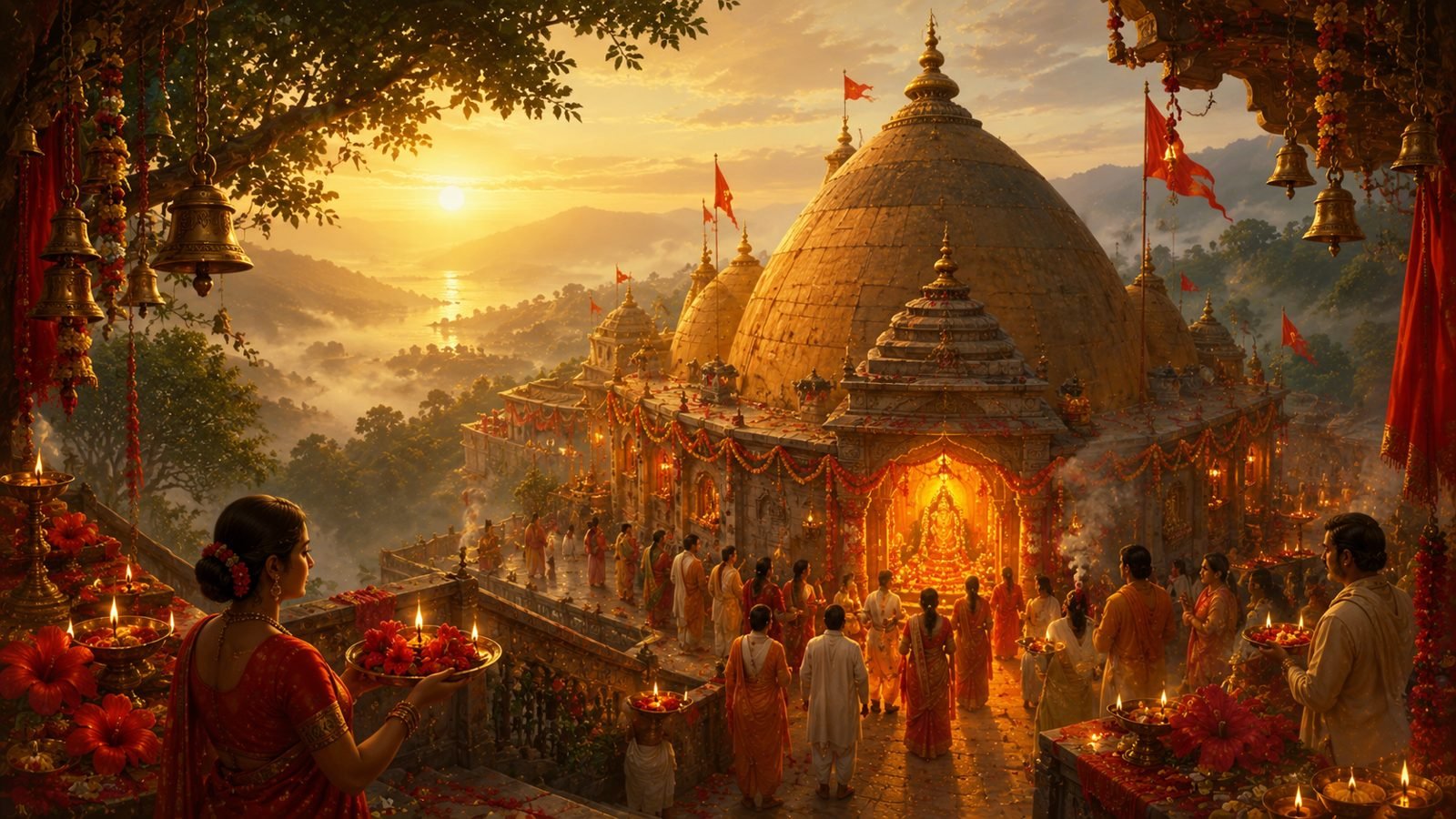
Festivals Connected to Sati and the Divine Mother
The worship of Sati as Adi Shakti flows into the great festivals of the Goddess celebrated across India.
- Navaratri: The nine sacred nights honouring the Divine Mother in her many forms are the foremost festival of Shakti, when devotees fast, chant the Devi Mahatmya, and worship the Goddess who first descended as Sati.
- Ambubachi Mela (Kamakhya): Held during the monsoon at the Kamakhya Shakti Peetha, this festival celebrates the creative power of the yoni-form of the Goddess, drawing vast crowds of pilgrims and Tantrics.
- Maha Shivaratri: The great night of Shiva is also a time to remember the eternal union of Shiva and Shakti embodied in Sati and Parvati.
- Durga Puja and Kali Puja: The autumn worship of Durga and the Kartik-night worship of Kali celebrate the fierce, victorious forms of the same Adi Shakti who once walked the earth as Sati.
Sati Devi stands at the heart of this path. Those who turn to Sati Devi with sincerity find that Sati Devi does not remove every difficulty. But grants the steadiness to meet it.
Frequently Asked Questions
Who was Sati Devi in Hindu mythology?
Sati Devi, also known as Dakshayani, was the first incarnation of Adi Shakti - the primordial Divine Feminine energy. She took birth as the daughter of Daksha Prajapati and became the first consort of Lord Shiva. She wore human form so that the cosmic union of Shiva and Shakti could return to the world.
Why did Sati immolate herself at Daksha's Yagna?
Daksha deliberately excluded Sati and Shiva from his grand fire sacrifice and publicly insulted Lord Shiva, calling him inauspicious and unworthy of a sacrificial share. Sati could not bear the dishonour her father showed her husband. She refused, too, to carry a body born of one who insulted the divine. So she invoked her yogic fire and consumed her mortal form, as the Shiva Purana and Devi Bhagavata Purana relate.
How were the Shakti Peethas created?
After Sati's death, the grief-stricken Shiva carried her body across the cosmos in a destructive Tandava dance. To save creation, Lord Vishnu used his Sudarshana Chakra to divide her body. Wherever a part of her sacred body fell, that place became a Shakti Peetha - a holy seat of the Goddess's living presence.
How many Shakti Peethas are there?
The most popular tradition counts 51 Shakti Peethas, corresponding to the 51 letters of the Sanskrit alphabet. However, the Devi Bhagavata Purana lists 108 Peethas, and other texts give different numbers. They are spread across India, Nepal, Bangladesh, Pakistan, and Sri Lanka.
What is the connection between Sati and Parvati?
Parvati is the rebirth of Sati. After leaving her body at Daksha's Yagna, Adi Shakti was reborn as Parvati, the daughter of Himavan (king of the Himalayas) and Mena. Through intense penance she again won Shiva as her husband, restoring the eternal union of Shiva and Shakti.
Which Puranas tell the story of Sati and Daksha?
The story appears in several Puranas, most notably the Shiva Purana, the Devi Bhagavata Purana, the Mahabhagavata Purana, the Linga Purana, and the Kalika Purana. Each text emphasizes different aspects, from the cosmic significance of the Goddess to the formation of the Shakti Peethas.
Where was Daksha's Yagna performed?
Tradition places Daksha's great sacrifice at Kankhal near Haridwar, on the banks of the Ganga. There the Daksheswara Mahadev Temple stands today and commemorates the legend.
What role did Vishnu's Sudarshana Chakra play?
When Shiva's grief-stricken cosmic dance threatened to destroy the universe, Vishnu used his Sudarshana Chakra to sever Sati's body part by part. This gradually freed Shiva from his attachment and ended the destructive Tandava, while the falling body parts gave rise to the Shakti Peethas.
What is the spiritual lesson of the Sati Devi story?
The story teaches the inseparable unity of Shiva and Shakti. It sets sincere devotion above hollow ritual and pride, and it reminds us to honour the divine. Above all, it shows the deathless nature of the Divine Mother, who departs as Sati and returns as Parvati.
Which mantra is used to worship the Goddess as Adi Shakti?
The universal Shakti seed-syllable 'Hreem' and the Navarna mantra 'Om Aim Hreem Kleem Chamundayai Vichche' from the Devi Mahatmya are widely chanted to invoke the Divine Mother. They are traditionally recited 108 times with a mala during the pre-dawn or night hours with devotion.
May the grace of Adi Shakti, who walked the earth as Sati and returned as Parvati, bless all who remember her story. Om Hreem.
Part of the Das Mahavidya series. All ten wisdom goddesses, the origin story, their beej mantras and temple guides are collected in one place: Das Mahavidya: The Ten Wisdom Goddesses.