Introduction to Maa Kamala
Maa Kamala is the tenth and final Mahavidya, the Tantric form of Goddess Lakshmi. Her name means 'lotus' and she represents the ultimate flowering of spiritual practice - the attainment of both material abundance and spiritual fulfillment. While conventional Lakshmi worship focuses on worldly prosperity, Kamala as a Mahavidya represents the deeper truth that genuine abundance flows naturally from spiritual realization.
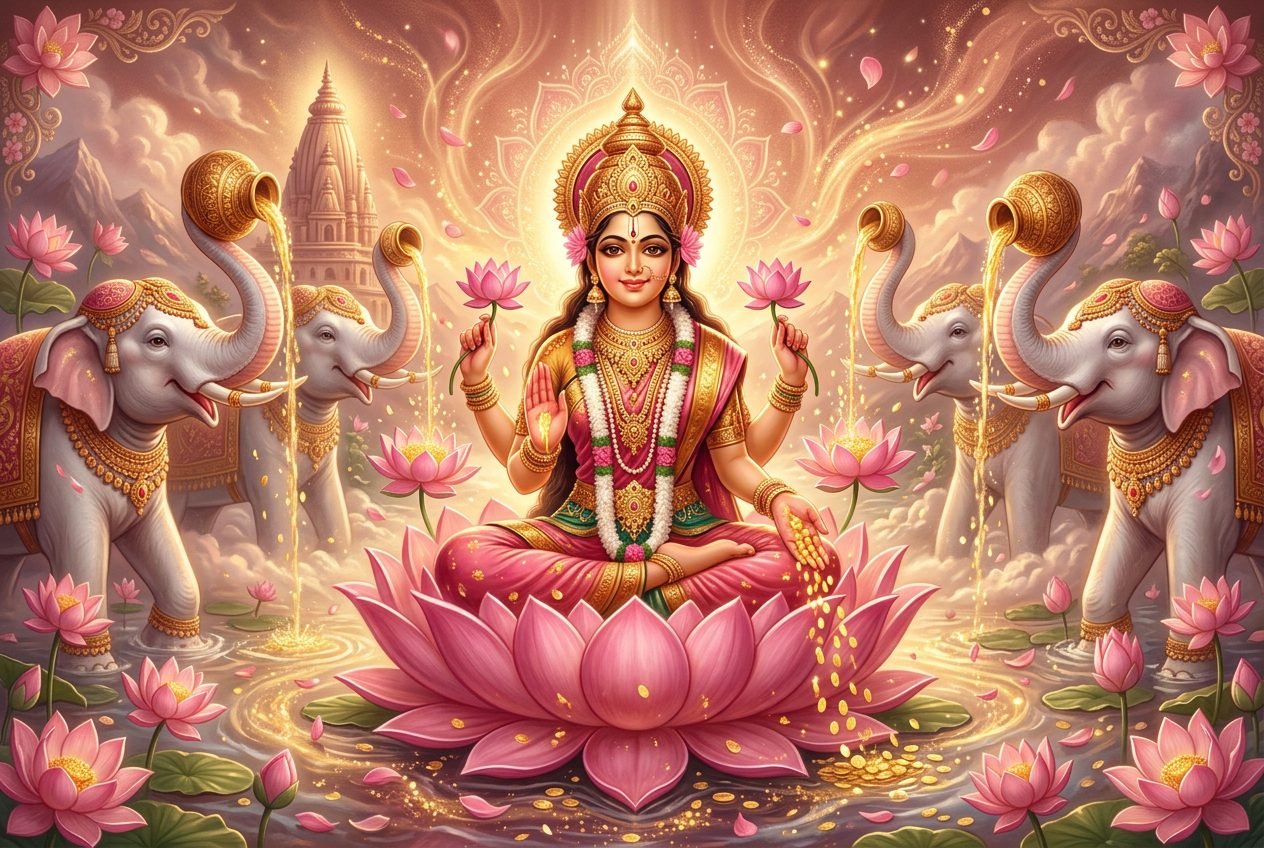
Kamala is depicted seated on a lotus, bathed by four elephants pouring nectar from golden vessels. She holds lotus flowers and makes gestures of blessing and fearlessness. Her golden complexion radiates warmth and benevolence.
As the final Mahavidya, she represents the culmination of the spiritual journey through all ten wisdom goddesses - from Kali's fierce dissolution of ego to Kamala's gentle bestowal of divine grace. She is the reward that comes after all the inner work has been done. Fridays are especially auspicious for her worship.
Formation and Incarnation
The most widely known origin of Kamala/Lakshmi is from the Samudra Manthan (Churning of the Cosmic Ocean). When the devas and asuras churned the ocean of milk to obtain the nectar of immortality, among the fourteen treasures that emerged was Lakshmi, seated on a lotus, radiating golden light. She chose Vishnu as her consort.
In the Mahavidya context, Kamala represents the final stage of spiritual evolution. After the practitioner has journeyed through Kali (time/destruction), Tara (guidance), Tripura Sundari (beauty), Bhuvaneshwari (space), Bhairavi (fire), Chinnamasta (ego-death), Dhumavati (void), Bagalamukhi (power), and Matangi (expression), Kamala appears as the natural flowering - the lotus of realization blooming from the mud of worldly experience.
Importance and Benefits
Kamala worship bestows: material prosperity and financial abundance; beauty, grace, and personal magnetism; harmonious family life and marital happiness; spiritual fulfillment and inner contentment; success in business ventures; royal lifestyle and luxurious comfort; fertility and abundant progeny; divine grace that makes everything feel effortless; and the integration of spiritual wisdom with worldly success.
She is the Mahavidya who proves that spirituality and material success are not opposites - they are complementary aspects of a full life. Her worship is recommended for those who want to bring abundance into their lives while maintaining spiritual integrity.
Beej Mantra of Maa Kamala
| Sanskrit | ॐ ऐं ह्रीं श्रीं क्लीं हसौः जगत्प्रसूत्यै नमः |
|---|---|
| Hindi | ओम् ऐं ह्रीं श्रीं क्लीं हसौः जगत्प्रसूत्यै नमः |
| Transliteration | Om Aim Hreem Shreem Kleem Hasauh Jagatprasutyai Namah |
| Meaning | I bow to the Mother of the Universe (Jagatprasuti), invoking knowledge (Aim), grace (Hreem), prosperity (Shreem), desire fulfillment (Kleem), and the joy of creation (Hasauh). |
Kamala's mantra is the most elaborate of all Mahavidya mantras, containing five seed syllables reflecting her nature as the goddess of fullness and completion. The unique bija 'Hasauh' represents creative joy and is found only in Kamala's mantra.
Chant on Fridays facing east, using a lotus-seed or crystal mala. Offer pink lotus flowers, honey, sweets, and fruits. Light a ghee lamp. This mantra is gentle and suitable for all practitioners.
Mool Mantra of Maa Kamala
| Sanskrit | ॐ श्रीं ह्रीं श्रीं कमले कमलालये प्रसीद प्रसीद श्रीं ह्रीं श्रीं ॐ महालक्ष्म्यै नमः |
|---|---|
| Hindi | ओम् श्रीं ह्रीं श्रीं कमले कमलालये प्रसीद प्रसीद श्रीं ह्रीं श्रीं ॐ महालक्ष्म्यै नमः |
| Transliteration | Om Shreem Hreem Shreem Kamale Kamalaalaye Prasida Prasida Shreem Hreem Shreem Om Mahalakshmyai Namah |
| Meaning | O Kamala, dweller of the lotus, be gracious, be gracious! I bow to Mahalakshmi with the sounds of prosperity (Shreem) and grace (Hreem). |
This Mool Mantra is a beautiful prayer invoking Kamala as both Mahavidya and Mahalakshmi. 'Prasida Prasida' means 'be gracious, be gracious' - a heartfelt plea for divine abundance. The triple repetition of Shreem amplifies the prosperity vibration. This mantra is particularly effective during Diwali and Fridays.
Core Sanskrit Root Words
Kamala's Sanskrit vocabulary centers on abundance, beauty, grace, and the ultimate flowering of spiritual life.
- कमल (Kamala) - Lotus - purity rising from mud, spiritual flowering
- लक्ष्मी (Lakshmi) - She who is the goal - prosperity, beauty, fortune
- श्रीं (Shreem) - Lakshmi's seed syllable - the sound of divine prosperity
- हसौः (Hasauh) - Creative joy bija - unique to Kamala's mantra
- ऐश्वर्य (Aishvarya) - Sovereignty, divine wealth in all forms
- सम्पत् (Sampat) - Wealth, abundance, spiritual and material treasure
- प्रसाद (Prasada) - Grace, divine favor - what Kamala bestows freely
Major Temples
Kamaleshwari Temple (Guwahati, Assam)
An important Kamala temple within the Kamakhya temple complex. Dedicated to the lotus goddess, this temple is particularly visited on Fridays and during Diwali for prosperity blessings. The temple overlooks the Brahmaputra River.
- By Air: Lokpriya Gopinath Bordoloi International Airport (20 km).
- By Train: Guwahati Junction (8 km).
- By Road: Nilachal Hill, part of the Kamakhya temple complex.
Padmavathi Temple (Tiruchanoor, Andhra Pradesh)
One of the most important Lakshmi-Kamala temples in South India, located near the famous Tirupati Balaji temple. Padmavathi (She who dwells in the lotus) is the consort of Venkateshwara and is considered a form of Kamala.
- By Air: Tirupati Airport (20 km).
- By Train: Tirupati Junction - well connected to all major cities.
- By Road: 5 km from Tirupati city center. Regular bus and auto-rickshaw services.
Mahalakshmi Temple (Kolhapur, Maharashtra)
One of the most ancient and revered Lakshmi-Kamala temples, this is one of the Shakti Peethas where the eyes of Sati are believed to have fallen. The temple is known for its powerful prosperity blessings and has a beautiful architectural heritage.
- By Air: Kolhapur Airport (10 km).
- By Train: Kolhapur Chhatrapati Shahu Maharaj Terminus - connected to Mumbai and Bangalore.
- By Road: Well connected via NH-48 from Mumbai (370 km) and Pune (230 km).
Festivals and Celebrations
Diwali is the primary festival for Kamala/Lakshmi worship, celebrated across India with lamps, prayers, and elaborate puja rituals. Lakshmi Puja on Diwali night (Kartik Amavasya) is the most important annual occasion for invoking Kamala's abundance.
Kojagiri Purnima (the full moon of Ashwin, September-October) is when Lakshmi is believed to roam the earth looking for devotees who are awake and worshipping. Staying awake this night and chanting Kamala mantras is considered extremely auspicious. Every Friday is a mini-festival for Kamala devotees.
Listen to the Mantra
Listen: the Kamala beej mantra, 108 times at 432 Hz, with the meaning and how to chant it.
Watch the mantra video on YouTube
🔱 Explore All Ten Mahavidyas
The Das Mahavidya are the ten aspects of the Divine Mother. Continue your journey through each Wisdom Goddess:
- Maa Kali - The First Mahavidya
- Maa Tara - The Second Mahavidya
- Maa Tripura Sundari - The Third Mahavidya
- Maa Bhuvaneshwari - The Fourth Mahavidya
- Maa Bhairavi - The Fifth Mahavidya
- Maa Chinnamasta - The Sixth Mahavidya
- Maa Dhumavati - The Seventh Mahavidya
- Maa Bagalamukhi - The Eighth Mahavidya
- Maa Matangi - The Ninth Mahavidya
Frequently Asked Questions
Is Maa Kamala the same as Lakshmi?
Kamala is the Tantric form of Lakshmi. While conventional Lakshmi worship focuses on worldly prosperity, Kamala as a Mahavidya represents the deeper truth that genuine abundance flows from spiritual realization and inner completeness.
What day is best for Kamala worship?
Fridays (Shukravar) are most auspicious, as Friday is ruled by Venus (Shukra), the planet of beauty and prosperity. Full moon nights and Diwali are also excellent.
What is the meaning of the five bija mantras?
Aim (knowledge/Saraswati), Hreem (grace/Maya), Shreem (prosperity/Lakshmi), Kleem (desire fulfillment/Kamadeva), Hasauh (creative joy - unique to Kamala). Together, they invoke total abundance.
Why are four elephants shown bathing Kamala?
The four elephants represent the four directions and four Vedas. They pour nectar (abundance) onto Kamala, symbolizing that prosperity flows from all directions to the genuine devotee.
Can Kamala worship bring financial prosperity?
Yes, Kamala is specifically the goddess of material and spiritual abundance. Her mantra is used for financial prosperity, business success, and a luxurious life - all integrated with spiritual growth.
What is the significance of the lotus?
The lotus grows from mud yet remains pure and beautiful. It symbolizes how spiritual realization (Kamala) can flower even from the muddy waters of worldly life. It represents purity within impurity.
Why is Kamala the final Mahavidya?
She represents the culmination of the spiritual journey. After dissolving ego (Kali), gaining guidance (Tara), beauty (Sundari), space (Bhuvaneshwari), fire (Bhairavi), sacrifice (Chinnamasta), void (Dhumavati), power (Bagalamukhi), and expression (Matangi), Kamala appears as the natural flowering.
What offerings does Kamala accept?
Pink and white lotus flowers, honey, sweets, fruits, gold coins, rice, milk, and ghee lamp. Offerings should be beautiful and abundant, reflecting her nature.
Can beginners worship Kamala?
Yes, Kamala is the most gentle and approachable Mahavidya. Her mantras are safe for all practitioners. She does not require intense sadhana - simple devotion and regular chanting are sufficient.
How to start Kamala practice?
Chant 'Om Aim Hreem Shreem Kleem Hasauh Jagatprasutyai Namah' 108 times on Fridays. Offer lotus flowers and sweets. Light a ghee lamp. Use lotus-seed or crystal mala. Listen to Musinara Sounds Kamala recording.
Kamala is Lakshmi within the Mahavidya framework, and Karnataka keeps her greatest household vrata in Shravana. See ವರಮಹಾಲಕ್ಷ್ಮಿ ಹಬ್ಬ - ಕಲಶ ಸ್ಥಾಪನೆ ಮತ್ತು ವ್ರತ ವಿಧಾನ in Kannada.
Part of the Das Mahavidya series. All ten wisdom goddesses, the origin story, their beej mantras and temple guides are collected in one place: Das Mahavidya: The Ten Wisdom Goddesses.