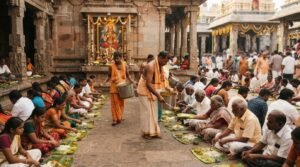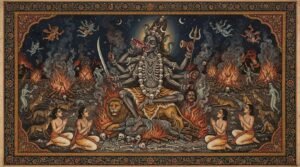
The principal aarti of Navratri is Jai Ambe Gauri, sung before the Goddess at the close of the evening puja on each of the nine nights. It is traditionally attributed to Shardha Ram Phillauri and is sung in homes, pandals and temples across northern and western India, followed by the distribution of prasad.
An aarti is not a performance. It is the moment at the end of worship when the lamp is circled before the deity and the whole household sings together, and the words matter less than the fact that everyone knows them. What follows is the full text of Jai Ambe Gauri in Devanagari with transliteration and meaning, along with the other aartis and bhajans most often heard through the nine nights.
Jai Ambe Gauri: Full Lyrics with Meaning
The aarti has ten verses and a refrain. The refrain returns after every verse, which is why a gathering can join in even without knowing the whole text.
Refrain
जय अम्बे गौरी, मैया जय श्यामा गौरी।
तुमको निशिदिन ध्यावत, हरि ब्रह्मा शिवरी॥
Jai Ambe Gauri, maiya jai Shyama Gauri. Tumko nishidin dhyavat, Hari Brahma Shivari.
Victory to Mother Ambe, the fair one; victory to Shyama, the dark one. Night and day Vishnu, Brahma and Shiva meditate upon you.
Verse 1
मांग सिंदूर विराजत, टीको मृगमद को।
उज्ज्वल से दोउ नैना, चंद्रवदन नीको॥
Maang sindoor virajat, tiko mrigmad ko. Ujjwal se dou naina, chandravadan niko.
Vermilion adorns the parting of your hair and a mark of musk your brow; your two eyes are luminous and your face lovely as the moon.
Verse 2
कनक समान कलेवर, रक्ताम्बर राजै।
रक्तपुष्प गलमाला, कंठन पर साजै॥
Kanak samaan kalevar, raktambar rajai. Raktpushp galmala, kanthan par sajai.
Your form shines like gold and red garments clothe you; a garland of red flowers rests upon your throat.
Verse 3
केहरि वाहन राजत, खड्ग खप्पर धारी।
सुर-नर-मुनिजन सेवत, तिनके दुखहारी॥
Kehari vahan rajat, khadag khappar dhari. Sur-nar-munijan sevat, tinke dukhhari.
You ride upon the lion, bearing sword and skull-bowl; gods, men and sages serve you, and you take away their sorrow.
Verse 4
कानन कुण्डल शोभित, नासाग्रे मोती।
कोटिक चंद्र दिवाकर, सम राजत ज्योति॥
Kanan kundal shobhit, nasagre moti. Kotik chandra divakar, sam rajat jyoti.
Earrings adorn your ears and a pearl the tip of your nose; your radiance equals ten million moons and suns.
Verse 5
शुम्भ निशुम्भ बिडारे, महिषासुर घाती।
धूम्र विलोचन नैना, निशिदिन मदमाती॥
Shumbh Nishumbh bidare, Mahishasur ghati. Dhoomra vilochan naina, nishidin madmati.
You tore apart Shumbha and Nishumbha and slew Mahishasura; you destroyed Dhumralochana, ever absorbed in your own bliss.
Verse 6
चौंसठ योगिनि गावत, नृत्य करत भैरों।
बाजत ताल मृदंगा, अरु बाजत डमरू॥
Chaunsath yogini gavat, nritya karat Bhairon. Bajat taal mridanga, aru bajat damru.
The sixty-four yoginis sing and Bhairava dances; cymbals and mridanga sound, and the damaru beats.
Verse 7
भुजा चार अति शोभित, वर मुद्रा धारी।
मनवांछित फल पावत, सेवत नर नारी॥
Bhuja chaar ati shobhit, var mudra dhari. Manvanchhit phal pavat, sevat nar nari.
Your four arms are resplendent, held in the gesture of boons; men and women who serve you receive the fruit their hearts desire.
Verse 8
कंचन थाल विराजत, अगर कपूर बाती।
श्रीमालकेतु में राजत, कोटि रतन ज्योति॥
Kanchan thaal virajat, agar kapoor bati. Shrimalketu mein rajat, koti ratan jyoti.
A golden platter is set before you with agarwood and camphor wicks; you shine in Shrimalketu with the light of ten million jewels.
Verse 9
श्री अम्बेजी की आरति, जो कोई नर गावै।
कहत शिवानंद स्वामी, सुख सम्पति पावै॥
Shri Ambeji ki aarti, jo koi nar gavai. Kahat Shivanand Swami, sukh sampati pavai.
Whoever sings this aarti of Shri Ambe, says Shivananda Swami, obtains happiness and abundance.
Regional variants of one or two lines exist, as with any hymn carried for generations by singing rather than by manuscript. Sing the version your family sings.
How the Aarti Is Performed
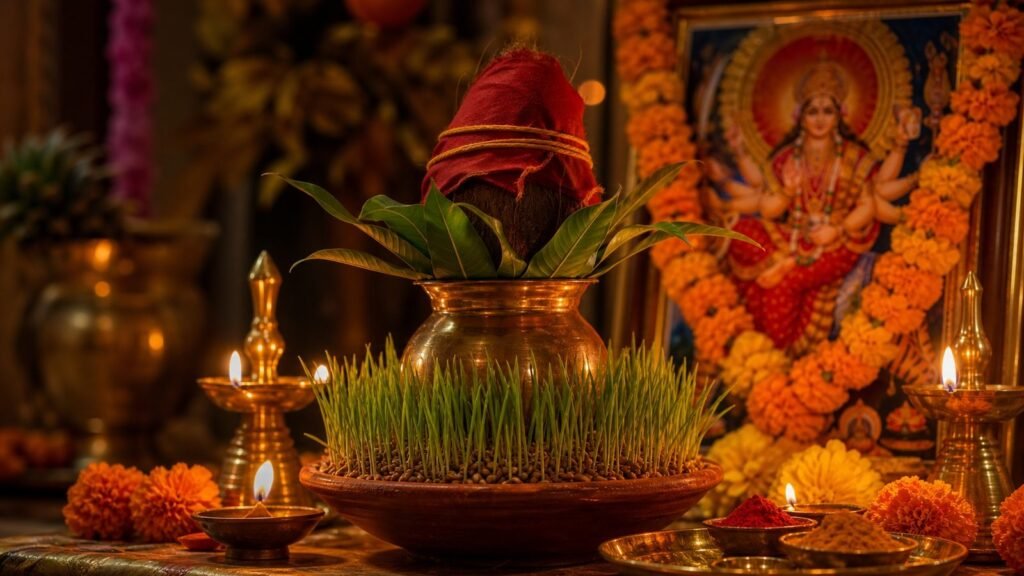
- The aarti thali holds a lit lamp, usually of ghee or camphor, along with incense, flowers, kumkum and a small offering of sweets.
- The lamp is circled clockwise before the image: traditionally four times at the feet, twice at the navel, once at the face, and seven times over the whole form.
- Everyone present sings. A bell or cymbals keep time, and the mridanga or dholak joins where there are players.
- At the close, the flame is passed among those gathered, who draw the warmth over their eyes and head with folded palms.
- Prasad is distributed last, and no one leaves without it.
Other Aartis and Bhajans Sung During Navratri
| Hymn | When it is sung | What it is |
|---|---|---|
| Jai Ambe Gauri | Every evening of the nine nights | The principal Durga aarti, sung at the close of puja |
| Ambe Tu Hai Jagdambe Kali | Evening, often after Jai Ambe Gauri | A second aarti to the Mother as Jagadamba |
| Durga Chalisa | Morning or evening, often before the aarti | Forty verses in praise of Durga. See our verse-by-verse guide |
| Mahishasura Mardini Stotram | Ashtami and Navami especially | Ayi Giri Nandini, the great hymn to the slayer of Mahishasura. See our full guide |
| Devi Kavach | Before beginning the Saptashati recitation | The armour of the Goddess. See our guide to Kavach, Argala and Keelak |
| Durga Saptashati | Across the nine days, a chapter or more each day | Seven hundred verses of the Devi Mahatmya. See our complete guide |
Sing Along Through the Nine Nights
The aarti is meant to be sung, not read. Keep this chant playing while you prepare the thali, and let the household join in as the lamp is lit.
Frequently Asked Questions
Which aarti is sung during Navratri?
Jai Ambe Gauri is the principal aarti of Navratri, sung at the close of the evening puja on each of the nine nights. Ambe Tu Hai Jagdambe Kali is often sung immediately after it.
Who wrote Jai Ambe Gauri?
It is traditionally attributed to Shardha Ram Phillauri, the nineteenth-century Punjabi scholar and poet. The closing verse signs off in the name of Shivananda Swami, as devotional hymns of that period commonly did.
How many times should the aarti lamp be circled?
The customary count is four times before the feet, twice at the navel, once at the face and seven times over the whole form, making fourteen in all. Households vary, and the count matters less than the attention behind it.
Can the aarti be sung without a priest?
Yes. The aarti is a household rite and needs no priest. Any member of the family may light the lamp and lead the singing.
What time is the Navratri aarti performed?
Most households perform it at dusk, after the evening puja, and many also sing a shorter aarti after the morning worship. During Navratri the evening aarti is the one the whole family gathers for.
Continue Your Journey
- Navratri 2026: dates and the nine forms of Navadurga
- Navratri colours 2026, day by day
- Goddess Durga: mantras, forms and worship
- The Durga Chalisa, verse by verse
May the lamp you circle this Navratri light the whole year. Jai Mata Di.
Stay in Touch
An occasional note when there is a new chant or a mantra worth sharing. No spam, and you can unsubscribe at any time.