There is a particular comfort in a goddess whose very name promises relief from worry. Chintpurni - chinta meaning anxiety or worry, and purni meaning one who fulfils or removes - is worshipped in the low, forested hills of Una district, Himachal Pradesh, as precisely that: the Mother who takes away the burden that keeps a devotee awake at night. Her temple, modest in scale compared to some of India's grander Shakti shrines yet immense in the devotion it commands, draws pilgrims from Punjab, Haryana, Himachal Pradesh, and far beyond, each carrying some private anxiety they hope to leave at her feet.
This guide sets out to explore Chintpurni fully - who the goddess is and how she came to be identified with Chhinnamasta, one of the ten Mahavidyas of Tantric tradition; the legend of Pandit Mai Das, the devoted Brahmin whose family still serves as hereditary priests of this shrine; the temple's place within the wider Shakti Peetha tradition, including the honest textual variation in exactly which part of Sati's body is said to have fallen here; her distinctive pindi form; the great melas that transform this quiet hill town twice a year; and the practical details of reaching the temple from Hoshiarpur, Amb, and beyond.
Chintpurni sits within the same living current of Shakti worship that flows through every Devi temple across the subcontinent - the reverence for the one Adi Shakti who takes innumerable forms to answer her children's needs. Readers wishing to understand her connection to the broader Mahavidya tradition may find it useful to read alongside this guide our complete account of Maa Chinnamasta, the fierce, self-decapitating goddess of radical self-giving with whom Chintpurni is closely identified, as well as our guide to the 51 Shakti Peethas of which this temple is counted among the number.
Who Is Chintpurni Mata? The Goddess Who Removes Worry
Chintpurni Devi is worshipped as a manifestation of the great goddess whose grace specifically dissolves chinta - worry, anxiety, mental anguish - from the lives of those who approach her with sincerity. Her name is unusual among Devi temples in that it describes not a mythological episode or an iconographic feature, but a promise: come here, the tradition tells the devotee, and your burdens will be lightened.
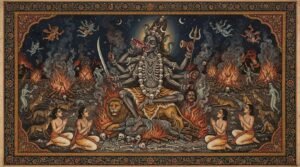
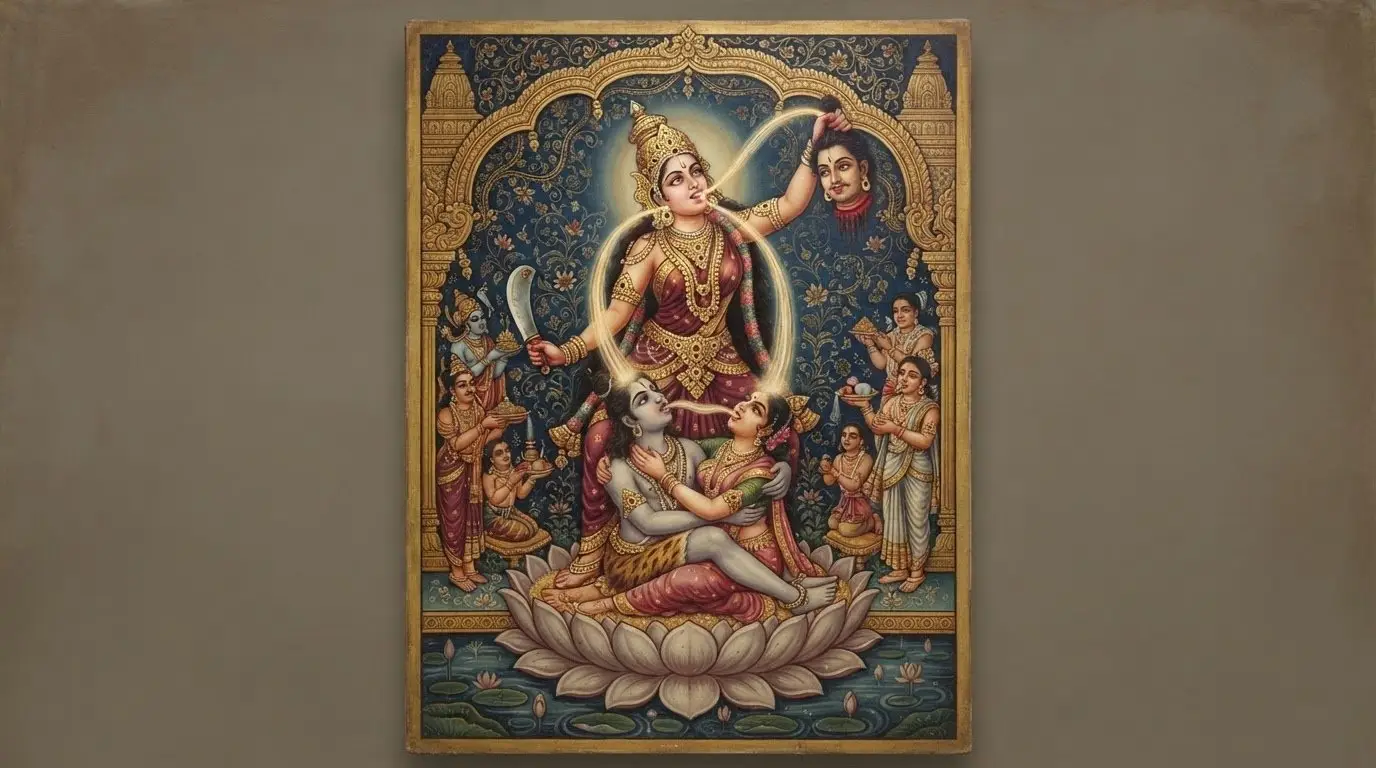
She is more formally known as Mata Shri Chhinnamastika Devi, a name that directly links her to Chhinnamasta, the fierce and startling goddess counted among the ten Mahavidyas, the great wisdom-forms of the Devi within Tantric Shakta tradition. Chhinnamasta is depicted in classical iconography as a goddess who has severed her own head with her own hand, holding it aloft while three streams of blood nourish her decapitated body and her two attendants - an image of radical self-sacrifice, the dissolution of ego, and the union of destruction and life-giving energy in a single startling form. At Chintpurni, this fierce theological identity sits alongside the gentler, more approachable local tradition of the worry-removing Mother, and most pilgrims arriving at the temple encounter the gentler face first, the deeper Mahavidya symbolism unfolding for those who study the tradition more closely.
This layering - a homely, practical local goddess who is also, at a deeper theological level, one of the most philosophically demanding forms in the entire Shakta corpus - is one of the most fascinating aspects of Chintpurni's identity, and it rewards a visitor who takes time to learn both faces of the goddess worshipped here.
Chintpurni's Place Among the Himachal Devi Circuit
Like Naina Devi in neighbouring Bilaspur district, Chintpurni forms part of a well-established circuit of Shakti shrines across Himachal Pradesh that pilgrims from the plains typically visit together across one or more journeys - Jwalamukhi, Chamunda Devi, and Brajeshwari Devi in Kangra completing the most commonly travelled group. Many pilgrims consider Chintpurni and Naina Devi a natural pair, given the relatively short distance between Una and Bilaspur districts, and it is common to see the same family groups completing both darshans within a single extended trip, sometimes continuing onward to Jwalamukhi as a third stop.
The Legend of Pandit Mai Das
The most cherished origin story told at Chintpurni concerns a devout Brahmin named Pandit Mai Das, whose descendants continue to serve as the hereditary priests of the temple to this day - a lineage of unbroken service that devotees consider itself a kind of living proof of the goddess's continued presence and favour.
According to the account passed down through generations of pilgrims and priests, Mai Das was a humble but deeply devoted worshipper of the goddess who lived in this region long before any temple structure existed on the site. He is said to have received a vision or a direct instruction from the goddess herself, revealing to him the exact spot where her presence - in pindi form, without any human carving - could be found manifest in the earth. Moved by this revelation and by his own unwavering faith, Mai Das devoted the remainder of his life to the goddess's worship at this spot, establishing the daily rituals of puja and the seva that his family continues to this day, generations later.
Other tellings elaborate the story further, describing a period of severe testing and hardship that Mai Das endured before the goddess revealed herself fully to him, echoing a very common pattern in Devi legend across India, in which sustained devotion under difficulty is precisely what draws out the goddess's grace, rather than any single dramatic miracle. Some versions also connect Mai Das's story to a broader local tradition of the goddess protecting devotees from disease, calamity, and the anxieties of daily survival in what was, in earlier centuries, a considerably harsher and more precarious rural existence than today - a detail that resonates directly with her name, Chintpurni, the remover of worry.
The temple priesthood at Chintpurni remains hereditary, drawn from the descendants of Mai Das, a lineage many devotees regard with particular respect precisely because of this unbroken chain connecting the present-day rituals to the goddess's original revelation.
The Shakti Peetha Tradition and Its Honest Variation
Chintpurni is widely counted among India's Shakti Peethas, the sacred sites associated with fragments of the goddess Sati's body falling to earth after Lord Vishnu's Sudarshana Chakra cut through her remains as a grief-stricken Shiva carried her across the heavens in his cosmic Tandava - the same foundational episode that anchors Naina Devi and dozens of other shrines across the subcontinent, fully recounted in our guide to the 51 Shakti Peethas.
It is worth being honest here, in keeping with the wider spirit of careful, non-dogmatic Shakta scholarship: different regional lists and textual traditions vary in exactly which body part is associated with Chintpurni. Some accounts hold that it is the feet of the goddess that fell here; others describe the forehead, or connect the site more loosely to her general presence rather than a single specified limb. This kind of variation is not unusual across the Shakti Peetha tradition as a whole - different Puranic and Tantric texts compiled the list of Peethas at different points in history, with some counting fifty-one sites and others a different number entirely, and naturally disagreeing here and there on the precise attribution at individual shrines. Rather than treating this as a problem to be resolved, most devotees and serious students of the tradition hold both possibilities lightly, understanding that the deeper truth - that the goddess's power is genuinely present and active at this site - matters considerably more than pinning down an exact anatomical correspondence recorded differently across centuries of oral and textual transmission.
What is not in dispute, locally or in wider Shakta tradition, is Chintpurni's identification with Chhinnamasta among the Mahavidyas, which is treated as settled and central to the temple's theological identity, whatever the precise Peetha attribution.
The Pindi Form and the Sanctum
As with several of the great Himachal Devi shrines, Chintpurni houses no elaborately carved anthropomorphic idol. The goddess is worshipped instead as a pindi - an unhewn, naturally occurring rock form, considered self-manifested rather than sculpted by human hands, and regarded by devotees as considerably more powerful and more directly the goddess's own chosen form precisely because it bears no human artistic intervention.
The pindi at Chintpurni is kept covered with a red chunri (ceremonial cloth) and adorned with silver ornaments, a nose ring, and a small silver mask or covering placed over the upper portion in some depictions, following a devotional convention found at several pindi-form Devi shrines across North India. Vermilion (sindoor) is applied generously, and pilgrims commonly bring fresh chunris to offer, which the temple priests drape over the pindi before returning older cloths, sometimes cut into smaller pieces, to devotees as a cherished form of prasad.
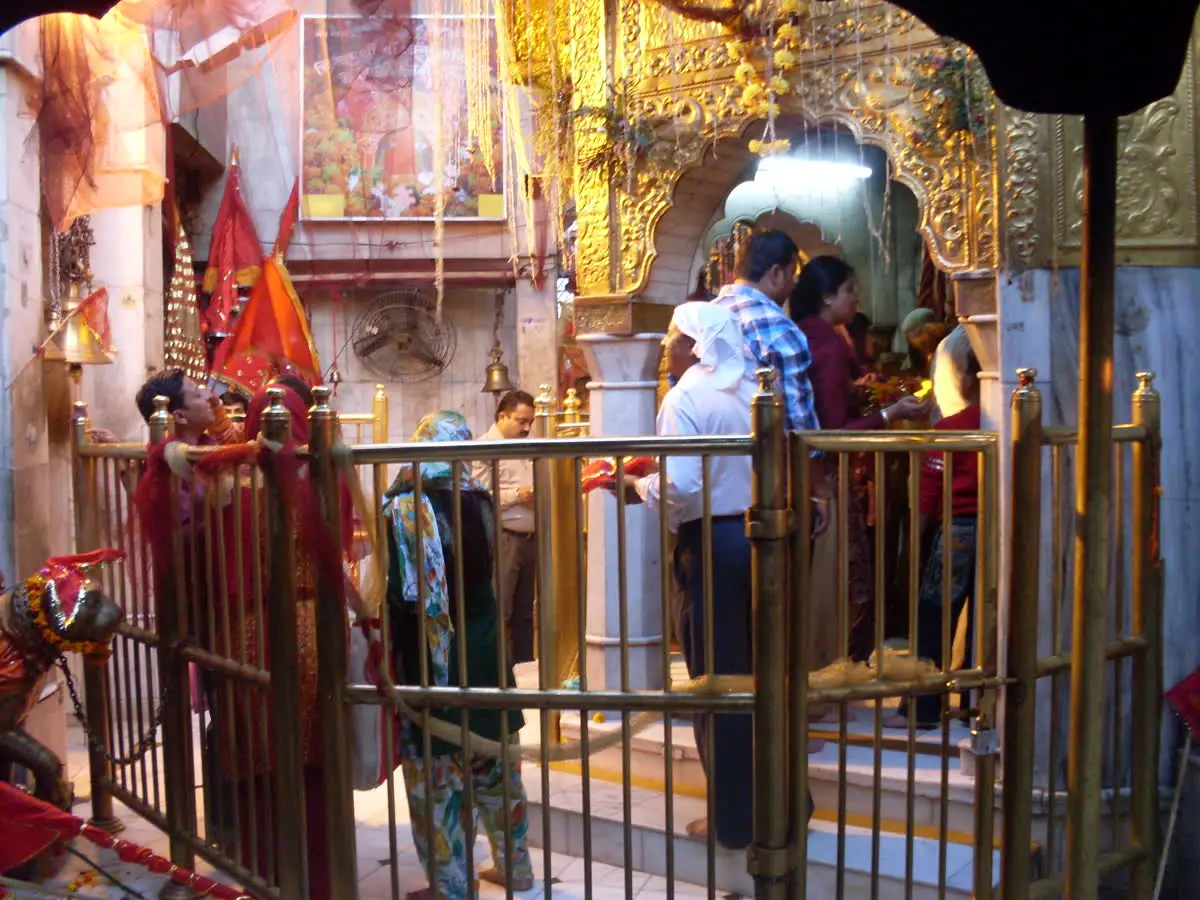
The sanctum itself is compact, in keeping with the temple's origins as a simple rural shrine that has grown enormously in scale of visitorship without correspondingly enlarging its innermost chamber - a pattern common to many ancient Devi Peethas, where architectural expansion has focused on courtyards, queue management infrastructure, and surrounding halls rather than on the sanctum proper, which retains its older, intimate character. Surrounding the main sanctum are subsidiary shrines to other deities commonly found at Devi temples in this region, along with space that, during major melas, becomes a carefully managed river of pilgrims moving steadily toward a few brief seconds of darshan before the pindi itself.
Votive Customs: The Mannat Thread and the Bell
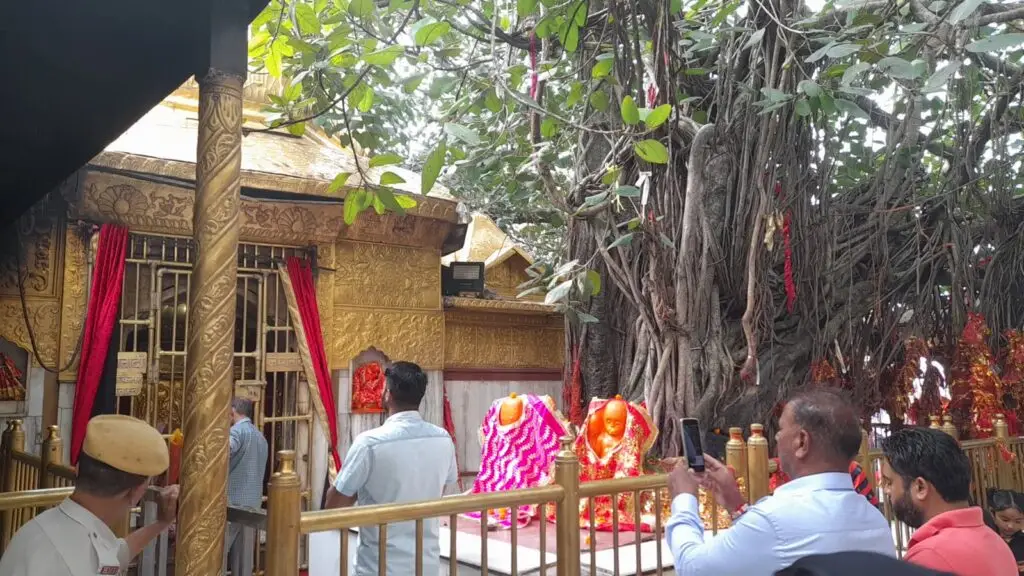
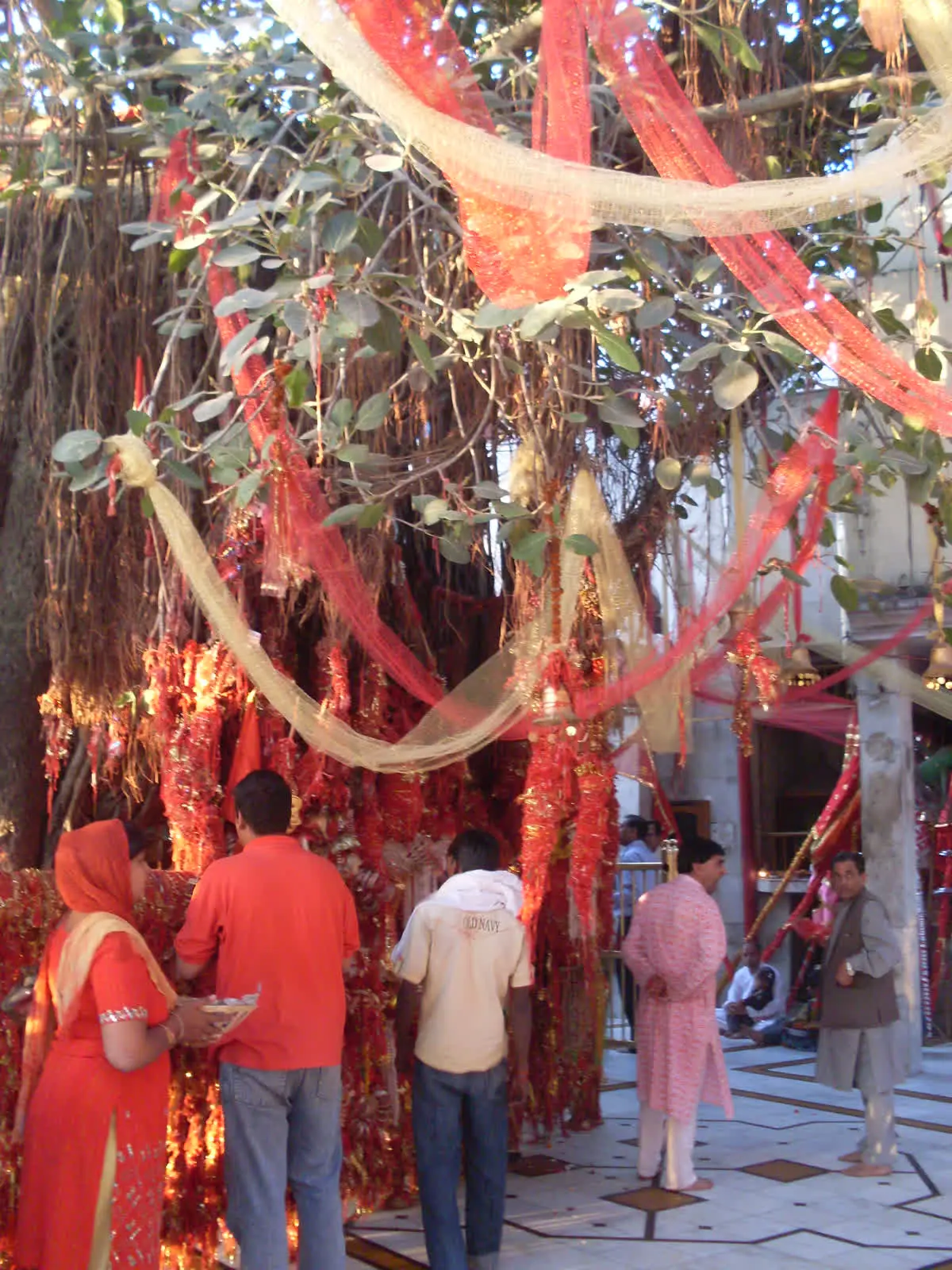
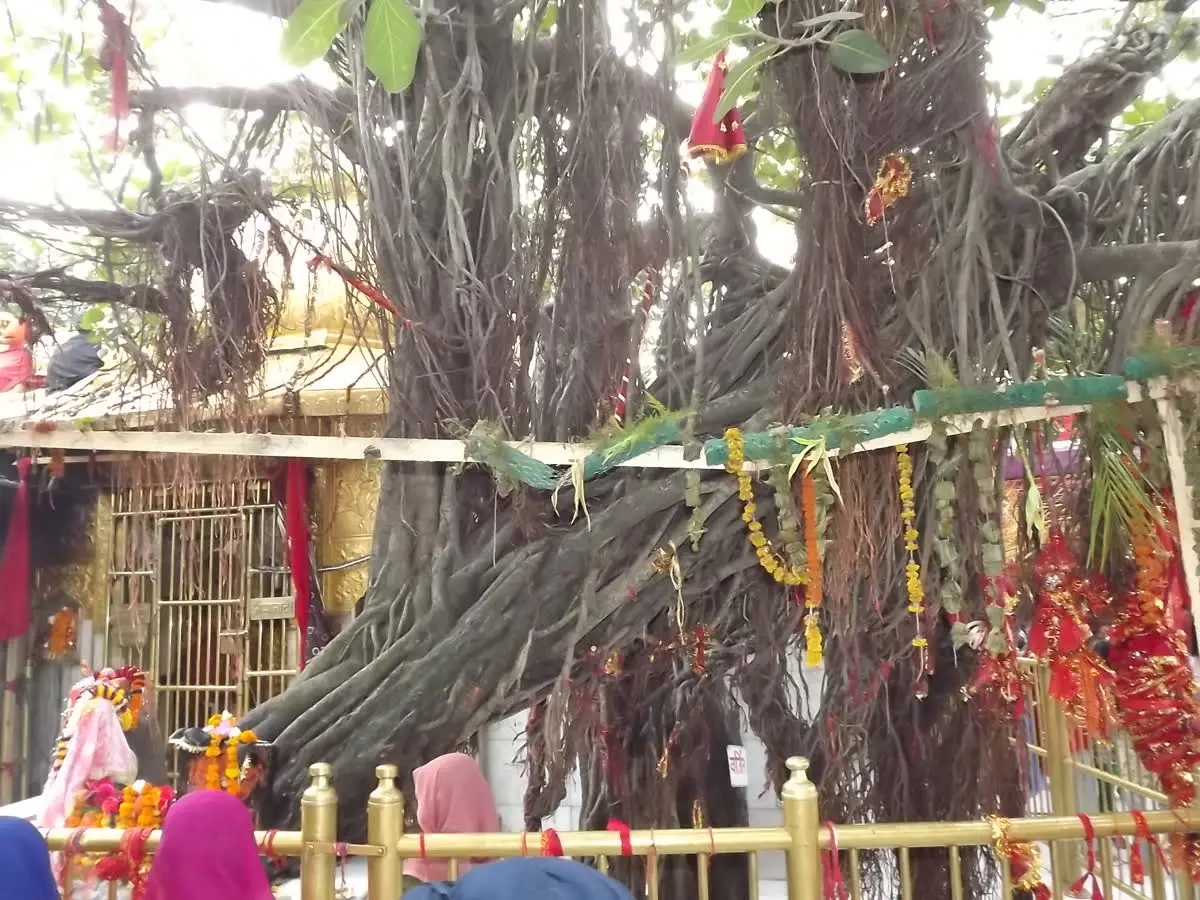
A particular custom associated with Chintpurni, and shared with a number of other North Indian Devi shrines, is the tying of a sacred thread (mannat dhaga) around the temple's pillars, railings, or a designated tree within the complex when a devotee makes a vow or petitions the goddess for a specific favour - a lost job restored, an illness overcome, a long-delayed marriage arranged. Once the wish is granted, tradition holds that the devotee should return, however long it takes, to untie the thread personally and offer thanks, often bringing a chunri, sweets, or a small monetary offering to mark the fulfilment of the vow. Walking through the temple courtyard, a visitor will notice hundreds, sometimes thousands, of these threads knotted in careful rows - a quiet, cumulative record of answered prayer that speaks more eloquently than any inscription of how deeply this particular goddess is trusted with the ordinary anxieties of daily life.
Devotees also commonly ring the temple bells on entering and leaving the sanctum, a near-universal practice at Hindu temples understood both as an announcement of one's arrival before the deity and as a means of settling the mind into a state receptive to darshan. At Chintpurni, given the sheer volume of daily visitors, the resulting chorus of bells during busy hours becomes almost continuous, a sound many pilgrims describe as itself deeply moving, a kind of ambient devotional music produced simply by the ordinary business of thousands of people passing through in worship.
The Temple Trust and Ongoing Management
Chintpurni Temple today is administered by a dedicated temple trust, working in coordination with the Himachal Pradesh state government, which oversees the practical demands of hosting such enormous seasonal crowds - crowd management barriers, sanitation, drinking water points, medical camps, and the logistics of the mannat thread tradition and the constant flow of chunri and prasad through the sanctum. This administrative structure sits alongside, rather than in place of, the hereditary priesthood descended from Pandit Mai Das, which continues to perform the actual rituals of worship, a division of responsibility - spiritual custodianship on one hand, practical management on the other - common to most of India's high-footfall pilgrim temples.
Darshan and Aarti Timings
Chintpurni follows the general rhythm typical of major North Indian Devi shrines - an early morning opening and aarti, a long day of continuous darshan, and a closing aarti in the evening.
| Ritual | Typical Timing | Notes |
|---|---|---|
| Temple opens / morning aarti | Around 4:00-5:00 am | Earlier during peak mela days |
| General darshan hours | Through the day into the evening | Very long queues during Navratri |
| Evening aarti | Around 7:00-8:00 pm | May shift with season |
| Temple closes | Shortly after evening aarti | Extended during major melas |
As with every timing given in this guide, these hours are typical rather than fixed, and can change with season, with festival crowds, and with decisions of the temple management. Pilgrims are strongly advised to verify current darshan and aarti timings directly with the temple trust, or via a recent, reliable local source, before finalising travel plans, particularly around Navratri.
Festivals and Melas at Chintpurni
Chintpurni draws its largest crowds, by a considerable margin, during the two Navratri periods of the Hindu calendar, when the town and temple complex swell with pilgrims arriving in a steady, day-and-night stream for the full nine days of worship.
| Festival / Mela | Approximate Timing | What Happens |
|---|---|---|
| Chaitra Navratri Mela | March-April (spring Navratri) | Nine days of intense worship; peak crowds on Ashtami and Navami |
| Ashwin (Sharad) Navratri Mela | September-October (autumn Navratri) | The larger of the two annual gatherings; extended temple hours |
| Local weekly and monthly gatherings | Every Tuesday and Sunday, and on specific tithis | Steady footfall; considerably shorter waiting times |
During the height of Navratri, the roads leading into the temple town from Una, Hoshiarpur, and Amb see heavy traffic, and local administration typically arranges additional bus services, temporary parking zones some distance from the temple, and expanded security and medical facilities. Many devotees deliberately choose an ordinary weekday outside the Navratri window for a calmer, more unhurried darshan, while others consider the crush and energy of the mela itself to be part of the spiritual experience - a shared, communal intensity of devotion that a quiet weekday visit simply cannot replicate.
- Book accommodation well in advance if travelling during Navratri, since rooms fill quickly
- Expect several hours of queueing on peak Ashtami and Navami days
- Carry offerings such as chunri, coconut, and flowers, widely available from shops lining the pilgrim path
- Elderly or unwell pilgrims should plan for the walking distance involved and allow extra time
How to Reach Chintpurni Temple
Chintpurni's location in Una district, in the town of Bharwain, places it within reasonable reach of both Himachal Pradesh's own transport network and neighbouring Punjab, particularly via Hoshiarpur, one of the most common approach routes for pilgrims travelling from the plains.
By Air
The nearest airport is Gaggal Airport near Kangra (also known as Dharamshala Airport), roughly 65-70 kilometres away, with domestic connections to Delhi and other major cities, though flight frequency can be limited. Chandigarh International Airport, though considerably further at around 120 kilometres, offers far more frequent and varied flight connections and is used by many pilgrims willing to undertake the longer onward road journey in exchange for greater flight availability.
By Train
The nearest railway station is Amb Andaura, a broad-gauge station roughly 15-20 kilometres from the temple, connected to the wider Northern Railway network. Una Himachal railway station is a further alternative, somewhat closer to Una town itself, with onward road connectivity to Chintpurni. Pilgrims travelling by rail from Punjab or Delhi typically combine a train journey to one of these stations with the remaining distance covered by taxi or local bus.
By Road
Chintpurni is well connected by road to Hoshiarpur (around 55-60 km), Una (around 55 km), and Amb (around 20 km), with regular bus services running from all three towns, as well as from Jalandhar and other parts of Punjab. Self-driven or hired taxis are a comfortable and popular option, particularly for pilgrims combining Chintpurni with a visit to Naina Devi or Jwalamukhi in a single circuit, since the roads connecting these Himachal Devi shrines are generally in reasonable condition, if hilly in stretches.
| Mode | Nearest Access Point | Approximate Distance |
|---|---|---|
| Air | Gaggal (Kangra) Airport | ~65-70 km |
| Air (better connectivity) | Chandigarh International Airport | ~120 km |
| Rail | Amb Andaura station | ~15-20 km |
| Road | Hoshiarpur | ~55-60 km |
| Road | Una | ~55 km |
Road and travel-time estimates in this hilly terrain can shift with weather, particularly during the monsoon months, so travellers are advised to check current conditions before setting out, especially if driving after dark or during heavy rain.
Nearby Attractions and Where to Stay
Chintpurni's location makes it a convenient stop for pilgrims travelling the wider Himachal Devi circuit. Naina Devi in Bilaspur district lies within a few hours' drive and is very commonly combined with a Chintpurni visit, given the shared regional identity of these Shakti shrines and the relatively modest distance between them. Jwalamukhi Temple, dedicated to the goddess manifest as an eternal flame, and Chamunda Devi near Dharamshala, are somewhat further but still frequently included in an extended Himachal pilgrimage itinerary by devotees with a few additional days to spare.
Una district itself offers a handful of smaller temples and pleasant, unhurried market towns worth a brief stop, along with easy onward connectivity toward Punjab for pilgrims combining the trip with a visit to Anandpur Sahib or Amritsar's Golden Temple, a pairing some families choose deliberately in a single extended religious tour of the region.
Accommodation near Chintpurni ranges from simple dharamshalas run by the temple trust and various charitable and community organisations, offering clean but basic rooms at modest cost, to a growing number of private hotels and guesthouses in Bharwain town and along the approach road, catering to a wider range of comfort and budget. As with most major pilgrimage sites in this part of India, rooms fill quickly during Navratri, and advance booking is strongly recommended for anyone travelling during those peak weeks; outside the festival season, finding suitable accommodation on arrival is generally straightforward.
- Dharamshalas maintained by the temple trust, close to the sanctum - inexpensive and convenient for pilgrims prioritising proximity
- Private hotels and guesthouses in Bharwain town, offering greater comfort
- Accommodation in Una or Hoshiarpur, for travellers preferring a larger town base with more amenities
Chintpurni Within the Wider Shakti Tradition
Chintpurni's dual identity - an accessible, homely goddess who removes the ordinary anxieties of daily life, and simultaneously one of the ten Mahavidyas, among the most philosophically radical forms the Devi assumes anywhere in Shakta tradition - makes her an unusually rich subject for any devotee wishing to understand the full range of what Shakti worship offers. On one hand stands the pilgrim who arrives with a specific, pressing worry: an illness in the family, a stalled career, a difficult decision weighing on the mind. On the other stands the Tantric practitioner or serious student of the Mahavidyas, for whom Chhinnamasta's severed-head iconography represents one of the most profound meditations on ego-dissolution, self-giving, and the union of death and vitality found anywhere in Hindu philosophical symbolism.
Both approaches are welcomed at Chintpurni, and this is, in many ways, the essence of Shakti Peetha worship across India - a single sacred site holding space simultaneously for the simplest devotional need and the deepest philosophical enquiry, exactly as the same Adi Parashakti manifests as Maa Chinnamasta in her most esoteric Tantric aspect and, on this particular hill in Una district, as the warm, approachable Mother who simply wants her children's worries lifted. Readers wishing to trace this connection more fully, along with the wider network of Shakti Peethas of which Chintpurni is one thread, will find our guides to Maa Chinnamasta and the 51 Shakti Peethas valuable companions to this one.
Further Reading
Plan Your Visit to Chintpurni: Timings, Tickets and Travel
The details below were checked on 3 October 2026 against the Mata Shri Chintpurni Temple trust and the other sources listed under each table. Timings and fees change on festival days, eclipses and special occasions, so confirm with the temple before you travel.
Visiting more than one Devi temple in the Kangra and Una hills? Our Himachal Devi temple circuit sets out the order, distances and days for Naina Devi, Chintpurni, Jwalamukhi, Brajeshwari and Chamunda.
Darshan and Aarti Timings
| Information | Details |
|---|---|
| Goddess snan and morning aarti | 6:30 am daily |
| Bhog (darshan paused) | 12:00 to 12:30 pm daily |
| Evening snan and aarti | 6:30 pm to 8:00 pm daily |
| Goddess sayan (night rest) | 10:00 pm daily |
Source: Mata Shri Chintpurni Temple trust: Religious Activity.
Tickets, Darshan Options and Sevas
| Option | Price | Notes |
|---|---|---|
| Sugam darshan, per person | Rs 300; Rs 500 on peak days | Reported by Himachal Tonite; confirm the current rate locally. Maximum 500 passes a day; golf cart to the lift area. |
Regular darshan is free but needs a darshan parchi, which you collect from the security guard before joining the queue. Darshan without a parchi, or by the back door, is not allowed. During melas, register at the parchi counter first. Bookings are handled on matashrichintpurni.com. The trust site lists online donation, Sugam Darshan, hawan, mundan, prasad delivery, langar booking, jagran booking, accommodation booking, and live darshan and aarti streaming. Phone: 01976-255818. Musinara is not connected with the temple and does not take bookings.
Sources: Himachal Tonite: Changes in VIP Darshan System at Chintpurni Temple from Maka..., Mata Shri Chintpurni Temple trust: Do's and Don'ts, Punjab Kesari: Chintpurni Shravan Ashtami Mela 2026 guidelines, Mata Shri Chintpurni Temple trust: Jai Mata Chintpurni Devi Ji (temple trust ..., Mata Shri Chintpurni Temple trust: Religious Activity.
Temple Rules and Dress Code
- Take a darshan parchi from the security guard and stand in line. Do not go for darshan without a parchi.
- Do not pay anyone for back-door darshan.
- No smoking or drinking. Do not feed monkeys, accept polythene, litter or throw prasad on the floor.
- Donate only in the donation box or at the office and take a receipt. Beware of pickpockets and chain snatchers.
- For the August 2026 mela, the Una administration banned plastic and polythene, loudspeakers other than the trust's, weapons, fireworks and roadside langars.
Sources: Mata Shri Chintpurni Temple trust: Do's and Don'ts, Punjab Kesari: Chintpurni Shravan Ashtami Mela 2026 guidelines.
How to Reach Chintpurni
Open Chintpurni in Google Maps for live directions.
| Mode | Nearest point | Distance to the temple |
|---|---|---|
| Air | Gaggal (Kangra) | about 60 km. Amritsar (160 km) and Chandigarh (200 km) are alternatives. |
| Rail | Hoshiarpur and Amb Andaura | Amb Andaura about 19 km; Hoshiarpur about 42 km |
| Bus | HRTC new bus stand, with parking | in Chintpurni |
Sources: Mata Shri Chintpurni Temple trust: How to reach, Mata Shri Chintpurni Temple trust: Facilities to Pilgrims.
Approximate distances and journey times from the cities most pilgrims start from. Road times assume normal traffic; festival weekends take longer.
| From | By road | Road time | Train or flight |
|---|---|---|---|
| Delhi | about 430 km via Chandigarh | Train to Jalandhar, then about 90 km by road | |
| Chandigarh | about 200 km | about 5 hours by bus | Chandigarh airport is about 200 km away |
| Jalandhar | about 90 km | Jalandhar railway station | |
| Hoshiarpur | about 42 km | Hoshiarpur railhead | |
| Kangra | about 70 km | Gaggal airport is about 60 km away | |
| Naina Devi | about 115 km | ||
| Jammu (for Vaishno Devi) | about 250 km |
Source: Mata Shri Chintpurni Temple trust: How to reach.
State transport buses run frequently, and the HRTC new bus stand has parking. Sugam darshan pass holders are taken to the lift area by golf cart. The road route from Delhi runs via Chandigarh, Ropar, Nangal, Una, Mubarakpur and Bharwain to Chintpurni.
When to Go and How Long to Allow
Large melas are held at Chaitra Navratri, Shravan Ashtami and Ashwin Navratri, each lasting about 10 days, and a New Year mela from 28 December to 2 January. Expect heavy crowds on these dates.
Source: Mata Shri Chintpurni Temple trust: Festivals.
Prasadam, Annadanam and Where to Stay
The trust says it serves free breakfast, lunch and dinner (langar) to pilgrims. HPPWD rest houses at Bharwain, Amb and Gagret; HP Tourism's Hotel Chintpurni Heights at Bharwain; and the temple's Yatri Bhawan at Bharwain. The trust site also lists online accommodation booking.
Sources: Mata Shri Chintpurni Temple trust: Facilities to Pilgrims, Mata Shri Chintpurni Temple trust: Jai Mata Chintpurni Devi Ji (temple trust ....
Frequently Asked Questions
Where is Chintpurni Temple located?
Chintpurni Temple stands in the town of Bharwain in Una district, Himachal Pradesh, within reasonable travelling distance of Hoshiarpur in Punjab, Una town, and the railway station at Amb Andaura.
What does the name Chintpurni mean?
Chintpurni combines chinta, meaning worry or anxiety, with purni, meaning one who fulfils or removes. The name expresses the goddess's promised role as the remover of her devotees' burdens and mental distress.
How is Chintpurni connected to Chhinnamasta?
Chintpurni Devi is formally worshipped as Mata Shri Chhinnamastika Devi, identifying her directly with Chhinnamasta, one of the ten Mahavidyas, depicted holding her own severed head while nourishing streams flow from her body, symbolising ego-dissolution and radical self-giving.
Who was Pandit Mai Das?
Pandit Mai Das was a devout Brahmin credited with receiving the goddess's revelation of her presence at this site and establishing her worship here. His descendants continue to serve as hereditary priests of the temple to this day.
Is Chintpurni one of the 51 Shakti Peethas?
Yes, Chintpurni is widely counted among the Shakti Peethas, though textual and regional traditions vary on whether it marks the fall of Sati's feet, her forehead, or a more general presence, a variation common across several Shakti Peetha attributions.
What form does the deity take at Chintpurni?
The goddess is worshipped as a pindi, a self-manifested, unhewn stone form rather than a carved idol, kept draped in a red chunri and adorned with silver ornaments and vermilion.
When are the major melas held at Chintpurni?
The largest gatherings occur during Chaitra Navratri (March-April) and Ashwin Navratri (September-October), with the autumn mela typically drawing the larger crowds. Smaller, steadier gatherings occur weekly, particularly on Tuesdays and Sundays.
What are the typical darshan and aarti timings?
The temple typically opens for morning aarti around 4:00-5:00 am and closes after evening aarti around 7:00-8:00 pm, though these hours shift with season and extend during major melas. Verifying current timings with the temple trust before travelling is advisable.
How do I reach Chintpurni from Hoshiarpur or Amb?
From Hoshiarpur, Chintpurni is around 55-60 kilometres by road, well served by buses and taxis. From Amb, the nearer railhead at Amb Andaura is only about 15-20 kilometres away, making it a convenient approach for pilgrims arriving by train.
Can Chintpurni be combined with a visit to Naina Devi?
Yes, Chintpurni and Naina Devi are commonly visited together as part of the wider Himachal Devi circuit, given their relative proximity and shared identity as major Shakti Peethas within the same region.
To stand before the pindi at Chintpurni is to set down, if only briefly, whatever worry brought you up the hill, trusting that the Mother who removes chinta has already begun her quiet work. If this guide has drawn you closer to her, Musinara invites you to continue that stillness at home - listen on YouTube to our 432 Hz recordings of Devi chants, a gentle companion for the worries you carry and the peace you seek in her name.
Related reading
- Mata Vaishno Devi: Complete Pilgrimage Guide to the Holy Cave Shrine
- Tulja Bhavani Temple, Tuljapur: A Complete Guide to the Kuldevi of the Marathas
- Kanaka Durga Temple, Vijayawada: A Complete Guide to the Goddess of Indrakeeladri
- Mahalakshmi Temple, Kolhapur: A Complete Guide to Ambabai, the Karavir Nivasini
Official and Reference Sources
- Mata Shri Chintpurni Temple, official - administered by the Temple Officer, Government of Himachal Pradesh
Planning a pilgrimage? All twenty Devi temple guides on this site are arranged by region, with practical circuits, in Devi Temples of India. For where each site sits in the disputed lists of 51, 52 and 108, see the Shakti Peeth list.