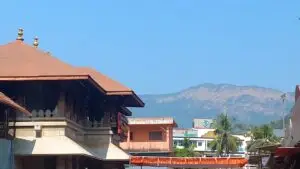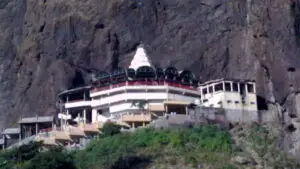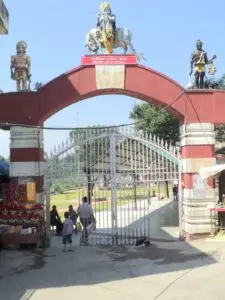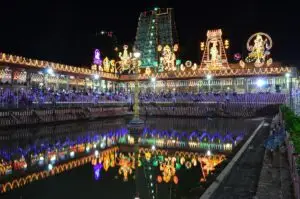
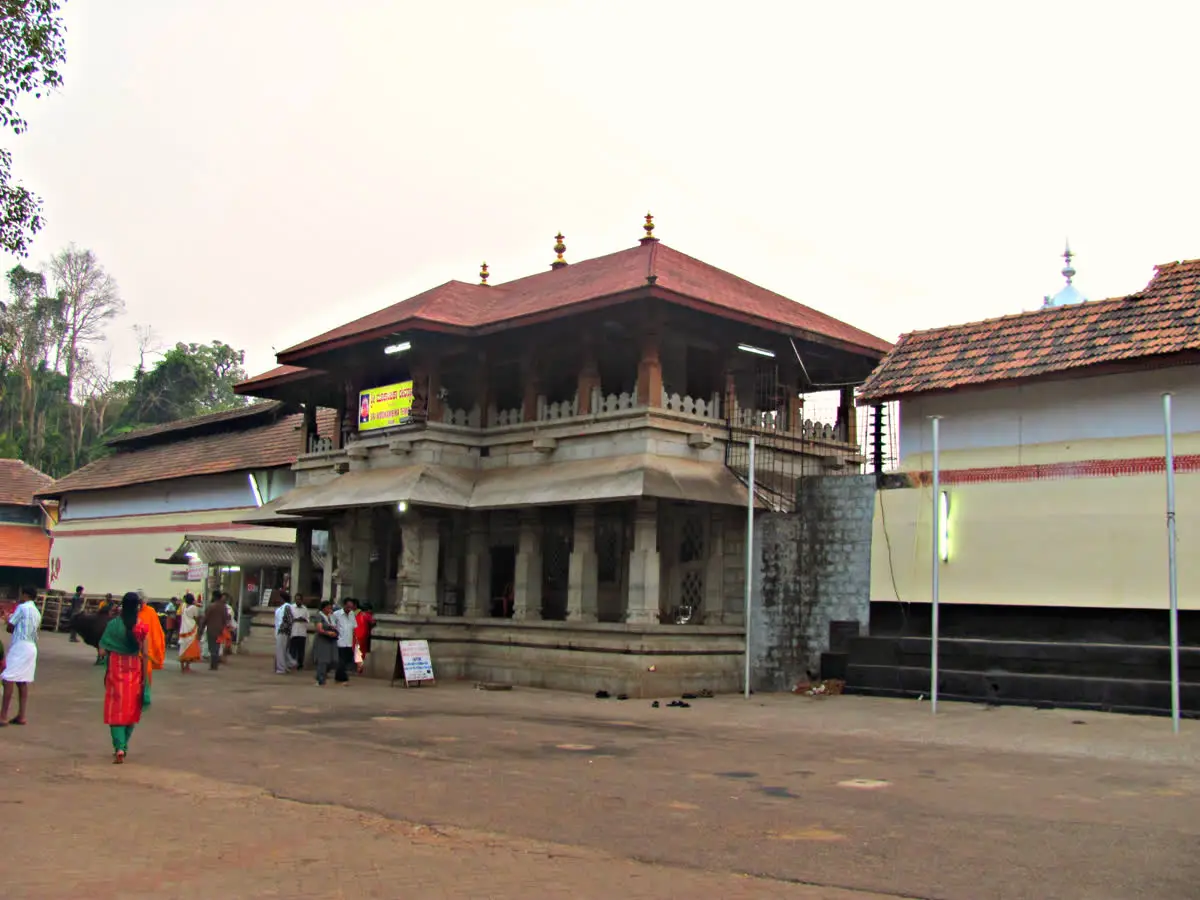
The Kollur Mookambika Temple in Udupi district, Karnataka, is one of South India's most beloved Shakti shrines. It enshrines a swayambhu (self-manifested) Jyotirlinga divided by a golden line, the Swarnarekha, uniting Shiva and Shakti in one form, and honours Mookambika, the Divine Mother of wisdom, worshipped as Mahakali, Mahalakshmi and Mahasaraswati combined.
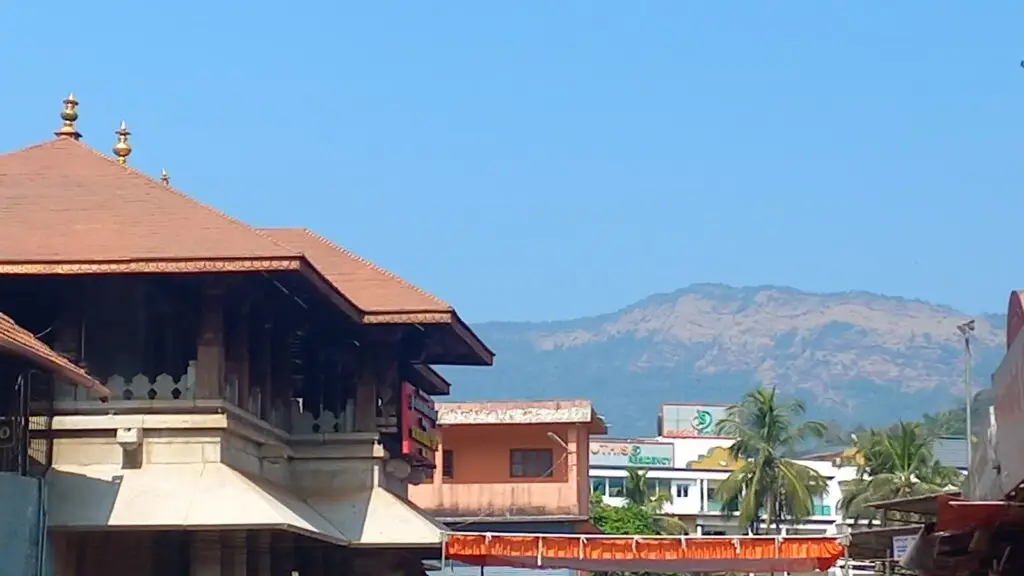
The temple stands on the southern bank of the sacred Souparnika river, cradled in the green foothills of the Kodachadri (Kudajadri) hills. To the streams of pilgrims who arrive from Karnataka, Kerala, Tamil Nadu and far beyond, the Mother here is at once the destroyer of darkness, the giver of abundance, and, above all, the goddess of vidya: learning, speech and wisdom.
Two threads of legend give the temple its soul: the story of the demon Mookasura, who was struck mute by the Goddess of speech and then slain by the Divine Mother, and the cherished tradition that the great philosopher-saint Adi Shankaracharya meditated on Kudajadri, received the Mother's vision, and consecrated her here at Kollur. This guide walks reverently through that history and legend, the meaning of the linga, the rituals of wisdom such as Vidyarambham, the Kudajadri pilgrimage, the mantras chanted to the Mother, and everything a devotee needs to plan a journey to her feet.
Key Takeaways
- Kollur Mookambika Temple stands in Byndoor taluk, Udupi district, Karnataka, on the southern bank of the Souparnika river below the Kudajadri (Kodachadri) hills.
- The main deity is a swayambhu Jyotirlinga divided by the golden Swarnarekha, one half embodying Brahma, Vishnu and Shiva, the other Saraswati, Lakshmi and Parvati.
- Mookambika takes her name from the demon Mookasura, struck mute by the Goddess of speech and then slain by the combined form of the Tridevi.
- Tradition holds that Adi Shankaracharya meditated on Kudajadri, beheld the Goddess, and installed the four-armed panchaloha murti at Kollur.
- Kollur is one of India's most famous places for Vidyarambham, the initiation of children into learning, which peaks on Vijayadashami during Navaratri.
Who Is Goddess Mookambika?
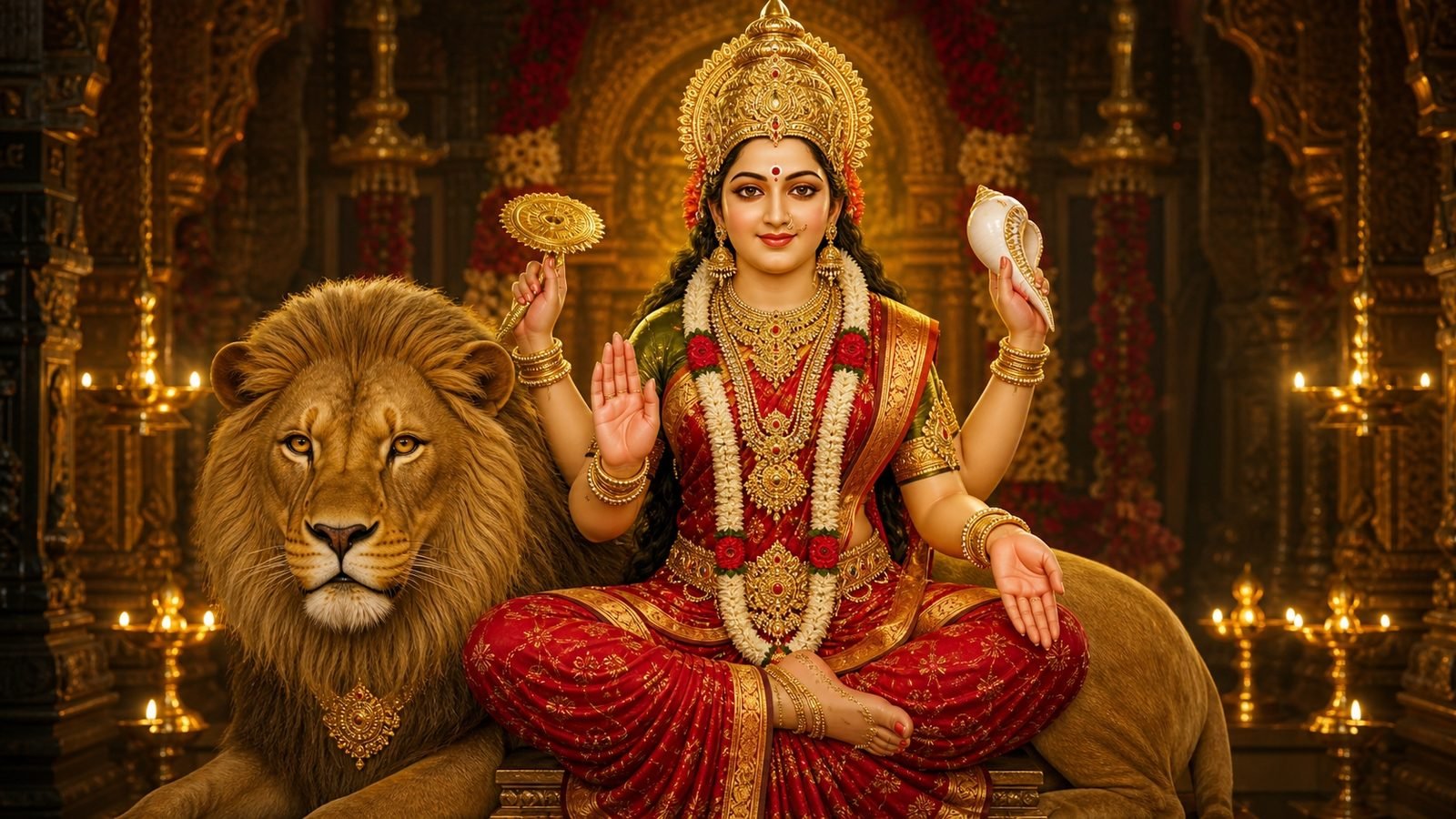
Mookambika (Sanskrit: मूकाम्बिका) is revered as an aspect of Adi Parashakti, the supreme Divine Mother, worshipped as the very source of creativity, intelligence and divine energy. Her name is most often explained as "the Mother (Ambika) of Mooka," the Mother in relation to the mute demon Mookasura whom she vanquished.
She is honoured across Karnataka, Kerala and Tamil Nadu, and her chief abode is the temple at Kollur in the Udupi district of coastal Karnataka. Devotees experience Mookambika as the unified Tridevi, the three great goddesses gathered into one. In a beautiful daily rhythm followed in tradition, she receives veneration as Saraswati, goddess of knowledge, in the morning; as Lakshmi, goddess of prosperity, at midday; and as Parvati or Durga, the power that protects, in the evening.
In her four-armed form she carries the conch (Shankha) and the discus (Chakra), and offers the gestures of fearlessness (Abhaya mudra) and boon-giving (Varada mudra). She is, in essence, the Mother who grants both worldly fullness and the inner light of wisdom. Readers drawn to the Mother's many faces can explore our guides to Maa Kali and Maa Kamala, the lotus goddess of abundance, and the wider origin story of the Das Mahavidyas.
The Goddess of Wisdom and Power
Mookambika is loved especially as the goddess of vidya: wisdom, learning, the arts and the spoken word. It is this aspect that draws scholars, students, musicians, dancers and seekers of every kind to her threshold. Yet she is equally the goddess of Shakti, of raw protective power, for she is the one who descended to slay a demon that the gods themselves could not subdue. In her, gentleness and ferocity, knowledge and strength, are held in perfect balance: the reason she is called the goddess of both wisdom and power.
What Is the Legend of Mookasura?
An asura named Kaumasura sought an invincibility boon from Lord Shiva through severe penance. The goddess of speech stilled his tongue so that he could not utter the fatal request, and the mute demon came to be called Mookasura. The Divine Mother, formed from the combined energies of the Tridevi, then descended on a lion and slew him, taking the name Mookambika.
Tradition adds detail to this outline. Kaumasura had earlier received the protection that only a woman could ever kill him; yet, alarmed by the slaying of the buffalo-demon Mahishasura at the hands of the Goddess, he sought even greater power. To prevent catastrophe, the gods appealed to the Divine Mother, and the goddess of speech intervened at the decisive moment: when Shiva appeared before the demon, the asura could not speak his request.
Struck irrational, and enraged by it, Mookasura conquered Indra, seized the heavens and threw the three worlds into chaos. The Trimurti, Brahma, Vishnu and Shiva, then called upon their consorts, the Tridevi, Saraswati, Lakshmi and Parvati, to manifest a single, irresistible form. Their combined energies took shape as a radiant goddess riding a lion, who descended and slew Mookasura. From that victory she became known, in this land, as Mookambika, "the Mother who conquered Mooka."
One tradition, drawn from the Skanda Purana, adds that after the battle the Mother performed a sacred rite and graciously elevated the demon's soul, a tale connected with the nearby Brahmalingeshwara shrine at Maranakatte. As with much sacred lore, the details vary between texts and local accounts; what remains constant is the heart of the story: wisdom silencing arrogance, and the Mother restoring cosmic order.
What Is Special About the Swayambhu Jyotirlinga and the Golden Line?
At the centre of the sanctum is a swayambhu Jyotirlinga, a linga believed to have manifested of its own accord, divided by a fine golden line called the Swarnarekha. One half represents the conscious male triad of Brahma, Vishnu and Shiva; the other represents the creative female triad of Saraswati, Lakshmi and Parvati.
This single feature carries the entire philosophy of the temple. The female triad is honoured together as Mahasaraswati, Mahalakshmi and Mahakali, and in the words of the tradition, the larger, more luminous portion is the seat of the Goddess, so the linga itself receives worship as Devi. The Mother here is therefore the union of Shiva and Shakti, of Parabrahman and Adi Parashakti, gathered into one self-born form. In this single stone, Shiva and Shakti are not two but one, a vision of non-duality the temple wears at its very heart.
Behind this linga stands a beautiful four-armed panchaloha (five-metal alloy) idol of Mookambika, seated in padmasana. Tradition holds that Adi Shankaracharya installed this murti so that devotees might gaze upon the Mother in a personal, accessible form while the swayambhu linga remained the eternal Moola Devi, the root deity. Because the linga embodies both Shiva and Shakti, Kollur is counted among both the 108 Shivalayas and the 108 Durgalayas of the old Kerala-Tulu sacred geography.
How Did the Linga Come to Be?
Local tradition tells of a sage, often named Kola Maharishi, who performed deep penance at this very spot and was harassed by the demon during his austerities. When Lord Shiva and the Divine Mother appeared, the sage asked that the Lord, together with his Consort, remain at this place forever. To grant his prayer, the Jyotirlinga arose with the golden Swarnarekha at its centre, so that both Shiva and Shakti would abide here eternally. It is from this sage Kola, many believe, that the place takes its name: Kollur.
What Is Adi Shankaracharya's Connection to Kollur?
Tradition holds that Adi Shankaracharya, the 8th-century philosopher-saint of Advaita Vedanta, performed penance on the peak of Kudajadri during his travels through the Western Ghats and was blessed with a vision of the Divine Mother. He is revered as the one who established the present worship of Mookambika at Kollur, installing the four-armed vigraha and ordering the rituals of the shrine.
A second, much-loved legend explains why the Goddess chose to remain at Kollur rather than travel onward. In this telling, Adi Shankara longed to take the Goddess of wisdom to Kerala and install her there, and through his austerities she agreed, on one condition. She would follow him. But he must never look back at her along the way. Shankara walked ahead, listening for the sound of her anklets. When the jingling fell silent, doubt and longing overcame him, and he turned to look. Because the condition was broken, the Mother chose to stay at the very spot where he had looked back, Kollur, and there she has remained ever since.
Yet, the tradition tenderly adds, because Shankara's devotion had been so complete, the Goddess promised that she would also be present in Kerala, a connection devotees associate with the Chottanikkara Temple, where it is said the doors are opened only after those of Kollur. As ever with such legends, regional versions differ in detail; but together they express a single truth dear to pilgrims: that the Mother of wisdom made her home at Kollur out of love for a great devotee, and out of love for all who would come after.
Why Are Kudajadri Hill, the Sarvajna Peetha and Chitramoola Cave Sacred?
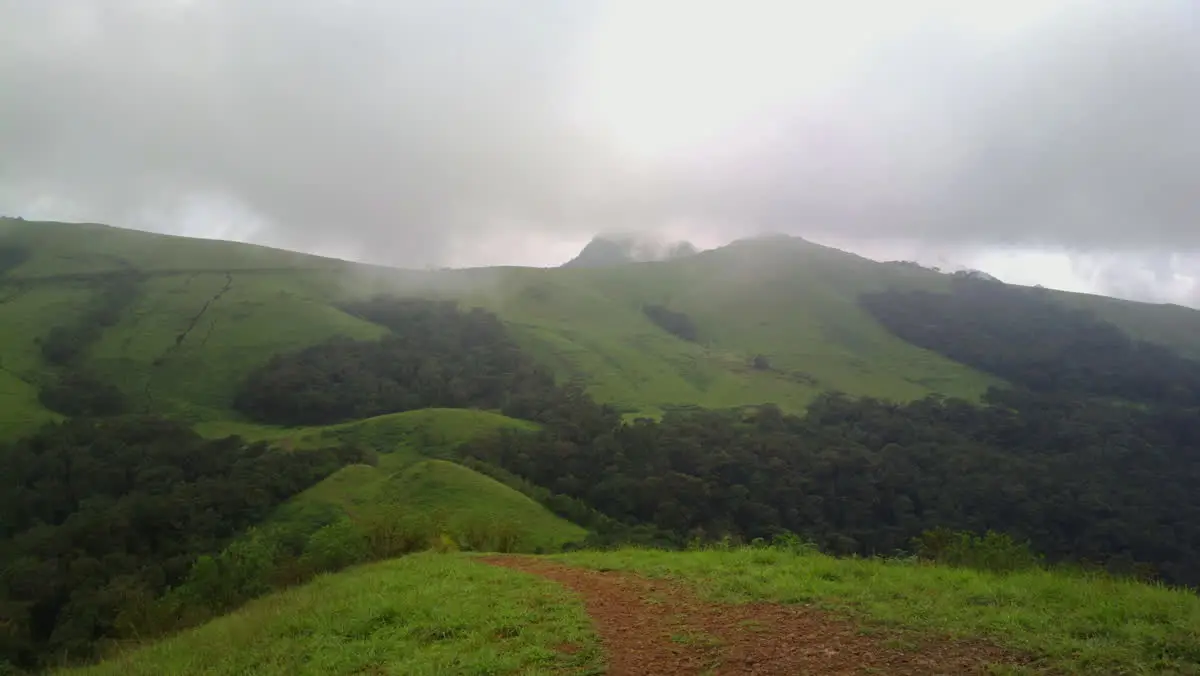
Kudajadri, also spelt Kodachadri, rises to around 1,343 metres in the Western Ghats east of the temple and stands as the Moola Sthana, the original seat of the Devi. Near its summit stand the Sarvajna Peetha, associated with Adi Shankara's meditation, and below it the Chitramoola cave of deep tapas.
It is here, devotees believe, that Adi Shankaracharya undertook his penance and beheld the Goddess. The mountain, dense with forest and rare medicinal plants, is the spiritual summit of the Mookambika tradition. The Sarvajna Peetha, also called the Shankara Peetha, is a small stone mandapa-like structure; the Chitramoola cave is a secluded grotto where, according to tradition, sages and Shankara himself performed deep tapas. A small Moola Mookambika shrine on the hill marks the spot held to be the Goddess's most ancient abode. For many pilgrims, climbing to Kudajadri to honour these places is the natural completion of a visit to Kollur.
How Do You Do the Kudajadri Trek?
Reaching Kudajadri is itself a pilgrimage. The summit can be approached on foot by a demanding trek of several hours through forest paths strewn with boulders, loose gravel and streams, a journey of roughly a dozen kilometres from the base for those who walk the full route. During the dry season, rugged four-wheel-drive jeeps are commonly hired from the base village to cover much of the rough track, with a final stretch on foot to the Sarvajna Peetha and the cave. The reward is a sweeping view of the Ghats, an atmosphere of profound stillness, and the sense of standing where the Mother first revealed herself.
Why Is the Souparnika River Sacred?
The temple sits on the bank of the Souparnika (Sowparnika), a river held holy by Mookambika's devotees, and a pilgrim's visit traditionally begins with a bath in its waters before darshan. Legend says an eagle named Suparna, in some tellings Garuda, performed penance on its banks, and the river was named after him as his boon.
When the Goddess appeared and offered a boon, Suparna asked that the river carry his name, and so it became the Souparnika. The river is cherished not only for its sanctity but for its reputed healing quality. As it winds through forested slopes rich in herbs and rare plants, tradition says it gathers the essence of many medicinal roots and leaves, a number often given as sixty-four, so that bathing in it is believed to cleanse both body and spirit. Whether one accepts the legend literally or as poetry, the cool, clear Souparnika remains an inseparable part of the Kollur experience.
What Is Vidyarambham at Mookambika Temple?
Vidyarambham, also called Aksharabhyasa, is the ceremonial initiation of a child into the world of letters, and Kollur is one of the most famous places in India to perform it. At the Saraswati Mandapa, children write their first syllables in rice, guided by a teacher's hand, seeking the Mother's blessing for learning, memory and eloquence.
Because Mookambika is supremely the goddess of wisdom, parents bring their young children here from across the south. The initiation is traditionally begun with the sacred phrase invoking Ganesha and the Goddess of speech.
Aksharabhyasa is performed at the temple through much of the year. But it reaches its peak during Navaratri, and especially on Vijayadashami, the tenth and final day, which is considered the most auspicious moment of all to begin one's education. On that day thousands of families gather, and the Saraswati Mandapa fills from the early morning hours. Devotees who wish to perform the ceremony on Vijayadashami should be prepared for very large crowds and plan well in advance.
Navaratri and the Great Festivals at Kollur
Navaratri, in the lunar month of Ashwin (September-October), is among the temple's grandest celebrations. For nine nights the Mother receives worship in her many aspects with special pujas, music and decoration, culminating in the Vijayadashami rites of wisdom. The other great festival is the Rathotsava, the chariot festival, held in the month of Phalguna (around February-March), when the Goddess is taken in procession through Kollur amid a sea of devotees. Friday stands as the Mother's special day for ongoing worship.
Daily Worship and Sevas
Through the day the temple offers a sequence of pujas and sevas, with the Mother adorned and venerated in her morning, midday and evening forms. Popular offerings and sevas include lamp offerings, archanas in the Goddess's many names, and abhishekams; the Saraswati-related sevas hold special meaning for students and artists. Devotees are encouraged to confirm current timings, rates and online booking arrangements through the temple's official channels before travelling, as these are periodically updated.
Which Mantras Are Chanted for Devi Mookambika?
Sound is the first prayer, and devotees invoke Mookambika with simple, traditional salutations to the Mother of wisdom. Tradition also closely associates her worship with the Mahalakshmi Ashtakam, an eight-verse hymn to the Goddess of abundance. The tables below present commonly recited salutations. Please treat them as devotional invocations rather than formal initiated mantras; for structured sadhana or any secret bija practice, seek guidance from a qualified teacher or the temple priests.
| Sanskrit | ॐ ऐं ह्रीं श्रीं मूकाम्बिकायै नमः |
|---|---|
| Hindi | ओम् ऐं ह्रीं श्रीं मूकाम्बिकायै नमः |
| Transliteration | Om Aim Hreem Shreem Mookambikayai Namah |
| Meaning | I bow to Goddess Mookambika, invoking the seed-sounds of wisdom (Aim, of Saraswati), grace and protection (Hreem) and abundance (Shreem): the Mother who unites learning, prosperity and power. |
Note: a simple, widely chanted salutation. Variations exist across lineages; the bija syllables Aim, Hreem and Shreem honour Saraswati, the Great Goddess, and Lakshmi respectively.
A still simpler salutation cherished by devotees, especially those who seek the Mother's blessing for knowledge, is given below.
| Sanskrit | ॐ ऐं सरस्वत्यै नमः |
|---|---|
| Hindi | ओम् ऐं सरस्वत्यै नमः |
| Transliteration | Om Aim Saraswatyai Namah |
| Meaning | Om and salutations to Saraswati, honouring Mookambika as the goddess of wisdom, speech and the arts, through the seed-sound Aim of divine learning. |
Note: often chanted by students and seekers of knowledge before study or before darshan. We present these reverently and do not claim to reproduce any initiated or secret scriptural mantra.
What Can You See Inside the Temple?
The Kollur Mookambika Temple, with roots traced to around the 8th century and rebuilt and embellished over the centuries, blends Dravidian, Vijayanagara and Hoysala influences. Beyond the sanctum with its swayambhu linga, golden Swarnarekha and four-armed Mookambika murti, the complex holds several sub-shrines that pilgrims visit in turn.
- Sub-shrines for Ganapathi (Ganesha), Shiva, Vishnu, Hanuman, Subrahmanya (Kartikeya) and Virabhadra.
- Shrines to the Naga Devatas (serpent deities), reflecting the strong tradition of snake worship in this coastal region.
- The Saraswati Mandapa, the focus of Vidyarambham and the rites of learning.
- A revered golden pillar and an ornate lamp tower near the sanctum, lit during worship.
Devotees typically bathe in the Souparnika, take darshan of the Mother in her morning, midday and evening forms if time allows, circumambulate the sanctum, and offer prayers at the surrounding shrines before partaking of the temple's prasadam.
How Do You Reach Kollur Mookambika Temple?
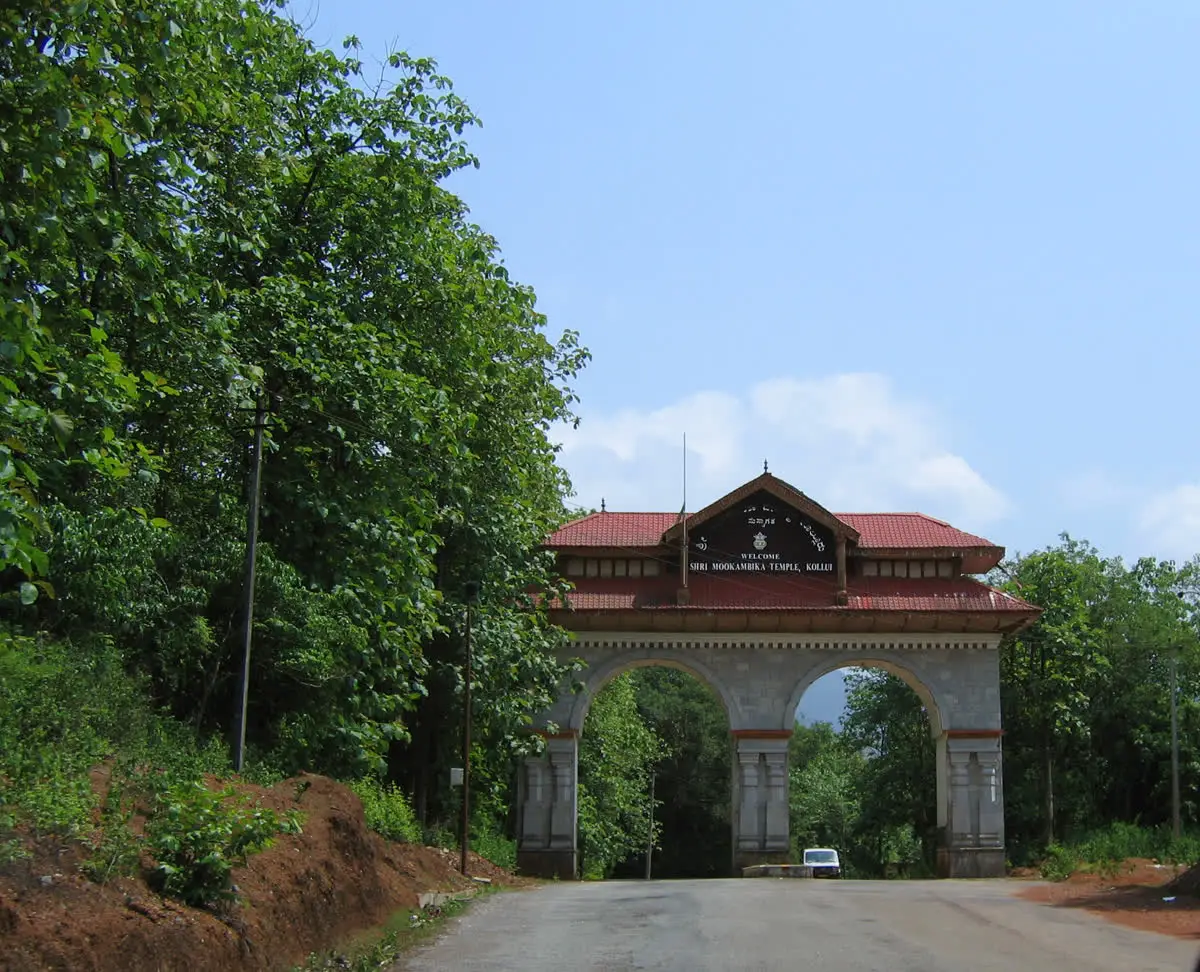
Kollur lies in Byndoor taluk of Udupi district, coastal Karnataka. The nearest airport is Mangaluru (about 130-140 km), the nearest railway station is Byndoor Mookambika Road (about 28-30 km) on the Konkan Railway, and by road you turn inland from NH-66 near Kundapura or Byndoor. The temple is generally open from around 5 AM to 9 PM.
| Location | Kollur village, Byndoor taluk, Udupi district, Karnataka, on the Souparnika river in the Western Ghats foothills |
|---|---|
| Nearest airport | Mangaluru International Airport (IXE), roughly 130-140 km south, about 3-4 hours by taxi via NH-66 |
| Nearest railway station | Byndoor Mookambika Road, about 28-30 km (Konkan Railway); Kundapura around 40 km; Udupi around 80 km |
| By road | Turn inland (east) from NH-66 near Kundapura/Byndoor; regular KSRTC and private buses from Mangaluru, Udupi, Kundapura, Shivamogga and Bengaluru |
| Timings (indicative) | Around 5 AM to 9 PM, with short breaks for rituals and decoration; Vidyarambham typically in the morning; confirm via official channels |
| Entry | Darshan open to all; sevas and online bookings managed through the temple's official channels |
By Air
- Mangaluru International Airport (IXE): the most practical gateway, roughly 130-140 km south of Kollur, with good onward road links via NH-66 toward Kundapura and then east to Kollur (about 3-4 hours by taxi).
- Other options: travellers from the north sometimes use airports further afield and reach Kollur by train or road; pre-booked taxis are widely available at Mangaluru.
By Train
- Byndoor Mookambika Road station: the nearest railhead, about 28-30 km away on the Konkan Railway line, with onward taxis and buses taking around 30-45 minutes to the shrine.
- Kundapura station: around 40 km away, a convenient second option, especially from Mangaluru and southern Karnataka.
- Udupi station: around 80 km away, useful for travellers from Bengaluru, Mysuru and other inland cities.
By Road
- From NH-66: Kollur is reached by turning inland (east) from the coastal NH-66 near Kundapura/Byndoor; the drive winds gently up toward the Ghats.
- Buses: regular KSRTC and private buses connect Kollur with Mangaluru, Udupi, Kundapura, Shivamogga and Bengaluru.
- Local transport: auto-rickshaws, taxis and town buses operate within Kollur; jeeps for the Kudajadri route are hired from the village.
What Are the Darshan Timings?
The temple is generally open from the early morning (around 5 AM) until the night (around 9 PM), with darshan available through the day except during brief intervals when specific rituals, abhishekams or decorations are performed. Vidyarambham at the Saraswati Mandapa is typically conducted in the morning hours. Timings, puja schedules and seva rates can change with the season and festivals, so confirm the latest details through the temple's official channels before your visit.
When Is the Best Time to Visit, and What Should You Keep in Mind?
- The cooler, drier months from roughly October to February are most comfortable for darshan and for the Kudajadri trek; the monsoon (June-September) is lush but slippery on the hill.
- Navaratri (September-October) and the Phalguna Rathotsava (February-March) are the most vibrant but also the most crowded times.
- Take a refreshing dip in the Souparnika before darshan, as many devotees do, and dress modestly in keeping with temple tradition.
- For Vidyarambham, especially on Vijayadashami, arrive early and be ready for long queues; plan accommodation in advance, as Kollur has numerous lodges and the temple's own guest facilities.
- If you plan the Kudajadri climb, start early, carry water and sturdy footwear, and hire a local jeep or guide for the rough track; respect the forest and the sanctity of the Sarvajna Peetha and Chitramoola cave.
- Photography is often restricted inside the sanctum; follow posted rules and the guidance of temple staff.
Conclusion: At the Feet of the Mother of Wisdom
Kollur Mookambika is more than a temple; it is a meeting of opposites made whole. In her swayambhu linga, Shiva and Shakti are one. In her daily worship, knowledge, abundance and power flow as a single grace. In her legends, a demon is silenced by wisdom and a great sage is held forever by love.
Whether you come to write a child's first letters at the Saraswati Mandapa, to climb the misty heights of Kudajadri, or simply to stand before the golden line and bow, the Mother of Kollur receives every seeker the same way: as her own child, come home. May Devi Mookambika bless your journey with wisdom, courage and peace. Om Aim Hreem Shreem Mookambikayai Namah.
Listen: Subscribe to Musinara Sounds for 432 Hz mantra chants
🕉️ Hear these sacred mantras come alive. Subscribe to Musinara Sounds on YouTube for 432 Hz Devi mantra chants, sung slowly enough to follow and repeat.
Plan Your Visit to Kollur Mookambika: Timings, Tickets and Travel
The details below were checked on 3 October 2026 against the Kollur Mookambika Temple and the other sources listed under each table. Timings and fees change on festival days, eclipses and special occasions, so confirm with the temple before you travel.
The Karnataka Devi temple circuit links Chamundeshwari, Horanadu, Sringeri, Kollur and Kateel in a five-day route by road. For what happens here during Navratri 2026 (11 to 19 October), see Navratri 2026 at major Devi temples.
Darshan and Aarti Timings
| Information | Details |
|---|---|
| Darshan | 5:00 am to 1:30 pm, break from 1:30 to 3:00 pm, then 3:00 pm to 9:00 pm. Timings differ on special days. |
Sources: Karnataka HRCE Department: Sri Mookambika Temple, Kolluru (temple web portal), Karnataka Tourism: Sri Mookambika Temple.
Tickets, Darshan Options and Sevas
| Option | Price | Notes |
|---|---|---|
| Poojas and homas (including Chandika Homa) | Fee shown at the counter | Tickets are sold at the temple counters. Same-day and next-day sevas can be booked at the counters; arrive 30 to 45 minutes early. |
General darshan is free. Tickets are needed only for poojas and homas. Bookings are handled on kollurmookambikatemple.org. The temple website lists an online services page. Online availability can vary, and tickets are also bought at the temple counters. Musinara is not connected with the temple and does not take bookings.
Sources: Kollur Mookambika Temple: Darshana Timing and Online Services, Karnataka HRCE Department: Sri Mookambika Temple, Kolluru (temple web portal), Karnataka Tourism: Sri Mookambika Temple.
How to Reach Kollur Mookambika
Open Kollur Mookambika in Google Maps for live directions.
| Mode | Nearest point | Distance to the temple |
|---|---|---|
| Air | Mangaluru Airport | |
| Rail | Mookambika Road Byndoor (Baindur) station | about 30 km |
| Bus | Kundapura (about 36 km) and Baindur (about 28 km) for buses and taxis |
Sources: Karnataka Tourism: Sri Mookambika Temple, Udupi District (nic.in): Sri Mookambika Devi Temple.
Approximate distances and journey times from the cities most pilgrims start from. Road times assume normal traffic; festival weekends take longer.
| From | By road | Road time | Train or flight |
|---|---|---|---|
| Mangaluru | about 130 km | Train from Mangaluru to Byndoor station, then about 30 km by road; Mangaluru airport | |
| Udupi | about 75 to 80 km | ||
| Bengaluru | about 430 km | ||
| Kundapura | about 36 km |
Sources: Karnataka Tourism: Sri Mookambika Temple, Udupi District (nic.in): Sri Mookambika Devi Temple.
Private buses run from Mangaluru. Taxis are available from Kundapura and Baindur.
Prasadam, Annadanam and Where to Stay
The temple has a guest house at affordable rates. Budget hotels are available in Kollur, Kundapura (about 36 km) and Baindur (about 28 km).
Source: Karnataka Tourism: Sri Mookambika Temple.
Temples and Places Near Kollur Mookambika
- KSTDC Paradise Wild Hills Resort (about 23 km): Government tourism resort
Source: Karnataka Tourism: Sri Mookambika Temple.
Frequently Asked Questions
Where is the Kollur Mookambika Temple located?
The temple is in Kollur village, Byndoor taluk, Udupi district, in coastal Karnataka. It stands on the southern bank of the Souparnika river at the foot of the Kudajadri (Kodachadri) hills in the Western Ghats.
Who is Goddess Mookambika?
Mookambika is revered as a form of Adi Parashakti, the supreme Divine Mother, worshipped as the union of Mahakali, Mahalakshmi and Mahasaraswati. She is especially honoured as the goddess of wisdom, learning and the arts, as well as of protective power.
Why is Mookambika called the goddess of wisdom?
She receives veneration as Saraswati, the goddess of knowledge and speech, particularly in her morning aspect. Kollur is one of India's most famous places for Vidyarambham (Aksharabhyasa), the ritual initiation of children into learning, which is why she is so closely linked with wisdom.
What is special about the linga at Kollur?
The main deity is a swayambhu (self-manifested) Jyotirlinga divided by a golden line, the Swarnarekha. One half represents the male triad (Brahma, Vishnu, Shiva) and the other the female triad (Saraswati, Lakshmi, Parvati), so the linga embodies the union of Shiva and Shakti.
What is the legend of Mookasura?
A demon named Kaumasura sought an invincibility boon from Shiva. The goddess of speech struck him mute so he could not ask for it, after which he was called Mookasura (mooka means mute). The Divine Mother, formed from the combined energies of the Tridevi, then slew him, taking the name Mookambika.
What is Adi Shankaracharya's connection to Kollur?
Tradition holds that Adi Shankaracharya meditated on Kudajadri, received a vision of the Goddess, and consecrated her worship at Kollur, installing the four-armed murti behind the linga. A beloved legend says the Goddess agreed to follow him to Kerala if he did not look back; when he did, she chose to remain at Kollur.
What is the Kudajadri trek and why is it important?
Kudajadri (Kodachadri) is the peak east of the temple where Adi Shankara is said to have done penance. Near the summit are the Sarvajna Peetha and, below it, the Chitramoola cave. Pilgrims trek or take a jeep up the rough track to honour these sites, regarded as the Goddess's most ancient abode.
What is Vidyarambham at Mookambika Temple?
Vidyarambham, or Aksharabhyasa, is the ceremonial initiation of a child into learning. At the Saraswati Mandapa, children write their first letters seeking the Mother's blessing. It is performed through the year but peaks during Navaratri and especially on Vijayadashami.
What are the Kollur Mookambika temple timings?
The temple is generally open from around 5 AM to 9 PM, with darshan available through the day apart from short breaks for rituals and decoration. Because timings and seva schedules change seasonally and during festivals, confirm them via the temple's official channels before travelling.
How do I reach Kollur Mookambika Temple?
The nearest airport is Mangaluru (about 130-140 km). The nearest railway station is Byndoor Mookambika Road (about 28-30 km), with Kundapura and Udupi as further options. By road, turn inland from NH-66 near Kundapura/Byndoor; buses and taxis connect Kollur with the coastal towns and Bengaluru.
Official and Reference Sources
- Kollur Mookambika Temple, official - maintained by the temple under the Karnataka Muzrai department
Planning a pilgrimage? All twenty Devi temple guides on this site are arranged by region, with practical circuits, in Devi Temples of India. For where each site sits in the disputed lists of 51, 52 and 108, see the Shakti Peeth list.