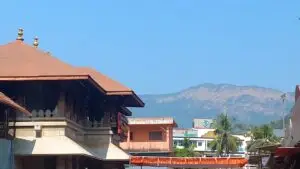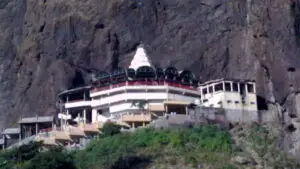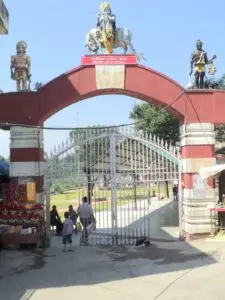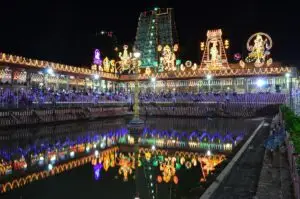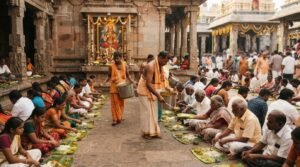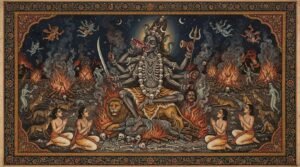
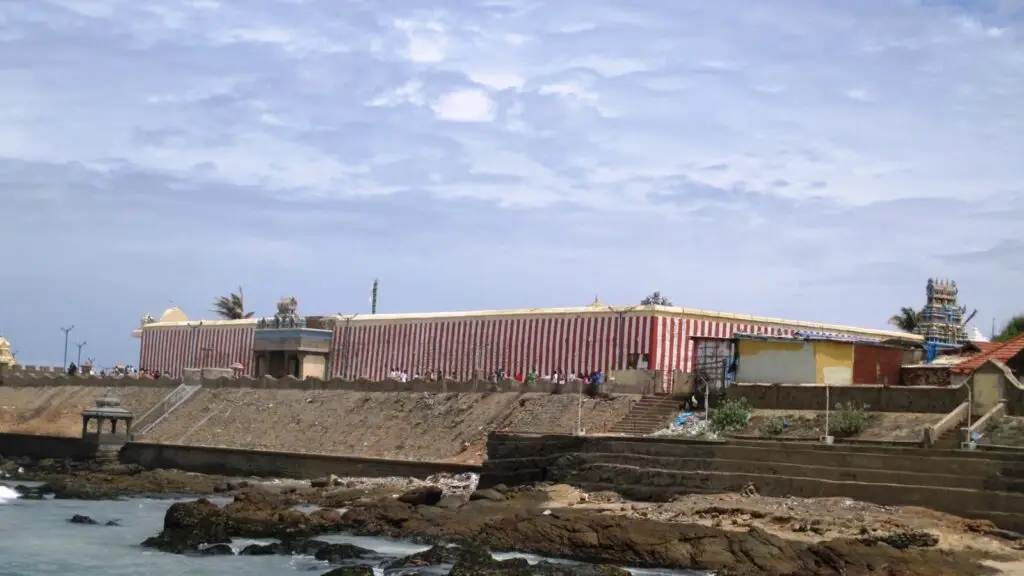
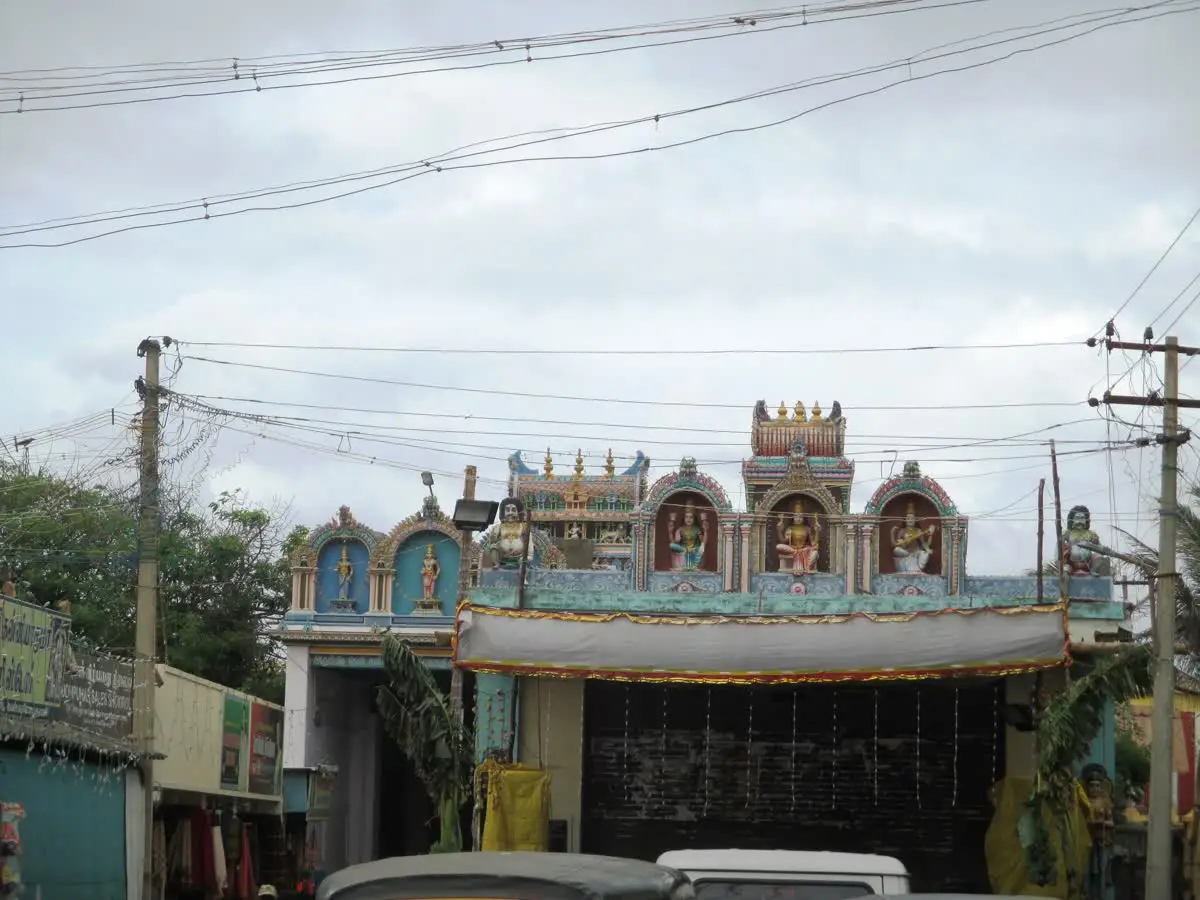
The Kumari Amman Temple, also called the Bhagavathy Amman Temple, stands at Kanyakumari, the southern tip of India, where the Bay of Bengal, the Arabian Sea and the Indian Ocean meet. It honours Devi Kanya Kumari, the eternal virgin form of the Divine Mother, and is revered as a Shakti Peetha of great antiquity.
Where the land of India finally surrenders to the sea, this shrine has drawn pilgrims for thousands of years. From her sanctum the goddess gazes east across the waters of the confluence revered as the Triveni Sangamam, keeping her eternal vigil over the southern ocean.
This is no ordinary temple. It is celebrated in the epics and in ancient Tamil Sangam literature, and it carries one of the most evocative legends in all of Hindu tradition: the goddess who undertook fierce penance to wed Lord Shiva, whose wedding was never completed, and who turned her unfulfilled longing into the strength that vanquished the demon Banasura.
This complete guide walks you through who Devi Kanyakumari is, the cherished legends of her penance and the interrupted wedding, her place among the Shakti Peethas, the famous diamond nose-ring said to gleam across the sea, and the practical essentials: timings, dress code, how to reach the temple, and the nearby sights of the Vivekananda Rock Memorial and the Thiruvalluvar Statue. Where traditions differ, this guide notes the variation honestly, so that it may serve as a reverent and accurate companion for your pilgrimage to the tip of India.
Key Takeaways
- The Kumari Amman (Bhagavathy Amman) Temple at Kanyakumari honours Devi Kanya Kumari, the Divine Mother in her eternal virgin form.
- Legend says her wedding to Shiva was never completed so that she could slay the demon Banasura, who could be killed only by a virgin maiden.
- The temple is a Shakti Peetha where a part of Sati's back is said to have fallen; the Goddess here receives veneration as Sarvani and the Bhairava as Nimisha.
- The deity's famous diamond nose-ring was once said to mislead sailors like a lighthouse, which is why the eastern sea-facing door is normally kept closed.
- Kanyakumari sits at the Triveni Sangamam, where the Bay of Bengal, the Arabian Sea and the Indian Ocean meet, and is one of the rare places to see both sunrise and sunset over the sea.
Who Is Devi Kanya Kumari?
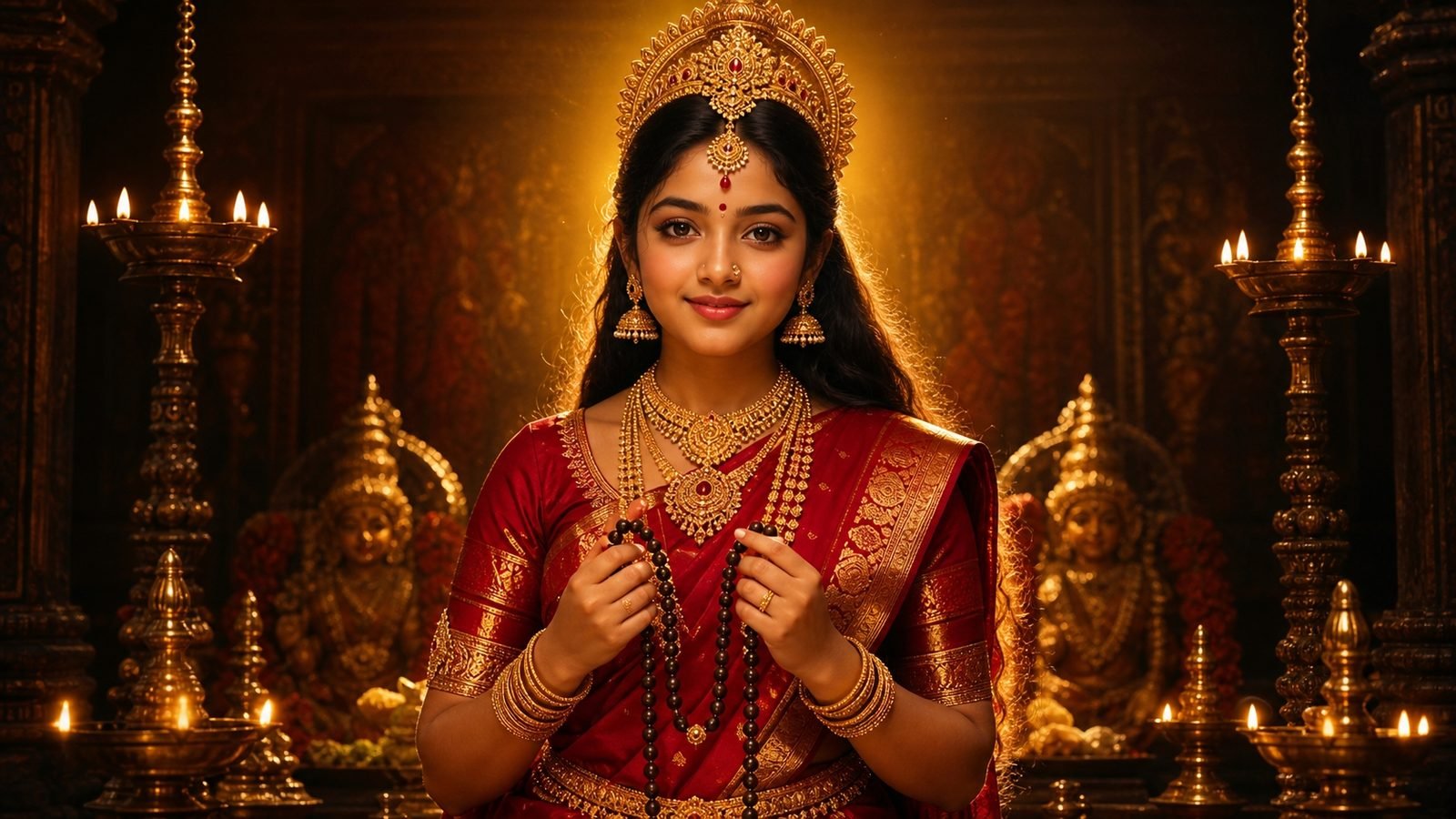
Devi Kanya Kumari is the presiding goddess of Kanyakumari, worshipped as Bhagavathy, the Divine Mother, in the tender form of an adolescent girl. Her name carries her meaning: kanya signifies a virgin or unmarried maiden, and kumari means a young girl. She is understood as a form of Parashakti, the supreme feminine energy, closely identified with Parvati.
Here she manifests as the eternal virgin who chose penance and battle over marriage. Devotees address her by several names: she is Kanyakumari and Kumari Amman; she is Bhagavathy Amman, the gracious Mother; and within the Shakta tradition of the Shakti Peethas she receives veneration as Sarvani. Her sanctum faces east, toward the sunrise over the sea, and her image is famed for its serene youthful beauty and for the brilliant diamond ornament at her nose, of which more will be said below.
The temple is widely held to be of great antiquity; popular accounts speak of it as more than three thousand years old. Whatever the precise age of the present structure, the sanctity of the site is unquestionably ancient, woven into the spiritual geography of the Tamil land and of the wider subcontinent as the place where the Mother keeps watch at the meeting of the waters.
A Sangam-Age Sacred Site
Kanyakumari and its goddess are remembered in some of the oldest layers of Indian literature. References to the shrine and to the maiden goddess of the southern cape appear in the great epics, the Mahabharata and the Ramayana, and the place is celebrated in the classical Tamil Sangam works, among them Purananuru and the epic Manimekalai, which speak of the holy waters and the goddess of the cape. This deep literary memory marks Kanyakumari as one of the venerable pilgrimage destinations of the south, sanctified by poets and seers long before the modern era.
Why Did the Goddess Perform Penance for Shiva?
According to tradition, the maiden goddess came to the southern tip of the land and undertook intense penance (tapas), longing to wed Lord Shiva, who was then worshipped at nearby Suchindram. Her austerity moved Shiva himself, and a marriage was arranged, yet a deeper divine purpose stood behind her longing.
A demon named Banasura had been granted a boon that he could be slain only by a virgin maiden. So long as Kanya Kumari remained unmarried, she alone held the power to destroy him and protect the world. For the cosmic order to be preserved, her wedding could not be allowed to take place.
Why Was the Wedding Never Completed?
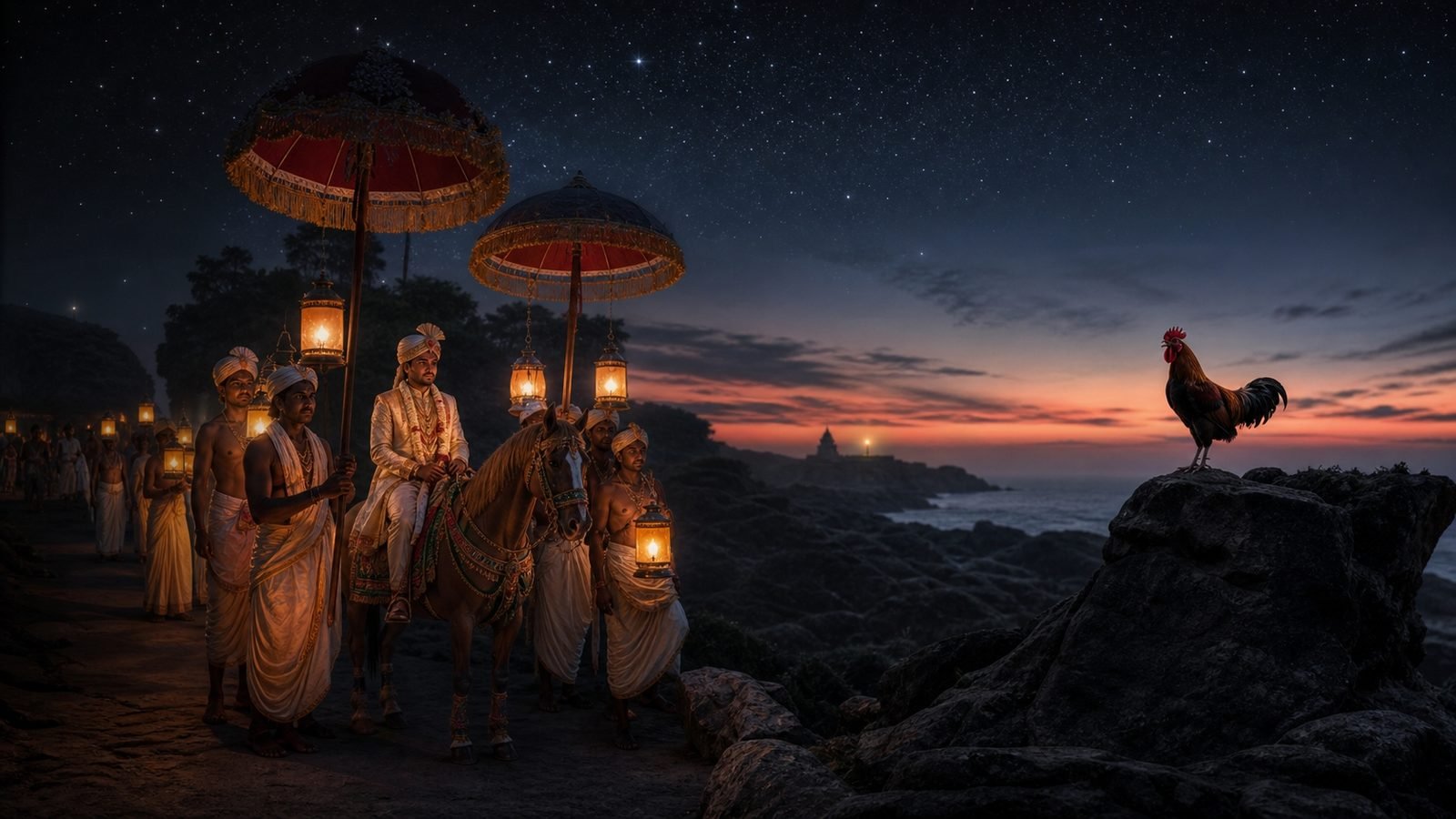
The legend recounts that on the appointed night the wedding procession set out from Suchindram for the auspicious hour, which fell before dawn. To ensure the marriage would not be completed, and so that the goddess might fulfil her destiny, the sage Narada intervened. In one widely told version he took the form of a rooster and crowed in the darkness, making it seem that day had already broken and the auspicious hour had passed. Believing he was too late, Shiva turned back and returned to Suchindram, and at Kanyakumari the wedding ceremonies were never solemnised.
So the goddess remained Kanya Kumari, the virgin, keeping her eternal vigil at the shore. The themes of longing, sacrifice and a higher purpose run through the whole story: her unmarried state is not a misfortune but the very source of her protective power.
The Rice That Turned to Stone
A gentle and much-loved detail completes the tale. The rice and grains that had been gathered for the great wedding feast were never cooked, for the wedding never came to pass. In folk tradition these grains are said to have turned to stone, and even today small pebbles found along the shore are pointed out as the uncooked rice of the wedding that never was. Visitors sometimes purchase tiny rice-like stones as keepsakes that recall this poignant legend.
How Did the Goddess Defeat Banasura?
Banasura, described in some accounts as a descendant of the demon king Mahabali, had grown arrogant through his boon and oppressed the world. Because he could be killed only by an unmarried maiden, the Divine Mother's eternal virginity was, in the end, the world's protection. Wielding her divine discus, she destroyed him and freed the world.
Tradition places the fierce battle at Mahadhanapuram, a short distance from Kanyakumari, where the goddess confronted Banasura and slew him with her chakra. In this way the maiden of the shore reveals herself as Parashakti in full: at once the tender daughter absorbed in devotion and the invincible warrior who upholds dharma. Compassion and power are united in her, and many tellings add that, in her victory, she sanctified the surrounding waters, leaving grace where there had been conflict.
Is Kanyakumari a Shakti Peetha?
Yes. The Kumari Amman Temple is counted among the Shakti Peethas, the sacred abodes of the Goddess that mark where parts of the body of Sati fell to earth. At Kanyakumari, tradition holds that a part of the goddess's back fell, and the Devi here receives veneration as Sarvani with Nimisha as her Bhairava.
In the well-known tradition, when Sati gave up her life and the grieving Shiva carried her body, Vishnu's discus divided it, and each place where a part came to rest became a Peetha, an enthroned seat of the Mother's power. You can read the full narrative in our story of Sati Devi and the Daksha Yagna, and explore the whole sacred network in our complete guide to the 51 Shakti Peethas.
Here it is worth noting honestly that accounts vary: some sources describe the relic as the back or the spine, while others speak of the right shoulder and the region of the spine. Such variation is common across the many lists of Peethas, and the differing details are best received as parallel strands of a living tradition rather than as contradictions to be resolved. By the standard convention that names the Shakti and her guardian Bhairava at each site, the shrine is also known as the Sarvani Shakti Peetha, binding the virgin goddess of the cape to the great pan-Indian sisterhood of the Mother's sacred seats.
What Is the Story of the Famous Diamond Nose-Ring?
The deity wears a brilliant diamond nose ornament celebrated for its extraordinary radiance. By tradition its light was once so intense that sailors at night mistook it for a lighthouse beam and wrecked their ships on the rocks. For this reason the eastern, sea-facing door of the temple is normally kept closed.
Several stories attach to the diamond itself; one tradition holds that the precious stone was offered by, or obtained from, the king of serpents. The eastern door, the door that faces the sea and the goddess's gaze, is opened only on a few special occasions in the year.
Whether one receives these accounts as history or as the poetry of devotion, they convey a deeper truth that the tradition cherishes: that the radiance of the Mother is so great it reaches across the waters, and that her presence is at once a beacon and a mystery, to be approached with reverence.
Which Three Seas Meet at Kanyakumari?
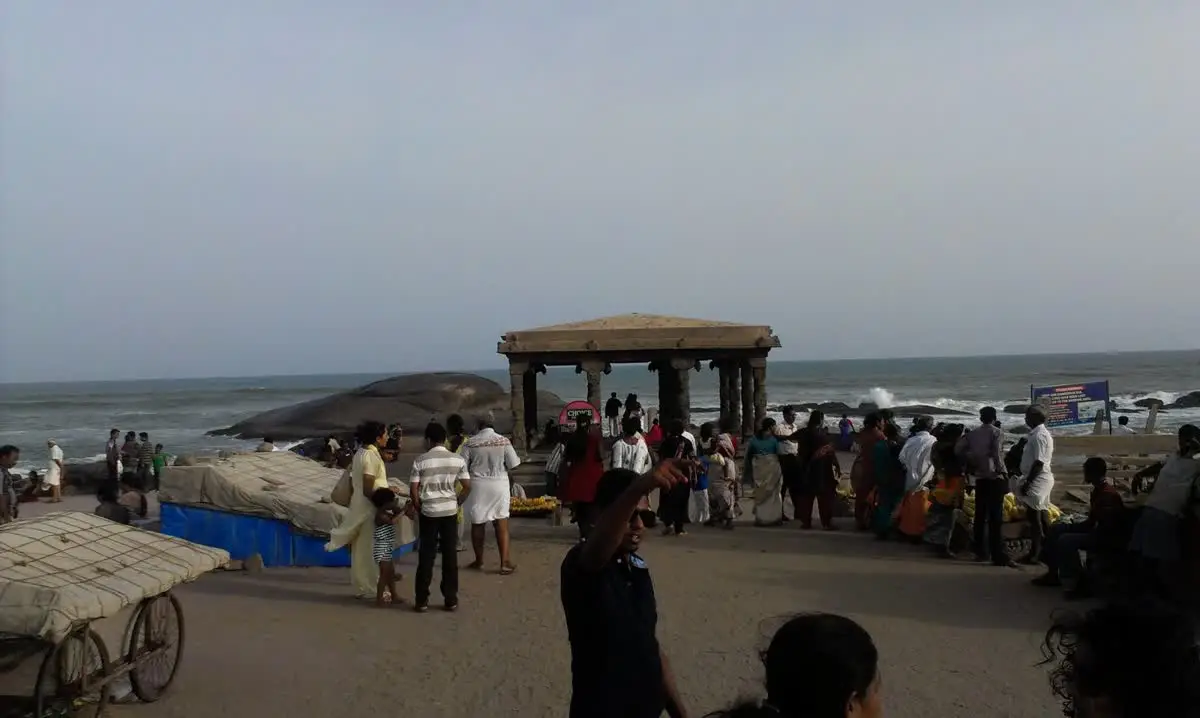
By long tradition, the Bay of Bengal to the east, the Arabian Sea to the west and the Indian Ocean to the south meet at the southernmost tip of mainland India at Kanyakumari. This meeting of the waters is revered as the Triveni Sangamam, and a bath here near the temple is considered deeply purifying.
The same point on the coast is famous as one of the rare places in India where travellers can witness both sunrise and sunset over the sea, and on certain full-moon evenings the moonrise and the setting sun may be glimpsed together. For the devotee, this convergence of waters and of light is not mere scenery: it is felt as the natural mirror of the goddess herself, who stands at the boundary of land and ocean, gathering all directions into her gaze.
Vivekananda Rock and the Thiruvalluvar Statue
Just off the shore rise two of Kanyakumari's most famous landmarks, easily visited together with the temple. On a rocky islet stands the Vivekananda Rock Memorial, raised at the spot where Swami Vivekananda is said to have meditated in 1892 before his journey to the West; today it draws visitors for its meditation hall and sweeping views of the confluence. On a neighbouring rock stands the towering Thiruvalluvar Statue, honouring the revered Tamil poet-philosopher and author of the Tirukkural.
Both are reached by ferry from the mainland, with services running through the day; in recent times a pedestrian footbridge has also been built linking the Thiruvalluvar Statue with the Vivekananda Rock. Together with the temple, they make Kanyakumari a place where devotion, philosophy and natural grandeur meet within a few hundred metres of one another.
Which Prayer Can You Offer to Devi Kanya Kumari?
Devotees invoke the Divine Mother by many names and through the great hymns of the Goddess. Below is a traditional salutation to Devi Kanyakumari, the youthful form of the Mother. Mantra practice in the Shakta tradition is best learned directly from a qualified teacher, and pronunciation and intent matter; these verses are given for reverence and understanding rather than as a substitute for proper initiation.
| Sanskrit | Hindi | Transliteration | Meaning |
|---|---|---|---|
| ओं देव्यै कन्याकुमार्यै नमः | ओम् देव्यै कन्याकुमार्यै नमः | Om Devyai Kanyakumaryai Namah | Om. I bow to the Divine Goddess Kanyakumari, the eternal virgin Mother. |
A second, equally honoured salutation is drawn from the Devi Mahatmya, in which the Goddess is praised as the Mother present within all creation:
| Sanskrit | Hindi | Transliteration | Meaning |
|---|---|---|---|
| या देवी सर्वभूतेषु मातृरूपेण संस्थिता । नमस्तस्यै नमस्तस्यै नमस्तस्यै नमो नमः ॥ | या देवी सर्वभूतेषु मातृरूपेण संस्थिता । नमस्तस्यै नमस्तस्यै नमस्तस्यै नमो नमः ॥ | Ya Devi Sarvabhuteshu Matri-rupena Samsthita; Namastasyai Namastasyai Namastasyai Namo Namah | To that Goddess who abides in all beings in the form of the Mother, salutations to her, salutations to her, salutations to her again and again. |
This celebrated verse honours the Goddess as the Mother present within all creation, and is fittingly offered to Kanya Kumari, who receives worship at the tip of India as the universal Mother in her youthful, virgin form.
What Is the Spiritual Significance of Kanyakumari?
For the pilgrim, Kanyakumari unites several streams of devotion in a single place: darshan of the Divine Mother in her virgin form, a bath at a revered confluence of waters, and a step onto one of the sacred seats of the Goddess among the Shakti Peethas. The same Mother who is tenderness itself is also the unconquerable power that guards the world.
Devotionally, the goddess of the cape links to purity, steadfast devotion and the strength that comes from inner resolve. Her story of penance speaks to seekers who hold to a vow; her victory over Banasura speaks to all who pray for protection from the forces that oppress; and her eternal vigil at the shore is a living image of the Mother's ceaseless watch over her children. Pilgrims commonly approach her with prayers for protection, for steadfastness of purpose, and for the grace to face life's trials with courage.
Which Festivals Are Celebrated at the Kumari Amman Temple?
Navaratri, the nine nights of the Goddess in autumn, is among the most important occasions at the shrine, alongside the Car Festival, the Float Festival, the Kalabham (sandal) festival, Chitra Pournami and the Vaisakha festival. On many special days timings are extended and additional rituals performed.
The Car Festival, the procession of the deity in a temple chariot, and the Float Festival are celebrated with great colour, while in the Kalabham festival the deity is adorned with fragrant sandal paste, a cherished annual rite. Chitra Pournami is the full-moon day in the Tamil month of Chithirai.
The rare opening of the eastern sea-facing door is also tied to particular sacred days through the year. Pilgrims who wish to witness these occasions are advised to confirm dates in advance, as they follow the traditional lunar calendar and vary from year to year.
How Do You Reach and Visit the Kumari Amman Temple?
Kanyakumari lies at the southern tip of Tamil Nadu, well connected by air, rail and road. The nearest major airport is Thiruvananthapuram (about 90 km), Kanyakumari has its own railway terminus (CAPE), and frequent buses arrive from Trivandrum, Nagercoil, Madurai and beyond. The temple stands close to the shore in the heart of town.
| Location | Kanyakumari town, southern tip of Tamil Nadu, close to the shore and the ferry point |
|---|---|
| Nearest airport | Thiruvananthapuram (Trivandrum) International Airport, roughly 90 km (2-3 hours by road); Madurai Airport is an alternative |
| Nearest railway station | Kanyakumari (CAPE) terminus, a short distance from the temple; Nagercoil Junction (NCJ) about 15-20 km away |
| By road | Frequent government and private buses from Thiruvananthapuram, Nagercoil, Madurai, Coimbatore and Chennai; good highways for taxis |
| Timings (indicative) | Around 4:30 AM to 12:30 PM and 4:00 PM to 8:00 PM; extended on festival days; confirm before visiting |
| Entry and customs | Open to all devotees; modest dress required, men remove upper garments before the inner shrine, leather items and footwear left outside |
By Air
- Nearest major airport: Thiruvananthapuram (Trivandrum) International Airport in Kerala, roughly 90 km away, is the most convenient, with onward travel by taxi, bus or train taking around two to three hours.
- Other options: Madurai Airport in Tamil Nadu is a further alternative for travellers approaching from the north and east, connected to Kanyakumari by road and rail.
By Train
- Kanyakumari (CAPE) station: Kanyakumari has its own railway terminus, served by long-distance trains from across India, located only a short distance from the temple.
- Nagercoil Junction (NCJ): the major nearby railhead at Nagercoil, about 15-20 km away, has wide connectivity; local trains, buses and taxis cover the short final leg.
By Road
- Buses: frequent government and private buses run to Kanyakumari from Thiruvananthapuram, Nagercoil, Madurai, Coimbatore, Chennai and other cities, arriving at the bus stand close to the shore.
- Taxi or self-drive: good highways link Kanyakumari with Nagercoil and Trivandrum, making a taxi or car a comfortable option, especially for those combining the temple with nearby sights.
What Are the Temple Timings?
The temple is generally open in the early morning and again in the evening, typically from around 4:30 AM to 12:30 PM and from about 4:00 PM to 8:00 PM, with timings extended on festival days. As hours can change with the season and the ritual calendar, it is wise to verify current timings before your visit.
What Is the Dress Code and Temple Custom?
- Dress modestly and traditionally. Skirts and shorts are not permitted for anyone.
- Male devotees are customarily required to remove upper-body garments (shirt and vest) before entering the inner shrine, in keeping with South Indian temple tradition; women generally wear a saree or salwar.
- Leather items are usually not allowed inside, and footwear must be left outside. Photography and mobile phones are often restricted within the temple; follow the posted rules and the guidance of temple staff.
- Maintain silence and reverence near the sanctum, and be mindful that this is a living place of worship rather than only a tourist site.
Travel Tips
- Arrive early in the morning for a calmer darshan and to enjoy the sunrise over the confluence before the crowds gather.
- Combine your visit with the ferry trip to the Vivekananda Rock Memorial and the Thiruvalluvar Statue; allow a couple of hours and expect queues during holidays and weekends.
- Stay hydrated and protect yourself from the coastal sun; the headland can be hot and bright through the middle of the day.
- If you wish to see a particular festival or the rare opening of the eastern door, confirm the lunar dates in advance, as they vary each year.
Nearby Sights
- Vivekananda Rock Memorial: the offshore meditation memorial at the spot associated with Swami Vivekananda's 1892 meditation.
- Thiruvalluvar Statue: the colossal statue of the Tamil poet-saint on a neighbouring rock, reached by the same ferry.
- Triveni Sangamam: the revered confluence of the three seas, where pilgrims take a sacred bath near the shore.
- Suchindram: the temple town nearby, linked to the legend of Shiva's journey toward Kanyakumari, home to the celebrated Sthanumalayan (Thanumalayan) Temple.
A Pilgrimage to the Tip of India
To journey to Kanyakumari is to come to the edge of the land and stand before the Mother who has kept her vigil there since time beyond memory. In her the gentleness of a maiden and the might of the warrior who felled a demon are one and the same; in her shrine the legends of penance and longing, the sanctity of a Shakti Peetha, and the grandeur of three meeting seas are gathered into a single, luminous darshan.
Whether you come as a devotee fulfilling a vow, a seeker drawn by the great names of Vivekananda and Thiruvalluvar, or a traveller chasing the sunrise at the tip of India, may your visit to the Kumari Amman Temple be one of peace, reverence and grace. May the eternal virgin Mother, who guards the southern ocean, bless your path.
Listen: Subscribe to Musinara Sounds for 432 Hz mantra chants
🕉️ Hear these sacred mantras come alive. Subscribe to Musinara Sounds on YouTube for 432 Hz Devi mantra chants, sung slowly enough to follow and repeat.
Plan Your Visit to Kanyakumari: Timings, Tickets and Travel
The details below were checked on 3 October 2026 against the sources listed under each table. Timings and fees change on festival days, eclipses and special occasions, so confirm with the temple before you travel.
Darshan and Aarti Timings
| Information | Details |
|---|---|
| Temple hours | Morning opening is reported between 3:30 am and 4:30 am, with closing around 12:15 to 12:30 pm. It reopens at 4:00 pm and closes between 8:00 and 8:15 pm. Check locally. |
Sources: Kanniyakumari District (nic.in): Temples (Bhagavathi Amman Temple), Incredible India (Ministry of Tourism): Kumari Amman Temple.
Tickets, Darshan Options and Sevas
| Option | Price | Notes |
|---|---|---|
| Special darshan | Fee shown at the counter | Special-entry tickets are sold at the temple, and the fee is shown at the counter. General darshan is free. |
General darshan is free. There is a separate queue for physically challenged visitors. Normal darshan takes about 20 to 30 minutes. The Devasthanam office phone number listed by the Kanniyakumari district administration is 04652-246223.
Sources: GoTirupati: Kanyakumari Amman Temple Timings Today, Kanniyakumari District (nic.in): Temples (Bhagavathi Amman Temple).
Temple Rules and Dress Code
- Traditional dress is expected. Men are usually asked to remove shirts and vests before entering the darshan line. Women should wear a saree, salwar or other decent traditional dress.
- The eastern door of the temple stays shut on most days and is opened only on a few special days in the year.
- The Tamil Nadu HR&CE Department banned mobile phones inside 52 major temples from 1 September 2026. Check at the temple entrance whether phones must be deposited.
Sources: GoTirupati: Kanyakumari Amman Temple Timings Today, Hotel Comorin Grand: 4 Things You Must Know About the Bhagavathi Amman Temple, Incredible India (Ministry of Tourism): Kumari Amman Temple, Wikipedia: Devi Kanya Kumari, Afternoon News: Mobile phone ban comes into effect at 52 major temples from t....
How to Reach Kanyakumari
Open Kanyakumari in Google Maps for live directions.
| Mode | Nearest point | Distance to the temple |
|---|---|---|
| Air | Thiruvananthapuram International Airport | about 80 to 95 km |
| Rail | Kanyakumari railway station | about 1 km |
Sources: YatraDham: Kumari Amman Temple Timings, Dresscode and Stay, Wikipedia: Kanyakumari, Incredible India (Ministry of Tourism): Kumari Amman Temple.
Approximate distances and journey times from the cities most pilgrims start from. Road times assume normal traffic; festival weekends take longer.
| From | By road | Road time | Train or flight |
|---|---|---|---|
| Thiruvananthapuram | about 90 km | Thiruvananthapuram airport is about 80 to 95 km from the temple | |
| Nagercoil | about 20 km | Nagercoil station also has direct trains to the metros |
Sources: YatraDham: Kumari Amman Temple Timings, Dresscode and Stay, Wikipedia: Kanyakumari, Yatra.com: Distance from Thiruvananthapuram and Nagercoil to Kanyakumari.
The railway station is about 1 km from the temple.
When to Go and How Long to Allow
Early morning, around Brahma muhurta (4:30 to 5:30 am), is a good time for darshan. Darshan takes about 20 to 30 minutes on normal days.
Sources: Hotel Comorin Grand: 4 Things You Must Know About the Bhagavathi Amman Temple, GoTirupati: Kanyakumari Amman Temple Timings Today.
Temples and Places Near Kanyakumari
- Suchindrum (Thanumalayan temple) (about 12 km): Distance from Kanniyakumari
- Nagaraja Temple, Nagercoil (about 19 km)
- Athikesava Perumal temple, Thiruvattar (about 60 km)
Source: Kanniyakumari District (nic.in): Temples (Bhagavathi Amman Temple).
Frequently Asked Questions
Who is the goddess worshipped at the Kumari Amman Temple?
The temple honours Devi Kanya Kumari, the Divine Mother (Bhagavathy) worshipped in the form of an eternal virgin maiden. She stands as a form of Parashakti, closely identified with Parvati, and receives veneration at this Shakti Peetha as Sarvani.
Why is Kanyakumari called the virgin goddess?
According to tradition, the goddess undertook penance to marry Lord Shiva. But the wedding was never completed so that she might remain unmarried and fulfil her destiny of slaying the demon Banasura, who could only be killed by a virgin. She therefore remains Kanya Kumari, the eternal virgin Mother.
Why was the wedding of Kanyakumari and Shiva never completed?
In the popular legend, the auspicious wedding hour fell before dawn. The sage Narada, ensuring the goddess would remain unmarried to fulfil her higher purpose, took the form of a rooster and crowed in the night. Believing day had broken and the hour had passed, Shiva turned back, and the marriage was never solemnised.
Is the Kumari Amman Temple a Shakti Peetha?
Yes. Kanyakumari is counted among the Shakti Peethas. Tradition holds that a part of Sati's back fell here; some accounts describe it as the back or spine, and others as the right shoulder and the spine region. The Goddess here receives worship as Sarvani and the Bhairava is named Nimisha, and the shrine bears the name the Sarvani Shakti Peetha.
What is special about the goddess's diamond nose-ring?
The deity wears a famous diamond nose ornament celebrated for its brilliance. By tradition its light was once so bright that sailors mistook it for a lighthouse and wrecked their ships on the rocks; for this reason the eastern, sea-facing door of the temple is kept closed and opened only on a few special occasions in the year.
Which three seas meet at Kanyakumari?
By long tradition, the Bay of Bengal, the Arabian Sea and the Indian Ocean are said to meet at the southern tip of India at Kanyakumari. This confluence is revered as the Triveni Sangamam, and a bath in these waters is considered purifying.
What are the Kumari Amman Temple timings?
The temple is generally open from around 4:30 AM to 12:30 PM and again from about 4:00 PM to 8:00 PM, with extended hours on festival days. Because timings can change with the season and the ritual calendar, it is best to confirm before visiting.
Is there a dress code at the temple?
Yes. Modest, traditional dress is expected; shorts and skirts are not allowed. In keeping with South Indian custom, male devotees are usually required to remove upper-body garments before entering the inner shrine, while women typically wear a saree or salwar. Leather items and footwear are left outside, and photography is often restricted.
How do I reach Kanyakumari?
The nearest major airport is Thiruvananthapuram (Trivandrum), about 90 km away. Kanyakumari has its own railway terminus, and Nagercoil Junction (about 15-20 km away) is the major nearby railhead. Frequent buses and taxis connect Kanyakumari with Trivandrum, Nagercoil, Madurai and other cities.
What else can I see near the temple?
Close to the temple you can take a ferry to the Vivekananda Rock Memorial and the towering Thiruvalluvar Statue on the offshore rocks, bathe at the Triveni Sangamam confluence, watch sunrise and sunset over the sea, and visit the nearby temple town of Suchindram associated with the Kanyakumari legend.
Official and Reference Sources
- Temple record, TN HR&CE - the official Tamil Nadu endowments database entry
Planning a pilgrimage? All twenty Devi temple guides on this site are arranged by region, with practical circuits, in Devi Temples of India. For where each site sits in the disputed lists of 51, 52 and 108, see the Shakti Peeth list.