
Karnataka Devi Temples: A 5-Day Route from Bengaluru to Mangaluru
A 5-day road route through five Karnataka Devi temples, from Chamundeshwari in Mysuru to Kateel near Mangaluru, with leg distances, darshan timings and Navaratri 2026 crowd dates.

A 5-day road route through five Karnataka Devi temples, from Chamundeshwari in Mysuru to Kateel near Mangaluru, with leg distances, darshan timings and Navaratri 2026 crowd dates.

The three and a half Shakti Peeths of Maharashtra in a workable order: Kolhapur, Tuljapur, Mahur and Saptashrungi, about 1,250 km by road over 6 to 7 days, with timings, passes and Navratri 2026 notes.

Naina Devi, Chintpurni, Jwalamukhi, Brajeshwari and Chamunda as one road trip: the order, the distance of each leg and a 3-day plan from Chandigarh, Delhi, Pathankot or Gaggal.

Sharad Navratri 2026 runs 11 to 19 October, with Vijayadashami on 20 October (21 October in Bengal and Mysuru). Here is what happens at twelve major Devi temples, with dates, timing notices and crowd tips.
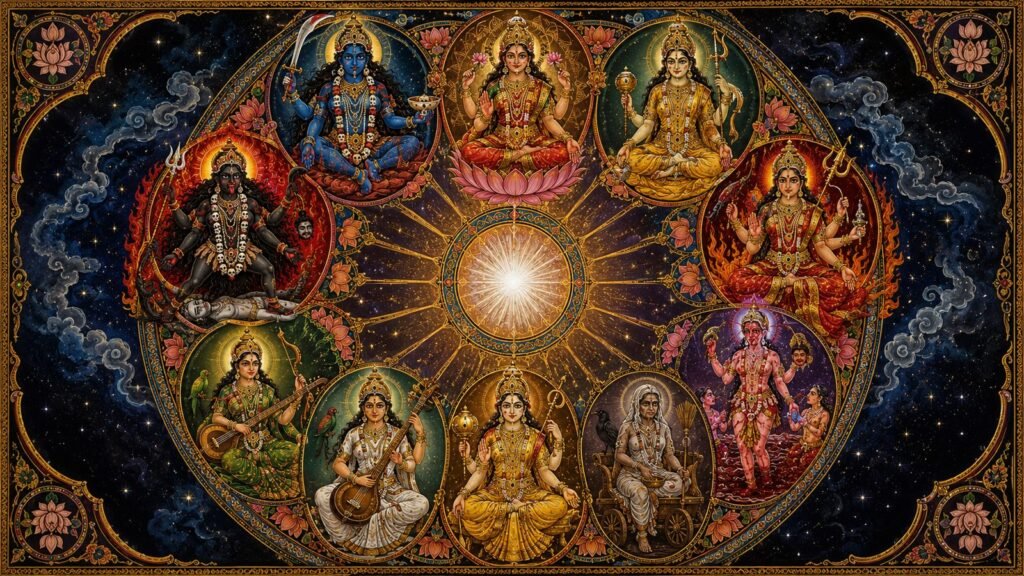
These Mahavidya guides are companions to the music. Where a mantra video gives you the sound, the writing here gives you the meaning: who each goddess is, what her mantra asks of you, and how her worship has been practised for centuries.
At the heart of the collection sit the ten wisdom goddesses of the Shakta tradition. Each has her own complete guide, covering her origin, her beej mantra, her temples and her sadhana. Read together, these Mahavidya guides trace a single path from Kali, the first and fiercest, through to Kamala, who returns the seeker to abundance and grace.
Around them stand the stories that hold the tradition together. You will find the origin story of the Das Mahavidya, the tale of Sati Devi and Daksha’s yagna, and a guide to the 51 Shakti Peethas formed when her body fell to the earth. These pieces give the Mahavidya guides their context: the grief, the fire and the love from which the ten forms first appeared.
Every article draws on the Puranic and Tantric sources - the Shiva Purana, the Devi Bhagavata Purana, the Mahabhagavata Purana and the Tantras - and says plainly where the accounts differ, because they often do. Where traditions disagree, we set out both rather than flatten them into one tidy version.
If you are new to Devi worship, begin with the reading rather than the ritual. Understanding why a goddess is invoked, and what her beej mantra actually means, changes how the chant lands. Practice follows understanding, and these Mahavidya guides exist to make that understanding available in plain language without diluting the tradition.
Read in any order you like. Many begin with Maa Kali and follow the series from there, pairing each article with its mantra video so that sound and meaning arrive together.

Join the Musinara community on YouTube for new 432 Hz mantra chants, sacred instrumentals and meditation music every week.
► Subscribe on YouTube